
For product formulators, the name Gorilla Glue (or GG4) represents more than just a popular strain; it signifies a specific, highly marketable chemical profile that has become a benchmark for success. Understanding its composition is not about general strain knowledge—it's about deconstructing a winning formula to replicate its distinct sensory experience in your own products, from vape cartridges to infused pre-rolls.
Getting this profile right is a matter of precision chemistry. This technical guide outlines the terpene profile of GG4 and provides actionable steps for accurately formulating products that meet the high expectations of a discerning market.
The GG4 Terpene Profile for Cannabis Product Formulation

To successfully replicate the Gorilla Glue experience in a product like a vape cart, you must move beyond being a fan and become a student of its molecular makeup. The goal is to deconstruct its complex aroma and flavor so you can rebuild it with consistency and accuracy.
Recreating the GG4 experience is not about luck or approximation; it’s about mastering the chemical blueprint that defines the strain.
Why This Profile Is a Formulation Gold Standard
A strain-specific product's commercial viability depends on how well it aligns with established consumer expectations. Customers seeking GG4 are looking for its signature pungent, earthy aroma layered with notes of sour citrus, pine, and a subtle hint of chocolate. Hitting this precise balance is crucial for building brand loyalty and market credibility.
A well-formulated GG4-inspired product must deliver on three technical fronts:
- Aromatic Accuracy: The initial aroma must be unmistakably "Gorilla Glue."
- Flavor Fidelity: The taste profile must remain consistent from the first draw to the last.
- Authentic Mouthfeel: The vapor or product experience should possess the characteristic full-bodied quality associated with the strain.
For a formulator, the Gorilla Glue terpene profile is a blueprint. It's a proven recipe of aromatic compounds—primarily Beta-Caryophyllene, Limonene, and Myrcene—that combine to create a distinct and highly marketable sensory experience. Mastering this combination is the difference between a generic vape and a top-selling product.
Here is a quick look at the key attributes you’ll be working with when formulating a Gorilla Glue profile for distillate or other bases.
Gorilla Glue (GG4) Formulation Snapshot
| Attribute | Specification | Formulation Relevance |
|---|---|---|
| Primary Terpenes | Beta-Caryophyllene, Limonene, Myrcene | These three isolates form the core of the aroma and flavor. Their ratios are the primary focus of the formulation. |
| Aroma Profile | Pungent, Earthy, Sour, Diesel | This is the target scent profile. The combination must be bold and complex, not one-dimensional. |
| Flavor Notes | Pine, Chocolate, Citrus | These secondary notes provide depth and round out the experience on the palate. |
| Viscosity Impact | Moderate | The terpene blend functions as a natural diluent for high-viscosity distillates. |
Understanding these components is the first step toward creating a product that truly honors the original strain's chemical signature.
From Plant Genetics To A Replicable Profile
The journey from a plant's genetic code to a replicable, bottled terpene profile is a study in phytochemistry. The unique genetics of GG4—a cross of Chem's Sister, Sour Dubb, and Chocolate Diesel—created a prolific chemical factory within the plant’s trichomes, responsible for its high concentration of terpenes and famously resinous texture.
To better understand the individual molecules that constitute this and other famous profiles, our guide on common cannabis terpenes is an essential resource. A fundamental knowledge of each terpene's function is critical for effective blending.
Next, we'll dive deeper into how those parent genetics contribute to GG4's final chemical signature—knowledge you can leverage to not only replicate this profile but also innovate and create new ones based on its successful framework.
Unpacking the Genetic Blueprint for Formulating with GG4
To master the Gorilla Glue #4 profile in your products, you must understand its genetic origins. The strain's lineage is a masterclass in how specific genetic crosses produce a commercially successful aromatic profile. For formulators, this genetic map reveals why certain aromas work so well together, providing a proven model for product development.
GG4’s notable resin production, unique scent, and robust characteristics are not accidental; they are the direct result of a powerful trio of parent strains.
The Three Parents Behind a Legendary Profile
GG4's unique chemical signature is a direct inheritance from its three parents: Chem's Sister, Sour Dubb, and Chocolate Diesel. Each contributed distinct traits that combined to create the balanced, layered profile prized by the market. Understanding these contributions is the first step to mastering your own GG4 formulations.
Here is a breakdown of the genetic contributions:
- Chem's Sister: This parent is responsible for GG4's legendary resin production. It passed on the genes for an exceptionally high density of trichomes, the microscopic factories that produce cannabinoids and terpenes. This is the source of the "glue" in Gorilla Glue.
- Sour Dubb: This parent provides the sharp, funky, sour aroma that defines the strain's top notes, making its scent profile immediately recognizable and memorable.
- Chocolate Diesel: This parent contributes the foundational base notes. It adds deep, earthy, almost coffee-and-chocolate undertones that ground the entire sensory experience, preventing the profile from feeling thin or incomplete.
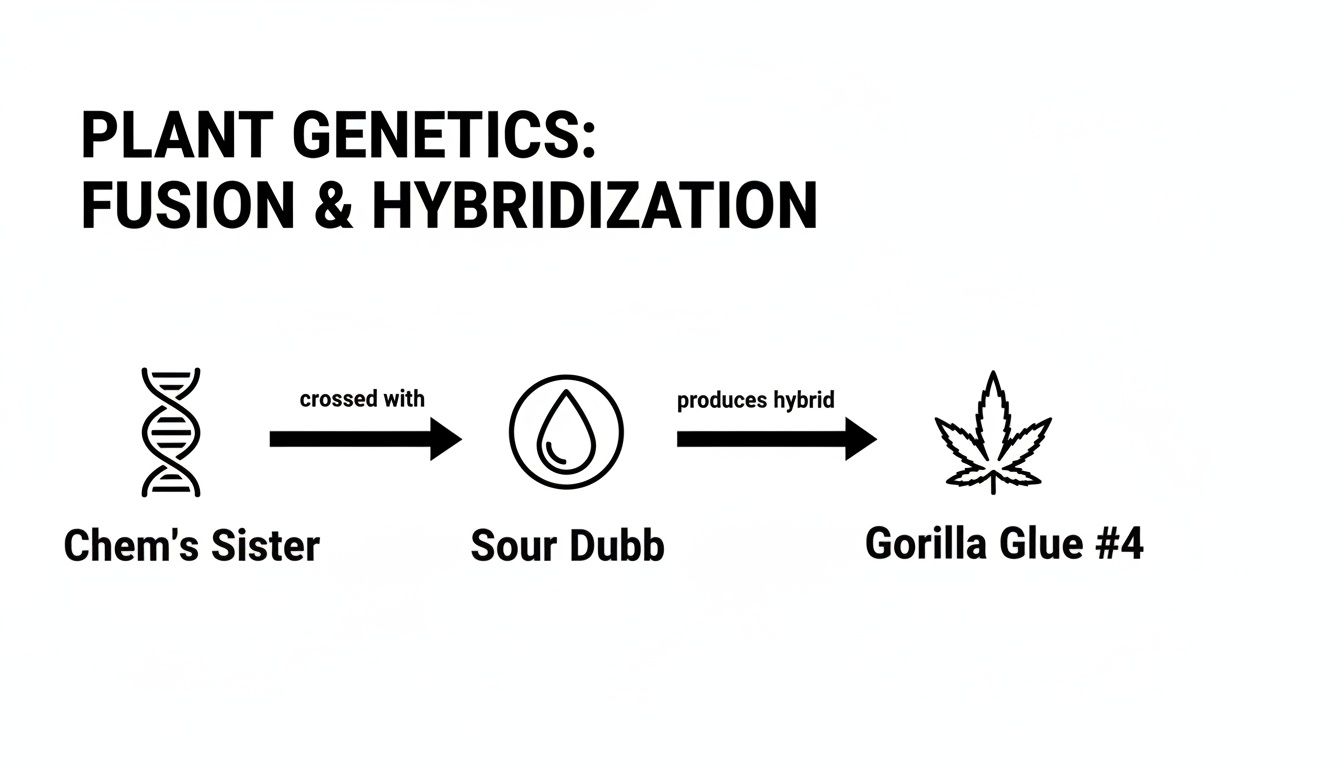
This three-way cross created a complex, layered aroma that was effectively "built" through selective breeding, which is why simply mixing the primary terpenes is insufficient for creating an authentic GG4 profile. The architecture is far more nuanced.
From Genetic Code To A Market-Ready Profile
This careful combination of genetics created a hybrid that took the market by storm. The cross of Chem's Sister (a sativa-leaning Chemdawg phenotype), Sour Dubb, and Chocolate Diesel resulted in an indica-dominant powerhouse known for its resinous texture and complex aroma.
This lineage has proven so successful that GG4 has become a genetic building block for other popular strains like Duct Tape and White Truffle. Its genetic stability ensures reliable production of its signature terpenes—caryophyllene, myrcene, and limonene—giving formulators a consistent and clear target to aim for.
Formulator's Insight: Think of building a GG4 profile like constructing a complex fragrance. Chem's Sister provides the rich, resinous base that carries the other notes. Sour Dubb contributes the sharp, volatile top notes that provide initial impact. And Chocolate Diesel adds the savory, complex mid and base notes that create depth and a lasting impression. Your job is to balance these core elements in your terpene blend.
Understanding the why behind a strain's profile is as crucial as knowing the what. When you understand how genetics shape the final terpene expression, you can elevate your entire formulation strategy. For a deeper dive, our guide on choosing cannabis strains based on terpene profiles can help you move beyond simple replication toward purposeful innovation.
Strain-Inspired Terpene Blend: Deconstructing the GG4 Aroma for Vapes
Crafting a convincing strain profile is an exercise in precision, much like perfumery. The objective is to carefully layer distinct aromatic compounds to recreate an instantly recognizable sensory experience. For Gorilla Glue #4, that means capturing the signature blend of pungent earth, sharp fuel, and sour citrus.
This requires a technical understanding of the three dominant terpenes that form the foundation of the GG4 profile. For any formulator looking to replicate this profile in a vape cartridge, mastering the interplay of these compounds as top, middle, and base notes is critical.
The Three Key Isolates in the GG4 Aroma
GG4's unforgettable scent is driven by a trio of Beta-Caryophyllene, Myrcene, and Limonene. While dozens of minor terpenes add nuance, an incorrect ratio of these three primary isolates will result in a failed formulation. Their interaction defines the strain’s character.
Let's examine the role of each isolate in the formulation:
Beta-Caryophyllene (Spicy Mid Note): This is the source of GG4's peppery, spicy character that cuts through the earthiness. Beta-Caryophyllene functions as the core mid note, bridging the bright citrus top notes with the heavy, musky base. It provides a warm, woody, and gassy funk essential for an authentic GG4 profile.
Limonene (Bright Top Note): As the most volatile of the primary three, Limonene delivers the initial bright, sharp, sour citrus aroma. It acts as the top note, lifting the entire profile and preventing it from becoming overly heavy. A common formulation error is overusing Limonene, resulting in a generic citrus scent. The goal is a distinct presence that doesn’t overpower the other notes.
Myrcene (Earthy Base Note): Myrcene is the bedrock of the GG4 profile. It provides a deep, musky, and earthy base note that gives the flavor depth and a long-lasting finish. This terpene acts as an anchor, adding a subtle sweetness and the full-bodied character associated with GG4. Proper Myrcene levels are crucial for creating the strain’s classic heavy sensory feel.
A Note From The Lab: Think of the formulation as a power chord. Limonene is the high, piercing note; Beta-Caryophyllene is the rich middle harmony; and Myrcene is the deep, rumbling bass. If one is out of tune or its amplitude is off, the entire composition fails.
Replicating the Flavor of Gorilla Glue for Distillate
A primary challenge in vape formulation is translating a complex aroma accurately into a highly refined, odorless distillate. Because distillate is a blank canvas, any imperfection in the terpene blend will be immediately apparent. For a profile as intricate as GG4, a deep understanding of terpene properties is required.
For example, Limonene's higher volatility means it vaporizes at a lower temperature, dominating the initial flavor of a draw. The heavier Beta-Caryophyllene and Myrcene molecules provide the lingering aftertaste. Your formulation must account for this to deliver a consistent, layered experience from start to finish.
This is precisely why a professionally engineered strain-inspired terpene blend for Gorilla Glue is a valuable tool. A pre-balanced blend from a reputable supplier has already optimized the ratios for stability and authenticity, allowing you to focus on dialing in the ideal concentration for your specific hardware and base oil, rather than attempting to build a complex profile from scratch.
A Practical Formulation Guide for GG4 Terpenes

Moving from theory to the lab bench requires a systematic process. The goal is to avoid common mistakes like terpene degradation from excessive heat, weak flavor from over-dilution, or oil separation from improper mixing. These are all avoidable with the correct standard operating procedures.
Best Practices for Mixing and Homogenization
To achieve a stable, consistent, and flavorful final product, follow this process for introducing your GG4 terpenes into a distillate base.
1. Measure with Precision.
Accurate measurement is non-negotiable. First, determine your target terpene percentage. For a robust profile like GG4, a concentration between 7% and 10% by weight is a reliable starting point.
- Example: For a 100-gram batch at an 8% concentration, you would combine 92 grams of distillate with 8 grams of your GG4 terpene blend.
Use a scale that measures to at least two decimal places (0.01g). Do not estimate. Inaccurate measurements lead to inconsistent products and wasted material.
2. Apply Low, Indirect Heat.
While your distillate needs to be fluid for mixing, heat is the enemy of terpenes. Gently warm your distillate in a sealed container to a temperature between 104–140°F (40–60°C). This is the optimal range—warm enough to reduce viscosity without boiling off volatile top notes like Limonene.
Critical SOP: Never heat terpenes directly. They are highly fragile compounds. Direct heat will degrade the complex aromatic molecules, resulting in a flat or off-tasting final product.
3. Combine and Homogenize Thoroughly.
Once the distillate is at the target temperature, add the pre-measured terpenes. The goal is complete homogenization, ensuring the terpenes are evenly distributed throughout the oil.
For small batches, a magnetic stirrer on a low setting is ideal. For larger production runs, an overhead mixer is necessary. Mix for at least 5-10 minutes until the liquid is entirely uniform, with no visible streaks or separation.
Common Pitfalls and How to Avoid Them
Even experienced formulators can encounter issues. Knowing what to watch for can save significant time and resources.
- Harshness: Exceeding a 10-12% terpene concentration can result in a harsh, perfumey flavor and may cause some vape hardware to leak. Start with a lower concentration and titrate upward in small increments.
- Separation: If you observe layering in your mixture, homogenization was incomplete. Gently reheat the batch and mix again, ensuring the entire volume is agitated.
- Flavor Inaccuracy: If the final product's flavor is not true to the target profile, audit your process. Was the terpene blend sourced from a quality supplier? Was the mixture overheated? One of these is the likely culprit.
Adhering to these guidelines will enable you to create an authentic GG4 experience that builds brand credibility. For more information on formulation techniques, explore our terpene formulation resources.
Matching Sensory Intensity: Gorilla Glue Terpene Profile for Vape Cartridges
A successful Gorilla Glue formulation is about more than just flavor replication. A product can perfectly match the taste but fail if the sensory experience feels thin or weak. The goal is to capture the intensity that defines the GG4 reputation.
The key is achieving synergy between a robust terpene profile and a high-potency cannabinoid base. When this is executed correctly, the result is an authentic product that feels as potent as it tastes.
Marrying Terpenes to Cannabinoid Potency
Gorilla Glue #4 flower exhibits a wide range of potencies. While most lab results show THC content between 18-25%, expert cultivation can push certain phenotypes to as high as 27-29% THC. You can find more data on this potency variance here.
This data provides a clear directive for formulators: the target consumer expects a high-impact product. A potent base, therefore, requires an equally bold and complex terpene profile to deliver an authentic experience. A timid flavor profile paired with high-THC distillate will feel incongruous.
Using Terpenes to Engineer the Experience
While terpenes are non-psychoactive, they are instrumental in shaping the overall sensory journey. For GG4, the strain’s "heavy-handed" perception is largely a function of the interplay between its three dominant terpenes.
- Beta-Caryophyllene: Provides the signature peppery bite, creating a physical sensation in the nose and throat that signals "strength."
- Myrcene: Lays down the deep, earthy, and musky foundation, giving the profile a full-bodied character and a perceived "weight."
- Limonene: Cuts through the heavier notes with a sharp, bright citrus accent, preventing the profile from becoming monolithic and adding a layer of complexity.
Formulator's Takeaway: The "entourage effect" is a practical concept for product development. Your task is to use terpenes to construct a sensory experience that aligns with the established expectations for a given strain. For GG4, this means formulating a profile that feels bold, full-bodied, and undeniably potent.
This is how you build a cohesive product that doesn’t just taste like Gorilla Glue but feels like it. When flavor, aroma, and sensory weight are all aligned, you not only meet consumer expectations—you exceed them, building trust in your brand's quality and consistency. To master this, it's worth diving deeper into how terpenes affect the overall cannabis experience.
Gorilla Glue Formulation FAQ for Product Developers
Even for experienced formulators, perfecting a classic profile like Gorilla Glue involves fine-tuning. Here are answers to the most common challenges encountered in the lab.
What is the ideal terpene percentage for a GG4 vape cartridge?
The optimal percentage depends on your base oil and vape hardware, but a reliable starting point for a robust profile like GG4 is the 7% to 10% range by weight.
Begin testing at 7% and incrementally increase the concentration by 0.5% in subsequent test batches. You are seeking the point where the flavor is intense and authentic without becoming harsh or "perfumey." High-quality, THC-free terpenes are highly concentrated; exceeding 10-12% can negatively impact flavor and may cause hardware issues like leaking.
Lab Tip: Always use a precision scale and a mixing calculator. Document every iteration. This systematic approach is essential for developing professional, repeatable products.
How do I enhance the "diesel" note in my GG4 formulation?
If your blend is presenting more pine than pungent fuel, it's a classic balancing issue. This typically indicates that the top notes (like Pinene) are overpowering the less volatile middle and base notes.
To emphasize the iconic diesel and earthy funk, you must adjust the foundational components of your terpene blend:
- Amplify the Funk: The signature peppery, gassy punch of GG4 comes from Beta-Caryophyllene. Incrementally increase its ratio in your blend.
- Strengthen the Base: The deep, musky earthiness is carried by Myrcene. Gently increase this isolate to provide a more solid, grounded foundation.
- Add Depth: A small amount of a supporting terpene like Humulene can introduce a woody, hoppy complexity that helps the primary notes stand out.
Make these adjustments in small, documented increments to your terpene blend before mixing it into large batches of distillate. This iterative process is the only way to dial in the precise flavor profile. For more advanced techniques, consult our terpene formulation resources.
Can the Gorilla Glue terpene profile be used in products other than vape cartridges?
Yes. The GG4 profile is highly versatile. Its bold, recognizable flavor is a powerful tool for creating brand consistency across an entire product line.
We have seen it used effectively in:
- Tinctures: It excels at masking the flavor of carrier oils like MCT.
- Concentrates: It is ideal for reintroducing a full, rich aroma to extracts like shatter or wax where native terpenes have been lost.
- Infused Pre-Rolls: A light application to flower or hemp can significantly enhance the aromatic experience.
- Edibles & Beverages: With the use of appropriate emulsifiers, the profile can be adapted for water-soluble applications. Concentration must be carefully managed to avoid an overwhelming sensory experience.
The key is to adjust the terpene percentage for each application. A high-quality Gorilla Glue strain-inspired terpene blend is one of the most versatile assets in a formulator's toolkit.
At Gold Coast Terpenes, we provide precisely blended, lab-tested terpene profiles that empower brands to create exceptional products with confidence and consistency. Explore our full range of strain-inspired blends and formulation resources. https://www.goldcoastterpenes.com