
A "CDT vape" refers to a vape product formulated with Cannabis-Derived Terpenes (CDTs). For product formulators, extractors, and brand owners, this distinction is critical. Utilizing CDTs means committing to a premium product that replicates the authentic aromatic and flavor profile of the original cannabis cultivar, a key differentiator in a competitive market.
The Formulator's Definition of a CDT Vape
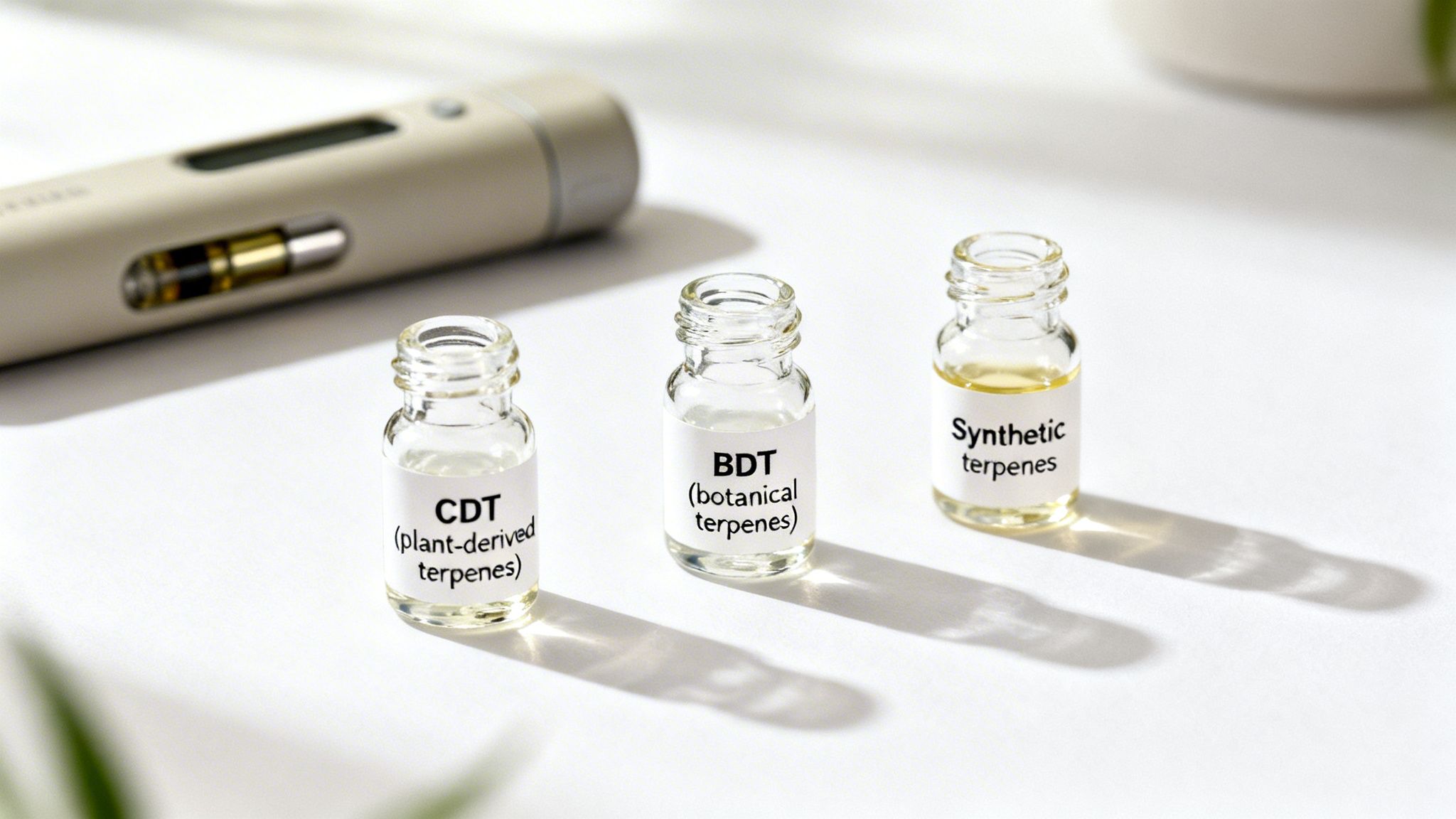
As a product developer, choosing to create a "CDT vape" is a strategic decision to deliver a premium, true-to-plant experience. Unlike botanical or synthetic terpenes, a CDT formulation captures the entire aromatic signature of a specific cannabis strain. This is the difference between a generic "pine" flavor and the unmistakable, complex profile of a specific cultivar like OG Kush.
This commitment to authenticity is a powerful market differentiator. A well-formulated CDT vape elevates a standard distillate into a top-shelf product, capable of building brand loyalty and justifying a premium price point. It’s a calculated move in an expanding market. With the global vape industry projected to grow significantly, premium products are essential for capturing market share.
CDT vs. BDT vs. Synthetic: A Formulation Perspective
A primary decision in vape product development is the selection of terpenes. While all provide flavor, the resulting product quality and market positioning differ dramatically. This guide compares the three main options to clarify the trade-offs between authenticity, cost, and end-user experience.
CDT vs BDT vs Synthetic Terpenes: A Formulator's Quick Guide
| Attribute | Cannabis-Derived Terpenes (CDT) | Botanical-Derived Terpenes (BDT) | Synthetic Terpenes |
|---|---|---|---|
| Source | Extracted directly from cannabis & hemp | Extracted from other plants (e.g., citrus, pine) | Created artificially in a lab |
| Flavor Profile | Full-spectrum, complex, and strain-specific | Simpler, often "inspired by" cannabis strains | Basic and one-dimensional; can taste artificial |
| Authenticity | Highest level of authenticity; a true-to-plant experience | Lacks the subtle nuances of real cannabis strains | The least authentic; often easily identifiable as artificial |
| Cost | Highest cost due to complex sourcing and extraction | Moderate cost, more affordable than CDTs | Lowest cost, produced in bulk |
| Market Perception | Perceived as a premium, high-quality product | Seen as a mid-tier or budget-friendly option | Often associated with low-quality or entry-level products |
For brands targeting the top-shelf segment and discerning consumers, CDTs are the superior choice. They deliver an authentic, nuanced experience that alternative terpenes cannot replicate.
Think of it this way: BDTs are like using a handful of primary colors to paint a picture, while CDTs give you the entire palette—every subtle shade and tone you need to create a masterpiece.
While a primary terpene like Limonene is the same molecule regardless of its source, the true character of a cannabis strain lies in the unique combination of all its terpenes, including dozens of minor ones. Using CDTs is the only method to truly capture that complex synergy. Understanding how the initial plant material is processed is also key, a topic we explore in our guide on the differences between resin and rosin.
CDT Extraction and its Impact on Formulation
The character of a CDT vape is determined long before the formulation phase—it begins at extraction. This is the stage where a plant's authentic aromatic profile is either captured with fidelity or irretrievably lost. For any formulator dedicated to creating a top-tier, true-to-strain vape, understanding extraction methods is fundamental.
The process starts with high-quality biomass. Premium terpenes cannot be extracted from subpar material. The best source is fresh-frozen or meticulously cured cannabis flower, which possesses a rich and diverse terpene profile. Using trim or old, degraded flower will result in a flat, uninspired final product. The objective is to capture these volatile compounds at their peak.
From there, the extraction method directly shapes the final terpene blend, influencing which aromatic compounds are preserved.
Steam Distillation
This traditional method for extracting essential oils involves passing hot steam through cannabis material. The steam causes the trichomes to rupture, releasing their aromatic oils as vapor, which is then condensed and collected.
- How it Works: The steam’s heat vaporizes the terpenes, which are then separated from the water upon cooling.
- Impact on Formulation: While reliable, the high heat can destroy the most delicate and volatile terpenes—the bright, floral top notes that define a fresh plant's aroma. The resulting profile is often heavy on robust base and mid-notes, lacking the full aromatic complexity of the original strain.
CO2 Extraction
CO2 extraction is a modern, precise method that uses carbon dioxide in a supercritical state, where it behaves as both a liquid and a gas. This supercritical CO2 acts as a clean solvent, stripping terpenes and other compounds from the plant material.
A key advantage is fractional extraction. By adjusting pressure and temperature, an extractor can selectively target and isolate specific compounds. This allows for the clean separation of the delicate terpene fraction from cannabinoids and waxes, preserving the entire profile. The lower operating temperatures, compared to steam distillation, are far better at protecting fragile top notes. For brands aiming for high-fidelity strain replication, CO2-extracted CDTs provide a clean, complete, and consistent aromatic foundation.
Hydrocarbon Extraction
This technique uses solvents like butane or propane to wash over plant material, dissolving terpenes and cannabinoids. The solvent is then meticulously purged, leaving a highly concentrated and aromatic extract. When executed correctly, this method is unparalleled for preserving the plant's original terpene profile.
- Key Advantage: Hydrocarbon extraction is the method behind "live resin" terpenes, produced from fresh-frozen cannabis. This process captures the aroma of the living plant, including highly sensitive compounds lost during drying and curing.
- Formulation Impact: For formulators, live resin CDTs offer unmatched authenticity and aromatic depth. They provide the full symphony of major and minor terpenes, enabling the creation of the most complex and genuine flavor profiles possible.
The choice of extraction method is the foundation of your product's flavor identity. Partnering with a supplier who has mastered these techniques and uses premium biomass is the critical first step toward creating a standout CDT vape.
A Practical Guide to Formulating with CDTs
Once you have secured a high-quality CDT profile, the formulation process begins. This stage blends art with science, involving the precise balancing of ratios, management of viscosity, and ensuring consistency across every filled cartridge. Effective formulation is about creating a stable, high-performance product that honors the complexity of the source material.
Your starting point should always be a clean, neutral distillate, which serves as a blank canvas. The goal is for the full-spectrum Cannabis-Derived Terpenes to be the sole aromatic driver. A good starting point for terpene concentration is between 4% and 8% by weight. This is a guideline; the final ratio will depend on the potency of the CDTs and the viscosity of your base oil.
Calculating Ratios and Managing Viscosity
Precision is paramount in formulation. Guesswork leads to inconsistent batches, product waste, and a poor end-user experience. Even a single percentage point variance can alter a vape's flavor, smoothness, and performance.
Using a dedicated tool is non-negotiable for achieving repeatable results. A terpene mixing calculator eliminates guesswork by providing exact measurements based on your total oil volume and target terpene percentage.
A significant benefit of high-quality, full-spectrum CDTs is their natural ability to reduce the viscosity of thick distillates. In many instances, a CDT ratio of 5-8% is sufficient to achieve the ideal flow for modern vape hardware, eliminating the need for additional diluents.
This is a key selling point for premium brands. Formulating without cutting agents like PG, VG, or MCT oil signals a cleaner, more authentic product—a feature that resonates with informed consumers.
Homogenization Best Practices
Simply adding terpenes to distillate is insufficient; they must be fully and evenly incorporated through a process called homogenization. This step is critical for creating a stable, uniform product and preventing issues like separation, inconsistent flavor, and harsh "hot spots" from concentrated terpenes.
Follow these steps for proper homogenization:
- Warm It Up: Gently heat your distillate to 100-140°F (38-60°C). This reduces its viscosity, allowing for easier blending without degrading delicate terpenes.
- Mix Thoroughly: After adding the terpenes, use an overhead or magnetic stirrer to ensure even distribution. Continue mixing until the oil achieves total uniformity in color and clarity.
- Let It Settle: Allow the blend to rest for a few minutes post-mixing. This enables any entrapped air bubbles to escape before filling cartridges.
Replicating Specific Strain Profiles
A primary goal for many formulators is to transform a neutral distillate into a product that accurately mirrors the aromatic and flavor profile of a specific cannabis strain. This is where a strain-specific CDT blend is indispensable. Starting with a clean distillate and a precisely crafted CDT profile allows for the consistent replication of sought-after strains like OG Kush or Blue Dream.
This diagram illustrates the essential journey from raw plant material to the purified terpenes used in your formulation.
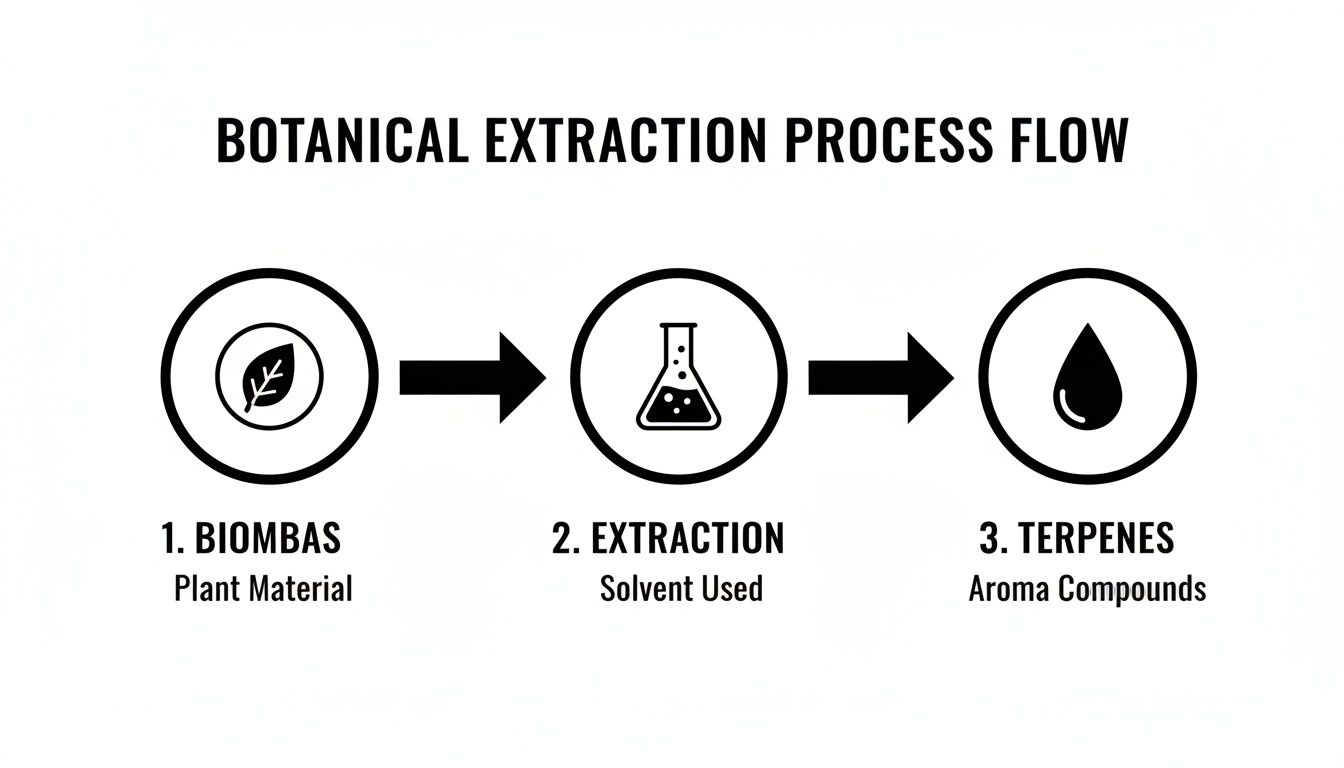
As shown, the path to a premium vape product begins long before mixing. Each step impacts the final quality of your terpenes.
Nailing a strain profile involves reintroducing the plant's complete aromatic fingerprint—the bright top notes, earthy mid-notes, and deep base notes—in their natural ratios. This creates an authentic experience that botanical or synthetic terpenes cannot replicate, setting your product apart in the marketplace.
Matching Your CDT Formulation with the Right Hardware
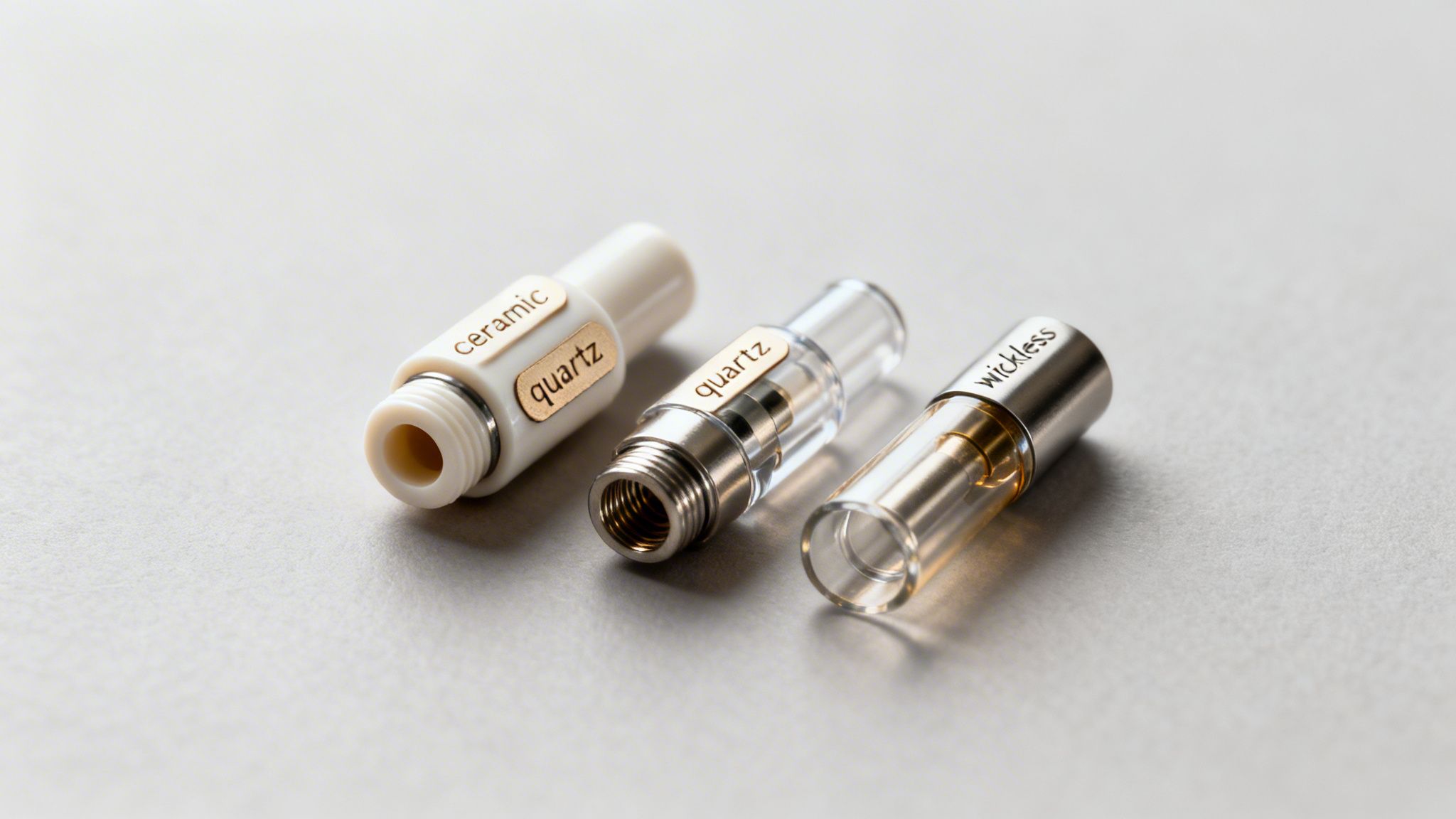
Investing in premium Cannabis-Derived Terpenes is only half the equation. Pairing a perfectly formulated CDT oil with incompatible hardware can negate your efforts, resulting in burnt flavors, clogs, and product waste. The cartridge is not merely a container; it is a critical component of the delivery system that determines the end-user experience.
Why Hardware Can Make or Break Your Flavor
A vape cartridge's function is to heat the oil sufficiently to create a flavorful vapor without causing combustion. With the complex profile of full-spectrum CDTs, this balance is critical. The delicate bouquet of terpenes can be instantly destroyed by a poorly designed heating element.
The key variables are the atomizer material, intake hole size, and atomizer resistance. Each plays a role depending on the viscosity and composition of your CDT blend. Proper matching is essential to avoid common performance issues.
- Terpene Burn-Off: Coils that operate at too high a temperature will scorch delicate terpenes, creating a harsh, bitter flavor that masks the strain's true character.
- Clogging and Leaking: This is a classic viscosity mismatch. Intake holes that are too small for the oil will cause the wick to dry out, leading to "dry hits." Conversely, oversized holes can cause leaks.
- Inconsistent Vapor: A poor hardware match can produce weak or inconsistent vapor, creating a frustrating user experience and reflecting poorly on your brand.
Comparing Atomizer Technologies for CDT Vapes
The atomizer is the engine of the cartridge. Its material directly affects heat distribution and flavor preservation.
The goal is always low, slow, and consistent heat. You want to gently volatilize the oil to release the full spectrum of terpenes, not incinerate them. This creates a smooth, authentic, and flavorful experience.
A well-chosen atomizer ensures that every subtle note in your strain-inspired terpene blend is delivered exactly as you intended.
Ceramic Coils
Ceramic atomizers are favored for terpene-rich oils due to their porous structure, which absorbs the oil and heats it evenly across a large surface area.
- Advantages: This even heating minimizes "hot spots" that burn terpenes, producing an exceptionally clean, pure flavor that allows the formulation to shine.
- Best For: High-quality distillates featuring CDT concentrations between 5-10%, where flavor preservation is the top priority.
Quartz Coils
Quartz offers rapid heating and flavor purity. As a non-porous material, it flash-heats the oil in direct contact with its surface.
- Advantages: Delivers a "true-to-the-oil" taste with minimal heat retention, allowing the atomizer to cool quickly between draws and preventing terpenes from slowly cooking inside the cart.
- Considerations: The rapid heat-up can be a liability. If not paired with a battery offering lower voltage settings, it may run too hot for the most delicate terpene profiles.
Selecting the right hardware is a non-negotiable step in developing a top-tier product. Understanding how these components interact with your specific CDT oil ensures that your investment in authentic, high-quality terpenes translates to a superior final product.
Quality, Safety, and Compliance for Your CDT Brand
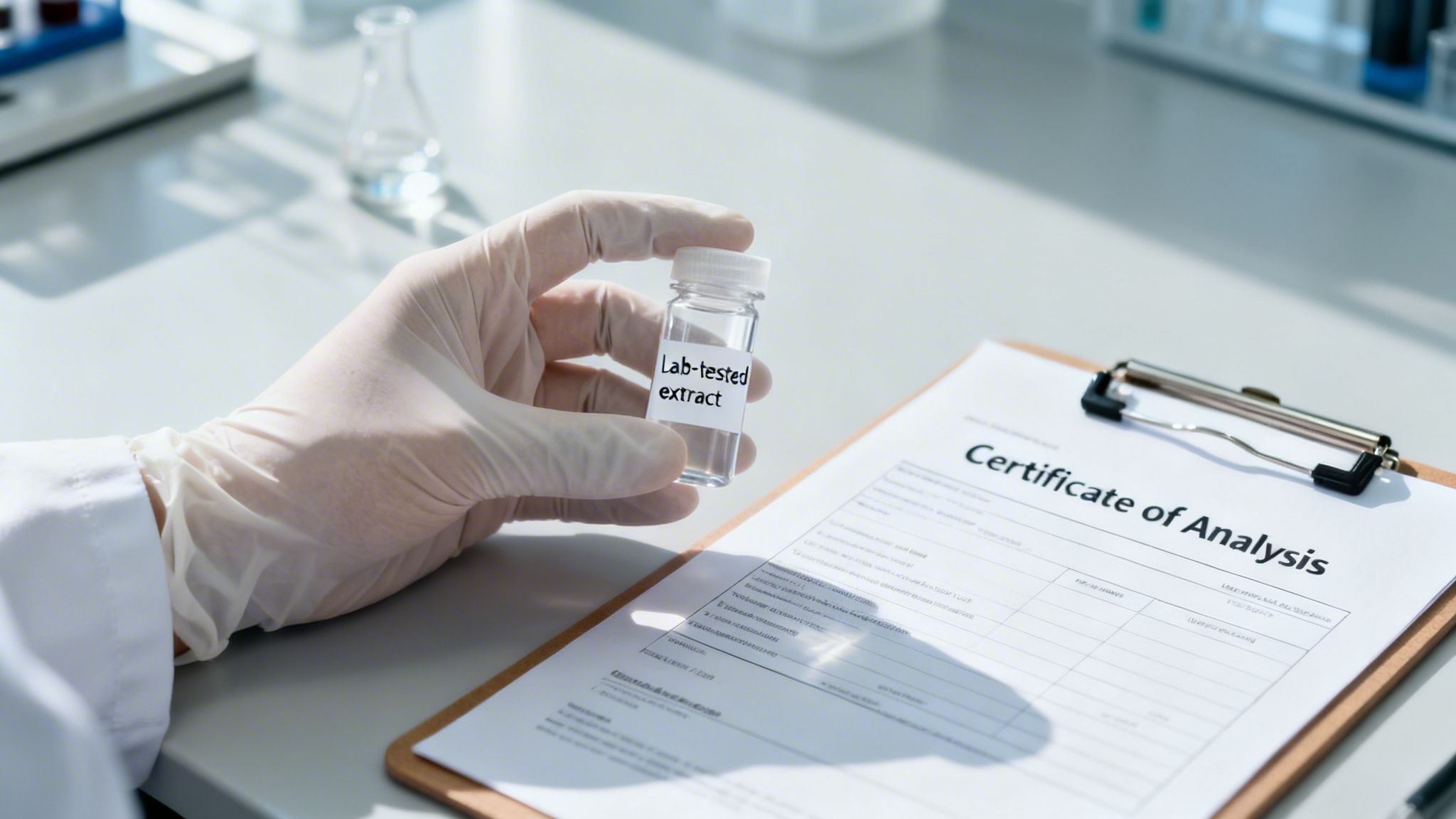
Creating a standout CDT vape extends beyond formulation and hardware selection; it demands an unwavering commitment to quality control and safety. For any serious brand, this is the foundation of its reputation. The trust of customers and partners is directly tied to the purity and safety of your ingredients.
One batch contaminated with pesticides, heavy metals, or residual solvents can destroy brand trust. Sourcing clean, lab-verified Cannabis-Derived Terpenes is therefore non-negotiable.
The Critical Role of Third-Party Lab Testing
The only verifiable method to prove terpene purity and safety is through comprehensive third-party lab testing. The resulting Certificate of Analysis (CoA) is the official record confirming your product is clean and meets all required safety standards.
A CoA is not just documentation; it is your brand's insurance policy. It fosters transparency, mitigates liability, and demonstrates a commitment to quality. If a supplier cannot or will not provide a complete, batch-specific CoA, it is a significant red flag.
The report should confirm the absence of several potential contaminants:
- Pesticides: Verification that no agricultural chemicals are present in the final product.
- Heavy Metals: Confirmation that the product is free from lead, mercury, arsenic, and cadmium.
- Residual Solvents: Proof that any solvents used during extraction, such as ethanol or butane, have been fully purged.
- Microbials: A guarantee that the product is free from mold, mildew, and other biological contaminants.
Navigating the Regulatory Landscape
Beyond safety, regulatory compliance is crucial. Using THC-free terpenes is key to accessing broader markets, enabling sales across state lines and internationally without navigating complex cannabis laws. When sourcing CDTs, you must confirm they are derived from compliant hemp and certified to contain 0.0% THC.
This compliance is a significant competitive advantage. Working with suppliers who provide detailed safety documents, such as a Material Safety Data Sheet (MSDS), adds another layer of security and is essential for workplace safety. For a clear example of what to look for, see our MSDS for Limonene.
A transparent, well-documented supply chain is not just good business practice—it is how you build a resilient and trustworthy brand.
Troubleshooting Common CDT Formulation Challenges
Even with the best Cannabis-Derived Terpenes and precise calculations, production issues can arise. These are common hurdles, and systematic troubleshooting can resolve them quickly, saving time, money, and protecting your brand's reputation.
Problem: Viscosity Is Too Thick or Too Thin
Incorrect viscosity is a frequent challenge. An oil that is too thick will not wick properly, resulting in dry, burnt hits. An oil that is too thin can leak from the cartridge.
- Likely Cause: The terpene-to-distillate ratio is almost always the issue. Too few terpenes (under 4%) can leave the oil too viscous. Too many (exceeding 10-12%) can make it watery and unstable.
- Solution: Conduct small-batch testing. Begin with a 5% terpene concentration and adjust by 1% increments, carefully documenting how each change affects flow and performance in your chosen hardware. This methodical approach allows you to perfect viscosity without using other diluents.
Problem: Harsh or Burnt Flavor
Feedback about a harsh, chemical, or burnt taste is a major red flag indicating a fundamental problem with the formulation or hardware.
- Likely Cause: This typically points to two culprits: terpene "hot spots" from incomplete mixing, or hardware that is operating at too high a temperature. Excessive heat scorches delicate terpenes, destroying the authentic CDT profile and creating an acrid flavor.
- Solution: First, review your homogenization process. Ensure thorough mixing with a magnetic stirrer while keeping the heat gentle—never exceeding 140°F. Second, test your final oil with different cartridge models and battery voltages to ensure the hardware is vaporizing the oil, not burning it.
Remember, a world-class formulation can be ruined in an instant by the wrong hardware. The goal is always a low, slow, and steady heat that lets the full spectrum of terpenes express themselves.
Problem: Product Separation or Cloudiness
If your filled cartridges exhibit cloudiness or separation, you have a stability issue.
- Likely Cause: In most cases, this is due to poor homogenization; the terpenes and cannabinoid oil have not been sufficiently blended to form a stable emulsion. It can also be caused by residual fats, lipids, or other impurities in a lower-grade distillate.
- Solution: Increase your mixing time and ensure your equipment provides enough shear force to fully blend the ingredients. Also, confirm your distillate is fully winterized and free of impurities. A stable, properly mixed blend should remain crystal clear at room temperature. For more advanced insights, our cannabis product formulation resources are an excellent reference.
Your CDT Vape Questions, Answered
For formulators and brand owners new to CDT vapes, having questions is part of the process. Here are answers to some of the most common inquiries from industry professionals.
Can I Use CDT Terpenes in Any Type of Distillate?
Yes. Cannabis-Derived Terpenes are compatible with nearly any high-purity cannabis or hemp distillate, including winterized oil and broad-spectrum extracts. The key is to begin with a clean, neutral base to allow the authentic CDT strain profile to be the primary aromatic driver. Thorough homogenization is non-negotiable to ensure a stable, consistent final product.
What Is the Ideal Percentage of CDTs in a Vape Formulation?
There is no single "magic number," but a concentration between 4% and 8% by weight is a standard industry guideline. The optimal ratio depends on the specific CDT blend and the viscosity of your starting cannabinoid oil. We recommend starting with test batches at a 5% concentration and adjusting until the desired flavor, aroma, and viscosity are achieved. To ensure precision, use a tool like our terpene mixing calculator.
Are CDT Vapes Legal to Manufacture and Sell?
Yes, provided two key conditions are met: the Cannabis-Derived Terpenes must be sourced from compliant hemp and be certified to contain 0.0% THC. The legality of the finished vape product depends on the source of its ingredients and the final composition.
Always partner with a reputable CDT supplier who provides a third-party Certificate of Analysis (CoA) for every batch. This provides assurance that you are producing a product that is federally legal and compliant in most jurisdictions. Always consult local and state regulations to ensure full compliance.
How Do CDTs Contribute to the Entourage Effect?
The entourage effect is the theory that cannabis compounds work synergistically to produce an experience greater than the sum of their parts. CDTs are essential for reintroducing this synergy into a formulated product. A true CDT profile contains the entire complex bouquet of a specific strain, not just one or two dominant terpenes. By adding this complete aromatic signature back into a pure distillate, you are reassembling the plant's natural chemical profile, leading to a richer, more authentic experience that captures the character of the original flower. You can explore how these compounds interact in our terpene guides.
Ready to create vape formulations with flavor and authenticity that stand out? Gold Coast Terpenes has a full lineup of lab-verified, strain-specific CDT profiles made for professionals. Take your products to the next level by exploring our collection at https://www.goldcoastterpenes.com.