
For cannabis product formulators, terpenes are far more than aromatic compounds. They are the primary drivers of sensory experience, the key to product differentiation, and the foundation for brand loyalty. Mastering terpene application is what separates a forgettable product from a market-leading one.
Why Terpenes Are Your Most Powerful Formulation Tool

For extractors, formulators, and brand owners, terpenes provide precise control over a product's final flavor, aroma, and overall character. The modern market is saturated with high-potency distillates. However, the refinement processes that yield pure THC or CBD inevitably strip away the native aromatic compounds that define a strain's unique identity.
This is where terpene formulation becomes essential. Terpenes are the tools used to reintroduce authentic flavor and aroma, transforming a generic extract into a premium, targeted product.
This guide moves beyond basic definitions to position terpenes as a critical competitive advantage. In today's market, a deep understanding of terpene formulation isn't an optional skill—it's a mandatory competency for anyone committed to creating consistent, high-quality cannabis products.
The Business Case for Mastering Terpene Formulation for Cannabis Products
The bottom line is this: cannabinoids like THC and CBD deliver the base effect, but terpenes define the experience. They are the deciding factor when a customer chooses one vape cartridge over another. That signature aroma and flavor profile are what they remember, and that recall builds brand equity.
A product with a flat, one-dimensional flavor profile is lost in a crowded marketplace. Conversely, a complex, well-engineered terpene blend creates a memorable sensory experience that drives repeat purchases.
Mastering terpene formulation allows you to:
- Differentiate Your Products: Create unique and consistent flavor profiles that competitors cannot easily replicate. This is how you secure a distinct position in a saturated market.
- Build Brand Identity: Associate your brand with a specific, high-quality sensory experience. Your product becomes more than a SKU—it becomes a signature.
- Guarantee Consistency: Eliminate the batch-to-batch variability inherent in raw botanical material. You can standardize the flavor and aroma across your entire product line. While plant biology introduces variables, understanding fundamentals like the differences between a male vs female weed plant can inform cultivation strategies.
Terpenes are the language your product speaks. They communicate quality, character, and intent, shaping a customer's perception of your product before consumption.
Ultimately, a strategic approach to terpenes is a business strategy. It provides the control needed to replicate iconic strain profiles, engineer novel sensory experiences, and scale production without sacrificing the defining characteristics that make your products successful. When you control the terpene profile, you control the end-user experience—and that means you control your brand's trajectory.
Building Flavor Profiles: A Perfumer's Approach to Formulation
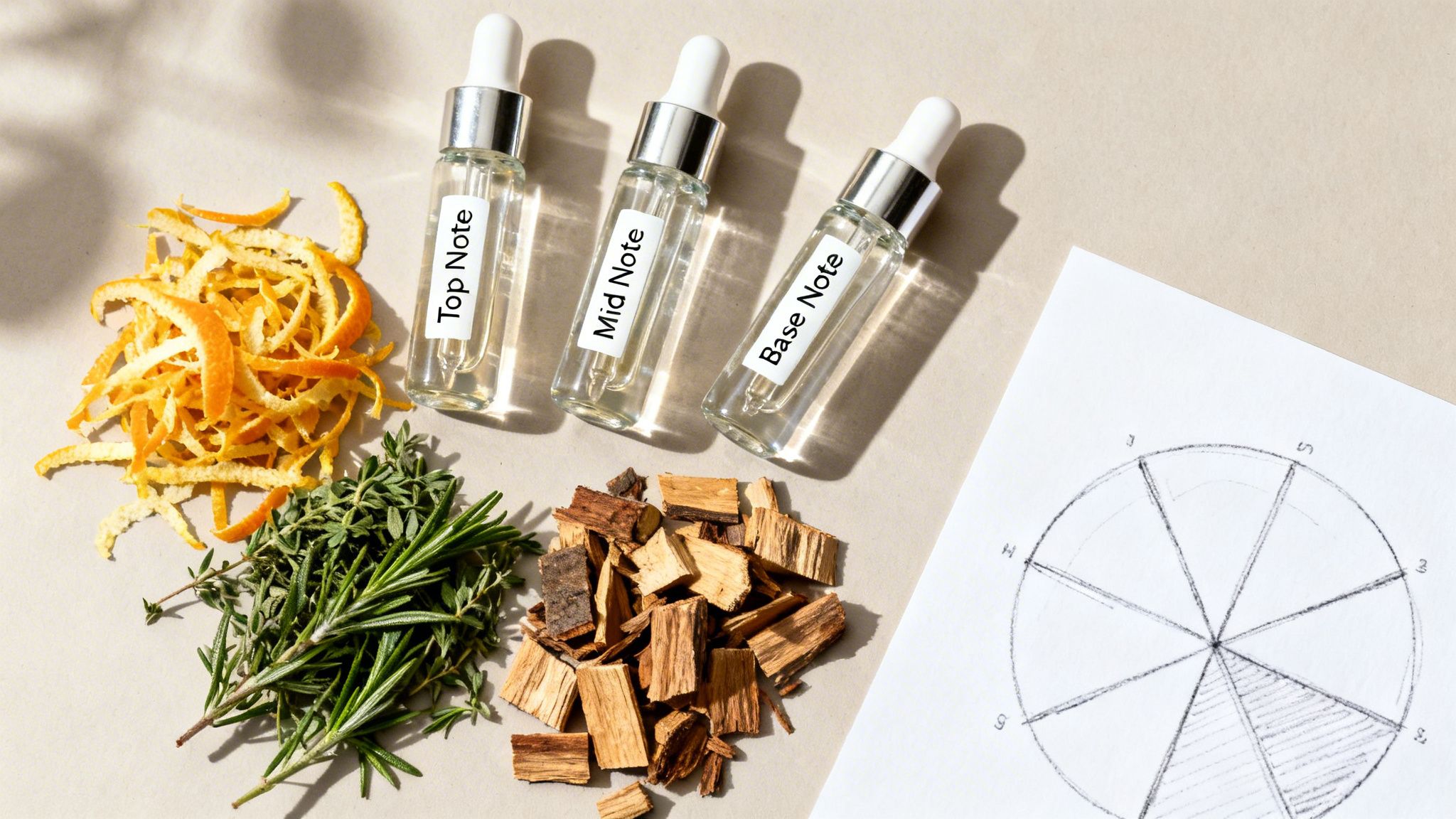
Crafting a memorable flavor profile is an exercise in chemical architecture, not just simple mixing. To develop a blend that stands out, it's beneficial to adopt the methodology of a master perfumer. A sophisticated terpene blend, much like a high-end fragrance, is constructed in layers. Different compounds collaborate to shape the initial impression, the core identity, and the lasting finish.
This layered approach is critical for product formulation, particularly for inhalables like vape cartridges. The experience must be cohesive from the first draw to the final exhale. A poorly structured blend risks creating a flavor that "falls flat" or presents a fleeting, chemical-like scent.
The key is to balance three distinct categories of aromatic compounds based on their volatility: top, mid, and base notes. Each plays a specific role in how the flavor and aroma are perceived over time.
The Role of Top Notes
Top notes provide the initial sensory impact—the first aromatic impression. These are the smallest, most volatile terpene molecules, meaning they deliver a bright, immediate burst of aroma before quickly evaporating.
This is the sharp, zesty aroma perceived upon opening a container. However, a blend composed solely of top notes will result in a flavor that dissipates almost instantly, leaving behind a weak or hollow finish.
- Limonene: A classic bright, zesty citrus. It’s ideal for creating an initial uplifting and clean scent.
- Pinene: Delivers a sharp, fresh burst of pine and herbs. It adds a crisp, natural quality that captures immediate attention.
- Terpinolene: A complex medley of floral, fruity, and herbal notes. It's a powerful top note that adds significant aromatic dimension from the outset.
The Heart of the Blend: Mid Notes
As the initial impact of the top notes begins to fade, the mid notes (or "heart notes") emerge. These terpenes consist of medium-sized molecules with a more moderate evaporation rate. They form the main body and character of the flavor profile.
This is the core of your strain-inspired terpene blend. These compounds define the profile's primary identity, bridging the bright introduction with the deep, lingering finish. A well-balanced heart is crucial for a full-bodied and satisfying sensory experience.
- Myrcene: One of the most common terpenes in cannabis, it provides the recognizable musky, earthy, and slightly fruity character that anchors many iconic strain profiles.
- Beta-Caryophyllene: Known for its distinct peppery and spicy aroma, Caryophyllene adds warmth and depth, unifying the other aromatic elements.
A successful formulation is a symphony of scents. The top notes are the bright opening melody, but the mid notes provide the rich harmony that gives the blend its soul and defines its character.
Creating a Lasting Impression with Base Notes
Finally, the base notes arrive. These are the last to be perceived and the longest to linger. Composed of the largest and least volatile terpene molecules, they provide the depth, richness, and staying power that make a flavor memorable.
Base notes act as an anchor, slowing the evaporation of the lighter top and mid notes. This extends the entire sensory experience, making it feel more complete. Without a solid base, a profile can seem thin and unsatisfying.
- Humulene: Offers a woody, earthy, and subtly spicy aroma, much like hops. It provides a solid, grounding foundation for the entire blend.
- Linalool: While possessing floral mid-note qualities, its lasting, gentle lavender and spice character allows it to function as a smoothing base note that rounds out any harsh edges in the profile.
Terpene Roles in Flavor and Aroma Formulation
To precisely control your blends, it is useful to visualize how these terpenes fit into a structured formulation. This table breaks down their roles, serving as a reference for flavor architecture.
| Terpene | Classification (Note) | Aroma Profile | Function in Formulation |
|---|---|---|---|
| Limonene | Top | Citrus, Lemon, Orange | Provides a bright, attention-grabbing initial scent. |
| Pinene | Top | Pine, Fresh, Herbal | Adds a sharp, clean, and crisp opening note. |
| Terpinolene | Top | Fruity, Floral, Complex | Creates a multi-faceted and powerful first impression. |
| Myrcene | Mid | Musky, Earthy, Fruity | Forms the core identity and body of the blend. |
| Beta-Caryophyllene | Mid | Spicy, Peppery, Wood | Adds warmth and complexity, bridging other notes. |
| Humulene | Base | Woody, Earthy, Hoppy | Anchors the blend and adds a lasting, deep foundation. |
| Linalool | Base / Mid | Floral, Lavender, Spice | Smooths the profile and provides a soft, lingering finish. |
Understanding these classifications enables you to move beyond simple mixing and begin engineering complex and stable sensory journeys. This methodical approach is the key to creating superior products, from vape cartridges for distillate to edibles, that deliver an unforgettable experience every time. To dive deeper, explore our comprehensive terpene guides to optimize your formulations.
A Formulation Guide to Replicating Iconic Strain Profiles
Replicating the sensory signature of a well-known strain is a true test of a formulator's skill. This process is more than combining a few common terpenes; it requires becoming a profile architect. It demands a precise understanding of the ratios and subtle interactions that give a strain its iconic character.
Simply knowing the primary terpenes in OG Kush or Blue Dream is insufficient. The art lies in deconstructing their aromatic blueprint and rebuilding it from individual components. You are not just adding "citrus" or "pine" back into a distillate; you are capturing the specific, nuanced experience that consumers instantly recognize. Mastering this allows you to deliver authentic and consistent products at scale.
Deconstructing the Blue Dream Terpene Profile for Formulation
Blue Dream is an excellent case study in balancing dominant notes with a strong supporting cast. It is known for its sweet, berry-like aroma, but the "magic" lies in how its main terpenes interact.
The profile is famously led by a high concentration of Myrcene, which establishes the sweet, slightly musky, and fruity foundation. What makes it distinctly "Blue Dream," however, is how other terpenes are used to sharpen and elevate that Myrcene base.
- Alpha-Pinene: This is the key differentiator. It cuts through Myrcene's sweetness with a bright, crisp pine note, preventing the profile from becoming a one-dimensional "sugar bomb."
- Beta-Caryophyllene: Following the initial wave of sweet berry and pine, Caryophyllene introduces a subtle spicy warmth. It gives the profile a more complex and satisfying finish.
Without the correct ratio of Pinene to provide that fresh lift, the blend would be generically sweet. The primary challenge here is nailing the proportions—Myrcene must be dominant, but Pinene and Caryophyllene must be present enough to create the unmistakable bright-yet-earthy character.
The Complex Architecture of an OG Kush Terpene Profile
OG Kush presents a different formulation challenge. Its profile is a masterclass in complexity, defined by a bold, "gassy" aroma layered with citrus, spice, and earth. To build this, you must create a multi-layered blend where no single terpene dominates.
Instead of one lead terpene, OG Kush derives its power from the synergy between several heavy-hitters. This makes the formulating process for this strain-inspired terpene blend a delicate balancing act.
- Limonene: This brings the sharp, citrusy top note that gives OG Kush its initial zesty punch.
- Myrcene: Underneath, Myrcene provides an earthy, slightly fruity base that grounds the sharper notes.
- Beta-Caryophyllene: This is essential for delivering the signature peppery, spicy kick central to the OG Kush experience.
The characteristic "gassy" or "fuel" note often arises from the interaction of these primary terpenes with other minor, more pungent compounds. The secret to a successful OG Kush formulation is achieving near-perfect harmony between Limonene, Myrcene, and Caryophyllene. When this balance is correct, the coveted diesel-like aroma emerges naturally from their interaction.
Formulating the Energetic Signature of Green Crack
The Green Crack profile is about delivering a sharp, energetic, and intensely fruity aroma. Unlike the deep, layered complexity of OG Kush, this profile is driven by a powerful structure of top notes that must feel bold without being perceived as artificial.
The key is a high concentration of Myrcene, but utilized in a way that emphasizes its tangy, mango-like aspect. This is achieved by pairing it with other specific terpenes that amplify its fruity character.
- Alpha-Pinene: This adds a fresh, herbal undertone that prevents the intense fruitiness from becoming cloying or overwhelming.
- Beta-Caryophyllene: Here, it acts as a subtle, spicy counterpoint, adding a touch of depth to an otherwise bright and forward profile.
The art of replication is in the ratios. A slight miscalculation in the Pinene level can turn an authentic Green Crack profile into something that smells more like a household cleaner. Precision is everything.
The demand for authentic strain experiences has fueled significant growth in the commercial terpenes market. As cannabis legalization expands, these aromatic compounds have become the cornerstone of product formulation. In 2024, the global natural terpenes market was valued at USD 477.18 million and is projected to reach USD 720.32 million by 2032, with a CAGR of 5.33%. This growth is driven by the shift toward clean-label products and new applications for cannabis-derived terpenes. For more details, see the report on the global natural terpenes market from Data Bridge Market Research.
For a deeper analysis of another famously pungent and complex profile, review our guide on the aromatic breakdown of the Sour Diesel strain. Understanding these iconic blueprints is the first step toward becoming a true formulator—one who can deliver premium products that honor the industry’s most legendary genetics.
Mastering Terpene Infusion for Distillates and Vape Cartridges
You have designed the ideal terpene blend. Now comes the critical stage: infusing it into a high-purity cannabis distillate. This is where formulation theory meets practical application. Proper infusion technique is what distinguishes an average vape cartridge from an exceptional one.
The objective is to perfectly homogenize your aromatic blueprint with the cannabinoid extract. This process hinges on precise dosing, uniform mixing, and viscosity management—all without degrading the delicate terpenes that create the desired flavor and experience. Executed correctly, the result is a stable, flavorful product that performs flawlessly in vape hardware.
This is not a process of guesswork. It is a methodical procedure of analysis, balancing, and formulation to create a consistent and authentic product.

As illustrated, this is a step-by-step journey, not a haphazard attempt.
Calculating Dosing Ratios for Optimal Flavor in Vape Cartridges
The first step is determining the correct amount of your terpene blend to add. This is a critical balancing act. Too little, and the flavor will be imperceptible. Too much, and the final product can be harsh, the oil may separate, or vape hardware may leak.
For most cannabis distillates, an optimal starting point is between 5% and 7% terpenes by total weight. For highly refined or winterized extracts, you may need to increase this concentration, sometimes up to 10%, to restore the robust aroma lost during processing.
Formulation Best Practice: Always begin with the low end of the recommended range—for instance, 5%—for initial test batches. It is simple to add more terpenes if necessary, but impossible to remove them once incorporated.
The calculation is based on weight:
- (Total Weight of Extract in grams) x (Desired Terpene Percentage as a decimal) = (Weight of Terpenes to Add in grams)
For example, to formulate a 7% blend into 100 grams of distillate:
100g x 0.07 = 7g of terpenes.
Essential Equipment for a Flawless Infusion
Manual mixing is insufficient for achieving a professional-grade product. It almost always leads to an inconsistent mixture with "hot spots" of intense flavor and other areas with none. Proper equipment is mandatory.
Here is the basic laboratory equipment required for a professional-grade infusion:
- Precision Scale: A digital scale accurate to at least 0.01 grams is non-negotiable.
- Glass Beaker or Lab-Grade Container: Use borosilicate glass, which can handle gentle heat without cracking or reacting with your oil.
- Magnetic Stirrer with a Stir Bar: This is the key to a perfectly smooth and homogenized mixture. It ensures uniform blending without introducing air or degrading terpenes.
- Heating Mantle or Hot Plate: A source of gentle, controllable heat is necessary to reduce the distillate's viscosity for proper mixing.
This setup ensures your process is repeatable and scalable, meaning every batch meets the same quality standard. This is critical in the cannabis concentrate market, where consistency builds brand reputation. With vaporization representing 52.7% of consumption, flavor is paramount. The global cannabis concentrate market is projected to grow from USD 1.6 billion in 2025 to USD 6.8 billion by 2035, with distillates accounting for 43.2%. Adding premium terpenes is how formulators restore the authentic character lost during extraction. For a deeper dive, review the market analysis by Morningstar.
Step-by-Step Homogenization Process for Distillate
The end goal is a stable, uniform liquid. Following these steps will yield a consistent product every time.
- Gently Warm the Extract: Place your distillate in the glass beaker on the hot plate. Slowly warm it to approximately 100-120°F (40-50°C). This is just enough to lower the viscosity and make it workable.
- Add the Terpenes: Once the oil is warm, use your precision scale to measure your terpene blend and add it directly to the beaker.
- Begin Mixing: Carefully place the magnetic stir bar into the beaker and activate the stirrer at a low speed. The goal is to gently fold the terpenes into the extract, not to create a vortex.
- Homogenize Thoroughly: Allow the mixture to stir for at least 5-10 minutes. The target is a smooth, consistent liquid with no visible streaks or swirls.
- Cool and Settle: Turn off the heat but continue stirring at a low speed as the mixture cools. This prevents separation as the oil returns to room temperature.
Once cooled, your infused distillate is ready for cartridge filling. Store it in airtight, light-proof containers to protect the meticulously crafted flavor profile. If you are formulating bright, citrus-forward profiles, our guide on leveraging D-Limonene's properties offers valuable technical insights.
Ensuring Product Safety and Compliance in Terpene Formulation
In professional product development, sensory appeal and safety are inextricably linked. An excellent flavor profile is meaningless if the product is not safe, compliant, and trustworthy. For formulators, this requires holding terpene sources to the highest standards of purity and transparency.
The contents of your terpene supply are paramount. Your brand's reputation and consumer well-being are at stake, which is why it is non-negotiable to work exclusively with lab-verified terpenes guaranteed to be free from contaminants.
Reading a Certificate of Analysis (CoA)
The Certificate of Analysis (CoA) is your most important quality assurance document. It is the verified, third-party proof that your terpenes are precisely what the supplier claims them to be.
When reviewing a CoA for a terpene blend intended for formulation, you must know what to look for. Here is a checklist:
- Purity Confirmation: The CoA should clearly list the concentration of each terpene, confirming the profile's accuracy.
- Absence of Contaminants: The analysis must explicitly state that the product is free from harmful cutting agents like VG, PG, PEG, and MCT oil. These diluents have no place in professional vape formulations.
- No Residual Solvents: Look for the section that tests for residual solvents from the extraction or purification process. A clean report is essential for a safe final product.
- Heavy Metals Screening: The CoA must also include a panel for heavy metals like lead, arsenic, and mercury to ensure the terpenes are clean.
A CoA isn't a suggestion; it's a passport. It’s the official documentation proving your ingredients are safe for inclusion in a finished product. Sourcing from suppliers who provide clear, comprehensive CoAs is a cornerstone of responsible formulation.
The Importance of Full-Spectrum Purity
Beyond safety, the quality of your terpenes directly impacts the synergistic potential of your final product. Using high-quality, botanically-derived, full-spectrum terpene blends is key to creating a more authentic and complete sensory experience. These complex profiles contain a wide array of aromatic compounds that work together, much as they do in the original plant.
This synergy contributes to a more nuanced and satisfying experience. While formulators must avoid making unproven medical claims, creating products with complex, multi-layered terpene profiles is a proven method for delivering a richer end-user experience.
This focus on precision is driving significant growth in the analytical side of the industry. The global cannabis testing market was valued at USD 2.129 billion in 2025 and is projected to reach USD 11.147 billion by 2034. Terpene analysis is a core part of that growth, expanding at a 14.39% CAGR—a clear indicator of its importance in validating the sensory claims of products. You can explore this trend further with the cannabis testing market analysis from Mordor Intelligence.
Ultimately, a commitment to safety and quality is a commitment to your brand. By prioritizing pure, lab-tested terpenes, you not only ensure compliance but also build the consumer trust necessary for long-term success. For a refresher on the basics, our guide on terpene fundamentals can help you make more informed sourcing decisions.
Common Formulation Questions Answered
Transitioning from theoretical design to practical application often reveals unforeseen challenges. This section addresses the most common technical and business-related questions encountered by professional formulators, providing clear, practical answers to help you refine your process and perfect your final product.
Consider this a collection of field notes, reinforcing best practices and applying them to real-world formulation scenarios.
What Is the Ideal Terpene Percentage for Vape Distillate?
For most clean, high-purity cannabis distillates, the optimal terpene concentration is typically between 5% and 7% by weight. This range is the industry standard because it delivers robust flavor and aroma without compromising the oil's stability or its performance in vape hardware.
For highly refined or winterized oils, it may be necessary to increase this concentration to as high as 10% to achieve the desired sensory impact. The cardinal rule is to start with a low concentration and conduct small-batch testing. You must determine the ideal ratio for your specific extract and the hardware being used.
Avoid excessive terpene concentrations. Over-infusing will create more problems than it solves:
- Harshness: An overly potent blend is harsh on the throat and provides a poor user experience.
- Product Separation: Excessive terpenes can destabilize the oil, causing it to separate within the cartridge.
- Leaky Hardware: Over-thinning the oil is a primary cause of leaky cartridges, leading to product loss and customer complaints.
A pro-tip: always use a precision scale and a formulation calculator. The difference between a perfect batch and a failed one can be as little as a single percentage point.
How Do I Prevent My Blends From Tasting Artificial?
A "perfumey" or artificial taste is a clear indicator of a formulation error. Achieving an authentic, true-to-plant flavor depends on two factors: the quality of your terpenes and the structure of your blend.
First, you must begin with high-purity, botanically-derived terpenes. Avoid any products containing fillers like PG, VG, PEG, or MCT oil. Low-grade terpenes or synthetic additives are the most common cause of an unnatural taste. To see what premium quality looks like, review our extensive collection of strain-inspired terpene blends.
Second, apply the principles of perfumery. A balanced structure of top, mid, and base notes is essential. A blend dominated by sharp, citrusy top-notes like Limonene without earthy base notes to ground them will result in a one-dimensional and harsh profile. The secret is to mimic the natural complexity of the target strain to achieve a smooth, authentic experience.
Can I Mix Terpene Isolates to Create My Own Strain Profile?
Yes. Crafting custom profiles from individual terpene isolates offers complete control over the final product. It is how you can create a truly unique sensory signature from scratch.
However, this is an advanced technique that requires a deep understanding of each isolate's aromatic properties, volatility, and synergistic interactions. Replicating a complex strain profile may involve balancing dozens of different components, making it a meticulous and time-consuming process.
For this reason, many formulators adopt a hybrid approach to improve consistency and efficiency:
- Start with a professionally formulated, strain-specific blend that is close to your target profile.
- Add small, precise amounts of specific isolates to modify and enhance the blend.
- This method allows you to add a unique signature to the final product without the complexity of building the entire profile from the ground up.
What Is the Best Way to Homogenize Terpenes into an Extract?
Proper homogenization is non-negotiable for producing a consistent, stable, high-quality product. The objective is to ensure the terpenes are evenly distributed throughout the entire batch of extract.
The best practice involves gentle heat and mechanical mixing. Begin by gently warming your extract to approximately 100-120°F (40-50°C) to reduce its viscosity. Once warm, add your precisely measured terpenes.
Next, use a magnetic stirrer with a stir bar to mix the solution for at least 5-10 minutes. This method creates a perfectly uniform blend without introducing air bubbles or degrading the volatile aromatic compounds. Avoid excessive heat, as it will destroy terpenes and ruin the flavor profile. When done correctly, the final product should be a smooth, consistent oil with no 'swirls' or signs of separation, ready for filling.
At Gold Coast Terpenes, we provide the lab-verified, full-spectrum terpene profiles and isolates you need to elevate your product line. From iconic strain replication to custom formulation, our premium ingredients ensure consistent, safe, and unforgettable sensory experiences. Explore our catalog and discover the tools to build your next best-seller at https://www.goldcoastterpenes.com.