
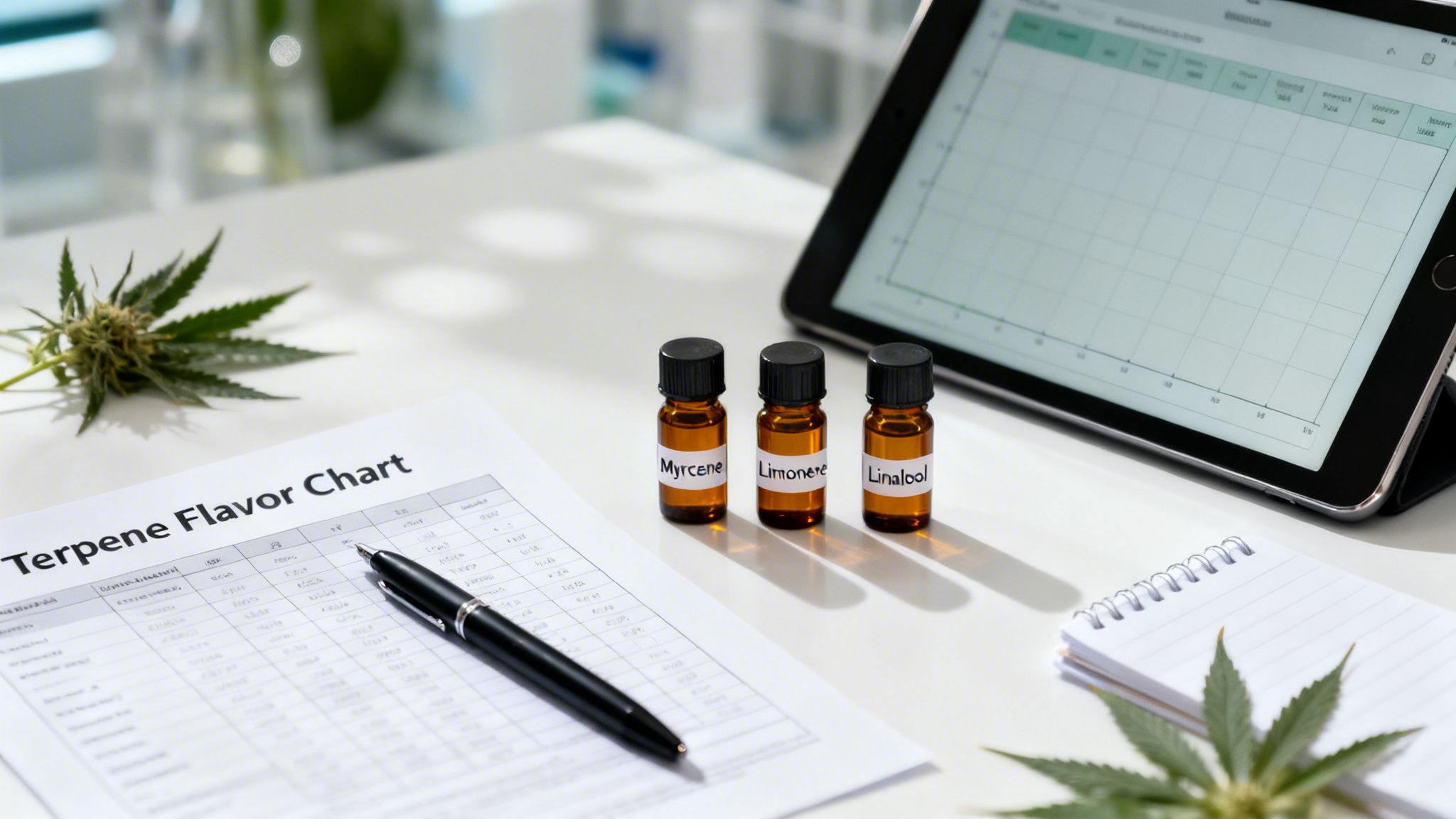
If you're in the business of formulating cannabis products, a good terpene flavor chart isn't just helpful—it's essential for achieving replicable, high-quality results. It acts as your formulation map, connecting individual aromatic compounds to the specific sensory profiles they create. This is how you achieve precision, whether you're replicating the exact experience of a classic strain or formulating something entirely new. Understanding these compounds is what separates standard products from premium, market-leading brands.
Your Essential Terpene Flavor Reference Guide
For any cannabis product formulator, consistency and precision are paramount. Whether you're tasked with recreating the signature aroma of a popular strain for a new vape line or developing a novel profile from scratch, commercial success depends on mastering your ingredients. This is where a solid terpene flavor chart becomes your most trusted tool.
This guide was built specifically for manufacturers, extractors, and product formulators. We will skip the consumer-focused generalities and provide the actionable data you need to formulate with confidence. By mapping each terpene to its specific flavor notes, physical properties, and role within a blend, you gain total control over the end product.
Navigating This Formulation Guide
We've organized this resource to be a practical, bench-side companion during your R&D and production cycles. Think of it as a quick-lookup guide designed for real-world application in a commercial lab.
Here’s a look at what’s inside:
- Detailed Terpene Breakdowns: We'll dive into both primary and secondary terpenes, outlining their unique flavor contributions and how they function as top, mid, or base notes within a blend.
- Technical Data Tables: You'll find easy-to-read charts with critical data like boiling points, molecular weights, and recommended usage rates—all crucial for accurate manufacturing and predictable performance.
- Practical Formulation Examples: We’ll walk you through a real-world scenario, demonstrating how to build a popular strain profile for a vape cartridge using individual terpene isolates.
Once you get a feel for how different terpenes interact, you can graduate from just replicating existing profiles to true innovation. This is how you create the signature blends that make a brand stand out.
Our goal is simple: to provide the knowledge you need to apply terpene science in a commercial setting. The genetic puzzle of the cannabis plant is incredibly complex—just look at the differences between a male weed plant vs female—but working with isolated terpenes gives you a direct, reliable, and scalable path to creating consistent products. This guide is that path.
How to Use This Chart for Better Formulations
Think of this terpene flavor chart as more than just a list of aromatic descriptors. It's a blueprint for creating precise and repeatable products. Every single data point, from the flavor notes and boiling points to the suggested usage rates, is here to guide your formulation process for distillate.
My goal is for you to move beyond guesswork. With this chart, you can develop a predictable method, whether you're trying to nail a specific strain profile or craft something entirely new. Let's walk through how to use this data to build a blend from scratch and turn these numbers into a real-world mixing recipe for vape cartridges or other products.
Breaking Down the Chart Data
To get the most out of this resource, you need to understand what each column means for your formulation work. Every piece of information directly impacts the final taste, aroma, and performance of your finished product.
- Flavor Profile: This is straightforward—it’s the primary taste the terpene contributes. It’s the most direct influence on how your final product will taste.
- Aroma Note (Top/Mid/Base): This describes the terpene's volatility, or how quickly it evaporates. Top notes are perceived first but fade quickly. Mid notes form the heart of the aroma. Base notes are the heavy, lingering scents that provide a lasting impression and anchor the blend.
- Boiling Point: This is a critical piece of technical data for manufacturing, especially for vape cartridges. It dictates which terpenes vaporize first. Understanding this helps you create a consistent flavor experience from the first hit to the last.
- Recommended Usage Rate: Think of these as proven starting points. They are typically given as a percentage by weight for incorporating a specific isolate into a distillate base.
A Practical Formulation Example
Alright, let's put this into practice. We'll formulate a blend inspired by the classic Blue Dream strain for vape cartridges. Lab reports for Blue Dream consistently show high levels of Myrcene, Alpha-Pinene, and Beta-Caryophyllene.
Identify Core Components: First, we look up these three terpenes on the chart. We find that Myrcene provides a fruity, earthy base note. Alpha-Pinene adds a sharp, fresh pine top note. Beta-Caryophyllene brings a spicy, woody character that acts as a mid-to-base note.
Determine Ratios: To achieve the classic Blue Dream aroma, a great starting point is a 5:3:2 ratio of Myrcene to Alpha-Pinene to Beta-Caryophyllene within the terpene blend itself. This ratio makes the dominant fruity-earthy character the star while layering in signature pine and spice notes.
Calculate for Distillate: Now, let's say you're making vape cartridges and want a total terpene concentration of 6%. You would simply add your Myrcene, Alpha-Pinene, and Beta-Caryophyllene isolates to the distillate according to that 5:3:2 ratio. If you need a deeper dive into creating custom blends, our guide on Terpenes 101 guide is an excellent next step.
Following a methodical approach like this one gives you total control over the flavor, aroma, and performance. The result? A consistent, high-quality product every single time.
A Formulator's Guide to Primary Terpenes
To build a memorable sensory profile, you must master the primary terpenes. These are the heavy hitters—the most abundant aromatic compounds in cannabis that lay the groundwork for both flavor and aroma. Developing a functional understanding of each one's contribution is key to creating consistent, top-shelf vape cartridges and concentrates.
Think of this section as your quick-reference guide for the lab. It contains the essential data you’ll need on the fly, from flavor notes and boiling points to the usage rates that serve as reliable starting points. Whether you're replicating a classic strain or formulating something novel, this is your starting point.
Myrcene (β-Myrcene)
You’ll find Myrcene in a huge number of modern cannabis strains, often as the most dominant terpene. It has a signature earthy, musky scent that’s rounded out by a subtle fruitiness, reminiscent of ripe mangoes. It’s the foundation for many iconic profiles.
- Flavor Profile: Earthy, Musky, Fruity (Mango, Grape)
- Aroma Note: Base Note. Myrcene has a heavy molecular weight, so it is less volatile. This helps anchor the lighter, more volatile terpenes in a blend, providing a lasting foundation.
- Formulation Tip: Use Myrcene to build a solid, slightly sweet and earthy base. It’s perfect for fruit-forward blends or classic “OG” style profiles, and it does a fantastic job of grounding the sharpness of citrus or pine terpenes.
- Recommended Starting Rate (Vape): 1.5% – 4.0%
Limonene (d-Limonene)
Limonene is what gives so many energizing strains their bright, zesty citrus punch. It’s a highly volatile monoterpene, meaning it makes a strong first impression.
Its ability to cut through heavier, earthier tones makes it an incredibly versatile formulation tool. Frankly, the precision you get from isolates like Limonene is why a terpene flavor chart has become such a game-changer for product developers. It’s no surprise that North America now makes up 30% of the global terpenes market, a figure from 2026 that shows just how much formulators rely on the accuracy of isolates like Limonene and Myrcene.
- Flavor Profile: Sharp Citrus (Lemon, Orange), Sweet
- Aroma Note: Top Note. This is one of the very first scents you’ll notice, but it’s also one of the first to dissipate.
- Formulation Tip: Add Limonene to give your blend an uplifting, zesty pop. It’s also great for masking unwanted “grassy” off-notes and brightening heavy, musky profiles. Start with low concentrations—its powerful aroma can easily dominate a blend.
- Recommended Starting Rate (Vape): 0.5% – 2.5%
If you really want to get a handle on this essential isolate, our guide on d-Limonene benefits and formulation strategies takes a much deeper dive.
Linalool
Known for its delicate floral and slightly spicy aroma, Linalool is commonly associated with lavender. It adds a sophisticated, complex layer to a blend without being overpowering, which makes it a go-to for creating more nuanced and calming profiles.
Its gentle character is perfect for softening the sharp edges of more pungent terpenes like Pinene or Caryophyllene. Getting that balance right is what separates a good formulation from a great one.
- Flavor Profile: Floral (Lavender), Spicy, Sweet
- Aroma Note: Mid Note. Linalool bridges the gap perfectly, connecting the initial burst of top notes with the lasting finish of the base notes.
- Formulation Tip: Use Linalool in small amounts (often less than 1%) to add a touch of floral elegance. It can smooth out any harshness in a blend and help create a more rounded, complete sensory experience.
- Recommended Starting Rate (Vape): 0.2% – 1.5%
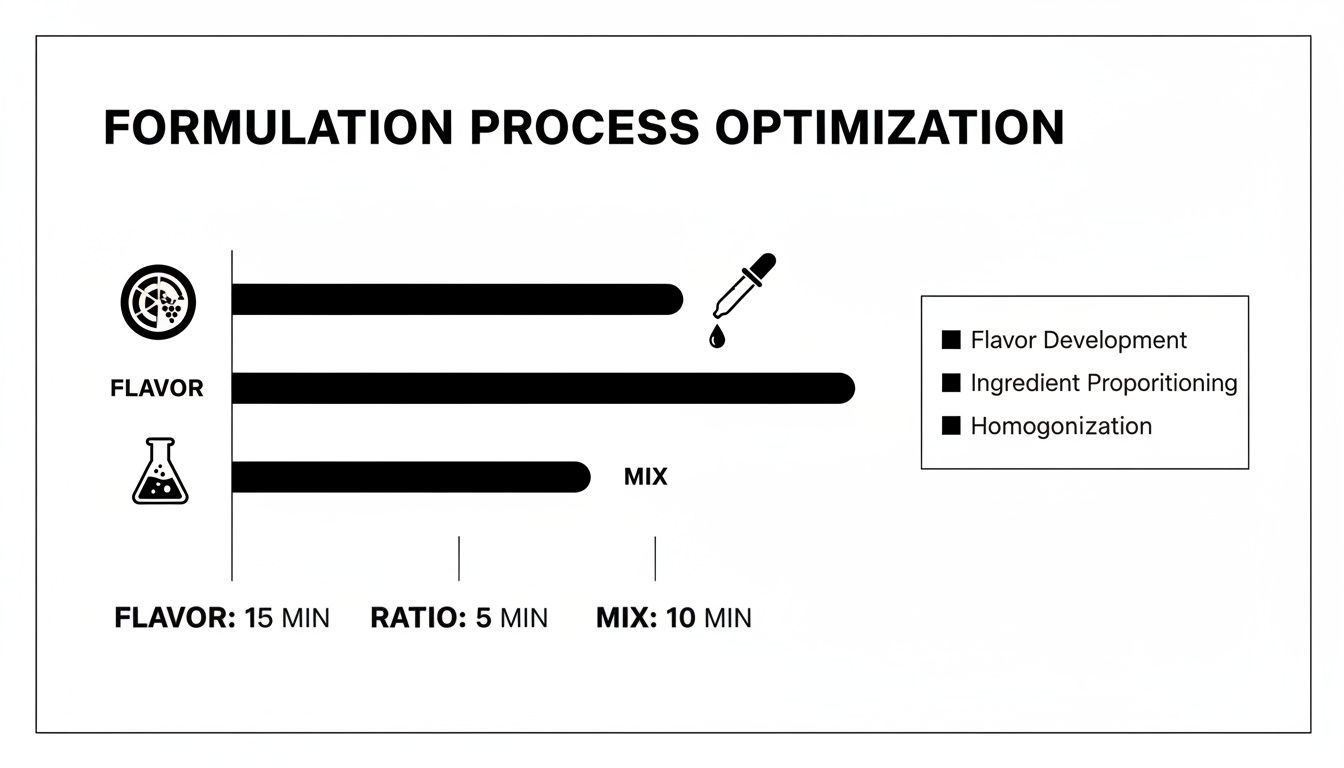
The chart below shows a typical workflow for putting these terpenes to work in the lab, from initial concept to the final product.
Caryophyllene (β-Caryophyllene)
Beta-Caryophyllene stands out with its spicy, peppery, and woody aroma—think black pepper or cloves. Because it’s a larger sesquiterpene with a high boiling point, it acts as a strong base note that provides real depth and a long-lasting finish.
This terpene is a must-have for any "gassy" or spicy strain profiles and is absolutely critical for achieving the authentic character of many classic cultivars.
- Flavor Profile: Spicy, Peppery, Woody, Clove
- Aroma Note: Base Note. Its low volatility means it’s going to hang around long after the top and mid notes have disappeared.
- Formulation Tip: Use Caryophyllene to build a warm, spicy foundation. It’s essential for creating authentic OG, Chem, or Cookie profiles. It also works beautifully with Limonene to create that timeless citrus-spice combination.
- Recommended Starting Rate (Vape): 1.0% – 3.0%
To help you keep these key players straight, here’s a quick-reference table with the most important formulation properties.
Primary Terpene Formulation Properties
| Terpene | Flavor Profile | Aroma Note (Top/Mid/Base) | Boiling Point (°C) | Recommended Usage Rate (Distillate) |
|---|---|---|---|---|
| Myrcene | Earthy, Musky, Fruity | Base | 167 | 1.5% – 4.0% |
| Limonene | Sharp Citrus, Sweet | Top | 176 | 0.5% – 2.5% |
| Linalool | Floral, Spicy, Sweet | Mid | 198 | 0.2% – 1.5% |
| Caryophyllene | Spicy, Peppery, Woody | Base | 266 | 1.0% – 3.0% |
Once you have a functional grasp of these four primary terpenes, you have the power to control the entire structure of your product’s sensory profile. The next step is learning how to use secondary terpenes to add those extra layers of nuance and complexity that truly make a blend unique.
Secondary Terpenes for Crafting Nuanced Flavors
While your primary terpenes are the heavy lifters that define a blend's core identity, it's the secondary and minor terpenes that create real character and sophistication. These are the compounds that, even in small amounts, separate a standard product from a premium one. Mastering them is how you add those subtle, complex layers that turn a good flavor into something truly unforgettable.
It’s a lot like cooking. Your primary terpenes are the salt, fat, and acid—the essential building blocks. Secondary terpenes, on the other hand, are the specific herbs and spices that give a dish its signature flair. This is where formulation evolves from a science into an art form, and where a good terpene flavor chart becomes your best friend for finding the perfect finishing touch.
Terpinolene: The Complex Chameleon
Often found in Sativa-leaning strains, Terpinolene is one of the most multifaceted terpenes in a formulator's toolkit. It's a tricky one to pin down, with a complex aroma that weaves together floral, pine, and herbal notes with a flicker of fresh citrus. This unique profile makes it incredibly useful for adding a vibrant, fresh layer that sits right between a top and mid note.
- Flavor Profile: Floral, Pine, Herbal, Citrus (Lime)
- Aroma Note: Top/Mid Note. It hits you with a bright, fresh character right away, but it has enough body to stick around, bridging the initial scent with the heart of the blend.
- Formulation Tip: A little Terpinolene goes a very long way. Keep it at low concentrations—think 0.5% to 2.0%—to bring a bright, almost sparkly quality to your mix. It’s fantastic for preventing fruity or sweet blends from falling flat or becoming one-dimensional.
- Common Strain Sources: Jack Herer, Dutch Treat, Golden Goat
Just a touch of Terpinolene can instantly elevate a profile, giving it a sophisticated edge that's tough to get with any other single isolate.
Humulene: The Hoppy Foundation
Formerly called alpha-Caryophyllene, Humulene is the terpene that gives hops their distinct earthy, woody, and slightly spicy character. As a sesquiterpene, it works as a solid mid-to-base note. It provides a dry, hoppy foundation that adds depth without stealing the show.
- Flavor Profile: Hoppy, Woody, Earthy, Spicy
- Aroma Note: Mid/Base Note. Humulene is a great anchor. It provides a grounding aromatic backbone that lets other, brighter terpenes shine.
- Formulation Tip: Use Humulene to add an authentic "craft" or "dank" note to your blends. It plays especially well with Myrcene and Caryophyllene, creating the kind of robust, earthy profiles you find in classic cultivars.
- Recommended Starting Rate (Vape): 0.5% – 2.5%
If you're trying to nail the complex bitterness of certain OG or Sour profiles, Humulene is non-negotiable. It adds a dry, herbal finish that you just can't get from Limonene or Myrcene alone.
Figuring out how these less-dominant isolates interact is the real key. For anyone ready to dig deeper, exploring a guide on formulating for vape cartridges is the next logical step toward true product innovation.
Ocimene: The Sweet Herbaceous Note
Ocimene offers a really unique aroma: sweet, herbaceous, and woody, but with hints of tropical fruit. It’s a monoterpene with a low boiling point, so it acts as a powerful top note that delivers a burst of fresh, almost perfume-like sweetness right at the start.
Although its presence is often subtle in the plant, its impact in a formulation can be massive.
- Flavor Profile: Sweet, Herbaceous, Tropical, Woody
- Aroma Note: Top Note. Ocimene is highly volatile, so it’s one of the first things you’ll smell. It defines that crucial first impression of a blend with its bright, sweet character.
- Formulation Tip: Use Ocimene sparingly—often below 1%—to lift and sweeten a profile. It's a secret weapon in fruit-forward blends where you want to add an exotic twist beyond the usual citrus or berry notes.
- Common Strain Sources: Clementine, Green Crack, Golden Pineapple
Its ability to introduce a pleasant sweetness without relying on typical fruity terpenes makes it an invaluable tool for creating flavors that stand out.
Camphene: The Damp Forest Floor
Camphene has a pungent, camphor-like scent that smells a lot like damp earth and fir needles. It's usually too intense to be a main player, but it’s fantastic as a minor accent. It adds a cooling, minty, and distinctly earthy note that can really make pine or mint profiles pop.
- Flavor Profile: Camphor, Minty, Damp Earth, Fir Needle
- Aroma Note: Mid Note. It has a sharp, penetrating quality that cuts right through other scents, offering a refreshing counterpoint.
- Formulation Tip: Be careful with Camphene. Go much higher than 0.5%, and it can quickly start to smell medicinal. I recommend using it in trace amounts to add an authentic "forest floor" vibe or to boost the cooling sensation in minty blends.
- Recommended Starting Rate (Vape): 0.1% – 0.7%
By strategically layering these secondary terpenes into your formulas, you can build complex, memorable products that people will come back for. It's these small details that show real expertise and give your brand an edge in a very crowded market.
Technical Data for Precise Product Manufacturing
A good terpene flavor chart is a great starting point, but for anyone serious about manufacturing, flavor is just one piece of the puzzle. To create products that are stable, safe, and consistent from batch to batch, you have to get familiar with the technical side of each terpene isolate. Things like boiling points, flash points, and molecular weights aren't just for chemists—they're what keep your terpenes from burning off during production and ensure your final product works exactly as you designed it.
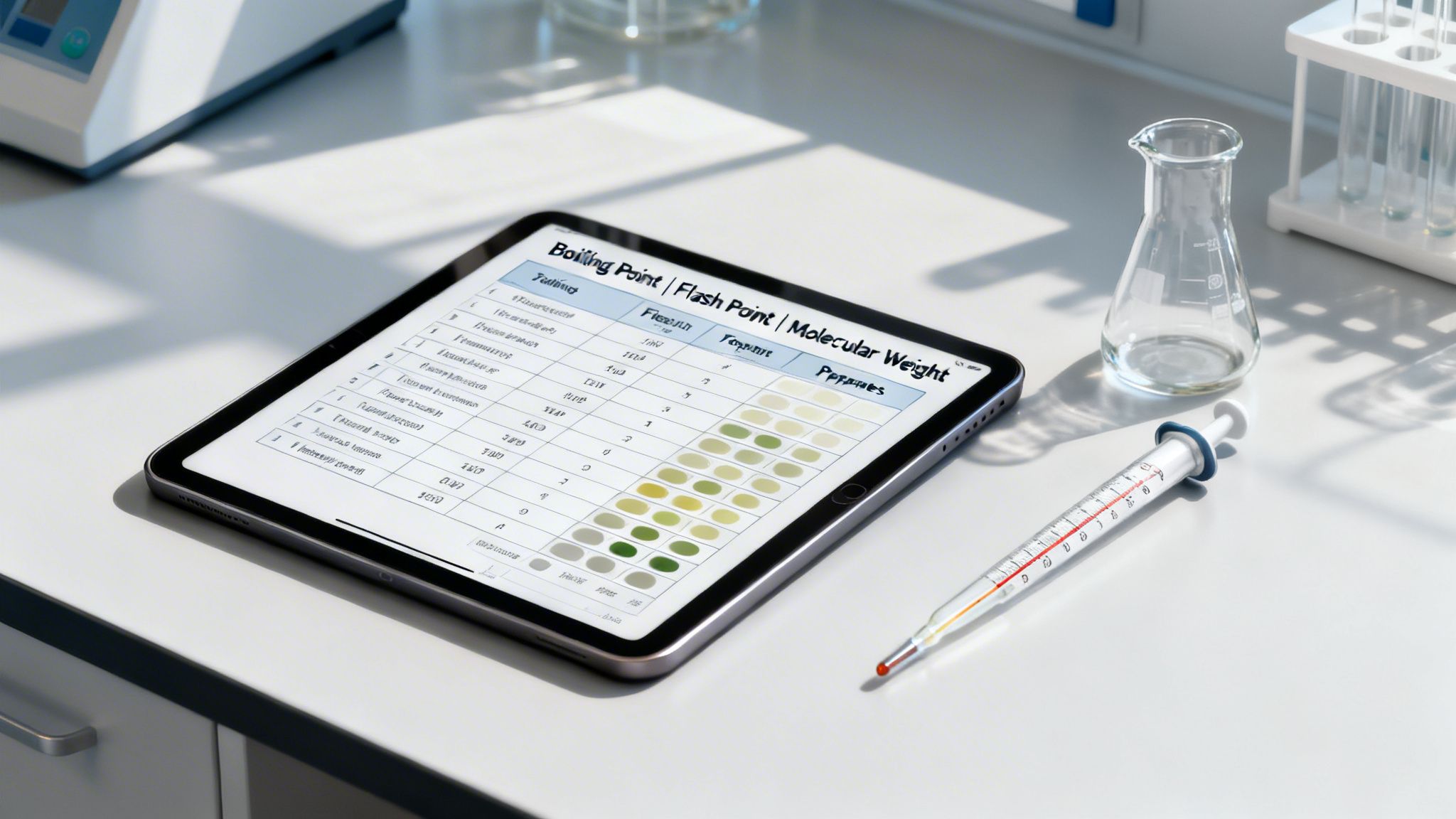
Knowing this data is what separates small-batch blending from scalable, professional manufacturing. It’s also a big reason the industry is moving toward 100% natural, filler-free vape cartridges and concentrates. The demand for clean, high-quality ingredients is growing fast; in fact, the global terpenes market is projected to grow at a 8.20% compound annual growth rate (CAGR) all the way through 2033. You can dig deeper into this trend by checking out the full terpenes market report to see how it’s influencing product development.
Understanding Boiling Points and Flash Points
For vape formulations, boiling and flash points are probably the two most critical metrics you'll work with. The boiling point directly impacts what a customer tastes and when, defining the entire sensory experience of your cartridge.
- Boiling Point (°C): This tells you which flavors will vaporize first. Terpenes with lower boiling points, like Alpha-Pinene at 155°C, hit you first as bright top notes. Those with much higher boiling points, like Caryophyllene at 266°C, stick around as lasting base notes. A great blend uses a spectrum of boiling points to create a rich, layered experience from the first puff to the last.
- Flash Point (°C): This is a non-negotiable safety number. It's the lowest temperature where a terpene's vapor can ignite if it meets a spark or flame. Knowing the flash point for every isolate in your blend is absolutely essential for safe handling, mixing, and storage in your facility. Always, always check the Safety Data Sheet (SDS) for every single compound you use.
By paying close attention to these numbers, you can avoid burning off your delicate and volatile terpenes during production. This makes sure the flavor you worked so hard to create is actually what your customer gets to enjoy.
Molecular Weight and Formulation Safety
Molecular weight might not get as much attention as boiling points, but it's another important factor in how a blend comes together. Heavier molecules, particularly sesquiterpenes, are less volatile. They can act as natural fixatives, helping to "anchor" the lighter, more aromatic monoterpenes and make the overall flavor profile last longer.
Formulation Best Practice: Never skip your homework on suppliers. Only work with a reputable source that provides a Certificate of Analysis (COA) for every single batch. This independent lab report is your proof of purity and confirms the absence of things you don't want—residual solvents, pesticides, and heavy metals. For any commercial product, this is a must-have.
Here is a quick-reference table with the key technical specs for some of the most common terpene isolates you'll encounter.
Technical Specifications for Common Terpene Isolates
This table is designed for formulators and provides the essential physical and safety data for key terpenes. Use it as a quick lookup tool during development to ensure you're working with precision and safety in mind.
| Terpene | Boiling Point (°C) | Flash Point (°C) | Molecular Weight (g/mol) | Safety Note |
|---|---|---|---|---|
| Myrcene | 167 | 39 | 136.24 | Flammable; handle in well-ventilated areas. |
| Limonene | 176 | 48 | 136.24 | Can be a skin irritant; wear gloves. |
| Alpha-Pinene | 155 | 33 | 136.24 | Highly flammable; low flash point requires caution. |
| Beta-Pinene | 166 | 37 | 136.24 | Flammable liquid and vapor. |
| Linalool | 198 | 75 | 154.25 | Store away from heat and ignition sources. |
| Caryophyllene | 266 | 100 | 204.36 | Higher flash point, but still combustible. |
| Humulene | 198 | 81 | 204.36 | Store in a cool, dark place to prevent degradation. |
| Terpinolene | 184 | 63 | 136.24 | Combustible; keep away from open flames. |
Keep this data handy. It will help you fine-tune your heating and mixing processes, predict how your blend will perform in a vape device, and most importantly, maintain a safe working environment.
How to Replicate Strain Flavors for Vape Cartridges
Alright, let's put all this theory into practice. We'll walk through a real-world example of how a professional formulator builds a complex strain profile from scratch for a vape cartridge. Our target? The legendary OG Kush.
This exercise shows you how to move from a basic terpene flavor chart to using individual isolates to construct an authentic, layered aroma. It’s a process where precision and high-quality ingredients are everything.
OG Kush is famous for its incredible balance of earthy, pine, and citrus notes. To get it right, we have to deconstruct it and build it back up, piece by piece.
Building an OG Kush Profile
If you look at lab reports for OG Kush, a few key terpenes consistently stand out. We'll use those as our blueprint and assign percentages to build our blend. For this example, let's say we're aiming for a total terpene concentration of 6% in our final distillate.
Here’s how we’d break down the terpene blend itself:
- Myrcene (Base Note): This is our foundation. It provides that classic earthy, musky, and slightly fruity character. We'll make this the star of the show at 40% of the terpene mix.
- Limonene (Mid-Note): This is where the bright, gassy citrus punch comes from. It's a critical part of the OG signature, so we’ll set it at 30% of the blend.
- Caryophyllene (Base Note): To add that spicy, peppery bite that gives OG its complexity, we'll use Caryophyllene at 20%.
- Minor Terpenes (Pinene & Humulene): These are the finishing touches. The last 10% will be a mix of Pinene, for that sharp pine top note, and a touch of Humulene to round it out with a subtle hoppy aroma.
This is exactly how you build a sophisticated profile—starting with the dominant base notes and layering in the mid and top notes for nuance. Each isolate has a specific role, and getting the ratios just right is what makes the final product instantly recognizable as "OG Kush."
Getting this level of detail correct is non-negotiable. Think about it: just as there are crucial differences that determine Sour Diesel's indica or sativa heritage, the specific terpene ratios are what give a strain its identity. Your ability to nail these nuances time and time again is what will make your products stand out on the shelf.
Ready to start formulating? Take a look at our library of strain-specific terpene profiles and high-purity isolates to kick off your next product creation.
Common Questions About Terpene Formulation
When you're in the lab developing a new product, a lot of practical questions pop up. Here are some quick answers to the most common ones we hear from formulators.
What’s a Good Starting Point for Terpene Usage Rates in Distillate?
For most vape cartridges, a great place to start is between 3% and 7% total terpenes by weight. If you're working with a strong, singular isolate like Limonene, I’d suggest starting on the low end, around 3-5%, to ensure the flavor isn't overpowering.
When using more complex, strain-inspired terpene blends, you have a bit more room to play with. You can comfortably start in the 5-7% range. The golden rule is to always start low, mix a small test batch, and then tweak your ratios based on how it tastes, smells, and performs.
How Much Do Terpene Boiling Points Matter for Vape Formulations?
Boiling points are absolutely critical for getting the performance you want. Think of it this way: terpenes with lower boiling points, like Pinene (155°C), turn to vapor first. They create that initial burst of aroma, or the "top note."
On the other hand, terpenes with higher boiling points, such as Caryophyllene (266°C), vaporize later in the heating process. These create the lasting "base note" that rounds out the experience.
A well-made blend gives you a consistent, full-bodied flavor from the beginning to the end of a single puff. It prevents what we call "flavor fractionation," where the user only tastes the light, flighty top notes. Getting this right is a crucial detail when you're formulating for vape cartridges.
When you understand and use boiling points correctly, you can essentially program the flavor release in your product. It’s the difference between a flat, one-note flavor and a dynamic, evolving sensory experience.
Can I Mix My Own Terpene Isolates to Create a Custom Strain?
Absolutely. In fact, that's where the real artistry of advanced formulation comes in. By using a detailed terpene chart, you can combine individual isolates in very specific ratios to either mimic a popular strain or create something entirely new.
A good way to start is by identifying the one or two dominant terpenes in your target profile. From there, you can use a chart to build out the blend, adding secondary and tertiary terpenes layer by layer until you get it just right.
At Gold Coast Terpenes, we're all about giving formulators the lab-tested isolates and strain profiles you need for consistency and precision. Take a look at our collection at https://www.goldcoastterpenes.com and get started on your next signature product.