
To create a vape or concentrate that commands market attention, replicating the punchy, fuel-forward aroma of the Super Sour Diesel terpene profile is a strategic decision. Its unmistakable sensory signature—a sharp blast of diesel cut with citrus—is precisely what a significant segment of the market seeks in an uplifting, focus-driven product. This is not about simple flavor matching; it's about delivering a specific, repeatable experience that builds brand loyalty.
Why the Super Sour Diesel Profile Drives Commercial Success
For any product formulator, understanding why a profile resonates with the market is as crucial as knowing how to construct it. The enduring popularity of Super Sour Diesel is a direct result of legendary genetics meeting a specific consumer demand.
Its lineage, a cross between the iconic Sour Diesel and Super Silver Haze, created a profile that is both layered and instantly recognizable. We're not discussing a generic "citrus" or "fuel" scent. This is a specific, complex aroma that makes a definitive statement in a crowded market.
Meeting a Clear Market Need
The commercial value of a Super Sour Diesel-inspired terpene blend is rooted in its established reputation. Customers associate this profile with daytime use, productivity, and creative endeavors. This provides brand owners with a clear marketing angle from the outset.
When you accurately replicate this profile, you're not just selling a flavor. You're offering a reliable and highly sought-after functional experience. That consistency is what converts a first-time buyer into a loyal customer.
By building products around this profile, you tap into pre-existing demand, bypassing the need to educate the market on a new concept. Instead, you leverage the positive recognition Super Sour Diesel already commands. Of course, this all hinges on sourcing high-quality isolates and blends, so knowing where to buy terpenes that guarantee consistency is a critical first step.
The Genetic Blueprint for a Winning Aroma
The powerful combination of Sour Diesel and Super Silver Haze is the key to its market success. Each parent strain contributes essential aromatic components:
- Sour Diesel: This is where the profile gets its backbone. It delivers the famous pungent, skunky, and gassy notes that give Super Sour Diesel its signature edge.
- Super Silver Haze: This parent lifts the entire profile, adding bright, zesty citrus and sweet top notes. It prevents the aroma from feeling heavy or one-dimensional.
This genetic synergy creates an experience that is both powerful and balanced. When formulating, your goal is to honor that balance. You need the classic gassy punch up front, followed by a clean, citrusy finish. Achieving this is what separates a premium product from a generic imitation.
The Molecular Blueprint for Replicating the Flavor of Super Sour Diesel
When bottling the essence of a legendary strain like Super Sour Diesel, the process is more akin to perfumery than simple mixing. It requires understanding how different terpenes function as top, middle, and base notes to create a complete sensory journey.
This strain's story begins with its powerhouse parents, Sour Diesel and Super Silver Haze. While this combination historically pushed its THC content into the 20-25% range, for formulators, the real value lies in the resulting terpene profile. It is dominated by limonene, myrcene, and beta-caryophyllene, which provides a clear roadmap for replicating that iconic, gassy, lemon-and-pine signature.
This diagram illustrates how a strain’s genetics and innate qualities converge to meet market demand.
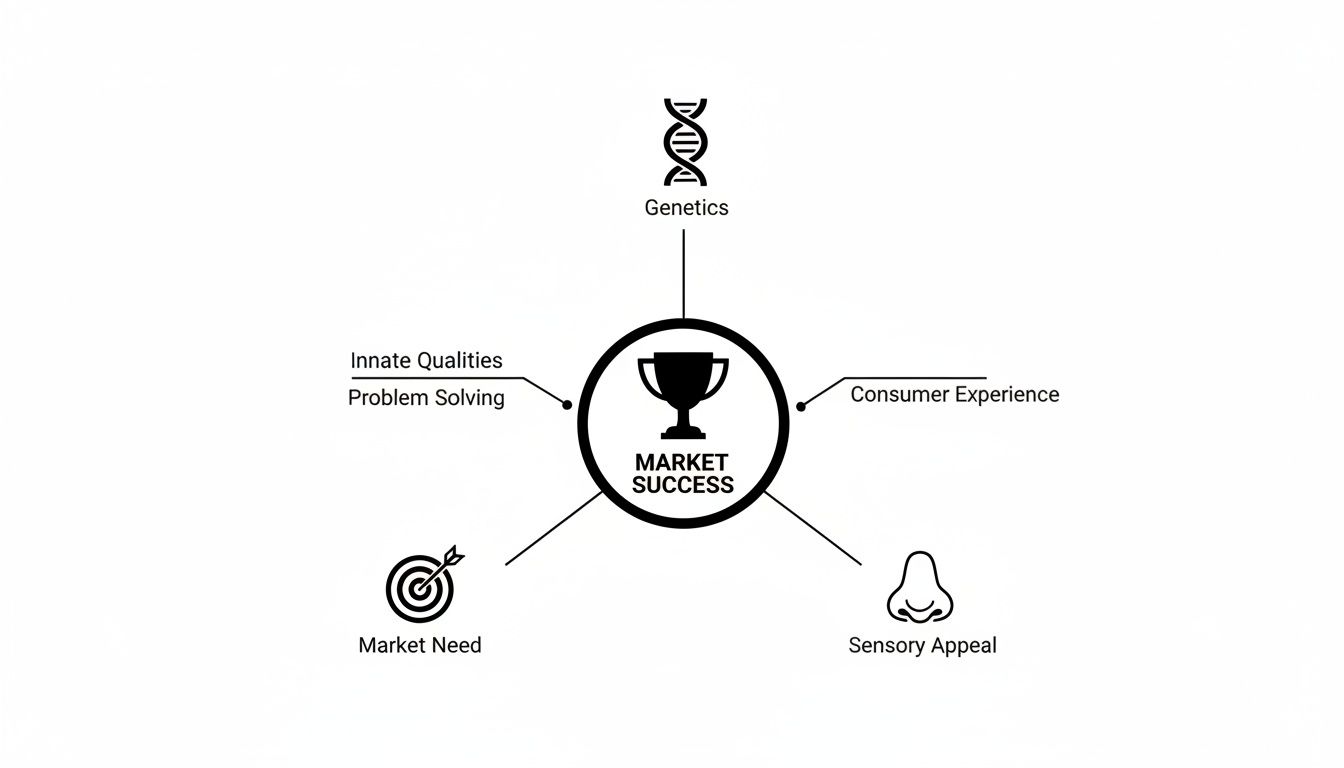
It serves as a reminder that a strain’s success is not accidental. It is the result of superior genetics meeting a distinct sensory profile that consumers actively seek.
Building the Aromatic Structure
To achieve an authentic Super Sour Diesel profile, you must layer your terpenes based on their volatility and aromatic contribution. Each component has a specific role, and precision is key to a successful formulation.
Here is a practical blueprint for constructing this profile, categorizing each terpene by its function.
Super Sour Diesel Strain-Inspired Terpene Blend Blueprint
| Terpene | Aromatic Role | Primary Sensory Contribution | Formulation Function |
|---|---|---|---|
| Limonene | Top Note | Sharp citrus, bright lemon peel | Provides the initial, energizing aromatic punch that defines the strain's character. |
| Beta-Caryophyllene | Middle Note | Spicy, peppery, black pepper | Delivers the signature "gassy" or "fuel" mid-body that bridges the citrus and earthy notes. |
| Myrcene | Base Note | Musky, herbal, slightly fruity | Grounds the profile with a deep, earthy foundation that adds complexity and a lasting finish. |
| Beta-Pinene | Secondary Top Note | Fresh pine, woody | Lifts the top notes, adding a layer of bright, forest-like complexity to the initial aroma. |
| Humulene | Secondary Base Note | Hoppy, earthy, woody | Works with Myrcene to create a robust, earthy base and enhances the strain's "dank" quality. |
This table demonstrates the balancing act required. The Limonene and Pinene must provide an immediate impact, the Beta-Caryophyllene has to deliver the classic fuel character, and the Myrcene and Humulene must establish a solid, earthy foundation.
A superior Super Sour Diesel formulation is an exercise in controlled chaos. The sharp Limonene must be front-and-center but not overpowering, the spicy Beta-Caryophyllene needs to add that unmistakable fuel kick, and the earthy Myrcene must anchor the entire experience.
Achieving this balance requires a solid grasp of molecular interactions. For those looking to deepen their technical knowledge, our guide on the chemistry of terpenes is an excellent resource. Mastering these interactions is what elevates a product from decent to one that truly honors the strain's legendary status.
Formulating Super Sour Diesel for Distillate: A Guide
Achieving the classic Super Sour Diesel profile in a distillate is a true test of a formulator's craft. It is a precise technical process, not a simple mix-and-stir operation. To create a stable, authentic, and premium-flavored product, precision, temperature control, and technique are paramount.
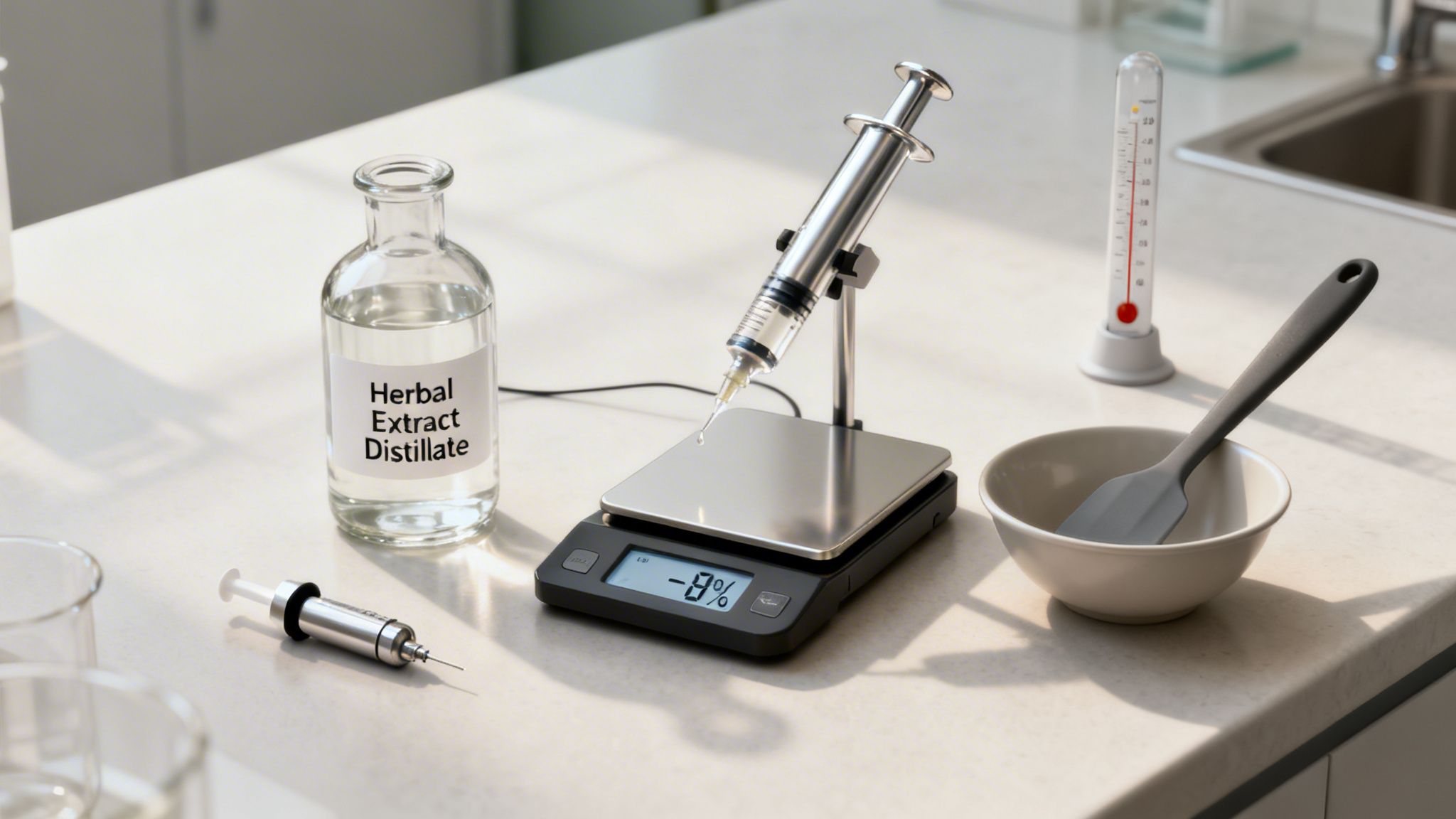
The process begins with an accurate dosing ratio. For a bold profile like Super Sour Diesel, a concentration between 5% and 8% terpenes by weight is the target range. This delivers the signature pungent kick without introducing harshness to the vapor. For batch-to-batch consistency, a digital scale measuring to at least two decimal places is non-negotiable.
Homogenization: Heat, Stirring, and Stability
Once terpenes are measured, the next critical step is homogenization—the complete integration of the terpene blend and cannabinoid oil. Improper homogenization leads to separation, resulting in inconsistent flavor, poor consumer experience, and potential damage to vape hardware.
Treat the distillate as a viscous medium that requires gentle persuasion to mix with the much thinner terpene blend. This is achieved through a careful balance of heat and agitation.
- Temperature Control: Gently warm the distillate to reduce viscosity, but never exceed 60°C (140°F). Higher temperatures will cause volatile top-note terpenes like Limonene to evaporate, permanently dulling the bright, gassy pop you are trying to achieve.
- Controlled Agitation: Use a magnetic stirrer or an overhead mixer on a low setting. The goal is a smooth vortex that draws the terpenes down into the oil. Avoid whipping excess air into the mixture, which can cause oxidation and degrade the final product.
A perfectly homogenized batch will appear crystal clear after mixing. There should be no visible streaks or signs of separation, even after cooling. This simple visual check is one of the most effective QC steps before filling cartridges.
Dialing in Final Viscosity
The final viscosity of your blend is critical, especially when formulating for vape cartridges. Adding terpenes will naturally thin the distillate, but the final product must be compatible with the chosen hardware. If the oil is too thin, it risks leaks. If it is too thick, wicking problems and dry, burnt hits will occur.
Fine-tune the viscosity by adjusting the terpene percentage within the 5% to 8% window. For formulators seeking a deeper dive into the technical aspects of this process, our guide on the best terpenes for distillate offers detailed advice on managing both flavor and viscosity.
By mastering these steps—precise dosing, controlled heating, and thorough mixing—you can consistently create a high-quality Super Sour Diesel product that stands out in the market.
Super Sour Diesel Terpene Profile for Vape Cartridges
Nailing the Super Sour Diesel flavor in your distillate is a significant achievement, but it is only half the battle in cannabis product formulation. If that perfect blend fails to perform in a vape cartridge, the effort is wasted. The hardware is not merely a container; it is an active component of the flavor delivery system and can make or break your product.
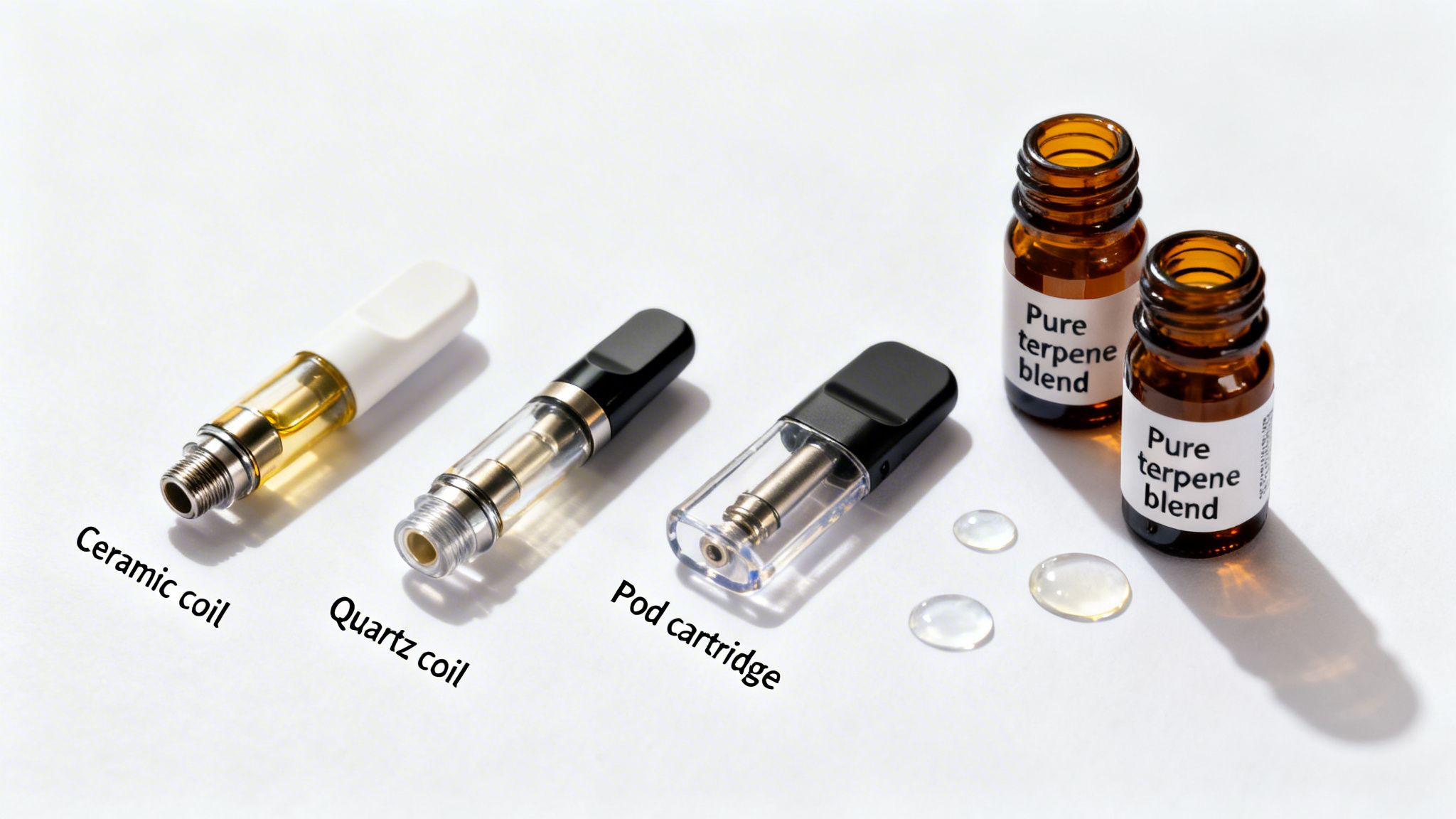
Ceramic and quartz coils heat oil differently. This fundamentally changes how terpenes are expressed. The formulator's job is to ensure the blend and hardware work in synergy.
Matching the Strain-Inspired Terpene Blend to the Hardware
Your Super Sour Diesel formulation must be optimized for its specific heating element. Failure to account for this can result in muted flavors or, worse, a burnt, chemical taste that signals a low-quality product to the consumer.
Ceramic Coils: These coils utilize a porous material to heat oil at lower, more consistent temperatures. This is ideal for preserving the delicate, gassy top notes of Super Sour Diesel, such as Limonene and Beta-Pinene. For ceramic cartridges, a slightly lower terpene concentration—around 5-6%—is often sufficient, as the gentle heat provides a more true-to-profile flavor.
Quartz Coils: These coils heat rapidly and reach higher temperatures, delivering an immediate, powerful effect. The tradeoff is that this intense heat can scorch the most volatile terpenes. When formulating for quartz, you may need to increase the terpene concentration to 7-8% to ensure the flavor profile remains punchy and present despite the aggressive heating.
The objective is to achieve harmony between your oil and the cartridge through rigorous testing with your chosen hardware. This meticulous attention to detail is what distinguishes a forgettable vape from a market leader.
The Non-Negotiable Purity Standard
For vape formulations, there is no room for compromise: pure, filler-free terpene blends are mandatory. Super Sour Diesel first emerged in the late 1990s from the cross of Sour Diesel and Super Silver Haze, creating its legendary sharp, fuel-like aroma.
The only way to honor that legacy in a modern cartridge is with a 100% natural terpene profile. This means absolutely no diluents like PG, VG, PEG, or MCT oil. As we cover in our guides, a strain's profile is heavily influenced by its parents; you can see this genetic link by exploring if Sour Diesel is an Indica or Sativa.
Adhering to pure terpenes is not just about achieving a clean, authentic flavor; it is a matter of hardware integrity and consumer safety. Fillers can alter viscosity, damage coils, and potentially create harmful byproducts when heated.
By committing to purity from the start, you engineer a premium, reliable product that delivers exceptional flavor from the first use to the last. This is how you build a brand that earns consumer trust.
Taking Super Sour Diesel to the Next Level
You have mastered the classic Super Sour Diesel terpene profile. This is a significant accomplishment, but it is also the starting point for true innovation. Moving beyond replication to create proprietary variations is how you build a memorable brand.
The secret lies in using specific terpene isolates to subtly modify the classic profile. The goal is not to reinvent it, but to refine the iconic Super Sour Diesel experience, creating something unique that still honors the original.
Crafting Your Signature Blends
Consider the core Super Sour Diesel profile your foundation. Now, you can add signature touches. Introducing a small amount of Linalool, for instance, can soften the sharp, gassy edges, creating a mellower, floral finish that may appeal to a new consumer segment.
This strategy allows you to build a family of related yet distinct products. You could create a "Double-Down Diesel" by amplifying peppery notes, or a "Zesty Diesel" by boosting Limonene with a grapefruit isolate. Each subtle tweak tells a new story and gives customers a reason to explore your entire product line.
Precision is key. Start with small, controlled test batches. We have found that adding isolates at concentrations between 0.5% to 1.5% of the total terpene blend is the sweet spot. Document every variable—every addition, every change, and the resulting sensory data. This is how you transform a concept into a scalable formula.
Putting It Into Practice: Formulation Ideas
Developing proprietary blends is what separates industry leaders from followers. It demonstrates a deep understanding of formulation and provides compelling reasons for customers to remain loyal to your brand.
Here are a few practical examples to inspire your own Super Sour Diesel variations:
- A Softer, Calmer Diesel: Add 1% Linalool to your blend. This floral isolate effectively rounds out the sharp citrus and fuel notes, making the profile feel less aggressive and more balanced.
- Extra Gassy & Pungent: For diesel purists, boost the spicy, funky notes by adding 0.5% Beta-Caryophyllene. This will amplify the classic "fuel" aroma that connoisseurs seek.
- A Tropical Diesel Twist: For a more creative direction, add 1% Myrcene or another fruit-forward isolate. This can create a fascinating hybrid that begins with a familiar gassy punch before finishing with an unexpected wave of sweet, tropical fruit.
When you begin experimenting in this manner, you transition from a replicator to an innovator. This approach not only adds value to your products but also builds a reputation for quality and creativity that is difficult to compete with.
Common Questions About Formulating with the Super Sour Diesel Terpene Profile
When working with a legendary profile like Super Sour Diesel, several technical questions frequently arise during formulation. Achieving the precise fuel-and-citrus balance requires finesse. Here are answers to common challenges formulators encounter.
What is the ideal usage rate for this strain-inspired terpene blend in a vape cartridge?
The optimal range for most vape formulations is 5-7% terpenes by weight. This is a solid starting point for both THC and CBD distillates.
This is not an absolute rule. Thinner, highly refined distillates may require a higher concentration—up to 8%—to achieve the desired flavor intensity. The only way to determine the precise ratio is through small, carefully documented test batches. A reliable mixing calculator is an invaluable tool for ensuring batch-to-batch consistency. The goal is a signature pungent flavor without any harshness.
How do I achieve the perfect balance between diesel and citrus notes?
This is the classic challenge when replicating any Sour Diesel profile. You are balancing the gassy funk from terpenes like Myrcene and Beta-Caryophyllene with the bright, sour citrus of Limonene.
First, ensure perfect homogenization. Proper mixing guarantees even distribution of these different terpenes. If you find the citrus notes are subdued, you can add a small amount of isolated Limonene—0.5-1%—to elevate the top notes.
The most critical factor is heat management. Overheating the mixture will cause the more volatile citrus terpenes to burn off long before the heavier diesel compounds are affected. This is the quickest way to unbalance the entire flavor profile.
Can this terpene profile for cannabis product formulation be used in products besides vapes?
Absolutely. While vape cartridges are the most common application, our Super Sour Diesel terpene profile is highly versatile. It is excellent for reintroducing authentic aroma into concentrates like shatter, wax, or badder that have lost their character during extraction.
It also performs surprisingly well in infused beverages and edibles, though careful R&D is required. The necessary concentrations are significantly lower, and finding the right flavor balance is key. For topicals, the energizing scent can create an invigorating and memorable user experience.
Are there common stability issues to watch out for in formulations?
With a profile like this, the primary stability issue is preventing the terpenes from separating from the oil. When they fail to remain homogenized, you get inconsistent flavor and "hot spots"—an overpowering and unpleasant concentration of terpenes.
Your first line of defense is a high-quality, filler-free terpene blend. Your second is mastering your mixing protocol. This involves gentle, consistent heat—never exceeding 60°C (140°F)—and mechanical stirring until the mixture is perfectly clear and uniform. Finally, store finished goods in a cool, dark place to protect volatile terpenes and preserve flavor integrity over time.
The market has consistently demonstrated that Super Sour Diesel is a winning profile. Cartridges featuring this profile often dominate sativa sales. For deeper insights into its lineage and cultivation, you can find excellent information on the Sour Diesel strain.
Ready to create a standout product with that authentic, fuel-forward aroma? Gold Coast Terpenes provides the lab-tested, strain-specific profiles you need for consistent, high-quality formulations.
Explore our Super Sour Diesel terpene blend today.