
For product formulators, the Strawberry Shortcake profile is a commercially valuable blueprint for creating high-demand vape cartridges and concentrates. This guide deconstructs its aromatic architecture to support precise, scalable product development.
Why the Strawberry Shortcake Profile is a Formulation Asset
The Strawberry Shortcake terpene profile is a strategic asset for product development. It masterfully balances a familiar creamy strawberry flavor with a subtle, gassy diesel finish that targets sophisticated aromatic preferences.
From a technical standpoint, its sensory notes provide a clear roadmap for formulating products that stand out in a saturated market. The commercial appeal lies not just in the name, but in its complex and, more importantly, replicable aromatic structure.
A Stable Genetic Blueprint for Replication
To consistently replicate the Strawberry Shortcake flavor, understanding its genetic foundation is crucial. The profile gained commercial traction around 2018-2019, with notable cultivars developed by Dark Horse Genetics, Lost River Seeds, and the Jungle Boys.
Its lineage is typically a cross of Juliet and Strawberry Diesel, which results in a stable and predictable aromatic profile—ideal for targeted replication. For instance, Dark Horse Genetics used a specific J3 cut of Juliet with Strawberry Diesel to develop their cultivar, improving yields from an initial 300 grams per plant to over 500 grams in optimized environments.
This genetic stability provides formulators with a consistent set of aromatic targets, enabling reliable blend development batch after batch.
For a product developer, a strain's market popularity is only one part of the equation. The other, more critical part, is its replicability. Strawberry Shortcake's well-documented genetics make it an ideal candidate for consistent, scalable terpene blend development.
Translating Sensory Notes into a Formulation Strategy
The core task is translating the sensory profile into a reliable, stable formulation. This requires more than combining a few fruit-forward isolates.
It involves a methodical deconstruction of how each individual terpene contributes to the overall aroma and mouthfeel. By reverse-engineering the profile, formulators can build a blend that accurately delivers not just the initial berry top note, but also the creamy undertones and gassy finish that define authenticity. To understand how terpene profiles define cannabis strains is to control the final product experience.
This technical approach ensures the final product—whether a vape cartridge or a concentrate—delivers the genuine Strawberry Shortcake experience every time, fostering brand loyalty and commercial success.
Deconstructing the Strawberry Shortcake Terpene Profile for Formulation
Nailing the Strawberry Shortcake profile is an exercise in chemical architecture. It requires careful layering of specific terpenes—top, middle, and base notes—to build a flavor that is both authentic and stable in various product matrices.
The objective is not a one-dimensional strawberry candy flavor. The goal is depth, complexity, and the unmistakable creamy, gassy finish that characterizes the target cultivar.
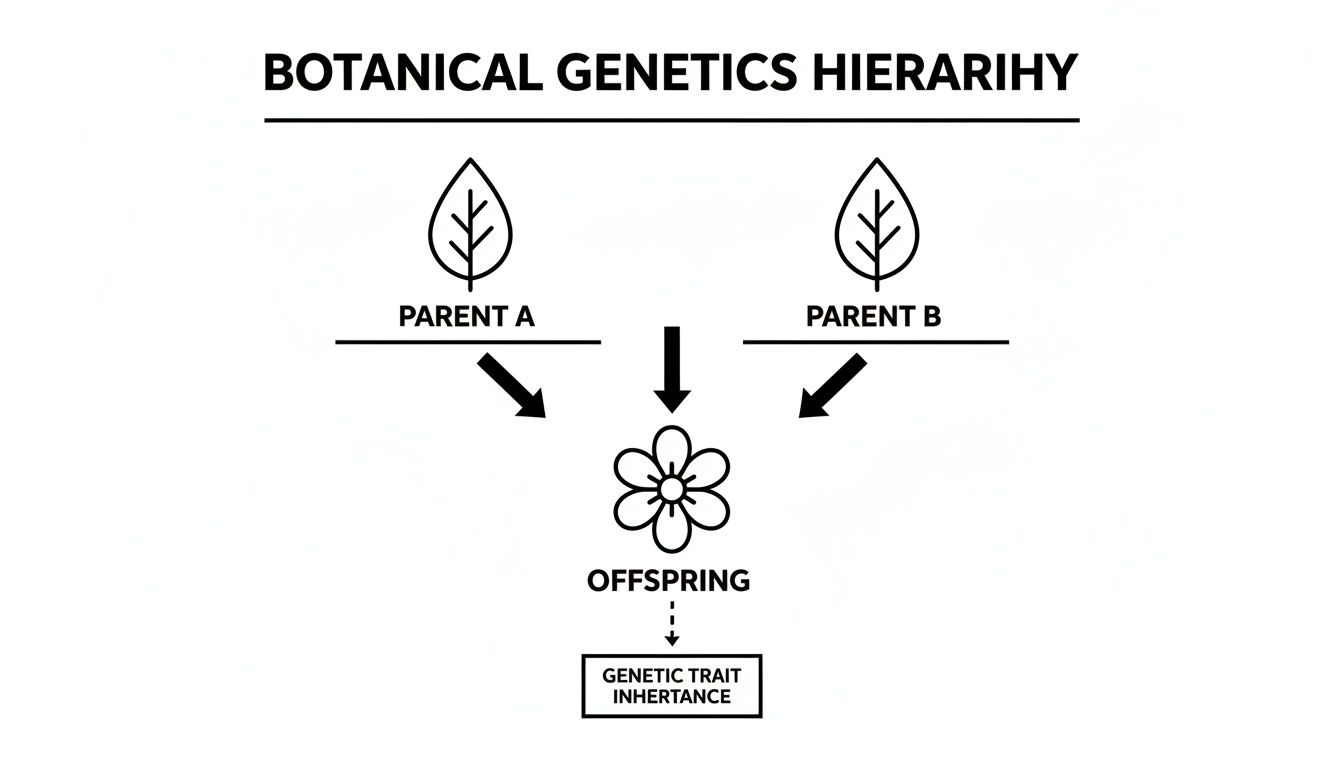
The plant’s genetics provide the blueprint. Its parentage—Juliet and Strawberry Diesel—offers a clear map of the dominant aromatic compounds required to build this profile from the ground up.
The Core Terpene Stack: Base, Middle, and Top Notes
At the heart of any effective Strawberry Shortcake formulation are three primary terpenes: Beta-Caryophyllene, Myrcene, and Limonene. Achieving the correct ratio between these three is the most critical first step.
- Beta-Caryophyllene (Base Note): This is the spicy, peppery anchor of the entire profile. It provides a warm, heavy foundation that prevents the flavor from becoming overly sweet or synthetic, adding a subtle gassy kick that grounds the formulation.
- Myrcene (Middle Note): Myrcene acts as the bridge between the spicy base and bright top notes. It introduces an earthy, musky fruitiness that adds body and contributes to the creamy mouthfeel associated with the "shortcake" element.
- Limonene (Top Note): This delivers the initial burst of sweet, citrusy fruit. However, its concentration must be carefully controlled. An excess of Limonene will shift the profile toward a synthetic, candy-like flavor that lacks sophistication.
A common formulation error is over-relying on Limonene to achieve the "strawberry" note. The authentic character of Strawberry Shortcake emerges from the interplay between Caryophyllene's spice, Myrcene's earthy body, and a controlled amount of Limonene's brightness.
The Role of Minor Terpenes in Achieving Authenticity
If the primary trio provides the structure, minor terpenes add character and nuance. These compounds are used in much smaller concentrations but are essential for filling aromatic gaps and creating a premium sensory experience.
For example, a small inclusion of Linalool can introduce a soft, floral hint that enhances the profile's creaminess. A touch of Pinene can cut through the sweetness with a whisper of fresh pine, preventing the profile from feeling heavy or cloying. These deliberate, minor additions are what distinguish a generic flavor from a true strawberry shortcake strain-inspired terpene blend.
This table illustrates how these components function within a well-balanced blend.
Terpene Breakdown for a Strawberry Shortcake Strain-Inspired Blend
| Terpene | Aromatic Profile | Role (Note) | Typical % in Profile |
|---|---|---|---|
| Beta-Caryophyllene | Spicy, peppery, woody | Base | 25% – 35% |
| Myrcene | Earthy, musky, fruity | Middle | 15% – 25% |
| Limonene | Sweet citrus, fruity | Top | 10% – 20% |
| Linalool | Floral, soft lavender | Accent | 5% – 10% |
| Humulene | Hoppy, earthy, woody | Middle | 5% – 10% |
| Pinene | Fresh pine, sharp | Accent | 3% – 7% |
Mastering these ratios is key to successful replication. For a complete guide on how different terpenes translate to specific flavors, our terpene flavor chart is an essential technical resource for moving beyond recipes to true product innovation.
Formulating with a Strawberry Shortcake Profile for Vape Cartridges
With the terpene profile deconstructed, the next stage is execution. This section covers the practical application of the blend, focusing on dialing in ratios and viscosity for vape cartridges and distillates.
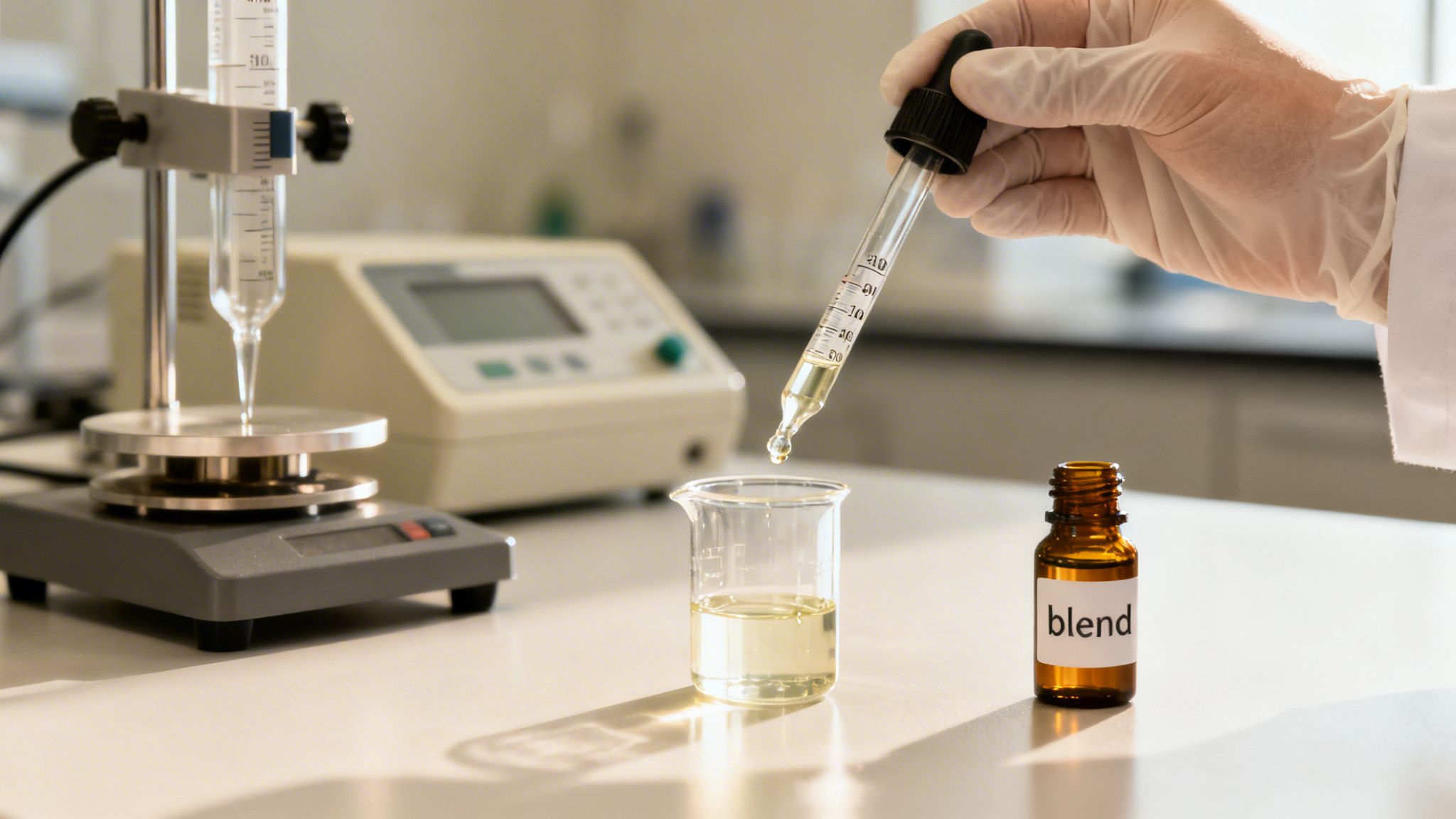
The primary objectives are twofold: first, to infuse a pure, highly refined distillate with an authentic flavor and aroma; second, to achieve the ideal viscosity for modern vape hardware without compromising the quality of the base oil.
Dialing In Mixing Ratios for Distillate
The concentration of your terpene blend is one of the most critical variables. Insufficient concentration results in a weak, unremarkable flavor. Excessive concentration leads to a harsh, unpleasant end-product.
For most distillate bases (THC, CBD, or other isolated cannabinoids), a 5% to 7% terpene concentration by weight is an effective starting point. This range typically achieves the desired flavor intensity while thinning the oil sufficiently for smooth vaporization.
For a more flavor-forward product, this ratio can be increased to 10%. However, concentrations above this level often yield diminishing returns and may introduce a sharp, biting sensation upon inhalation.
Best practice is to start with small test batches. Prepare samples at 5%, 7%, and 9%. Allow them to fully homogenize before evaluating flavor, aroma, and viscosity. This methodical approach prevents material waste and helps pinpoint the optimal ratio for your specific cannabinoid base and hardware.
Achieving Target Viscosity Without Cutting Agents
Market demand is shifting toward clean-label products. Consumers are actively avoiding formulations containing diluents like Vegetable Glycerin (VG), Propylene Glycol (PG), or MCT oil. Formulators must achieve ideal viscosity using only compliant ingredients, and terpenes are uniquely suited for this role.
As natural solvents, terpenes are highly effective at reducing the viscosity of thick distillates. By adjusting the terpene percentage, you can achieve a smooth, consistent flow without introducing undesirable cutting agents.
- For Thicker Oils: Begin testing near the 7-8% range to ensure proper wicking in ceramic or wick-based cartridges.
- For Thinner Bases: A lower concentration, around 5-6%, will likely suffice to hit target viscosity while maintaining robust flavor.
This method not only produces a cleaner product label but also preserves the natural synergy between cannabinoids and terpenes. Our guide on how to use terpenes in your formulations offers more detailed techniques for viscosity management.
Purity and Safety: A Non-Negotiable Requirement
The final and most critical component of replicating the flavor of Strawberry Shortcake for vape cartridges is ensuring the absolute purity of your ingredients. The quality of your final product is dictated by the quality of your raw materials.
Using unverified, low-grade terpenes introduces significant risk, including batch-to-batch flavor inconsistency and the potential for harmful contaminants like residual solvents or heavy metals. Partnering with a supplier that provides third-party lab reports for high-purity terpenes is essential for protecting your brand and ensuring consumer safety.
A true, premium strain-inspired terpene blend should contain no additives, diluents, or impurities. This commitment to quality is what transforms a known formula into a flawless, market-ready product.
Advanced Flavor Replication Techniques for Cannabis Product Formulation
Achieving the primary notes is the baseline. To differentiate a product, one must replicate the subtleties that define the Strawberry Shortcake terpene profile. This involves moving beyond primary terpenes to fine-tune with trace compounds and optimize for specific hardware.
The art of formulation lies not in simply mimicking the main flavor, but in constructing a complete sensory experience by layering minor notes that add depth and complexity.
Capturing Creamy and Baked Undertones
The "shortcake" element is the most challenging to replicate. It requires a delicate balance of creamy, sweet, and slightly baked notes that cannot be achieved with standard terpenes alone.
To accomplish this, experienced formulators utilize specific esters and other rare isolates. Esters are critical for creating authentic fruit aromas. For a Strawberry Shortcake blend, a trace inclusion of an ester like ethyl butyrate can shift the strawberry note from fresh to a richer, jam-like profile.
For the warm, baked-goods characteristic, a whisper of vanillin or a similar compound can build the necessary creamy foundation. The key is restraint; these are accent notes designed to support, not overpower, the primary terpenes.
An exceptional formulation is analogous to a well-composed piece of music. The major terpenes form the melody, while minor isolates and esters provide the harmony and texture that make the final product memorable.
Mimicking the Complex Gassy Background Aroma
Beyond the sweet and creamy notes, an authentic Strawberry Shortcake profile has a subtle gassy finish inherited from its Strawberry Diesel parentage. Base and middle notes, especially Beta-Caryophyllene and Humulene, perform the heavy lifting here.
To add another layer of authenticity, a trace amount of an isolate like Guaiol can introduce a smoky, woody edge that complements the spice of Caryophyllene. This subtle addition creates the desired gassy finish without dominating the profile. These small adjustments prevent the flavor from feeling one-dimensional.
This unique profile makes Strawberry Shortcake a valuable target for formulators. Cultivars typically test between 18-22% THC, with some autoflower variants hitting 25%. CBD content is low, generally 0.32-2%. The Dark Horse Genetics version (a sativa-leaning cross of Juliet and Strawberry Diesel) is known for its market appeal. For a deeper dive, review the complete breakdown of the Strawberry Shortcake strain to further inform your product development.
Adjusting Formulations for Different Hardware
A formulation's sensory output will vary depending on the vaporization hardware. The coils and heating technology in a vape cartridge can dramatically alter flavor expression.
Ceramic Coils: These heat at lower, more stable temperatures, which is ideal for preserving delicate top notes and subtle esters. This allows the full complexity of a well-crafted Strawberry Shortcake blend to be perceived.
Wick-Based Cartridges: Older wick-and-coil systems can operate at higher temperatures. This can volatilize lighter top notes while accentuating spicier base notes like Caryophyllene.
Formulations must compensate for this. For wick cartridges, one might slightly increase the percentage of Limonene or other bright top notes. For ceramic systems, the focus can remain on perfecting the balance of creamy mid-notes, confident they will be vaporized correctly. This hardware-specific tuning is a hallmark of top-tier product development.
Sourcing and Verifying Terpenes for Formulation
A meticulously designed formulation is rendered useless by low-quality input materials. Sourcing pure, verified terpenes is the absolute foundation for creating a safe, compliant, and reliable product. The quality of your final product is directly tied to the quality of your raw materials.

When developing a strain-inspired terpene blend like Strawberry Shortcake, supply chain integrity is paramount. It is the only way to guarantee both flavor accuracy and consumer safety. This requires partnering with a supplier who provides complete transparency for every batch.
Decoding the Certificate of Analysis
A Certificate of Analysis (CoA) is the critical verification document from a supplier. It is not enough to simply have one; one must know how to interpret it to protect the brand.
A legitimate CoA from an accredited third-party lab will always include:
- Purity Confirmation: This section details the blend's concentration, confirming it is not diluted with unlisted fillers. Look for purity levels of 99% or higher.
- Contaminant Screening: This is non-negotiable for safety. The panel must show a clean slate for heavy metals (lead, arsenic, mercury), residual solvents, and pesticides.
- Cannabinoid-Free Verification: For compliance and product consistency, the CoA must certify that the blend is 100% THC-free.
Never accept a supplier’s in-house CoA as final proof. Always demand a report from an independent, ISO-accredited laboratory. This third-party validation ensures the results are unbiased and accurate.
The Critical Need for Supplier Consistency
A single high-quality batch is insufficient for scalable production. Batch-to-batch consistency is what enables a brand to grow. Inconsistent terpene profiles from a supplier can derail flavor and damage a brand's reputation.
A reliable supplier operates with stringent quality control and standardized processes to ensure every batch is identical. The blend used in R&D must be the same as the blend used in full-scale production. This is the bedrock of a successful, scalable brand.
Our guide on where to buy terpenes provides a framework for vetting potential supply partners. Choosing the right partner protects your investment, ensures compliance, and allows you to focus on product innovation. Prioritizing transparency, purity, and consistency in sourcing builds a foundation of quality that will differentiate your brand.
Putting It All Together: Formulating Your Next Bestseller
We have deconstructed the genetics, the sensory profile, and the technical details of formulation. You now have the necessary information to build a Strawberry Shortcake product that captures the essence of the cultivar. A successful outcome depends on a methodical approach that respects the profile's complexity.
The formulation begins with a foundational base: a precise ratio of Beta-Caryophyllene, Myrcene, and Limonene to create the core spicy, earthy, and citrus-fruit structure. The defining characteristics emerge from layering in minor terpenes and trace esters to achieve the creamy, dessert-like finish.
Best Practices for Application
When formulating for vape cartridges or distillates, initial ratios are critical.
- A 5-7% concentration by weight is an effective starting point.
- Always conduct small test batches to dial in flavor and viscosity for specific hardware.
- Adhere to clean formulation principles, avoiding prohibited diluents like VG, PG, or MCT oil. A high-quality strawberry shortcake strain-inspired terpene blend provides the necessary solvent properties to achieve target consistency without additives.
The single most important decision is supplier selection. A verifiable Certificate of Analysis is the minimum requirement for ensuring purity and safety. Your brand's reputation is built on the quality of your inputs; never compromise on sourcing.
Ultimately, formulation is not just mixing ingredients; it is crafting a precise sensory experience. You now have the framework to move beyond simple replication and toward innovation. The market is receptive to a Strawberry Shortcake product that is authentic, consistent, and memorable.
Ready to begin formulation? Explore our full catalog of lab-verified, strain-specific terpene blends and isolates. It’s time to create a product that sets a new standard for this sought-after profile.
Your Strawberry Shortcake Formulation Questions, Answered
This section addresses common technical questions from formulators working with a complex profile like Strawberry Shortcake. Mastering these details is crucial for developing a superior strain-inspired terpene blend for distillate.
What Is the Ideal Starting Percentage for This Blend in THC Distillate?
For most high-potency distillates, the optimal range is between 5% and 7% terpenes by weight. This is a reliable starting point for balancing flavor and viscosity.
We recommend beginning at 5%. Mix thoroughly, allow for homogenization, and then test the result in your target hardware. From there, you can incrementally increase the concentration up to 10% for a more intense flavor profile. Exceeding 10% often leads to harshness and can over-thin the oil. Always run small test batches before committing to a full production run to determine the ideal ratio for your specific extract and cartridges.
How Can I Enhance the Creamy Note in My Formulation?
This is where advanced formulation techniques come into play. The signature creamy, dessert-like finish is achieved not by primary terpenes, but by the precise inclusion of trace amounts of specific esters and other aromatic compounds.
While our exact formulations are proprietary, this effect can be achieved by experimenting with food-grade isolates known for vanilla or cream notes. These should be used in minute quantities, typically under 0.1% of the total blend. For reference, our terpene flavor chart is an excellent resource for understanding how different isolates contribute to flavor. For a ready-to-use solution, our "Elevated Strains" line incorporates these complex layers for a perfectly balanced profile.
What Are Common Mistakes to Avoid When Replicating This Flavor?
When formulating with a Strawberry Shortcake terpene profile for vape cartridges, several common errors can compromise the final product.
The three most significant mistakes are:
Overusing Fruit Isolates: Relying too heavily on Limonene to create the "strawberry" note typically results in an artificial, candy-like flavor. The key is balancing bright top notes with the earthy, spicy foundation of Myrcene and Beta-Caryophyllene.
Inadequate Homogenization: Terpenes and cannabinoids require proper mixing. Gentle heat and thorough agitation are necessary to ensure a consistent, stable emulsion. Failure to do so can result in separation within the cartridge and inconsistent flavor delivery.
Using Unverified Ingredients: This is a critical failure point. Only work with suppliers who provide documentation proving their terpenes are pure and free of banned diluents like VG, PG, or MCT oil. If you need assistance in vetting a partner, consult our guide on where to buy terpenes.
Ready to create a Strawberry Shortcake product that stands out? At Gold Coast Terpenes, we provide the lab-verified, strain-specific terpene blends and isolates you need to formulate with confidence. Explore our full catalog and start building your next bestseller today.