
For product formulators, some strain profiles are more than just a name—they're a commercial opportunity. Strawberry Cake is one of those strains. Its unique combination of sweet berry, creamy vanilla, and a touch of earthiness isn't just popular; it's the kind of complex profile that builds loyal customers and differentiates a brand in a crowded market.
Why Formulators Focus on Replicating the Flavor of Strawberry Cake
The value of the Strawberry Cake profile lies in its complexity. It delivers a multi-layered dessert experience that presents a rewarding challenge for formulators. Achieving an accurate replication has a significant commercial payoff.
When developing vape cartridges or other infused products, nailing this profile isn't about mimicking a plant. It’s about reverse-engineering and recreating a specific sensory experience. The goal is to formulate a product that delivers a consistent "aha!" moment of satisfaction every single time. To do that, formulators must understand the primary aromatic compounds and how they function together within a blend.
The Commercial Case for Strawberry Cake Strain-Inspired Terpene Blends
Dessert flavors are a dominant and durable trend in the vape and edibles market. Consumers are consistently drawn to flavors that are comforting, familiar, and indulgent. Strawberry Cake hits the sweet spot between fresh fruit and a rich, baked dessert, making it a high-value target for product development.
The core technical challenge is balance. Over-relying on sweet aromatic isolates results in an artificial, chemical-like taste. Insufficient creaminess fails to deliver the "cake" experience consumers expect. Formulating with the Strawberry cake terpene profile for vape cartridges is a matter of mastering the delicate interplay between its aromatic compounds.
This attention to detail is what separates a high-velocity SKU from a product that sits on the shelf. By deconstructing the flavor into its core chemical components, you can develop a reliable, repeatable formulation for your products. This guide provides the technical framework to do just that, breaking down the key aromatic compounds and how to blend them into a stable, high-fidelity product.
Before diving into the specifics, a strong grasp of the underlying science is crucial. For a closer look at how these aromatics function, our guide on decoding terpene strain profiles provides essential background. Understanding these fundamentals is what enables a formulator to move from simply mixing to true innovation.
Deconstructing the Signature Strawberry Cake Flavor for Distillate
Anyone can combine "strawberry" and "cake" flavors. To authentically capture the essence of the Strawberry Cake strain in a vape cartridge, one must think like a perfumer. It’s not a simple mixture; it’s a carefully constructed sensory experience built in layers.
The key is understanding how a flavor profile unfolds—the top, mid, and base notes. Achieving the correct balance separates a forgettable product from one that tastes authentic and complex. Let's break down how these layers come together to create the signature Strawberry Cake experience.
Top Note: The Initial Sweet Strawberry Impression
The first aromatic layer is a bright, juicy burst of fresh strawberry. This is the profile's top note, designed to provide an immediate and recognizable hook. This is not the monolithic, candy-like flavor of an artificial ester; this is the nuanced sweetness of a ripe, slightly tart berry.
This initial impression comes from the most volatile terpenes and esters—the ones that flash off almost instantly, delivering the first scent. Nailing this vibrant opening is critical. It establishes the "strawberry" element before the richer, creamier mid-notes develop.
Mid-Note: The Creamy, Rich Cake Heart
Following the initial berry flash, the flavor profile settles into its core. This is where the "cake" element emerges—a warm, creamy, and rich dessert flavor that forms the heart of the profile. It’s a complex note that can evoke vanilla batter, buttercream frosting, or the subtle tang of cheesecake.
This mid-note is built from less volatile terpenes that linger longer, providing the full, mouth-coating richness that defines the strain. It’s the component that transforms the experience from a simple fruit flavor into a genuine dessert.
For formulators, this is where the artistry lies. The challenge is to suggest creaminess and baked goods without tasting artificial. You are aiming to evoke the sensation of cake, not just a generic sweet flavor.
To better navigate this, it helps to understand how different aromas connect. Our comprehensive terpene flavor chart is a valuable tool for this purpose. It provides a roadmap for selecting the right isolates to build the precise creamy, baked notes required.
Base Note: The Subtle Earthy Foundation
Finally, a subtle but essential base note provides the foundation. Beneath the sweetness lies a faint, earthy, and sometimes slightly gassy layer. This note prevents the profile from becoming cloying and provides a sophisticated, authentic finish.
This foundation is composed of the heaviest, least volatile terpenes that persist the longest. It can be likened to the scent of a golden-brown cake crust or a hint of spice. While not immediately obvious, its absence would make the entire profile feel thin and incomplete, lacking the true character of the Strawberry Cake flower.
Terpene Blueprint for Strawberry Cake Formulation
Let's transition from flavor concepts to chemical formulation. To consistently create a successful Strawberry Cake product, a reliable map of its terpene profile is necessary. This is where we replace guesswork with a repeatable, scalable formulation process. It’s not just about knowing which terpenes are present, but understanding their function and optimal concentration.
The profile is built around several key terpenes, each with a specific role. Myrcene serves as the foundation, providing a subtle fruity, musky base. Beta-Caryophyllene is crucial for the "cake" character, bringing a spicy, peppery warmth reminiscent of baked goods. Finally, Alpha-Pinene cuts through the richness with a clean pine note, preventing the profile from becoming overly sweet and adding natural brightness.
Dominant Terpenes and Their Roles in Formulation
The profile's effectiveness comes from the synergy of these key players. Myrcene lays the groundwork, Beta-Caryophyllene builds out the rich body, and Alpha-Pinene adds a clean finish. Achieving this balance is what makes the flavor feel both decadent and fresh.
Of course, the supporting isolates are just as important. Minor terpenes like Limonene and Linalool add crucial layers of complexity. Limonene contributes a pop of citrus zest that enhances the strawberry top notes, while Linalool offers a soft floral character that rounds out sharper edges. To better understand how these individual compounds function, our guide to the properties of different terpenes is an excellent resource.
This diagram illustrates how these distinct flavor layers are structured, from the initial scent to the lingering finish.
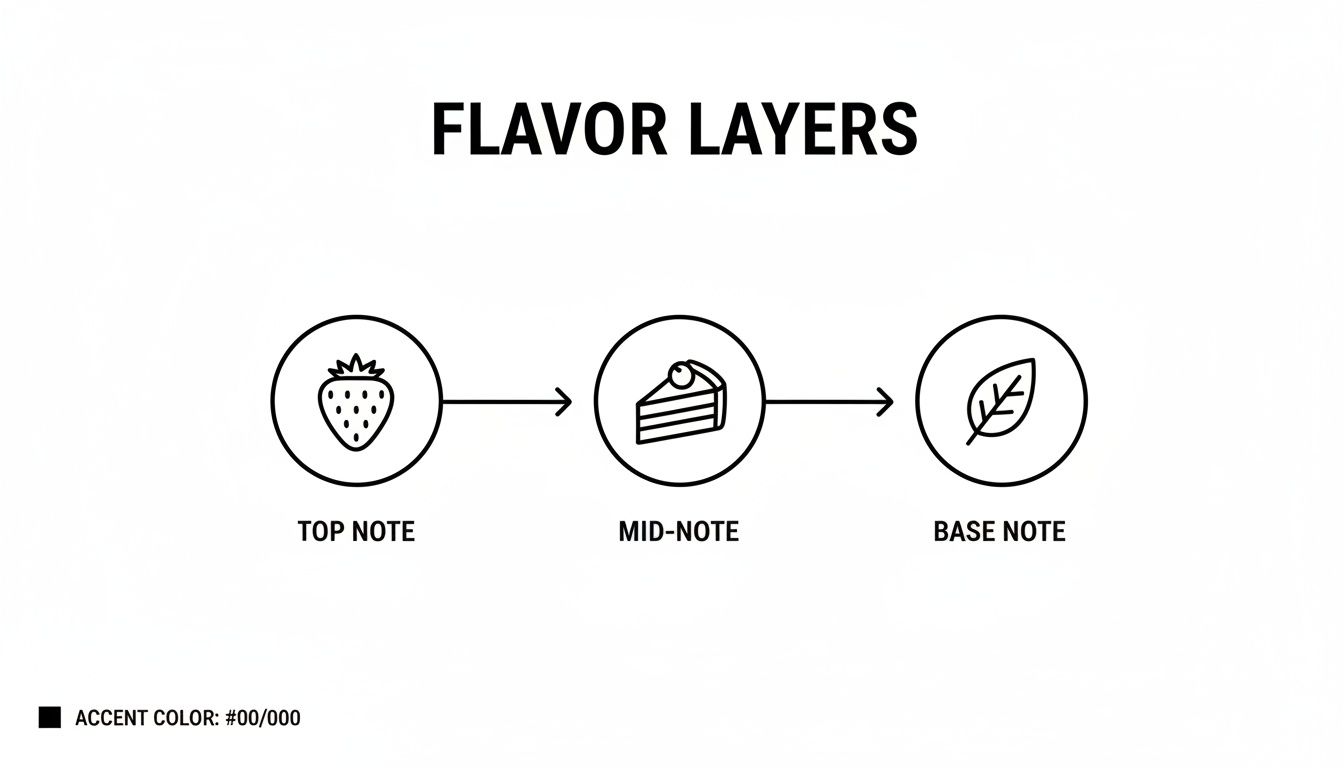
As shown, the experience begins with a bright strawberry top note, transitions into a rich and creamy cake mid-note, and is anchored by an earthy base note that provides depth.
Precise Formulation Data for Cannabis Product Formulation
To execute this in a laboratory setting, real-world data is essential. Analysis of retail batches consistently shows that the most dominant terpenes are Myrcene (often 40-50% of the total profile), β-caryophyllene, and α-pinene. This trio reliably produces the creamy, sweet berry notes that define the strain.
The table below provides the specific formulation intelligence needed to build a Strawberry Cake profile from scratch. It breaks down the primary and secondary terpenes, their typical concentrations, and their classification as a top, mid, or base note.
Terpene Profile Breakdown for Strawberry Cake Formulation
| Terpene | Typical Concentration (%) | Aroma/Flavor Contribution | Note Classification (Top/Mid/Base) |
|---|---|---|---|
| Myrcene | 40% – 50% | Musky, earthy, subtly sweet and fruity foundation | Base |
| Beta-Caryophyllene | 15% – 25% | Spicy, peppery, warm; creates the "baked goods" note | Mid |
| Alpha-Pinene | 10% – 15% | Fresh pine, herbaceous; adds brightness and cuts richness | Top/Mid |
| Limonene | 5% – 10% | Bright citrus, sweet; enhances the "strawberry" top note | Top |
| Linalool | 2% – 5% | Floral, lavender, subtly sweet; adds aromatic complexity | Top/Mid |
| Humulene | 1% – 4% | Hoppy, woody, earthy; complements the base notes | Base |
| Terpinolene | <1% | Complex medley of floral, pine, and citrus | Top |
Use this data as a starting point. Construct the baseline profile and then make incremental adjustments to the ratios to achieve the desired sensory experience. This data-driven approach provides the control and precision to consistently replicate the profile.
Formulating with the Strawberry Cake Terpene Profile for Vape Cartridges
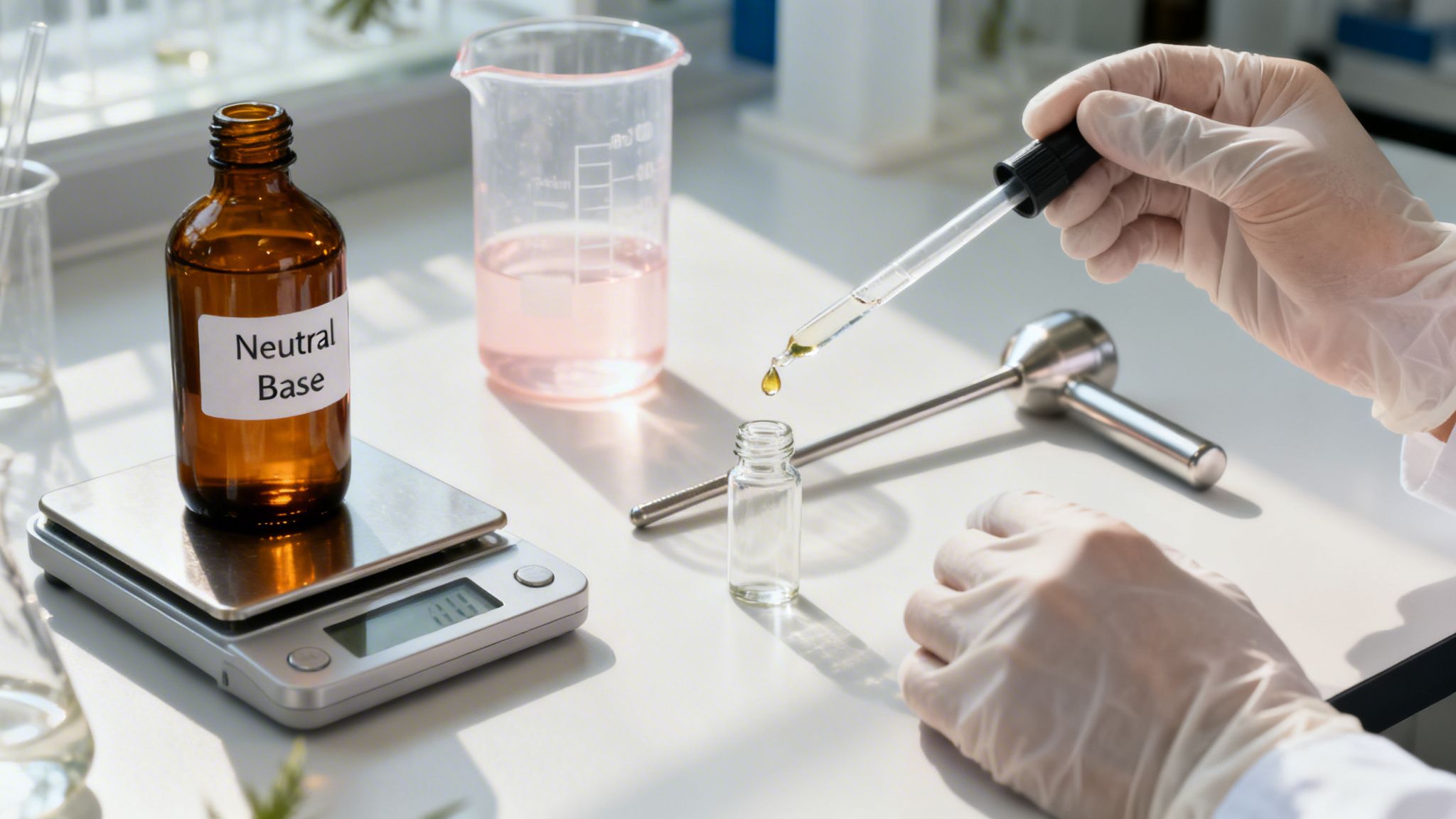
Knowing the terpene profile is one thing; translating it into a finished vape cartridge is the true craft. This is where we move from lab report to production floor. To successfully replicate the Strawberry Cake experience, precision, high-quality ingredients, and a robust mixing protocol are required for batch-to-batch consistency.
Here, we'll outline the exact protocol for formulating with complex profiles like Strawberry Cake. This covers everything from selecting the appropriate distillate to the fine points of heating and mixing that ensure a high-quality outcome. The goal is to provide a reliable method that delivers flavor fidelity every time.
Selecting Your Base Distillate
The quality of the final product is entirely dependent on the starting material. For a flavor-forward profile like Strawberry Cake, a clean, neutral base that does not interfere with delicate dessert notes is non-negotiable. A high-purity, winterized, and fully deodorized cannabis or hemp distillate is the only viable option.
Source a distillate that is:
- High Potency: Target a cannabinoid content above 85%. A purer base minimizes the potential for off-notes.
- Neutral Flavor: The distillate itself should be as tasteless as possible. Any residual plant-like or earthy notes will clash with the sweet, creamy profile.
- Visually Clear: A clean, light golden color typically indicates proper refinement and freedom from impurities.
Consider your distillate a blank canvas. For a complex profile like Strawberry Cake, you need a perfectly primed surface. A premium base allows the terpenes to express fully, ensuring the final product tastes like a rich dessert, not a muddled compromise.
Calculating the Ideal Terpene Ratio for Distillate
Determining the optimal terpene concentration is a balancing act. Too low, and the flavor will be weak and underwhelming. Too high, and the vape will be harsh and overpowering. For a rich, layered profile like Strawberry Cake, finding this sweet spot is critical.
We recommend starting with a terpene concentration between 5% and 7% by weight. This range is the optimal zone—strong enough to deliver a full, authentic flavor but not so high as to over-thin the oil or create a harsh sensory experience.
Begin test batches at 5%. Evaluate the flavor and sensation. If more intensity is needed, incrementally increase the ratio toward 7%. We strongly advise against exceeding 10%, as this is almost always counterproductive. The flavor can become perfumey and you risk long-term stability issues.
For a deeper dive into the science and math of dilution, our guide on how to use terpenes in your formulations is a valuable resource for best practices across different product matrices.
The Mixing and Homogenization Process
With your distillate and terpenes ready, the most critical step is mixing. This is where consistency is achieved or lost. Terpenes are volatile; excessive heat will degrade the aromatic compounds. A gentle, controlled approach is essential.
Follow this process for consistent, repeatable results:
- Gentle Pre-Heating: Warm the distillate to reduce viscosity. Target a temperature between 100–150°F (38–65°C) using a hot plate with a magnetic stirrer. Never use direct, high heat.
- Measure by Weight: This is non-negotiable. Always use a calibrated scale to measure both distillate and terpenes by weight. Volumetric measurement is too inaccurate and leads to batch inconsistency.
- Combine and Mix: Add the precisely measured terpenes to the warm distillate. Immediately begin mixing with a magnetic stirrer on a low-to-medium speed to create a gentle vortex.
- Ensure Full Homogenization: Stir for at least 15-20 minutes. Do not rush this step. This ensures complete and even distribution of terpenes, preventing "hot spots" (inconsistent flavor between carts) and future separation.
- Cool and Settle: After homogenization, remove the mixture from the heat. Allow it to cool and settle for several minutes before filling cartridges. This allows any trapped air bubbles to escape.
Adhering to this methodical process ensures you can confidently translate the terpene blueprint into a premium, market-ready Strawberry Cake vape cartridge that delivers consistent flavor.
Innovating on the Strawberry Cake Profile for New SKUs
Once you’ve mastered the classic Strawberry Cake blend, you have a solid foundation. But this is just the starting point. True innovation begins when you start iterating on that profile to create signature SKUs that are unique to your brand.
This is where deep knowledge of terpene isolates becomes a competitive advantage. By skillfully tweaking the ratios of key isolates, you can guide the profile in entirely new directions. Consider the classic Strawberry Cake a versatile base for creative product development.
Leaning into the "Cheesecake" Note
A popular and highly effective modification is to amplify the creamy, tangy notes to create a distinct "strawberry cheesecake" profile. This small change transforms the profile from a light, airy cake to a rich, decadent dessert.
The key isolate here is Beta-Caryophyllene. It already provides the warm, "baked goods" character. By increasing its proportion, you enhance that spicy, full-bodied note.
- Your Move: Gently increase the Beta-Caryophyllene concentration by 10-15% relative to its original level in your formulation.
- The Payoff: This pushes the mid-note forward, building a creamier body with a peppery kick analogous to a cheesecake's crust and rich filling.
- A Word of Caution: A little goes a long way. Overdoing it can make the profile overly spicy and obscure the delicate berry top notes. Make adjustments in small, controlled increments.
Dialing up a single isolate like this is how you create a defensible flavor variation. It’s still instantly recognizable as Strawberry Cake, but it has a unique signature that gives your product a clear, marketable edge.
Crafting a "Fresh Strawberry" Variant
Another viable option is to emphasize the fruit-forward aspect of the profile. This creates a "fresh-picked strawberry" or "strawberry jam" character by dialing back the heavier base notes and allowing the bright, sweet berry to dominate.
For this modification, Limonene is the primary tool. It’s a minor component in the classic blend, but boosting it will brighten the entire experience. To give it the necessary aromatic space, you'll need to slightly reduce the earthier base notes.
- Your Move: Increase Limonene by 20-30% from its baseline. Concurrently, reduce the foundational Myrcene by approximately 5-10%.
- The Payoff: The strawberry note becomes sharper and juicier, popping at the forefront and evoking fresh fruit rather than a baked dessert.
- Best Use Case: This variation is ideal for products targeting consumers who prefer vibrant, direct fruit flavors over more complex dessert profiles.
To begin experimentation, our complete catalog of botanical terpene isolates provides all the high-purity building blocks required.
Troubleshooting Common Formulation Problems
During customization, common issues may arise. Knowing how to diagnose and correct them will save significant time and resources.
The Problem: The Profile Tastes "Perfumey" or Soapy
- What's Happening: This is almost always caused by an excess of Linalool. A touch adds a pleasant floral hint, but too much can impart a soapy off-flavor.
- The Fix: Immediately reduce the Linalool. A good starting point is to cut its concentration in half, then reintroduce it in small increments until the desired balance is achieved.
The Problem: The Flavor Feels "Flat" or One-Dimensional
- What's Happening: The profile lacks depth and layering. This typically occurs when base and mid-notes (Myrcene and Beta-Caryophyllene) overpower the more delicate top notes.
- The Fix: Rebalance the formulation. Slightly decrease the base and mid-notes to allow top-note contributors like Alpha-Pinene and Limonene to express more clearly. This will restore layered complexity and prevent the flavor from feeling muddy.
Once you master these adjustments, you are no longer just replicating a single flavor. You are using the Strawberry Cake strain profile as a creative platform for an entire line of distinct products.
Sourcing and Stability for Commercial Production
Your formulation is only as good as its constituent raw materials. In commercial production, a perfect recipe is meaningless if your ingredients are inconsistent or degrade prior to use. Sourcing and handling terpenes correctly is the backbone of a reliable manufacturing operation.
Your ability to deliver an authentic Strawberry Cake experience, batch after batch, rests entirely on the quality and consistency of your terpenes. Working with a supplier who provides lab-verified, botanically derived blends is the only way to guarantee safety, meet compliance standards, and deliver the consistency consumers expect. Anything less introduces unacceptable risk to your product and brand reputation.
Protecting Your Investment Through Proper Storage
Terpenes are highly volatile. This is both their strength and their greatest vulnerability. Improper storage is one of the most common and costly mistakes in product formulation. Exposure to the wrong elements will quickly degrade the complex flavor profile you've invested in.
Three main culprits will sabotage your terpenes:
- Light: UV rays are notorious for breaking down delicate aromatic molecules, which can completely alter the flavor.
- Heat: High temperatures cause the most volatile top notes to evaporate, resulting in a flat or even burnt-tasting profile.
- Oxygen: Oxidation can cause terpenes to develop harsh, unpleasant off-flavors that are impossible to mask.
Treat your terpene blend like a premium culinary ingredient. A chef wouldn't leave fresh basil on a hot stove, and a sommelier wouldn't store vintage wine by a sunny window. Your terpenes require the same level of care.
Strawberry Cake, originally bred by Heavyweight Seeds, became a sensation for its remarkably consistent flavor. After its introduction to the North American market around 2015, it quickly became a staple. You can read more about its journey and genetics in this detailed strain guide. Preserving that famous profile comes down to proper handling of the raw ingredients.
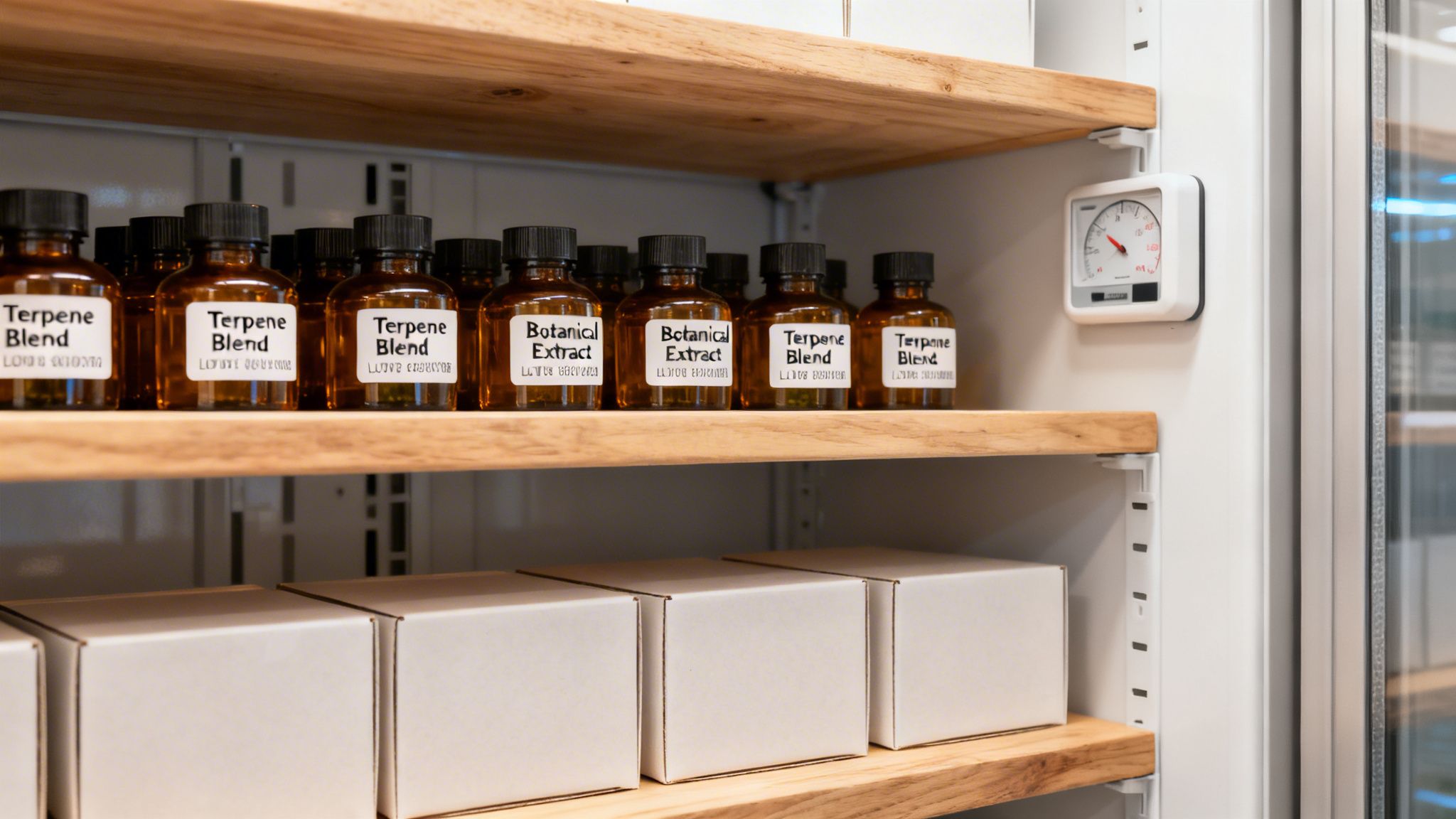
To maintain flavor integrity, always store terpenes in airtight, amber glass containers in a cool, dark place. This simple protocol ensures that the Strawberry Cake profile in your first batch is identical to the one in your last. It is the key to protecting your investment and your brand's reputation.
To see our full range of professionally crafted and tested profiles, view our complete list of strain-specific terpene blends.
Common Formulation Questions Answered
When dialing in a new flavor, especially a complex dessert profile like Strawberry Cake, several questions consistently arise. Addressing them correctly from the outset can prevent wasted material and ensure batch-to-batch consistency.
Here are the straightforward answers to the questions we are most frequently asked by formulators.
What's the Best Starting Terpene Percentage for Distillate?
For vape cartridges, the optimal range is almost always between 5% and 7% terpenes by weight. This concentration delivers an authentic, rich Strawberry Cake flavor without harshness or excessive viscosity reduction.
Our recommendation is to always begin test batches at the low end of the range. A 5% concentration is the perfect starting point. From there, you can evaluate the flavor and incrementally increase the ratio if more intensity is desired. We do not recommend exceeding 10%, as it rarely improves flavor and can introduce perfumey off-notes and stability issues.
How Do I Fix Inconsistent Flavor Between Batches?
Flavor inconsistency almost always points to one of two variables: your terpene source or your mixing procedure. First, ensure you are sourcing your terpenes from a single, reliable supplier who provides consistent, lab-verified blends. This guarantees your starting ingredients are identical for every batch.
Second, you must standardize your mixing process with a formal Standard Operating Procedure (SOP).
- Measure by Weight: Always. Never by volume. A calibrated scale is mandatory for accuracy.
- Standardize Temperature: Heat degrades terpenes. Be gentle and consistent. We find maintaining the mixture between 100-150°F (38-65°C) is optimal.
- Uniform Mixing: Homogenize for the same duration, every time. This ensures complete and even distribution.
Can This Profile Be Used in Other Cannabis Product Formulations?
Absolutely. While the Strawberry Cake profile is exceptionally well-suited for vapes, it is also highly versatile. Its sweet, creamy notes perform well in edibles like gummies and chocolates, where the flavor can be the main feature.
It can also be used to flavor concentrates. However, a much lower ratio of 1-3% is required. The key is to adjust your percentage based on the product matrix and desired flavor intensity.
Ready to create a standout Strawberry Cake product? Gold Coast Terpenes offers the lab-verified, botanically derived Strawberry Cake strain-inspired terpene blend you need for consistent, delicious results.