
The aroma of Sour Diesel is unmistakable. That sharp, gassy profile, cut with a twist of sour citrus, is a legend for a reason. But for product formulators, that iconic scent isn't just about nostalgia—it's a powerful tool for developing energizing and instantly recognizable vape cartridges, concentrates, and other infused products.
The Blueprint for Formulating with the Sour Diesel Terpene Profile
For formulators, certain strain profiles represent commercial gold. Sour Diesel is at the top of that list. Moving beyond basic strain descriptions, this profile is a foundation for building consistent, best-selling products. Its famous blend of pungent diesel, zesty citrus, and rich earthiness has set the standard for what consumers expect from an "Uplifting" or "Sativa-like" product experience for decades.
Nailing a Sour Diesel formulation is an exercise in consistency. The challenge is to capture that legendary character in a way that's stable, reliable, and true to the original, batch after batch. This isn't guesswork; it’s about translating its sensory profile into a solid, scientific component for your vape cartridges and distillates. Precision here is how you build brand loyalty.
For formulators new to the intricacies of cannabis science, understanding plant basics can provide context. If a refresher is needed, our guide on male vs. female plant characteristics is a useful resource.
The Commercial Power of a Classic Profile
The chemistry behind the Sour Diesel terpene profile is a perfect lesson in aromatic synergy. The profile is driven by a handful of key terpenes that work together to create that signature fuel-and-citrus punch. This combination was so groundbreaking when it first appeared in the 1990s that it became a cornerstone for countless modern hybrids.
It's no surprise that lab analyses consistently show this profile has become one of the top five most replicated strain profiles in the global market. That pungent, diesel-forward scent, rounded out by citrus and earth, is precisely what many consumers seek.
When a customer sees 'Sour Diesel' on a product label, they have a very specific expectation for taste and aroma. The formulator's job is to hit that target precisely, every single time. This is how a popular profile is transformed into a flagship product.
Deconstructing the Sensory Experience for Formulation
To master formulating with Sour Diesel terpenes, one must think like a perfumer or flavor chemist. It's beneficial to break the profile down into its core sensory notes and link them directly to the objectives for the final product. This targeted approach is far more effective than simply adding a generic blend.
Here's a look at how we deconstruct the Sour Diesel experience, connecting each aromatic layer to a specific formulation goal.
Sour Diesel Sensory Blueprint for Formulation
This table breaks down the essential aromatic components of the Sour Diesel profile, serving as a guide for achieving the right notes in your formulations.
| Sensory Note | Aromatic Description | Associated Terpenes | Formulation Goal |
|---|---|---|---|
| Pungent Fuel | Sharp, gassy, almost chemical-like aroma reminiscent of diesel. | Myrcene, Caryophyllene | Create a powerful, recognizable, and potent-smelling base for the blend. |
| Sour Citrus | Bright, zesty notes of lemon and lime that cut through the heaviness. | Limonene, Beta-Pinene | Add an uplifting, energizing top note that defines the "sour" character. |
| Earthy Musk | Deep, grounding notes of damp soil and skunky undertones. | Myrcene | Provide complexity and depth, anchoring the more volatile top notes. |
By understanding how these individual notes work together, you can move from simply mimicking a profile to truly engineering a sensory experience. The objective is to balance the aggressive fuel notes with bright citrus and grounding earthiness to create that classic, multi-layered Sour Diesel aroma.
Deconstructing the Core Terpene Ratios for Cannabis Product Formulation
Achieving the classic Sour Diesel aroma is a matter of understanding the specific terpenes that define its structure. The iconic profile is built like a pyramid, with each terpene acting as a distinct top, middle, or base note. For formulators, mastering this structure is key to creating an authentic and reproducible profile.
The experience begins with a powerful, gassy foundation. This comes from Caryophyllene, the terpene responsible for the spicy, peppery, and fuel-heavy notes for which Sour Diesel is famous. It acts as the base note; without a strong caryophyllene foundation, the entire profile can lack its signature diesel punch.
The Aromatic Mid-Notes
Once the gassy base is established, the earthy, musky mid-notes from Myrcene are layered in. While myrcene contributes its own fuel-like scent, its primary role here is to add depth and a grounding, herbal quality. It acts as the bridge between the heavy diesel base and the bright citrus top, preventing the final blend from feeling one-dimensional. This is where the classic "skunky" undertone originates—an essential component for any true-to-strain Sour Diesel formulation.
The final touch—and arguably the most recognizable part—is the sharp, zesty top note. This is where Limonene shines, delivering the bright, sour citrus explosion that gives the profile its name. As a highly volatile terpene, it's the first aroma detected but also the first to dissipate. An effective formulation balances the limonene perfectly, making it strong enough to cut through the diesel without overpowering the complex layers underneath.
This chart illustrates how the three main aroma categories—fuel, citrus, and earth—combine to create the complete Sour Diesel experience.
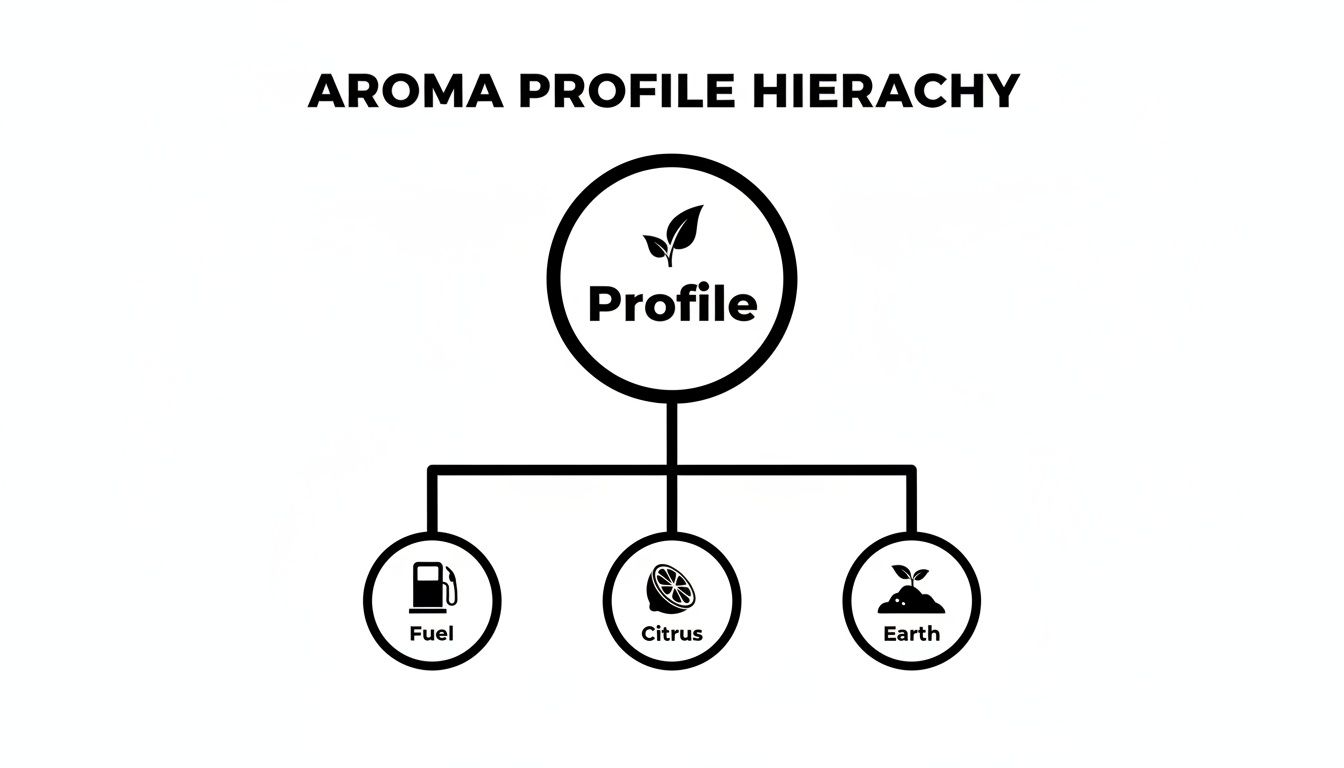
Although the fuel notes are dominant, the citrus and earthy elements are critical for achieving a well-rounded, instantly recognizable scent.
Building Your Flavor Pyramid
To effectively work with sour diesel terpenes, one must think like a perfumer building a scent profile. The ratios are everything. Even minor adjustments can swing the final experience from an aggressive gas-heavy blend to a bright, citrus-forward aroma.
The table below breaks down the key players in the Sour Diesel profile, their typical concentrations, and their functional role in the overall aroma.
Sour Diesel Terpene Profile Composition and Function
This table outlines the primary terpenes in the Sour Diesel profile, their typical percentage ranges, and their functional role in the blend's aroma.
| Terpene | Typical Percentage Range | Aromatic Contribution | Note Classification (Top/Mid/Base) |
|---|---|---|---|
| Myrcene | 20% – 25% | Earthy, musky, fuel-like undertones | Middle Note |
| Limonene | 12% – 15% | Sharp, sour citrus, zesty lemon-lime | Top Note |
| Caryophyllene | 8% – 10% | Spicy, peppery, pungent diesel fuel | Base Note |
This specific combination of terpenes has a massive commercial footprint. With North America expected to lead the market into 2026, terpene-infused products are more popular than ever. In the vape sector, blends that lean on the synergy between limonene and myrcene often dominate.
For both brands and formulators, a 7% dilution rate in distillate is an excellent starting point. This concentration is typically high enough to deliver a powerful, authentic aroma while preserving the integrity of the blend. For additional insights on terpene performance in product formulation on massterpenes.com, their product page offers useful data.
When formulating, always build from the base up. Establish your Caryophyllene base first, then build on it with Myrcene. Add the highly volatile Limonene last. This layered method provides stability and depth, ensuring the bright top notes don't flash off and disappear prematurely.
Sour Diesel Terpenes for Vape Cartridges: A Formulation Guide

This is where theory is put into practice. The principles of terpene ratios are meaningless until successfully applied in a lab setting. Incorporating sour diesel terpenes into a vape formula is a game of precision. Proper usage rates, compatibility, and mixing techniques will yield a cartridge that is smooth, potent, and packed with consistent flavor.
The first critical parameter is the usage rate. The optimal concentration depends on the base material—be it a thick winterized oil, a thinner distillate like delta-8, or cannabinoid isolates. An incorrect ratio can result in a vape that is either overly harsh or lacks sufficient flavor.
Determining the Optimal Usage Rate
For most distillates, a starting point between 5% to 7% terpenes by weight is recommended. This range typically provides a powerful flavor without making the vapor too thin or uncomfortable. However, this should be treated as a guideline, not an absolute rule.
Formulator's Tip: Always start at the low end of the recommended range, around 5%. It is far easier to add more terpenes to an under-flavored batch than to salvage one that has been over-infused and tastes chemical.
From this starting point, make small, incremental adjustments. If a 5% mix tastes muted, conduct a small test batch at 6%. If the diesel kick is still lacking, increase to 7%. The key is to document every adjustment and sensory test to develop a reliable recipe for your specific base oil.
Homogenization and Stability Best Practices
Achieving a perfectly stable and uniform mixture is critical for a top-shelf product. Unevenly mixed terpenes create "hot spots" of flavor, leading to inconsistent hits, harshness, and potential issues with vape hardware.
Temperature Control: Gently warm the distillate to reduce its viscosity. A temperature of 115-120°F (46-49°C) is generally ideal—warm enough for easy mixing but not so hot that volatile top notes like Limonene are degraded.
Mixing Method: A magnetic stirrer set to a low or medium speed is the preferred tool. Add the sour diesel terpenes slowly while the stirrer is active to ensure even distribution from the outset.
Mixing Time: Mix for at least 15-20 minutes. Larger batches may require a longer mixing time to ensure full homogenization. After mixing, allow the blend to rest before filling cartridges to let any entrapped air bubbles escape.
When mixed and stored correctly, a terpene-infused distillate will maintain its flavor and stability for months. Understanding consumer expectations is also part of the formulation process; you can dive into common questions surrounding Sour Diesel's indica or sativa categorization to better inform product marketing.
Troubleshooting Common Formulation Issues
Even experienced formulators encounter challenges. The key is to identify the issue and implement a solution quickly.
1. Muted or Weak Flavor
- Problem: The signature gassy, citrusy punch is weak or absent.
- Solution: The terpene percentage is likely too low. Increase the concentration by 0.5% to 1% in a new test batch. Also, verify your mixing temperatures—excessive heat can boil off the target aromatic compounds.
2. Harsh or Chemical Taste
- Problem: The product causes throat irritation or has an artificial taste.
- Solution: This is a classic sign of over-infusion. The batch must be diluted with more unflavored distillate to bring the concentration back down into the ideal 5-7% range.
3. Leaking or Overly Thin Cartridge
- Problem: The oil is too fluid and is seeping from the cartridge hardware.
- Solution: Terpenes act as natural solvents, reducing the viscosity of the oil. Adding too much, especially to an already thin distillate, will cause leaks. Reduce the total terpene percentage. It may also be necessary to test different hardware, such as cartridges with smaller intake holes designed for thinner oils.
Mastering these fundamental steps enables the consistent creation of a high-quality Sour Diesel vape cartridge that accurately captures the strain’s iconic profile.
Advanced Formulation: Customizing a Sour Diesel Strain-Inspired Terpene Blend
Replicating the classic Sour Diesel profile is a significant achievement. True innovation, however, begins when that profile is viewed not as a final product, but as a platform for creating something new. This is the opportunity to take a beloved classic and develop a signature version that differentiates a brand.
Consider our standard Sour Diesel blend as the foundation—a perfectly balanced and recognizable starting point. From here, fine-tuning minor terpenes can steer the aroma and overall experience in a new direction. This is the difference between simple replication and creative product development.
Elevating the Profile by Boosting Minor Terpenes
While Myrcene, Limonene, and Caryophyllene are the dominant terpenes in Sour Diesel, customization lies in the supporting cast. Making small, precise adjustments to less dominant terpenes can radically shift the final experience without losing the core character of Sour Diesel.
For a Crisper, Pine-Forward Finish: Increase the Alpha-Pinene and Beta-Pinene. A small boost of 1-2% can add a sharp, clean, forest-like note that cuts through the diesel, making the entire profile feel brighter. This is an excellent way to create a "Mountain Diesel" variant for consumers who prefer earthy, natural aromas.
To Enhance Fruit Notes: Gently increase the Terpinolene. This terpene is known for its complex fruity and floral character. A slight increase can shift the profile away from sharp citrus toward something sweeter and more tropical, adding a layer of modern flair.
For a Spicier, Bolder Kick: Amplify the Beta-Caryophyllene beyond its typical level. This doubles down on the peppery, pungent fuel notes, creating an intensely "gassy" experience that connoisseurs often seek.
The goal of these adjustments is not to reinvent the profile, but to take the established excellence of Sour Diesel and create a signature version that is uniquely yours while still delivering on consumer expectations.
Blending Recipes for Product Innovation
Once comfortable with minor adjustments, more ambitious custom blends are possible. By introducing terpene isolates not typically prominent in Sour Diesel, you can design entirely new flavor concepts that stand out on a crowded shelf. These "mash-ups" are perfect for creating exciting new SKUs.
Here are a few concepts to consider. For these recipes, assume the standard Sour Diesel profile comprises approximately 90% of the final terpene blend.
1. "Sour Diesel Electric Lemonade"
- Concept: A hyper-bright, zesty, and intensely sour experience.
- Method: Boost the existing Limonene by another 5-7% and introduce Citral at 2-3%.
- Result: Citral adds a powerful, candy-like lemon kick that turbocharges the profile's natural citrus notes. To learn more about working with this potent isolate, explore our complete guide to D-Limonene. This blend is ideal for a summer product launch or a vape line focused on vibrant fruit flavors.
2. "Tropical Diesel Haze"
- Concept: A fusion of the classic gassy punch with exotic, fruity notes.
- Method: Add Ocimene at 3-4% and a touch of Valencene at 1-2%.
- Result: Ocimene brings a sweet, herbaceous, almost mango-like scent, while Valencene provides a distinct sweet orange and grapefruit character. This blend transforms the sharp diesel into something smoother and more fruit-forward.
3. "Mint-Infused Diesel"
- Concept: A cool, refreshing spin on the pungent classic.
- Method: Carefully add L-Menthol or Menthone isolate at a very low concentration, starting around 0.5-1%.
- Result: This creates an immediate cooling sensation that complements the warm, spicy notes from Caryophyllene. It's an unexpected combination that can carve out its own market niche.
These are just starting points. The possibilities are endless when you stop seeing sour diesel terpenes as a fixed recipe and start seeing them as a versatile ingredient for innovation.
Quality Control for Replicating the Flavor of Sour Diesel
Developing a great formula is one thing; recreating it perfectly, batch after batch, is where professional standards are set. A brand's reputation depends on its quality control, especially with a profile as well-known as Sour Diesel. Consumers have clear expectations for its taste and aroma and will notice any inconsistencies.
It all starts with sourcing. Before mixing, it is imperative to source lab-verified, carrier-free terpenes. Any profile cut with VG, PG, or MCT oil is unsuitable for professional formulation. These diluents can compromise stability, introduce off-flavors, and raise safety concerns, undermining the quality of the finished product from the start. For a clean, authentic, and safe formulation, pure, uncut terpenes are the only acceptable option.
Storage and Handling for Peak Freshness
The classic, pungent punch of Sour Diesel terpenes is driven by highly sensitive aromatic compounds, especially the bright citrus top note from Limonene. These are volatile—meaning they can evaporate if not handled properly, resulting in a dull, flat profile that fails to meet expectations.
Proper storage is the first line of defense against degradation. To maintain the full-spectrum aroma, follow these protocols:
- Keep it Cold: A standard refrigerator, set between 35-40°F (2-4°C), is ideal. The cold slows the natural degradation of these delicate molecules.
- Keep it Dark: UV light degrades terpenes. Always store them in their original amber vials or other opaque, light-proof containers.
- Keep it Sealed: Oxygen causes oxidation, which leads to stale flavors. Keep containers tightly sealed. For long-term storage, flushing the container with an inert gas like nitrogen to displace oxygen is a professional best practice.
Treat terpenes with the same care as cannabinoid extracts. This ensures the signature aroma you invested in makes it into the final product.
Batch Testing Protocols for Brand Reliability
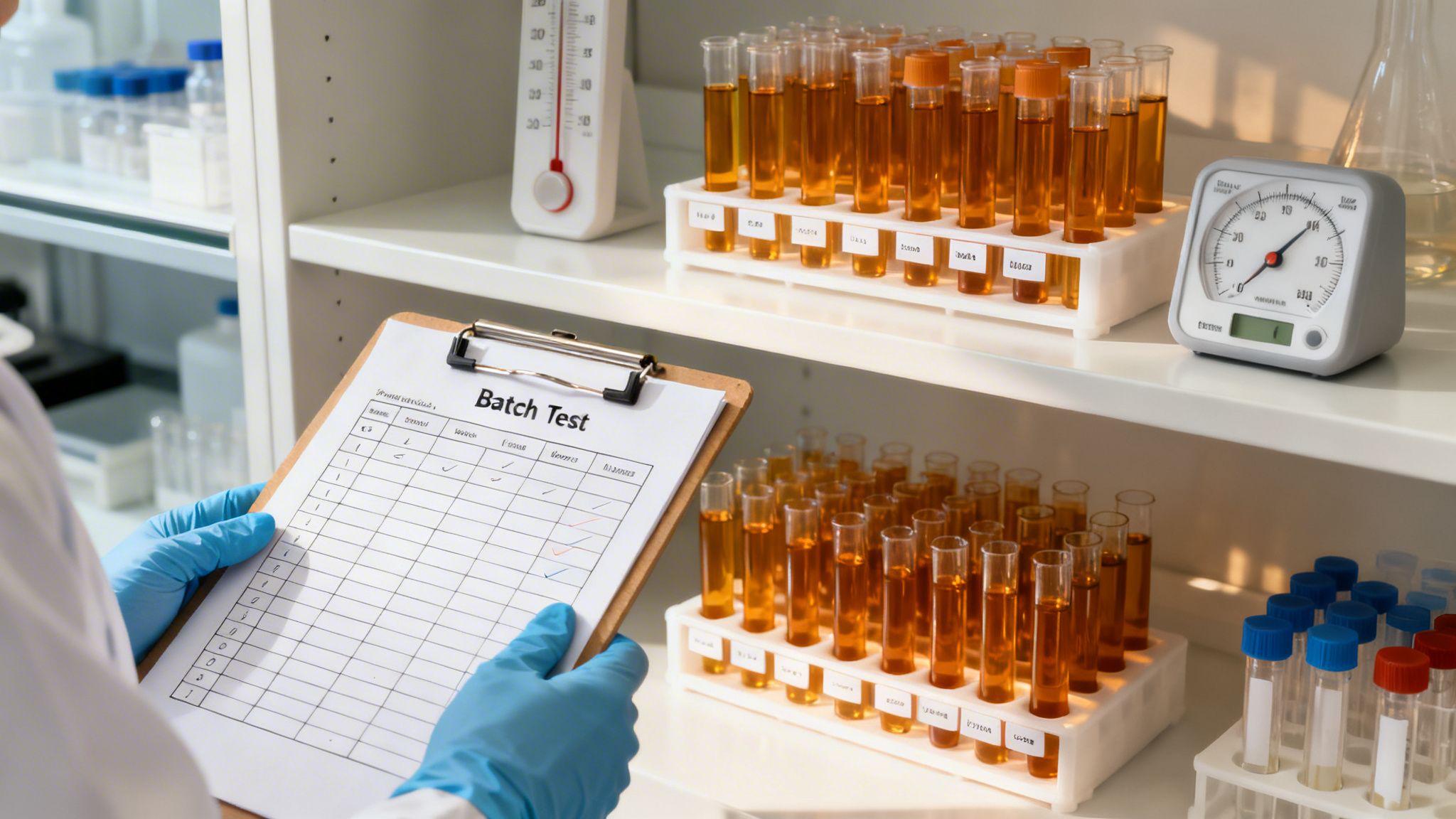
The primary differentiator between a professional brand and an amateur operation is batch-to-batch consistency. The only way to guarantee this is through finished product testing.
After mixing and homogenization, pull a sample from every batch for analysis. This final check confirms that the terpene concentration meets the target and that the mixing process was successful.
A final Certificate of Analysis (COA) for your finished goods is not just for compliance; it is a statement of quality and transparency to your customers.
Sour Diesel's unmistakable aroma—the zesty citrus from Limonene, earthy funk from Myrcene, and peppery bite from Beta-Caryophyllene—is a must-have for formulators. Consistent testing ensures you hit your target flavor profile every time.
Common Questions About Formulating with Sour Diesel Terpenes
Here are answers to common questions about working with our Sour Diesel terpene profile, based on hands-on formulation experience.
What is a good starting ratio for a Sour Diesel vape cartridge?
For most cannabinoid distillates, a concentration between 5% and 8% terpenes by total weight is the ideal range. We recommend starting conservatively at 6% for your initial test batch. This is typically sufficient to achieve the classic pungent fuel and sharp citrus notes without being harsh. You can then adjust upward in small increments if the flavor is too subtle. Documenting your ratios is critical for reproducibility.
How can I prevent the Sour Diesel aroma from fading?
The signature "sour" note comes from highly volatile terpenes like Limonene. Proper storage is essential to prevent their evaporation.
- Store Cold: Keep sour diesel terpenes refrigerated at 35–40°F (2–4°C).
- Store Dark: Use amber or other opaque containers to protect from UV light.
- Store Sealed: Keep lids tight to prevent oxidation. For long-term storage, an inert gas flush (e.g., nitrogen) is recommended.
My vape tastes harsh. What went wrong?
A harsh, chemical taste is almost always a sign of over-infusion. If the final product causes throat irritation, the terpene concentration is too high for your base oil. The only solution is to dilute the batch by adding more unflavored distillate to bring the terpene percentage back into the optimal 5-8% range. This underscores the importance of starting with a lower concentration and adjusting upward.
Formulator's Insight: The viscosity of your starting material is a key factor. Thinner oils, such as some Delta-8 distillates, may require a lower terpene percentage (e.g., 4-5%) to prevent the final product from becoming too runny and causing cartridge leakage.
What’s the difference between a standard and an ‘elevated’ profile?
A standard profile, like our classic Sour Diesel, is formulated for authenticity, perfectly replicating the iconic strain experience. An "elevated" profile uses that classic blueprint as a base and introduces a creative twist by strategically boosting specific minor terpenes. For example, we might amplify Pinene for a sharper, pine-heavy finish. This creates a proprietary blend that is unique yet familiar. For more on this topic, explore our detailed terpene guides.
Ready to create a consistent, top-shelf product that truly captures the legendary aroma of Sour Diesel? Gold Coast Terpenes delivers lab-tested, carrier-free terpenes engineered for professional results. Explore our authentic Sour Diesel strain-specific terpene blend and start building your next bestseller.