
A runtz terpene blend provides formulators with the exact aromatic and flavor components of the renowned Runtz strain, stabilized for consistent product manufacturing. For professionals developing vape cartridges, concentrates, or infused pre-rolls, leveraging a pre-formulated Runtz profile is the key to achieving its in-demand candy-like characteristics in every batch, eliminating the variability inherent in raw plant material.
Decoding the Runtz Terpene Profile for Formulation
The Runtz profile is a commercial powerhouse due to its uniquely sweet and fruity character, which has proven consumer appeal. For product formulators, understanding its composition is not about simple replication—it's about mastering a proven formula for marketable success. A high-fidelity Runtz product relies on a precise balance of specific terpenes, each performing a distinct role to create the signature aromatic experience.
The market demand for authentic strain profiles is a primary driver of the global terpenes market, projected to reach USD 862.6 million by 2026. With the North American market segment forecast to exceed USD 293 million, achieving formulation accuracy for popular profiles like Runtz provides a significant competitive advantage.
The Core Terpenes and Their Roles as Formulation Notes
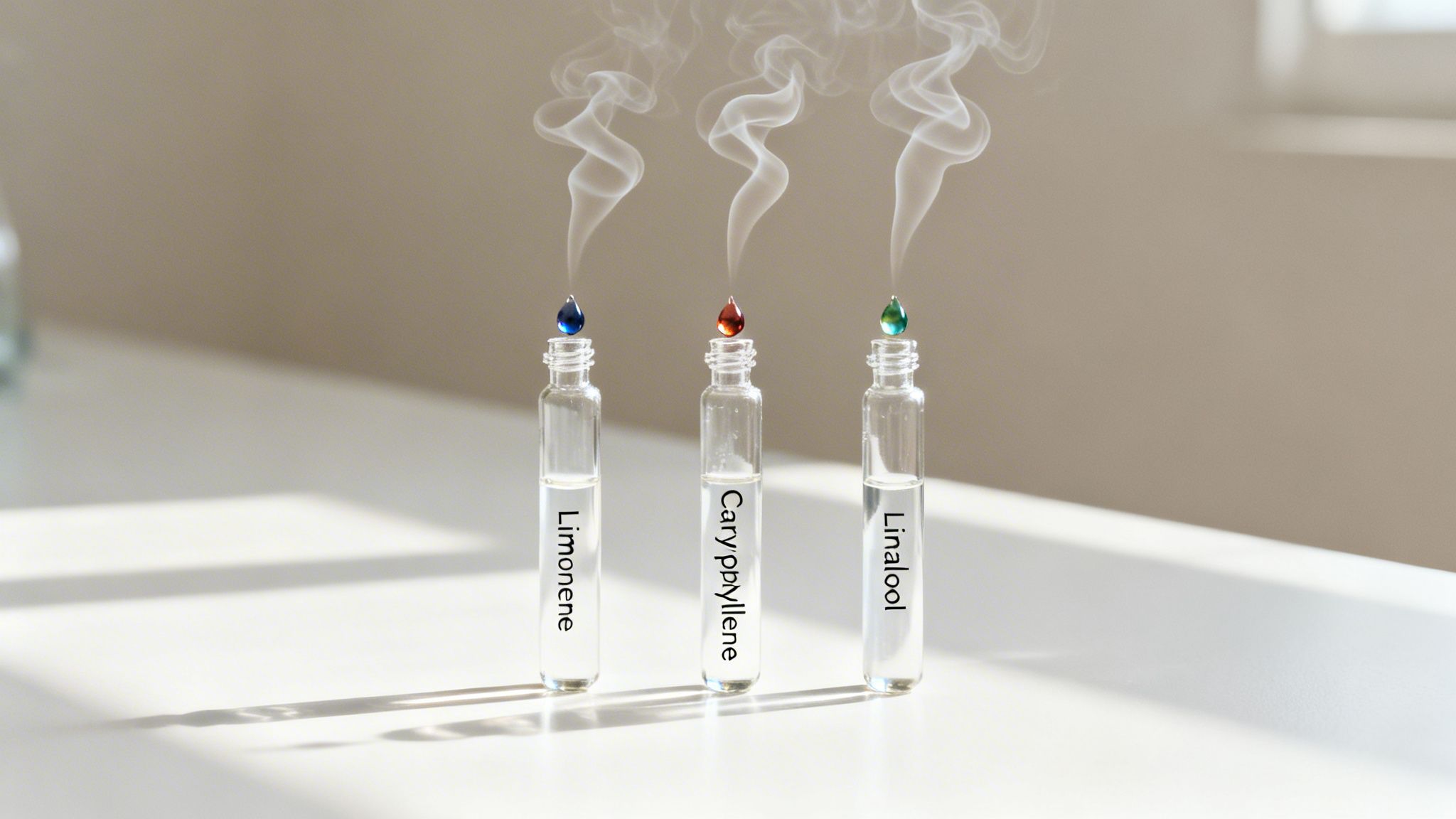
The iconic Runtz aroma is constructed from three primary terpenes functioning in concert. In formulation science, these are understood as top, mid, and base notes, each contributing to the overall aromatic structure and sensory experience.
- Limonene (Top Note): As the dominant isolate, comprising 25-35% of the blend, Limonene delivers the initial, volatile wave of bright, citrusy sweetness that defines the Runtz profile. It serves as the primary aromatic signature and establishes the candy-like characteristic.
- Beta-Caryophyllene (Mid Note): At 15-20%, Beta-Caryophyllene provides the formulation's body. It introduces a spicy, peppery complexity that grounds the profile, preventing the sweetness from becoming one-dimensional and adding crucial depth.
- Linalool (Base Note): Making up 10-15% of the profile, Linalool functions as the base note, providing a smooth, floral, and subtly woody finish. It anchors the top and mid notes, rounding out the blend for a complete and balanced aromatic experience.
By understanding these ratios, formulators move from approximation to precise engineering. A Runtz-inspired terpene blend provides the toolset to consistently replicate this exact aromatic architecture, which is fundamental to building product reliability and brand loyalty.
Achieving this specific balance is what distinguishes a premium product from an average one. While minor terpenes contribute subtle nuances, these three isolates form the non-negotiable foundation of an authentic Runtz profile. A deeper understanding of terpene science is invaluable for any formulator; for a primer, see our Terpenes 101 guide.
Key Applications of Runtz Terpenes for Cannabis Product Formulation
Mastery of the Runtz terpene profile allows formulators to address key manufacturing challenges and unlock new product development opportunities. A Runtz-inspired terpene blend is a critical tool for reintroducing specific, desirable aromatic and flavor characteristics with precision.
The most common application is in the formulation of vape cartridges. The distillation process, particularly at scale, strips the source material of nearly all its native terpenes, resulting in a potent but viscous and flavorless cannabinoid oil.
Here, a Runtz terpene blend serves a dual function. First, it acts as a natural viscosity modifier, ensuring the oil flows correctly into the wick of a vape cartridge. More critically, it infuses the blank-slate distillate with the authentic, candy-like Runtz flavor profile. This transforms a generic base oil into a premium, strain-specific product without resorting to undesirable diluents like PG, VG, or MCT oil.
Replicating Flavor and Restoring Concentrates
Vape cartridges are only the beginning. A Runtz terpene blend is a game-changer for creating a consistent strain experience across a diverse product portfolio. For hydrocarbon extracts like shatter, wax, and badder, the purging process often volatilizes the most delicate terpenes. A light, even application of a terpene blend can restore this lost aromatic intensity, reviving a product that has lost its initial appeal.
- Strain Replication: Enables the creation of a consistent Runtz profile in any distillate batch, regardless of the original biomass's aromatic qualities.
- Aroma Restoration: Compensates for terpenes lost during extraction, imparting the potent aroma consumers expect from premium concentrates.
- Product Consistency: Guarantees that every Runtz-branded product delivers the exact same flavor and aroma, a cornerstone of brand trust.
This is critical for any brand building its reputation on specific, recognizable strain profiles. The ability to precisely reintroduce the sweet, fruity notes of Runtz is a key differentiator between top-shelf and mass-market products. To better understand how individual isolates like Limonene create these bright, citrusy profiles, you can explore our guide on D-Limonene benefits.
Innovative Uses for Vape, Pre-Rolls, and Edibles
The liquid format also facilitates innovative applications. Infused pre-rolls are a rapidly growing product category, and a terpene blend is the ideal tool for their manufacture.
By atomizing a fine mist of the Runtz profile onto flower before rolling, formulators achieve a perfectly even coating. This enhances "bag appeal" with a powerful aromatic burst upon opening and contributes a distinct flavor layer to the smoke itself.
This technique can also be used to flavor edibles like gummies or hard candies. An atomized spray delivers a light, even surface coating of flavor without introducing excess moisture or compromising the product's texture. This simple process can be the foundation for an entire line of strain-specific edible products.
A Formulation Guide for Runtz-Inspired Terpene Blends
Integrating a Runtz terpene blend into your production workflow is a process of precision. Success depends on three factors: accurate measurements, thorough homogenization, and a high-quality base material.
This process flow illustrates how a botanical additive, such as our Runtz blend, fits into the manufacturing pipeline, converting a base distillate into a range of finished consumer goods.
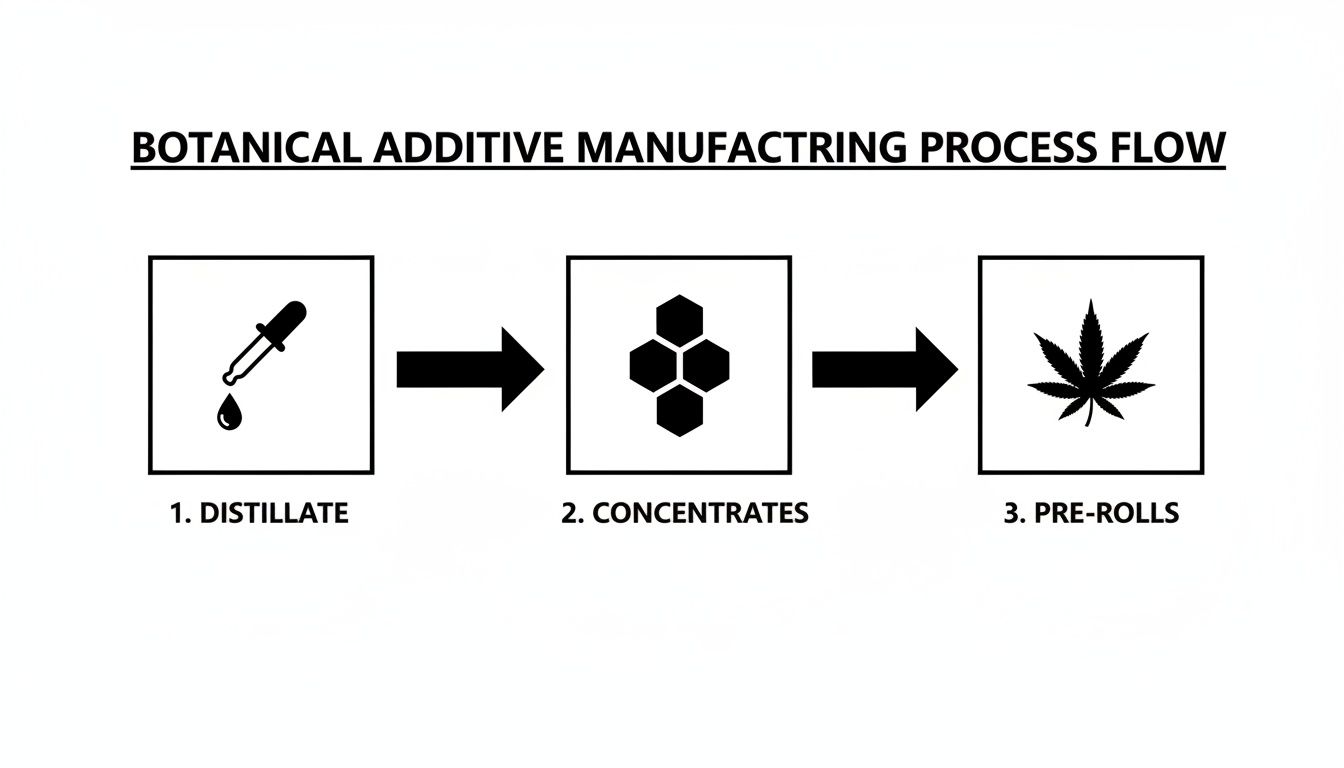
As shown, a single starting material—high-purity distillate—can be transformed with a specific terpene profile to create diverse products, from high-value concentrates to uniformly infused pre-rolls.
Finding the Right Mixing Ratio
First, establish the optimal terpene-to-distillate ratio. A critical best practice: always measure by weight, not by volume. This is the only method to ensure batch-to-batch accuracy and consistency. For most distillate-based products, a starting range of 3% to 5% terpenes by weight is recommended.
- For a milder flavor and higher viscosity: Begin at 3%. This is typically sufficient to impart the distinct Runtz character without being overpowering.
- For a bolder flavor and lower viscosity: Start at 5%. Use caution when exceeding this; concentrations above 7-8% can introduce harshness and may result in a final product that is overly fluid.
To illustrate: for a 100-gram batch targeting a 5% terpene ratio, you will combine 95 grams of distillate with 5 grams of the Runtz terpene blend. This measurement must be performed with a calibrated scale.
The table below provides starting-point ratios for various product types. These are baselines for further refinement based on your specific base material and desired end-product characteristics.
Recommended Runtz Terpene Blend Mixing Ratios for Various Products
| Product Type | Base Material | Recommended Ratio (% by weight) | Key Objective |
|---|---|---|---|
| Vape Cartridges | High-Purity Distillate | 3% – 6% | Optimal viscosity for wicking; balanced flavor |
| Dab Sauces/Terp Sauces | THC/CBD Isolate or Distillate | 7% – 12% | Intense aroma and flavor; sauce-like consistency |
| Infused Pre-Rolls | Ground Flower | 1% – 2% (sprayed on) | Enhance aroma without oversaturation |
| Edibles & Topicals | MCT Oil, Shea/Cocoa Butter | 0.5% – 2% | Flavor/aroma infusion; ensure stability in base |
| Tinctures | MCT or Ethanol Base | 1% – 3% | Flavoring and consistent aromatic profile |
Remember, these ratios are a guide. The optimal formulation for your product will depend on your specific base material and the target consumer experience.
The Art of Homogenization
Simply adding terpenes to distillate is insufficient. Without proper homogenization, the blend will eventually separate, leading to inconsistent flavor, poor texture, and hardware failure in vape cartridges. Achieving a completely uniform mixture is non-negotiable for a professional-grade product.
The standard method involves gentle heat and mechanical agitation.
- Warm the Distillate: Gently heat your distillate to 100–120°F (38–49°C). This reduces its viscosity, making it more receptive to the terpene blend. Avoid overheating, as excessive heat can degrade both cannabinoids and terpenes.
- Mix Thoroughly: Add your measured Runtz terpene blend to the warmed distillate. Use a magnetic stirrer on a low setting for a minimum of 5–10 minutes to ensure complete integration. Slow, consistent mixing is crucial for a stable final emulsion.
An often-overlooked professional tip: always begin with clean, fully winterized oil. Residual fats, waxes, or lipids in the distillate will interfere with proper homogenization, causing cloudiness (the "louche effect") and eventual separation. For maximum clarity and stability, a high-purity, fully dewaxed base material is essential.
Following this protocol ensures that every unit of your finished product delivers the same authentic, high-quality Runtz experience. While Runtz is a popular hybrid, understanding how different strain profiles are constructed can elevate your formulation capabilities. For further insight, review our article exploring whether Sour Diesel is an indica or sativa.
Ensuring Product Stability and Safety in Formulation
Achieving the correct Runtz flavor profile is a major formulation milestone, but the work is not complete. Long-term market success requires a product that is stable, safe, and reliable. Issues like separation, oxidation, or color degradation can compromise a batch and damage brand reputation. It is critical to proactively address these potential failure points.

Product integrity begins with sourcing. Using a Runtz-inspired terpene blend from a reputable supplier is essential. High-purity, lab-verified terpenes will be free of residual solvents or undeclared fillers that can cause unpredictable reactions, poor performance, and safety concerns.
How to Mitigate Common Formulation Problems
Several common issues can manifest post-formulation. Recognizing and preventing them is key to maintaining product consistency and consumer trust.
- Oxidation and Color Changes: Exposure to oxygen and light causes terpenes to degrade, often resulting in oil darkening and flavor degradation. The solution is straightforward: store finished products in airtight, opaque containers, minimizing headspace to reduce oxygen exposure.
- Product Separation: A visible separation of oil and terpenes indicates poor homogenization. This is aesthetically unappealing, creates an inconsistent user experience, and can clog vape hardware. Ensure your mixing process is robust and effective.
- Hardware Incompatibility: The choice of hardware is a critical formulation variable. Low-quality plastics or reactive metals in vape cartridges can interact with terpenes, leading to the leaching of contaminants. This not only compromises the product but also introduces harsh, artificial off-notes.
To preserve the clean, candy-like Runtz flavor, always select hardware constructed from inert materials. Ceramic core cartridges are the industry standard for a reason—they are resistant to terpene interaction, ensuring flavor fidelity from the first use to the last.
The Non-Negotiable Role of Product Testing
Ultimately, comprehensive testing is the final safeguard for your product and your brand. This extends beyond regulatory compliance; it is a validation of your quality claims.
Your in-house quality control (QC) serves as the first line of defense, conducting checks for clarity, color consistency, and viscosity.
However, in-house QC is insufficient. Third-party lab testing is mandatory. An independent Certificate of Analysis (COA) is the only way to verify potency, confirm terpene purity, and screen for contaminants like heavy metals, pesticides, and microbial life. This is a critical step in building a trustworthy brand. For a deeper dive into the science, our Terpenes 101 guide is an excellent resource.
Unlocking New Market Opportunities with the Runtz Profile
Integrating a popular flavor profile like Runtz into your product line is a strategic commercial decision. For manufacturers, a high-quality Runtz-inspired terpene blend is a direct path to enhancing brand value and accessing new revenue streams by delivering the sweet, candy-like cannabis experience consumers actively seek.
This is especially relevant in the context of the infused products boom. The market is demonstrably moving toward more sophisticated consumer goods, with terpenes at the forefront of this evolution. For astute extractors and brand owners, this represents a significant commercial opportunity.
Capitalizing on the Infused Pre-Roll Market
Currently, the infused pre-roll category is one of the fastest-growing segments in the cannabis industry. These products command a premium price point by offering a more potent and flavorful experience than standard flower—a value proposition that resonates with a large consumer base. A Runtz terpene blend is the ideal manufacturing tool for this application, allowing for precise and uniform aroma enhancement.
- Enhanced Bag Appeal: A light misting delivers a powerful and appealing aroma the moment the consumer opens the package.
- Improved User Experience: The blend adds a layer of authentic Runtz flavor to the smoke, complementing the infused concentrate or kief.
- Manufacturing Consistency: An atomized spray application eliminates the inconsistencies of manual methods, ensuring every pre-roll in a batch provides the same premium experience.
This is not a transient trend. Infused pre-rolls are projected to capture 50% of the total pre-roll market by 2026. For brands seeking to claim a share of this segment, leveraging a reliable and popular profile like Runtz is a sound strategy.
The market data is compelling. The global terpenes market was valued at USD 1.45 billion in 2024 and is projected to reach USD 2.42 billion by 2030. With North America’s share forecast to exceed USD 460.6 million in 2025, the message is clear: significant potential exists for formulators who master strain-specific blends. You can review the data on terpenes market growth on strategicmarketresearch.com.
The Crossover Power of a Well-Formulated Flavor
The sweet, dessert-like characteristic of Runtz also gives it broad appeal in other product formats. As consumer palates mature, they seek cannabis products with flavors that align with familiar food and beverage experiences. This makes the candy notes of Runtz an excellent fit for modern product innovation.
Consider applications beyond the traditional:
- Flavored Gummies and Hard Candies: Achieve an authentic candy flavor without altering your base edible formulation.
- Beverage Enhancers: Develop cannabinoid syrups or water-soluble drops with a flavor profile that has mass appeal.
- Standout Concentrates: Create live resins, badders, or sauces that differentiate themselves on the shelf with a distinct and in-demand dessert flavor.
Investing in a high-quality, authentic Runtz terpene blend is not merely purchasing a flavoring agent. It is acquiring a proven, market-tested asset that can be deployed across an entire product portfolio to drive sales and build a reputation for quality. To dial in your ratios perfectly, utilize our terpene mixing calculator for precise dosing.
Common Formulation Questions Answered
When integrating a new ingredient into a production process, technical questions inevitably arise. For a precision component like a Runtz-inspired terpene blend, addressing these details is what separates an adequate product from a superior one. Here are answers to common challenges faced by formulators.
Can I Mix Terpene Blends with Any Type of Oil?
While technically possible, for a professional-grade product, the quality of the base oil is paramount. Terpenes are organic solvents and achieve the best miscibility with highly-purified, winterized distillates (THC, CBD, etc.). These oils have had fats, waxes, and lipids removed.
This is crucial because these impurities can cause the final product to appear cloudy, separate over time, or present off-flavors. Starting with a clean base allows the pure Runtz profile to be the dominant characteristic, ensuring your products meet visual, flavor, and performance standards.
How Do I Prevent the Flavor from Fading or Changing?
The candy-like Runtz flavor profile is susceptible to degradation if not handled correctly. The primary catalysts for this degradation are oxygen, light, and heat. Proper storage and handling protocols are therefore essential.
- Store in Airtight Containers: Always use airtight, dark glass containers (amber or opaque) to protect the product from light and oxygen.
- Minimize Headspace: The less empty air in a storage container, the less available oxygen there is to degrade the terpenes over time.
- Control Temperature: Store both the terpene blend and finished goods in a cool, dark environment. Large temperature fluctuations will accelerate degradation.
Adhering to these steps ensures that the carefully formulated flavor is preserved through the product's shelf life.
What Is the Difference Between Botanical and Cannabis-Derived Terpenes?
This is a critical distinction with direct implications for product cost, consistency, and regulatory compliance. Both can be used to construct a Runtz profile, but their sourcing is fundamentally different.
Botanical terpenes are sourced from a wide variety of non-cannabis plants—citrus peels, pine, lavender, etc. They are molecularly identical to the terpenes found in cannabis but offer superior consistency and scalability at a lower cost. A Runtz-inspired terpene blend formulated with botanical terpenes provides a reliable, clean flavor that is federally legal and free of cannabinoids.
Cannabis-derived terpenes (CDTs) are extracted directly from the cannabis plant. While they can offer a complex aroma due to trace compounds, they are significantly more expensive and subject to the complex legal framework governing cannabis. For most scaled manufacturing operations, botanical terpenes represent the optimal balance of authenticity, quality, and commercial viability. If you want to dive deeper into the science, our Terpenes 101 guide is a great place to start.
Why Does My Mixture Look Cloudy After Adding Terpenes?
Cloudiness, or the "louche effect," is a frustrating but common issue. In nearly all cases, the cause is not the terpenes themselves but the base oil. This effect occurs when terpenes act as a solvent, causing residual fats and lipids in an under-winterized oil to precipitate out of the solution.
The solution is preventative: you must begin with a cleaner, fully dewaxed oil. A pristine final product requires a pristine starting material. This is the only way to guarantee perfect clarity and prevent future separation, which is especially critical for products like vape cartridges.
Ready to achieve perfect Runtz flavor consistency in every batch? Gold Coast Terpenes provides lab-verified, botanically-derived terpene profiles engineered for professional results.
Explore our full range of strain-specific terpene blends today.