
For cannabis product formulators and brand owners, the Monkey Business strain represents more than a popular cultivar—it’s a commercially proven blueprint for flavor, aroma, and effect. Its stable indica-dominant profile, derived from Gorilla Glue #4 and Fornicator, offers a reliable and highly sought-after target for replication in vape cartridges, distillates, and other formulated products.
This guide is designed to deconstruct the Monkey Business terpene profile for commercial application, providing a roadmap for accurate replication and successful product development.
Why the Monkey Business Terpene Profile Matters in Formulation
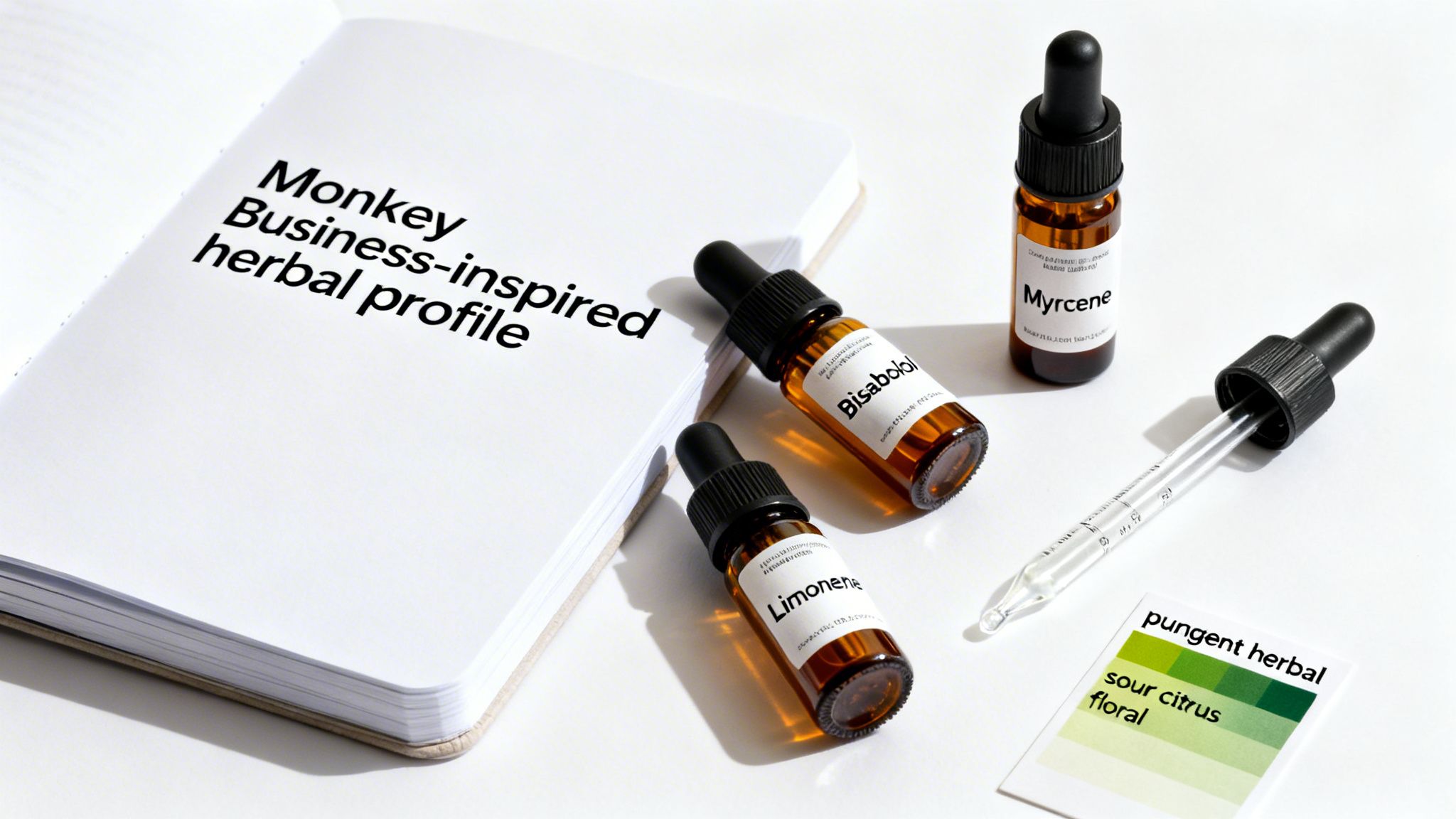
In product formulation, the objective isn't merely to copy a strain. The goal is to deconstruct its most valuable organoleptic and functional traits—its aroma, flavor, and target effect—and engineer them into a stable, scalable, and consistent terpene blend. This process mitigates the inherent unpredictability of agricultural sourcing, providing a reliable foundation for commercially viable products.
Monkey Business is a standout indica-dominant hybrid. Its genetic lineage provides a robust and pungent base that is already familiar and desirable to the market. Formulating a product inspired by this profile is a strategic move that aligns with established consumer preferences.
The table below breaks down the key characteristics of the Monkey Business strain from a product developer's perspective, highlighting the "why" behind each formulation decision.
Monkey Business Strain At-A-Glance for Cannabis Product Formulation
| Characteristic | Specification | Relevance for Formulation |
|---|---|---|
| Genetics | Gorilla Glue #4 x Fornicator | Provides a well-known, pungent, and resinous base profile that is commercially proven. |
| Type | 70% Indica / 30% Sativa | Guides the target functional outcome; formulation should aim for relaxing, calming effects. |
| THC Content | Typically 26-30% | High potency is a key market driver. The terpene blend must complement, not clash with, a high-THC distillate. |
| Primary Aroma | Pungent, Herbal, Sour Citrus | The core sensory notes to replicate using specific terpene isolates like Myrcene, Limonene, and Caryophyllene. |
| Reported Effects | Relaxing, Sleepy, Happy | The target functional experience. The terpene blend is crucial for steering the effect toward relaxation. |
| Market Position | Premium, High-Potency Indica | Attracts discerning consumers. Product quality, flavor accuracy, and consistency must be top-tier. |
This data-driven approach shows how every attribute of the original cultivar informs decisions in the lab, from terpene selection to final product branding and market positioning.
The Business Case for Replicating the Flavor of Monkey Business
Relying solely on agricultural harvests for a specific strain profile introduces significant business risk. Terpene and cannabinoid content can vary dramatically from one crop to the next, leading to product inconsistency that can damage a brand's reputation and bottom line.
By isolating the chemical signature of Monkey Business, we can create a standardized terpene blend. This is how you guarantee that every single vape cartridge or gram of concentrate delivers the exact same flavor, aroma, and effect, time after time.
This strategy moves beyond quality control; it's about building a predictable and scalable ingredient from a desirable but variable botanical. It transforms a popular plant into a reliable asset you can build a business on.
Key Technical Focus Areas for Replication
When deconstructing the Monkey Business strain for a strain-inspired terpene blend, we focus on three commercially critical elements:
- Genetic Backbone: Its Gorilla Glue #4 heritage provides a pungent, gassy, and robust foundation that is a well-understood and commercially successful starting point for any formulator.
- Layered Sensory Notes: The profile is a complex interplay of pungent herbs, a sharp twist of sour citrus, and a subtle hint of floral sweetness. The technical challenge is to deconstruct and then precisely reconstruct these layers using individual terpene isolates.
- Proven Market Appeal: Heavy, relaxing indica profiles are a perennial top-seller. Aligning a product with this profile is a strategic move that targets a large and active market segment.
Mastering these elements is the first step in using the art of strain selection for commercial success. By focusing on rebuilding these core traits, you can create a product that not only captures the essence of Monkey Business but is also profitable and perfectly consistent.
From Tasting Notes to a Tangible Formula
Translating the descriptive profile of Monkey Business into a functional formula for vape cartridges or other products is a core discipline of the modern formulator. The process is less about abstract chemistry and more akin to reverse-engineering a complex sensory experience.
The objective is not just to mimic the aroma but to guide the end-user through the exact same sensory journey—from the initial aromatic impression to the final lingering flavor—with every use.
At its core, Monkey Business is defined by a powerful, spicy herbal foundation. This base is punctuated by a bright pop of sour citrus, which provides a critical counterpoint. The experience is rounded out by delicate floral top notes that add sophistication and complexity.
Layering Terpenes for an Authentic Experience: Top, Mid, and Base Notes
Constructing a high-fidelity profile requires a tiered approach to formulation. Simply combining the most abundant terpenes is insufficient. A perfumer's methodology, which considers top, middle, and base notes, is essential for creating a dynamic and authentic blend.
- Base Notes (The Foundation): These are the deep, low-volatility aromas that provide depth and longevity. For a Monkey Business formulation, this layer is built with the pungent, earthy spice of isolates like Myrcene and Beta-Caryophyllene. They anchor the entire profile.
- Mid-Notes (The Heart): This is the core character of the strain. Here, the sharp, sour citrus provided by Limonene is the star, bridging the heavy base notes with the lighter top notes.
- Top Notes (The Introduction): These are the most volatile compounds, providing the immediate first impression. The subtle floral hints in Monkey Business, likely from Bisabolol and Linalool, serve this purpose perfectly.
Mastering this layering technique provides complete control over the consumer experience. To deepen your understanding of these aromatic relationships, our guide to cannabis aromas and flavors is an invaluable resource.
Deconstructing the Signature Monkey Business Terpene Profile
The unique signature of Monkey Business arises from the precise interplay of its dominant terpenes. The combination of isolates like Limonene and Bisabolol is responsible for the unforgettable blend of pungent herbs, sour lemon, and delicate floral notes.
This aromatic complexity resolves into a skunky exhale that has become a hallmark of the strain. This is precisely the kind of memorable experience that drives repeat purchases and brand loyalty when replicated in strain-specific cartridges and concentrates.
The goal is to build a formula that isn't just a collection of ingredients, but a structured composition. Each terpene must be added with purpose, contributing to a specific part of the overall flavor journey.
By deconstructing the profile in this manner, you move beyond simple flavor mimicry and into the realm of sensory engineering. This approach ensures your final product consistently delivers an authentic profile, creating a reliable and differentiated product in a competitive market.
A Starting Formulation Guide for a Monkey Business-Inspired Terpene Blend
Moving from theory to practice, this section provides a foundational recipe for building a terpene blend that captures the essence of Monkey Business. Treat this as a validated starting point for your own R&D, ready for you to test, tweak, and perfect for your specific base oil and hardware.
First, let's visualize the formulation strategy. This flavor map illustrates how we layer different notes to construct the iconic Monkey Business profile.
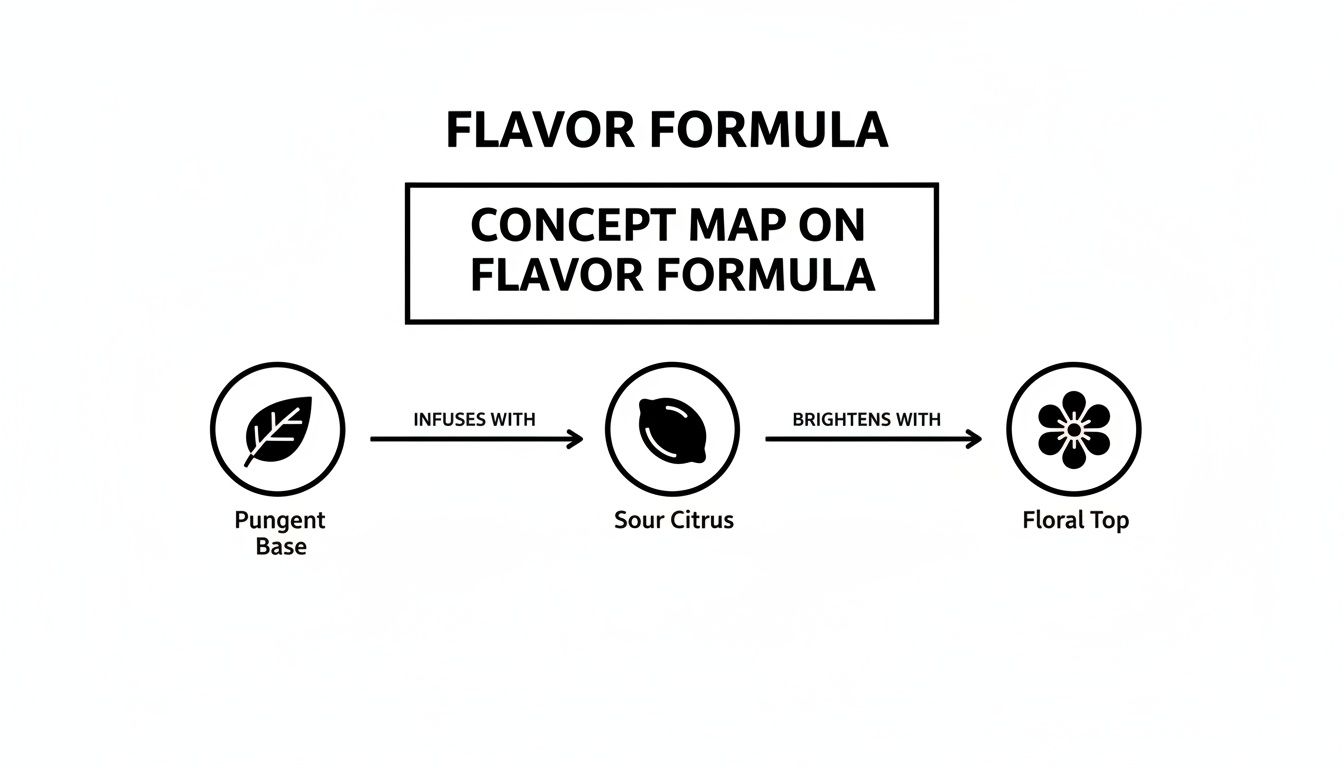
The strategy is clear: begin with a heavy, pungent base, cut through it with sharp citrus, and finish with a delicate floral lift for balance and complexity.
The Core Components of the Blend: Terpene Roles
To build this profile, it is critical to understand the function of each terpene isolate. In professional formulation, we categorize these isolates as top, middle, and base notes, mirroring perfumery principles. Base notes provide the lasting foundation, mid-notes define the main character, and top notes deliver the initial sensory impact.
Here are the four key isolates for our starter recipe:
- Limonene (Top/Mid-Note): This is the primary driver of the signature sour citrus note. Limonene provides the bright, zesty character that defines the initial impression. Its volatility makes it a top note, but it possesses enough tenacity to influence the mid-range of the experience.
- Beta-Caryophyllene (Base Note): This isolate delivers the critical spice and pepper notes. Beta-Caryophyllene establishes a warm, woody foundation that provides the blend's backbone, anchoring the profile with the classic warmth associated with its Gorilla Glue #4 lineage.
- Myrcene (Base Note): Working in concert with Beta-Caryophyllene, Myrcene contributes classic musky, earthy tones with a subtle fruitiness. It is essential for building a deep, robust base and helps steer the blend's functional effect towards relaxation.
- Bisabolol (Top Note): This is the formulation's key differentiator. Bisabolol adds a light, sophisticated floral sweetness that cuts through the heavier notes. Used judiciously, it softens the sharp edges of the citrus and spice, adding a layer of complexity that elevates the entire blend.
Mastering the interplay between these isolates is a hallmark of an expert formulator. To explore the flavor contributions of these and other isolates, our terpene flavor chart is a useful reference tool.
Key Takeaway: Formulation is an iterative process. Begin with this baseline, prepare small, precisely measured test batches, and evaluate them organoleptically. Adjust ratios incrementally until you achieve the desired target profile.
Suggested Starting Ratios for Formulation
This blueprint is designed for blending with standard cannabis or hemp distillate. Remember that your base oil has its own characteristics, so minor adjustments will be necessary to achieve perfect flavor accuracy.
Starting Formulation For A Monkey Business-Inspired Terpene Blend
| Terpene | Note Category | Suggested Percentage | Primary Flavor/Aroma Contribution |
|---|---|---|---|
| Limonene | Top/Mid | 35% | Sharp, sour citrus and bright lemon zest. |
| Beta-Caryophyllene | Base | 25% | Pungent spice, black pepper, and warm wood. |
| Myrcene | Base | 20% | Earthy, musky, and subtle ripe fruit notes. |
| Bisabolol | Top | 10% | Light, sweet floral aroma (e.g., chamomile). |
| Other Isolates | Supporting | 10% | Humulene, Linalool, or others for nuance. |
This recipe provides a balanced foundation. The 10% "Other Isolates" allocation is your designated space for fine-tuning. A small addition of Humulene can amplify hoppy notes, while a touch of Linalool can enhance the floral finish.
The objective is not for one terpene to dominate, but for all components to synergize, creating a seamless and authentic sensory experience. Happy formulating.
Optimizing the Formulation for Vape Cartridges
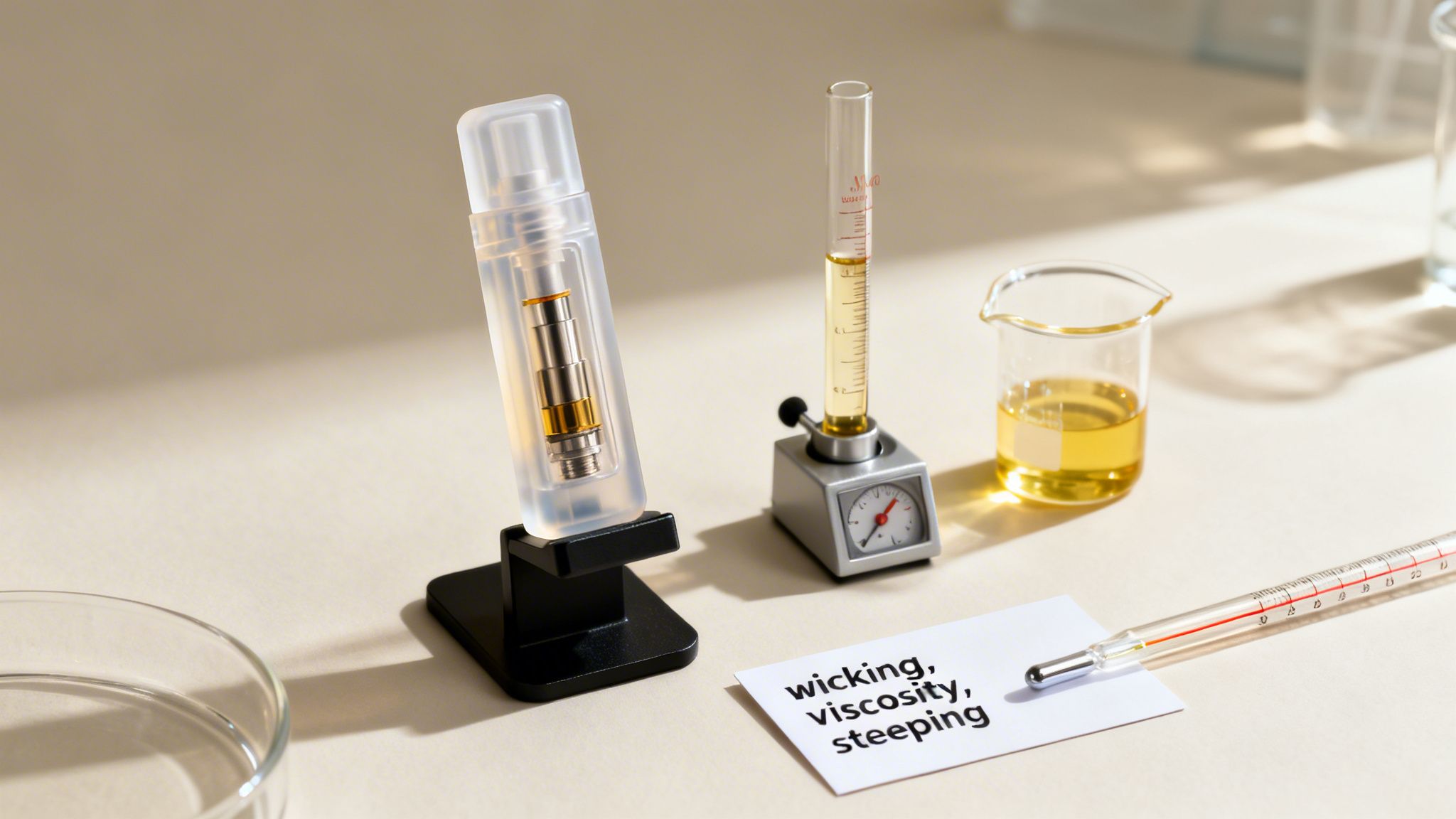
Perfecting a Monkey Business-inspired terpene blend on the benchtop is a critical first step. The true test, however, is its performance within a vape cartridge. This phase requires a careful balance between the terpene formula, the cannabinoid base oil, and the specific hardware chosen for delivery.
A successful formulation must do more than taste authentic; it must function flawlessly from the first activation to the last. This is where technical precision prevents common product failures that can damage a brand's reputation. The most frequent error is an incorrect terpene concentration, leading to leaking, harshness, or poor vaporization (burnt wicks and dry hits).
Nailing Viscosity for Optimal Cartridge Performance
Viscosity is the single most critical variable for vape cartridge formulation. It dictates the flow rate of the oil into the atomizer's wick. The objective is to achieve a "sweet spot": a viscosity low enough for efficient wicking but high enough to prevent leakage.
A Monkey Business profile, rich in volatile terpenes like Limonene and Bisabolol, acts as a natural thinning agent. This is advantageous when working with high-viscosity bases like winterized THC or CBD distillate. The terpenes serve a dual function: providing the target flavor profile while simultaneously reducing viscosity to an optimal range for vaporization hardware.
- For common CCELL-style ceramic cartridges, the target viscosity range is typically 300-800 centipoise (cP) at room temperature.
- A pragmatic starting point is a 5% terpene blend by weight. Formulate a small test batch and evaluate its flow characteristics in the target hardware. If the oil is too viscous, increase the terpene concentration in 0.5% increments until performance is optimized. Most final formulations fall between 5% and 8%.
It is imperative to conduct testing with the exact hardware intended for the final product. A formula that performs perfectly in one cartridge may clog or leak in another due to variances in intake hole diameter, wick porosity, or coil design.
Proper Mixing and Homogenization Protocols
An ideal formulation ratio is useless without proper homogenization. If not fully integrated, terpenes and cannabinoid distillates will separate over time (stratification), leading to inconsistent flavor, potency, and a negative end-user experience.
Standard Operating Procedure for Heating and Mixing:
- Gentle Heating: Warm the distillate to 40–60°C (104–140°F). This reduces viscosity for efficient mixing without degrading volatile terpenes.
- Terpene Addition: Add the pre-weighed Monkey Business terpene blend to the warmed distillate.
- Controlled Mixing: Use a magnetic stirrer on a low-to-medium setting for a minimum of 15-20 minutes. The goal is to create a sufficient vortex for mixing without incorporating air or causing excessive shear.
After mixing, allow the blend to steep for 24-48 hours in a sealed, dark, and cool environment. This critical step allows the aromatic compounds to fully meld and stabilize, ensuring a consistent and refined final flavor. For a refresher on these foundational techniques, our guide on how to properly use terpenes covers the essentials.
Scaling from R&D to Production
You have successfully engineered a lab-scale batch of the Monkey Business profile that meets all organoleptic and functional targets. The next phase, scaling to commercial production, presents a new set of challenges centered on consistency, sourcing, and quality control.
Transitioning from the R&D bench to the production floor requires a shift in mindset from formulator to manufacturing strategist. The objective is to transform a one-time success into a profitable, repeatable, and scalable process.
Maintaining Batch-to-Batch Consistency with SOPs
The primary hurdle in scaling up is maintaining absolute consistency. End-users expect the product they purchase today to be identical to the one they purchased last month. This level of consistency is only achievable through rigorously detailed Standard Operating Procedures (SOPs).
Your SOPs must eliminate ambiguity and guesswork. They should codify:
- Exact Ratios: Precise gram-for-gram measurements of each terpene isolate and the base distillate, with clear instructions for scaling to various batch sizes.
- Mixing Parameters: Specific heating temperatures, mixer RPMs, and total mixing times required for complete homogenization.
- Steeping Protocol: Defined duration and environmental conditions (temperature, light exposure) for the post-mix resting period.
A superior formulation can be undone by inconsistent production methods. Document every step, train your team thoroughly, and enforce adherence to SOPs as a non-negotiable aspect of your quality management system.
Sourcing and Supply Chain Management
The consistency of your final product is directly dependent on the consistency of your raw materials. As you scale, you cannot afford stock-outs of a key terpene or variations in the quality of your isolates. A robust and reliable supply chain is non-negotiable. Partnering with a reputable supplier like Gold Coast Terpenes is critical, as they provide lab-verified, consistent, and filler-free terpenes with certificates of analysis for every batch.
Treat your terpene supplier as a strategic partner, not a mere vendor. Communicate your production forecasts and growth plans. Inquire about their inventory levels and lead times. A sudden shortage of a key isolate like Myrcene can halt your entire production line.
Their consistency is your consistency.
Adapting Your Formula for Different Bases
A single terpene blend is not a universal solution. The formulation you perfected for a high-THC distillate will require adjustments when used with other bases, such as live resin, full-spectrum CBD oil, or other types of cannabis extracts.
For example, a live resin base already contains a significant native terpene profile. Adding your full-strength blend could result in an over-flavored or muddled final product. The formulation must be adapted to complement, not overpower, the terpenes already present in the base material. This often involves reducing the concentration of certain isolates in your blend and re-validating the final profile through sensory analysis.
Communicating Quality in a Formulated Product
Creating a formulated product does not mean abandoning the authentic story of the strain that inspired it. The appeal of the Monkey Business strain is rooted in its boutique qualities: its dense, pepper-shaped olive green nugs, hints of light purple, and a thick coating of frosty milky trichomes. You can learn more about the strain's boutique qualities to understand its legacy.
Leverage this narrative in your marketing. Be transparent. Explain that your product is inspired by this legendary strain and has been meticulously formulated to recreate its signature profile with scientific precision. This approach builds consumer trust, connects your product to a legacy of quality, and provides a powerful point of differentiation.
Frequently Asked Questions About Formulation
When perfecting a strain profile for cannabis product formulation, several technical questions consistently arise. Here are concise, actionable answers to help you finalize your Monkey Business-inspired product.
What’s the optimal terpene percentage for a Monkey Business vape cartridge for distillate?
For a vape cartridge using a standard distillate base, the optimal terpene concentration typically falls between 5% and 8% by weight. The exact percentage is contingent upon your base oil's viscosity and your chosen hardware.
If formulating with a high-viscosity distillate, you will likely need to target the upper end of this range (closer to 8%) to achieve proper wicking. Conversely, a lower-viscosity base may only require 5% to avoid oversaturation and leakage.
Best Practice: Begin with a small test batch at 5%. Evaluate flavor, vapor production, and potential harshness in the target cartridge. If needed, increase the concentration in 0.5% increments, re-testing at each stage until the ideal balance of performance and flavor is achieved.
How can I enhance the "skunky" note in a Monkey Business formulation?
The characteristic "skunk" aroma is not derived from a single terpene but is a complex synergistic effect, primarily driven by Myrcene in combination with trace amounts of volatile sulfur compounds (VSCs).
To amplify this note, you must experiment with adding micro-doses of specific sulfur-containing isolates. These compounds are extremely potent. Work with dilutions and add them incrementally to a small test sample, not your main production batch. Olfactory evaluation after each micro-addition is critical to avoid overshooting the target.
Can this terpene profile be used for formulating products other than vapes?
Yes, this strain-inspired terpene blend is highly effective in other applications, but the concentration must be significantly adjusted for each product type. The ratios for inhalation are not suitable for ingestion or topical use.
- Edibles & Beverages: Use extremely low concentrations, typically less than 0.5% of the final product weight. The goal is a subtle flavor accent, not a dominant aromatic profile.
- Tinctures: A 1-3% concentration is a common starting point for sublingual products, providing a pleasant flavor and aroma without being overwhelming.
- Concentrates (e.g., Shatter, Wax): When reintroducing terpenes to post-processed concentrates, a 1-4% concentration is generally sufficient to restore the desired aroma and flavor.
Always conduct small-batch testing to validate the formulation for each specific application. For a comprehensive overview of using terpenes across different product categories, our Terpenes 101 guide is an essential resource for formulators.