
For cannabis product formulators, a reliable mixing ratios calculator is an indispensable tool. It separates amateur experiments from professional, shelf-ready formulations for vape cartridges, edibles, and tinctures. By removing guesswork, it converts target percentages into precise weights, ensuring batch-to-batch consistency and accurate product replication.
Nailing Precision and Consistency in Your Formulations

Consistency is paramount in product manufacturing. For formulators, extractors, and manufacturers, the line between a successful product and a costly write-off often comes down to precise calculations. Manual calculations are a minefield of potential errors that can lead to inconsistent products and a damaged brand reputation.
This is where a dedicated mixing ratios calculator comes in. It’s built to simplify the complex conversions between different measurements, especially between weight (grams) and volume (milliliters), enabling formulators to move beyond risky guesswork and achieve reliable, scalable results for cannabis product formulation.
The Problem with Manual Calculations
Manually calculating terpene and cannabinoid ratios invites operational risk. A single misplaced decimal or a misunderstanding of density differences between terpenes and distillate can compromise an entire production run.
These minor errors create significant problems:
- Inaccurate Potency: A calculation error can cause your final product to deviate from the THC or CBD percentage on the label, creating a compliance issue.
- Flavor Drift: Even a slight deviation in terpene percentage can alter a product’s flavor profile, failing to deliver the authentic strain experience you're formulating.
- Wasted Ingredients: Over-mixing or under-mixing results in the loss of expensive distillate and terpenes, directly impacting your bottom line.
A professional mixing ratios calculator handles all complex conversions for you. It provides the exact weights needed for your base concentrate and terpene blend, transforming a complex, error-prone task into a simple, repeatable process.
This tool empowers you to perfectly replicate popular profiles, like those in our strain-inspired terpene blends, and guarantee the product designed in R&D is the one that reaches the market every time.
Why Weight is the Only Reliable Metric
Mixing by volume (mL) is a common but flawed practice. The reality is that terpenes, distillates, and diluents all have different densities. For instance, 1 mL of a terpene blend weighs approximately 0.85 grams, while 1 mL of cannabis distillate is closer to 1.0 gram. If you formulate by volume and ignore this difference, your ratios will always be inaccurate.
A good mixing calculator standardizes everything to weight (grams), the only truly reliable metric for professional formulation. This ensures that a 7% terpene cut is exactly 7% of the total weight, regardless of batch size.
This level of precision is the industry standard. The recommended terpene concentration for vape cartridges typically falls between 5-15% by weight, with most formulators aiming for 7-12%. A mixing ratios calculator for vape cartridges is indispensable for hitting this target accurately.
You can dive deeper into these standards with this excellent terpene formulation guide. For any brand looking to build trust with distributors and customers, mastering this tool is essential for commercial success.
Defining Core Inputs in the Mixing Calculator
The principle of "garbage in, garbage out" is highly relevant to product formulation. The mixing calculator is a powerful tool, but its accuracy depends on the quality of your inputs. Nailing these core values is the first step toward consistent, repeatable results.
At its core, the calculator requires a few key pieces of information: the total weight of your starting concentrate, your target terpene percentage, and any other ingredients you plan to add, such as cannabinoid isolates. Understanding the "why" behind each number transforms this from a simple calculator into a strategic part of your formulation process for distillate and other extracts.
Define Your Starting Material Weight
First, you need to know the weight of your base concentrate. This is the total amount of oil you're starting with before adding anything else. For accuracy, you must measure this in grams.
For example, if you have a jar with 500g of THC distillate, that number, 500, is your starting point. It anchors every other calculation, ensuring all other ingredients are added in the correct proportion.
Do not eyeball this measurement. A precise digital scale is a non-negotiable piece of equipment for any serious formulator. Being off by even a few grams can throw your entire formula out of balance, affecting both the final potency and the flavor profile.
Set Your Target Terpene Percentage
Next, you must decide on the desired flavor and aroma intensity. This is your target terpene percentage, a critical decision that depends on your starting material, product type, and the intended sensory experience.
- For highly refined distillates: These oils have been stripped of most of their natural terpenes during processing. To reintroduce aroma and flavor for a vape cartridge, you'll typically aim for a ratio between 7% and 12%. A 10% ratio can transform a bland distillate into a vibrant and flavorful product. Terpenes here act as both top and mid notes, defining the core profile.
- For less refined extracts (BHO, live resin): These extracts retain some of their original terpenes. Here, you're enhancing the existing profile, not creating a new one. A lower percentage, perhaps 3% to 5%, is usually sufficient to boost the aroma without overpowering the extract's natural character. These additions often function as base notes to add depth.
Pro Tip: When developing a new formulation, always start with a low terpene percentage. You can always add more terpenes to a small test batch. It’s far more difficult to correct a product that is too harsh or over-flavored. Small, incremental adjustments are key to successful R&D.
Account for Additional Cannabinoid Isolates
Many advanced formulations are more than just concentrate and terpenes. You might add specific cannabinoid isolates to achieve a certain effect or potency. For example, adding CBD isolate to a THC distillate is a common method for creating a balanced 1:1 blend. Or you might add CBN isolate when formulating a product geared toward evening use.
Each of these additions must be factored into the mixing calculator. Just as with your terpenes, you'll enter the target percentage for every isolate you plan to add. While diving into cannabinoids, you might find other aspects of the plant interesting. For a deeper look into its biology, check out our guide on the differences between male and female cannabis plants.
Here’s a practical application:
- Base Material: 500g of 90% THC Distillate
- Goal: Create a product with a 1:1 THC:CBD ratio and a robust flavor.
- Calculator Inputs:
- Starting Distillate Weight: 500g
- Target Terpene Percentage: 8%
- Target CBD Isolate Percentage: 45% (Calculated to balance the existing THC)
A good mixing calculator takes these numbers and instantly provides the exact weight in grams needed for each ingredient. This eliminates the headache of complex manual math, prevents waste of expensive materials, and guarantees the final product meets your exact specifications.
Taking Your Formulations to the Next Level
Moving beyond basic recipes and into advanced calculations is what distinguishes a homemade blend from a professional, market-ready product. A good mixing ratios calculator doesn't just do simple math; it solves the complex, real-world formulation problems that can make or break a batch, giving you a significant operational advantage.
This flow chart breaks down the core of any formulation: your base oil, your flavor (terpenes), and the final percentage you're aiming for.

Getting these three elements right is foundational. But to truly perfect your product consistently, you must account for details like density, potency, and scale. That's where an advanced calculator becomes essential.
Why You Must Account for Density
One of the most common—and costly—mistakes formulators make is mixing ingredients by volume (milliliters) instead of by weight (grams). This stems from ignoring a fundamental physical property: density. Your terpene blend and your cannabinoid concentrate do not weigh the same, even at the exact same volume.
Here's a quick look at the difference:
- Terpenes are lighter and less dense, typically weighing around 0.85 g/mL.
- Cannabinoid Distillate is much thicker and denser, usually right around 1.0 g/mL.
If you mix 10mL of terpenes with 90mL of distillate, assuming you've created a 10% terpene blend, you're mistaken. Because the terpenes are lighter, your actual terpene percentage by weight will be significantly lower, resulting in a product with a weak flavor and aroma.
A professional mixing calculator avoids this by basing all calculations on weight. This ensures your target of 7% terpenes is a true 7% of the final batch's weight, not a rough estimate based on volume.
Key Takeaway: Mixing by weight is the only scientifically sound method for achieving precise, repeatable results. It's a fundamental requirement for any serious quality control program in cannabis product formulation.
Scaling Up: From Test Batch to Production Run
So, you’ve perfected a blend in a small 25-gram test batch. Now you need to replicate that exact formula for a 2,500-gram production run without any variation. This is where batch scaling becomes critical.
Instead of manually multiplying every ingredient—a tedious and error-prone process—you simply change one number. Update the "Total Batch Size" field in the calculator, and it will instantly adjust the required weights for your distillate, terpenes, and any other additives. This feature is absolutely critical for maintaining consistency as you scale your operations.
For a deeper dive into using these features for your specific product, we’ve laid out everything on our Mixing Calculator page.
The Critical Role of Potency Compensation
Perhaps the most important function of an advanced calculator is potency compensation. The concept is simple: when you add any non-cannabinoid ingredient (like terpenes) to your concentrate, you are diluting the final potency.
For instance, if you add an 8% terpene blend to a distillate that tested at 92% THC, the final product will not be 92% THC. It will be lower.
A smart calculator automatically computes this dilution. It shows you the final cannabinoid percentage of your finished oil, which is crucial for ensuring the potency on your label and Certificate of Analysis (COA) is accurate and compliant. This protects your brand from making false claims and helps you hit precise potency targets mandated by state regulations.
Modern calculators, by incorporating features like potency compensation, have been instrumental in reducing formulation errors and improving product consistency across the industry. You can see how other professionals approach this by checking out the terpene mixing guidelines from Terpene Belt Farms, which offer excellent starting points.
Speaking of starting points, every product type has a different optimal range for terpene concentration. To help you begin, here are some generally accepted ratios for cannabis product formulation.
Recommended Starting Terpene Ratios By Product Type
This table provides industry-standard starting points for terpene percentages in common cannabis product formulations, helping formulators establish a baseline for new product development.
| Product Type | Recommended Starting % (by Weight) | Typical Range (% by Weight) | Formulation Goal |
|---|---|---|---|
| Vape Cartridges (510) | 7% | 5% – 10% | Achieve ideal viscosity, flavor, and effect. |
| Disposable Vapes | 8% | 6% – 12% | Balance flavor intensity with hardware performance. |
| Dab Waxes / Shatters | 3% | 2% – 5% | Enhance aroma without compromising texture or stability. |
| Live Resin / Rosin | 2% | 1% – 4% | Reintroduce specific terpenes lost during extraction. |
| Tinctures & Edibles | 1% | 0.5% – 2% | Add subtle flavor and aroma for improved experience. |
Remember, these are starting points. The ideal percentage for your product will depend on your specific hardware, concentrate, and the desired flavor profile. Always start with a small test batch and adjust from there.
Real-World Blending: Scenarios and Quick Fixes
Theory is useful, but the true test of a mixing ratios calculator is its application in the lab. Let's walk through common scenarios to see how this tool eliminates guesswork when crafting precise blends.
Scenario 1: The High-Potency Vape Cartridge
You have a high-quality batch of THC distillate and a goal: create a top-shelf vape cartridge with high potency and exceptional flavor, optimized for a standard 510-thread cartridge.
The Plan:
- Start with 250g of high-grade distillate testing at 94% THC.
- Target a final potency of around 88% THC after adding terpenes.
- Infuse an 8% terpene blend by weight for a memorable flavor profile.
Putting the Calculator to Work:
First, input your starting material: 250g of distillate. Then, set your target terpene percentage to 8%.
A good calculator instantly performs the necessary calculations. It will show that your final potency will land around 86.5% THC (calculated as 94% * 0.92, since terpenes now constitute 8% of the total weight). This is within your target range.
The calculator then provides the exact weights needed:
- Terpene Blend to Add: 21.74g
- Total Final Weight: 271.74g
This precision ensures you deliver on your flavor promise without over-diluting your cannabinoids, protecting your product's value and keeping your label claims accurate.
Scenario 2: Enhancing BHO with Terpenes
Let's say you have 100g of BHO shatter. The cannabinoid content is high, but it lacks the aromatic punch of live resin. The goal is to carefully reintroduce terpenes to boost aroma and flavor without compromising the shatter's stability.
The Plan:
- Start with 100g of BHO shatter.
- Add a conservative 3% terpene cut to enhance the profile.
- Maintain the shatter's texture and stability.
Putting the Calculator to Work:
For this application, less is more. You input your 100g of shatter and set the terpene target to a modest 3%. The calculator immediately tells you to add exactly 3.09g of your chosen terpene blend.
This small, controlled addition is enough to elevate the sensory experience without ruining the texture.
This demonstrates why you don't "eyeball" it. A small estimation error could easily push the ratio to 5% or 6%, potentially ruining the entire 100g batch. The calculator removes that costly temptation.
Scenario 3: Dialing in a Custom Tincture
Now for a different challenge: creating a custom tincture. You're blending CBD isolate into an MCT oil base and want to add a specific blend of terpene isolates. Here, compliance and consistency are paramount. The final product needs a very precise, low terpene content to meet regulations for oral use and avoid being overwhelming.
The Plan:
- Create a 1,000g batch of tincture base.
- Achieve a final, sub-1% total terpene content—specifically 0.75%.
Putting the Calculator to Work:
Just enter your desired total batch size (1,000g) and the target terpene percentage (0.75%).
The calculator will specify that you need to add exactly 7.5g of your terpene blend to 992.5g of your tincture base. Calculating such a micro-dose accurately by hand, batch after batch, is a recipe for error. A calculator makes it foolproof.
Troubleshooting Common Formulation Issues
Even with the best tools, you'll encounter challenges. Knowing how to diagnose and fix them is what separates professionals from amateurs.
Problem: The flavor is weak or muted.
- What's Happening: Your terpene percentage is likely too low for your base material. Highly refined concentrates like distillate are a blank slate and often require a higher ratio (e.g., 7-10%) for the flavor to be prominent.
- The Fix: Use your calculator to determine how much more terpene blend is needed to reach a higher percentage. Add it incrementally, mixing and testing along the way.
Problem: The vape hit is harsh and has a chemical taste.
- What's Happening: You've used too many terpenes. Anything above 12-15% can create a harsh, unpleasant sensation. Some profiles, like the one we covered in our deep dive on Sour Diesel, have sharp, pungent top notes that require a delicate touch.
- The Fix: This is difficult to reverse. Your best option is to use the calculator to blend the over-flavored batch with a fresh, unflavored batch of distillate, diluting the overall terpene concentration to a more palatable level.
Problem: I'm seeing "polka-dots" or separation in my oil.
- What's Happening: This is almost always due to insufficient mixing or an excessively high terpene ratio. Terpenes and cannabinoids have different densities and will separate if not fully homogenized.
- The Fix: First, ensure you're mixing thoroughly. A magnetic stirrer on a hot plate at a low temperature (40-55°C) is ideal. If it still separates, your terpene percentage is too high for the concentrate to absorb. You'll need to add more unflavored distillate to lower the ratio.
Getting the Flow Just Right: Managing Viscosity with Diluents and Terpenes
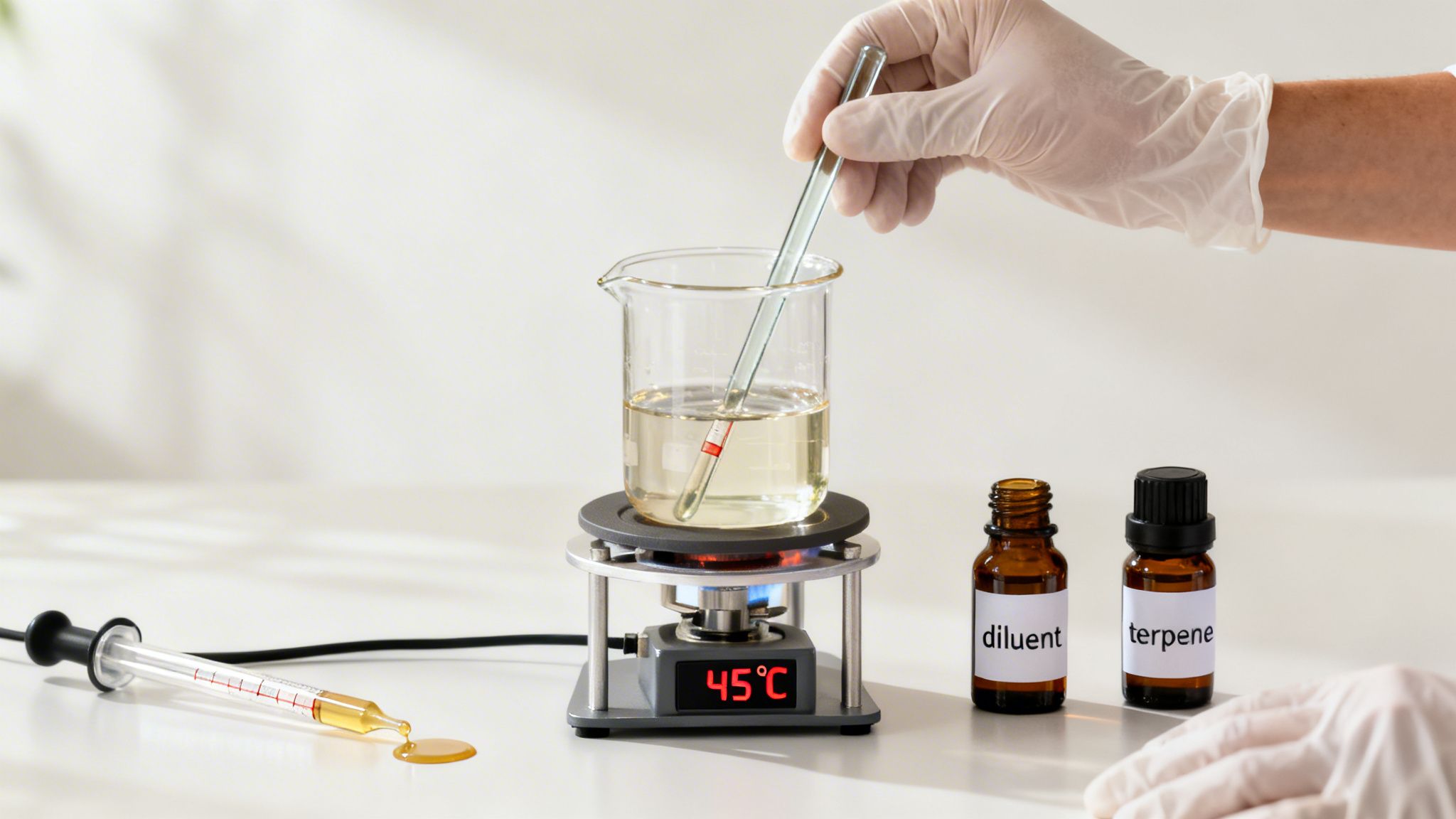
Viscosity is a critical parameter in vape formulation. Highly purified distillates are prized for their potency but are often too thick to work with directly from the container. If your oil cannot wick properly into a cartridge's coils, it leads to dry hits, a burnt taste, and product failure.
While terpenes help reduce viscosity, relying on them alone can be problematic. Pushing your terpene percentage too high just to achieve the right flow can result in a harsh, over-flavored blend. This is where clean, flavorless diluents become valuable, and a mixing ratios calculator allows you to add them with precision.
Finding the Balance Between Diluents and Terpenes
The art of formulation lies in finding the perfect balance. You need a terpene blend for flavor and effect, and you may need a diluent to achieve the ideal viscosity for your hardware. Using a mixing calculator for vape cartridges lets you dial in both a target terpene percentage and a target diluent percentage, so you know the exact composition of your final blend before you begin mixing.
This dual approach is a game-changer for several reasons:
- Protect Your Flavor: Set terpene levels based on optimal taste, not just viscosity requirements.
- Manage Costs: Diluents are generally more affordable than premium terpenes, helping manage your bill of materials without compromising quality.
- Optimize Hardware Performance: Ensure your final oil is a perfect match for your chosen cartridge, preventing clogs, leaks, and burnt wicks.
Your terpenes are the flavor engine, while the diluent is the transmission fluid. Both must work together in the right ratios to create a smooth, high-performance experience. The calculator ensures you add the exact amount of each, every time.
How to Mix Without Damaging Your Terpenes
Planning the perfect ratio is half the battle; the other half is the physical mixing process. A common mistake is using excessive heat, which destroys volatile top-note terpenes—the compounds that provide bright, fresh character. Don't let poor mixing technique undo the hard work of precise formulation.
For a smooth, homogenous blend that preserves your terpenes, a gentle approach is key. A magnetic stirrer on a hot plate is the standard tool. We've found the optimal temperature range is between 40-55°C (104-131°F). This is just warm enough to reduce the distillate's viscosity so that terpenes and diluents can mix in perfectly, without boiling off delicate aromatic compounds like those we cover in our guide to formulating with D-Limonene.
Scaling Up and Maintaining Compliance
Precise control over your ratios isn't just about quality—it's about scaling your business and maintaining compliance. In markets with strict regulations, a calculator is non-negotiable for hitting specific viscosity targets and ensuring accurate labeling.
Our own Mixing Calculator allows formulators to go from a tiny 1g test batch to a 64oz bulk production run with guaranteed consistency. This consistency reduces waste and is a major factor in earning repeat business from distributors and brands. By using a calculator to manage your formulation, you're building a reliable, repeatable process that delivers predictable results from the lab bench to full-scale production.
Common Questions About Using a Mixing Ratios Calculator
Even with the best tools, questions arise when dialing in a new formulation. Clear, confident answers are key to avoiding costly mistakes and perfecting your process. Here are some of the most frequent questions we hear from formulators using a mixing ratios calculator.
Can I Just Mix by Volume Instead of Weight?
The answer is an emphatic no. For any professional formulation, mixing by volume (using milliliters) is a recipe for inconsistent results.
The issue stems from density. Your ingredients do not weigh the same.
- Terpenes: Typically weigh around 0.85g per mL.
- Distillate: Is closer to 1.0g per mL.
If you mix by volume, your "10%" terpene blend will never actually be 10% by weight. Using a mixing ratios calculator that operates exclusively in weight (grams) is the only way to guarantee your ratios are precise, compliant, and—most importantly—repeatable.
What's a Good Starting Terpene Percentage for Formulating with Distillate?
When working with highly refined distillate for vape cartridges, a great starting point is between 5% and 8% terpenes by weight. This range typically provides excellent flavor and thins the oil sufficiently for proper wicking in most standard vape hardware.
Pro Tip: Always start on the lower end of that range for a new formulation. You can easily add more terpenes to a test batch, but you cannot remove them once they're mixed in. For particularly vibrant profiles, you might push to 10-12%, but test in small increments to check for harshness before scaling up.
How Does a Calculator Handle Potency Changes?
This is where a good calculator truly excels. It automatically handles the dilution effect. Any time you add a non-cannabinoid ingredient—terpenes, flavors, or diluents—you lower the final product's overall cannabinoid concentration.
For example, if you start with a 90% THC distillate and add an 8% terpene blend, your final product is no longer 90% THC. The calculator does the math instantly, showing you the new, final potency. This feature is critical for ensuring your Certificate of Analysis (COA) is accurate and your label claims are compliant.
Does the Order of Mixing Matter?
Yes, both the order and method are crucial for a stable, homogenous blend. Best practice is to gently warm your base concentrate (like distillate) first, using a hot plate with a magnetic stirrer.
Once the concentrate is fluid—usually around 40-55°C—slowly add your terpenes while the mixture is still stirring. This technique ensures the terpenes are evenly incorporated without being exposed to excessive heat, which can degrade volatile aromatic compounds. Proper mixing prevents "hot spots" and ensures a consistent product.
How Much Can I Make at Once?
A professional calculator is built for scalability. Whether you're creating a 5g test batch or a 5,000g production run, the ratios remain constant.
You simply change the "Total Batch Size" in the calculator, and it will provide the exact gram weights for every ingredient. This scalability is a cornerstone of professional manufacturing and ensures perfect consistency from your lab bench to the retail shelf.
Ready to stop guessing and start formulating with precision? The Gold Coast Terpenes Mixing Calculator gives you the power to create consistent, high-quality products every single time.