
Most decarb advice is built around a simple goal: activate cannabinoids as fast as possible. That works if your only KPI is conversion.
It fails if you are building a premium vape product.
For formulators, the lowest temp for decarboxylation is not a trivia question. It decides whether your oil stays clean enough for a bright top note, whether your strain-inspired terpene blend still tastes intentional after filling, and whether the final cartridge comes across as refined or cooked. Fast decarb can produce active oil. It can also strip the nuance that gives a cartridge shelf appeal and repeat purchase value.
A useful way to frame decarb is this: you are activating cannabinoids, but also preparing a sensory base for formulation. Once you look at the step that way, temperature choice stops being a back-room process detail and becomes part of product design.
Why Standard Decarb Temps Destroy Your Product Value
The common hot-and-fast mindset is expensive.
A formulator may save time with an aggressive decarb, then lose that time back trying to cover harsh notes, rebuild flavor, or explain batch drift to a brand team. High heat changes more than just potency. It changes the material you have left to formulate with.
For vape cartridges, that matters more than most SOPs admit. A cooked distillate base can mute citrus lift, flatten floral character, and push the whole profile toward heavy, generic resin notes. That is not a branding issue. It is a process issue.
What gets lost first
The earliest losses are the features customers notice first.
- Top-note brightness: The fresh, volatile aroma that gives a cartridge its first impression.
- Blend clarity: The separation between top, mid, and base notes becomes muddy.
- Smoothness in inhale: Overheated oil often tastes broader and rougher, even before added terpenes go in.
The reason this matters commercially is simple. If your base oil tastes stressed, every post-decarb terpene decision becomes more corrective and less creative.
Practical takeaway: A premium cart program should treat decarb as a preservation step, not just an activation step.
The trade-off is visible in any serious processing environment. Heat gets you conversion. It also pushes volatile compounds toward loss, especially once you move into the range where terpene handling gets more delicate. If your team is already using a terpene temp chart for formulation decisions, decarb temperature should sit in that same conversation.
Cost of going too hot
You rarely see the damage described clearly in operator language, so here it is.
A hotter decarb can lead to:
- More rework because the oil needs more sensory correction later
- Less believable strain replication because the underlying base no longer supports a clean profile
- Harder batch matching when one run gets slightly more thermal exposure than the last
In other words, standard decarb temperatures often protect throughput better than product value. If you are formulating for low-cost bulk output, that may be acceptable. If you are formulating for high-value vape SKUs, it usually is not.
The Science of Decarboxylation for Formulators
Decarboxylation is the conversion of acidic cannabinoids into their active forms. In practical terms, heat removes the carboxyl group as CO2, turning THCA into THC.
For formulation, the important point is not the textbook definition. The important point is control. Heat is the tool that unlocks the molecule, but too much heat changes other parts of the material you care about.

Why time matters as much as temperature
A lot of new formulators think of decarb as a fixed temperature target. It is a temperature-and-time relationship.
According to Leafly’s decarboxylation overview, decarboxylation follows first-order kinetics and the rate constant increases exponentially with temperature under the Arrhenius equation. That is why lowering heat slows the reaction so dramatically. The same source notes that at 115°F (46°C), only partial decarb occurs at about 75% THCA conversion over 2 to 3 days in open air, because the system does not gain enough thermal energy quickly enough and the extended exposure increases oxidation risk.
That single point explains why so many low-temp experiments disappoint operators. They pick a temperature that sounds gentle, but the process drags out long enough to create new problems.
A simple way to think about it
Use this mental model.
Heat is the hand turning the key. Enough pressure opens the lock. Too much force bends the key and scuffs the door.
In extraction terms:
- The lock is cannabinoid activation
- The key is your resin or oil matrix
- The scuffed door is thermal stress on flavor compounds and the finished sensory profile
This is also why a decarb SOP should sit next to your volatility references, not apart from them. If your team needs a refresher on thermal behavior, this guide on the boiling point of THC and related handling considerations is useful context.
What formulators should watch
The science matters because it changes how you set up production.
A formulator should evaluate decarb through three questions:
- How much activation is required for the product format?
- How much aroma integrity must survive into the blending stage?
- How long can the material stay under heat before oxygen exposure becomes the larger problem?
Those questions push you toward process discipline. They also explain why the lowest temp for decarboxylation is rarely the lowest possible number on paper. It is the lowest temperature that works reliably inside your equipment, with your batch size, your atmosphere, and your sensory target.
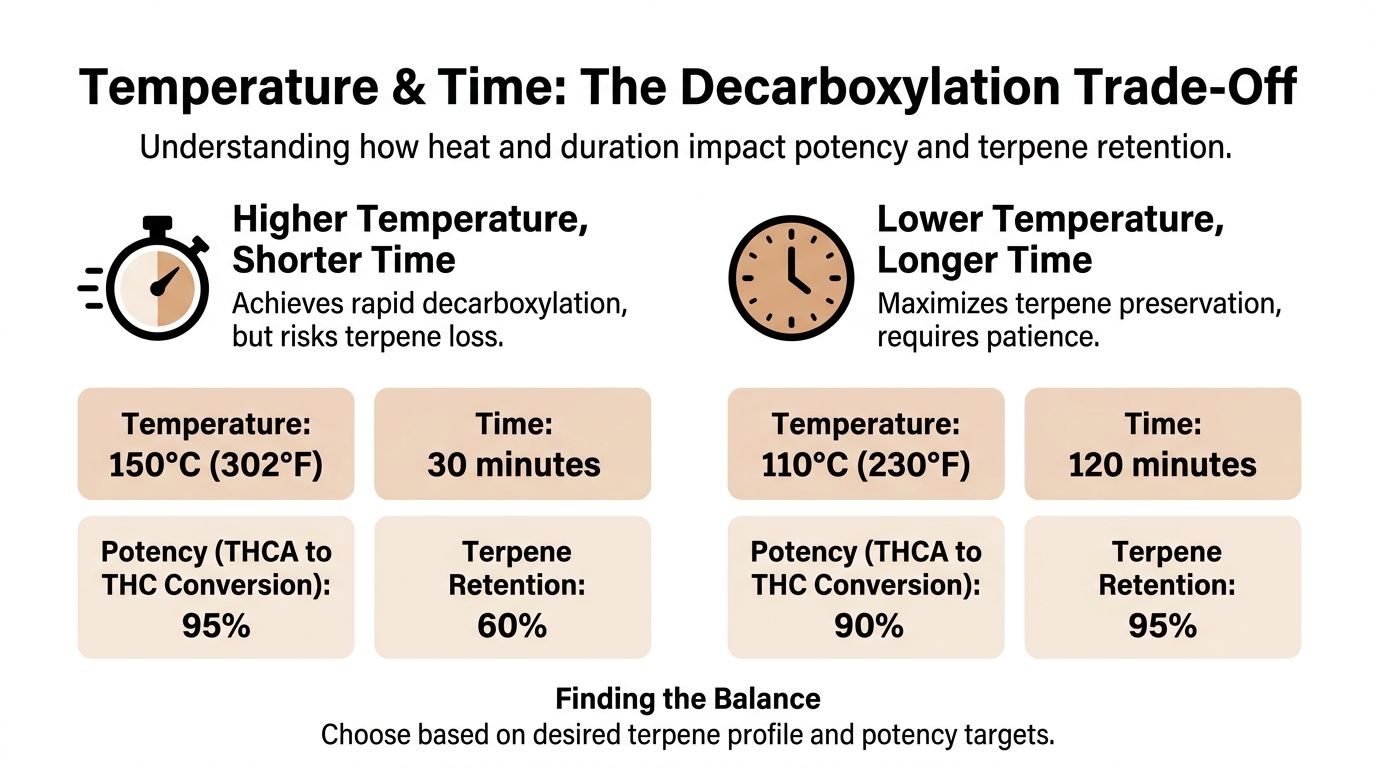
Temperature and Time The Ultimate Formulation Trade-Off
The number most formulators want is a single lowest setting. In practice, you need a workable floor and a reason to use it.
The lowest practical temperature for effective cannabis decarboxylation is 200°F (95°C), where conversion happens gradually over approximately 2 to 3 hours, while helping conserve delicate terpenes, according to this decarboxylation temperature guide. The same source notes that terpene volatilization typically begins above 220°F.
That is the threshold that matters for most atmospheric workflows. Below it, the process becomes less commercially useful unless you change the equipment conditions.
What 200°F buys you
At 200°F, you are buying restraint.
You are giving the oil more time to convert while reducing the thermal shock that can strip delicate aroma material. For premium distillate or concentrate workflows, that often gives you a cleaner canvas for post-decarb terpene blending.
What you are not buying is speed. This is not the profile for a facility whose main priority is pushing material through with minimal dwell time.
A decision table for real production
| Decarb approach | What it does well | Main drawback | Best fit |
|---|---|---|---|
| Around 200°F | Better preservation of delicate sensory character | Longer process time | Flavor-first vape formulation |
| Around 220°F | More balanced activation speed | Greater terpene stress than lower-temp runs | General-purpose production |
| Higher atmospheric temps | Faster conversion | More cooked flavor and weaker aroma integrity | Throughput-driven SKUs |
This is why the lowest temp for decarboxylation should be chosen from the product backward, not from the oven forward.
Where formulators make the wrong call
The most common mistake is optimizing the decarb step in isolation.
A lab operator gets an acceptable activation result, signs off on the batch, and only later discovers that the finished cart needs a heavier terpene load to read as intended. At that point the team has already lost flexibility. The base is flatter, so the blend has to work harder.
Use this filter instead:
- If the SKU is price-led: a more standard decarb profile may be acceptable.
- If the SKU is flavor-led: the lower, slower profile usually protects more value.
- If the oil will carry a precise strain-inspired terpene blend: preserving a neutral, less-cooked base is often more important than shaving time from activation.
Key takeaway: The better your decarb preserves the oil, the less your terpene blend has to compensate later.
For teams building carts specifically, process alignment matters. A dedicated guide on how to decarb cart oil for formulation use is a good companion when you are translating these trade-offs into a fill-ready workflow.
Flavor logic for top, mid, and base notes
A practical flavor view helps.
- Top notes carry lift and freshness. They are the easiest to lose when the oil is overworked.
- Mid notes create the recognizable core of a strain-inspired profile.
- Base notes add depth and staying power, but they cannot rescue a dead top end by themselves.
If your decarb profile damages the top end of the oil before formulation starts, the final cart often tastes dense and one-dimensional, even when the terpene blend is technically sound.
Low-Temp Decarboxylation Methods for Manufacturing
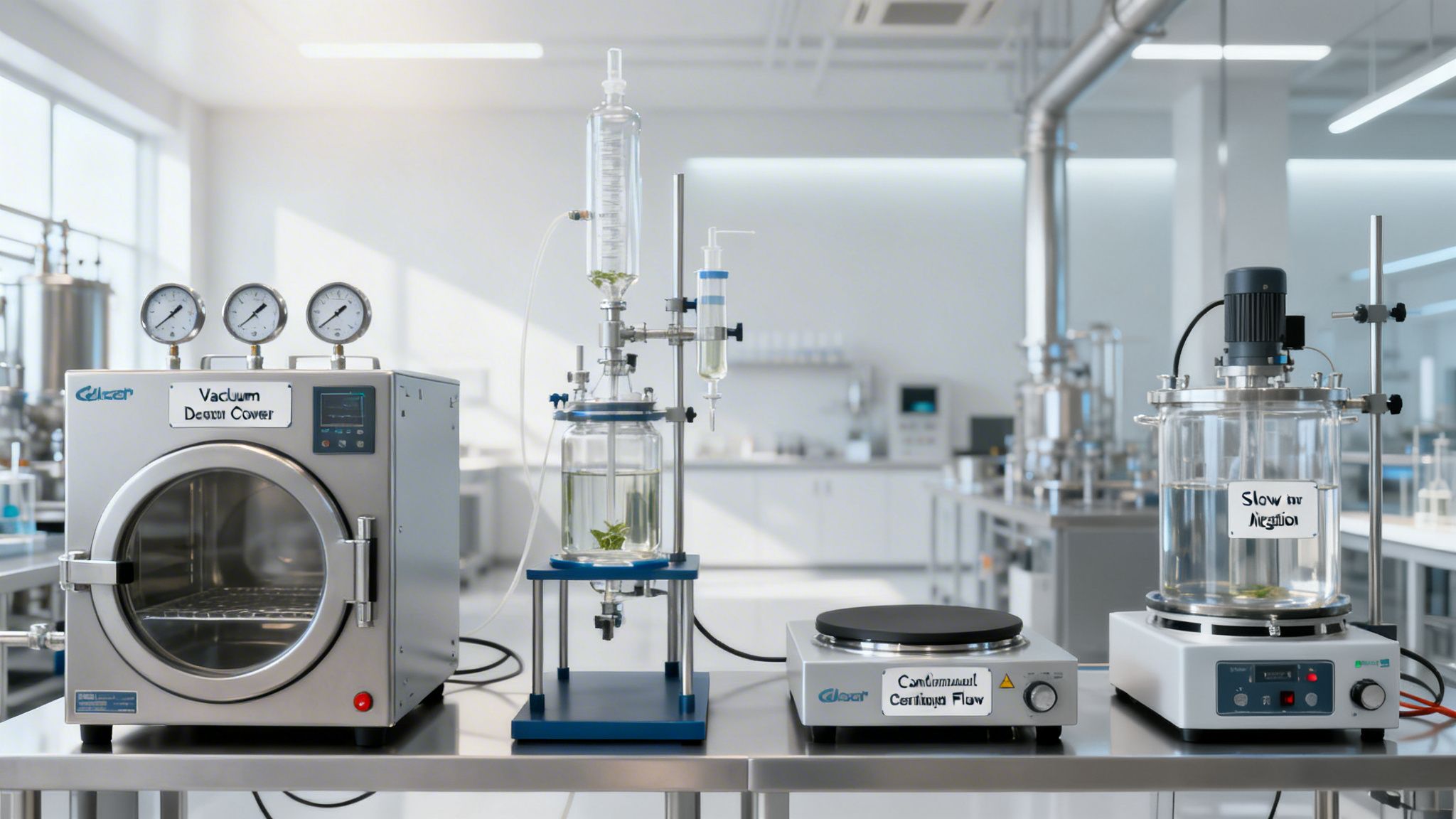
The right low-temp approach depends on your equipment, batch size, and tolerance for variability. There is no universal best method.
There is, however, a clear hierarchy in how much control each setup gives you over heat exposure and volatile retention.
Conventional oven
This is the most accessible path. It is also the easiest one to run inconsistently.
A conventional oven can handle lower-temp atmospheric decarb effectively if your load depth is controlled and the vessel setup limits unnecessary air exposure. For small production environments, it is often the starting point because the hardware is familiar.
What it does well:
- Works for pilot runs
- Simple to train around
- Acceptable if the product does not demand maximum aroma fidelity
Where it falls short:
- Hot spots are common
- Recovery between batches can drift
- Extended low-temp runs increase oxygen exposure concerns
This method is workable. It is not ideal for terpene-sensitive premium oil.
Sous vide and sealed-water-bath style control
This method matters because it improves thermal precision.
When a sealed system is held in a controlled bath, the operator reduces temperature swings and can decarb more gently than a typical open-air oven setup. It is useful for smaller, terpene-aware workflows where consistency matters more than speed.
The downside is scalability. Water-bath methods are usually better for development, specialty batches, or process validation than for larger production.
Vacuum oven
With vacuum ovens, low-temp manufacturing gets much more interesting.
According to the Future4200 low-temp decarb discussion, vacuum decarboxylation enables viable temperatures around 115°F to 140°F (46°C to 60°C), and the reduced pressure facilitates CO2 escape while lowering volatile boiling points. That same source reports more than 95% retention of terpenes like beta-caryophyllene under vacuum, compared with 50% to 70% loss in atmospheric ovens at 240°F.
For a formulator, this changes the floor. The lowest temp for decarboxylation under vacuum is dramatically lower than the practical floor in air.
That does not mean every vacuum run is automatically better. It means the process window is wider if the equipment is dialed in.
A vacuum oven is strongest when you need:
- Better volatile retention
- Gentler thermal treatment
- More control over oxidation exposure
- A repeatable path for premium concentrates and vape oil inputs
Tip: Vacuum decarb makes sense when the value of flavor accuracy is higher than the cost of equipment complexity.
Here is a useful visual reference before comparing your setup choices:
Rotary evaporator and related closed-process systems
Some manufacturers adapt rotovap-style equipment or adjacent closed-process tools for controlled thermal handling. These systems can support careful solvent removal and temperature management, but they are not a plug-and-play replacement for every decarb application.
Their strength is process integration. If your operation already relies on closed handling and careful recovery steps, they can fit into a broader quality-focused workflow.
Their weakness is complexity. They demand tighter operator control, stronger SOP discipline, and clearer endpoint checks.
Quick comparison for operators
| Method | Precision | Scale fit | Terpene protection | Notes |
|---|---|---|---|---|
| Conventional oven | Moderate to low | Small to moderate | Fair at best | Sensitive to hot spots and air exposure |
| Sous vide style control | Good | Small | Better than open-air baking | Useful for specialty runs |
| Vacuum oven | High | Moderate to large | Strong | Best option for low-temp terpene-sensitive work |
| Rotary or closed-process systems | High | Process-dependent | Strong when managed well | Best for advanced operations |
The practical lesson is simple. If you need the lowest temp for decarboxylation in a real manufacturing setting, atmospheric equipment has one floor and vacuum equipment has another. Your product tier should decide which floor matters.
Monitoring QC and Replicating Flavor with Terpene Blends
A low-temp decarb only creates potential. QC turns that potential into a repeatable input.
The first checkpoint is process observation. Operators usually watch for visible CO2 release behavior, texture changes, and the point where the oil settles into a more uniform appearance. Those are useful cues, but they are not enough for production release.
What to monitor after decarb
For commercial formulation, the sequence should be disciplined.
- Verify the endpoint: Use your analytical workflow to confirm the conversion profile rather than relying only on visual cues.
- Evaluate the oil sensory baseline: Smell and appearance matter because they tell you how much thermal stress the base picked up.
- Record batch behavior: If one lot needed more time or responded differently, that should follow the batch into formulation notes.
The reason is straightforward. Even a well-run low-temp cycle changes the original aroma picture. Some loss is unavoidable. The smart move is not pretending otherwise. The smart move is rebuilding intentionally.
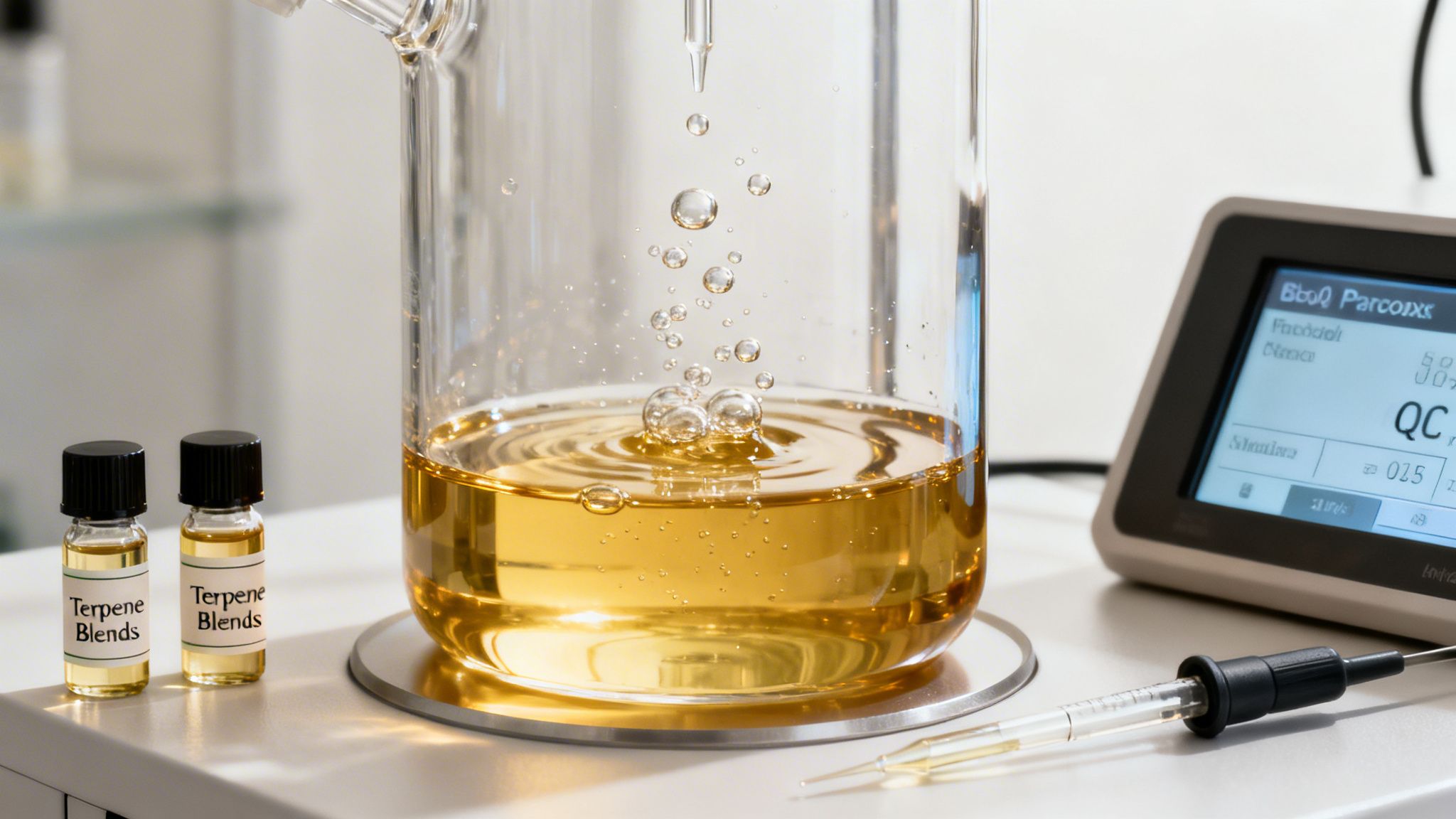
Why post-decarb blending matters
A finished vape oil needs a coherent flavor structure.
That means rebuilding the profile with purpose:
- Top notes restore the first aromatic lift
- Mid notes recreate recognizable strain character
- Base notes anchor the blend and carry persistence through the exhale
Many product teams improve consistency through this. Rather than hoping the original extraction aroma survives intact, they treat decarb as a controlled activation step and then restore the intended profile with a strain-specific terpene blend designed for the target SKU.
A flavor mapping reference like this terpene flavor chart for formulation work can help teams assign ingredients to top, mid, and base-note jobs instead of blending by instinct alone.
A practical workflow for replication
Use a repeatable sequence:
- Start with activated oil that still smells clean
- Build a target profile before blending
- Adjust in small sensory steps rather than trying to fix everything in one pass
- Document the final ratio and tasting notes for batch matching
Practical takeaway: Decarb does not finish the product. It creates the base that makes accurate flavor replication possible.
The best carts are rarely the ones that preserved everything. They are the ones built by teams that knew what would be lost, measured what remained, and reintroduced the missing profile elements with control.
Conclusion A Blueprint for Flavor-First Formulation
The best answer to the lowest temp for decarboxylation is not the smallest number anyone has tried. It is the lowest temperature that gives your operation reliable activation without damaging the oil you need for final formulation.
For most atmospheric workflows, that practical floor is 200°F, used with patience and process control. For vacuum systems, the workable range can go lower, which changes the economics for terpene-sensitive manufacturing. The point is not to chase novelty. The point is to preserve value.
A flavor-first decarb philosophy is simple:
- Activate cannabinoids without cooking the base
- Protect the oil so top, mid, and base notes can be rebuilt cleanly
- Match the decarb method to the product tier, not just the equipment on hand
That mindset improves more than aroma. It improves consistency, batch matching, and formulation efficiency.
A new formulator often thinks decarb ends when the bubbling stops. In premium vape development, that is only the handoff point. The actual work is what the activated oil allows you to do next. If the base is clean, your strain-inspired terpene blend can read as intentional. If the base is stressed, every downstream choice becomes damage control.
Frequently Asked Questions for Formulators
Can I decarb after adding terpenes
No if flavor matters.
Added terpenes should not go through decarb heat if you are trying to preserve profile accuracy. Decarb first, verify the oil, then blend terpenes into a controlled post-process base.
Is the lowest temp for decarboxylation always the best choice
Not automatically.
A lower temperature can preserve more aroma, but time and atmosphere still matter. According to Hemp Generation’s discussion of decarb temperature trade-offs, 220°F for 60 minutes may outperform 240°F for 30 minutes for terpene preservation, while prolonged heating at 200°F can still cause oxidative degradation if the atmosphere is not controlled.
Does starting material change the decarb decision
Absolutely.
A terpene-rich extract gives you more to lose and more reason to protect it. A highly refined input may tolerate a more standard decarb profile because less native aroma remains to preserve. The target SKU should guide the choice.
What are signs that the oil was overheated
Formulators usually notice sensory cues first.
Watch for:
- Flattened aroma where the profile smells broad but not distinct
- Harshness that shows up before the blend is finalized
- A cooked or darkened impression that makes strain replication harder
Should I choose atmospheric or vacuum decarb for premium carts
If you are building a flagship flavor program, vacuum usually offers better control. If you are producing general-purpose distillate at smaller scale, atmospheric low-temp decarb can still work if the setup is disciplined.
The right answer depends on whether your operation values throughput first or sensory fidelity first.
If you are developing carts, concentrates, or distillate blends and need reliable terpene inputs for flavor-first formulation, Gold Coast Terpenes offers strain-specific profiles, isolates, and formulation resources built for professional use. Their catalog is a practical next step when you want your post-decarb oil to taste consistent, intentional, and batch-repeatable.