
The Lemon Haze profile is a commercial workhorse. For formulators, its consistent, Limonene-dominant profile is a reliable blueprint for creating vape cartridges and concentrates with broad market appeal. It occupies a strategic position with its uplifting, citrus-forward experience that drives repeat purchases.
Understanding the Commercial Value of a Lemon Haze Terpene Profile for Formulation

Beyond its reputation, the Lemon Haze profile is stable, predictable, and bankable for product manufacturers. Its staying power in a crowded market is a result of its genetics and a sensory experience with incredibly broad appeal, making it a lower-risk investment for new product line development.
This guide provides a technical breakdown of the profile's architecture, explaining why it performs so well in manufactured goods and how to replicate it with precision for commercial applications.
Genetic Stability and Market Recognition
The strength of the Lemon Haze profile begins with its lineage, a cross between Lemon Skunk and Silver Haze, resulting in a dependable 70% sativa to 30% indica expression.
With THC levels consistently in the 17-22% range, its effects are well-documented and sought after in major markets. (For a deeper dive into its origins, check out the history of Lemon Haze on AllBud.com).
This lineage offers two significant advantages for formulators:
- Predictability: The stable genetics yield a consistent terpene and cannabinoid profile, providing a known quantity to work with rather than a moving target.
- Built-In Demand: The names "Lemon" and "Haze" carry substantial market recognition and consumer trust. Launching a Lemon Haze product taps into a pre-existing audience.
A Proven Blueprint for Formulation
The Lemon Haze profile should be viewed as a proven formula. Its dominant citrus top note is balanced by subtle earthy and spicy undertones, creating a layered experience that excels in vape cartridges, distillates, and other infused products.
This well-defined structure prevents it from tasting like a flat, one-note lemon aromatic—a common pitfall of less sophisticated formulations.
By understanding this aromatic architecture, formulators can build products that are not only authentic but also optimized for specific applications. Of course, a solid formulation requires a reliable supply chain. That means knowing where to buy terpenes that are high-quality and consistent.
Replicating the Aromatic Architecture of the Lemon Haze Strain
To create a commercially viable Lemon Haze blend, one must approach the task like a perfumer. The profile’s sophistication lies in its layered structure of top, middle, and base notes that work in concert to create a full sensory experience.
Ignoring this layered approach is a common mistake, resulting in a product that delivers an initial flash of lemon but lacks depth and character. The objective is not just to mimic a flavor, but to construct a dynamic profile that unfolds over time.
The All-Important Top Notes
The first impression of Lemon Haze comes from its top notes. These are the most volatile compounds, responsible for the signature bright, sharp, zesty punch.
For Lemon Haze, Limonene is the key component. It delivers an immediate, unmistakable blast of fresh lemon peel. However, simply overloading a blend with Limonene will create a harsh, one-dimensional profile reminiscent of a household cleaner.
The technique is to use Limonene as the primary top note and support it with other bright terpenes to create a more natural and complex citrus bouquet. This initial aromatic lift is what captures attention and sets the stage for the richer notes that follow.
Crafting the Body With Middle Notes
Once the initial citrus flash subsides, the middle notes emerge to provide the profile's body and character. These terpenes are less volatile than top notes and prevent the flavor from becoming hollow. They act as the bridge between the bright top and the heavy base.
Key middle notes include:
- Beta-Caryophyllene: This is the most important middle note for a Lemon Haze profile. It introduces a warm, spicy, peppery character that cuts through the acidic citrus, adding sophisticated depth.
- Myrcene: With its subtle, earthy, and slightly fruity musk, Myrcene helps ground the entire profile. It softens the sharp edges of the citrus and adds a classic "cannabis" aroma that contributes to authenticity.
- Terpinolene: Typically present in smaller amounts, Terpinolene's impact is significant. Its complex aroma—floral, piney, and citrusy—helps to integrate the dominant Limonene with the earthier notes.
Achieving the correct balance is critical. An excess of Beta-Caryophyllene will make the blend overly spicy; too little, and it will lack substance after the top notes dissipate.
Anchoring the Profile With Base Notes
Finally, the base notes provide the foundation of the blend and create a long-lasting finish. As the heaviest and least volatile molecules, they anchor the entire aromatic structure, ensuring it has a lingering presence.
In formulation, base notes are what create a memorable and lasting impression. While top notes provide the initial 'wow' factor, the base notes are responsible for the rich, full-bodied character that defines a high-quality product.
For a Lemon Haze profile, the base notes are subtle but essential. Isolates like Humulene add a woody, hoppy character that complements the earthiness of Myrcene. While not immediately prominent, their absence would be noticeable in a thin, fleeting finish.
To better understand how these components interact, our comprehensive terpene flavor chart is an invaluable resource for visualizing these relationships.
To better guide your formulation, think of the primary terpenes in terms of their role as top, middle, or base notes.
Lemon Haze Aromatic Note Breakdown for Formulation
| Terpene Note Role | Primary Terpene(s) | Aromatic Contribution | Formulation Goal |
|---|---|---|---|
| Top Notes | Limonene | Bright, sharp, citrus zest | Create an immediate, attention-grabbing lemon burst. |
| Middle Notes | Beta-Caryophyllene, Myrcene, Terpinolene | Spicy, peppery, earthy, musky, floral | Add body, complexity, and a bridge to the base notes. |
| Base Notes | Humulene | Woody, hoppy, earthy | Provide a lasting finish and anchor the lighter notes. |
By methodically building these three layers, you are re-engineering the authentic, multi-dimensional experience that defines the classic Lemon Haze strain.
A Step-By-Step Blueprint for Your Terpene Blend
Moving from theory to practical application, building a convincing Lemon Haze terpene profile requires precision and an understanding of isolate interactions. The goal is to construct a stable, scalable, and authentic experience for products like vape cartridges and distillates.
The secret is to layer the aromas carefully—the top, middle, and base notes—to create a single, cohesive profile. This infographic illustrates how the aromatic journey unfolds.
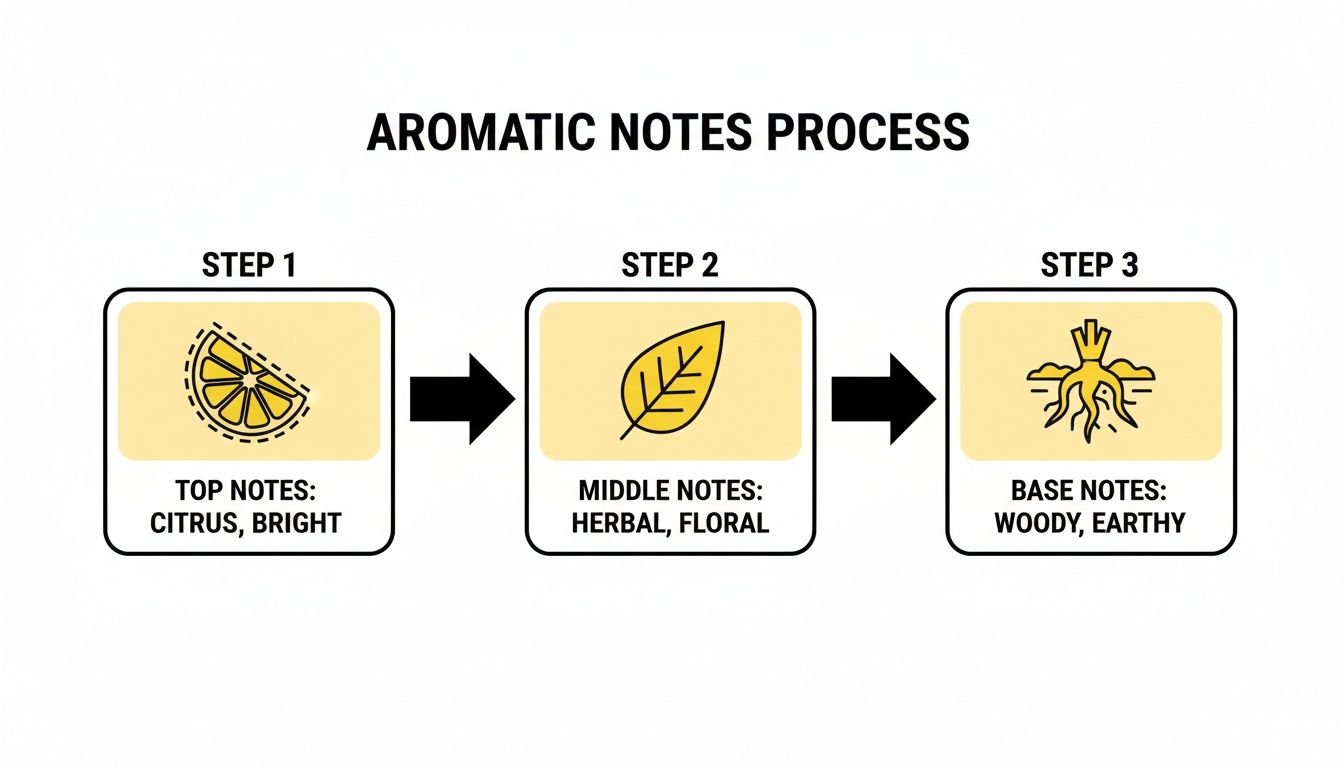
As shown, a successful formula is built in layers. Middle and base notes are essential to support and round out the initial citrus explosion from the top notes.
Establishing Your Core Ratios
When building any strain profile from individual isolates, start with the ratios between the dominant terpenes. For Lemon Haze, the relationship between Limonene and Beta-Caryophyllene is the foundation.
For a classic Lemon Haze, a 3:1 ratio of Limonene to Beta-Caryophyllene is an excellent starting point. This ratio allows the bright, zesty character of Limonene to lead without overwhelming the blend, while the spicy notes of Beta-Caryophyllene provide body and complexity.
Once that base is established, layer in the other key middle and base notes.
- Myrcene: Add Myrcene at approximately 50% of your Beta-Caryophyllene volume. Its earthy, musky character grounds the sharper citrus and pepper notes.
- Terpinolene and Humulene: These are supporting isolates. Introduce them at much lower levels, around 10-15% of the Beta-Caryophyllene volume, to add subtle floral, woody, and hoppy undertones.
This initial framework—3 parts Limonene, 1 part Beta-Caryophyllene, and 0.5 parts Myrcene—gives you a solid and balanced foundation. From there, you can add tiny amounts of other isolates to really fine-tune the final profile.
Adjusting for Nuance and Product Type
This base formula is a starting point. Product differentiation comes from making small, deliberate tweaks based on sensory goals and the final product application. A "brighter" Lemon Haze for a sativa-branded vape will require a different touch than an "earthier" version for a tincture.
Here’s how to make those adjustments:
- For a Zestier Profile: Increase the Limonene-to-Beta-Caryophyllene ratio to 3.5:1. This will amplify the sharp citrus top note for a more energetic first impression.
- For a Deeper, Earthier Undertone: Gently increase the relative amounts of Myrcene and Humulene. This softens the citrus edge and leaves a richer, more grounded finish.
These small changes, often fractions of a percent, can have a significant impact on the final product. To dial in percentages with precision, our guide on using a mixing ratios calculator can be a useful tool.
Addressing Technical Formulation Challenges
When formulating for vape cartridges, two key technical hurdles are terpene degradation and viscosity control.
Managing Terpene Degradation
Limonene and other top notes are highly volatile and can degrade or evaporate when exposed to excessive heat, resulting in a dull, flat-tasting product.
To prevent this:
- Maintain Low Temperatures: When adding terpenes to distillate, ensure the blend does not exceed 60-70°C (140-158°F).
- Mix Efficiently: Homogenize the blend quickly but thoroughly to ensure even distribution without prolonged heat exposure.
- Add Terpenes Last: Always introduce the terpene blend at the final stage of the process to minimize heat exposure.
Controlling Viscosity for Hardware Compatibility
The final oil's viscosity is crucial for vape cartridge performance. If it's too thick, it won't wick correctly, leading to dry hits. If it's too thin, it may cause leaks and flooded coils.
Terpene concentration is the primary tool for controlling viscosity. Most formulators use a 5% to 10% terpene concentration by weight. Start at the lower end (around 6%) and conduct small test batches with your specific cartridge hardware to find the optimal balance between flavor and performance.
Why Lemon Haze's Cultivation Metrics Matter for Formulation

While formulators may not focus on cultivation metrics, for a profile like Lemon Haze, these numbers are critical. They indicate a stable supply chain, a key factor in product development and management.
Choosing this profile is a strategic business decision. It is based on a strain known for being a reliable performer, and that reliability has downstream benefits for manufacturers.
A Solid Foundation for Production
Lemon Haze's commercial viability is rooted in its predictable cultivation performance. The strain became a global staple because it consistently delivers. You can find out more about its history over at Kilogrammes.com.
Indoors, cultivators can expect yields of 475-550g per square meter. Outdoors, a single plant can produce between 400-500g. Combined with a flowering time of just 9-10 weeks, the production cycle is incredibly efficient.
For a brand or manufacturer, this efficiency translates to:
- A Dependable Supply: Consistent harvests ensure a steady supply of raw material to meet demand.
- Cost Management: High yields and fast turnarounds help control cultivation costs, protecting profit margins.
- Confident Scaling: Predictable sourcing allows for accurate forecasting and confident production scaling.
These are not just agricultural metrics; they are de-risking factors for anyone investing in a Lemon Haze product line.
How Cultivar Aesthetics Translate to Market Value
The physical appearance of Lemon Haze flower—dense and covered in trichomes—carries its own market value. It signals potency and flavor to experienced consumers.
When this profile is captured in a manufactured product, it taps into that built-in reputation for quality.
As a formulator, your job is to bottle the idea of Lemon Haze. Its well-earned reputation for premium quality becomes a powerful part of your product's story, communicated through authentic flavor and aroma.
By aligning your product with a strain that already has a premium image, you lend it an immediate halo of quality. This helps your products stand out on crowded shelves and signals a top-tier experience, leveraging inherited trust to influence purchasing decisions.
Advanced Techniques for Product Differentiation
Achieving an accurate Lemon Haze profile is the baseline. The next step is using that classic profile as a foundation for innovation and brand differentiation.
The goal is not to create something unrecognizable, but to build upon its famous characteristics to offer consumers a new yet familiar experience. This approach allows for the creation of new SKUs without the risks associated with entirely new flavor concepts.
Pairing Profiles for Novel Flavor Combinations
One effective method for innovation is to pair the Lemon Haze blend with a complementary profile. Its bright citrus note is an excellent partner for other fruit-forward terpenes, enabling the rollout of new SKUs that retain the name recognition of Lemon Haze.
Consider these potential combinations:
- Lemon Haze + Mango: Adding a mango-dominant profile introduces a sweet, tropical layer that softens the sharp citrus, resulting in a smoother, rounder flavor fusion.
- Lemon Haze + Pineapple: This combination enhances the bright, tangy notes, creating an intensely zesty profile suitable for sativa-branded products.
- Lemon Haze + Berry: A subtle hint of raspberry or blueberry can add a sophisticated sweet-tart complexity, creating a more artisanal feel that stands out from standard citrus profiles.
The technique involves starting with a base Lemon Haze blend and slowly titrating in the second profile while testing methodically to achieve the desired balance.
Elevating the Profile by Boosting Minor Terpenes
A more advanced technique involves amplifying the minor terpenes already present in the Lemon Haze profile. While Limonene is dominant, subtle notes from compounds like Terpinolene and Humulene contribute significantly to its character. Modestly increasing their concentrations can create a signature version of Lemon Haze.
For instance, a slight increase in Terpinolene can enhance the floral and piney notes, making the blend more aromatic and complex. Alternatively, amplifying Humulene can boost the woody, hoppy undertones for a richer, earthier finish. These small adjustments can significantly alter the profile's character.
Think of it like a chef seasoning a dish. A little pinch of one spice can change everything without making the dish unrecognizable. The same principle applies here.
This technique helps create a unique "fingerprint" for a brand's Lemon Haze, a subtle shift that is difficult for competitors to replicate.
Tuning Hardware to Optimize Flavor Expression
The formulation process extends to hardware selection. The vape cartridge, specifically its atomizer design and temperature settings, plays a crucial role in flavor expression.
A delicate profile like Lemon Haze requires appropriate hardware. The bright top notes from Limonene are highly volatile and can be lost if a cartridge operates at too high a temperature. To preserve the signature flavor, the formulation must be matched with suitable technology. You can learn more about its benefits and characteristics in our detailed guide to understand why this is so critical.
Consult with hardware suppliers about cartridges designed for lower-temperature vaping. Ceramic coils, for example, tend to heat more evenly and can prevent the scorching that degrades citrus notes. Pairing a premium formulation with optimized hardware ensures the end-user experiences the Lemon Haze profile as intended.
Why a Championship Bloodline is a Commercial Advantage
Choosing the Lemon Haze profile is more than a flavor decision; it is an investment in decades of brand recognition and customer loyalty.
Its genetics—a cross of Lemon Skunk and Silver Haze—provide a significant commercial advantage by reducing the risks associated with new product launches. You are leveraging a built-in story of quality that consumers already know and trust.
Much of the marketing work is already done. The names "Lemon" and "Haze" signal a specific bright, energetic experience to a customer base that is actively seeking it.
The Halo Effect of a Champion Family
The market power of Lemon Haze is amplified by its famous relatives. Its cousin, Super Lemon Haze, created a massive "halo effect" for the Haze family after winning the High Times Cannabis Cup in 2008 and 2009. These victories cemented the "Lemon Haze" name as a benchmark for quality. You can get a sense of its impact on its Wikipedia page.
This legacy provides direct benefits:
- Instant Credibility: A product with the Lemon Haze name inherits the reputation of its award-winning lineage.
- Reduced Purchase Friction: Consumers are more willing to try a new product with a familiar and respected name.
- Premium Brand Positioning: The association with Cannabis Cup victories allows for immediate top-shelf market positioning.
What This Means for Your Product Strategy
Leveraging this lineage is a sound business strategy. When you perfect a Lemon Haze strain-inspired terpene blend, you are connecting your brand to a legacy of champions.
This connection reinforces your brand's value and signals to distributors and customers that they are getting a product rooted in proven excellence.
For a brand, an accurate Lemon Haze profile is a low-risk, high-reward asset. It delivers on a pre-existing market expectation, ensuring a baseline of demand and a clear path to profitability without the heavy lift of building a new flavor concept from scratch.
Ultimately, choosing Lemon Haze provides an immediate, powerful edge in a competitive market.
Lemon Haze Formulation FAQs
Here are answers to common questions that arise when working with a top-note-heavy profile like Lemon Haze.
How can I keep my Lemon Haze blend from tasting "artificial"?
An artificial, "floor cleaner" taste typically occurs when one terpene, Limonene, overpowers the blend. Without grounding notes, the profile tastes thin and synthetic.
The solution is balance. The bright citrus must be anchored with earthy, spicy middle and base notes. Blending in terpenes like Beta-Caryophyllene and Myrcene adds the necessary depth and complexity for an authentic flavor. A 3:1 ratio of Limonene to Beta-Caryophyllene is a reliable starting point.
What's the best terpene percentage for distillate?
For a Lemon Haze terpene profile in distillate, the optimal range is typically between 5% and 10% by weight. The ideal concentration depends on your hardware and desired flavor intensity.
- Start Low: Mix a small test batch at 6% to establish a baseline.
- Test on Your Hardware: Use the exact vape cartridges intended for the final product to evaluate wicking, flavor clarity, and potential for leaking.
- Adjust as Needed: Increase the percentage for a stronger flavor profile, or decrease it if the oil is too thin.
Why is my Lemon Haze vape clogging or tasting burnt?
Clogging or a burnt taste is often a hardware or viscosity issue, not a problem with the terpenes themselves. If the oil is too thick, it cannot flow fast enough to saturate the wick, causing the atomizer to dry fire and scorch the oil, destroying delicate citrus notes.
The goal is to match the final oil's viscosity to the cartridge's intake holes. A slight increase in the terpene percentage can often thin the oil sufficiently. For a detailed guide on optimizing flow, see our resource on formulating for vape cartridges.
Ready to create a Lemon Haze product that delivers an authentic, consistent experience? At Gold Coast Terpenes, we offer the lab-tested, strain-specific profiles and individual isolates you need for precise and repeatable formulation.