
When cultivators debate HPS versus LED, the conversation often centers on upfront cost versus long-term efficiency. But for product formulators, extractors, and brand owners, this debate is about something more critical: the quality and consistency of your starting material. The choice of lighting is the first and most pivotal step in determining the chemical profile of the biomass you will eventually process.
How Grow Lights Impact Cannabis Product Formulation
For brands striving to replicate a strain's flavor profile with precision, your work begins long before the extraction process—it starts under the grow lights. The final chemical makeup of the flower, especially its terpenes and cannabinoids, is a direct result of the light spectrum and intensity the plant receives. This isn't just a cultivation concern; it’s a quality control issue that lands squarely on the formulator's desk.
A cultivation facility's lighting decision directly shapes the sensory profile and, ultimately, the value of your final extract. If the flower arrives with a weak or inconsistent terpene profile, it cannot be magically fixed in post-production. You are left attempting to reconstruct the profile with botanical terpenes, a process that can compromise the authentic, true-to-strain experience your brand promises.
The Connection Between Light and Final Product Quality
When it comes to crafting high-end extracts and replicating complex flavor profiles, the real difference between HPS and LED isn't just power—it's spectral control.
HPS Lights: These are legacy fixtures. They emit a fixed, narrow band of light heavy on the yellow and red end of the spectrum. While effective for inducing flowering, this technology offers no ability to influence the biosynthesis of specific terpenes or other valuable compounds.
LED Lights: Modern full-spectrum LEDs are a different class of technology. They allow cultivators to create custom "light recipes," fine-tuning the levels of blue, red, far-red, and even UV light at different stages of the plant's life cycle. This enables a skilled cultivator to steer the plant toward producing a more desirable chemical profile for extraction.
This level of precision is paramount for creating terpene-rich flower. A growing body of research confirms that specific wavelengths can encourage denser trichome development and help preserve volatile terpenes, which can easily be degraded by the intense, direct heat of HPS lamps.
For a product formulator, the grow light debate isn’t about grams per watt. It’s about sourcing a consistent, complex, and predictable chemical profile that makes the task of replicating the flavor of a specific strain not just possible, but profitable.
Ultimately, the quality of the flower dictates the quality of your extract, and that extract defines your brand. It all begins with the trichomes—the microscopic chemical factories on the plant's surface. Understanding their maturation is key, and a trichome color chart provides an excellent visual guide. The HPS vs. LED decision is the first major variable in ensuring that mature flower translates into a world-class final product suitable for high-value formulation.
HPS vs. LED: A Technical Breakdown for Extractors and Formulators
If you're an extractor or product formulator, the grow light debate is not a distant cultivation issue. The light source used to grow your starting material has a massive downstream effect on everything from terpene profiles to the consistency of your final product.
It all boils down to how each technology creates and delivers light, which directly shapes the plant's chemical expression. Let's examine the technical differences.
The Old Guard: High-Pressure Sodium (HPS)
For decades, HPS was the industry standard. These lights are inexpensive to purchase and deliver high-intensity output. They work by passing an electrical arc through a tube filled with vaporized sodium, which glows with a powerful, yellowish-orange light. It’s a brute-force approach that is effective for the flowering stage.
However, this power comes with significant trade-offs. HPS lamps are highly inefficient, converting a large portion of electricity into heat rather than photosynthetically active radiation (PAR). This excess heat increases HVAC operational costs and can degrade the delicate, volatile terpenes you need to preserve. Furthermore, their fixed, narrow spectrum offers zero control for fine-tuning the plant’s chemotype.
The New Standard: Precision with LED Technology
LEDs operate on a completely different principle. These solid-state devices convert electricity directly into photons with remarkable efficiency, measured as photosynthetic photon efficacy (PPE). The result is more usable light per watt and significantly less waste heat.
This is where LEDs fundamentally change the game for product development: spectral control. Modern LED fixtures can be engineered to deliver a full spectrum that mimics natural sunlight or tuned to deliver precise ratios of blue, red, far-red, and even UV light. This gives a savvy cultivator unprecedented control over a plant's growth, structure, and, most importantly, its chemical profile.
For an extractor, this is the critical difference. LED-grown flower often arrives with a more robust and complete terpene profile because the cultivator can steer the plant toward that outcome while minimizing the heat that degrades those same compounds.
To put the core differences into perspective, let's look at the underlying technology side-by-side.
HPS vs LED Core Technology Comparison
This table outlines the fundamental specifications that define how each light technology operates and what it means for your cultivation environment and resulting biomass.
| Specification | High-Pressure Sodium (HPS) | Light-Emitting Diode (LED) |
|---|---|---|
| Light Generation | Gas-discharge lamp (electric arc through vaporized sodium) | Solid-state semiconductor (electroluminescence) |
| Spectrum | Fixed, narrow-band (heavy in orange/red) | Tunable, full-spectrum (customizable ratios of wavelengths) |
| Heat Output | Very high (significant infrared radiation) | Very low (efficient heat dissipation) |
| Energy Efficiency (PPE) | Low to moderate (~1.7 μmol/J) | High to very high (2.5 – 3.0+ μmol/J) |
| Lifespan | Shorter (~24,000 hours with significant degradation) | Much longer (50,000 – 100,000 hours with minimal degradation) |
| Control | On/Off/Dimming (limited) | Full control (dimming, spectral tuning, scheduling) |
As you can see, the technologies are worlds apart. HPS is a simple, powerful tool with major drawbacks, whereas LED offers a level of precision and efficiency that was previously unimaginable.
The impact of this technological shift on the final product is undeniable.
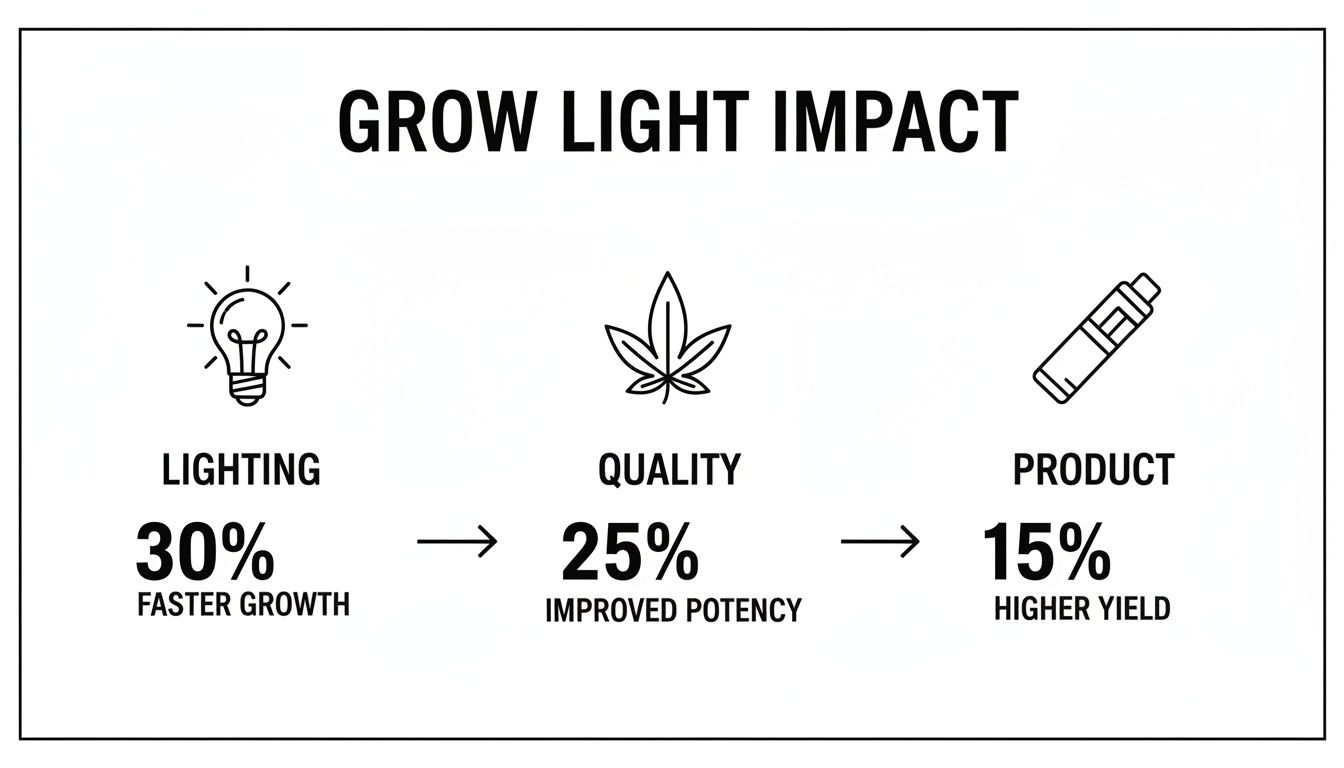
Superior lighting creates superior biomass, which ultimately allows you to produce a superior product. It's a direct line from the photons in the grow room to the quality of your vape cartridge. The way lighting and other environmental factors interact is complex, and you can learn more about how they affect cannabis terpene levels in indoor vs. outdoor cultivation to gain a broader perspective on sourcing. For anyone focused on producing premium, terpene-rich biomass for high-end extracts, the efficiency, lower heat, and spectral control of LEDs make them the clear technical winner.
Light Spectrum and Its Impact on Terpene Profiles
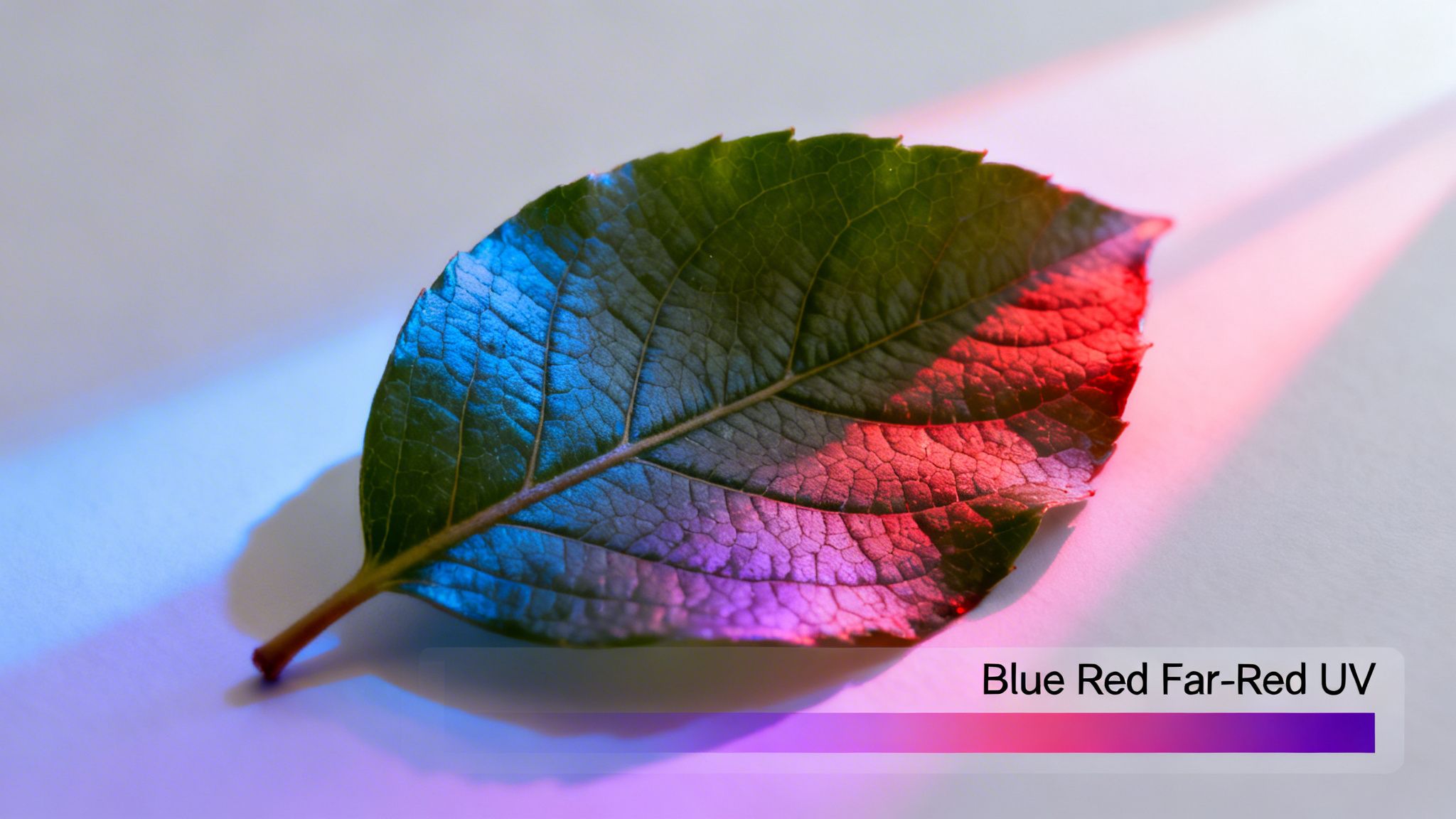
For a product formulator, the light spectrum isn't just a cultivation detail—it’s the tool that directly shapes the chemical composition of your raw material. The difference between the light an HPS bulb emits versus a modern LED is the single biggest factor determining a plant's final terpene and cannabinoid profile. This is a critical consideration for anyone aiming to capture the true, consistent flavor of a specific strain for vape cartridges.
High-Pressure Sodium (HPS) lights are legacy workhorses. They operate on a fixed, narrow spectrum that is heavy in yellow, orange, and red wavelengths (570–700 nm). While effective for pushing plants into flower, it offers zero room for adjustment. It’s a one-size-fits-all approach that achieves high yields but does little to encourage the rich, complex terpenes required for premium product formulation.
Worse, the intense infrared heat from HPS bulbs can degrade delicate, volatile monoterpenes. These compounds create the bright, fresh top notes that define many popular strain profiles. For a formulator, this means you are often starting with biomass that is already missing key aromatic notes, making it a challenge to replicate the true essence of a strain.
The Power of Tunable Light with LEDs
Full-spectrum LEDs represent a paradigm shift from brute-force lighting to precision agriculture. Unlike the static output of HPS, modern LEDs allow cultivators to dial in specific wavelengths at specific times. This “light recipe” is a powerful method for steering a plant’s development toward a desired chemical outcome.
By tweaking the ratios of blue, red, far-red, and even UV light, a skilled cultivator can influence everything from a plant’s physical structure to its final chemical expression. This is a massive advantage when producing high-value biomass specifically for extraction.
For formulators, the takeaway is clear: biomass from an LED grow provides a much better starting point for achieving a complete, diverse, and intact terpene profile. This makes achieving flavor accuracy in your products a far more predictable and successful process.
The ability to manipulate the light spectrum isn't just theoretical; it creates real, measurable changes in the final product that directly affect your work in the lab.
How Specific Wavelengths Steer Terpene Production
Understanding how different wavelengths affect the plant gives you a significant advantage when sourcing biomass. It allows for a more sophisticated conversation with your cultivation partners—you're not just requesting a strain, you're specifying a chemical profile.
Blue Light (400–500 nm): Essential during the vegetative stage, blue light promotes compact, bushy growth. More importantly, studies show it can boost the concentration of certain terpenes. Increased blue light can lead to higher levels of crucial monoterpenes like Limonene (a top note) and Myrcene (a middle note), which form the foundation of many popular profiles.
Red & Far-Red Light (600–750 nm): This end of the spectrum triggers flowering and increases biomass. The right balance of red and far-red light influences flower density and structure. Research also suggests that specific red-light ratios can impact the biosynthesis of sesquiterpenes like Beta-Caryophyllene, which deliver deep, spicy base notes.
UV Light (UVA/UVB): When used carefully, supplemental UV light acts as a mild stressor that activates a plant's defense mechanisms. This response can trigger an increase in trichome density and the production of valuable terpenes and cannabinoids, resulting in more potent and aromatic flower.
This strategic approach allows growers to act as chemical navigators, guiding the plant to produce a profile ideal for extraction. It’s a critical difference when comparing HPS vs. LED. The deep connection between these factors is a fascinating subject, and you can learn more by reading about how terpene transformation is influenced by environmental factors. For any brand that wants to deliver an authentic, true-to-flower experience, the precision of LEDs provides a much better starting material than HPS ever could.
The Real Cost of Growing: Energy, Efficiency, and ROI
When deciding between HPS and LED lights, it's easy to fixate on the initial purchase price. But that upfront capital expenditure is only a fraction of the total financial impact. To truly understand the economics, you must analyze the Total Cost of Ownership—encompassing everything from installation to replacement and all operational costs in between.
HPS fixtures have a lower upfront cost, which can be tempting for new operations managing capital. The problem is that this initial saving is quickly eroded by high operational expenditures. The real cost of HPS isn't on the purchase order; it's hidden in monthly power bills and maintenance schedules.
CapEx vs. OpEx: The Full Financial Picture
Comparing HPS and LED isn't as simple as pricing out two light fixtures. It's about the entire cultivation environment. The massive amount of heat generated by HPS lights creates a domino effect of additional costs that many operators don't account for until it's too late.
LEDs, conversely, are designed for long-term operational efficiency. While the initial CapEx is higher, their efficiency begins delivering returns from day one. By consuming less power and running cooler, they slash operational expenses (OpEx) and fundamentally change the ROI calculation.
It's not the purchase price that makes or breaks your budget—it's the monthly energy bill. That’s where LEDs have a massive, undeniable advantage that goes straight to your bottom line.
This isn't just a marginal improvement in efficiency; it's a transformative one. In large-scale cultivation, energy costs can be the single biggest factor determining profitability. HPS lamps are notoriously inefficient, converting only 30-35% of energy into usable light and wasting the other 65% as heat that your HVAC system must combat. Modern LEDs achieve 50-60% efficiency. That can reduce electricity consumption by 40-60% and slice a facility's total power draw nearly in half. You can check out a detailed comparison of these lighting technologies to see how the performance specs stack up.
Calculating Your Long-Term ROI
To see the real ROI, we need to examine the numbers. The savings with LEDs start with their superior efficiency, measured as photosynthetic photon efficacy (PPE). Top-tier LED fixtures today deliver a PPE of 2.5 to 3.0 µmol/J or even higher. HPS systems are technologically stagnant, maxing out around 1.7 µmol/J. In simple terms, LEDs deliver far more plant-usable light for every watt of electricity.
Here’s where the savings accumulate:
Lower Power Bills: This is the most direct financial benefit. An LED-powered cultivation facility can see its lighting-related electricity costs drop by 40% or more compared to an identical HPS setup. That saving goes directly to profit.
Reduced HVAC Load: HPS lights function as expensive space heaters. The heat they produce must be removed, requiring large, power-hungry HVAC systems to run constantly. LEDs run much cooler, dramatically cutting the strain—and the cost—of cooling a facility.
Fewer Replacements: Lifespan is another significant factor. An HPS bulb has a usable life of 10,000 to 24,000 hours, with its light output degrading steadily throughout. A quality LED fixture is rated for 50,000 to 100,000 hours with minimal light loss, saving substantially on replacement bulbs and labor costs.
Even with a higher upfront investment, the combined savings on electricity, cooling, and maintenance often mean an LED system achieves a positive ROI in just a couple of years. For an extractor or formulator sourcing biomass, this is critical. A cultivator with stable, predictable costs is a more reliable partner. They can deliver consistent, high-quality material without being at the mercy of volatile energy prices—which is exactly what you need when creating your own strain-inspired terpene blends. Understanding these cost dynamics helps you choose partners who are positioned for long-term success.
Maximizing Yield and Cannabinoid Potency for Extraction
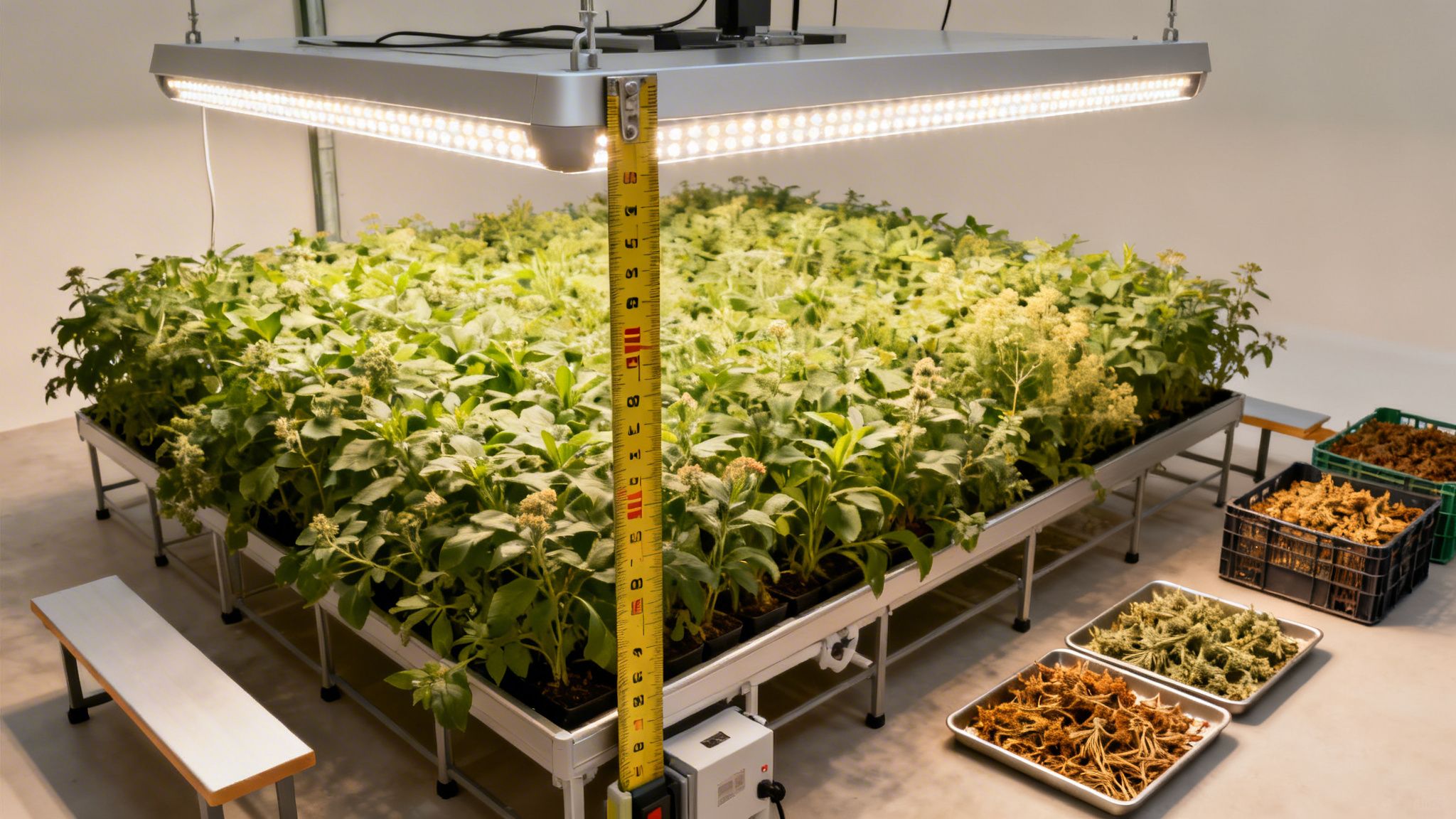
For those in the extraction sector, yield isn't just about the total weight of the harvest. The critical metric is the total output of valuable cannabinoids and terpenes per square foot. This metric is at the heart of the HPS vs. LED debate for cannabis product formulation.
A higher yield of potent, terpene-rich flower directly lowers your cost per gram of finished oil. For years, HPS lights were the standard for heavy yields, and many legacy cultivators still prefer them. However, technology has evolved. Modern, high-efficacy LEDs are now consistently matching—and often exceeding—HPS performance, not through brute force, but through smarter, more effective light delivery.
Improving Yield Per Square Foot
One of the most significant advantages of LEDs is their low operating temperature. HPS lamps emit substantial infrared heat, requiring them to be kept far from the canopy to prevent plant damage. This creates wasted vertical space and delivers less intense light where it matters most.
LEDs run significantly cooler, allowing them to be placed much closer to the plants. This single adjustment has a massive impact on yield potential.
- Closer Placement: Positioning lights closer to the canopy boosts the Photosynthetic Active Radiation (PAR) hitting the leaves, driving more vigorous photosynthesis and growth.
- Denser Canopies: With less heat stress, plants can be packed more tightly, enabling vertical farming configurations. This can dramatically increase the yield per square foot of a facility.
- Uniform Light: Quality LED fixtures distribute light more evenly, eliminating hotspots and ensuring every plant receives consistent energy for uniform development.
This ability to increase light intensity without the negative consequence of heat is why LED-powered facilities are achieving larger harvests.
The core advantage of LEDs for yield isn't just about light intensity, but about usable intensity. By minimizing heat waste, LEDs allow growers to deliver more photons directly to the plant canopy, resulting in denser, heavier, and more potent flower.
The Role of Full-Spectrum Light in Bud Development
Yield is also a direct result of overall plant health. Here, a full-spectrum LED provides everything a plant needs to thrive from seedling to harvest. Unlike the narrow, red-heavy spectrum of an HPS bulb, LEDs deliver the crucial blue light for building a strong vegetative structure and the precise red wavelengths needed for robust flowering.
This well-rounded spectral diet produces healthier plants that can physically support larger, denser buds. While HPS lights are effective at triggering the flowering response, the lack of blue light can cause plants to stretch and become lanky. These elongated plants simply cannot support the same weight as their stocky, robust LED-grown counterparts.
Stronger plants produce bigger, better flowers—the first step toward more efficient extraction. If your goal as a formulator is replicating the flavor of a specific strain, you need to start with dense, perfectly developed buds.
Connecting Light, Yield, and Potency
The data from commercial grows makes a clear case in the HPS vs. LED showdown. High-efficacy LEDs, some reaching an impressive 3.0 µmol/J, can deliver 1,200 µmol PAR onto the canopy. This has led to yield increases of up to 40% over HPS systems, which typically average around 800 µmol PAR and 1.5 µmol/J.
It's not just about weight. LEDs equipped with UV and far-red diodes have been shown to boost the expression of certain terpenes by 20-40%, a massive advantage for formulators. You can see a real-world example in this ViparSpectra LED grow that matched an HPS harvest with denser buds and stronger aromas.
Ultimately, maximizing yield means creating the perfect environment for plants to biosynthesize cannabinoids and terpenes. By delivering intense, uniform light without damaging heat, LEDs help growers produce a far superior starting material for extraction. This provides formulators with a richer, more potent biomass to work with, making it significantly easier to create high-value, strain-specific products.
Strategic Recommendations for Product Formulators
As a formulator or extractor, the HPS vs. LED debate is not an abstract cultivation issue; it is a strategic business decision. Your entire product development process hinges on the quality of your biomass. The choice of light source directly shapes flavor, consistency, and your bottom line.
LEDs for Precision and Terpene Diversity
If your brand reputation is built on authentic, complex flavors, or if you are outfitting a new facility, LEDs are the superior choice. Their tunable spectrums allow a skilled grower to "steer" the plant toward expressing specific terpenes. This provides a significant advantage, enabling you to source flower that is already rich in the aromatic compounds needed to replicate a strain’s true character.
For any company producing high-end vape cartridges or live resin, LED-grown flower is a far superior starting material. The key is the lower heat output. LEDs do not bombard the canopy with the same intense infrared radiation as HPS lamps, which helps preserve the most delicate and volatile monoterpenes. These are the top-note compounds that often degrade under HPS and are essential for a vibrant flavor profile. Sourcing this material means you receive biomass that is closer to the living plant, making your work in the lab much more efficient. A deep dive into a good terpene formulation guide is the next logical step for any brand serious about leading the market on flavor.
HPS for Bulk Biomass and Isolate Production
HPS technology, while dated, is not entirely obsolete. For established operations focused strictly on bulk biomass for isolate production, HPS can still be a viable option. If your primary product is THC or CBD isolate, the nuanced terpene profile is going to be stripped out during processing anyway. In that specific use case, the lower upfront cost of HPS fixtures can be attractive. These lights are workhorses known for producing heavy flower, and if grams per watt is your sole KPI, they remain effective.
However, there is a trade-off. The high operational costs of HPS—electricity and HVAC—are significant and can erode profit margins over time. If you produce distillates and reintroduce terpenes, starting with HPS-grown material creates more work. You will essentially have to build a flavor profile from scratch, which requires a high level of expertise in formulating for distillate.
The lighting decision dictates the quality of your raw material. For brands where terpene integrity and authentic flavor are paramount, LED is the smarter long-term investment. For sheer bulk where terpenes are not a factor, HPS can work, but at the cost of high operational expenses.
When you examine hard data from commercial cannabis research, the trend overwhelmingly favors LEDs. Studies consistently show that LEDs have a much higher light efficiency, converting more electricity into photosynthetically active radiation. This not only creates the potential for larger yields but also slashes power consumption by 30-50%.
For a formulator, the most compelling data point is this: the precise spectral control from LEDs can boost key secondary metabolites like myrcene and limonene by 10-20%. That's a huge advantage when sourcing biomass for terpene-rich products. You can discover more insights on these grow light findings and see the numbers for yourself.
Common Questions About HPS vs. LED Grow Lights
Migrating from HPS to LED lighting is not just a technical change—it raises practical questions that impact everything from daily operations to final product quality. For extractors and formulators, understanding these differences is crucial for ensuring consistency. Here are the most common questions from industry professionals making the switch.
Can I Just Swap My HPS Bulbs for LED Fixtures?
Assuming a one-for-one swap of HPS bulbs for LED fixtures is a common and costly error. A successful transition requires a comprehensive reassessment of your cultivation environment, not just a simple fixture replacement. LEDs distribute light differently and, more importantly, produce far less ambient heat.
This change creates a domino effect on the room's temperature, humidity, and even nutrient uptake by the plants. A full facility assessment is necessary to map out new fixture spacing, adjust mounting heights, and recalibrate your HVAC system. This is the only way to realize the full potential of LEDs and avoid issues like poor light coverage or environmental stress that can compromise biomass quality.
Do Flowers Grown Under LEDs Need Different Extraction Parameters?
It is highly likely, yes. Because LEDs can produce denser flowers with richer, more varied terpene profiles, your existing extraction SOPs may require optimization. You are often working with a higher concentration of delicate monoterpenes, which means you could achieve better results by using slightly lower temperatures or shorter extraction times to preserve these volatile top notes.
Our recommendation: Always run test batches with any new material from an LED-powered grow. This provides the empirical data needed to fine-tune your SOPs, ensuring you capture the full, complex aromatic profile instead of degrading valuable compounds during processing.
Is There a Real Flavor Difference in the Final Vape Carts?
Absolutely. For any brand that builds its reputation on quality, the difference is not just noticeable—it is a powerful market differentiator. Oil derived from LED-grown flower typically delivers a more vibrant, complex, and authentic flavor because a broader spectrum of terpenes was preserved from the very beginning of the supply chain.
This provides formulators with the ability to create true-to-flower experiences that do not rely on botanical terpenes to fill in aromatic gaps. When comparing the HPS vs. LED choice for your source material, this distinction separates a standard product from a premium one.
Whether you're working with material from an HPS or LED grow, hitting that perfect flavor profile comes down to precision. Gold Coast Terpenes offers lab-verified, strain-specific terpene blends and isolates to lock in consistency and quality with every batch. Explore our collection and elevate your formulations today.