
For cannabis product formulators, mastering terpene integration is about more than adding flavor. It’s a technical process of precision. To create top-tier products like vape cartridges and concentrates, success depends on integrating specific terpene ratios by weight into your extract, ensuring every batch is stable, consistent, and achieves the exact target profile.
Mastering Terpene Integration In Product Formulation

This is a technical guide for formulators who need to understand how to use terpenes for creating premium vape cartridges and concentrates with precision and scalability. Success doesn't start with mixing; it begins with a solid grasp of the physiochemical relationship between terpenes and cannabinoid extracts.
We’ll cover the essentials for any successful formulation. This includes understanding the critical relationship between your terpene blend and base extract, nailing your ratios by weight, and selecting the appropriate equipment for test batches and full production runs.
The Foundation Of Successful Formulation
Learning to use terpenes effectively is about mastering process variables. Every choice—from starting material selection to final product storage—impacts flavor, viscosity, and stability. This is the blueprint for repeatable success in a competitive market.
The global terpenes market is projected to more than double, from USD 923 million in 2025 to USD 1,886 million by 2034. A significant portion of that growth comes from formulators mastering terpene profiles for vape cartridges and other infused products. Technical data shows that using high-quality, botanically-derived terpenes can cut viscosity-related issues by 25-30%, leading to improved hardware performance and more reliable flavor delivery. You can explore the growth drivers for terpene usage to see where the industry is headed.
Key Takeaway for Formulators: Your process is your product. In a crowded market, consistency is the key differentiator. Mastering terpene integration is what separates inconsistent, one-off batches from a reliable, scalable brand standard that builds commercial trust.
To help you keep these critical details straight, here’s a quick-reference table summarizing the key parameters for the most common applications.
Terpene Integration Quick Reference
This table provides a summary of critical parameters and best practices for common terpene applications in cannabis product formulation.
| Application Type | Recommended Terpene Ratio | Optimal Mixing Temperature | Key Consideration |
|---|---|---|---|
| Vape Cartridges | 5-10% by weight | 120-150°F (49-65°C) | Ensure extract is fully decarboxylated to prevent cannabinoid crystallization. |
| Dabbing Concentrates | 2-5% by weight | 100-120°F (38-49°C) | Use minimal heat to preserve volatile top-note terpenes. |
| Tinctures | 1-2% by weight | Room Temperature | Mix thoroughly with a carrier oil like MCT for even distribution. |
| Topical Infusions | 1-3% by weight | 110-130°F (43-54°C) | Select terpenes known for skin permeability and synergistic aromatic properties. |
Think of this table as a starting point. Your specific extract and desired outcome will always require fine-tuning, but these guidelines provide a technically sound baseline.
Core Principles Of Terpene Integration
Before we get into the step-by-step methods, it’s important to understand the core principles that govern the outcome.
- Viscosity Control is Paramount: Terpenes are natural solvents and thinning agents. Understanding precisely how they lower the viscosity of thick distillates is crucial for formulating a product that wicks correctly in vape hardware without leaking.
- Flavor Profile Accuracy: Replicating a specific strain requires an understanding of terpene synergy. It’s not about one or two dominant compounds; it's about how the top, mid, and base notes interact to create a complex and recognizable aroma and flavor.
- Preventing Degradation: Terpenes are volatile and sensitive. Heat, light, and oxygen are their enemies. Your entire process, from mixing to packaging, must be designed to protect these delicate molecules to ensure the flavor crafted in the lab is the same one the end-user experiences. A good formulation guide can be an invaluable tool for your initial calculations.
Preparing Your Extract for a Flawless Blend
Before a single drop of a terpene profile for cannabis product formulation contacts your extract, the final outcome has been largely determined by the quality of your base material. The most precise ratios will not save a poorly prepared extract. A stable, premium product starts here.
These early steps directly impact final product clarity, stability, and flavor. Skipping them is the fastest way to encounter separation, cloudiness, or a muted flavor profile.
The Critical Role of Winterization
The first hurdle for formulators is managing unwanted compounds in the raw extract. Winterization is the process of removing lipids, fats, and waxes. If left in, they are the primary cause of cloudy vape carts and separation, a problem often called "crashing."
Why does this happen? At room temperature, these compounds precipitate out of the solution, compromising the product's appearance and consistency. A thorough winterization yields a clean, pure base ready to bond with your terpenes, resulting in a crystal-clear and stable oil.
A clean base is the canvas for your formulation. Adding a complex terpene profile to an unwinterized extract is like trying to paint a masterpiece on a dirty surface—the final result will always be compromised.
Mastering Decarboxylation for Full Activation
Next is decarboxylation. This is essential for any inhalable product. It’s a process of gently heating the extract to convert non-active acidic cannabinoids (like THCA) into their active forms (like THC). This is a balancing act.
The goal is full activation without destroying valuable compounds. Excessive heat can volatilize molecules and degrade the starting flavor of your base material. Insufficient heat results in incomplete conversion, which can cause vape cartridges to crystallize. It all comes down to precise temperature control. While the plant's biology is fascinating, our focus here is on post-extraction handling; for more on the plant itself, you can explore the differences between a male weed plant vs female.
Material Handling and Workspace Best Practices
The final piece of preparation is your environment and equipment. Contamination is a silent killer of quality.
- Use Non-Reactive Materials: Stick with lab-grade glass (like borosilicate beakers) or stainless steel for all containers and mixing tools. Plastics can leach chemicals or react with certain terpenes, tainting flavor and purity.
- Maintain a Clean Workspace: Your formulation area must be clean, free of dust, and well-ventilated. Terpenes have powerful aromas, so good ventilation is critical for safety and preventing cross-contamination between profiles.
- Prepare Your Equipment: Every tool, from magnetic stir bars to homogenization probes, must be spotless before and after each use. Any residue from a previous batch will compromise the unique profile you are creating.
By executing these preparation steps—winterizing for clarity, decarboxylating for potency, and maintaining a clean workspace—you build the foundation for a reliable and repeatable process.
Calculating Ratios For Precise Flavor And Viscosity
Nailing your target flavor profile is a game of precision. Whether enhancing an existing profile or replicating a specific strain, it all comes down to correct terpene ratios. For professionals, this means abandoning volumetric measurements (drops, milliliters) in favor of the accuracy of mass-based measurements (weight).
Why Measuring By Weight Is The Industry Standard
Measuring by weight is the only method to guarantee batch-to-batch consistency. It's a matter of density. Terpenes and cannabinoid distillates have different densities, meaning one milliliter of extract does not weigh the same as one milliliter of a terpene blend. This discrepancy can significantly throw off your ratios, leading to inconsistent flavor and viscosity.
Using a calibrated scale and measuring in grams eliminates this variable. A 5% terpene solution will always be 5% by mass, regardless of the components. This is the bedrock of professional product development.
Before mixing, ensure your extract is properly prepared.
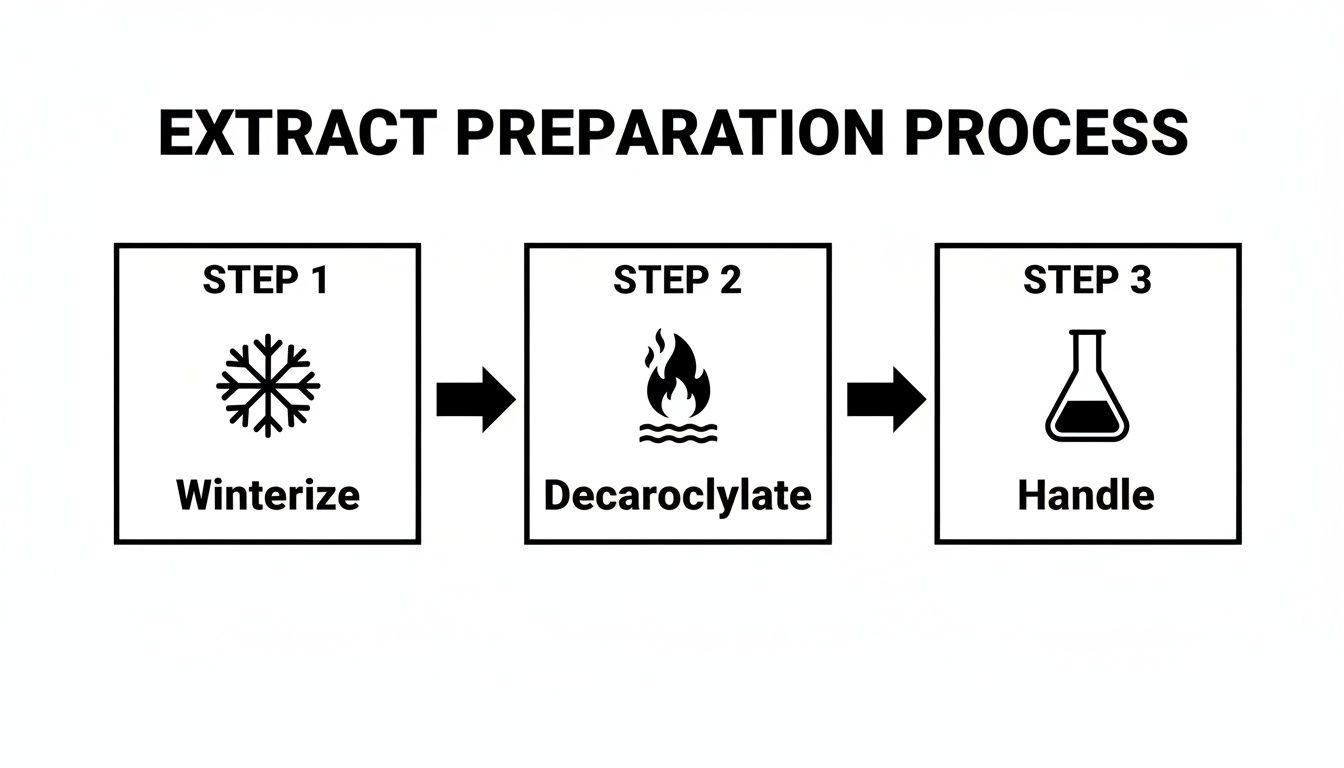
Each step—winterizing, decarboxylating, and proper handling—is crucial for a stable, predictable final product.
Calculating Your Target Ratio: A Practical Example
Let's walk through a real-world scenario. You are formulating 1,000 grams of finished oil for vape cartridges. You're using a Sour Diesel strain-inspired terpene blend and require a final concentration of 7%.
The calculation is straightforward:
- Total batch weight: 1000g
- Calculate terpene weight: 1000g x 0.07 (7%) = 70g of terpenes
- Calculate extract weight: 1000g – 70g = 930g of distillate
To execute, place a mixing vessel on a scale, tare it to zero, add 930g of warmed distillate, and then add exactly 70g of the terpene blend. This method scales perfectly from a 10g test batch to a 10,000g production run.
Formulator's Tip: Always add terpenes to the extract, not the other way around. This promotes more even and efficient distribution of the lower-volume liquid into the larger-volume oil, preventing terpenes from adhering to the vessel walls.
Recommended Starting Ratios For Common Products
While every formulation is unique, established starting points can reduce R&D time. These percentages are by total weight and serve as an excellent baseline for initial tests.
- Vape Cartridges (Distillate): 5-8% is the industry sweet spot. This range sufficiently reduces viscosity for proper wicking in most CCELL-style hardware and delivers a full, authentic flavor.
- Dab Concentrates (Shatter, Wax): Stay within 2-5%. These products often retain native terpenes, so the goal is to enhance or shift the profile, not overpower it.
- Tinctures & Edibles: A much lighter touch of 1-4% is needed to add a distinct aroma and flavor without creating a perfumy or overwhelming taste.
A critical rule of thumb is to stay below a 10% total terpene concentration in nearly any application. Higher concentrations can result in a harsh product, cause hardware leakage due to low viscosity, and raise potential safety concerns.
The growth in this sector has been significant. Since 2018, terpene use in cannabis product formulation has increased by over 150%. Lab data indicates that blending 5-8% terpenes into BHO warmed to 45-55°C and processed with an ultrasonic mixer for 10 minutes can achieve 98% homogeneity, helping formulators avoid the 20% separation risk common with inadequate mixing techniques.
Advanced Mixing Techniques for a Homogenous Product
The difference between a premium product and one that separates on the shelf often comes down to mixing technique. You've prepared your extract and calculated your ratios; now it's time to integrate the terpenes. This step locks in a consistent end-user experience.
This stage is about control—specifically, temperature control. The goal is to gently warm the extract to reduce its viscosity, allowing for complete and even terpene distribution. An oil that is too viscous will never achieve a truly homogenous blend, leading to flavor inconsistencies ("hot spots").
Why Controlled Heating is Non-Negotiable
For most distillate-based products, the optimal temperature range is 50-70°C (122-158°F). This is the sweet spot: warm enough to make the distillate flowable but cool enough to prevent volatilizing delicate top-note terpenes like Myrcene or Pinene.
Losing these top notes is a common error that results in a dull, one-dimensional flavor. You've invested in a complex terpene profile; do not compromise it with excessive heat.
Pro Tip: Never use direct heat. Always use an indirect heat source like a lab-grade hot plate with a water bath or a heated magnetic stirrer. Direct heat creates hotspots that will scorch the oil and degrade terpenes, compromising the entire batch.
Comparing Common Mixing Methods
Your choice of equipment will depend on batch size. What works for an R&D sample is insufficient for a production run.
Manual Stirring: For very small test batches (<50g), a glass or stainless steel stir rod can suffice. However, it is highly inconsistent and not recommended for any commercial product, as achieving a truly uniform mix by hand is nearly impossible.
Magnetic Stirrers: This is the workhorse for most small-to-medium-sized batches. A heated magnetic stirrer uses a spinning, coated magnet ("stir bar") to create a vortex, providing consistent agitation and even heating. It is an essential tool in any formulation lab.
Overhead Mixers: For scaling up to large batches, an overhead mixer with a propeller or paddle attachment is necessary. These are more powerful and can handle the thick, large volumes of oil that would overwhelm a magnetic stirrer, ensuring consistency across multi-kilogram batches.
Regardless of the tool, the objective is always the same: create a perfectly homogenized solution where every drop of extract contains the same concentration of terpenes.
The Role of Homogenization
While a magnetic stirrer is effective, for best-in-class results, many top-tier formulators use high-shear homogenizers. These tools use intense mechanical force to create an incredibly stable emulsion that will not separate. An ultrasonic homogenizer, for instance, uses powerful sound waves to achieve microscopic-level mixing.
This step is your insurance policy against separation, guaranteeing a long shelf life and ensuring the first puff from a cartridge is identical to the last.
As the industry matures, these professional methods are becoming standard. North America now represents over 40% of the global terpenes market, and this growth is driven by formulators who have optimized their processes. A common professional workflow involves cooling decarboxylated distillate to 50°C, adding the terpene profile, and mixing with a magnetic stirrer for 15-20 minutes. This technique has been shown to improve flavor retention by as much as 90% compared to unflavored oils. For more market analysis, you can review the latest terpenes market research.
Mastering these techniques separates amateur products from professional-grade formulations. Every isolate, like D-Limonene, has unique properties and benefits from this precise integration. For a closer look at what makes individual isolates tick, check out our guide on the benefits of D-Limonene.
Troubleshooting Common Formulation Problems
Even seasoned formulators encounter issues. You follow the SOP, but the final batch isn't right. Most problems are correctable once you know what to look for. This section is a field guide to diagnosing and solving the most common challenges in terpene formulation.
Diagnosing And Solving Product Separation
One of the most frequent issues is product separation, which can manifest as cloudiness, crystallization, or distinct layers forming in the oil. This is often called ‘crashing’ or nucleation. While it’s easy to blame the terpenes, this is almost always a problem with your base extract.
The primary culprit is incomplete winterization. Residual fats, waxes, and lipids precipitate out of the solution. To salvage the batch, you may need to gently reheat the oil to redissolve the components and then perform another winterization cycle. A stable product depends on a clean, fully decarboxylated extract from the start. For a look at our full range of profiles, you can check out our complete list of cannabis product formulation terpene profiles.
Correcting Flavor And Aroma Issues
Flavor problems typically fall into two categories: the taste is too harsh, or the aroma is muted. Both are usually caused by correctable process errors.
Harsh or Overpowering Flavor: This is a clear indicator of terpene overuse. Exceeding a 10% ratio can result in an aggressive, chemical-like flavor. We recommend starting low—around 5-7%—and adjusting based on small test batches. If a batch is too strong, the only fix is to dilute it with more base extract to lower the overall terpene concentration.
Muted or "Cooked" Aroma: If the flavor seems weak or lacks the expected bright top notes, you likely applied excessive heat during mixing. Terpenes are volatile, and high temperatures will boil off the most delicate aromatic compounds. Keep your mixing temperature below 70°C (158°F) to preserve the full character of the blend.
Formulator's Insight: Countless batches are compromised by impatience during the heating step. Rushing the process or adding terpenes to an overly hot extract consistently produces a dull, one-dimensional flavor that lacks the intended vibrant, authentic profile.
Managing Viscosity For Hardware Compatibility
Achieving the correct viscosity is a delicate balance. The oil's thickness must be perfectly matched to the vape hardware to ensure proper function.
If the oil is too thick, it won't saturate the wick correctly, leading to dry hits and burnt coils. This often occurs when the terpene ratio is too low or the starting distillate is exceptionally viscous. The solution is typically to incrementally increase the terpene ratio.
Conversely, if the oil is too thin, it will cause cartridges to leak. This is a sign of an excessive terpene percentage. Terpenes are powerful cutting agents, and an extra 1-2% can make a significant difference. You are looking for the sweet spot where the oil flows well enough to saturate the wick but is viscous enough to remain stable in the hardware. If you need to thin a mixture without altering the flavor profile, a purpose-built terpene diluent is the ideal tool.
Formulation Problem and Solution Guide
| Common Issue | Potential Cause | Recommended Solution | Pro Tip |
|---|---|---|---|
| Cloudiness or Separation | Incomplete winterization of the base extract. Residual fats/waxes are 'crashing out'. | Reheat the batch gently and run it through another winterization and filtration cycle. | Start with the cleanest, fully winterized distillate possible. This prevents 99% of separation issues. |
| Harsh, Chemical Flavor | Terpene concentration is too high (overdosing). | Dilute the batch with more unflavored base extract to lower the overall terpene percentage. | Always formulate in small test batches first. Start at 5% and work your way up to find the ideal flavor. |
| Weak or Muted Aroma | Excessive heat during mixing burned off volatile terpenes. | There's no fix for a cooked batch. Prevent it by keeping your mixing temperature below 70°C (158°F). | Use a quality digital thermometer and mix in a temperature-controlled environment. Do not estimate. |
| Oil is Too Thick (Dry Hits) | Terpene concentration is too low for the hardware. | Incrementally add more terpenes (0.5% at a time) and re-mix until the desired viscosity is reached. | Test your final formulation in the specific hardware you plan to use before committing to a large batch. |
| Oil is Too Thin (Leaking Carts) | Terpene concentration is too high. | Add more base extract to thicken the mixture and lower the terpene ratio. | A little goes a long way. If a 7% ratio is perfect, an 8% ratio might cause leaks. Be precise. |
Think of this table as your first line of defense. By correctly identifying the signs, you can quickly get to the root of the problem and, in most cases, salvage your work with minimal loss.
Post-Formulation QC And Storage Best Practices
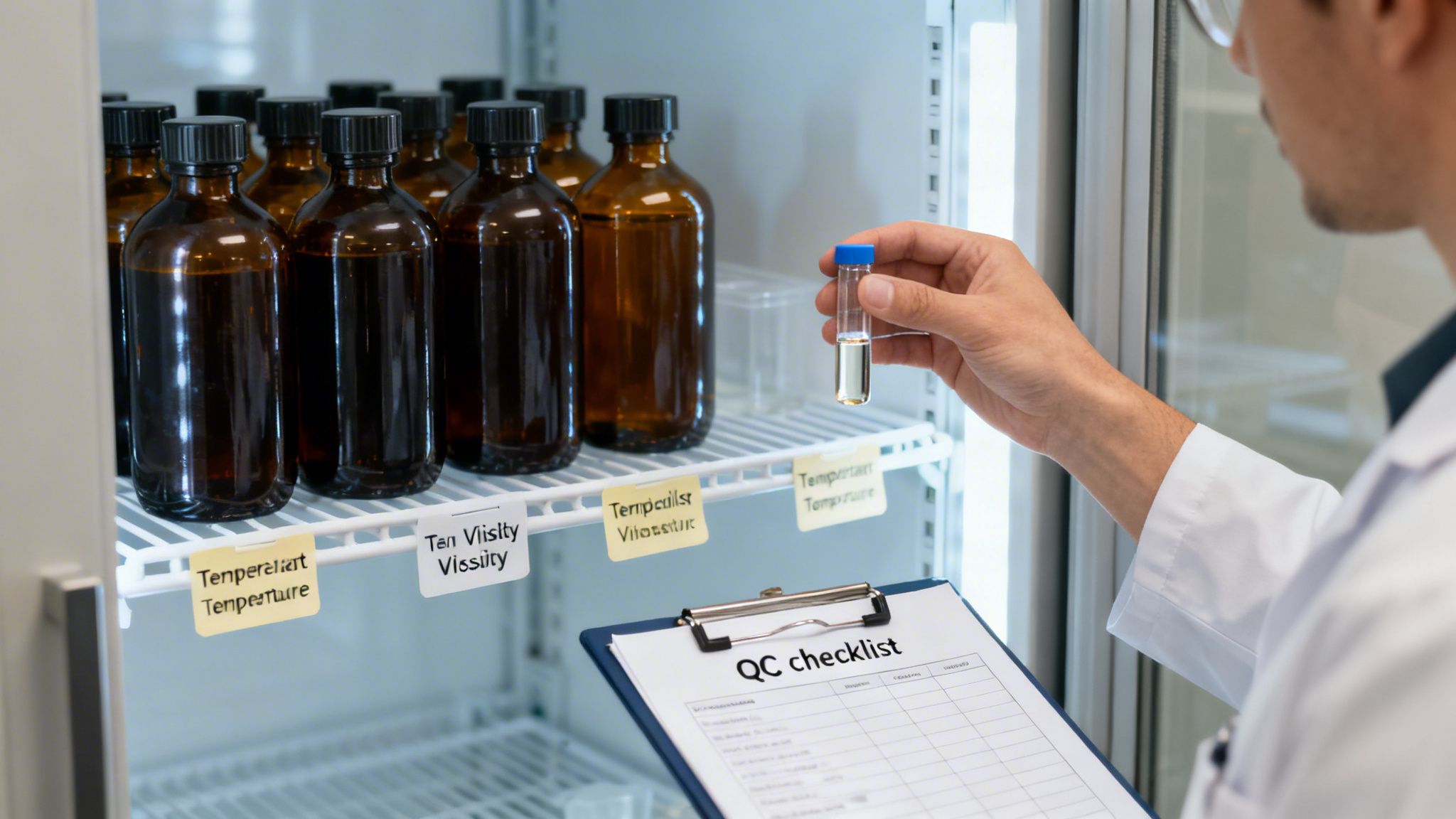
The formulation process isn't complete after mixing. The final stage involves quality control and proper storage to protect your investment and brand reputation.
Consistency is what drives repeat business. Before any product is released, it must pass several crucial checks. This is not just about catching major errors; it’s about ensuring every unit delivers the exact experience you engineered.
Essential Quality Control Checks
Make these checks a mandatory part of your SOP for every batch.
- Sensory Analysis: This is your first and most important test. Compare the aroma and flavor of a small sample against your reference standard. You're looking for bright, accurate terpene notes—not a muted or "cooked" profile indicative of excessive heat.
- Visual Inspection: Look for consistent color and clarity. The oil should be crystal clear, with no cloudiness, particulates, or separation. Any of these are red flags pointing to incomplete winterization or inadequate mixing.
- Viscosity Testing: Ensure the oil’s thickness is compatible with your hardware. While experienced formulators can often assess this visually, using a viscometer provides quantitative data, ensuring the oil wicks properly without causing leaks or clogs.
A Note on Homogenization: Ultimately, your QC process confirms that you have achieved a truly homogenous blend. Samples from the top, middle, and bottom of the batch should be identical in flavor, appearance, and viscosity. That is the sign of a successful mix.
Protecting Your Investment Through Proper Storage
Terpenes are delicate compounds. The primary threats are light, heat, and oxygen. All three will degrade your carefully crafted profiles, turning a vibrant flavor dull or off. Protecting both your raw terpenes and finished goods is critical.
For your bulk terpenes, use airtight, dark glass containers (amber or cobalt are ideal). Store them in a cool, dark environment. A refrigerator is perfect for long-term storage as it significantly slows the oxidation that degrades terpene potency. You can learn more about how different compounds perform in our terpene guides.
The same principles apply to your finished products. Proper storage and handling from your facility to the retail shelf ensure the customer experiences the product exactly as intended. Adhering to these QC and storage protocols is how you protect your bottom line and build a trustworthy brand.
Common Questions (and Expert Answers) About Using Terpenes
As you gain experience with terpene formulation, certain technical questions frequently arise. Here are answers to some of the most common challenges formulators encounter.
What's the absolute max percentage of terpenes I can add to a vape cart?
For nearly all distillate-based vape formulations, you must stay at or below 10% terpenes by weight. Exceeding this threshold can lead to a harsh flavor, excessively low viscosity causing hardware leakage, and potential safety issues.
The industry sweet spot for most professional formulators is between 5% and 8%. This range typically delivers the optimal balance of flavor, aroma, and reliable hardware performance.
Help! My distillate turned cloudy after I added terpenes.
This is almost always a sign of one issue: residual waxes and lipids in your extract. The cloudiness, a process called nucleation, indicates that the winterization step was not sufficiently thorough.
The only reliable solution is to properly re-winterize your extract before adding terpenes. Starting with a clean, impurity-free base is the only way to achieve a perfectly clear and stable final product.
Can I mix and match different terpene profiles or isolates?
Absolutely. This is where true product innovation occurs and how formulators develop new, proprietary strain profiles.
Experiment by:
- Layering different strain-inspired terpene blends to create a more complex, unique profile.
- Adding specific isolates, like Limonene, to accentuate a particular citrus note in an existing blend.
Always work in small test batches and maintain meticulous documentation. Detailed notes are essential when creating a novel, repeatable formulation.
Ready to create products that stand out with incredible, consistent flavor? At Gold Coast Terpenes, we deliver lab-verified, precisely formulated terpene profiles that formulators trust. Check out our full catalog and find the perfect foundation for your next creation at https://www.goldcoastterpenes.com.