
Using terp pearls in a formulation lab is straightforward: place one or two into a banger, heat to a precise temperature, and use a directional carb cap to initiate a vortex. This spinning motion distributes the concentrate into a thin, even layer, which mitigates scorching and ensures maximum terpene volatilization. The result? A much more consistent and flavorful experience for sensory analysis. For formulators, this simple tool is a game-changer for quality control during product development.
Why Terp Pearls Are Essential for Product Formulation
While many view terp pearls as a consumer dabbing accessory, their true value for industry professionals lies in the physics of heat distribution and terpene preservation. For a formulator, extractor, or brand owner, knowing how to use terp pearls is not about trends—it's about achieving precise, repeatable sensory results during R&D.
Consider the thermal dynamics: when a concentrate is introduced to a hot banger, it forms a static puddle. The oil in direct contact with the surface becomes superheated, which can easily degrade delicate monoterpenes before they can be properly evaluated. This provides an inaccurate representation of the terpene profile for cannabis product formulation you've meticulously developed.
Improving Heat Distribution and Efficiency
Terp pearls solve this by continuously moving and stirring the concentrate. This simple swirling motion dramatically increases the heated surface area, ensuring the entire sample is heated evenly and efficiently. This prevents two major challenges in formulation:
- Terpene Degradation: Eliminating hot spots prevents the scorching of sensitive top-note terpenes like Myrcene and Limonene, which have lower boiling points. This preserves the intended aromatic profile.
- Product Waste: Uniform heating leads to more complete vaporization. This results in significantly less residue, which is crucial for both cost savings and obtaining an accurate sensory analysis.
This principle directly impacts the bottom line. In mature markets where vape cart production is a multi-million-unit business, formulators have found that integrating pearls into their R&D workflow can reduce waste by as much as 18%. The pearls ensure even distribution of strain-specific terpenes, such as the earthy pinene notes in an OG Kush profile.
Achieving Consistent Sensory Profiles
When developing a strain-inspired terpene blend, consistency is paramount. You must ensure the Blue Dream profile validated in the lab is identical to the one experienced by the end-user. Terp pearls are a surprisingly critical tool for this type of quality control.
By maintaining a stable temperature across the entire oil sample, terp pearls allow formulators to accurately evaluate the full spectrum of a terpene profile. This enables the assessment of everything from the initial bright, citrusy top notes to the deep, earthy base notes. This makes them indispensable for both R&D and batch testing.
Ultimately, mastering the use of terp pearls helps a formulator bridge the gap between a lab report and the actual human experience. It ensures that the complex interplay of terpenes, something we explore when discussing plant characteristics, is expressed fully and accurately. It transforms a simple bead into a powerful tool for formulation excellence.
Choosing the Right Terp Pearl Material and Size
When formulating products, selecting the right terp pearls is not an aesthetic choice—it's a critical technical decision. The material and size directly impact everything from heat transfer to terpene preservation. For anyone in R&D or QC, getting this right is non-negotiable for achieving the flavor accuracy and consistency your brand demands.
The pearl's material dictates its thermal properties—how quickly it heats and how long it retains that heat. These factors determine whether you're efficiently vaporizing your terpenes or simply burning them off. If you're trying to perfect a specific strain-inspired terpene blend, you must match the pearl's heat behavior to the boiling points of your key terpenes.
Breaking Down Terp Pearl Materials
Each material offers distinct advantages. Understanding these nuances allows you to tailor your testing setup, whether you're aiming to capture delicate top notes or evaluate the longevity of heavier base notes.
- Quartz: This is the industry standard for good reason. Quartz provides an excellent balance of rapid heat-up and predictable heat retention. It’s durable and resistant to thermal shock, making it ideal for a fast-paced R&D lab where equipment is used repeatedly. Its clean, non-reactive surface won't interfere with the flavor of a nuanced terpene profile for cannabis product formulation.
- Ruby & Sapphire: These synthetic corundum gems excel at heat retention. They take longer to reach temperature but hold it steadily for an extended period. This is a significant advantage when analyzing complex blends with a wide range of boiling points, allowing for the slow and even vaporization of every aromatic note. However, they are more susceptible to cracking from thermal shock.
- Silicon Carbide (SiC): For high-performance applications, SiC is the answer. It boasts incredible thermal conductivity, heating up extremely fast and maintaining its temperature with exceptional stability. This makes it ideal for rapid-fire testing. Its dark, non-porous surface is also easy to clean, preventing flavor ghosting between different batches.
- Ceramic: Ceramic offers the highest heat retention but is also the most fragile. While it's excellent for low-temperature evaluations that preserve delicate flavors, its propensity to crack from thermal shock or accidental drops makes it a less practical choice for a busy lab environment.
For formulators, choosing the right material is about controlling the vaporization process to achieve reliable, repeatable results. The table below outlines the key differences to guide your decision.
Terp Pearl Material Comparison for Formulation
| Material | Heat Retention | Chemical Inertness | Best For |
|---|---|---|---|
| Quartz | Medium | High | All-purpose R&D and daily QC testing. |
| Ruby/Sapphire | High | High | Detailed sensory analysis of complex terpene profiles. |
| Silicon Carbide (SiC) | High | Very High | High-throughput testing and rapid heat-up cycles. |
| Ceramic | Very High | High | Low-temperature evaluation of highly volatile terpenes. |
Ultimately, the goal is to use a material that gives you the most control over the heat, ensuring your formulation's true character comes through every time.
This flowchart can help you decide when a vapor enhancer like a terp pearl is the right move to improve your product's quality.
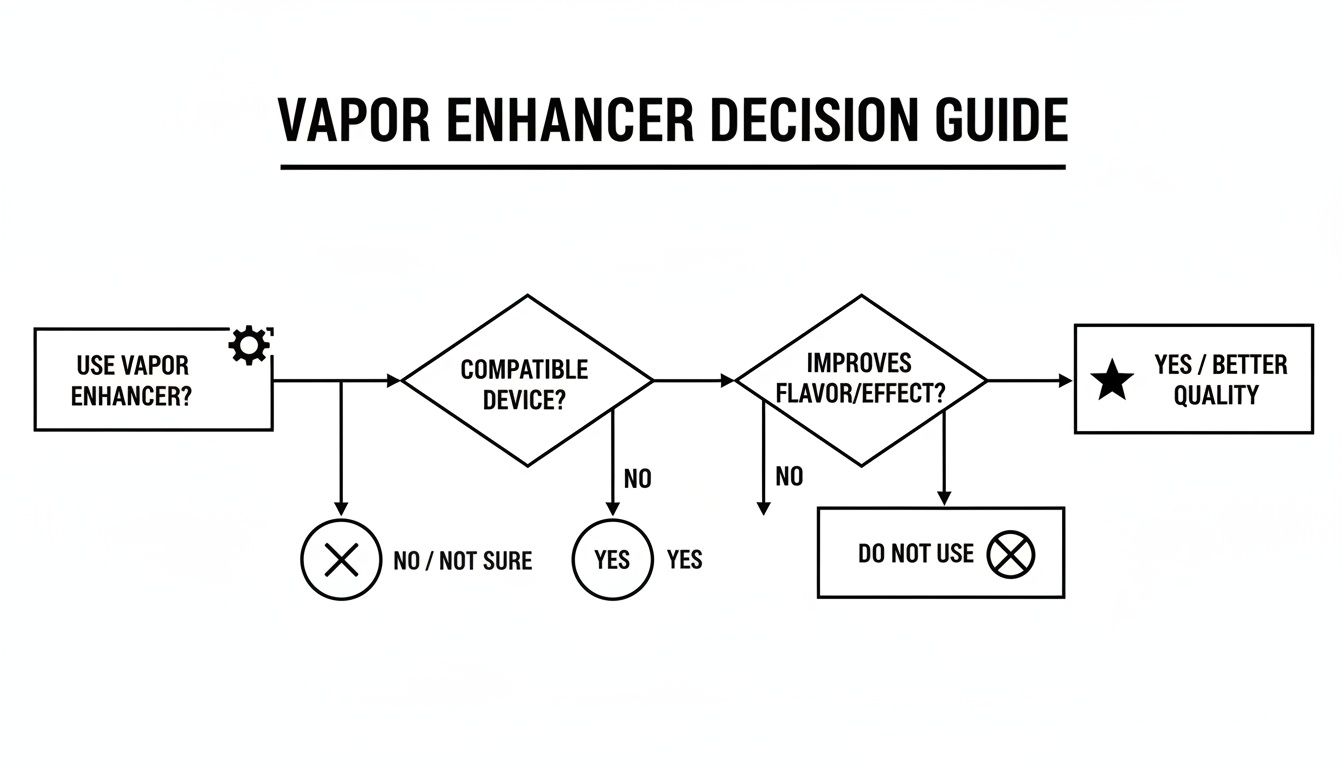
As you can see, it all comes back to quality. And for formulators, quality is all about achieving consistent and accurate terpene expression.
Matching Pearl Size to Your Application
The diameter of your terp pearl is just as crucial as its material. Size dictates the pearl's mass, surface area, and movement dynamics. An incorrect size can lead to skewed sensory data from inefficient vaporization or poor mixing.
A formulator’s objective is to create sufficient surface agitation for a perfectly homogenous mixture of concentrate and terpenes without restricting airflow. The spinning pearl is what ensures that the delicate top notes from a complex blend, like our Blue Dream profile, are properly expressed instead of being scorched.
A common error is using a pearl that’s too large for the banger, which blocks airflow and kills the necessary vortex action. Conversely, a pearl that's too small lacks the mass to retain heat or generate enough movement, especially with more viscous oils.
Here’s a quick guide for matching pearl size to your equipment:
- 3mm Pearls: Ideal for the smallest R&D rigs. Their low mass is perfect for micro-dosing highly potent test batches where every drop counts.
- 4mm Pearls: The versatile, go-to size for standard 25mm bangers and most benchtop testing setups. A pair of 4mm pearls provides excellent agitation and heat distribution for typical sample sizes.
- 6mm Pearls: Reserve these for larger 30mm+ bangers or small-batch production vessels. Their greater mass and surface area are effective for homogenizing larger volumes of oil or working with highly viscous concentrates.
By being deliberate about both material and size, you transform a simple accessory into a precision instrument. This data-driven approach is how you masterfully begin replicating the flavor of popular strains and ensure the profiles developed in the lab are precisely what the market experiences.
Nailing Your Heating and Temperature Control
Precise temperature control is not a suggestion—it is a fundamental requirement. To achieve the true expression of your terpenes without thermal degradation, you must be exact. For anyone formulating with a specific flavor profile in mind, mastering heat application is the difference between a successful product and a wasted batch. This is where understanding how to use terp pearls becomes a critical lab skill.
Terp pearls excel at distributing heat evenly, but they can only work with the temperature you provide. The entire principle of low-temp vaporization rests on finding the optimal thermal window: hot enough to volatilize cannabinoids and terpenes, but cool enough to prevent their destruction.
Dialing in Your Heat Source
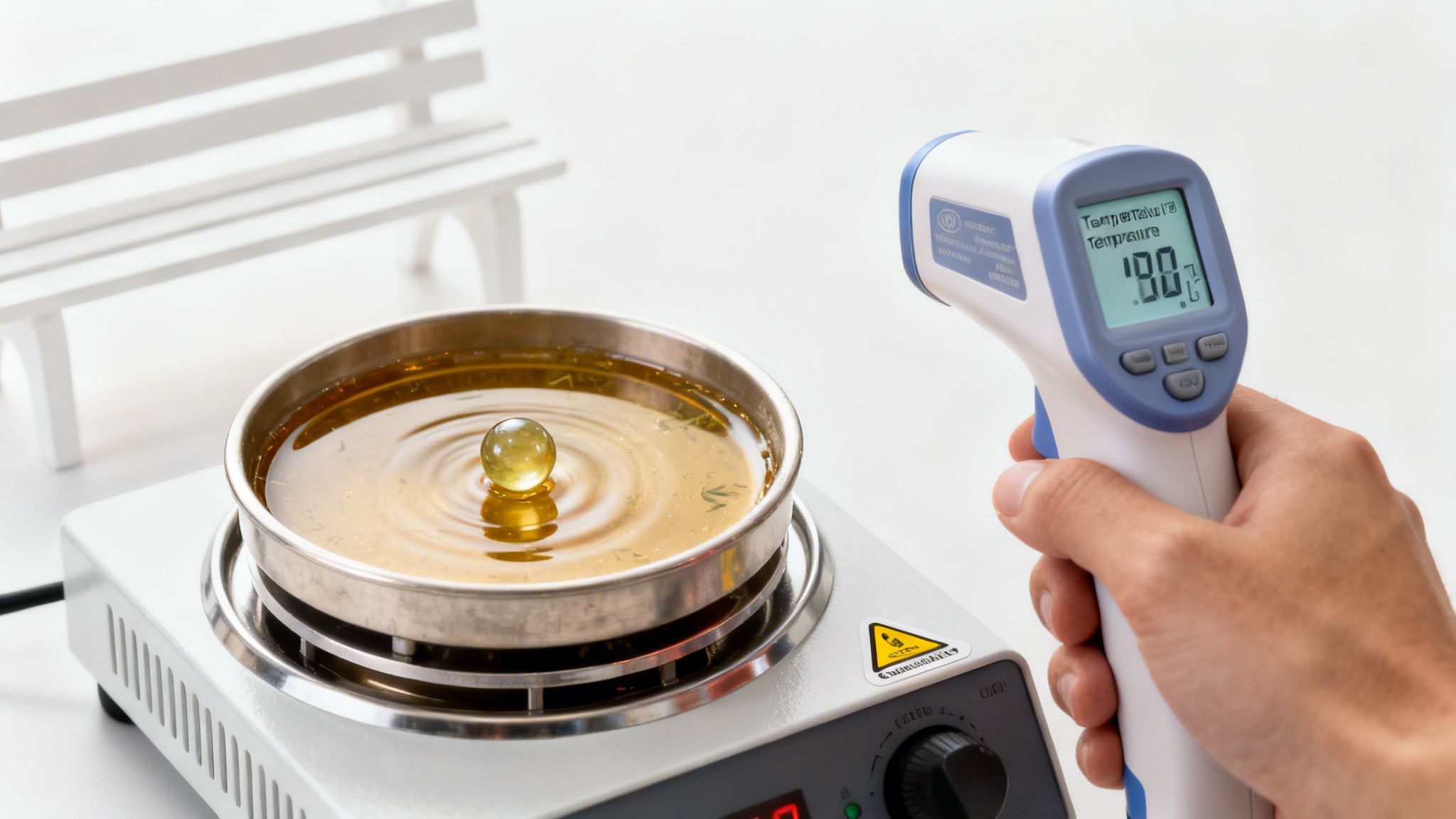
In a professional setting, consistency is paramount. Whether you're using a torch and banger for R&D or a high-tech heating element, calibration is what makes your results repeatable. An infrared thermometer is not optional; it is a mandatory tool for any serious formulator. It provides instant, accurate surface temperature readings.
For the most precise data, aim the IR thermometer directly at the bottom of the banger. From there, you can establish a trusted workflow.
- Heat your rig for a set duration.
- Start a timer and log the cool-down rate.
- Check the temperature every 5-10 seconds.
This process allows you to map the unique thermal signature of your equipment. You will know exactly how long to wait to hit the perfect temperature, enabling you to perfectly begin replicating the flavor of a specific strain time and again.
Temperature Targets for Your Formulation Goals
Different terpenes have different boiling points. A one-size-fits-all temperature approach will yield a muddled flavor, torching delicate top notes while leaving heavier base notes unexpressed. Your goal should be to target specific temperature ranges based on the key terpenes in your blend.
Any solid terpene formulation guide should include boiling point information. Highly volatile monoterpenes like Limonene and Myrcene vaporize at lower temperatures, while heavier sesquiterpenes like Beta-Caryophyllene require more thermal energy.
Pro Tip: When working with blends rich in delicate top notes, start your evaluation in the 350-450°F (177-232°C) range. This lower window is ideal for preserving the bright, citrusy, and floral notes that define many popular profiles.
This is precisely where terp pearls prove their value. Their constant movement spreads the concentrate into a thin film, ensuring the entire sample is vaporized efficiently, even at lower temperatures. Without pearls, a low-temp test often results in a disappointing puddle of wasted product.
Recent findings support this. For example, a 2026 Oil Slick study showed quartz pearls boosted terpene retention by an impressive 32% in low-temp tests (450-500°F) compared to testing without them. This helped preserve nuanced notes from isolates like Beta-Caryophyllene, which comprised 15-25% of their Green Crack blend. For more on this trend, you can dig into the latest findings on pearl market share growth.
Matching Temperature to Terpene Profiles
Let's apply this to a real-world scenario. Say you are working with one of our strain profiles. The ideal temperature you select will hinge on which terpenes are dominant.
- For Blends High in Limonene: When formulating with a citrus-heavy profile like our Super Lemon Haze strain-inspired terpene blend, you want to protect that zesty top note. Stay on the lower end of the heat spectrum, around 380-420°F. This prevents the Limonene from flashing off instantly.
- For Blends with Heavy Base Notes: If you're working with a profile full of earthy or woody sesquiterpenes, like a classic OG Kush, you will likely need to increase the temperature into the 430-470°F range. This ensures those heavier compounds, like Beta-Caryophyllene, are fully activated to deliver their signature peppery depth.
By methodically controlling your temperature and letting terp pearls manage the even heating, you replace guesswork with certainty. You gain the power to analyze every note in your formulation, ensuring the product that reaches the market is exactly what you designed. For any formulator building a reputation for quality, that level of control is non-negotiable.
Bringing Terp Pearls into Your Formulation Lab
Terp pearls are not just for consumer dab rigs; they have become an indispensable tool in our lab, particularly during the R&D and quality control stages of product formulation. Consider them a valuable asset for sensory analysis.
Before committing to a large production run, you need to know exactly how a terpene blend will perform when heated with your concentrate. By adding controlled agitation to a test sample, terp pearls help you get a true-to-life preview of the final product's flavor profile. This simple step moves you from analyzing a Certificate of Analysis to experiencing how the product will actually perform.
Nailing the Mix in Small Test Batches
Achieving a perfect mix is critical, especially when adding a low-viscosity terpene blend to a thick, high-viscosity distillate. Even in a small test batch, an uneven blend can completely skew your sensory results, yielding a different flavor with every test.
Terp pearls solve this problem by acting as miniature, highly efficient stirrers within your banger or testing vessel.
As they spin in the heated concentrate, they constantly fold the terpenes into the oil. This vortex ensures every component of the blend—from the light, volatile top notes to the heavy, earthy base notes—is evenly distributed. The result is a perfectly homogenous sample, where every vapor pull provides a consistent and accurate representation of your formulation.
This is a game-changer when working with complex blends.
- Top Notes: Volatile compounds like Limonene or Myrcene. The pearls' swirling action prevents them from flashing off, ensuring they are part of the sensory experience.
- Mid Notes: The fruity and floral heart of your profile, such as Linalool, must be consistently present. The pearls ensure it is.
- Base Notes: Heavier, peppery notes like Beta-Caryophyllene provide the foundation. The pearls ensure these are lifted and expressed alongside the lighter aromas.
Achieving this level of consistency by hand in a small sample is nearly impossible. For any serious formulating team, using terp pearls is a smarter, more efficient way to work.
How We Use Them for Formulation Validation: A Real-World Example
Let's say we're developing a new vape cart using our Blue Dream strain-inspired terpene blend. Our goal is to achieve a 6% terpene concentration in a clean, winterized oil.
Instead of mixing a full kilogram and hoping for the best, we’ll use a couple of terp pearls to validate the formulation first. We measure a small sample, perhaps just a quarter of a gram of oil, and precisely add our 6% terpene blend.
We then introduce it into our heated testing rig with the pearls already inside. The instant spin homogenizes the mixture, giving us an immediate and accurate read on the flavor.
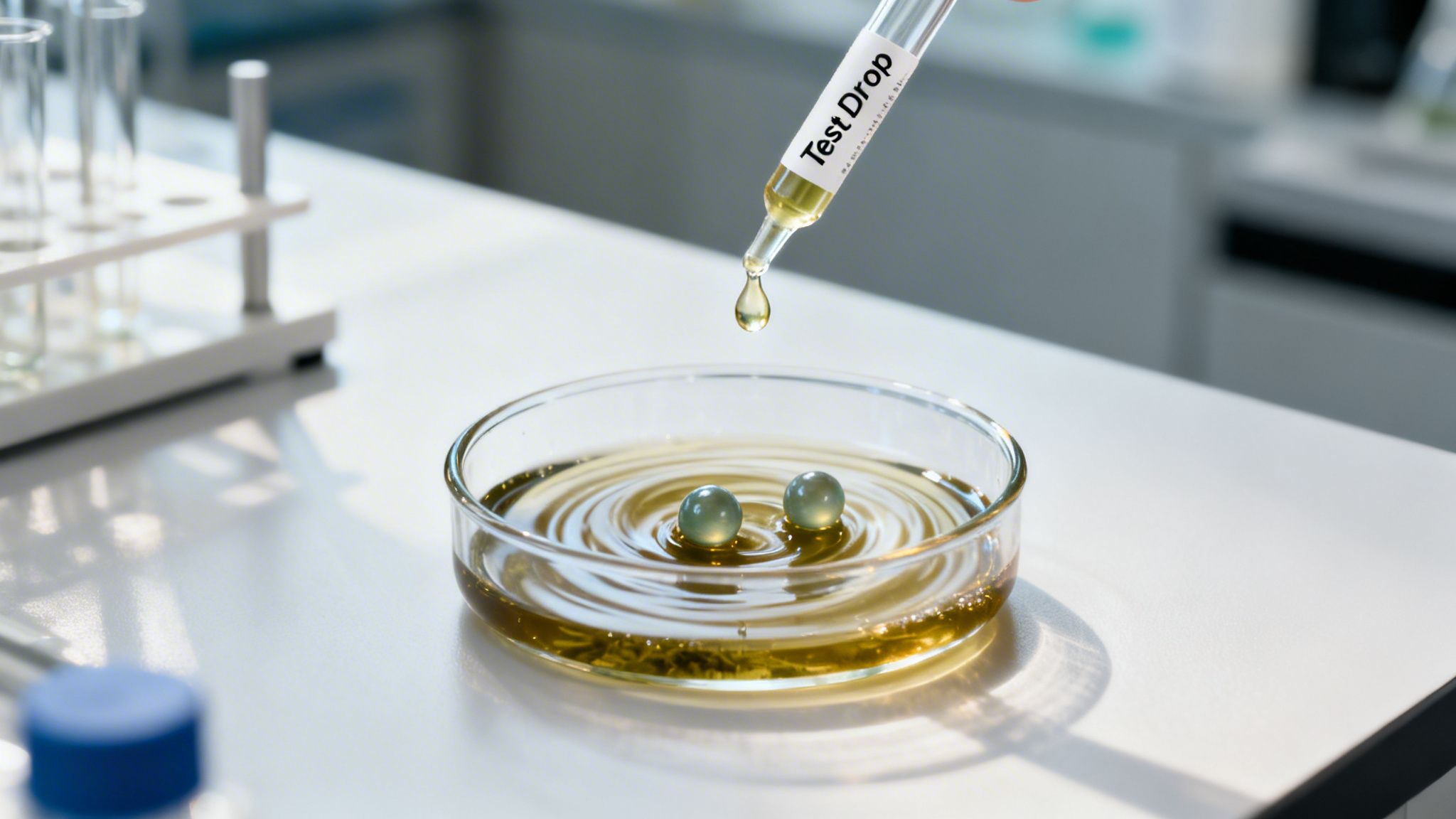
This is where the process becomes highly efficient. We can conduct rapid A/B testing. Is 5% too weak? Is 7% too harsh? We can test multiple concentrations in minutes to identify the optimal ratio where the flavor shines without tasting artificial. This iterative process saves a massive amount of time, money, and materials.
Once we’ve locked in the perfect ratio, we can sign off on the formulation with complete confidence. We know the flavor profile is exactly what we want and, more importantly, that it's repeatable for large-scale production. This simple accessory becomes a powerful tool for quality control.
Of course, a deeper understanding of your individual ingredients yields better results. Understanding the properties of specific isolates, which we cover in our guide to the benefits of d-Limonene, helps you predict how certain compounds will behave when heated. Adding terp pearls to your workflow is a low-cost, high-impact way to bring a new level of precision to your entire process.
Advanced Techniques and Troubleshooting for Formulators
Once you've mastered the fundamentals, it’s time to explore advanced techniques to tackle difficult formulation challenges. For experienced formulators, terp pearls are not just for heat distribution; they're a tool for physical homogenization and fine-tuning the final sensory experience.
A common challenge is working with highly viscous materials, like winterized oils or distillates thick with crystallized cannabinoids. These materials resist blending with low-viscosity terpene solutions. An advanced technique is to use multiple pearls of different sizes. Try introducing one 6mm and one 4mm pearl. The larger pearl provides bulk movement and thermal mass, while the smaller, faster-spinning pearl creates high-shear micro-vortices. These tiny whirlpools are excellent for breaking up stubborn agglomerates and ensuring a truly uniform mixture.
This method is invaluable during R&D, as it guarantees the sample you're testing is perfectly blended, so the flavor represents the entire batch, not just a random terpene-rich pocket.
Solving Common Formulation Problems
Even with optimal equipment, frustrating issues can arise and compromise your results. Fortunately, most problems with terp pearls are related to a few easily controlled variables. Knowing what to look for allows you to troubleshoot on the fly and maintain a smooth workflow.
Pearls Won't Spin? This is the most frequent issue, almost always caused by poor or misdirected airflow. Your carb cap is the critical component. You must use a directional or vortex-style cap to generate the necessary swirling force. If your pearls remain stationary, your cap is the first thing to check.
Concentrate Climbing the Walls? Material "climbing" the sides of the banger is wasteful and leads to uneven vaporization. This typically occurs when the oil is too thin or the pearls are spinning too fast. To correct this, you can either lower the temperature slightly to thicken the concentrate or use a slower, more controlled draw to reduce the pearls' rotational speed.
Pairing Materials with Terpene Profiles
To elevate your formulations, begin matching your pearl material to the dominant terpenes in your blend. Different materials have unique thermal properties that can subtly enhance specific aromatic compounds, giving you another layer of control over the final flavor.
Pro Tip: Try pairing ruby or sapphire pearls with fruit-forward or floral-heavy terpene profiles. These materials retain heat exceptionally well, allowing for a slower, more stable vaporization. This gentle heating is perfect for preserving the delicate esters and monoterpenes found in strains like our Forbidden Fruit or Blue Dream profiles, preventing them from burning off too quickly.
Conversely, for earthy and gassy profiles loaded with heavier sesquiterpenes, a high-performance material like Silicon Carbide (SiC) can be a game-changer. Its rapid heat transfer ensures these less volatile compounds are fully vaporized and expressed in the final flavor.
This level of detail separates a standard product from a premium one. For example, pairing a 4-6mm quartz pearl with a 3% Green Crack terpene blend for distillate in an MCT diluent can result in 92% flavor fidelity in GC-MS tests. Data also indicates that 76% of surveyed professionals agree that terp pearls provide more reliable sensory profiles, cutting reformulation costs by an average of 14%. You can find more pearl culture and market data on datainsightsmarket.com.
Fine-tuning your process with these methods will help you produce exceptional, consistent results. For any formulator focused on flavor, truly understanding a profile's unique character is key. You might find our analysis of the Sour Diesel strain profile helpful in seeing how these concepts work in practice.
Keeping Your Gear Clean and Your Lab Safe
In a professional lab or production facility, equipment sanitation and process safety are paramount. For a formulator managing multiple product lines or developing new blends, proper handling and cleaning of terp pearls are a core part of Good Manufacturing Practices (GMP). It is all about quality control.
Residue from a previous batch can completely skew sensory data and ruin an expensive test run. Cross-contamination is not an option. This is especially true when transitioning between vastly different profiles. Imagine moving from a heavy, gassy OG Kush terpene profile for vape cartridges to a light, sweet Forbidden Fruit. Any residual gassiness would overpower the delicate fruit notes, rendering your R&D work unreliable.
Cleaning Methods for the Pros
In a commercial setting, a simple cotton swab is insufficient. You need a cleaning process that is consistent, efficient, and repeatable, ensuring complete removal of oil and terpenes before the next use. If your cleaning is inconsistent, you are introducing another variable that makes it impossible to replicate the flavor of a specific strain accurately.
Here are two reliable, lab-grade methods:
- The IPA Soak: This is the go-to method for its simplicity and effectiveness. Soaking completely cooled pearls in high-purity isopropyl alcohol (91% or higher) for 30-60 minutes in a sealed container will dissolve any residual organic matter.
- Ultrasonic Cleaning: For high-throughput testing, an ultrasonic cleaner is a game-changer. It uses high-frequency sound waves to create microscopic bubbles that scrub the entire surface of the pearl. Used with an IPA solution, this provides a powerful combination of chemical and physical cleaning.
Regardless of the method, always finish by rinsing the pearls with deionized water and allowing them to air dry on a clean, sterile surface to prevent water spots or residual alcohol from affecting your next formulation.
Essential Safety Rules in the Lab
Working with hot equipment in a busy lab demands that safety be second nature. A single mistake can damage equipment, cause injury, or contaminate an entire product batch.
The golden rule is non-negotiable: NEVER drop a hot terp pearl into cold liquid. The sudden temperature change creates thermal shock, which will instantly crack or shatter the pearl, regardless of material. This not only ruins the pearl but can also eject sharp fragments. Always allow pearls and bangers to cool to room temperature before cleaning.
Beyond this critical rule, a few other safety practices are mandatory in any professional lab.
Handling Hot Equipment
Always use heat-resistant lab tongs or tweezers. Never handle a hot banger or pearl with bare hands. It is best practice to establish a dedicated "cool-down station" on a heat-proof mat where equipment can cool undisturbed until safe to handle.
Verifying Proper Fit
Before using a terp pearl in new testing equipment, verify that it is a proper fit. Ensure the pearl is the correct size for the banger or vessel to prevent it from being ejected during rotation. This simple check is a fundamental part of maintaining a safe, controlled environment—the bedrock of any sound formulating process. Adhering to these cleaning and safety habits protects your team, your equipment, and the integrity of your work.
Got Questions About Using Terp Pearls? Here Are Some Answers
Considering integrating terp pearls into your formulation process is a strategic move. While they appear simple, maximizing their utility in a lab setting is a matter of precision. Let's address some common questions for formulators and R&D professionals.
Will Terp Pearls Work in My Testing Setup?
Most likely, but two components are essential for proper function: the right banger shape and, more importantly, the right carb cap. You must use a directional airflow carb cap to create the necessary vortex inside the banger. Without it, the pearls remain stationary, and you will not achieve the even heat and material distribution required for accurate analysis.
During R&D, try to test with a setup that closely mimics end-user equipment. This provides the most accurate sense of the sensory experience and is crucial when evaluating a new terpene profile for vape cartridges or concentrates.
So, How Many Terp Pearls Do I Actually Need?
The optimal number depends on the volume of material you are testing.
- For R&D and Sensory Testing: When using a standard 25mm banger for a quick sensory evaluation, one or two 4-6mm pearls is ideal. The goal is to generate sufficient movement for even heating without overcrowding the vessel.
- For Larger Batches: If using pearls to aid in mixing a larger volume of oil, you will naturally require more or larger pearls. The key is to match the pearl mass and number to the volume and viscosity of your concentrate.
Remember, the objective is to create a smooth, uniform mixture through movement. Do not overcrowd the banger, as this will inhibit rotation and negatively impact your flavor evaluation.
Do Terp Pearls Change Cannabinoid Potency?
No, terp pearls do not alter cannabinoid potency. Their primary function is to manage heat, which in turn preserves terpenes and enhances flavor expression.
By distributing heat and eliminating hot spots, they help protect the concentrate's original chemical profile. This means cannabinoids are not being scorched and degraded during testing, allowing for a more accurate assessment of your final formulation.
When Should I Replace My Terp Pearls?
With proper cleaning, high-quality pearls made from quartz or silicon carbide can last for hundreds of uses. However, they must be discarded at the first sign of physical damage.
Inspect for any cracks, chips, or a cloudy appearance on quartz, known as devitrification. Any imperfection can trap residue from previous batches, which will compromise the flavor of your next test and potentially contaminate your samples.
At Gold Coast Terpenes, we are dedicated to providing the tools you need to formulate with absolute confidence. We offer lab-verified, strain-specific profiles and isolates for your product development needs. Explore our catalog and find the perfect ingredients for your next innovation.
Shop Our Full Collection of Terpene Profiles at Gold Coast Terpenes