
Crafting professional-grade THC oil for cannabis product formulation is a sophisticated process that transforms raw plant material into pure, potent, and reliable concentrates for the vape market. This journey involves extraction, purification, and formulation—the critical step where product developers define a product's character with specific terpene blends to replicate strain profiles and ensure flavor accuracy.
A Formulator's Approach to THC Oil Production
Producing THC oil for a commercial brand requires a synthesis of science, safety, and brand strategy. This is not about simple infusions; it's about manufacturing a stable, consistent, and marketable oil that performs flawlessly in vape cartridges.
The entire workflow is built around achieving high cannabinoid potency, removing undesirable compounds, and then artfully constructing the final product's flavor profile and viscosity. Every decision, starting with the extraction method, impacts the entire process, influencing purification requirements and the final formulation strategy. For any brand aiming to create a standout product, mastering this workflow is essential for commercial success.
Overview of THC Oil Production Pathways
At a high level, two primary pathways exist for producing THC oil. Each presents distinct costs, operational requirements, and market positioning opportunities.
| Methodology | Primary Mechanism | Best For | Key Advantage |
|---|---|---|---|
| Solvent-Based | Using a chemical solvent (e.g., CO2, ethanol, butane) to dissolve and separate cannabinoids and terpenes. | Large-scale production, creating high-purity distillate for consistent product lines for vape cartridges. | High efficiency and scalability, capable of producing very high potency oils suitable for precise formulation. |
| Solventless | Using mechanical and physical forces (heat and pressure) to physically separate resin from plant material. | Craft, small-batch, and "full-spectrum" products that appeal to connoisseurs seeking authentic strain replication. | Preserves the native terpene profile of the plant; strong "clean" marketing appeal. |
Choosing between solvent-based and solventless extraction is a foundational business decision that dictates equipment investment, lab infrastructure, and brand narrative.
The Three Core Phases of Production
Regardless of the chosen pathway, the journey from plant biomass to finished vape oil consists of three critical phases. Excellence in each is non-negotiable for producing commercially viable THC oil for distillate.
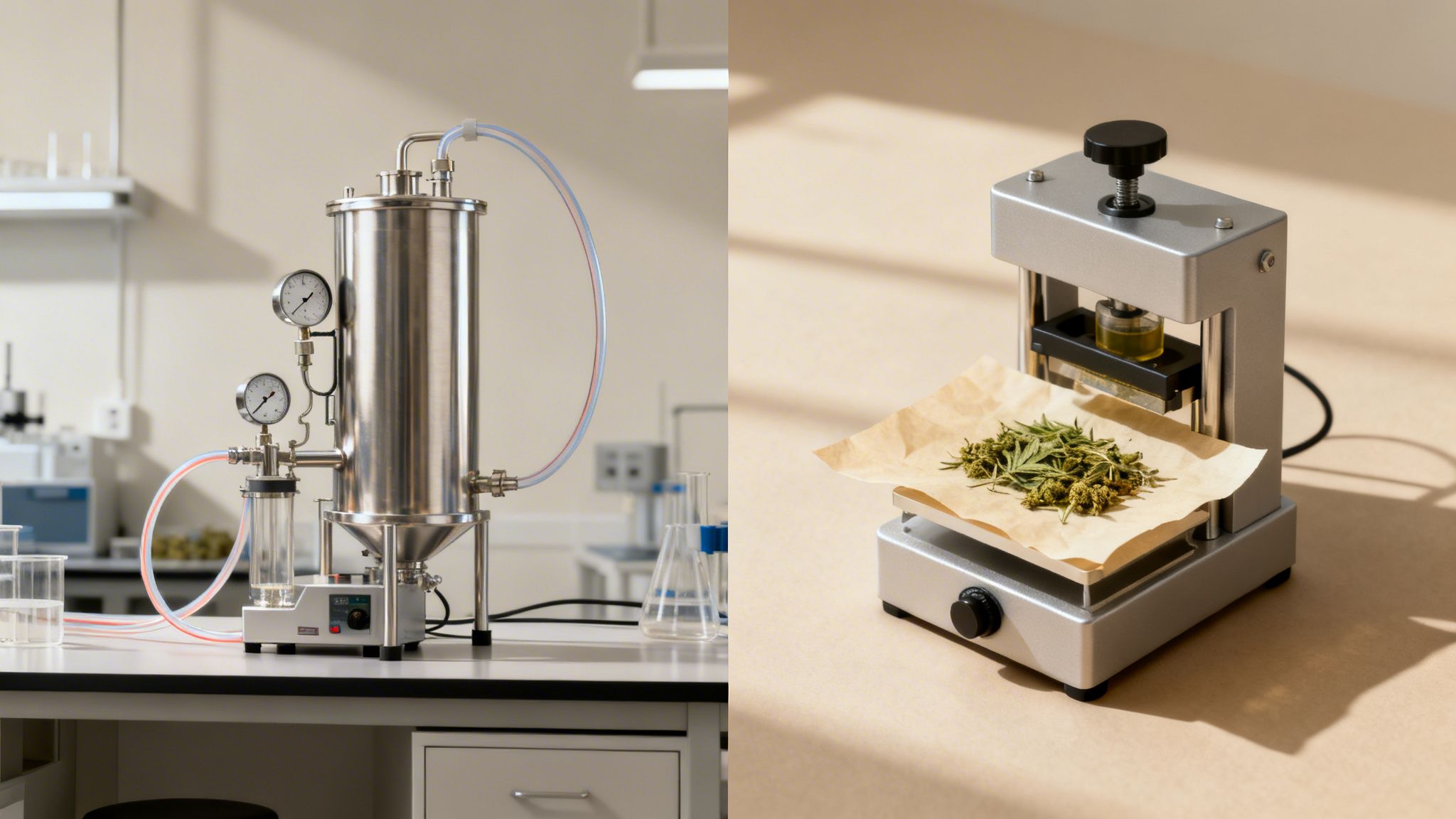
Extraction: This initial phase isolates valuable cannabinoids and terpenes from the raw plant matter. The choice between a solvent-based method like CO2 or BHO and a solventless one like rosin pressing is a strategic business decision that shapes initial investment and product identity.
Purification: The crude oil from extraction is not suitable for vape cartridges. It requires refinement through crucial steps like decarboxylation (to convert THCA to THC) and winterization (to remove fats, waxes, and lipids). Neglecting this stage results in poor product performance and clogged hardware.
Formulation: This is the value-add stage where art meets science. Starting with a clean cannabinoid base, formulators reintroduce precise terpene profiles to control flavor, aroma, and viscosity. This is how generic distillate is transformed into a signature product with a recognizable and replicable flavor profile.
This diagram provides a high-level overview of how these stages integrate.

As illustrated, each step flows logically into the next. A clean extraction simplifies purification, which in turn provides an ideal canvas for precise formulation.
The demand for high-quality, reliable cannabis products is expanding rapidly. With the global market projected to hit USD 72.83 billion by 2025, a significant opportunity exists for brands that master technical production. For those developing their extraction expertise, our guide on how to make cannabis concentrates provides further detail. Ultimately, a commitment to quality control is what separates market-leading products from the rest.
Choosing Your Extraction Method for Cannabis Product Formulation
The first major decision in producing THC oil is selecting an extraction method. This choice extends beyond technical specifications; it defines your operational footprint, budget, brand positioning, and the final product destined for vape cartridges.
The decision fundamentally comes down to two philosophies: employing solvents or proceeding without them. Each path has distinct operational realities and commercial implications.
The Realities of Solvent-Based Extraction
For brands targeting high-volume production and high-potency distillate, solvent-based methods are the industry standard. Using butane (BHO) or CO2 is highly effective for stripping cannabinoids and terpenes from plant material, making it the preferred choice for large-scale manufacturing.
However, this efficiency comes with significant operational demands.
- Capital Investment: This path requires major capital expenditure. Professional-grade closed-loop systems for BHO or supercritical CO2 extractors are costly, and compromising on equipment quality is not an option.
- Stringent Safety Protocols: Working with volatile materials like butane mandates a C1D1-rated, explosion-proof lab environment. This necessitates specialized ventilation, continuous monitoring, and strict safety protocols to ensure safe and compliant operation.
- Intensive Post-Processing: The resulting crude oil requires intensive post-processing, especially rigorous purging in a vacuum oven, to ensure complete removal of residual solvents. Incomplete purging yields an impure, unsafe, and commercially unviable product.
The primary goal of solvent-based extraction is often to create a clean, flavorless cannabinoid distillate. This provides a perfect blank canvas for formulators to add back a specific terpene profile for vape cartridges, ensuring batch-to-batch consistency.
The Craft of Solventless Extraction
Solventless extraction utilizes mechanical forces—heat and pressure—to physically press resinous oils from the cannabis plant. The most prominent method is rosin pressing.
Key Insight: With solventless methods, starting material quality is paramount. There is no way to mask mediocre biomass. While solvents can refine lower-quality material to a degree, with rosin, the input quality directly determines the output quality.
This method has gained significant market traction due to its "clean" and "natural" appeal. The absence of foreign substances is a powerful marketing tool. For those exploring the nuances between outputs, our guide on resin and rosin offers valuable insights.
"Solventless" is not synonymous with "small-scale." Modern hydraulic and pneumatic rosin presses can handle commercial volumes, making it a viable pathway for growing brands. The resulting oil retains more of its native terpenes, which is a significant advantage, but it often requires additional refinement to achieve optimal viscosity for vape cartridges.
Ultimately, this choice is a business decision. With some market growth projections citing a compound annual growth rate (CAGR) as high as 34.03%, aligning production with brand identity is critical. Whether choosing the efficiency of solvents or the craft appeal of solventless, mastering this first step is key to producing THC oil that meets commercial standards.
Mastering Decarboxylation and Winterization for Formulation
After successful extraction, the raw cannabis oil is a crude product, far from ready for a high-quality vape cartridge. This is where technical refinement begins. To create a clean, potent, and stable THC oil for distillate, mastering two key processes is essential: decarboxylation and winterization.
These are not optional steps; they are foundational for any serious formulator. Bypassing them leads to clogged hardware, negative product feedback, and a cloudy, harsh final product.
The Science of Decarboxylation
Freshly extracted cannabis oil is rich in tetrahydrocannabinolic acid (THCA), a non-active cannabinoid. To achieve the desired effects, THCA must be converted into active THC through decarboxylation, a process that uses controlled heat to induce a chemical reaction.
Beyond cannabinoid activation, decarboxylation significantly reduces the oil's viscosity. Thick, viscous oil containing THCA will not flow properly into a cartridge's atomizer, leading to poor performance, burnt tastes, and hardware failure.
The key is precise control over heat and time. Sufficient heat is needed for full conversion, but excessive heat can degrade THC into other compounds like CBN.
Most labs heat crude oil on a hot plate with a magnetic stirrer for even heat distribution, targeting a temperature between 220-250°F (105-121°C). Depending on batch size, this can take 30 minutes to over an hour. The process is marked by vigorous bubbling as CO2 gas is released.
A Tip from the Lab: Monitor the bubbling closely. It will be aggressive initially and then slow to a near-complete stop, signaling the reaction's end. Stopping too soon leaves inactive THCA in the oil; waiting too long risks product degradation. To refine your technique, see our guide on how to decarb cart oil correctly.
The Necessity of Winterization
Post-decarboxylation, the oil is potent but still contains unwanted plant waxes, fats, and lipids. These compounds compromise the vape experience by creating a cloudy appearance, contributing a harsh flavor, and clogging the delicate wicking ports in modern vape hardware.
The removal process is called winterization, or dewaxing. It is a critical filtration step for any formulator looking to produce THC oil that meets commercial standards.
The process leverages the different freezing points of cannabinoids and lipids. The practical steps are as follows:
Dissolve the Oil: Dissolve the decarboxylated crude oil in food-grade ethanol. A 10:1 ratio of ethanol to oil is a good starting point to ensure proper dissolution.
Deep Freeze: Place the mixture in a lab-grade freezer set between -20°C and -80°C. At these temperatures, cannabinoids remain in solution while heavier waxes and fats precipitate out, turning the liquid cloudy.
Filter It Out: While the solution is freezing cold, run it through a series of fine filters. A Büchner funnel with vacuum assistance is standard practice to accelerate separation, capturing the solidified lipids.
Recover the Ethanol: The final step is removing the ethanol using a rotary evaporator (roto-vap). This equipment uses gentle heat and vacuum pressure to boil off the ethanol at a low temperature, preserving cannabinoids and terpenes while allowing for ethanol reclamation.
The result is a pure, golden cannabinoid oil. This refined base is the ideal canvas for the creative and critical step of formulation: adding terpenes to define the final product's flavor profile and viscosity for vape cartridges.
Formulating with Terpenes for Flavor and Viscosity
With a potent and clean purified distillate, the foundational work is complete. However, this base is a blank canvas. The rigorous extraction and purification processes, while essential, strip out the volatile terpenes that define a strain's signature aroma and flavor. The next step is formulation, where raw oil is transformed into a finished product.
This is where the formulator's expertise in replicating the flavor of a strain becomes paramount.

Reintroducing terpenes is what distinguishes a bulk commodity from a premium, branded product. This process enables perfect strain replication, the creation of unique proprietary blends, and—critically—the precise adjustment of viscosity for flawless performance in any vape cartridge.
Replicating Strains and Crafting Signatures
The cannabis market is highly competitive. Formulators can gain insights from reports like this CBD and cannabis market analysis, but the real competitive advantage lies in product development. The ability to deliver a consistent and memorable flavor profile is a powerful differentiator.
Formulators generally have two strategic options for flavor:
- Strain Replication: Use a professionally formulated, strain-specific terpene blend to recreate the exact terpene profile for a well-known cultivar like OG Kush. This meets established consumer expectations.
- Signature Blending: Develop a unique product line by mixing and matching different terpene isolates. This allows a brand to create a proprietary flavor and aroma.
Either approach requires a technical understanding of how different terpenes function within a blend.
Balancing Top, Mid, and Base Notes in a Terpene Profile for Vape
Not all terpenes behave identically. Like in perfumery, terpenes have varying levels of volatility that dictate their role in a flavor profile. A well-constructed blend requires a careful balance of top, mid, and base notes to create a complex and lasting sensory experience.
- Top Notes: These are the most volatile and provide the initial impression. They are often light, sharp, and citrusy or piney. Key examples include Limonene and Pinene.
- Mid Notes: These form the heart of the blend, emerging as top notes dissipate. They are typically more herbal, spicy, or floral. Linalool and Beta-Caryophyllene are classic mid notes.
- Base Notes: These are the least volatile terpenes, providing a deep, earthy, or musky foundation that gives a blend its longevity. Myrcene is a quintessential base note that anchors the entire profile.
Formulator's Insight: A common error is over-relying on top notes. While this provides an initial burst of flavor, the experience is thin and fleeting. A memorable blend requires a solid foundation of mid and base notes to create depth and a satisfying finish.
Calculating Percentages and Managing Viscosity
Terpenes are highly potent compounds. The industry standard for vape cartridges is a total terpene concentration between 5% and 15% by weight.
A concentration below 5% may result in insufficient flavor and inadequate viscosity reduction. Exceeding 15% can lead to a harsh taste and potential stability issues.
Terpenes also serve as a natural diluent. Pure, high-potency THC distillate is a solid at room temperature and too thick for vape hardware. Terpenes act as a thinning agent, creating an ideal consistency for wicking and vaporization without requiring additives like PG, VG, or MCT oil.
Terpene Formulation Starting Ratios for Distillate
This table provides practical starting points for adding a strain-inspired terpene blend to winterized THC distillate. These are recommendations; always test in small batches to optimize for your specific oil and hardware.
| Desired Effect Profile | Suggested Terpene Percentage | Dominant Terpene Examples | Notes |
|---|---|---|---|
| Bright and Uplifting | 6-8% | Limonene, Terpinolene | Focus on citrus and pine top notes for a sharp, energetic aroma. |
| Calm and Relaxing | 7-10% | Myrcene, Linalool | Emphasize earthy base notes and floral mid notes for a smoother profile. |
| Complex and Fruity | 8-12% | Beta-Caryophyllene, Humulene | Blend spicy mid notes with fruity isolates for a "craft" flavor experience. |
| Maximum Viscosity Cut | 10-14% | Pinene, Eucalyptol | Higher percentages of thinner terpenes can be used for very thick distillates. |
These are starting points for experimentation. For more advanced techniques, our guide on the best terpenes for distillate provides a deeper look at fine-tuning blends.
Once the ratio is determined, the final step is homogenization. Gentle heat and a magnetic stirrer ensure the terpenes are fully integrated into the oil, resulting in a stable, consistent, and shelf-ready product.
Quality Control: How to Test and Troubleshoot Your THC Oil
Once a batch of oil is formulated, the work is not yet complete. Strict quality control and troubleshooting protocols are what separate professional operations from amateur efforts. This final phase is about ensuring safety, consistency, and brand integrity.

Before any product is released, it must be verified as safe, potent, and accurately labeled. This is essential for both regulatory compliance and building consumer trust.
The Critical Role of Third-Party Lab Testing
Internal testing is not sufficient. An unbiased analysis from a reputable third-party laboratory is required to obtain a Certificate of Analysis (COA). This document is essential for regulators, distributors, and consumers.
A full-panel test should include, at a minimum:
- Potency: Confirms the exact percentage of THC, CBD, and other target cannabinoids to guarantee a consistent end-user experience.
- Purity: Screens for residual solvents, pesticides, heavy metals, and mycotoxins to ensure product safety.
- Terpene Profile: Verifies that the flavor profile is accurate and consistent with the product's description, confirming the success of the terpene formulation.
A clean, detailed COA is a brand's most valuable asset. It demonstrates a commitment to quality and transparency, building trust in a crowded marketplace.
A Formulator's Troubleshooting Guide
Even with a refined process, issues can arise. Knowing how to diagnose and solve common problems is critical for maintaining batch consistency and minimizing waste.
The Oil is Crystallizing or "Sugaring Up"
Crystallization, or "sugaring," is a common issue with high-potency oils, typically occurring when THC concentration exceeds 85%. The THC molecules begin to agglomerate, turning the oil into a semi-solid state unusable in a vape cartridge.
While a sign of high purity, this must be managed during formulation. Introducing a small amount of a different cannabinoid (like CBD or CBN) or using a more complex terpene blend can inhibit crystallization. Our terpene mixing calculator can help model these adjustments. Often, increasing the terpene percentage into the 10-12% range is sufficient to maintain stability.
The Oil is Darkening or Losing Flavor
If a light golden oil darkens over time and the flavor flattens, the cause is almost always oxidation. Oxygen, heat, and UV light degrade cannabinoids and terpenes.
This can begin during mixing if the oil is overheated or agitated too aggressively, introducing air into the blend. It can also occur post-filling if cartridges are not sealed properly. To mitigate this, use gentle heat (130-150°F / 55-65°C) and mix only until homogenized. Store finished products in a cool, dark place and use high-quality, airtight hardware.
The Carts are Leaking or Clogging
Leaking or clogged cartridges are often a result of improper oil viscosity.
If the oil is too thin (from excessive terpenes or other diluents), it will flood the atomizer and leak. If it is too thick (insufficient terpenes), it will not wick properly, leading to dry hits and clogs. This is controlled during formulation. Start test batches with a 7-8% terpene ratio and evaluate performance in your chosen hardware, adjusting as needed.
Common Questions We Hear from Formulators
Even experienced formulators encounter questions when developing a new product. Here is guidance on some of the most common challenges.
What About Infusing Store-Bought Gummies?
While it is technically possible to melt commercial gummies and attempt to mix in cannabis oil, this is not a professional manufacturing method. Achieving homogenous distribution is extremely difficult, leading to inconsistent dosing. Furthermore, the flavor and texture of the original product are often compromised. Building a formula from scratch is necessary for a high-quality, reliable product.
What’s the Best Carrier Oil for Vape Carts?
This question stems from a misunderstanding of vape formulation. Unlike edibles, which use carrier oils like MCT or coconut oil, modern vape cartridges should not contain any carrier oils. The "oil" is the cannabis distillate itself.
The goal is to purify the cannabis concentrate and use terpenes to achieve the desired viscosity and flavor profile for vape cartridges. Adding diluents like MCT, PG, or VG is an outdated and unsafe practice that creates a low-quality product.
Key Takeaway: The only ingredients in a modern, high-quality vape cart should be purified cannabis distillate and botanically-derived terpenes.
How Much Terpene Blend Should I Actually Use?
The optimal terpene percentage depends on your distillate's viscosity and target flavor intensity. A good starting range for most THC oils is 6% to 10% terpenes by weight.
- Below 6%: The oil may be too thick to wick properly, and the flavor may be too subtle.
- Above 12%: The flavor can become harsh, and you risk oversaturation, leading to separation.
The best practice is to start with a small test batch at 7%, let it homogenize, and evaluate its performance in your selected hardware. Adjust up or down from there. For a more detailed walkthrough, consult our comprehensive guide to terpene formulation.
Why Is Decarbing So Important for Vapes?
Decarboxylation is a non-negotiable step in producing THC oil for vapes. Raw extract is high in THCA, the non-active acid form. Heat converts it to active THC. Without this step, the product will lack the intended effect.
Furthermore, THCA has a crystalline structure that makes oil extremely thick. An incomplete decarb results in a viscous slurry that will clog vape hardware. Proper decarboxylation ensures both potency and functionality.
Why Did My Oil Get Darker in the Cartridge?
Oil darkening to a brown or murky color is almost always due to oxidation. Cannabinoids and terpenes degrade when exposed to oxygen, light, or excessive heat.
To prevent this, use gentle mixing temperatures (around 130-150°F or 55-65°C), avoid aggressive agitation, and use high-quality, airtight hardware. Proper storage in a cool, dark environment is also critical.
Ready to perfect your next formulation? A solid understanding of these principles is the foundation for creating exceptional products. The final step is sourcing terpenes that deliver consistent, vibrant, and authentic flavor profiles.
At Gold Coast Terpenes, we provide formulators with the industry's purest, strain-specific terpene blends and isolates, enabling you to craft unforgettable vape experiences.
Shop our complete collection of lab-tested terpene profiles today.