
Creating a successful THC-infused beverage for the commercial market is a complex exercise in chemical engineering and sensory science. It’s not about simple mixing; it’s about crafting a stable, precisely dosed, and palatable experience. Success hinges on mastering several key technical stages: cannabinoid activation, solubilization, accurate dosing, and sophisticated flavor formulation. This guide provides a technical framework for formulators and brand owners aiming to launch a commercially viable product.
The Cannabis Drink Market: A Technical Opportunity
Cannabis-infused beverages are transitioning from a niche category to a mainstream alternative to alcohol. As this market expands, the demand for high-quality, reliable, and professionally formulated products is paramount. This guide outlines the technical roadmap required to develop a THC beverage that stands out through superior formulation.
Success in this space is defined by technical execution. The era of unstable, unpredictable homemade concoctions is over. Today's market demands a professionally manufactured product, which requires a firm grasp of cannabinoid science to deliver a beverage that is not only effective but also consistent and enjoyable.
The Technical Hurdles for Beverage Formulators
For formulators and brands entering this vertical, a casual approach is not viable. Manufacturing a superior THC beverage involves mastering core challenges unique to cannabinoid science. It requires far more than simply adding THC oil to a water-based liquid.
Key technical challenges include:
- Solubility: Cannabinoids are lipophilic oils, making them immiscible in water. Advanced emulsion technology is required to create a homogenous beverage that remains stable and does not separate on the shelf.
- Flavor Profile: Raw cannabis extracts often possess bitter or earthy off-notes. The core skill lies in masking these undesirable flavors or engineering a new flavor profile that complements them.
- Stability & Safety: A commercial beverage must be shelf-stable. This means preventing phase separation, potency degradation, and microbial growth. Brand reputation is contingent on these factors.
The market data underscores the opportunity. The global cannabis beverage market was valued at USD 3.57 billion in 2025 and is projected to reach USD 4.11 billion in 2026. With an estimated compound annual growth rate (CAGR) of 15.12% through 2035, the potential is significant—but only for those who master the formulation.
In this market, technical proficiency is the primary competitive advantage. A product that separates, has an unpleasant taste, or delivers an inconsistent dose is destined for commercial failure. Precision is what differentiates a leading product.
This guide provides the technical knowledge to create a top-tier, scalable THC beverage for cannabis product formulation. We will move beyond rudimentary concepts and into the specifics of commercial production, from cannabinoid preparation to final packaging. For additional background, refer to our post on terpene-infused beverages and how to make them. Mastering these steps is critical to launching a successful product in this competitive landscape.
Preparing Cannabinoids for Beverage Infusion
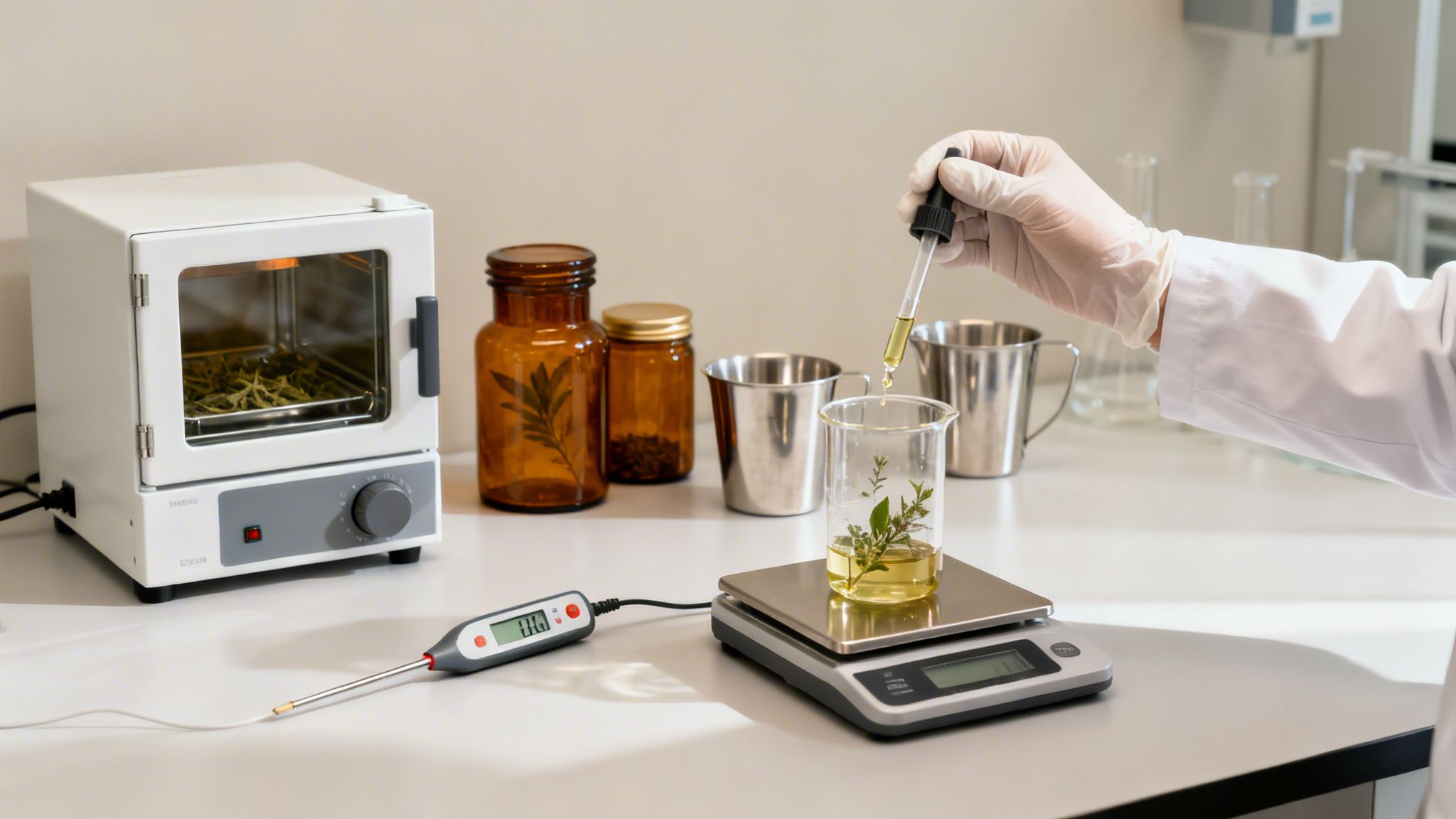
Before any mixing can begin, the cannabinoid input itself must be meticulously prepared. This initial stage dictates the potency, consistency, and overall quality of the final beverage. The two most critical processes are cannabinoid activation (decarboxylation) and the selection of the appropriate extract.
The first, and most crucial, step is decarboxylation. Raw cannabis biomass contains tetrahydrocannabinolic acid (THCA), a non-psychoactive acidic precursor. To convert THCA into the psychoactive Delta-9-THC that the market demands, heat must be applied in a controlled manner.
This process is a delicate balance. Excessive heat or duration will degrade THC into other cannabinoids, such as cannabinol (CBN), reducing potency. Insufficient heat results in unactivated THCA, leading to an under-dosed beverage that fails to meet label claims.
Achieving Precise Decarboxylation
Successful decarboxylation depends on precise control over time and temperature. While equipment specifics vary, a reliable starting point for cannabis oil is heating to approximately 240°F (115°C) for 30 to 45 minutes.
For formulators using crude oil, a dedicated decarboxylation step is mandatory. For those working with distillate, this conversion is typically completed during the distillation process, where high temperatures activate any residual acidic cannabinoids.
For beverage manufacturing, incomplete decarboxylation is a critical failure point. A product that tests below its advertised potency not only disappoints customers but also creates significant compliance risks. Precision at this stage is paramount for brand integrity.
Selecting Your Cannabinoid Starting Material
With the activation process defined, the next decision is the choice of starting material. This choice impacts the entire production workflow, from cost to the final sensory profile of the beverage. The two primary inputs for this application are THC distillate and full-spectrum extracts.
Each option presents a distinct set of advantages and disadvantages. The correct choice depends on the desired product outcome. Is the goal a clean, fruit-forward seltzer or a more complex, earthy tonic? For a deeper dive into processing, our guide on how to properly make THC oil is an excellent resource.
This table provides a direct comparison of these inputs for beverage formulation.
Cannabinoid Input Comparison for Beverage Formulation
| Cannabinoid Input | Pros | Cons | Ideal For |
|---|---|---|---|
| THC Distillate | Highly potent (90%+ THC), flavorless, and odorless, offering a blank canvas for formulation. | Lacks native terpenes, requiring reintroduction for flavor and effect. Can be more costly per gram. | Products where consistent dosing and controlled flavor profiles are critical, such as seltzers, sodas, and flavored waters. |
| Full-Spectrum Extract | Contains a range of cannabinoids and native terpenes, potentially contributing to a more nuanced effect. | Strong, often bitter, and earthy flavor that is difficult to mask. Potency is lower and less consistent. | Niche products where an authentic "cannabis" flavor is desired, or for brands marketing the "entourage effect." |
For the vast majority of commercial beverages, THC distillate is the preferred input. Its purity and neutral sensory profile provide formulators with a blank slate. This level of control is essential for creating a consistent and reproducible product.
Using distillate for cannabis product formulation eliminates the challenge of masking undesirable plant-like flavors. Instead, formulators can build a precise flavor profile from the ground up using targeted, food-grade terpenes for product formulation, ensuring batch-to-batch consistency. This reliability is fundamental to building a loyal consumer base.
Cannabinoid Solubilization: The Science of Emulsion
With activated cannabinoids prepared, the next and most significant technical challenge is achieving miscibility in a water-based system.
As lipophilic compounds, cannabinoids are inherently insoluble in water. Directly adding THC oil to a beverage base results in phase separation—an unstable, unappealing, and commercially unviable product.
While rudimentary methods like steeping cannabis in high-fat liquids may suffice for immediate, at-home consumption, a shelf-stable commercial product requires the application of modern food science. The solution lies in emulsion technology.
Emulsion Science: The Key to Homogenous THC Beverages
An emulsion is a stable mixture of two immiscible liquids, such as oil and water. For cannabinoid beverages, the objective is to break down the cannabinoid oil into microscopic droplets and suspend them uniformly throughout the aqueous phase.
This requires two components: high-shear energy and a stabilizing agent known as a surfactant or emulsifier.
A surfactant molecule is amphiphilic, possessing both a water-loving (hydrophilic) head and an oil-loving (lipophilic) tail. When introduced into the mixture, these molecules encapsulate each oil droplet, creating a protective barrier that prevents them from coalescing and separating. Common and effective emulsifiers include gum arabic, quillaja extract, and certain modified starches.
A successful emulsion produces a uniform beverage that remains stable over its shelf life, preventing the "ringing" effect where oil collects at the top of the container. Furthermore, a well-formed emulsion significantly enhances cannabinoid bioavailability, leading to faster onset times and more consistent effects—a key differentiator in the market.
Choosing Your Emulsion Type
The quality and performance of the final beverage—including its appearance, stability, and onset time—are directly related to the size of the emulsified oil droplets. There are three main categories of emulsions.
- Macroemulsions: Droplet sizes exceed 400 nanometers. These emulsions are milky or cloudy and are inherently unstable, leading to eventual phase separation. They are unsuitable for professional beverage manufacturing.
- Microemulsions: Droplet sizes range from 100 to 400 nanometers. These are more stable than macroemulsions but remain opaque and can impart a noticeable texture or "mouthfeel" to the beverage.
- Nanoemulsions: With droplet sizes under 100 nanometers, this is the gold standard for THC beverages. The particles are so small they do not scatter light, resulting in a clear, transparent beverage. Nanoemulsions offer superior stability and the fastest onset of effects due to maximal bioavailability.
For any serious commercial beverage, creating a nanoemulsion is the primary goal. This is achieved by combining the right formulation with high-energy processing techniques.
Essential Equipment for Creating Stable Emulsions
Generating a true nanoemulsion requires a significant input of focused energy to reduce oil droplet size. Commercial-scale production necessitates high-shear processing equipment.
There are two primary technologies for this task:
- High-Shear Mixers: These devices use a rotor spinning at high velocity within a stationary stator. This creates intense mechanical shear forces that break down oil droplets into a smaller, pre-emulsion state.
- Ultrasonic Processors (Homogenizers): To transition from a microemulsion to a true nanoemulsion, sonication is the most effective method. These machines use high-frequency sound waves to induce acoustic cavitation—the rapid formation and collapse of microscopic vacuum bubbles. The resulting shockwaves are powerful enough to pulverize oil droplets to the nano-scale, often well below 100 nm.
A successful emulsion is defined by particle size reduction. The key performance indicator (KPI) is the final particle size distribution. Investment in a particle size analyzer is crucial for quality control and ensuring long-term beverage stability.
Mastering this advanced formulation is what unlocks market leadership. The global cannabis drinks market, valued at USD 1.00 billion in 2025, is projected to grow to USD 23.8 billion by 2036, representing a CAGR of 37.3%.
As seen in these projections on the cannabis drinks market, this growth is driven by consumer demand for well-manufactured, precisely dosed, and superior-tasting products. Mastering the science of solubilization is the key to meeting this demand.
Flavor Formulation and Precision Dosing Strategy
With a stable emulsion achieved, the next critical steps are dosing and flavor—the two elements that directly shape the consumer experience. These components are inextricably linked.
Inconsistent dosing erodes brand trust, while a poor flavor profile ensures a product will not receive a repeat purchase. This stage requires a balance of precise calculation and creative sensory development. Every 10mg serving must be exactly 10mg, and the flavor profile must be compelling enough to stand out in a competitive market.
Calculating Cannabinoid Dosing for Batch Production
In commercial beverage manufacturing, precise dosing is a non-negotiable requirement. The label claim is a guarantee. Consistently meeting this specification is fundamental to brand integrity and regulatory compliance.
The calculation is straightforward but requires meticulous accuracy. The formula is:
(Total Batch Volume in mL) x (Target mg of THC per mL) / (Potency of Cannabinoid Extract in mg/g) = Grams of Extract Needed
Consider a practical example: producing a 1,000-liter batch of seltzer with a target of 5 mg of THC per 355 mL (12 oz) can.
Calculate Total THC Required:
- Number of units: 1,000,000 mL / 355 mL/can ≈ 2,817 cans
- Total THC mass: 2,817 cans x 5 mg/can = 14,085 mg of THC
Determine Mass of Extract Needed:
- Assume the use of THC distillate with a lab-verified potency of 92% (920 mg of THC per gram).
- Grams of Distillate: 14,085 mg / 920 mg/g = 15.31 grams of distillate
For a 1,000-liter batch, only about 15 grams of high-potency distillate are needed. This illustrates the critical need for precision; a minor measurement error is magnified across thousands of units. Always use a high-precision analytical balance measuring to at least two decimal places.
To streamline this process, our cannabinoid and terpene mixing ratios calculator is a useful tool for verifying calculations.
The Art and Science of Flavor Formulation
With dosing locked in, the focus turns to flavor. This is the primary opportunity for brand differentiation. The task is twofold: first, mask any off-notes from the cannabinoid extract, and second, construct a unique and appealing sensory profile.
Even high-purity THC distillate can impart a slight bitterness. Full-spectrum extracts present a greater challenge, with earthy, botanical notes that can easily overwhelm a beverage. The most effective tools for this task are terpenes and other food-grade flavorings.
This flowchart illustrates the fundamental requirement for creating a stable cannabinoid beverage: emulsion is necessary to combine oil-based cannabinoids with a water-based system.
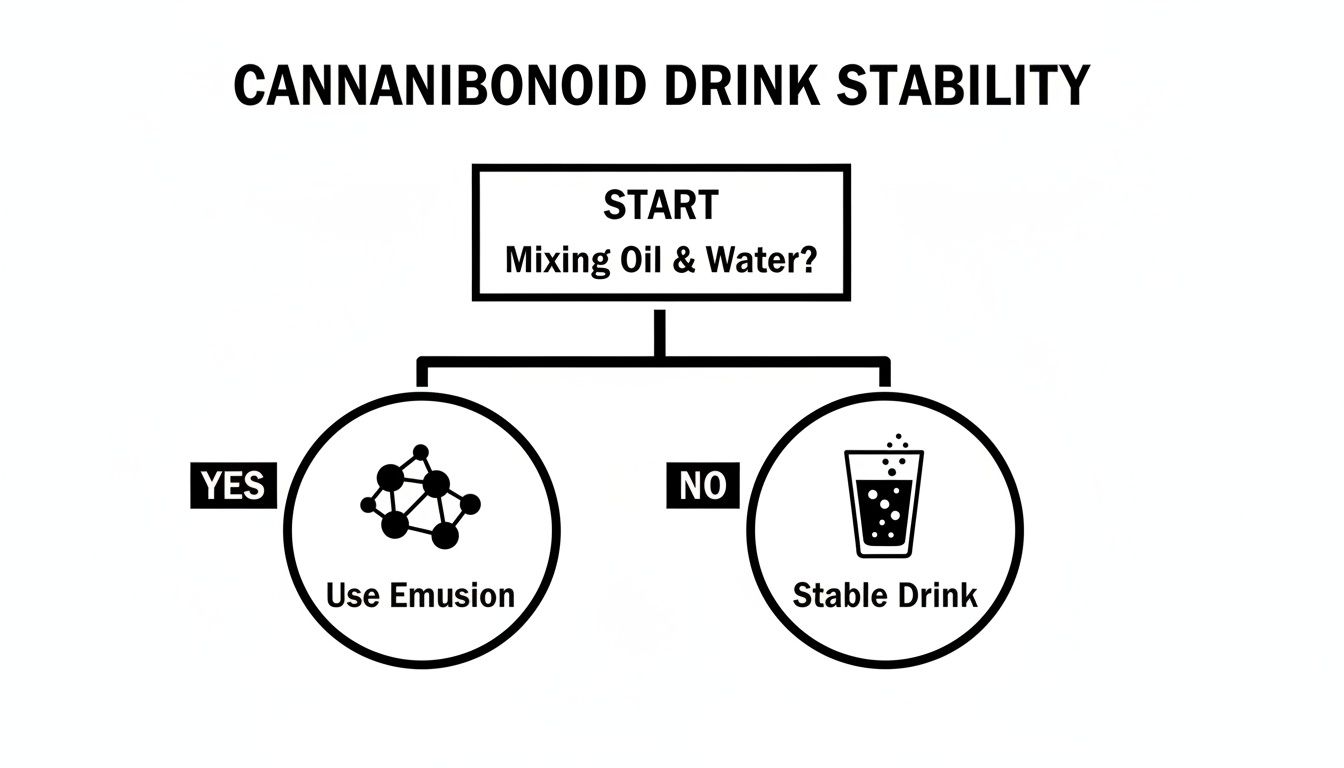
As the diagram shows, achieving a stable beverage depends entirely on the successful emulsification of lipophilic cannabinoids into the aqueous phase.
Terpenes are functional ingredients, not just flavorants. They are effective at masking bitterness, adding bright aromatic top notes, and building a complex sensory experience that elevates a simple beverage into a premium product.
Building a Flavor Profile with Terpenes
Terpenes are the aromatic compounds responsible for the distinct sensory profiles of different cannabis strains. By using isolated terpenes or precisely engineered strain-inspired terpene blends, formulators can create sophisticated flavor profiles that go beyond simple fruit notes.
Flavor construction with terpenes can be approached like perfumery, using a structure of top, middle, and base notes.
- Top Notes (Heads): These are volatile, immediate aromas like Limonene (citrus) and Pinene (pine). They provide the initial burst of freshness upon opening the container.
- Middle Notes (Hearts): These form the core of the flavor profile, emerging after the top notes dissipate. Terpenes like Linalool (floral) and Beta-Caryophyllene (spice) add character and depth.
- Base Notes (Tails): These are the deep, lingering notes that provide a rich finish. Earthy and musky terpenes like Myrcene (herbal) and Humulene (woody) anchor the sensory experience.
For example, when formulating a mango seltzer, adding a mango flavor concentrate is only the first step. Incorporating Myrcene, a terpene naturally abundant in mangoes, contributes an authentic, earthy sweetness that creates a more layered and realistic flavor. This technique of replicating the flavor of popular fruit and cannabis pairings is essential for developing a product with a devoted following.
Commercial Production Workflow for Cannabis Beverages
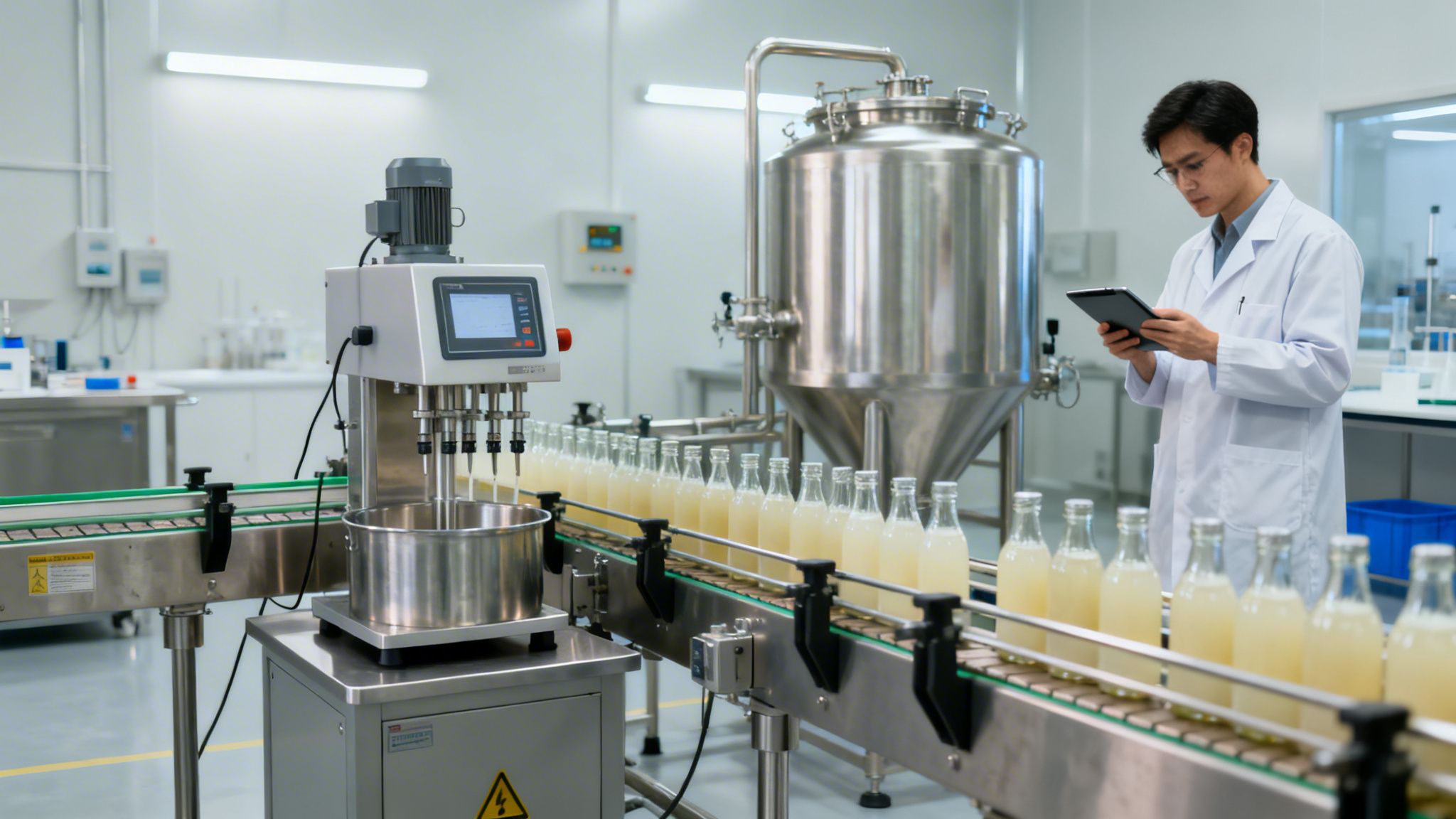
Transitioning a validated benchtop formula to large-scale production presents a new set of challenges. The focus shifts from invention to replication, with consistency as the primary objective.
A documented, robust workflow is non-negotiable at this stage. It serves as a safeguard against costly errors. A single deviation during a large production run can compromise an entire batch, resulting in significant financial loss and reputational damage. A standardized operating procedure (SOP) is essential.
Scaling Up Production Equipment
The transition from lab-scale glassware to industrial-scale tanks is significant. The choice of machinery directly impacts production capacity, product consistency, and operational efficiency. A professional beverage operation requires a dedicated production line.
Key equipment for a commercial line includes:
Mixing Vessels and Tanks: Jacketed, stainless steel tanks are standard. They are used for holding and mixing the base beverage, while smaller vessels are used to prepare the cannabinoid emulsion. The jacket provides precise temperature control, critical for maintaining stability.
High-Shear Homogenizer: As previously discussed, a stable nanoemulsion is paramount. An industrial-grade ultrasonic homogenizer or high-pressure homogenizer is required to achieve the necessary particle size reduction for a shelf-stable product.
Filling and Canning/Bottling Lines: Automation is key to maintaining speed and precision. Automated fillers ensure each unit is filled to the correct volume, minimizing product waste and ensuring dose consistency across the entire batch.
Pasteurization or Tunnel Pasteurizer: Depending on the formulation and desired shelf life, a pasteurization step is often necessary. This thermal process eliminates potential microbial contaminants, ensuring product safety without relying solely on chemical preservatives.
This equipment forms the core of a professional beverage line, enabling the scalable production of a market-ready product.
Best Practices for Batching and Quality Control
With the equipment in place, the focus shifts to process optimization. The order of operations is critical. A reliable method involves preparing the cannabinoid nanoemulsion in a separate, dedicated vessel first.
Once the emulsion is prepared and its quality verified, it is dosed into the larger brite tank containing the pre-mixed base beverage. This approach provides tighter control over the active ingredient before it is diluted into the full batch volume. A final, thorough mixing step ensures the emulsion is uniformly distributed.
Quality assurance is not a final step but an integrated process. Continuous monitoring at every stage is necessary to identify and rectify issues before they escalate and compromise an entire batch.
An effective QA protocol should be embedded in the workflow. The following checkpoints are essential:
- Incoming Material Inspection: Verify the Certificate of Analysis (COA) for all raw materials, particularly the cannabinoid extract. Always confirm potency and purity.
- In-Process Potency Testing: Test the concentrated emulsion for potency before introducing it to the main batch. This verifies dosing calculations before committing the full volume.
- Final Product Homogeneity: After the final mix, pull samples from the top, middle, and bottom of the tank. Test all three for potency to confirm uniform distribution of cannabinoids.
- Microbial and Safety Screening: Test the final packaged product for contaminants such as yeast, mold, and bacteria. This final check guarantees the product is safe for consumption.
Packaging for Stability and Compliance
Packaging serves as the final defense for product quality. Cannabinoids and terpenes are sensitive to light and oxygen, which can cause degradation and negatively impact potency and flavor.
Aluminum cans are an excellent choice as they provide a complete light barrier and a hermetic seal, preventing oxygen ingress. If using bottles, amber or opaque glass is necessary to protect the contents from photodegradation.
The THC beverage category is experiencing explosive growth, with U.S. sales estimated between $1.0 to $1.3 billion in 2024. Projections indicate the category could reach nearly $15 billion by capturing a small share of the alcohol market. As you can learn from these THC beverage industry insights, differentiation requires a sophisticated product. This means complex, memorable flavors driven by a strategic terpene profile for cannabis product formulation. This workflow ensures that the product developed in R&D is the same one consumers experience.
Common Questions in THC Beverage Formulation
Even experienced formulators encounter challenges when developing commercial-scale THC beverages. Moving from concept to a shelf-stable, palatable product requires solving specific technical problems.
This section addresses some of the most frequent questions from formulators, providing practical solutions to common real-world issues.
Why Is My Beverage Separating and How Do I Stop It?
Phase separation, often visible as an oily ring at the top of the container, indicates a failed emulsion. This is a critical failure for any commercial beverage, as it looks unprofessional and results in wildly inconsistent dosing.
The root cause is almost always insufficient emulsion stability. The solution is not simply more aggressive mixing; it requires addressing the physics of the formulation to create a true nanoemulsion.
- Reduce particle size. The primary objective is to reduce cannabinoid oil droplet size to below 100 nanometers. At this scale, Brownian motion keeps the particles suspended indefinitely, achieving kinetic stability.
- Utilize appropriate equipment. Standard blending equipment cannot achieve the required energy input. A high-shear device, such as an ultrasonic homogenizer, is essential. The intense energy from acoustic cavitation is necessary to shatter oil droplets to the nano-scale.
- Optimize your surfactant. A quality emulsifier is mandatory, but the concentration is equally critical. Insufficient surfactant leads to emulsion breakdown, while an excess can introduce soapy off-flavors. Begin with the manufacturer's recommended usage rate and conduct small-batch trials to optimize for your specific matrix.
Product stability is the cornerstone of quality control. The only definitive way to validate emulsion stability is through accelerated shelf-life testing. This involves subjecting the final packaged product to temperature and agitation cycles that simulate real-world shipping and storage conditions.
What Is the Best Way to Mask the Bitter Taste of Distillate?
Even high-purity THC distillate can impart a distinct bitter aftertaste. Simply adding sugar is an ineffective solution that often results in a cloyingly sweet product with a persistent bitter finish. A more sophisticated approach involves building a comprehensive flavor system to mask the bitterness.
The most effective combination includes:
- Acids for brightness. Ingredients like citric acid or malic acid introduce a tartness that cuts through bitterness, brightens the overall flavor, and enhances the perception of refreshment.
- Strategic use of sweeteners. Sweeteners are a component of the solution but should not be the primary tool. Use them to balance the profile after other masking agents have been incorporated.
- Terpenes as the secret weapon. This is where true differentiation occurs. A bright, citrus-forward terpene like Limonene is highly effective at distracting the palate from bitter notes. For a more comprehensive solution, a complex strain-inspired terpene blend can introduce a symphony of aromatic compounds that completely masks any subtle off-notes from the distillate.
Our guide to terpene formulation is an excellent resource for understanding how different terpene isolates and blends can be combined to achieve a specific sensory outcome.
Can I Use Water-Soluble Terpenes in My Formulation?
Yes, and it is highly recommended. Utilizing water-soluble terpene blends is one of the most efficient strategies when formulating a THC beverage. They are specifically designed for aqueous systems and solve multiple formulation challenges simultaneously.
Because they are pre-emulsified, they disperse perfectly into the batch without requiring a separate solubilization step. This simplifies the manufacturing process and ensures that flavor and aroma are uniformly distributed throughout the product. This eliminates the risk of terpenes floating to the surface and creating an unpleasant oily aroma when the container is opened. They provide a reliable, plug-and-play solution for beverage flavoring.
While these points cover common issues, every formulation presents unique challenges. Here are concise answers to other frequently asked questions.
| Question | Answer |
|---|---|
| How do I ensure accurate dosing in every can? | It starts with a homogenized batch. If your cannabinoid emulsion is stable and evenly distributed, your dosing will be consistent. Always follow up with third-party lab testing on your final product to verify potency. |
| What's the best pH for a THC beverage? | Most cannabis beverages perform best in a slightly acidic environment, typically a pH between 3.0 and 4.5. This range helps with microbial stability and often enhances fruit flavors. |
| Can I add vitamins or other supplements? | Yes, but you must test for interactions. Some vitamins can affect the stability of your emulsion or the flavor of your product. Always run small-scale R&D tests before committing to a large batch. |
| How long should my beverage's shelf life be? | With a proper nanoemulsion and the right preservatives (like potassium sorbate or sodium benzoate), you can realistically aim for a shelf life of 9-12 months. Stability testing is crucial to confirm this. |
These answers provide a solid foundation for troubleshooting your own production process.
Ready to perfect your beverage's flavor profile? Gold Coast Terpenes offers a wide range of lab-tested, strain-specific terpene blends and water-soluble solutions designed for commercial formulation. Explore our collection at https://www.goldcoastterpenes.com to find the precise aromas and tastes you need to create a market-leading THC beverage.