
For cannabis product formulators, mastering how to decarb cart oil is a fundamental process that directly impacts product quality, stability, and commercial viability. This isn't an optional step; it's a critical chemical conversion that transforms raw, acidic cannabinoids into the activated, stable, and viscous oil required for high-performance vape cartridges. A precise decarboxylation protocol prevents product failures like crystallization and ensures consistent potency and flavor delivery.
Why Decarboxylation is Critical for Cartridge Formulation
In a professional setting, decarboxylation is a core competency for any formulator. It's the controlled application of heat to initiate a chemical reaction that ensures cannabinoid activation and product stability. Bypassing or mismanaging this process results in cartridges that fail to deliver the target effect and will almost certainly crystallize over time, leading to significant financial loss and brand damage.
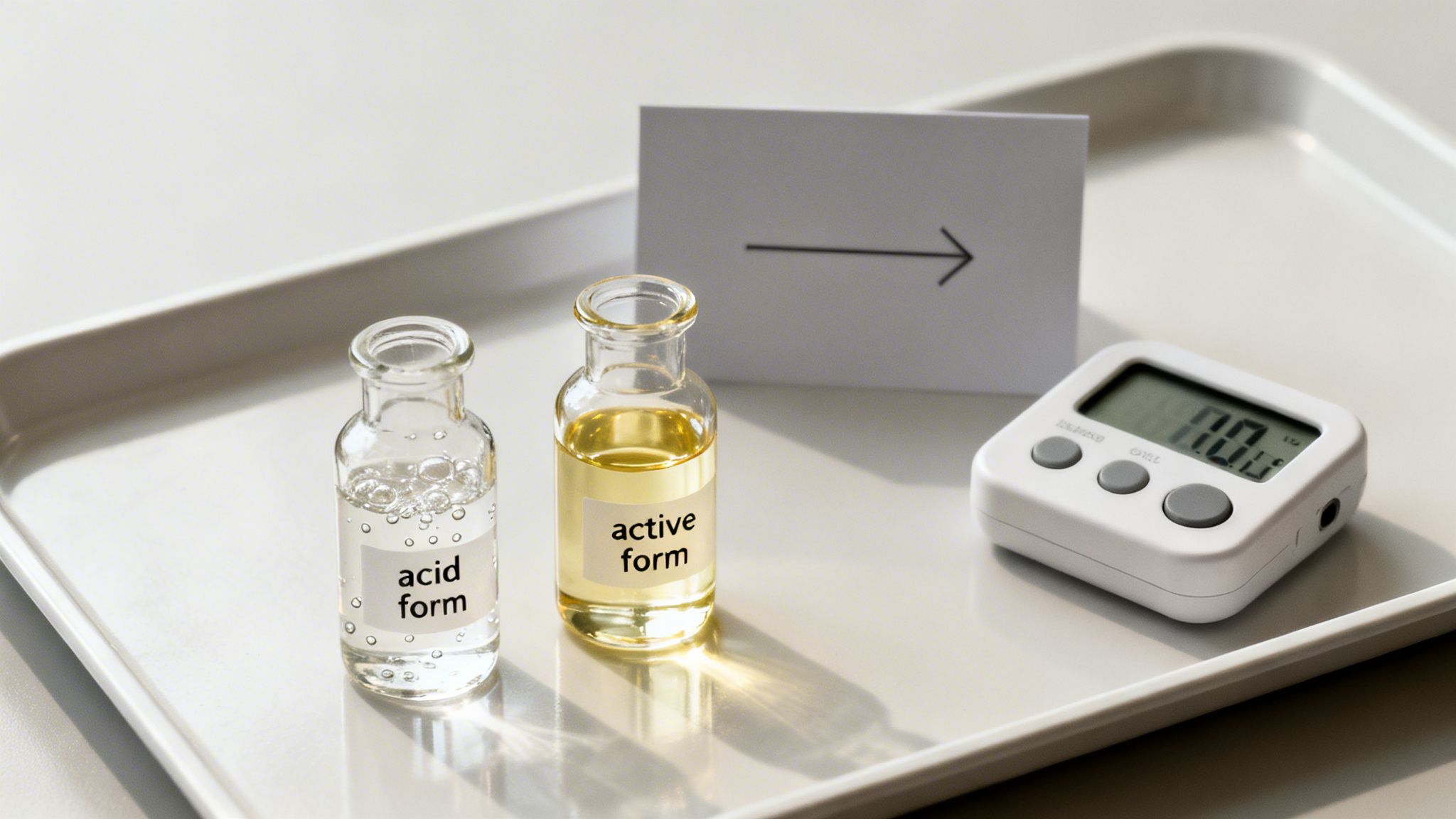
The science is direct: heat removes the carboxyl group (COOH) from cannabinoid acids like THCA, converting them into their neutral, active forms (e.g., THC). This "activation" is essential for any product intended for vaporization, where combustion temperatures are not reached.
Beyond Activation: Ensuring Product Stability
A common misconception is that decarboxylation is solely about cannabinoid activation. For formulators, its role in ensuring product stability is equally important. High-potency extracts are saturated with THCA, a cannabinoid acid with a strong propensity to form a crystalline lattice structure. If significant levels of THCA remain in your oil, it will inevitably "crash out" of the solution, forming solid crystals within the cartridge.
This phenomenon, often called "sugaring" or crystallization, renders a vape cartridge unusable and is a direct consequence of incomplete or improper decarboxylation. A fully decarboxylated oil is far more amorphous and stable, mitigating this costly formulation error.
Achieving a successful decarb requires precise control over three interconnected variables:
- Time: The duration of heat application dictates the extent of the THCA-to-THC conversion.
- Temperature: The temperature level determines the reaction rate. Insufficient heat results in an incomplete reaction, while excessive heat degrades valuable cannabinoids like THC into CBN.
- Atmosphere: The presence of oxygen accelerates oxidative degradation, which can damage both cannabinoids and terpenes. A vacuum or an inert gas environment is the professional standard for mitigating this.
Protecting Potency and Terpene Integrity
Mastering these variables is essential for protecting the final quality of your distillate. The goal is to achieve complete THCA activation while minimizing the degradation of cannabinoids and the volatile terpenes that define a strain's unique aromatic profile.
Laboratory analysis using ultra-high-performance supercritical fluid chromatography confirms that a full THCA conversion can be achieved in a vacuum oven at 110°C (230°F) in just 30 minutes, with a minimal molar concentration loss of only 7.94%.
This table serves as a quick reference for dialing in your process.
Decarboxylation Quick Reference Guide
| Temperature | Time for Full Conversion | Key Outcome | Formulation Consideration |
|---|---|---|---|
| 110°C (230°F) | ~30-40 minutes | Efficient THCA conversion | Optimal balance for preserving some volatile terpenes (top notes). |
| 120°C (248°F) | ~20-30 minutes | Faster conversion | Higher risk of terpene loss and minor THC degradation to CBN. |
| 130°C (266°F) | ~10-15 minutes | Very rapid conversion | Significant risk of degrading THC to CBN and losing valuable terpenes. |
These parameters are starting points. Your specific equipment, batch size, and extract composition will necessitate process optimization to achieve perfect, repeatable results. While understanding basic plant science like the difference between a male weed plant vs female provides context, mastering this chemical conversion is what underpins successful product formulation.
Selecting Professional Decarboxylation Equipment
We've covered the chemistry; now let's address the hardware required to execute it with precision. For consistent, lab-quality results suitable for commercial production, formulators must move beyond rudimentary methods and invest in equipment designed for control and repeatability.
Your choice of equipment directly impacts process efficiency, throughput, and the preservation of valuable terpenes. In professional laboratories and manufacturing facilities, three systems are standard: vacuum ovens, rotary evaporators, and heated reactors. Each offers distinct advantages depending on batch size, workflow, and the desired characteristics of the final oil.
Vacuum Ovens: The Standard for Terpene Preservation
The vacuum oven is an indispensable workhorse for many formulators, primarily for its ability to protect volatile compounds. By evacuating the chamber, you significantly lower the atmospheric pressure. This reduces the boiling point of all compounds within the oil, enabling a more controlled and gentle decarboxylation process.
The primary advantage is the mitigation of oxidation. Oxygen acts as an aggressive agent at elevated temperatures, degrading both cannabinoids and terpenes. Removing it creates an inert environment that facilitates a full decarb at lower temperatures.
By pulling a vacuum, you create a protective atmosphere for your oil. This allows you to achieve complete decarboxylation while preserving the more volatile terpenes (top and mid notes) that would otherwise be lost to heat and oxidation.
This method is ideal for small-to-medium batches where preserving the nuanced aromatic profile of the starting material is a primary objective.
Rotary Evaporators: For Enhanced Control and Degassing
Rotary evaporators ("rotovaps") offer a more dynamic approach. The system comprises a rotating flask containing the extract, which is partially submerged in a heated bath while under vacuum. The rotation constantly spreads the oil into a thin film across the flask's interior surface.
This thin-film action dramatically increases the surface area, accelerating two key processes simultaneously:
- Solvent Recovery: For crude extracts, a rotovap is exceptionally efficient at purging residual solvents prior to decarboxylation.
- Decarboxylation: The thin film provides an easy escape path for the CO2 gas generated during the reaction, preventing pressure buildup and ensuring uniform heat distribution for a clean, complete conversion.
A key benefit of the rotovap is the real-time visual feedback. The operator can directly observe the rate of bubbling slow and cease, providing a clear indication of reaction completion. This level of process control is invaluable for formulators before they begin constructing complex strain-inspired terpene blends.
Heated Reactors: The Solution for Commercial Scale-Up
For large-scale production, a heated, stirred-glass reactor is the industry standard. These systems are engineered for processing large volumes—from hundreds of grams to multiple kilograms in a single run. They feature a jacketed glass vessel, an overhead mechanical stirrer, and ports for applying a vacuum or introducing an inert gas blanket.
These features enable unparalleled control for bulk production:
| Feature | Formulation Advantage |
|---|---|
| Mechanical Agitation | The overhead stirrer ensures constant motion throughout the batch, eliminating thermal gradients (hot spots) and guaranteeing uniform decarboxylation. |
| Jacketed Heating | A thermal fluid circulating within the reactor's outer jacket provides highly stable and precise temperature control across the entire batch volume. |
| Atmospheric Control | The ability to pull a deep vacuum or backfill with an inert gas like nitrogen provides maximum protection against oxidative degradation during the extended heating cycles required for large batches. |
For any manufacturer focused on consistent, high-volume output for vape cartridges, a reactor represents a significant capital investment that delivers unmatched scalability and process control essential for commercial operations. Once the bulk oil is decarboxylated, a comprehensive terpene formulation guide is the next step for finalizing the product.
Dialing in Time and Temperature for Optimal Formulation
Achieving the correct time and temperature parameters is the core technical challenge of decarboxylation for vape cartridges. This is not about following a simple recipe but about precisely managing a chemical reaction. Your control over this process directly influences the oil's final potency, viscosity, and shelf stability, defining the line between a premium product and a commercial failure.
Consider time and temperature as inverse variables on a sliding scale. Increasing the temperature can reduce the required process time, but this trade-off often comes at the expense of quality.
The "Low and Slow" Protocol for Quality Assurance
Experienced formulators universally advocate for a "low and slow" approach. This methodology prioritizes quality and consistency over speed. Utilizing a moderate temperature over a longer duration is the key to achieving a complete THCA-to-THC conversion without degrading valuable cannabinoids and terpenes.
Pushing the temperature too high—for instance, above 130°C (266°F)—will result in rapid decarboxylation but will also cause significant degradation. You will volatilize the delicate terpenes that constitute the oil's aromatic profile (the top and mid notes) and accelerate the conversion of valuable THC into CBN, a less desirable cannabinoid known for its sedative properties. Conversely, a temperature that is too low will lead to an incomplete reaction, leaving residual THCA that will crystallize post-filling.
The optimal processing window for most THCA-rich extracts is approximately 110°C (230°F). At this temperature, a full decarb can typically be achieved in 30-60 minutes, depending on batch size and equipment, without significant terpene loss or CBN formation.
This methodical approach is fundamental to producing a consistent, repeatable product batch after batch.
Decarboxylation Rates of Different Cannabinoids
Formulations involving multiple cannabinoids introduce another layer of complexity. A one-size-fits-all protocol is not effective, as each cannabinoid decarboxylates at a unique rate and temperature.
Different cannabinoids exhibit distinct thermal stability:
- THCA: Converts efficiently around 110°C (230°F).
- CBDA: Is more thermally stable and requires either a longer processing time at lower temperatures or a higher temperature, which increases degradation risk.
- CBGA: Is notoriously unstable. It decarboxylates rapidly but also degrades quickly if not managed with precise temperature control.
When formulating with multiple cannabinoid isolates, kinetic models become critical. For example, while CBG will fully decarb at 110°C in roughly 40 minutes, its instability can lead to a loss of up to 52.67%. In contrast, THC can be decarboxylated in just 6.5 minutes at 160°C, while CBD requires a gentle three-hour process at 110°C. You can review the underlying science with this decarboxylation data from Ripper Seeds. Clearly, the process must be tailored to the specific cannabinoid profile of your formulation.
This diagram illustrates a common laboratory workflow for achieving this precision.

It provides a visual representation of how professionals utilize sequential equipment—such as ovens, rotovaps, and reactors—to execute a controlled, multi-stage process.
Visual Indicators of Reaction Completion
While analytical testing provides the ultimate verification, experienced operators can accurately judge the reaction's progress through visual cues. The primary indicator is the evolution of CO2 gas. As the carboxyl group is cleaved from the THCA molecule, it is released as CO2, creating bubbles in the oil.
At the beginning of the process, bubbling will be vigorous as the decarboxylation reaction accelerates.
As the conversion nears completion, the bubbling will noticeably slow down, and the bubbles will become much smaller and finer. When effervescence has almost completely ceased, the reaction is finished. A few minute bubbles are acceptable, but the initial rolling action should be complete.
This visual confirmation is an invaluable in-process check. It signals when to terminate the heating cycle, preventing over-processing and degradation. Combining this observational skill with tightly controlled time and temperature parameters is how formulators achieve perfect, consistent results.
Advanced Techniques: Formulating for Terpene Preservation
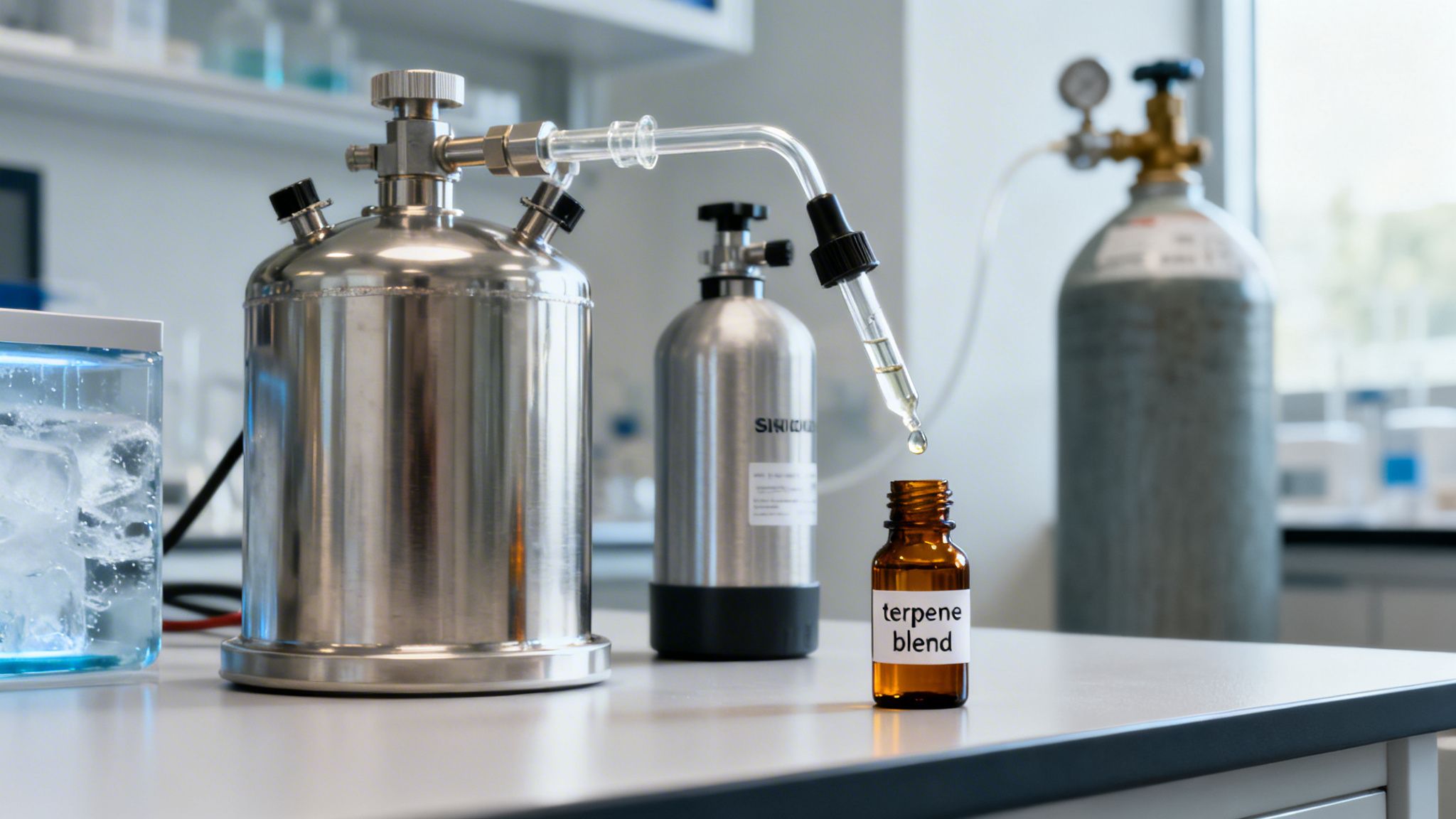
For formulators creating premium vape products, flavor and aroma are paramount. While standard decarboxylation protocols are effective for cannabinoid activation, they are inherently destructive to volatile aromatic compounds—terpenes. To formulate a product with a distinct and memorable profile, one must employ advanced techniques to protect these critical molecules.
This requires a dual strategy: first, minimize terpene loss during the decarboxylation process itself, and second, master the art of post-decarb terpene reintroduction to build a precise and consistent final product.
Locking in Flavor with Inert Atmospheres
The primary driver of terpene degradation during decarboxylation is not heat alone, but heat in the presence of oxygen. Oxygen is a highly reactive molecule that readily oxidizes delicate terpenes, resulting in a muted or off-flavor profile. The professional solution is to displace oxygen with an inert gas.
Utilizing a sealed pressure vessel and backfilling it with an inert gas like nitrogen is a highly effective technique. By purging the headspace of oxygen, you create a protective blanket around the oil, allowing the full decarboxylation cycle to complete without significant volatilization or degradation of the aromatic profile.
Pro Tip: When learning how to decarb cart oil for top-tier products, consider nitrogen backfilling as an insurance policy against flavor loss. The investment in appropriate equipment is justified by the resulting improvement in product quality and brand equity.
Another advanced method discussed by industry experts on Future4200 involves using a sealed pressure vessel held at a -14 psig vacuum. This nitrogen-purged environment not only prevents oxygen ingress but also uses pressure stabilization to confirm 100% reaction completion. For large batches, this can enable cycles of 14-15 hours at 110°C without agitation.
The Art of Post-Decarb Formulation
Even with the most advanced preservation techniques, some degree of terpene loss is inevitable. This is where post-decarb formulation becomes a formulator's most powerful tool for product differentiation. By reintroducing a precise blend of botanically derived or cannabis-derived terpenes, you gain complete control over the final aromatic and flavor profile.
This step elevates a basic, high-potency distillate into a strain-specific experience. It allows for the precise replication of sought-after cultivars or the creation of novel, signature blends. Our guide to the Sour Diesel strain profile offers a great example of how top, mid, and base note terpenes come together to create a classic profile.
Calculating Terpene Concentration for Formulation
Adding terpenes back into decarboxylated oil requires precision. Insufficient addition results in a weak flavor, while excessive addition creates a harsh, unpalatable product that can cause throat irritation and is often a sign of a low-quality formulation.
For most vape cartridge applications, the ideal terpene concentration is between 4-8% by weight.
The calculation is straightforward. For a target concentration of 6% terpenes in a final blend, you would combine 94 grams of decarboxylated cannabinoid oil with 6 grams of your chosen terpene blend to produce 100 grams of finished oil (94g oil + 6g terpenes).
Always use a calibrated analytical balance for this measurement. After decarboxylation, allow the oil to cool to a manageable temperature, typically 60-70°C (140-158°F). At this temperature, the oil's viscosity is low enough for easy mixing, but the temperature is not so high that it will volatilize the added terpenes. Mix with a homogenizer or magnetic stirrer until the solution is completely uniform to ensure consistent flavor and potency in every filled cartridge.
Post-Decarb QC and Cartridge Filling Protocol
Successful decarboxylation is a major milestone, but the process is not complete. The final stages—quality control, viscosity management, and cartridge filling—are where professional execution separates top-tier products from the rest. Rushing this stage can nullify all previous efforts.
The immediate next step is to analytically confirm the success of your decarboxylation. Visual cues are helpful, but hard data is required for professional quality assurance.
Confirming Conversion with Potency Testing
The only definitive method to verify a successful decarb is to submit a sample of the oil to a third-party laboratory for High-Performance Liquid Chromatography (HPLC) analysis. This is the ground truth for your process.
An HPLC report provides two mission-critical data points for a formulator:
- Complete Activation: The analysis confirms that you have converted all or nearly all of the THCA into active THC. Any significant residual THCA indicates an incomplete reaction and a high risk of future product crystallization.
- CBN Conversion: The report also quantifies the amount of THC that has degraded into Cannabinol (CBN). A high CBN value, typically over 1-2%, is a clear indicator of over-processing (excessive heat or time) and compromises the product's intended effect and market value.
This data serves as a critical feedback loop for process validation and optimization for future batches.
Managing Viscosity for Cartridge Performance
Even after a perfect decarb, high-potency distillate is extremely viscous at room temperature. Attempting to fill cartridges with oil in this state will lead to hardware failure, poor wicking, and a negative end-user experience.
The initial step is to gently heat the oil. Raising the temperature to 50-60°C (122-140°F) will typically reduce the viscosity sufficiently for smooth filling and proper cartridge function. If the oil remains too thick, a viscosity modifier may be necessary.
When selecting a diluent, quality is paramount. Never use MCT, VG, PG, or PEG oils, as these agents compromise flavor, can clog hardware, and are not designed for inhalation. Use only high-quality, flavorless viscosity modifiers engineered specifically for cannabis extracts.
If a diluent is required, begin with a minimal addition. Add 1-3% by weight, homogenize thoroughly, and test the flow characteristics. The objective is to use the lowest possible concentration necessary to achieve optimal performance in your chosen cartridge hardware.
Cartridge Filling and Troubleshooting Common Failures
Once the oil has reached the target viscosity and temperature, it is ready for filling. A heated, automated, or semi-automated cartridge filling system is essential for maintaining temperature and ensuring each unit receives a precise and consistent dose without introducing air bubbles.
Even with a well-defined process, issues can arise. Here are common failures and their root causes:
- Crystallization in Cartridge: Sugar-like crystals forming post-filling indicate incomplete decarboxylation. Re-evaluate your time and temperature parameters and always verify with HPLC analysis.
- Leaking Cartridges: This is almost always a hardware or viscosity issue. If the oil is too thin (due to excessive terpenes or diluent), it will oversaturate the atomizer and leak. Ensure your oil's final viscosity is compatible with your cartridge's intake aperture size.
- Inconsistent Potency: Significant potency variations between batches often point to inadequate homogenization. Before filling, the entire batch of oil and any additives (terpenes, diluents) must be mixed until completely uniform.
Formulator's FAQ: Advanced Decarboxylation Questions
Even for experienced professionals, the nuances of decarboxylation for vape cart formulation can present unique challenges. Here are answers to some of the most common technical questions that arise in the lab.
Is There a Case for Leaving Residual THCA in the Oil?
Yes, for certain extracts like live resin or rosin, intentionally leaving a controlled amount of residual THCA can be a strategic formulation choice. We find that aiming for a residual THCA content of 5-20% can act as a stabilizing agent, surprisingly inhibiting the crystallization or "sugaring" of the bulk oil within the cartridge.
This is an advanced technique that requires a careful balancing act. Too much THCA will cause the product to fail, but the right amount can help maintain a stable, viscous oil and may contribute to the overall entourage effect. This approach is not suitable for guesswork and requires significant R&D. Begin with small-scale tests targeting less than 20% residual THCA and conduct stability trials in your specific hardware before scaling up.
What Are the Indicators of Over-Decarboxylation?
The primary visual indicator of over-processing is a significant darkening of the oil. A desirable light gold extract will shift to a deep amber or reddish hue. You may also observe an increase in viscosity as thermal degradation occurs.
Analytically, the key indicator is the conversion of THC into CBN (Cannabinol), which is confirmed via HPLC testing. This degradation reduces the product's psychoactive potency and introduces an unintended sedative effect.
To prevent this, precise temperature control is non-negotiable. As a standard operating procedure, do not exceed 130°C (266°F). Limiting oxygen exposure through a vacuum or nitrogen backfill is also critical. Adhere strictly to validated time and temperature parameters; process deviations are the leading cause of batch failure.
Should Terpenes Be Added Before or After Decarboxylation?
After. Always after. There are no exceptions to this rule in a professional workflow.
Terpenes are highly volatile compounds with low boiling points. Introducing an expensive terpene blend before the heating process will result in the complete loss of your aromatic profile as the terpenes evaporate. This is a costly and entirely avoidable error. Any legitimate formulation guide for cannabis products will reinforce this critical sequence.
The correct professional workflow is as follows:
- Complete the decarboxylation process.
- Allow the oil to cool to a safe mixing temperature, typically 60-70°C (140-158°F).
- Introduce the precisely measured terpene blend to the warm oil.
- Homogenize the mixture until it is completely uniform to ensure product consistency.
Following this sequence is essential for preserving the complex character of high-quality strain-inspired terpene blends.
My Decarboxylated Oil Is Too Viscous. What Are My Options?
This is a common issue, particularly with high-potency distillates. An overly viscous oil will not function correctly in most vape cartridge designs.
Your first step is thermal management. Gently reheat the oil to 50-60°C (122-140°F). This temperature is often sufficient to reduce viscosity for filling and allow for proper wick saturation.
If the oil remains too thick, a diluent may be used. Exercise extreme caution and select only a high-quality, carrier-free diluent specifically designed for cannabis extracts. Never use VG, PG, PEG, or MCT oil. Begin with a minimal concentration of 1-2% by weight, mix thoroughly, and test the viscosity.
Alternatively, your terpene blend itself can act as a viscosity modifier. Adding an additional 1-3% of a low-viscosity terpene blend can help thin the oil. However, be mindful of the impact on the final flavor profile and ensure it remains balanced and not overly harsh.
Ready to create vape cartridges with unforgettable, consistent flavor? At Gold Coast Terpenes, we provide lab-verified, strain-specific terpene profiles and isolates to help you perfect your formulations. Explore our collection and find the perfect blend for your next product at https://www.goldcoastterpenes.com.