
For cannabis product formulators, the term “high terpene strains” must be more than marketing hype—it must be a quantifiable metric on a Certificate of Analysis (COA). While consumers are drawn to creative strain names, professionals building vape cartridges, edibles, and tinctures need actionable data to ensure flavor accuracy, product consistency, and operational efficiency.
This guide provides a framework for understanding and utilizing high terpene strains for cannabis product formulation, focusing on the technical requirements for replicating complex flavor profiles with precision.
Why High Terpene Content is a Formulation Asset
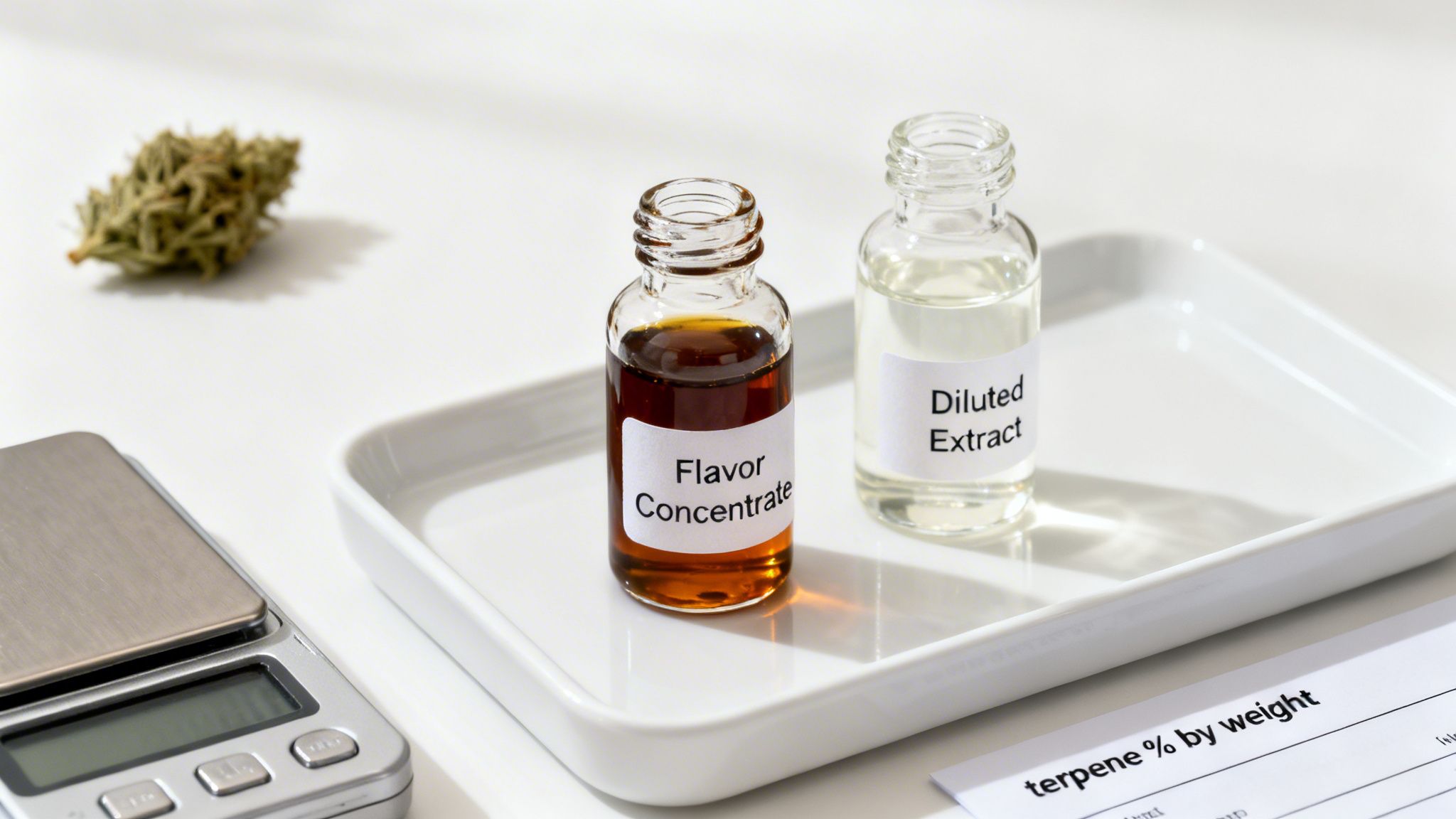
As a formulator, "high terpene" is not a subjective descriptor; it’s a measurable metric that dictates sourcing strategy, predicts extraction outcomes, and ultimately defines the quality of a finished product. The quantifiable terpene content, measured by weight, is the primary indicator of a biomass's potential for creating authentic, full-flavored products.
Starting with high-terpene flower is analogous to a chef using a rich, complex spice blend as a base. Conversely, formulating with low-terpene material is like attempting to build flavor from a diluted seasoning; it requires significant time and cost to reconstruct a profile that was never robust to begin with.
Industry Benchmarks for Terpene Content in Biomass
The increasing precision of lab analytics has established clear benchmarks for classifying terpene content in raw cannabis flower. This data provides a crucial guide for sourcing and product development.
Industry Benchmarks for Terpene Content in Cannabis Flower
| Terpene Content (% by Weight) | Industry Classification | Significance for Product Formulation |
|---|---|---|
| < 1% | Low | Requires substantial terpene additions post-extraction. |
| 1% – 2% | Adequate | A viable starting point for extracts with a decent native aroma. |
| 2% – 3% | High | Excellent material; produces fragrant extracts needing minimal enhancement. |
| > 3% | Premium | Elite-tier biomass for live resins and high-value, flavor-forward products. |
These benchmarks evolved as professional breeders began leveraging lab analytics to validate their genetics. By using a COA to verify these figures, formulators transform sourcing from a speculative endeavor into a strategic, data-driven decision.
The Impact of Terpene Percentage on Your Bottom Line
Selecting source material with a high terpene percentage directly and positively influences operational efficiency and final product quality. This is not merely about superior aroma; it is a strategic business decision.
- Reduced Formulation Costs: Starting with terpene-rich flower results in a more aromatic native extract. This reduces the volume of botanical terpenes required post-extraction, directly lowering your cost of goods sold (COGS).
- Superior Product Quality: Extracts derived from high-terpene strains, particularly live resin, capture a more authentic and complex profile. This facilitates the creation of a premium product that commands a higher price point.
- Brand Consistency: Sourcing based on chemical data rather than strain names enables the creation of a consistent product, batch after batch. This reliability is fundamental to building brand loyalty.
For formulators, the terpene percentage in source material is a direct indicator of its potential. Biomass with over 3% terpenes is a high-value asset capable of producing top-tier extracts with minimal intervention.
Focusing on these metrics empowers you as the architect of your product line. To delve deeper into specific aromatic profiles, our guide on unlocking the secrets of terpene-dominant strains offers valuable insights that can enhance both product quality and profitability.
Terpene Yield: A Critical Metric for Extractors
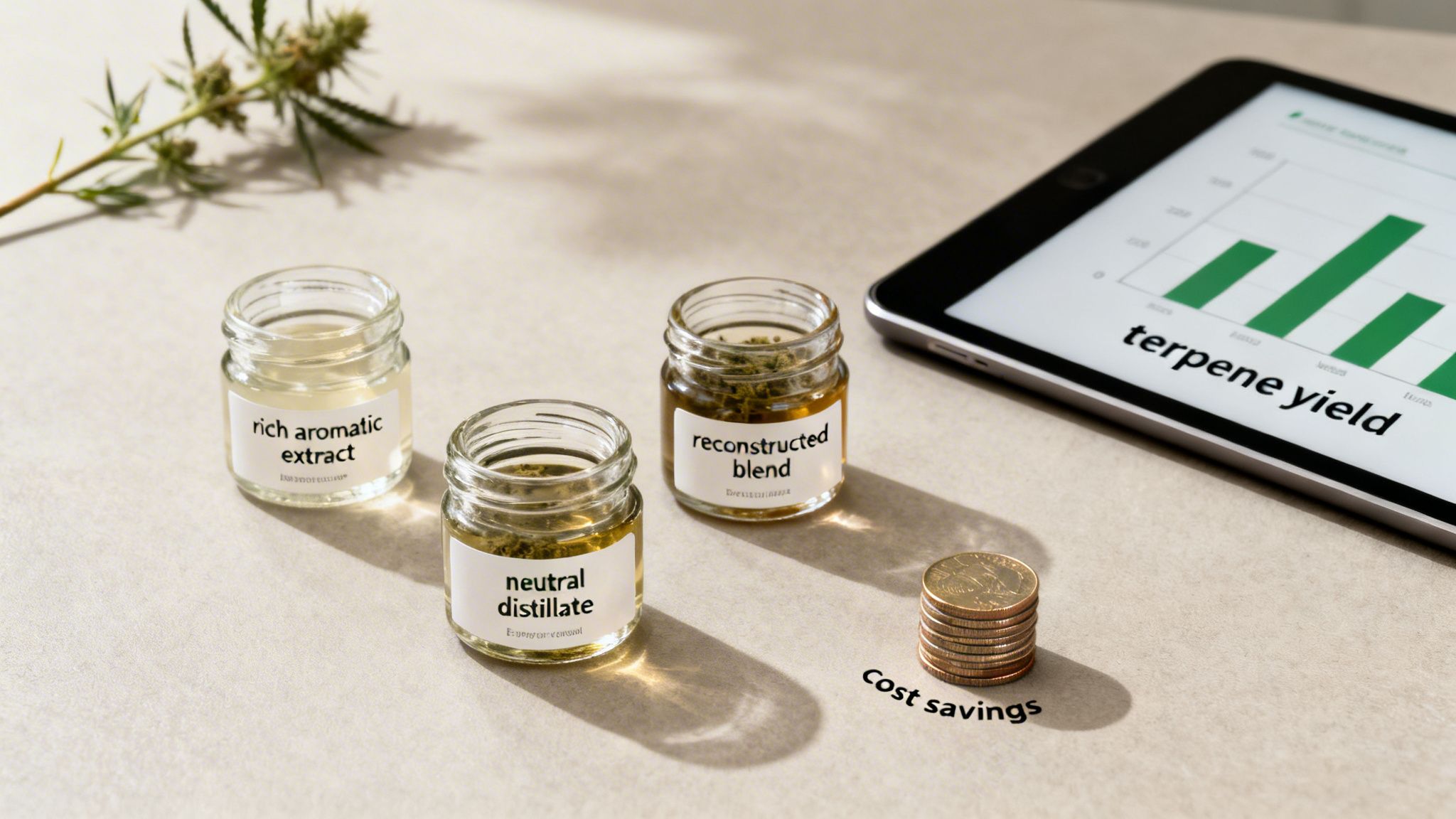
For extractors and brand owners, the terpene percentage of starting material is a critical variable that directly impacts profitability. Sourcing biomass is a strategic decision that influences everything from extraction efficiency to the final market appeal of your product. The choice is simple: start with superior ingredients and make minor adjustments, or begin with a bland base and attempt to construct a complex flavor profile from scratch. The former is consistently more efficient, cost-effective, and yields a superior result.
The Advantage of High-Terpene Starting Material
Initiating an extraction run with flower possessing a high terpene content (over 2% is an excellent benchmark) sets the stage for success. This quality material provides a higher native terpene yield in the crude oil, capturing an authentic and potent aroma from the outset and preserving the true essence of the selected chemovar.
This high native yield is particularly advantageous when producing premium extracts like live resin, where the primary objective is to deliver a "fresh-from-the-flower" sensory experience. Starting with biomass rich in terpenes means your extract already possesses significant character and complexity, minimizing the need for post-extraction manipulation.
This provides two major operational advantages:
- Lower Formulation Costs: When your extract has a strong native terpene foundation, you spend significantly less on botanical blends to achieve your target profile, directly improving your COGS.
- A More Authentic Product: An extract with a rich native terpene profile will always be perceived as more genuine than one reconstituted from a flavorless distillate. In a competitive market, authenticity is a key differentiator.
We detail methods for preserving these volatile compounds in our formulator’s guide to live resin sauce.
The Challenge of Low-Terpene Biomass
Conversely, utilizing low-terpene biomass creates a cascade of operational challenges. Standard extraction and distillation processes, involving heat and pressure, will volatilize the few aromatic compounds present, leaving you with a clean but neutral distillate.
Low-terpene starting material forces the formulator to become a re-creator, not an enhancer. You must construct an entire sensory experience from the ground up, an approach that is expensive, time-consuming, and less authentic.
This necessitates a significant investment in terpene blends to impart any identity to the product. You are no longer fine-tuning a profile; you are building it entirely. While this offers control, it adds cost and complexity to your workflow and introduces the risk of creating a product that tastes artificial if the formulation is not executed perfectly. Seeking out high terpene strains is a sound business strategy that simplifies processes, lowers costs, and results in a superior product that can command a premium.
Formulating with Top, Middle, and Base Terpene Notes
Effective product formulation requires a structured approach. Crafting an authentic and memorable aroma—whether replicating a known strain or developing a novel profile—is analogous to architectural design. The perfumer's framework of top, middle, and base notes provides a proven blueprint for creating stable, complex, and impactful flavor profiles.
This methodology is essential for products like vape cartridges, where flavor stability from the first to the last inhalation is paramount. By deconstructing an aroma into these three layers, the formulator transitions from a simple mixer to a flavor architect.
The Three Tiers of Aroma Construction
Each layer in the aromatic pyramid serves a specific function, determined by the terpene's molecular weight and volatility.
Top Notes: These are the initial impression. As the lightest, most volatile compounds, they deliver the immediate burst of aroma upon opening the package or during the initial inhalation. They must be impactful.
Middle Notes: As the top notes dissipate, the middle notes emerge. These form the "heart" of the profile, providing substance and character. They act as a bridge between the bright opening and the lasting finish.
Base Notes: These are the heavy, low-volatility compounds that anchor the entire experience. Base notes create depth, richness, and the lingering scent that defines the product's finish.
A deficiency in any layer compromises the entire profile. A product lacking strong top notes will seem flat and uninviting. Conversely, a blend missing its base notes will taste thin and fade rapidly, resulting in a poor consumer experience.
Classifying Terpenes for Formulation
Thinking like a flavor architect means understanding which terpenes function in each layer. This knowledge allows for the strategic selection of isolates and blends to construct a precise sensory journey.
A well-constructed profile guides the consumer through a sensory narrative. It should begin with bright, attention-grabbing notes that transition smoothly into a fuller body, all supported by a deep, resonant foundation. This is the key to avoiding the "flavor fade" that degrades the experience in many vape products.
This classification guide is a practical tool for building balanced and stable profiles. For more granular pairings, our terpene flavor chart is an essential resource during the formulation process.
Terpene Classification for Flavor and Aroma Formulation
The table below provides a functional classification of common terpenes. Use it to structure balanced aromatic profiles for your vape and other cannabis products, ensuring each note serves a specific purpose.
| Terpene | Classification | Aromatic Contribution | Example Strain Application |
|---|---|---|---|
| Limonene | Top | Bright, sharp citrus for a fresh first impression. | Agent Orange |
| Pinene | Top | Crisp, clean pine for an energetic opening. | Jack Herer |
| Myrcene | Top/Middle | Foundational earthy, musky scent that bridges other notes. | Blue Dream |
| Linalool | Middle | Soft, floral lavender that smooths sharp top notes. | Do-Si-Dos |
| Beta-Caryophyllene | Base | Key anchor with a spicy, peppery, woody aroma for a long finish. | GSC (formerly Girl Scout Cookies) |
| Humulene | Base | Woody, earthy, hoppy foundation for a rich, resonant impression. | Death Star |
By mastering this tiered approach, you gain granular control over the product's sensory journey. You are no longer just mixing ingredients; you are intentionally designing a flavor that unfolds in stages, creating a consistent, sophisticated experience that fosters brand loyalty. This is what differentiates a generic product from one with a true, strain-inspired soul.
A Technical Guide to Formulating with Terpenes
With a clear understanding of top, middle, and base notes, we can now transition from theory to practice. The objective is to transform a neutral cannabinoid distillate into a premium, strain-specific product. This process is not about simply adding flavor; it is about crafting a stable, consistent, and safe product that delivers a predictable experience.
Executing this requires meticulous attention to detail. Deviations in ratios, mixing procedures, or sourcing can compromise an entire batch—an expensive lesson. Adherence to fundamentals is critical for creating replicable, high-quality products.
This diagram illustrates the architectural approach to aroma construction.
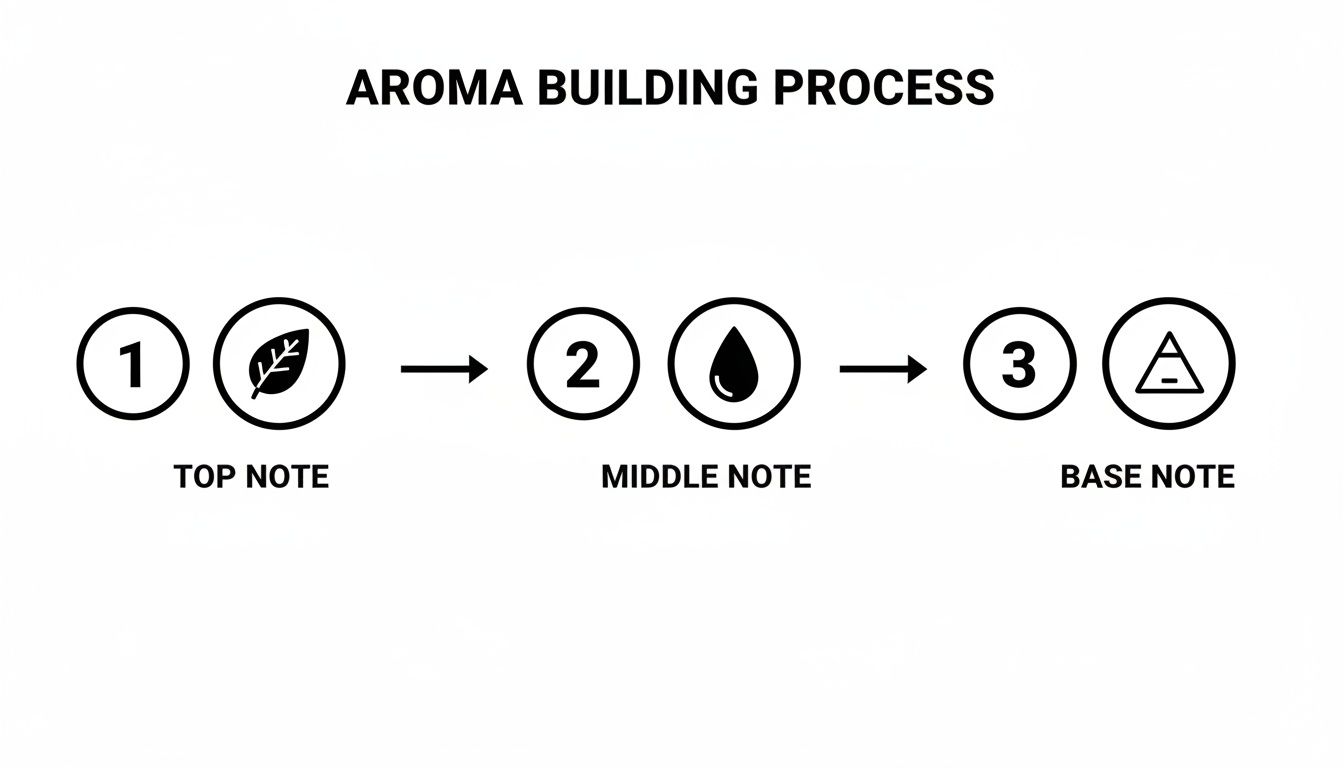
You begin with the light, volatile top notes, build the core character with middle notes, and anchor the profile with deep, lasting base notes. It is a structured, scientific process.
Establishing Ratios for Optimal Flavor
The most common question is: "What is the correct usage rate?" While the answer is context-dependent, a professional benchmark exists.
The optimal concentration for most distillate-based products is 5% to 7% terpenes by weight. For high-potency, clean distillates, a rate of 3-4% may suffice. While some formulations go as high as 10%, this risks creating a harsh sensory experience.
The best practice is to start with a low concentration and titrate upward. Prepare small test batches at 4% or 5% and evaluate the flavor, aroma, and mouthfeel. This iterative testing process is the only way to identify the ideal balance where the strain's character is expressed without being overpowering.
Homogenization: The Key to a Stable Formulation
Simply adding terpenes to an oil and stirring is insufficient. Terpenes are significantly less viscous than cannabinoid oil and will separate over time, leading to "hot spots" of concentrated flavor and other areas that are bland. This results in an inconsistent user experience that damages brand credibility.
To achieve a perfectly stable and uniform product, these steps are mandatory:
- Gentle Warming: Heat the distillate to 40-50°C (104-122°F). This reduces viscosity for effective mixing without degrading terpenes or cannabinoids.
- Terpene Addition: Introduce the precisely measured terpene blend to the warmed oil.
- Mechanical Mixing: This is the critical step. Utilize a magnetic stirrer or overhead mixer for 15-30 minutes. This mechanical action is non-negotiable for creating a completely homogenous solution.
Proper homogenization guarantees that every unit, from vape cartridges to tinctures, delivers the exact same experience.
The Critical Importance of Sourcing
The quality of your final product is dictated by the quality of its inputs. For inhalable products like vape cartridges, purity is a non-negotiable requirement. Using terpenes containing diluents such as VG, PG, PEG, or MCT oil is a dangerous and professionally irresponsible practice.
Always partner with a supplier who provides pure, uncut terpenes and supports them with a Certificate of Analysis (COA) for every batch. The COA is your proof of purity and a critical compliance document. Using pure botanical terpenes is the only way to safely and accurately replicate the complex essence of high terpene strains.
By standardizing your ratios, perfecting your homogenization protocol, and maintaining stringent sourcing standards, you establish the foundation for producing exceptional products that build consumer trust. To explore specific profiles, our catalog of strain-inspired terpene blends provides a starting point for bringing authentic flavors to your product line.
A Guide to Replicating the Flavor of Popular Strains
Consistency is the bedrock of a trusted brand. Formulators, however, understand the inherent challenge of replicating the authentic flavor of a popular strain like Sour Diesel or Blue Dream. Relying on botanical raw material introduces variability; each harvest, grower, and curing process yields a different chemical profile.
To overcome this, leading formulators are using precisely blended terpenes based on analytical data. This shifts the paradigm from chasing an unpredictable plant to engineering a consistent sensory experience. It grants you complete control to deliver the same flavor profile in every product, every time, eliminating sourcing volatility.
From Agricultural Variability to Brand Reliability
Mastering replication is how you differentiate your brand in a crowded marketplace. It is about building a reputation for predictable quality that fosters consumer loyalty.
Today's market is educated. Consumers seek rich, terpene-driven experiences and understand the metrics of quality. The cannabis flower market has set the standard: terpene content over 2% is considered craft quality, while premium flower often exceeds 3%. This 2% threshold has become an industry-accepted dividing line, highlighting what consumers value.
By blending your own profiles, you can consistently meet and exceed this standard. You are no longer subject to agricultural variables; you are in control, building a loyal customer base on the foundation of predictable excellence.
Deconstructing a Strain for Accurate Replication
Replicating a strain profile is akin to obtaining the original recipe from a master chef. It requires a detailed list of every ingredient, not guesswork. This "recipe" is derived from a laboratory analysis—typically a Gas Chromatography-Mass Spectrometry (GC-MS) report—of a prime sample of the target strain.
This report serves as your formulation blueprint. It details the strain’s chemical fingerprint, listing every terpene and its precise percentage. A classic profile like Sour Diesel is not merely "gassy" and "citrusy"; its iconic aroma is a specific ratio of dominant terpenes like Caryophyllene and Limonene, supported by dozens of minor terpenes that contribute to its unique character.
Using a GC-MS report as your guide removes subjectivity from the formulation process. You are not just mimicking a flavor; you are reconstructing an authentic molecular experience.
The Blending Process: A Fusion of Science and Art
With your target terpene ratios established, the formulation work begins. This is where the science of the analytical report meets the art of blending. It is a methodical process that allows for unparalleled precision.
- Build the Foundation: Begin by blending the most dominant terpenes. These are the compounds that form the core identity of the profile. For a strain like Sour Diesel, this means first establishing the foundational balance between its peppery and citrus notes.
- Layer in Complexity: Next, add the secondary and tertiary terpenes. These middle and top notes provide the blend's unique personality, complexity, and the initial aromatic impact when a consumer engages with the product.
- Integrate Trace Compounds: The final step involves adding the trace terpenes, which may be present in concentrations below 0.1%. While seemingly insignificant, these subtle notes are often what make a replication feel truly authentic and complete.
This systematic, multi-stage approach is what distinguishes a generic "diesel" flavor from a convincing and accurate recreation. By mastering this technique, you gain the ability to produce products with unmatched consistency, building a brand synonymous with quality.
Upholding Safety and Quality in Terpene Formulations
In the cannabis product manufacturing industry, brand reputation is your most valuable asset. While an exceptional flavor profile may drive initial trial, an unwavering commitment to safety and quality is what earns long-term consumer trust. This is particularly true for inhalable products, where purity is not a marketing benefit but a fundamental responsibility.
Protecting your brand and your customers starts with rigorous sourcing and handling protocols for your terpenes. Adhering to best practices is about mitigating risk, ensuring compliance, and building a sustainable business. Every decision in the lab has a direct impact on the end-user's safety and your brand's integrity.
The Non-Negotiable Rule for Vape Cartridge Formulation
For vape cartridges, there is zero tolerance for diluents. Your terpene blends must be completely free of cutting agents. This means no VG (Vegetable Glycerin), PG (Propylene Glycol), PEG (Polyethylene Glycol), or MCT (Medium-Chain Triglyceride) oil.
These substances are not intended for inhalation, and their thermal decomposition can produce harmful byproducts. The only way to formulate with confidence is to use pure, uncut terpenes. This standard protects consumers and insulates your brand from the significant liability associated with marketing an unsafe product. You can explore this topic further in our library of cannabis product formulation resources.
Your Documentation Blueprint for Safety and Compliance
Beyond sourcing pure ingredients, a professional, documented process is required to validate your commitment to quality. These three documents are the pillars of a robust safety and consistency program.
- Safety Data Sheets (SDS): Every terpene isolate and blend must have an accompanying SDS. This document provides critical information for safe handling, storage, and emergency procedures. It is an essential component of your lab's safety protocol.
- Certificates of Analysis (CoA): A CoA from a reputable third-party laboratory is your proof of purity. It verifies that your terpenes are free from contaminants such as pesticides, heavy metals, and residual solvents. A supplier who cannot provide a batch-specific CoA should not be considered.
- Standard Operating Procedures (SOPs): Your laboratory must operate under clear, written SOPs for every stage of production. From raw material intake to final product testing, SOPs ensure that every batch is manufactured with complete consistency.
These documents function as your brand’s insurance policy. They demonstrate a commitment to professional standards, facilitate regulatory compliance, and create a verifiable paper trail that substantiates the safety and quality of your products.
By integrating these protocols into your workflow, you build a foundation of trust with partners, regulators, and consumers. This is what distinguishes a transient brand from an industry leader. Witness how premium ingredients elevate product quality in our collection of strain-inspired terpene blends.
Common Questions on High-Terpene Formulations
Here are answers to common questions that arise during the formulation of products with high terpene concentrations. Addressing these practical issues is key to achieving optimal results.
What is the correct usage rate of terpenes for distillate?
A reliable starting point for most applications is a concentration between 5% and 7% terpenes by weight. This should be treated as a baseline, as the final ratio will depend on the potency of your terpene blend and the characteristics of your base cannabinoid oil.
The recommended best practice is to start with a lower concentration, such as 4% or 5%, in small test batches. Evaluate the results and titrate upwards until you achieve the desired flavor and aroma intensity without introducing harshness.
How do I prevent terpenes from separating from my distillate?
Separation is a clear indicator of inadequate mixing. The key to a stable product is thorough homogenization. After gently warming your distillate to approximately 40-50°C and adding your terpenes, the mixing process is critical.
Utilize a magnetic stirrer or an overhead mixer for a duration of 15-30 minutes. This mechanical agitation is essential to ensure the complete and even distribution of terpenes throughout the oil, creating a stable solution that will not separate over time.
A perfectly homogenized blend ensures that every unit you produce delivers an identical sensory experience. This consistency is fundamental to building brand loyalty and consumer trust.
Can I accurately replicate a cannabis strain’s flavor with botanical terpenes?
Yes, this is achievable through a scientific approach. It requires more than combining a few common terpenes. Authentic replication involves obtaining a laboratory analysis, such as a GC-MS report, for the target strain and using that data as a blueprint.
The process often involves precisely blending dozens of different botanical isolates to mirror the strain's unique chemical fingerprint—from its volatile top notes to its heavy base notes. Without this level of detail, the resulting flavor will lack the complexity and authenticity that define a memorable strain. For those new to this process, consulting a comprehensive terpene formulation guide is highly recommended.
Ready to achieve consistent, authentic flavor in your product line? Gold Coast Terpenes provides lab-tested, strain-specific terpene blends and isolates that deliver the precision needed to master your formulations. Explore our full collection and elevate your products at https://www.goldcoastterpenes.com.