
For cannabis product formulators, certain strain profiles represent proven commercial velocity. The Green Crack terpene profile is chief among them. Its distinct mango, citrus, and pine aroma is a reliable seller, making it a cornerstone for vape carts, distillates, and other products engineered for a bright, focused sensory experience.
However, to truly leverage its market power, you must move beyond consumer-level descriptions and deconstruct its aromatic architecture. This guide provides the technical breakdown necessary to accurately replicate this iconic profile for cannabis product formulation.
Deconstructing the Green Crack Terpene Profile for Formulation
To develop a successful product that consistently performs, nailing the aroma and flavor is non-negotiable. For Green Crack, this means capturing its signature sensory experience—the one brand owners and manufacturers depend on. We are not just mimicking a scent; we are engineering a specific, reproducible product experience.
The profile is defined by its bright, fruity top note layered over a more complex earthy, pine foundation. This aromatic structure is why it's a staple for products marketed with energetic or focused attributes.

The first step in any formulation is to identify the primary terpenes driving the profile. Several key isolates work in concert to give Green Crack its unforgettable character.
Primary Aromatic Drivers
The core of the Green Crack flavor profile is built on three essential terpenes. Myrcene is the dominant force, delivering the powerful, sweet mango characteristic the strain is known for. Consider it the central pillar supporting the entire aromatic structure.
Next, Beta-Caryophyllene introduces a spicy, peppery complexity. This isolate is critical for preventing the profile from becoming overly sweet or one-dimensional, grounding the fruit notes with a robust, earthy base.
Finally, Pinene adds a crisp, fresh pine aroma. It provides a clean, invigorating lift that cuts through the sweetness and defines the initial sensory impression.
Formulation Insight: The key to a successful Green Crack replication lies in the precise ratio of Myrcene to Pinene and Caryophyllene. An imbalance can cause the vibrant mango note to be lost in a generic pine scent or overwhelmed by spice, fundamentally altering the product's character and market appeal.
Achieving this balance is paramount for any brand aiming to produce a consistent and authentic Green Crack strain-inspired terpene blend. The table below breaks down the key components for your formulation.
Green Crack Terpene Breakdown for Product Formulation
This table outlines the primary and secondary terpenes typical in the Green Crack profile, their aromatic notes, and their functional roles in formulation. For advanced customization, consider sourcing from a full range of terpene isolates to fine-tune your blend.
| Terpene | Typical Concentration (%) | Aromatic Contribution (Flavor Note) | Role in Formulation |
|---|---|---|---|
| Myrcene | 40-55% | Sweet, Ripe Mango, Musky | Serves as the dominant middle note, creating the profile's core fruity body. |
| Beta-Caryophyllene | 15-25% | Spicy, Peppery, Woodsy | Acts as a base note, adding depth and grounding the sweetness with an earthy spice. |
| Pinene (Alpha & Beta) | 10-15% | Sharp Pine, Fresh, Herbal | Functions as a top note, providing a bright, clean aromatic lift that defines the initial impression. |
| Limonene | 5-10% | Zesty Citrus, Lemon Rind | Contributes a secondary top note, enhancing the profile's energetic feel and adding brightness. |
| Humulene | 3-7% | Hoppy, Earthy, Woody | Complements Caryophyllene as a base note, reinforcing the earthy and woody character. |
By understanding how each of these terpenes contributes to the overall profile, you have a solid blueprint for deconstructing and rebuilding this commercially powerful aroma in your own lab.
Building the Scent Profile of Green Crack
Approach crafting the Green Crack profile as a perfumer or flavor chemist would. You are layering different aromatic notes to build a cohesive sensory narrative. The objective is not merely to mix terpenes; it is to construct a specific, predictable experience for the end-user. To achieve this, you must understand the function of each terpene as a top, middle, or base note in the blend.
Authenticity in a Green Crack product depends on this layered structure. The initial impression must be bright and sharp, the body must be full of its signature fruitiness, and the finish should leave a complex, satisfying aftertaste. A failure in this structure results in a flat, one-dimensional product that misses the core attributes driving the strain's popularity.
Top Notes: The Initial Aromatic Burst
Top notes are the most volatile compounds in the profile, providing the immediate aromatic impression before quickly dissipating. They are light, sharp, and essential for setting the initial tone. For Green Crack, the top notes deliver its signature clean, energetic kick.
The main players here are Limonene and Pinene.
- Limonene: This is the source of the sharp, zesty citrus note—more akin to fresh lemon peel than candy. Its function is to impart an immediate sense of brightness and energy.
- Pinene: Adding a crisp, fresh pine scent, Pinene cuts through potential sweetness and reinforces a clean, focused aromatic feel.
These two work in synergy to create the initial energetic impression. A word of caution when formulating with the Green Crack strain terpene profile for vape cartridges: these terpenes are highly volatile. Excessive heat during mixing will cause them to flash off, resulting in a final product that is dull and lacks its signature opening.
Middle Note: The Core of the Profile
As the top notes recede, the middle note emerges. This is the heart of the aroma—the main body of the flavor that is more rounded and has greater staying power. In the Green Crack profile, the middle note is dominated by one key player.
Myrcene is the absolute hero of this blend. It delivers the rich, sweet, and slightly musky aroma of ripe mango universally associated with Green Crack. It is the central theme around which the top and base notes are constructed.
Without a strong, high-quality Myrcene presence, your blend will not be identifiable as Green Crack. It serves as the bridge between the sharp top notes and the earthy base, creating a smooth transition and the lingering fruitiness that defines the experience.
Base Notes: The Earthy Foundation
Finally, as the fruitiness mellows, the base notes become perceptible. These are the heaviest, least volatile molecules that anchor the entire profile, providing depth, complexity, and a long-lasting finish. They prevent the flavor from being overly sweet or one-dimensional.
The primary base note required for a Green Crack formulation is Beta-Caryophyllene. This terpene brings a warm, spicy, and peppery flavor with a distinct woody undertone. It grounds the bright mango and citrus notes, adding an earthy complexity that makes the entire profile feel complete. When replicating the flavor of Green Crack for cannabis product formulation, this spicy counterpoint is non-negotiable.
By carefully balancing these top, middle, and base notes, you can build an authentic and complex aromatic profile. Using high-purity terpene isolates is the most effective method, as it provides the granular control needed to fine-tune each layer and ensure your Green Crack blend is not just accurate, but exceptional.
Why Green Crack's History is Your Roadmap to Success
When formulating a product, a strain’s backstory is not trivia—it's a playbook. Understanding the origin of a classic like Green Crack explains its enduring commercial power. It represents a low-risk, high-reward profile that has stood the test of time, which is ideal for formulators.
Its incredible stability is a product of its genetics. Green Crack is a cross between the famously resilient Skunk #1 and a hearty Afghani landrace. This pairing created a hybrid with predictable, desirable traits. For manufacturers of vapes or concentrates, this is a significant advantage. It means you are working with a dependable terpene profile that can be consistently reproduced, guaranteeing customers receive the same quality experience, batch after batch.
A Legacy of Proven Market Demand
A strain does not remain a market leader for over 30 years by accident. Green Crack emerged in the late 1980s, developed by a breeder known as Cecil B. in Athens, Ohio. It quickly established itself as a legendary profile.
Its reputation is supported by industry accolades. In 2015, it secured 3rd place for Best Sativa at the Denver High Times Cannabis Cup. By 2017, Rolling Stone had named it a top-five strain, cementing its global appeal. It remains one of the most searched-for strains online, a testament to its enduring market demand. You can explore its history further at dnagenetics.com.
This lasting fame provides built-in marketing leverage. You are not just launching a new flavor; you are tapping into decades of brand recognition and a loyal customer base actively seeking the signature Green Crack experience.
These awards and media mentions function as powerful, third-party validation. They confirm that the strain’s energetic, fruity profile resonates with a broad audience, which de-risks new product development.
The image below illustrates the core aromatic notes that have made this strain a commercial success.

This visual shows how the bright citrus top notes, the dominant mango middle, and the subtle earthy base combine to create the unforgettable profile.
Translating Genetics to Formulation Strategy
Green Crack’s genetic stability provides formulators with a clear blueprint. The consistent expression of Myrcene (mango), Pinene (fresh pine), and Caryophyllene (spice) offers a reliable recipe for creating products with the effects and flavors customers expect.
- Reliability: The well-documented profile means less trial-and-error in R&D.
- Speed to Market: Working with a proven profile accelerates product launch timelines.
- Consumer Trust: Nailing the authentic Green Crack experience builds significant brand loyalty.
Ultimately, the history of Green Crack makes a solid business case for its inclusion in your product line. This is not just another flavor—it's a commercially proven asset. By using a high-quality, pre-formulated strain-inspired terpene blend, you can confidently create vape and concentrate products that meet market expectations every time. For a more technical look, our cannabis product formulation guide can walk you through the specifics.
Step-by-Step Guide to Vape Cartridge Formulation
To capture the legendary Green Crack profile in a vape cart, precise execution is key. It's one thing to have a high-quality distillate, but consistently nailing that bright, energetic flavor requires a disciplined process. Let's walk through the essential steps, avoiding common pitfalls that can compromise a batch.

Success lies in the details—perfecting ratios, temperatures, and mixing techniques. Following this process will enable you to produce a premium product that does justice to the profile, free from separation or flavor degradation.
Step 1: Dial in Your Terpene Ratio
First, determine your desired flavor intensity. This is the most critical decision, as the terpene percentage dictates flavor strength, oil viscosity, and the overall end-user experience. Too little results in a weak product; too much creates a harsh one.
For a Green Crack profile, industry-standard starting points are highly effective:
- Starting Ratio: We recommend beginning with a terpene concentration of 5-7% by weight. This is the sweet spot for a full-bodied flavor that isn’t overpowering.
- Maximum Ratio: For a bolder flavor, you can increase the ratio to 10%. Exercise caution above this level. Exceeding 10% often leads to a harsh vapor and can mute the profile's more delicate notes.
For any production run, visual estimation is not an option. Using a tool like our terpene mixing calculator removes guesswork and is essential for batch-to-batch consistency. Always conduct a small test batch to validate the result before scaling up.
Step 2: Get the Temperature Right
Terpenes are highly sensitive to heat. If the oil is too hot, you will volatilize the delicate top notes like Pinene and Limonene that are crucial to the Green Crack profile. This results in a dull, flat flavor.
The goal is to warm the distillate just enough to achieve a workable viscosity for mixing, without thermally degrading the terpenes.
Formulation Best Practice: Gently heat your distillate to a range of 122°F to 158°F (50°C to 70°C). This is the ideal temperature to make the oil fluid without damaging the aromatic compounds. Never use direct, high heat.
A magnetic hotplate stirrer is the ideal tool for this step. It provides gentle, even heating while simultaneously mixing, which prevents hot spots that can scorch your terpenes.
Step 3: Mix It Up—Properly
You have added your Green Crack strain-inspired terpene blend to the warmed distillate. The final, critical step is to mix until the solution is completely homogenized. Inadequate mixing will result in carts with "hot spots" of flavor and others that are under-flavored.
A thorough mechanical mix is the only way to guarantee a uniform product.
- Add Terpenes: Slowly pour your measured terpenes into the warmed distillate.
- Mix Thoroughly: Use a magnetic stirrer or an overhead mixer on a low setting for at least 2-3 minutes. You want to create a gentle vortex that folds the terpenes into the oil until the solution is perfectly blended.
- Visual Check: A properly mixed batch will appear completely clear and uniform. There should be no visible swirling, streaks, or signs of separation.
By following this process and starting with a high-quality, lab-tested terpene blend, you are positioned for success. This method allows you to create excellent Green Crack terpene profiles for vape cartridges without the need for fillers like PG, VG, or MCT—delivering the pure cannabinoid and terpene experience consumers demand.
Advanced Techniques for Customizing Your Profile
Once you have mastered the classic Green Crack profile, you have a powerful commercial foundation. The next step is to begin strategic customization.
Think of the standard profile as a template. By selectively boosting certain terpenes, you can modify the experience and create a signature version proprietary to your brand. This is how you transition from replicating a strain to innovating as a flavor architect. We call this creating an "Elevated Strain"—taking a familiar profile and adding a unique twist that captures market attention.
Creating a 'Super Lemon' Variant
One of the most direct and effective ways to customize Green Crack is by amplifying its citrus notes. The classic profile already contains a zesty kick from Limonene. By adding a supplemental dose of a high-quality Limonene isolate, you can push the blend into "Super Lemon" territory.
This is an incremental adjustment, not a total reinvention. Increase the Limonene by a few percentage points above the baseline. The result is a much sharper, more electric citrus note on the inhale. This enhances the profile’s energetic feel and is a proven success with consumers who prefer intense citrus flavors. This simple tweak can generate a new SKU from a single reliable base profile.
Introducing Nuanced Floral Complexity
Another advanced technique is to introduce a terpene not traditionally found in the profile to add an unexpected layer of sophistication. For instance, incorporating a small amount of Linalool can weave a subtle, lavender-like floral note into the background of the mango and pine.
Formulator's Tip: When introducing a new isolate like Linalool, less is more. Start with a low concentration, perhaps 0.5% to 1% of your total terpene blend. The objective is to add a subtle complexity, not to overpower the core Green Crack character.
This touch of floral complexity can smooth the blend’s sharp edges, creating a more layered and aromatic finish. It is an effective way to appeal to consumers who appreciate refined, complex flavors over more straightforward fruity profiles, positioning a familiar favorite as a premium, artisanal offering.
Building Your Proprietary Blend
The ultimate goal is to create a blend that is not easily replicated by competitors. Using the Green Crack profile as your starting point, you can experiment with different isolates to build a signature aroma that consumers instantly associate with your brand. The base profile is your chassis; the individual isolates are your performance enhancements.
Here are a few strategic ideas:
- Boost the Myrcene: To create a richer, sweeter "Ripe Mango" edition, increase the Myrcene concentration to amplify the fruity middle note.
- Amplify the Earthiness: Add more Humulene or Beta-Caryophyllene to create a "Spicy Pine" version that emphasizes the strain's earthy, grounding base.
- Experiment with Exotics: Try adding a trace amount of a less common isolate, like Terpinolene, to introduce a complex fruit-and-floral note that creates a unique and memorable flavor.
Each adjustment helps you capture a specific market niche. For any brand focused on building a loyal customer base, this level of customization is essential. By starting with a proven winner and applying your own innovative spin, you can build a product line with both broad appeal and a one-of-a-kind signature. A detailed cannabis product formulation guide can offer even more insight as you dive deeper into creating these unique effects.
Why Green Crack is a Smart Choice for Commercial Production
For any large-scale extractor or producer, profitability hinges on input costs and operational efficiency. The choice of biomass is a critical decision with cascading effects on the entire operation. This is where Green Crack demonstrates its value not just as a popular strain, but as a strategic business asset.
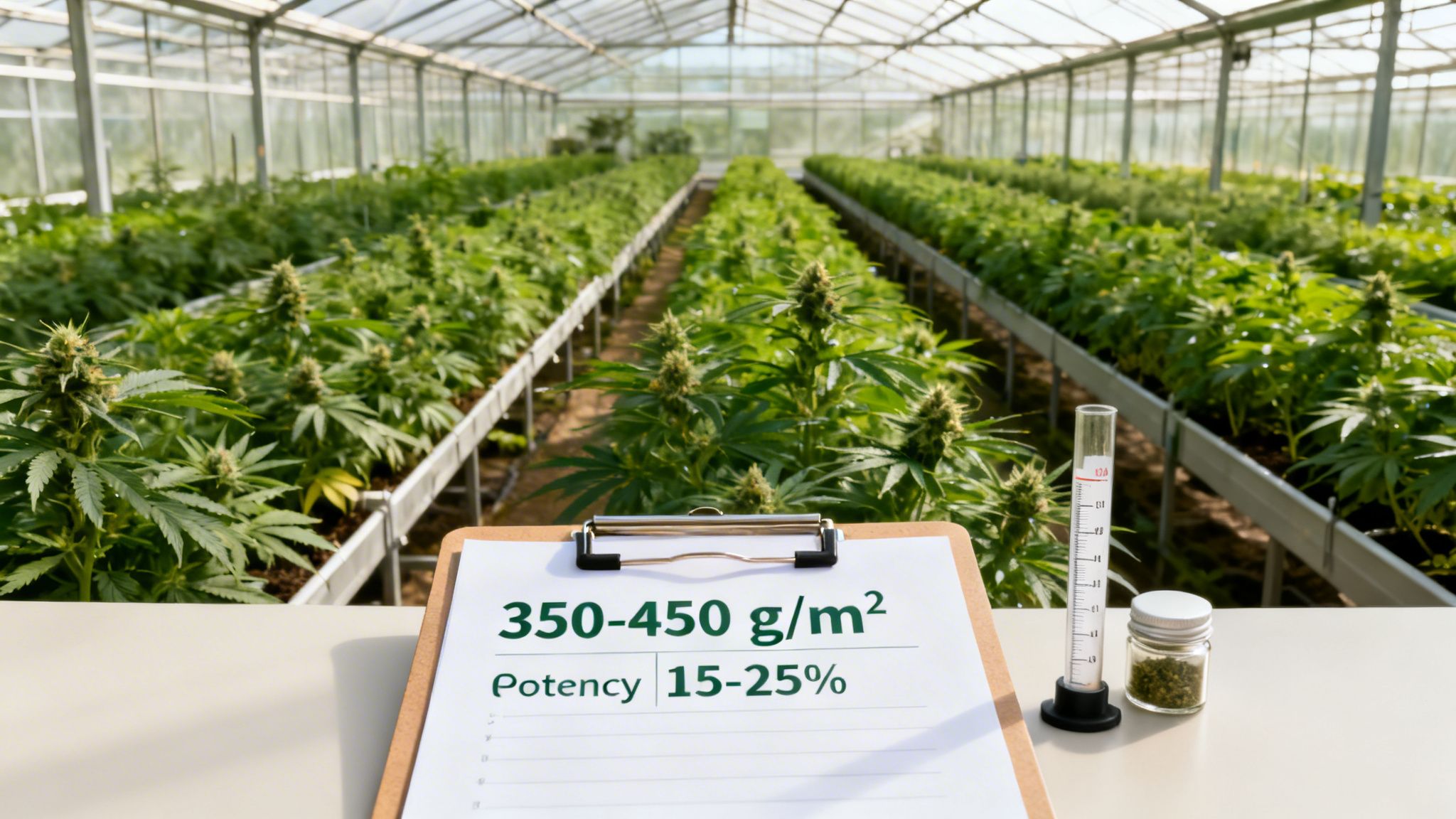
Its cannabinoid profile alone makes it highly desirable for extraction. With THC levels consistently ranging from 15-25% and minimal CBD, you begin with a clean, potent base material. This means less time and capital spent on remediation and filtering, providing a more direct path to a valuable, high-purity distillate.
Big Yields, Fast Turnaround
Beyond raw potency, Green Crack is a workhorse cultivar. Top-tier genetics from reputable breeders can push THC levels to 26-28%. But for producers, the key metrics are yield and speed.
We are talking about impressive harvests of 350-450 grams per square meter indoors. Crucially, it achieves this with a rapid flowering time of just 7-8 weeks. For a deeper look at its cultivation metrics, you can review this comprehensive guide.
This incredibly short flowering cycle provides a massive competitive advantage. It allows for more harvests per year compared to sativas with longer maturation periods. More cycles translate directly to more biomass, higher production volume, and increased revenue.
How Smart Cultivation Leads to Smarter Formulation
These cultivation specifications are not just abstract numbers—they represent tangible cost savings and a clear pathway to scaling up formulations.
When you start with a high-potency, high-yield plant, you have already won half the battle. You simply need less raw material to reach your target cannabinoid levels, which cuts down on everything from extraction costs and solvent use to labor hours.
Ultimately, selecting Green Crack biomass simplifies the entire production chain, from cultivation to finished product. When your starting material is already rich in THC and grows quickly and abundantly, every subsequent step in the workflow becomes more efficient. This makes formulating with the Green Crack strain terpene profile for distillate not just a creative choice, but a sound financial one.
Answering Your Formulation Questions
As you work in the lab to perfect your Green Crack product, questions will inevitably arise. Optimizing flavor intensity or troubleshooting vape performance are common formulation hurdles.
Let’s address some of the most frequent technical questions. Clarifying these details will help you avoid costly mistakes, especially when scaling production of a Green Crack terpene profile for vape cartridges.
What’s the Best Mixing Ratio for a Green Crack Terpene Blend in Distillate?
For vape cartridges, a starting concentration of 5-7% terpenes by weight is the industry standard. This range consistently provides a rich, full flavor without being overpowering.
If your goal is a particularly bold flavor profile, you can incrementally increase this ratio to a maximum of 10%. Be sure to use a mixing calculator for precision and always validate with small test batches first. Concentrations above 10% typically result in a harsh product and negatively impact profit margins.
My Green Crack Vape Tastes Harsh. What Did I Do Wrong?
A harsh vape is a common issue that almost always stems from two factors: excessive terpene concentration or overheating during mixing.
First, re-verify your calculations. Ensure you have not exceeded the 10% ceiling. This is a frequent error.
Second, review your heating process. The distillate should only be gently warmed to achieve a workable viscosity. Overheating will burn off delicate top-note terpenes like Pinene and Limonene, leaving behind an unbalanced and sharp flavor. Starting with pure, lab-tested terpenes free of additives is also critical for achieving a smooth final product.
Can I Use This Terpene Blend for Edibles or Tinctures?
Yes, our strain-inspired terpene blend can be used in non-inhalable products like edibles and tinctures, but the formulation parameters are completely different. While vapes primarily concern flavor and viscosity, edibles require consideration of solubility, ingredient interaction, and thermal stability during cooking.
Consequently, the usage ratios for edibles and tinctures are significantly lower than for vapes. We strongly recommend consulting specialized formulation resources focused on non-inhalable applications to ensure you create a product that is both safe and effective.
Ready to lock in a best-selling profile for your product line? Gold Coast Terpenes offers the lab-verified Green Crack blend and pure isolates you need for a consistent, amazing flavor and aroma, batch after batch.