
Let's get right to it, from one formulator to another. Do terpenes get you ‘high’ by themselves? The short answer is no. But do terpenes affect the high from cannabinoids? Absolutely. Think of them as the ultimate modulators, capable of fine-tuning the intensity, character, and even the length of a product's effects.
The Formulator's Answer to How Terpenes Affect a High
If you're creating vape cartridges, edibles, or any other cannabis product, understanding the interplay between terpenes and cannabinoids is mission-critical. While compounds like THC are the engine providing the raw psychoactive power, terpenes are the steering wheel. They direct the entire experience, guiding it toward a specific feeling or outcome. This relationship is the secret behind truly advanced product formulation.
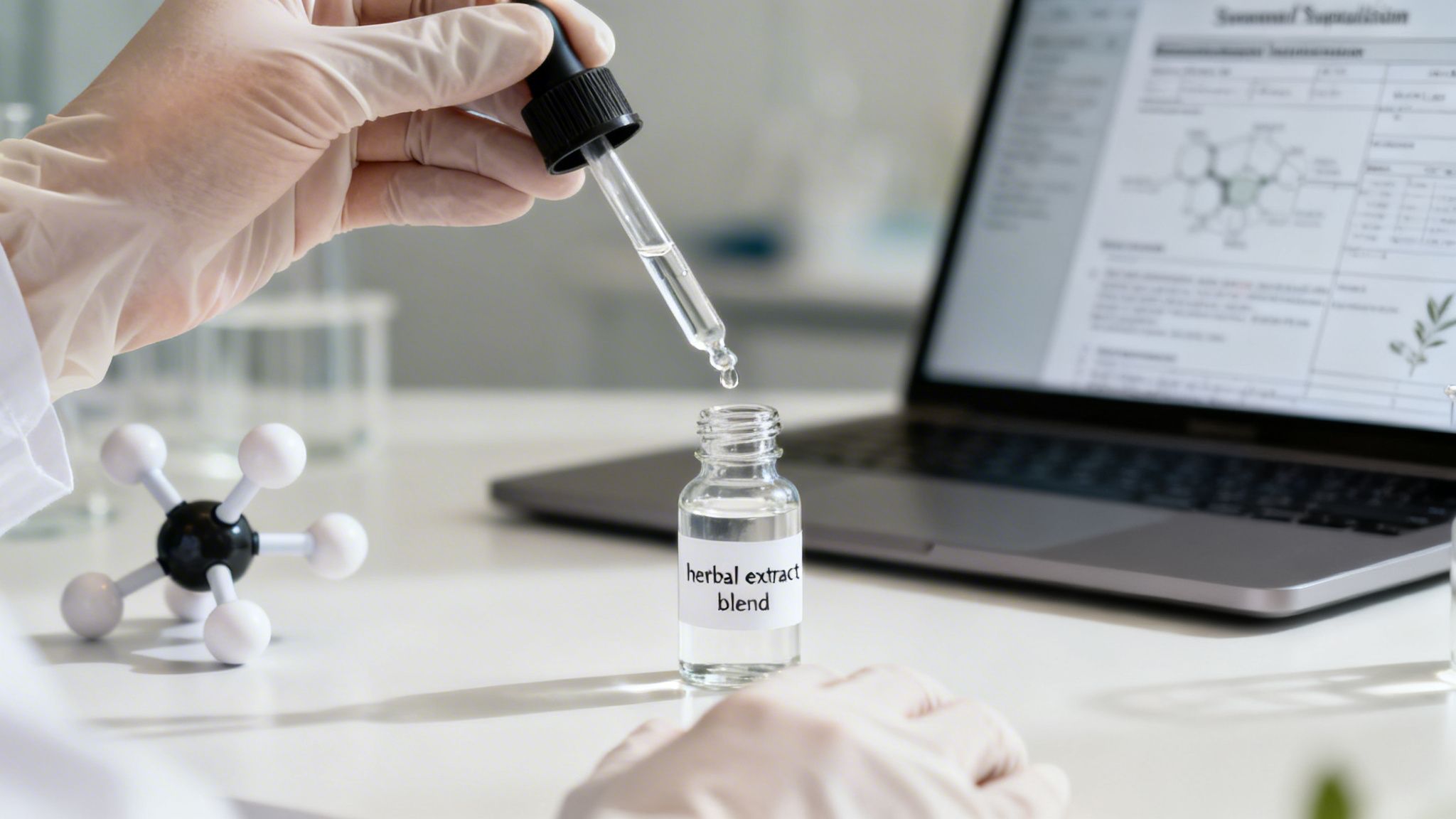
Terpenes don't bind to the brain's CB1 receptor the way THC does, which is why they aren’t intoxicating on their own. Instead, they work in synergy with cannabinoids, influencing how they communicate with the body's endocannabinoid system. This teamwork is what we call the entourage effect, a concept we'll dig into much deeper.
For formulators, this means your terpene selection is a functional design choice, not just a flavoring decision. The right blend can create predictable, repeatable experiences that define your product line and build brand loyalty.
Clarifying Roles in Product Formulation
The key is to see these compounds as partners. THC might provide the horsepower, but terpenes act as the car's sophisticated control systems—the transmission, suspension, and steering that ultimately determine what the ride feels like. This perspective shifts product development away from a simple numbers game of THC percentage and toward crafting targeted, reliable effects. If you want to dive deeper into this, you can learn more about how terpenes work on their own.
Thinking this way allows you to engineer products with clear goals:
- Modulating Intensity: Certain terpenes can either amplify or soften the perceived strength of THC.
- Shaping Character: A terpene blend can be specifically designed to feel more ‘uplifting’ or more ‘relaxing.’
- Ensuring Consistency: Precise terpene ratios are your best tool for delivering predictable results, batch after batch.
To make this distinction crystal clear, the table below breaks down the cooperative but distinct roles that cannabinoids and terpenes play in your final product.
Cannabinoid vs Terpene Functional Roles in Product Formulation
| Component | Primary Role | Mechanism of Action | Example in Formulation |
|---|---|---|---|
| Cannabinoids | Provide the core psychoactive or therapeutic effect (e.g., the 'high'). | Directly bind to and activate cannabinoid receptors (CB1, CB2). | THC is the primary psychoactive "engine." CBD is added for non-intoxicating, functional benefits. |
| Terpenes | Modulate and steer the character and intensity of the cannabinoid effect. | Influence receptor binding, neurotransmitter activity, and overall system synergy. | Myrcene is added to a THC distillate to promote a more sedative, "indica-like" effect. |
Grasping these separate functions is the first real step toward mastering the art and science of formulation. Once you see them as a team, you unlock a new level of control over the end-user experience.
Understanding the Entourage Effect for Product Formulation
The "entourage effect" gets thrown around a lot, but for those of us formulating products, it's not just a buzzword. It's the key to making vape cartridges and concentrates that deliver predictable, high-quality experiences. At its core, it’s about how terpenes work together with cannabinoids like THC to steer the overall effect.
Think of it this way: THC is the lead singer of a band. That voice is powerful and distinct all by itself. But the song truly comes to life when the rest of the band kicks in. Terpenes are those instruments—the drums setting the rhythm, the bass adding depth, and a guitar solo coloring the mood. The result is a complete, cohesive experience, not just a single, flat note.
So, do terpenes affect the high? Absolutely. They don’t create the psychoactive effect, but they absolutely direct its character and feel.
From Buzzword to Blueprint
For a formulator, truly grasping the entourage effect means you can move beyond selling generic distillate. You can start crafting specific, reliable experiences that customers will seek out and come back for. It's the difference between a product that just has THC and one that delivers a targeted feeling, whether that's focus, relaxation, or a burst of creative energy.
This is what lets you replicate the profile of a classic cultivar or even engineer entirely new blends that become your brand's signature.
And this isn't just theory; the science is catching up. A detailed literature review on the entourage effect confirmed what many have long observed: the cannabis experience is about much more than THC. Researchers highlighted that terpenes have their own effects, interacting with our neurotransmitter systems. These interactions can actually change how our bodies process cannabinoids, which is precisely why your choice of terpenes is so critical. You can discover more insights from this study on Marijuana Moment.
When you start treating terpenes as active ingredients instead of just flavor, you gain an incredible amount of control. It’s how you create proprietary formulas that build brand loyalty because customers know they can count on a consistent effect every time.
Practical Implications for Formulation
Once you grasp this, every drop of terpene you add to a distillate has a clear purpose that goes way beyond aroma. It becomes a functional tool.
Let’s look at some real-world formulation goals:
- For a calming blend: You might mix Linalool and Myrcene into your THC distillate to gently guide the experience toward relaxation.
- To engineer an uplifting profile: A combination of Limonene and Pinene can help shape the effect, making it feel brighter and more energetic.
- For a complex experience: Just like a fine fragrance, you can layer top, mid, and base note terpenes to create an effect that evolves over time.
This level of precision is what separates a standard, run-of-the-mill product from a premium, top-shelf offering. By using the full palette of terpenes available, you can design products that hit the mark for specific customer needs and make your brand stand out in a very crowded market.
If you want to dive deeper into this, you can check out our guide on how terpenes develop the entourage effect. The ability to nail these targeted effects again and again is what makes a truly skilled formulator.
How Terpenes Shape the High at a Molecular Level
To move from just mixing ingredients to designing sophisticated experiences, you have to understand what's happening under the hood. Terpenes don’t get you high on their own, but they completely change the game for how THC interacts with your body. They specifically influence the CB1 receptor, which is the main switchboard for the psychoactive effect.
This process is called allosteric modulation.
Think of your CB1 receptor as a finely tuned lock and THC as the key. When the key fits, the lock turns, and you feel the effects. Terpenes are like a master locksmith who can subtly reshape that lock. They don't turn it themselves, but they can make it easier—or harder—for the THC key to get in and do its job.
This isn't just a small tweak. It's a fundamental shift in how we can approach product development. The right terpene blend can essentially turn up the volume on THC, making a lower dose feel more potent and targeted. On the flip side, a different blend can turn the volume down for a smoother, more mellow experience.
The Science of Receptor Modulation
This isn't just a theory; we're seeing more and more science back it up. New studies are finally giving us a clear picture of this molecular teamwork, which is a huge deal for anyone formulating products.
For example, a fascinating 2023 study showed just how much certain terpenes can amplify THC's effect on the CB1 receptor. Researchers found that terpenes like borneol, geraniol, and limonene could weakly activate CB1 receptors on their own—only about 10-50% as much as THC. But when they were combined with THC, some blends boosted the receptor activity to levels several times higher than what THC could do by itself. You can read the full research about these terpene findings and see the data for yourself.
So, what does this mean for formulators? A powerful effect doesn't just come from a high THC percentage. By choosing terpenes that act as positive allosteric modulators, you can create a more potent and nuanced experience with less cannabinoid content. That’s a win for both the product's effectiveness and its cost.
Putting This Knowledge to Work
Once you grasp this interaction at the receptor level, you can start formulating with incredible precision. You're no longer just adding flavor; you're directing a biochemical process to get a consistent, predictable result in your vape carts or concentrates.
This knowledge gives you the power to:
- Design for Potency: Use terpenes known to amplify CB1 activity to make products that feel stronger, even without sky-high THC percentages.
- Engineer for Nuance: Select terpenes that mellow out THC’s effects to create smoother, more approachable products that appeal to a wider audience.
- Ensure Consistency: By locking in your terpene-to-cannabinoid ratios, you can deliver the exact same experience, batch after batch.
This is the kind of control that separates premium, brand-defining products from generic distillate. If you want to go even deeper, our guide on how terpenes affect the brain breaks it down even further. At the end of the day, terpenes are your best tool for steering the entourage effect and delivering on the promise your brand makes to its customers.
A Blueprint For Formulating Uplifting And Relaxing Effects
Knowing that terpenes can shape an effect is one thing. Actually building a specific feeling on demand? That’s where formulation moves from science to art. This is how you go from just copying popular cultivars to engineering your own unique blends that customers will seek out by name.
Think of building a terpene blend like composing a piece of music or creating a high-end perfume. It’s all about layering. You have your top notes—the bright, zesty ones that hit you first—your mid notes that form the body of the experience, and your base notes that provide the deep, lasting foundation. Uplifting blends lean heavily on those bright top notes, while relaxing blends are all about the heavy, grounding base notes.
Architecting An Uplifting Profile
When you want to create a vape or concentrate that feels energetic, focused, or even euphoric, your formulation needs to be led by certain top- and mid-note terpenes. These are the compounds with sharp, citrusy, or piney aromas that can steer the THC experience toward something more cerebral and lively.
For an uplifting blend, Limonene is almost always your star player. Think of it as the engine driving that bright, mood-lifting feeling.
But you can't just throw a ton of Limonene in and call it a day. The best blends have nuance.
- Primary Driver (Top Note): Limonene sets the bright, happy tone.
- Secondary Modifier (Mid Note): Adding Beta-Caryophyllene brings a touch of spicy complexity, which can help smooth out the intensity and prevent the experience from feeling too racy.
- Tertiary Accent (Top Note): A dash of Pinene can introduce a crisp, "clear-headed" feeling, cutting through any potential fogginess.
By building your formula this way—with Limonene leading the charge and others playing supporting roles—you can create a reliable, focused effect. This is the thought process behind a classic strain-inspired terpene blend that consistently hits the mark.
Architecting A Relaxing Profile
Now, on the flip side, creating a blend for relaxation requires a totally different approach. The goal here is to guide the THC toward a calm, body-centric, and even sleepy state. To do that, you need to build your formula around earthy, floral, and musky base notes.
The cornerstone of almost any "calming" blend is Myrcene. It’s the heavy-hitter that anchors the entire experience, delivering that classic sense of ease and physical tranquility.
From that heavy base, you layer in other terpenes to deepen the sense of calm.
- Primary Driver (Base Note): Myrcene lays down the sedative foundation.
- Secondary Modifier (Mid Note): Linalool, known for its soft, floral scent, helps to mellow everything out. It’s the terpene most associated with the calming properties of lavender.
- Tertiary Accent (Mid Note): Beta-Caryophyllene makes another appearance here, this time lending a soothing, peppery warmth that contributes to the overall sense of comfort.
This combination works together beautifully. Myrcene provides the strong relaxing base, while Linalool and Beta-Caryophyllene round out the edges for a smooth, peaceful ride. This is how you formulate products that people can trust to help them unwind, moving beyond THC percentage as the only selling point.
The diagram below helps visualize how these compounds work at a receptor level. It shows that while cannabinoids and terpenes both interact with the body's receptors, they do so in different ways, creating the opportunity for them to work together.
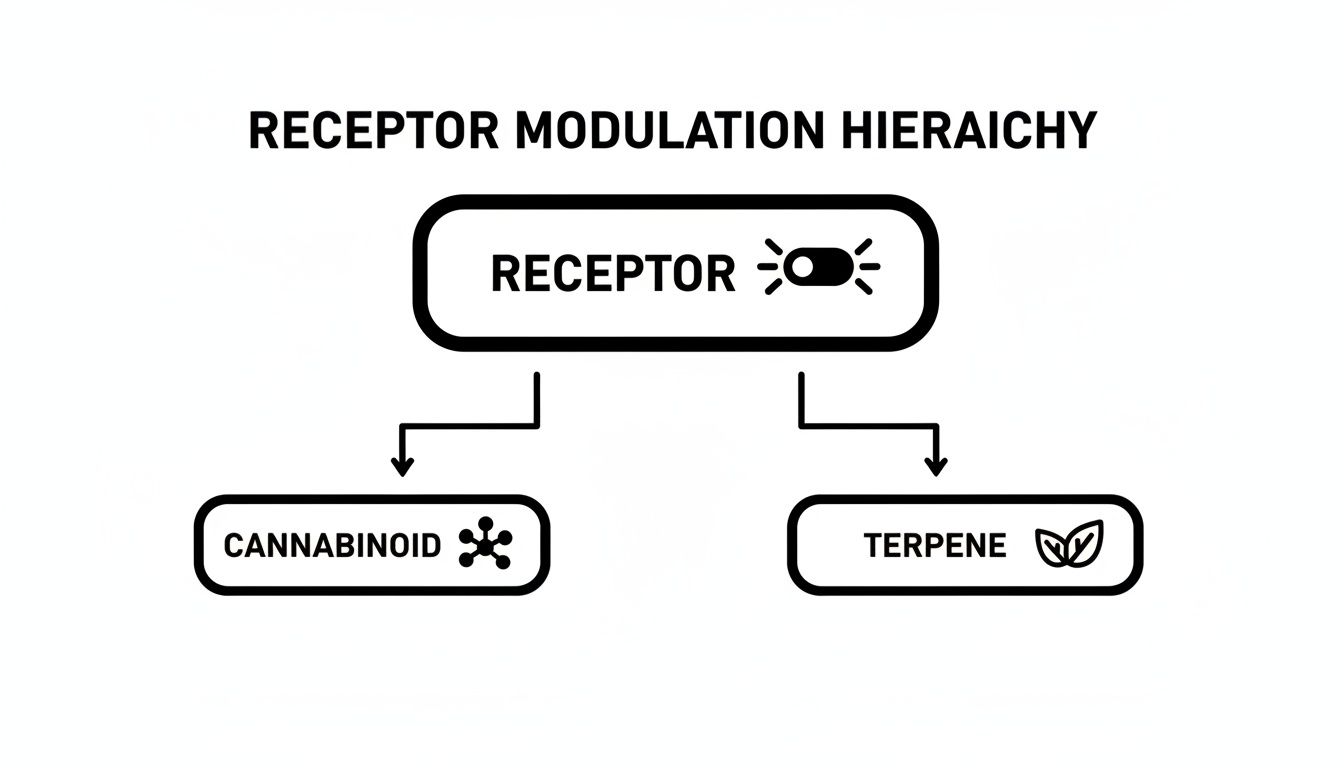
Understanding this hierarchy—how different compounds can influence the same system—is the key to smart, effective formulation.
Terpene Formulation Blueprint For Targeted Effects
To bring this all together, here’s a simple cheat sheet for formulators. Think of this as a starting point for mapping desired effects to specific terpene combinations, using the analogy of top, mid, and base notes.
| Desired Effect | Primary Terpenes (Drivers) | Secondary Terpenes (Modifiers) | Mimics Cultivar Profiles Like: |
|---|---|---|---|
| Uplifting | Limonene, Terpinolene | Beta-Caryophyllene, Pinene | Jack Herer or Super Lemon Haze |
| Relaxing | Myrcene | Linalool, Beta-Caryophyllene | Granddaddy Purple or OG Kush |
| Focus | Pinene, Alpha-Bisabolol | Limonene, Beta-Caryophyllene | Green Crack or Durban Poison |
| Creative | Limonene, Ocimene | Beta-Caryophyllene, Humulene | Blue Dream or Chemdawg |
This table isn't a rigid recipe but a guide. The art lies in adjusting the ratios to create something truly unique that still delivers a predictable and enjoyable experience for your customer.
By understanding these principles, you stop being just a mixer of ingredients and become an architect of experience. You can innovate beyond what’s popular today and start engineering the exact feelings your customers are searching for.
When you master these blueprints, you build brand loyalty. A customer who knows your "Unwind" vape will consistently help them relax after a stressful day stops looking at cultivar names and starts looking for your logo. In a crowded market, that kind of predictability is everything.
Essential Safety and Handling for Terpene Formulation
When you’re working with concentrated terpenes, the devil is truly in the details. Getting it right is what separates the pros from the amateurs. While terpenes are your secret weapon for shaping a product’s effect, being careless with them can ruin your oil, lead to inconsistent batches, and even create real safety hazards. Following strict safety and handling protocols isn’t just good practice—it's your fundamental duty as a formulator.
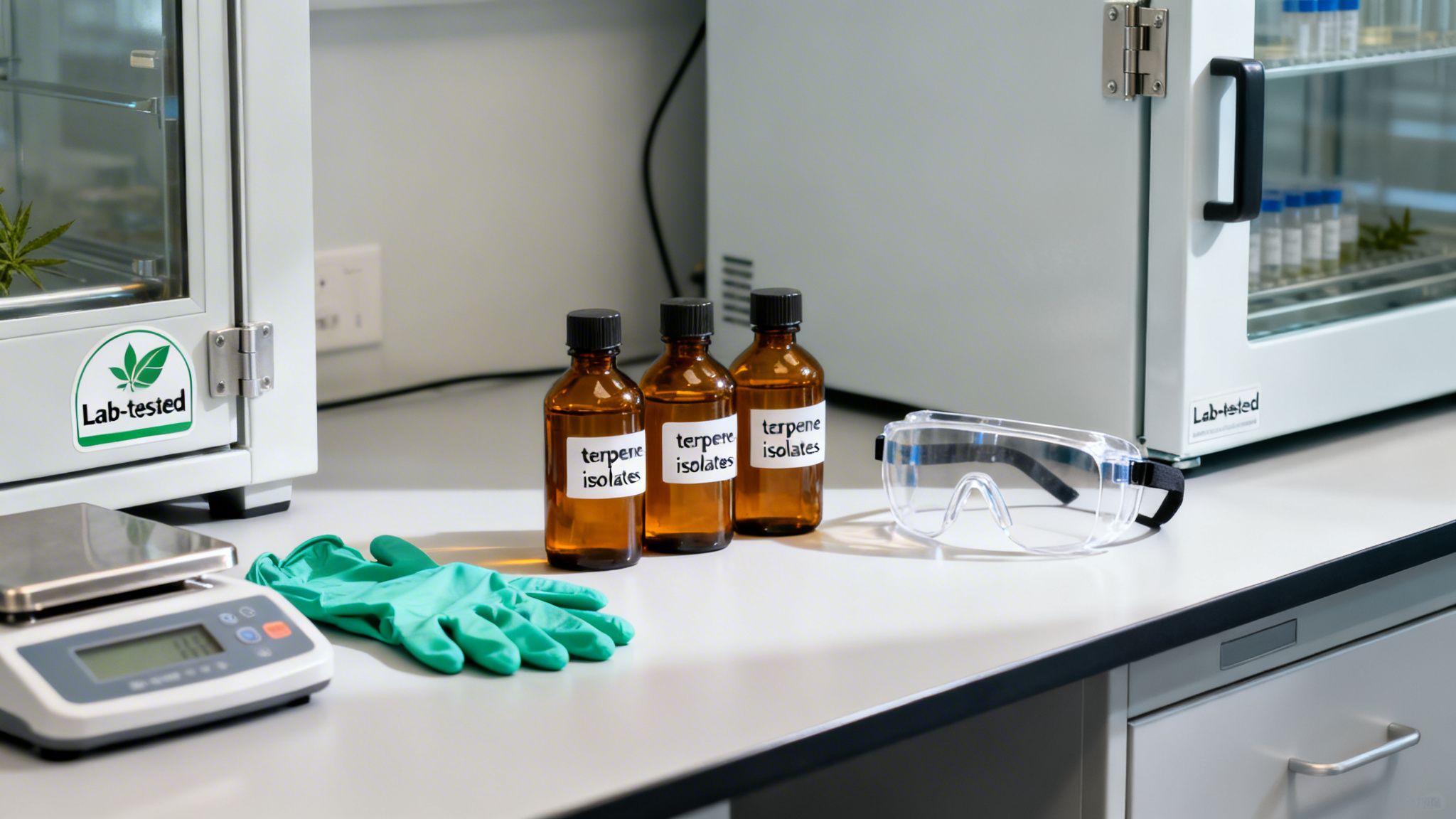
It all starts with sourcing. You absolutely must use lab-tested, contaminant-free terpenes from a supplier you trust. Finding out your batch is tainted with pesticides, heavy metals, or residual solvents can destroy a production run and your brand’s reputation overnight. This is one corner you can never, ever cut.
Proper Dosing and Dilution
The single most common mistake new formulators make is going overboard with terpenes. For most vape cartridges, the sweet spot is between 5% and 10% of the total volume. Pushing past that limit rarely makes the product better. More often than not, it creates a harsh, perfume-y taste and can even raise safety concerns.
Think of terpenes like a powerful spice in a gourmet dish. A pinch can elevate the entire meal, but a spoonful will overwhelm every other flavor and make it inedible. The goal is synergy, not saturation.
Just as important is what you use to dilute your concentrate, if you need to at all. Using the wrong cutting agents is one of the biggest liabilities in the entire industry.
- Forbidden Diluents: Never, under any circumstances, should you use Vitamin E Acetate, Propylene Glycol (PG), Vegetable Glycerin (VG), or MCT oil in products meant for vaping. These have been tied to serious lung injuries and have no business being in a professional vape formulation.
- Approved Diluents: If your distillate is just too thick to work with, only use a tiny amount of a lab-tested, flavorless diluent specifically designed and recognized as safe for inhalation.
For a deeper dive, check out our complete guide on how to use terpenes safely to better protect your product and your customers.
Managing Volatility and Temperature
Terpenes are volatile organic compounds, which is a fancy way of saying they evaporate easily, especially with heat. This is a double-edged sword. It’s what creates the amazing aromas we’re after, but it also means they can be destroyed during mixing if you aren't careful. Your equipment and your mixing temperatures are critical here.
Gently warming your cannabinoid distillate to make it less viscous is a standard step. However, you have to wait to add your terpenes until the oil has cooled to the lowest possible temperature. If it's too hot, you'll boil off all the delicate top notes like Myrcene or Limonene. You’re essentially cooking out the very profile you paid for, altering the flavor and ruining the intended effect.
Best Practices for Handling and Storage
Protecting your investment begins the moment your terpenes walk in the door. Batch-to-batch consistency depends entirely on how you handle and store them.
- Work in a Ventilated Area: Always handle concentrated terpenes in a space with good airflow. Wear your personal protective equipment (PPE)—gloves and safety glasses are non-negotiable.
- Store Cold and Dark: Keep terpenes in their original airtight, amber glass bottles inside a refrigerator. Light, heat, and oxygen are the three biggest enemies of terpene stability.
- Use Precise Measurements: Use a calibrated scale or micropipettes for dosing. "Eyeballing" it is a surefire way to get inconsistent results and waste expensive material.
By sticking to these safety and handling basics, you protect your formulation's integrity, ensure your final product is safe, and ultimately, preserve your investment. It’s what being a true professional is all about.
Advanced Formulation Strategies to Differentiate Your Brand
If you want to move from just another brand on the shelf to a true market leader, you have to stop simply copying popular cultivar profiles. The real magic—and the biggest opportunity—is in creating unique flavor and effect combinations that your competitors can't easily knock off.
This is where you graduate from just mixing terpenes to becoming a true artist. It's about looking at your library of isolates as a painter's palette, ready to create something entirely new.
The key to unlocking this next level? It’s all about the minor terpenes. Most formulators build their blends on the same foundational isolates, like Myrcene and Limonene. But it’s the subtle, careful addition of the less common terpenes that gives a product its own distinct signature.
The Power of Minor Terpenes
Think about terpenes you don't see every day, like Fenchol or Terpinolene. Fenchol, with its woody, camphor-like scent, can add a sharp, refreshing note that really cuts through a blend that might otherwise feel too heavy.
And then there's Terpinolene. It’s a major player in many "sativa-like" uplifting blends, known for its complex floral and herbal aroma, but it’s still surprisingly underused.
By methodically testing and folding these minor players into your formulas, you can develop proprietary blends that deliver a nuanced experience no one else is offering. You’re not just answering the question "do terpenes affect the high?" with science—you're proving it with a product that people can feel. This is how you build a brand identity that’s hard to copy and easy to love.
A brand that consistently delivers a unique, desirable effect becomes a destination for consumers. Your proprietary blend is your intellectual property—a competitive moat that protects your market share and inspires deep brand loyalty.
The Art of Top-Noting for a Signature Scent
Another advanced trick is what’s known as "top-noting," where you layer in accent flavors that go far beyond the usual cannabis aromas.
Picture a relaxing blend built on a solid foundation of Myrcene and Linalool. Now, imagine adding a surprising top note of creamy vanilla or bright, tropical guava. This is where formulation becomes design.
That unforgettable first impression—that sensory signature—is what makes your product stand out. The initial aroma grabs a customer's attention, while the terpenes underneath deliver the reliable effect they’re looking for. It's a one-two punch of incredible flavor and predictable function that builds a truly memorable brand.
To get started on this path, you need the right tools. That means having a broad and reliable library of components to work with. Exploring curated terpene formulation kits or setting up bulk purchasing for both major and minor isolates is the first practical step. When you equip your lab with a diverse palette, you give yourself the freedom to experiment, innovate, and define the next wave of top-tier products.
FAQ: Getting Hands-On with Terpenes to Guide Effects
Alright, let's get down to brass tacks. As a formulator, you need straightforward answers to the real-world challenges you're facing in the lab. Here are some of the most common questions we get about using terpenes to shape a product's final effect.
What is the ideal terpene percentage for a vape distillate formulation?
For most vape carts using cannabis or hemp distillate, the sweet spot is generally between 5% and 10% terpenes by weight. Think of 5% as your baseline—it’s a great starting point to introduce noticeable flavor and effects without overpowering the cannabinoids.
Pushing past 10-12% is usually a bad idea. It can make the vapor unpleasantly harsh and might even raise safety questions. Always, and I mean always, start with small test batches and use a good mixing calculator to keep your ratios precise and repeatable.
Can terpenes really be used to modulate THC-induced anxiety?
Yes, absolutely. This is one of the most exciting frontiers in product development. When people ask if terpenes actually affect the high, this is a perfect example of how they can. Certain terpenes, like Linalool and Limonene, have a solid reputation for their potential calming, anti-anxiety properties.
By carefully adding these to a THC-heavy formula, you can create a blend that guides the experience toward something more mellow and balanced. You're essentially using the entourage effect as a steering wheel to avoid the anxious edge some people feel from high-THC products.
Do I need to worry about mixing temps for different terpenes?
You definitely do. Terpenes are volatile, and they don't all behave the same way under heat. Each one has a different boiling point. The lighter, "top-note" terpenes like Myrcene will vaporize and disappear at much lower temperatures than heavier "base-note" terpenes like Beta-Caryophyllene.
Here’s the best practice: gently warm your distillate just enough to make it workable—think 100-140°F (or 40-60°C). Once it’s flowing, add and stir in your terpenes at the lowest temperature possible. This simple step prevents you from accidentally boiling off the delicate aromatics you paid for, ensuring the final product has the exact profile and effect you designed.
Ready to start crafting your next signature blend? Gold Coast Terpenes has a massive library of lab-tested strain profiles and individual isolates to bring any concept to life. Explore our full collection and start formulating today.