
For product formulators and brand owners, identifying a winning profile is critical. The Cherry Lemonade Gelato terpene profile is a commercial powerhouse, but successful replication for products like vape cartridges and distillates requires technical precision. It’s not about approximating a flavor; it’s about deconstructing its aromatic architecture and rebuilding it for consistent, scalable production.
This guide provides a technical blueprint for formulators to replicate the Cherry Lemonade Gelato profile accurately, moving beyond basic blending to create a commercially successful product that stands out in a competitive market.
Deconstructing the Cherry Lemonade Gelato Terpene Profile for Formulation
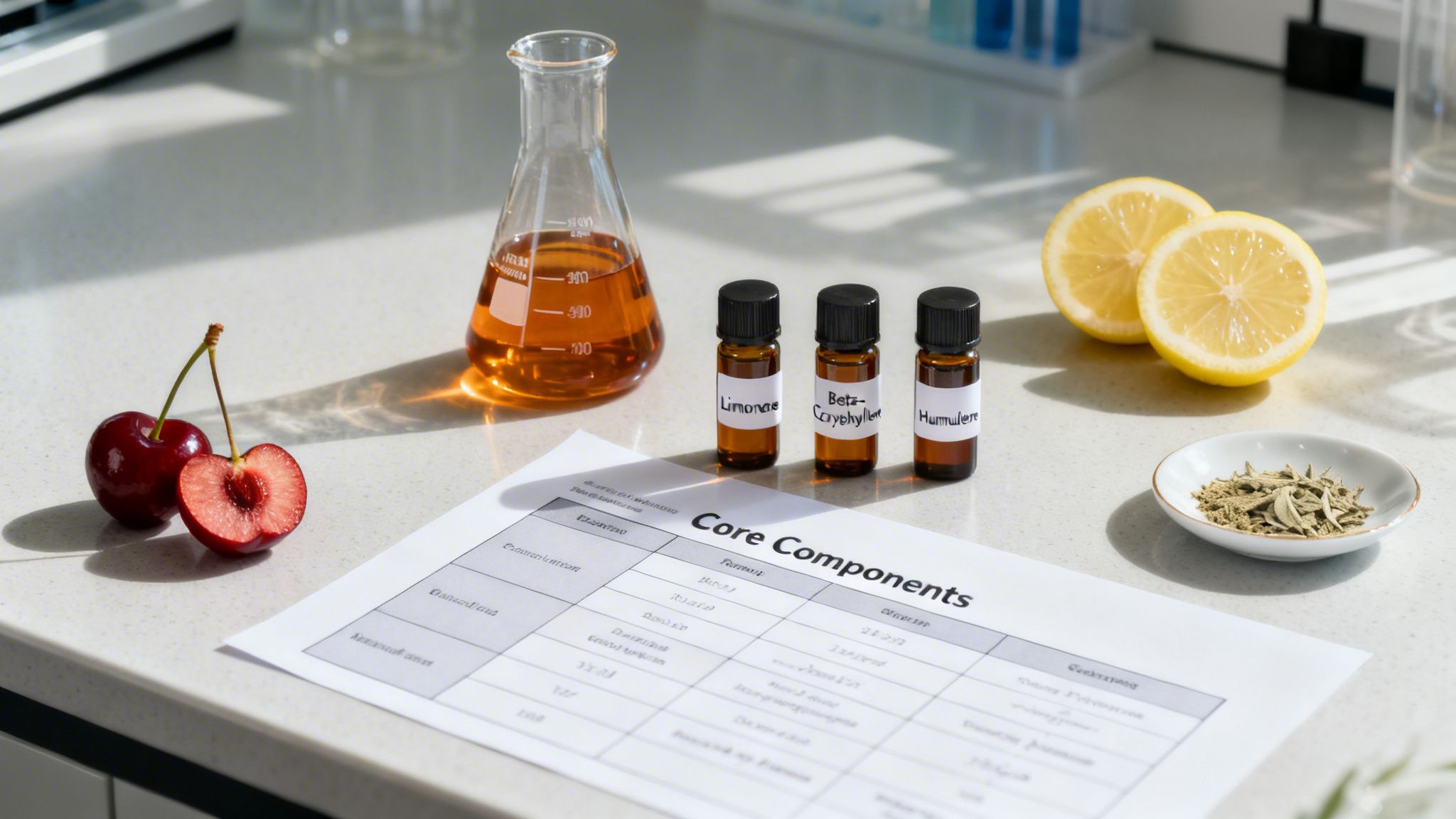
The market dominance of Cherry Lemonade Gelato is a direct result of its genetic lineage, which combines Sunset Sherbet and Girl Scout Cookies to create a complex balance of sweet, sour, and creamy notes. This profile didn't just appear; it was engineered for mass appeal and has demonstrated significant market penetration since its emergence.
Its influence is substantial. For instance, data indicates that for a significant period, over 90% of new genetic varieties in key markets originated from either the Lemon Cherry Gelato or Runtz families. When a profile achieves this level of market saturation, mastering its replication becomes a strategic imperative for any brand aiming to compete effectively.
For successful cannabis product formulation, you must understand its core building blocks.
| Cherry Lemonade Gelato Formulation At-A-Glance | ||
|---|---|---|
| Formulation Component | Key Characteristic | Primary Role in Blend |
| Beta-Caryophyllene | Spicy, Peppery, Woody | Forms the warm, earthy base note. |
| Limonene | Bright Citrus, Lemon Zest | Delivers the signature "lemonade" top note. |
| Humulene | Hoppy, Earthy | Adds complexity as a woody middle note. |
| Linalool & Myrcene | Floral, Fruity, Herbal | Creates the nuanced "cherry" and "gelato" accents. |
| Cannabinoid Base | (e.g., THC/CBD Distillate) | The carrier matrix that the terpene profile infuses. |
Achieving the correct ratios of these components is what distinguishes a premium, authentic product from a generic imitation.
Key Formulation Considerations
A successful formulation depends on balancing three critical layers:
The Terpene Foundation: The profile's structural integrity relies on a core trio of Beta-Caryophyllene, Limonene, and Humulene. This combination provides the signature spicy, citrus, and earthy character that serves as the backbone of the sensory experience.
The Aromatic Accents: The defining "cherry" and "gelato" notes are delivered by minor terpenes like Linalool and Myrcene. Precise dosing is non-negotiable. Over-dosing results in an artificial, perfumey character, while under-dosing eliminates the strain's distinctive identity.
The Cannabinoid Matrix: The type and purity of your distillate or concentrate base will significantly impact terpene expression. A clean, high-quality base allows the full spectrum of the flavor profile to be perceived without interference.
A common formulation error is over-saturating a blend with Limonene to force the "lemonade" characteristic. This approach typically results in a harsh, one-dimensional product that is more reminiscent of a cleaning agent than a premium cannabis profile. Authenticity is achieved through the sophisticated interplay between the bright citrus top notes and the creamy, spicy base.
A functional understanding of what terpenes do in cannabis is fundamental. Each compound fulfills a specific role as a top, middle, or base note. Replicating the Cherry Lemonade Gelato flavor for distillate requires a methodical approach that respects this aromatic architecture. Get it right, and you’ll deliver the rich, full-bodied flavor that commands a premium price point.
Why Replicating Flavor of Cherry Lemonade Gelato is a Strategic Move
For a product formulator, the selection of a new profile is a strategic investment, not a trend-chasing exercise. Mastering the Cherry Lemonade Gelato profile is about tapping into a proven commercial asset with demonstrated market longevity.
This profile has exceptionally broad appeal, showing impressive distribution and consumer demand across North America. After its rapid rise in late 2019, it became a staple in major US and Canadian markets, including California, Michigan, and Nevada. Its projected inclusion as a top-10 strain in New York for 2026 signals its staying power in emerging East Coast markets. The data is clear: this is a profile with sustained commercial relevance.
Driving Higher Margins and a Broader Audience
From a business standpoint, the profile's inherent premium positioning is a significant advantage. The complex, layered flavor of Cherry Lemonade Gelato allows finished products, particularly vape cartridges and concentrates, to command a higher retail price. Consumers demonstrate a willingness to pay more for an authentic and sophisticated flavor experience, which translates directly to healthier profit margins.
Furthermore, this profile uniquely resonates with two key market segments simultaneously:
- The Connoisseur: Experienced users who can discern and appreciate the nuance in a multi-layered profile. They recognize and value a high-fidelity replication.
- The Newcomer: This segment is attracted by the accessible and appealing combination of sweet cherry, bright lemon, and creamy dessert notes.
This dual-market appeal mitigates risk. Instead of formulating for a narrow niche, you are developing a product with broad applicability, creating opportunities for significant sales volume.
When you invest in a high-quality, strain-inspired terpene blend, you're not just buying flavor; you're leveraging established market demand. A precise replication of the Cherry Lemonade Gelato terpene profile for vape cartridges allows your brand to capitalize on the strain's existing reputation, reducing the marketing spend required to educate consumers.
A Strategic Play for Product Development
Ultimately, working with this profile is a strategic decision supported by market data and consumer behavior. It provides a clear path for developing a high-velocity product line with built-in brand equity. The market is educated, demand is established, and the premium price point is set.
The primary challenge—and opportunity—lies in execution. Your product's success will be determined by your ability to deliver an authentic profile that meets consumer expectations. Utilizing a meticulously crafted strain-inspired terpene blend provides the consistency and accuracy required to capture and retain market share. A well-executed Cherry Lemonade Gelato product is not just another SKU; it's a potential flagship offering. For formulators ready to capture this market, our collection of strain-specific terpene blends provides an ideal starting point.
Breaking Down the Terpenes for Flavor Formulation
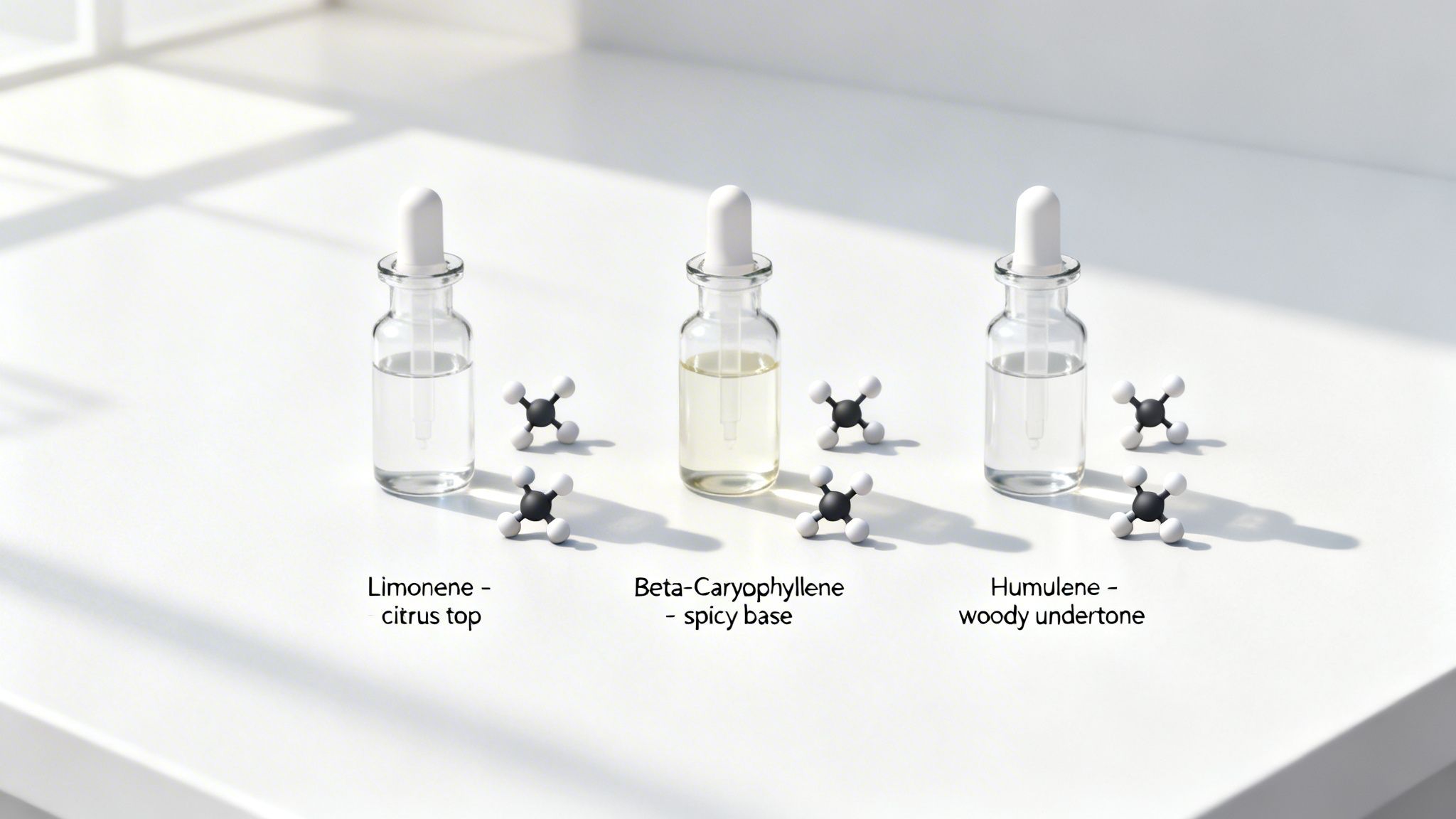
To accurately replicate the Cherry Lemonade Gelato profile, formulators must operate as flavor architects. The strain's unique character is derived from a specific aromatic structure where each terpene fulfills a distinct function. The entire profile is built on three pillars: Beta-Caryophyllene, Limonene, and Humulene. Establishing the correct ratio of these three foundational terpenes is the most critical first step in the formulation process for any cannabis product.
The Role of Top, Middle, and Base Notes
In professional flavor science, terpenes are categorized by their volatility and perceptual timeline. This framework is essential for crafting a dynamic profile that evolves from the initial draw to the final exhale.
- Top Notes: Highly volatile compounds perceived first. They are bright but dissipate quickly.
- Middle Notes: The core of the profile, emerging as top notes fade. They provide body and character.
- Base Notes: Low-volatility compounds that ground the blend and provide a long-lasting finish.
Understanding where each key isolate fits within this structure is crucial for replicating the authentic Cherry Lemonade Gelato sensory journey.
Beta-Caryophyllene: The Spicy Base
The foundation of this profile is Beta-Caryophyllene. This sesquiterpene provides a warm, spicy, and peppery character with distinct woody undertones. As the primary base note, it provides the blend with depth and a classic "gassy" finish that sophisticated consumers expect. A formulation lacking a sufficient Beta-Caryophyllene base will present as shallow and overly sweet, failing to deliver the profile's signature complexity.
Limonene: The Citrusy Top Note
The "lemonade" element is delivered by Limonene. This zesty, bright monoterpene functions as the primary top note. It delivers the initial burst of sweet citrus that makes the profile immediately recognizable. The key to effective Limonene use is precision. The goal is a fresh lemon zest character, not an overpowering, artificial citrus. It must be carefully balanced against other terpenes to smooth its sharp edges and create an authentic expression.
Humulene: The Earthy Middle
Working in synergy with Beta-Caryophyllene, Humulene occupies the middle note space. It contributes a subtle hoppy, woody, and earthy layer that serves as a bridge between the bright Limonene top note and the spicy base. It is the component that prevents the profile from being a simple, static fruit flavor, instead adding a botanical complexity that evolves on the palate.
Formulation Insight: The successful replication of Cherry Lemonade Gelato is achieved in the interplay between the bright Limonene and the earthy Caryophyllene/Humulene foundation. An optimal blend delivers a vibrant citrus onset that transitions smoothly into a warmer, spicier body with a creamy finish.
The table below provides typical concentration ranges for these core terpenes within a flavor blend. For a deeper dive into isolate characteristics, our terpene flavor chart is an essential resource for any formulator.
| Dominant Terpene | Aromatic Role | Typical Concentration in Blend* |
|---|---|---|
| Beta-Caryophyllene | Base Note (Spicy, Woody) | 25% – 35% |
| Limonene | Top Note (Citrus, Sweet) | 20% – 30% |
| Humulene | Middle Note (Hoppy, Earthy) | 8% – 15% |
*These percentages refer to the proportion within the terpene blend itself, not the final product.
Building the Complete Sensory Profile: A Formulation Guide
Blending the three primary terpenes—Beta-Caryophyllene, Limonene, and Humulene—will produce a basic approximation. However, market-leading products are defined by their nuance. The signature "cherry" sweetness and creamy "gelato" finish are derived from trace compounds that must be dosed with precision. Without them, the result is a generic citrus-spice blend that lacks the authentic character consumers demand.
The Supporting Cast of Terpenes
To achieve a full-spectrum replication, formulators must integrate key secondary terpenes that create the distinct fruit and cream layers.
Linalool: This tertiary alcohol is used to introduce a floral sweetness with hints of fruity berry. Linalool's function is to soften the sharp, zesty edges of Limonene, lending a smooth, candy-like quality to the aroma. It is critical for building the "cherry" note without introducing an artificial taste.
Myrcene: Found in mangoes and lemongrass, Myrcene adds a subtle, musky fruitiness that connects the bright citrus top notes with the earthy base. It contributes a sense of ripeness and depth, preventing the profile from feeling thin or one-dimensional. It acts as an anchor for the brighter fruit notes.
The Art of Blending for Authenticity
The primary challenge lies not in identifying which terpenes to use, but in determining their precise ratios. A slight over-dosing of Linalool can result in a soapy or perfumey off-note. Too little Myrcene, and the fruit character will feel underdeveloped.
Formulation Tip: When incorporating minor terpenes, the guiding principle is to start low and titrate slowly. A common mistake is attempting to force a "cherry" flavor by adding a high concentration of a single aromatic compound. This invariably fails. Instead, build the profile in layers. Introduce a small amount, homogenize the blend completely, and then conduct a sensory evaluation before making further additions.
Temperature control is also a critical variable, as it directly impacts how these compounds are expressed in the final product. For an in-depth analysis of terpene behavior under heat, our guide on the boiling point of terpenes is an essential technical resource for vape cartridge formulation.
To provide a functional starting point, we have developed a target ratio guide for building a complete Cherry Lemonade Gelato profile from individual isolates.
Target Terpene Ratio Guide for Cherry Lemonade Gelato
| Terpene | Role in Profile | Suggested Concentration Range (%) |
|---|---|---|
| Beta-Caryophyllene | Base (Spicy, Woody, Warm) | 25% – 35% |
| Limonene | Top (Bright Citrus, Lemon) | 20% – 30% |
| Humulene | Middle (Earthy, Hoppy) | 8% – 15% |
| Linalool | Nuance (Floral, Sweet, Berry) | 3% – 7% |
| Myrcene | Nuance (Musky Fruit, Herbal) | 2% – 6% |
| Other Trace Terpenes | Complexity (e.g., Pinene, Terpinolene) | <5% |
While dominant terpenes form the blend's backbone, true authenticity is achieved through the precise application of secondary isolates in smaller, controlled concentrations.
Practical Formulation Guide for Cherry Lemonade Gelato Vape Cartridges
Translating a terpene blueprint into a stable, consistent vape cartridge requires disciplined execution. This section outlines the standard operating procedure for infusing the Cherry Lemonade Gelato profile into a common base like winterized distillate. Success depends on precision, proper equipment, and a technical understanding of terpene-cannabinoid interactions.
The process is analogous to layered construction. You begin with a stable base, add the foundational aromatic notes, and then meticulously build the finer details on top.

This step-by-step methodology ensures each layer contributes to a complete, cohesive aromatic profile.
Nailing the Terpene Concentration
The most critical variable in your formulation is the terpene concentration. It dictates flavor intensity, oil viscosity for cartridge hardware compatibility, and overall product performance.
For Standard Distillate Carts: A concentration of 5% to 8% terpenes by weight is a standard starting point. This range is typically sufficient to deliver a full-bodied flavor while reducing the viscosity of thick distillate for proper wicking in common vape hardware.
For Live Resin or Rosin Infusions: When augmenting an already-flavorful concentrate, a more subtle approach is required. Start with a much lower concentration, typically in the 2% to 4% range, to enhance existing notes rather than overpowering them.
Pro Tip: Always begin formulation at the low end of the recommended concentration range. It is simple to titrate a blend by adding more terpenes, but impossible to remove them from an over-flavored batch. An overly potent blend results in a harsh, unpalatable product that is unsalvageable.
Step-by-Step Mixing for Distillate
Achieving a perfectly homogenous blend requires strict control over temperature, equipment, and technique. The objective is to fully integrate the terpenes into the distillate without thermally degrading the volatile aromatic compounds.
Your Toolkit:
- Lab-grade glass beakers
- Magnetic stirrer with a hot plate
- PTFE-coated (Teflon) stir bar
- Digital scale (accurate to at least 0.01g)
- Glass syringes for measurement and transfer
The Mixing Process:
- Warm Your Distillate: Gently heat your cannabinoid distillate on the hot plate to a target temperature of 40-50°C (104-122°F). This reduces viscosity for effective mixing while preserving volatile terpenes.
- Measure Your Terpenes: While the base is warming, accurately weigh your terpene blend. Whether using a pre-formulated Cherry Lemonade Gelato strain-inspired terpene blend or a custom mix, precision is paramount.
- Combine and Stir: Slowly introduce the terpenes to the warm distillate while the magnetic stirrer operates at a low-to-medium speed to prevent splashing and aeration.
- Homogenize the Mix: Allow the mixture to stir for a minimum of 15-20 minutes. This step is critical for ensuring even distribution, preventing flavor "hot spots," and ensuring long-term stability of the oil.
Safety and Stability
Professional product manufacturing demands a commitment to safety and quality control. All mixing should be conducted in a well-ventilated environment, as concentrated terpenes are potent volatile compounds.
After homogenization, allow the blend to rest for 24 hours before filling cartridges. This "steeping" period allows the flavors to meld and mature, resulting in a smoother, more cohesive final product. For additional best practices, explore our guide on how to use terpenes effectively. Consistency is the hallmark of a professional operation, and adhering to a controlled, repeatable process is how you achieve it.
Wrapping It Up: Your Blueprint for a Bestseller
This formulation guide has deconstructed the Cherry Lemonade Gelato terpene profile, providing a technical roadmap for creating a consistent, high-demand product.
Success begins with respecting the profile's aromatic structure: building a foundation of Beta-Caryophyllene and Humulene, lifting it with bright Limonene, and finishing with carefully dosed Linalool and Myrcene. Mastering this balance is the key to capturing the authentic experience that consumers seek.
Your Path to Market Leadership
A precise recipe requires precise execution. Your formulation process must be dialed in, with controlled terpene concentrations and thorough homogenization to prevent common production failures like flavor separation or harshness, which can compromise a product's market viability.
The market for Cherry Lemonade Gelato is established. Consumer demand exists. Your objective is not to create a market, but to meet existing demand with a superior product that commands loyalty and justifies a premium price point.
By applying these principles, you transition from imitating a flavor to replicating a complete sensory experience. This is the differentiator that separates market leaders from the competition.
Take the Next Step in Your Formulation
Whether your operation requires the turnkey consistency of a pre-made Cherry Lemonade Gelato strain-inspired terpene blend or the creative latitude of individual isolates, we provide the lab-tested, high-purity ingredients you need.
Explore our catalog of terpene isolates to begin building your next flagship product, or contact our team for bulk pricing and formulation support.
Your Questions Answered: Formulating with Cherry Lemonade Gelato
Executing a complex profile like Cherry Lemonade Gelato often raises specific technical questions during formulation. Here are direct answers to common challenges.
What’s the Best Terpene Percentage for My Vape Cartridge?
The optimal range for most THC distillate vape cartridges is between 6% and 9% terpenes by weight. This concentration typically provides robust flavor and ideal viscosity for wicking in standard hardware.
However, the "best" percentage is contingent on several factors:
- Hardware Specifications: Cartridges with larger intake holes can accommodate higher viscosity oils, allowing for a lower terpene percentage. Conversely, restrictive hardware may require a higher percentage to reduce viscosity and prevent clogs.
- Flavor Intensity Target: For a subtle, premium experience, begin around 6%. For a mass-market, flavor-forward product, pushing toward 8% or 9% will deliver greater impact.
- Base Material: The inherent viscosity and flavor of your starting distillate will influence the required terpene ratio.
It is best practice to begin with small test batches at the low end of the concentration range and titrate upwards to achieve the desired balance for your specific product and hardware combination.
Can I Just Use Isolates to Build This Profile?
Yes, building a profile from individual terpene isolates is possible and offers maximum control. However, it is a resource-intensive process. It requires significant R&D, extensive trial-and-error, sensory panel testing, and a deep understanding of complex terpene interactions. Achieving the precise balance of the Cherry Lemonade Gelato profile is difficult, and maintaining batch-to-batch consistency is even more challenging.
For most commercial operations, a professionally formulated strain-inspired terpene blend is a more efficient and reliable solution. These blends are the product of extensive R&D, ensuring an accurate and repeatable profile that saves significant time and resources while guaranteeing a consistent consumer experience.
How Do I Keep My Citrus from Tasting Fake?
The sharp, chemical-like off-note often described as the "Pledge effect" is a common issue when formulating citrus profiles. It is almost always caused by an over-saturation of Limonene without adequate supporting terpenes to round out its sharp character.
To achieve a natural, nuanced citrus flavor, you must buffer Limonene’s sharp top notes with other compounds.
The solution is to use Myrcene and Beta-Caryophyllene to ground the bright citrus. Myrcene contributes a ripe, musky fruitiness that softens Limonene’s sharp edges. Simultaneously, Beta-Caryophyllene provides a warm, spicy foundation that adds depth and complexity. This synergistic interaction is what transforms a flat "lemon" note into a rich and authentic "lemonade" experience.
Ready to create a standout product with a flavor that’s already a proven winner? Gold Coast Terpenes has the precisely formulated, lab-tested terpene blends and isolates you need for consistent, top-shelf results.
Explore our Cherry Lemonade Gelato Strain-Inspired Terpene Blend