
Formulating cannabis vape liquid is where art truly meets science. It is the craft of taking a raw cannabinoid concentrate and meticulously blending it into a consistent, stable, and flavor-accurate product. The primary goal is to balance the cannabinoid base with a specific terpene profile to achieve target viscosity, flavor, and aroma for vape cartridges.
The Blueprint for High-Performance Cannabis Vape Liquid Formulation
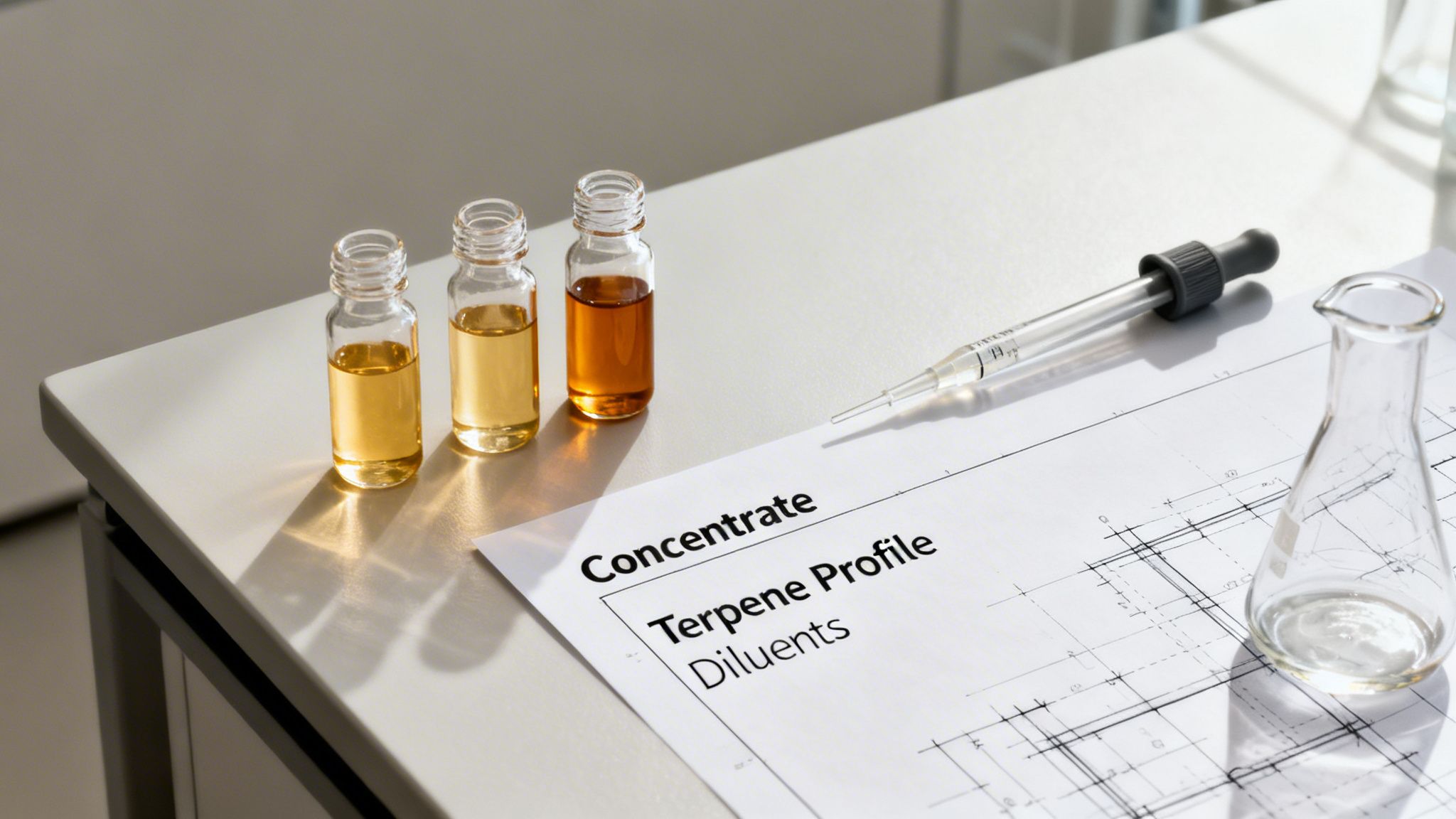
Any market-leading vape liquid is built on three core pillars: the cannabinoid base, the terpene profile, and occasionally, a diluent. Mastering this blueprint is the first step to creating commercially successful products that are both effective and distinct.
Each ingredient serves a precise function. The base—whether a highly-refined distillate or a complex live resin—delivers the cannabinoid payload. However, in its raw state, this material is often too viscous for vape hardware and typically lacks the aromatic complexity required for a premium product.
This is where the terpene profile becomes critical.
Terpenes are much more than flavor components. They are functional excipients that modulate the liquid's viscosity, define its aromatic character, and shape the overall sensory experience. They transform a basic concentrate into a finished, marketable product.
The Role of Each Core Component
An optimal formulation achieves a synergistic harmony between these components. It is a technical balancing act that, when executed correctly, yields superior product performance and brand differentiation.
Below is a technical breakdown of each component's function and its impact on the final product. This serves as a foundational guide for constructing a cannabis vape liquid formulation from the ground up.
Core Components of Cannabis Vape Liquid
| Component | Primary Role in Formulation | Impact on Final Product |
|---|---|---|
| Cannabinoid Base | Delivers the primary cannabinoid content (THC, CBD, etc.). | Serves as the "engine" of the vape, dictating potency and core effects. |
| Terpene Profile | Provides flavor, aroma, and acts as a natural viscosity modifier. | Defines the product's brand identity, sensory profile, and rheological properties. |
| Diluents (Optional) | Further reduces viscosity if terpenes alone are insufficient. | Can affect flavor and mouthfeel; modern formulations for cannabis product formulation often avoid them. |
Ultimately, a successful formulation is one where material science meets the art of sensory experience.
Why Precise Formulation Matters
Mastering this blueprint is not just a technical exercise; it directly impacts market viability and brand reputation. A well-executed formulation ensures batch-to-batch consistency, which is fundamental to building brand trust. It prevents critical failures like crystallization, phase separation, or cartridge leakage that can irrevocably damage a brand's credibility.
Furthermore, precision grants formulators creative control. It allows for the faithful replication of a classic strain's terpene profile or the development of entirely novel, proprietary blends with unique flavor and aromatic signatures. This capability is the differentiator between a commodity producer and a premium, sought-after brand.
By mastering this blueprint, formulators are equipped to create stable, effective, and in-demand products that define the top tier of the market.
Mastering Terpenes in Vape Formulation
In the competitive cannabis vape market, terpenes represent the most significant opportunity for product differentiation. Moving beyond a superficial understanding of flavor and aroma to a deep, functional knowledge of terpene chemistry is what separates forgettable products from premium brands. This requires a dual mindset: part analytical chemist, part perfumer.
The objective is to construct a complex and stable aromatic profile that defines the product's character. This involves analyzing the functional roles individual terpenes play within the formulation.
The Aromatic Pyramid in Formulation
The principle behind a memorable vape experience is analogous to the structure used in perfumery: the aromatic pyramid. A sophisticated blend is built on a balanced architecture of top, mid, and base notes. Each layer reveals itself sequentially during use, creating a structured sensory journey.
Top Notes: These are the most volatile compounds, delivering the initial aromatic impact. They are bright, sharp, and dissipate quickly. Examples include the citrus notes from Limonene or the fresh, coniferous scent of Pinene.
Mid Notes: This layer forms the heart of the profile, emerging as top notes fade. It provides the blend's primary character and body. Most floral and fruit-forward terpenes function as mid notes.
Base Notes: These are the least volatile, heavy molecules that anchor the blend. They provide depth and a lasting impression. Earthy, musky, or woody terpenes like Myrcene are classic base notes that create a full, satisfying finish.
A well-formulated cannabis vape liquid guides the user seamlessly through these layers, creating an experience that feels complete and intentionally crafted.
The Functional Roles of Terpene Isolates
Beyond aromatic construction, individual terpene isolates are powerful tools for addressing common formulation challenges. This technical application is particularly valuable when working with high-viscosity distillates.
For example, Limonene is not just a citrusy top note; it is also an effective natural solvent. Its inclusion can reduce the viscosity of a thick cannabinoid concentrate, ensuring proper wicking in a cartridge without resorting to undesirable diluents.
Conversely, Myrcene provides the classic earthy, musky base note characteristic of many legacy cannabis strains. Functionally, it grounds the brighter top notes, creating a well-rounded and authentic profile that avoids being one-dimensional.
By strategically selecting and blending isolates, formulators gain complete control over the flavor, aroma, and rheological properties of the final product. This is the key to accurately replicating the flavor of a specific strain or creating a proprietary blend for vape cartridges.
Sourcing for Quality and Consistency
All formulation efforts are rendered moot by substandard raw materials. Low-purity or contaminated terpenes will compromise a batch, resulting in off-flavors, physical instability, and potential safety liabilities. It is critical to source lab-tested, high-purity terpenes with verified chain of custody.
When formulating cannabis vape liquid, insist on terpenes that are completely free from:
- Vegetable Glycerin (VG)
- Propylene Glycol (PG)
- Medium Chain Triglycerides (MCT)
- Vitamin E Acetate
These additives negatively impact flavor, performance, and present significant health concerns. For any serious formulator, partnering with a supplier who provides a Certificate of Analysis (COA) for every batch is non-negotiable. This ensures consistency, protects brand integrity, and supports a responsible product development process. Our extensive guides on terpene formulation offer more practical tips for your projects.
Getting Your Mixing Ratios and Process Just Right
This stage moves the formulation from theoretical design to practical application. Achieving a perfectly consistent batch of cannabis vape liquid is not a matter of chance; it relies on a robust and repeatable process. In the lab, precision is paramount.
Finding Your Sweet Spot: Mixing Ratios
A general starting point is a mixture of 5% to 15% terpenes to concentrate by weight. However, this is merely a guideline. The optimal ratio is contingent on the specific properties of the cannabinoid base and the desired characteristics of the final product.
For instance, a high-viscosity distillate may require a higher terpene percentage to achieve the target viscosity for use in vape cartridges. Conversely, a less viscous concentrate or a formulation aiming for a subtler flavor profile will necessitate a lower percentage. It is a process of adjustment to meet specific material and performance parameters.
The Secret to a Smooth, Stable Mix: Homogenization
Simply combining terpenes and concentrate is insufficient. To produce a high-quality vape liquid that does not separate or exhibit "hot spots" of concentrated flavor, the mixture must be fully homogenized. This process ensures an even distribution of all components.
Proper homogenization requires specific equipment:
- Glassware: Use borosilicate glass beakers to withstand thermal stress and prevent chemical reactions.
- Magnetic Stirrer & Stir Bar: This is essential for professional-grade blending. It creates a vortex that ensures thorough mixing without introducing excessive air.
- Gentle Heat Source: A hot plate or heating mantle is ideal. Gently warming the concentrate reduces its viscosity, facilitating easier and more complete mixing.
This setup ensures that every unit of the formulation is identical, from the first to the last.
Precision is Key: Using a Mixing Calculator
To ensure formulaic precision and repeatability, a mixing calculator is an invaluable tool. It eliminates guesswork, preventing costly errors and product wastage. By inputting the target terpene percentage and total batch size, it provides the exact weights required for both the concentrate and the terpene blend.
A mixing calculator is a key component of a scalable process.
The primary benefit of a mixing calculator is consistency. It allows for the perfect replication of a validated formula, regardless of whether you are producing a 10-gram test batch or a 1,000-gram production run.
Think of building a flavor profile like crafting a perfume. You have different layers—base, mid, and top notes—that come together to create the full experience.

The process begins with a solid foundation (base notes), with the bright, volatile top notes added last to ensure a strong initial aromatic impression.
Don't Skip the Test Batch
It is imperative to conduct small-scale test batches before committing to a large production run. This is the most effective method for optimizing a recipe while minimizing expenditure of time and materials.
Prepare several small, 1-gram variations. For example, create formulations at 5%, 7%, and 10% terpene concentration. Label each sample clearly. Allow them to rest for at least 24 hours to permit the flavors to meld and the viscosity to stabilize.
Following this equilibration period, evaluate each sample for flavor, aroma, and performance within the target vape hardware. This empirical testing is the only way to validate the final recipe for your cannabis vape liquid before scaling up production.
So, you’ve put in the work and crafted what seems like the perfect vape liquid. The flavor is on point, the potency is exactly where you want it, and the color is beautiful. But the real test isn't what happens in the lab; it's what happens on the shelf and in a customer's pocket.
A great formulation can be ruined by poor stability or the wrong hardware. This is where the amateurs are separated from the pros. Getting this right means creating a product that's just as good on the last puff as it was on the first. Let's walk through how to make sure your product holds up.
Preventing Common Liquid Stability Issues
Two primary culprits will try to sabotage your beautiful cannabis vape liquid over time: crystallization and separation. Seeing either of these is an instant red flag for a customer.
Crystallization, often called "sugaring," occurs when highly pure cannabinoids like CBD or THCA precipitate out of the solution, forming solid crystals. This is a common challenge in high-potency formulations. The most effective preventative measure is to start with a properly winterized distillate. Winterization removes the microscopic fats and waxes that act as nucleation sites for crystal growth.
Terpene separation is the other major issue, resulting in visible layers within the liquid, similar to a separated vinaigrette. This typically indicates insufficient homogenization or an excessively high terpene concentration. Adhering to a 5-10% terpene ratio and ensuring complete homogenization are key to prevention.
Don’t forget that your terpenes themselves play a huge role in stability. Some heavier terpenes can throw off the balance of your mix, while others with different boiling points can behave in unexpected ways when heated. Knowing the physical properties of your terpenes, like their individual boiling points, is a pro-level move for building a stable blend.
Choosing the Right Cartridge Hardware
All that effort crafting a stable liquid is completely wasted if the cartridge fails. Your hardware isn't just a container; it's the delivery system, and picking the wrong one is a recipe for disaster. Leaks, clogs, and burnt hits are almost always a hardware problem.
When you're evaluating cartridges, pay close attention to these three things:
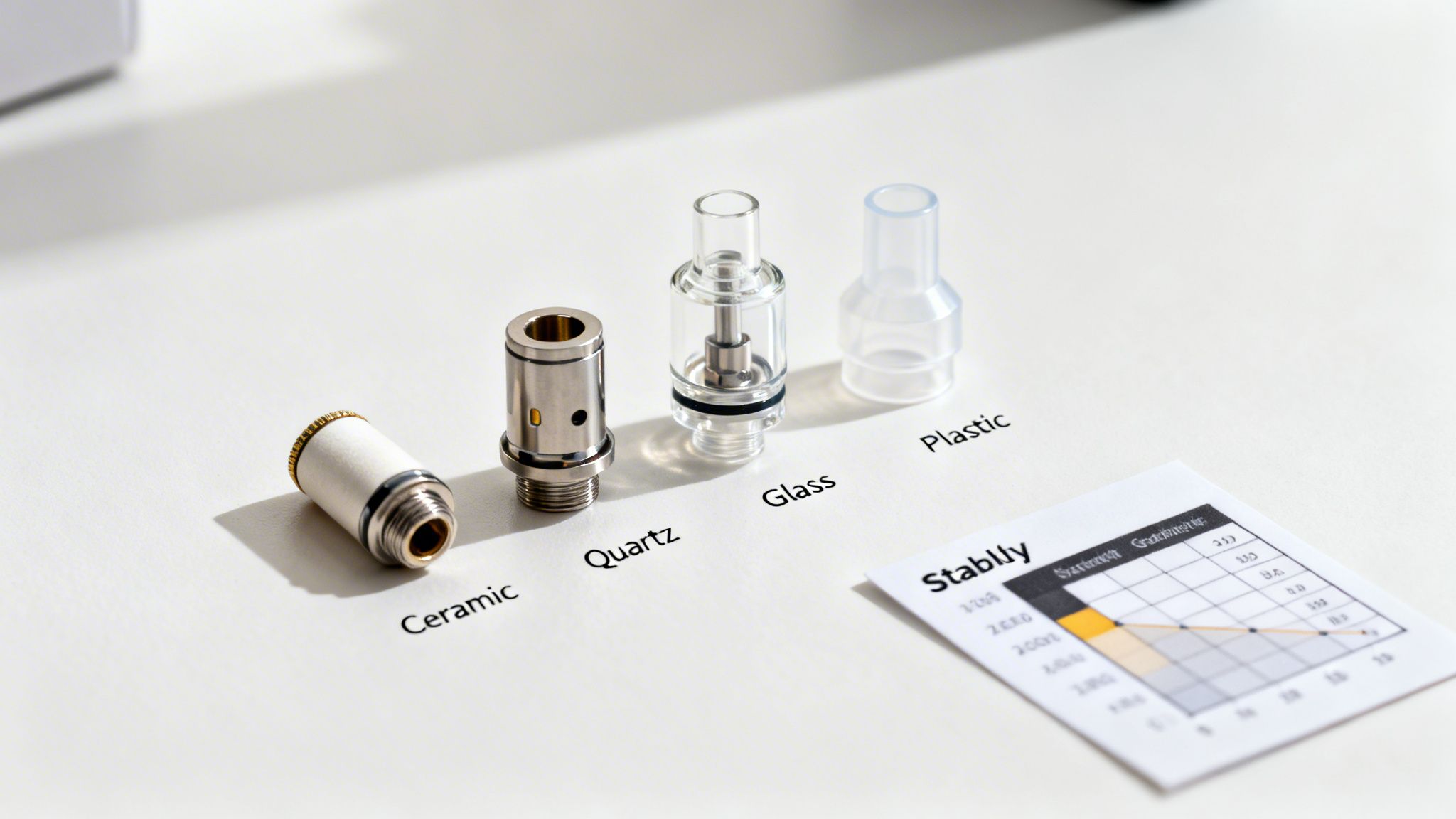
Coil Material: The industry favorites are ceramic and quartz. Ceramic coils are porous and heat gently, which is fantastic for preserving those delicate terpene flavors you worked so hard on. Quartz heats up much faster for a bigger initial cloud, but you risk burning the oil if you’re not careful.
Tank Material: You'll mostly see glass and high-quality plastic. Borosilicate glass is the gold standard because it’s inert and won't react with your oil. If you go with plastic, make sure it’s a heat-resistant polymer like PCTG, so you don't have to worry about it degrading and leaching into the product.
Intake Hole Size: This is the single most overlooked spec, and it's absolutely critical. The little holes on the side of the coil need to be the right size for your oil's thickness. A thick, viscous oil needs larger holes to wick properly. A thinner oil needs smaller holes to keep it from flooding the coil and leaking out the bottom.
There's no shortcut here. You have to test your final formulation in a few different cartridges. Find the perfect hardware pairing for your specific cannabis vape liquid to guarantee every customer gets a great, reliable experience.
Staying Safe and Compliant in 2026
In this industry, brand reputation is paramount. While a superior flavor profile can capture initial market attention, it is the trust built through consistent safety and quality that ensures long-term viability. Errors in safety and compliance are not merely mistakes; they can lead to catastrophic brand failure and, more critically, pose public health risks.
The 2019 EVALI crisis, where illicit Vitamin E acetate was linked to over 2,800 hospitalizations and 68 deaths, served as a stark lesson for the industry. It fundamentally reshaped consumer and manufacturer expectations. In its wake, demand for clean, lab-verified ingredients surged by nearly 300%. Today, an estimated 85% of manufacturers refuse to source terpenes that are not SC Lab-tested and certified free of carriers. You can dig into these evolving market demands and technology trends at FutureDataStats.com.
The key takeaway is unequivocal: for any cannabis vape liquid formulation, every single ingredient must be pure, traceable, and validated for safety. There are no acceptable shortcuts.
The New Gold Standard for Sourcing Terpenes
The most critical safety decision a formulator makes is the selection of a terpene supplier. Post-2019, sourcing carrier-free terpenes became the non-negotiable baseline for all responsible product development. This requires that terpenes be 100% pure, with no hidden additives or diluents.
Ensure any sourced terpenes are explicitly free from:
- Vegetable Glycerin (VG)
- Propylene Glycol (PG)
- Polyethylene Glycol (PEG)
- Medium-Chain Triglycerides (MCT)
- Vitamin E Acetate
These fillers compromise formulation stability and flavor, and can pose significant dangers when aerosolized and inhaled. A high-quality cannabis vape liquid should achieve its target viscosity solely through the natural solvency of pure terpenes—no cutting agents required. Partnering with a supplier transparent about their ingredients, such as our own line of strain-inspired terpene blends, is fundamental to creating a product that meets modern safety standards.
How to Read a Certificate of Analysis (COA)
A Certificate of Analysis (COA) serves as an independent verification of ingredient quality and safety. It is an essential lab report that confirms the purity and composition of your raw materials. Demanding a COA for every batch of terpenes and concentrates is a cornerstone of responsible manufacturing.
When reviewing a COA, verify these key results:
- Purity/Potency: Confirms the concentration of terpenes or cannabinoids.
- Pesticide Analysis: Shows freedom from agricultural contaminants.
- Heavy Metals Screening: Checks for lead, mercury, arsenic, and other toxic metals.
- Residual Solvents Test: Verifies no harmful solvents remain from the extraction process.
A clean COA is your primary tool for risk mitigation and a clear indicator of supplier quality. Any hesitation from a supplier to provide a complete, current COA is a major red flag and grounds for disqualification.
Keeping Up with a Shifting Legal World
The regulatory landscape for cannabis vape liquid is in constant flux, with significant variations between jurisdictions. Maintaining compliance requires ongoing vigilance. As a brand owner or formulator, you are responsible for understanding the specific regulations concerning labeling, testing, and packaging in every market you operate in.
For example, most jurisdictions now mandate strict child-resistant packaging and specific warning labels. Our formulation resources are an excellent starting point for understanding the best practices that align with current standards, helping you develop a product that is not only safe but also market-ready.
Troubleshooting Common Formulation Issues
At some point, every formulator encounters a batch that does not meet specifications, despite following a validated process. These moments can be frustrating, impacting timelines and profitability. This section serves as a practical guide for diagnosing and resolving common formulation problems.
Mastering these troubleshooting techniques will prevent costly errors and reinforce your brand's reputation for consistent quality.
Diagnosing Viscosity Problems
Achieving the target viscosity is a critical balancing act. Deviations result in either a product too thick to function or too thin to be stable.
Problem: The Liquid is Too Thick
This is characterized by extremely slow flow. The high viscosity prevents the liquid from wicking into the vape coil efficiently, leading to dry hits and coil burnout. This is a frequent issue with high-purity distillates.
The cause is almost always an insufficient terpene concentration. The solution is to methodically increase the terpene percentage. Start by incrementally adding 0.5% to 1% more terpenes by weight, ensuring complete homogenization after each addition before re-testing. Utilizing a strain-inspired terpene blend naturally high in a solvent-like terpene such as Limonene can be highly effective for thinning a formulation without compromising its flavor profile.
Problem: The Liquid is Too Thin
Conversely, a low-viscosity liquid will result in leakage from the cartridge's intake holes and mouthpiece. This is almost always caused by an excessive terpene concentration.
This issue is more difficult to rectify than excessive thickness, underscoring the importance of starting with conservative terpene ratios. The only remedy is to add more cannabinoid concentrate to the batch to increase the overall viscosity. This requires recalculating all ratios to meet the target potency. Document the successful ratio for future batches.
I’ve seen countless people blame their hardware for leaks when the real culprit was a vape liquid that was simply too thin. Before you spend a fortune on new cartridges, double-check that your formulation isn't the problem.
Addressing Flavor and Aroma Issues
The sensory experience is paramount in vaping. If the flavor is harsh, weak, or otherwise off-putting, consumer retention is unlikely.
Problem: The Flavor is Harsh or Chemical
This manifests as an unpleasant, throat-burning sensation. It often indicates either terpene degradation due to improper storage or an over-concentration of a particularly pungent isolate. Overheating during the mixing process can also scorch delicate terpenes, creating acrid flavors.
First, verify your terpene storage conditions: cool, dark, and in an airtight container. During mixing, apply heat gently, never exceeding 60-70°C. If the blend remains harsh, consider reducing the concentration of aggressive isolates like Beta-Caryophyllene.
Problem: The Flavor is Muted or Weak
The terpenes are aromatic in the bottle, but the vaped flavor is disappointingly faint.
This typically means the overall terpene percentage is too low. Alternatively, the blend may lack sufficient top and mid notes to create a vibrant flavor profile.
Try incrementally increasing the total terpene percentage. To build a more complex and impactful flavor, consult our guides on terpene formulation to learn about layering top, mid, and base notes. Sometimes, a small addition of 0.5% of a bright, citrusy top-note isolate is all that is needed to revitalize a dull blend.
Here are some of the most common questions we get from formulators in the lab. Let's get you some quick, practical answers to the technical hurdles you're facing.
How Do I Actually Replicate a Specific Strain’s Flavor Profile?
Accurately replicating a strain's unique flavor profile is a data-driven process. It requires moving beyond approximation.
The first step is to obtain a Gas Chromatography-Mass Spectrometry (GC-MS) analysis for the target strain. This report provides the precise terpene recipe, detailing the exact percentage of each constituent compound.
The next step is to source high-purity terpene isolates and meticulously blend them to match the ratios from the GC-MS report. Pay close attention to the minor terpenes; these trace compounds are often what define a strain's signature character. If you require a robust starting point, our library of strain-inspired terpene blends provides a significant advantage.
What’s the Best Way to Stop My High-Potency Distillate From Crystallizing?
Crystallization is a common challenge for formulators, particularly when working with high-purity distillates such as CBD or THCA. This "sugaring" phenomenon occurs when cannabinoid concentrations are high enough for molecules to precipitate out of solution.
The single most important step is to start with a properly winterized distillate. Winterization strips out the waxes and lipids that act as seed points for crystals to grow on. After that, a strategic terpene cut of 5-10% is usually enough to keep the cannabinoids dissolved and your oil clear and stable.
How Do I Tweak My Formula for Different Cartridge Hardware?
This is a critical consideration. A premier formulation will fail if it is incompatible with the chosen hardware. The viscosity of your cannabis vape liquid must be precisely matched to the intake hole aperture of your cartridge.
- Thicker Oils (Lower Terpene %): These require cartridges with larger intake holes to ensure proper wicking and prevent dry, burnt hits.
- Thinner Oils (Higher Terpene %): These necessitate smaller intake holes. If the apertures are too large, the coil will flood, causing gurgling and leakage.
Always test your final formulation in the specific hardware intended for commercial use before committing to a full production run. This validation step is essential for avoiding widespread product failure. For a more detailed guide on matching formulations to hardware, explore our formulation resources for advanced techniques.