
For product formulators, replicating the Blue Dream terpene profile isn't a creative exercise—it's about leveraging one of the most commercially successful flavor profiles in the cannabis industry. A precisely engineered Blue Dream strain-inspired terpene blend is critical for achieving product consistency and meeting the expectations of a massive, pre-existing customer base.
Why the Blue Dream Profile is a Commercial Asset for Formulators
Blue Dream has demonstrated incredible market longevity. Its enduring popularity provides a significant commercial advantage. When launching a vape cartridge, distillate-infused product, or edible featuring this profile, you are not introducing an unknown concept; you are tapping into a deeply established market.
This name recognition can accelerate product adoption and reduce marketing friction. However, this advantage is contingent on authenticity. The challenge for formulators lies in consistently replicating its complex character.
The profile is defined by the balance between sweet berry notes from its Blueberry parentage and the sharp, herbaceous character from its Haze lineage. This duality is its core appeal and its primary formulation challenge. An authentic Blue Dream product is a mark of quality that experienced consumers identify immediately, making precision in replicating the flavor of Blue Dream non-negotiable.
The Foundational Components of the Blue Dream Profile
To achieve the signature balance, a formulator must understand the primary aromatic compounds and their interplay. This is a technical process where each terpene functions as a precise ingredient contributing to the final, harmonious blend.
Three foundational terpenes create the classic Blue Dream experience:
- Myrcene: As the base of the profile, Myrcene provides a sweet, earthy, and subtly fruity foundation. It is the source of the unmistakable berry anchor.
- Alpha-Pinene: This terpene cuts through the sweetness with a bright, fresh pine aroma. As the primary top note, it introduces the quintessential "haze" element and prevents the profile from becoming overly dense or cloying.
- Beta-Caryophyllene: Contributing a spicy, peppery mid-note, Beta-Caryophyllene adds a crucial layer of complexity. It bridges the sweet and sharp notes, preventing the profile from being one-dimensional.
The art of formulation lies in balancing these three core components. An effective Blue Dream blend is not merely a list of ingredients; it's a precise ratio engineered to interact predictably with your cannabinoid concentrate.
Mastering the roles of these foundational terpenes is the first step toward accurately replicating the Blue Dream profile for a product line. For those new to the technical aspects of blending, a general guide on how to mix terpenes can provide essential background on the techniques required for precise formulation.
Deconstructing the Blue Dream Terpene Profile for Formulation
To successfully execute a Blue Dream terpene profile for formulation, one must adopt a chemical perspective. Analysis via Gas Chromatography (GC) reveals a distinct pattern: a few dominant terpenes dictate the profile's organoleptic properties.
This is analogous to musical composition. Each terpene is a note; their harmonic arrangement creates the final sensory experience.
The foundation of Blue Dream rests on three primary terpenes existing in a specific, delicate balance. For product manufacturers, achieving this balance is the most critical step in creating a recognizable and commercially viable product.
This diagram illustrates the core of the Blue Dream profile, highlighting the relationship between its three most important terpenes.

The sweet, sharp, and spicy notes are not coincidental; they are woven into a cohesive sensory architecture.
Top, Middle, and Base Notes: The Scent Architecture
In perfumery, aromatic compounds are categorized by volatility—the rate at which they evaporate and are perceived. This framework of top, middle, and base notes is directly applicable to replicating the flavor of Blue Dream.
- Top Notes: These are the most volatile compounds, perceived first and dissipating quickly. In Blue Dream, this is Alpha-Pinene. It delivers the initial burst of sharp, fresh pine characteristic of its Haze genetics.
- Middle Notes (Heart Notes): These emerge as the top notes fade, forming the "body" of the aroma. Beta-Caryophyllene is the key middle note, introducing a warm, spicy, peppery element that adds depth and complexity.
- Base Notes: These are the least volatile compounds, providing the lasting impression. Myrcene serves as the classic base note, delivering the rich, sweet, fruity foundation reminiscent of ripe berries.
A successful Blue Dream formulation presents these notes in the correct sequence. If the pine top note is absent or the berry sweetness is overpowering from the start, the profile will feel inauthentic. The technical skill is in layering these aromatics correctly.
The Ratios: A Formulator's Starting Point
While exact percentages vary between chemotypes, most Blue Dream cultivars adhere to a consistent ratio. These ranges provide a reliable starting point for developing a proprietary blend or verifying the quality of a pre-made Blue Dream strain-inspired terpene blend.
Lab data confirms that three terpenes perform the majority of the work. Mastering their balance is the key to a convincing Blue Dream product.
Blue Dream Dominant Terpene Formulation Roles
The table below outlines the primary terpenes in a typical Blue Dream chemotype, detailing their function in shaping the final aroma and flavor.
| Terpene | Typical Concentration Range (%) | Aroma Contribution (Note) | Formulation Role |
|---|---|---|---|
| Myrcene | 40% – 60% | Sweet, fruity, earthy (Base) | Creates the core berry and musky foundation that lingers. |
| Alpha-Pinene | 10% – 20% | Sharp, pine, fresh (Top) | Provides the bright, Haze-like aromatic lift at the beginning. |
| Beta-Caryophyllene | 5% – 15% | Spicy, peppery, warm (Middle) | Adds complexity and bridges the sweet and sharp notes. |
Collectively, these three terpenes often constitute over 75% of the total profile, making their precise ratio critical.
Minor terpenes like Limonene, Linalool, and Humulene add subtle nuances. For advanced formulation, precise additions of individual terpene isolates can be used to fine-tune the profile and create a proprietary signature.
The Commercial Legacy of the Blue Dream Profile
Understanding the commercial significance of Blue Dream requires looking beyond its chemistry. For formulators and brand owners, the "why" behind this profile is as important as the "how," and the answer lies in its profound market history. Blue Dream is not just a strain; it is one of the most successful commercial archetypes in the modern cannabis industry.
Originating in Santa Cruz, California, from a cross of Blueberry and Haze, it produced a universally appealing blend of sweet berry and fresh pine. This broad appeal rapidly translated into market dominance, establishing Blue Dream as a commercial powerhouse long before the legal market formalized.
From Regional Staple to National Bestseller
Blue Dream's ascent was quantitatively validated by sales data. As regulated markets began tracking sales, its commercial power became undeniable, cementing its status as an essential flavor for any serious product portfolio. This history represents a pre-built customer base for today's formulators.
Data from the mid-2010s illustrates this. By 2016, BDS Analytics reported Blue Dream as the #1 best-selling strain in both Colorado and Washington. This legacy makes its terpene profile an invaluable asset for vape and concentrate formulators. You can dive deeper into the history of Blue Dream's market impact to understand its full commercial trajectory.
Why This Legacy Matters for Product Formulation
This proven track record provides a significant advantage for today's formulators. When launching a product featuring a Blue Dream strain-inspired terpene blend, you are not just selling a flavor. You are leveraging familiarity, trust, and a proven commercial entity.
This provides:
- Reduced Marketing Friction: The name itself performs significant marketing work, increasing the likelihood of trial.
- Built-In Consumer Trust: Years of positive consumer experiences have forged a strong association between the Blue Dream name and a reliable, high-quality product.
- Broad Market Appeal: Its balanced profile appeals to a wide demographic, from new consumers to experienced connoisseurs, preventing the product from being confined to a niche market.
For a product developer, replicating Blue Dream is not simply about recreating a flavor. It is about leveraging a decade of market conditioning and consumer loyalty to confer an immediate competitive edge upon a new product.
This fame, however, comes with high expectations. An inaccurate or low-quality Blue Dream profile will be immediately identified by consumers and can damage brand perception. Precision is non-negotiable. The sweet berry notes from Myrcene and the classic sharp finish from Alpha-Pinene must be perfectly rendered.
This is where a formulation guide for cannabis products becomes critical. An authentic profile must honor the legacy that made the strain famous, delivering the exact experience millions of consumers expect. For formulators seeking ultimate control over this balance, working with individual terpene isolates is the most effective approach.
A Step-by-Step Formulation Guide for Blue Dream Vape Cartridges
Replicating the Blue Dream experience in a vape cartridge requires precision, proper equipment, and a robust process. This guide provides a methodology for creating a high-quality, stable, and authentic Blue Dream product using cannabinoid distillates.
The process hinges on accurate measurements, correct mixing techniques, and a technical understanding of the interaction between terpenes and the base concentrate. Following these steps provides a reliable starting point for a Blue Dream for distillate formulation.
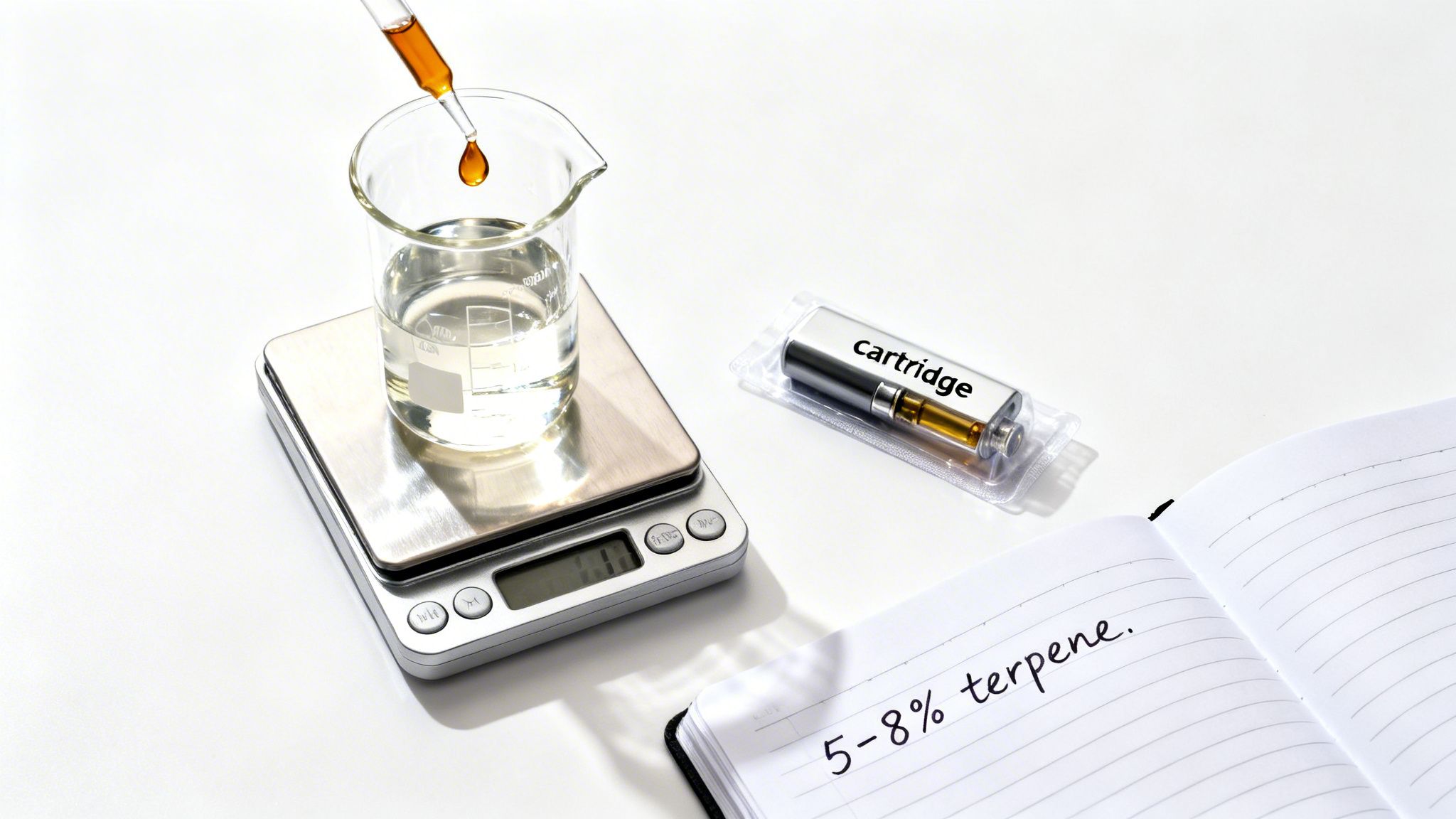
Step 1: Prepare Workspace and Equipment
A clean, organized, and safe workspace is paramount. For consistent, professional-quality results and to prevent contamination, lab-grade equipment is essential.
Required equipment includes:
- Lab-Grade Glassware: Borosilicate glass beakers or vials are non-reactive and withstand thermal stress.
- Digital Scale: Accuracy is critical. A scale with a resolution of at least 0.01g is necessary for precise weighing of distillate and terpenes.
- Magnetic Stirrer with Hot Plate: This equipment is essential for achieving a homogenous blend through controlled heating and agitation.
- Glass Syringes or Pipettes: These are used for accurate transfer of terpenes and filling cartridges with the final mixture.
Safety Protocol for Formulators
Handling concentrated terpenes requires strict safety measures. Operate in a well-ventilated area, preferably under a fume hood. Always wear nitrile gloves, safety glasses, and a lab coat to prevent dermal and ocular exposure.
Step 2: Determine Terpene-to-Distillate Ratio
The concentration of the Blue Dream strain-inspired terpene blend dictates the final product's flavor and viscosity. A common error is over-saturating with terpenes, resulting in a harsh flavor and potential hardware compatibility issues.
A standard and effective starting point is between 5% and 8% terpenes by weight.
For example, to formulate 100 grams of vape liquid at a 7% concentration, you would use 93 grams of cannabinoid distillate and 7 grams of the terpene blend.
For initial batches, begin at the low end of the range, such as 5%. Conduct small test batches to determine the optimal ratio for your specific distillate and target flavor profile before scaling production. Different cannabinoid distillates (THC, CBD, etc.) possess unique characteristics that will influence the final profile, making empirical testing essential.
Step 3: Execute the Mixing Process
Proper mixing ensures even distribution of terpenes throughout the distillate, preventing separation and ensuring a consistent consumer experience. The magnetic stirrer and hot plate are indispensable for this step.
A reliable method is as follows:
- Warm the Distillate: Place the weighed distillate in a glass beaker on the hot plate. Gently warm it to between 120-140°F (49-60°C). This reduces viscosity for easier mixing without degrading volatile terpenes.
- Add the Terpenes: Once the distillate reaches the target temperature, slowly introduce the measured terpene blend. Adding terpenes to overly hot distillate will cause them to volatilize and escape.
- Homogenize the Mixture: Place a magnetic stir bar into the beaker and set the stirrer to a low-to-medium speed. Agitate for approximately 5-15 minutes, or until the liquid is completely clear and uniform, with no visible striations.
Step 4: Troubleshoot Common Formulation Issues
Even with a robust process, issues such as terpene separation and crystallization can occur. Separation often indicates insufficient mixing or an excessively high terpene percentage.
If the mixture is not homogenous, applying gentle heat and continued stirring typically resolves the issue. Crystallization, particularly with high-purity CBD distillates, can be more complex. Adjusting the terpene blend can sometimes mitigate this, as certain terpenes act as crystallization inhibitors.
Mastering these details is part of advanced formulation. It's a concept explored in our formulating guide for the Sour Diesel strain terpene guide, where minor ratio adjustments yield distinct outcomes. After mixing, allow the blend to cool and settle before filling cartridges.
Advanced Techniques: Fine-Tuning Your Blue Dream Formulation
Once the classic Blue Dream profile is mastered, the opportunity for product innovation begins. A perfect replica serves as a consistent foundation, but the true art lies in using it as a base for a line of unique products. By strategically incorporating specific terpene isolates, you can modulate the flavor and aroma to create signature blends that differentiate your brand in a competitive market.
Consider the base Blue Dream profile a canvas. From here, you can introduce other aromatic compounds to highlight certain notes or introduce new ones. This is the transition from strain replication to genuine product development, anchored in a profile consumers already trust.
Crafting Variations with Terpene Isolates
Effective customization requires an understanding of terpene synergy. Small, precise additions of an isolate can significantly alter the final sensory experience. This strategy enables the creation of a product family—a "Blue Dream Collection"—where each SKU offers a distinct character.
Consider these formulation scenarios:
- For a Softer, Floral Profile: To temper Blue Dream’s sharper notes, add 1-2% Linalool. Linalool introduces delicate lavender and floral notes that complement Myrcene’s sweetness, resulting in a more refined and relaxing aromatic profile.
- For a Brighter, Citrus-Forward Profile: To create a more energetic, zesty variant, increase the Limonene content. An additional 2-3% will enhance the berry notes with a tangy, citrus character. This is an ideal formula for a "Daybreak" or "Sunrise" edition. Learn more in our technical brief on d-Limonene benefits.
- For a Deeper, Earthier Profile: To emphasize the Haze lineage, a small addition of Humulene is effective. Just 0.5-1% is sufficient to introduce a subtle hoppy, woody, and earthy character, reinforcing the classic "hazy" finish provided by Alpha-Pinene.
Strategic formulation involves deliberate modifications to achieve a specific outcome. Every adjustment must be documented and tested, allowing you to build a proprietary library of Blue Dream variations.
Adjusting Your Blend for Different Vape Hardware
Flavor is not the only consideration; the hardware is equally important. The performance of a vape cartridge is directly tied to the viscosity and volatility of the oil. A blend optimized for one atomizer may fail in another.
Therefore, fine-tuning your Blue Dream for vape cartridges formulation must account for the technology.
Ceramic Coil Atomizers
Ceramic coils excel at preserving delicate terpene flavors due to their even, gentle heating. However, they can struggle with highly viscous oils. When formulating for ceramic hardware, it may be necessary to increase the terpene percentage slightly—for example, from 7% to 8%—to reduce viscosity and ensure proper wicking.
Wicked Atomizers (Cotton/Silica)
These traditional atomizers have excellent wicking capabilities but can create "hot spots" that scorch terpenes if the oil is too thin. For these cartridges, a lower terpene concentration (around 5-6%) is often optimal. This creates a slightly more viscous oil that vaporizes smoothly without producing a harsh, burnt taste.
Tailoring your formulation to the hardware is a professional standard. It ensures consistent product performance and a high-quality consumer experience, which is a key differentiator for leading brands.
Sourcing Terpenes: The Importance of Quality and Consistency
Replicating the Blue Dream profile is a technical achievement. Ensuring every unit sold delivers that identical experience is a supply chain challenge. Your terpene supplier is the foundation of your brand's reputation for consistency.
If a customer purchases a Blue Dream vape cartridge that tastes bright and piney one week, and a subsequent purchase is dull and overly sweet, trust is eroded. Inconsistency undermines brand loyalty. To build a scalable product line, you require a supplier who delivers an identical profile with every batch.

Vetting a Terpene Supplier: Key Criteria
Not all terpenes are created equal. When evaluating a supplier, you must look beyond olfaction and scrutinize the technical documentation. A professional partner will provide the necessary paperwork to validate their claims and ensure consumer safety.
Non-negotiable criteria include:
- Certificates of Analysis (CoA): Demand a CoA for every batch. This document verifies the exact terpene ratios and confirms the absence of contaminants.
- Purity Standards: Your terpenes should be pure. Ensure your supplier guarantees their products are free of VG, PG, MCT, PEG, or other diluents. These additives can compromise flavor and introduce safety risks.
- Source Transparency: A reputable supplier will be transparent about their sourcing and manufacturing processes. This transparency is a strong indicator of quality control.
Selecting a supplier should be viewed as establishing a long-term partnership. Sourcing cheap, undocumented terpenes is a short-term saving that can lead to long-term costs from product recalls, hardware failure, and brand damage.
The Business Risk of Low-Quality Blends
Using unverified terpene blends introduces significant business risk. These products often lack the precise balance required for an authentic Blue Dream strain-inspired terpene blend, resulting in a generic, unconvincing flavor. More critically, they may contain undeclared ingredients that affect product stability or safety.
Working with a professionally crafted, strain-specific blend from a reputable source like Gold Coast Terpenes mitigates these risks. You receive a product that has been rigorously tested for purity and consistency, allowing for scalable and predictable production. This reliability is a core requirement for building a lasting brand. Understanding the fundamentals of plant science, such as the difference between male and female cannabis plants, can provide deeper context on how genetic origins influence final chemotypes.
Blue Dream Formulation FAQs
This section addresses technical questions that arise during the formulation process for a Blue Dream profile.
How Can I Prevent a Burnt Taste in My Blue Dream Formulation?
A burnt or acrid taste is typically caused by excessive heat or a hardware/viscosity mismatch. The first variable to check is terpene concentration.
For cartridges with wicked coils, maintain a 5-6% terpene concentration. Ceramic atomizers may tolerate slightly higher percentages, but it is always prudent to start low. Furthermore, ensure end-users are educated on appropriate voltage settings, as excessive power is a primary cause of terpene degradation.
What is the Optimal Viscosity for a Blue Dream Vape Cartridge?
While the ideal viscosity is hardware-dependent, a target range of 1500-2500 centipoise (cP) at room temperature is a good benchmark.
This can typically be achieved by combining a high-purity distillate with 5-8% terpenes. If the resulting oil is too viscous for your hardware, consider a high-quality, tested diluent, but only after attempting to adjust viscosity with your Blue Dream terpene blend first.
A common formulation error is over-thinning the oil at the expense of flavor. A slightly more viscous oil often better preserves the volatile top notes from Pinene, delivering a more authentic sensory experience.
Can This Profile Be Used in Products Besides Vapes?
Yes. The wide appeal of the Blue Dream flavor makes it highly versatile for use in tinctures, edibles, and beverages.
The critical adjustment is the usage rate. For edibles, start at a much lower concentration, in the range of 0.1% to 0.5% by weight, as the flavor can easily become overpowering. Conduct small test batches to determine the optimal balance for your specific product matrix. To explore other versatile profiles, our Sour Diesel strain terpene guide offers additional formulation insights.
Ready to formulate a product that consistently delivers the legendary Blue Dream experience? At Gold Coast Terpenes, we provide lab-tested, strain-specific terpene blends engineered for predictable, premium results.