
The best terpenes for distillate are those that achieve a specific formulation goal, whether it's precise strain replication, viscosity optimization for vape cartridges, or the development of a novel flavor profile. For production efficiency and consistency, a pre-blended, strain-inspired terpene blend like OG Kush offers a reliable solution. For complete creative control over the final product's sensory characteristics and effects, formulating with individual isolates like Limonene or Myrcene is the superior approach.
Why Terpene Formulation is Critical for Distillate
Pure cannabinoid distillate is essentially a blank canvas. The distillation process, while effective at isolating cannabinoids like THC and CBD to high purities, simultaneously strips out the volatile aromatic compounds—terpenes and flavonoids—that define a strain's character.
Without these crucial compounds, the distillate is potent but lacks the signature aroma, flavor, and nuanced effects that differentiate cannabis cultivars. Reintroducing terpenes is a critical step for any professional formulator aiming to create a premium, market-ready product. This process is not merely about adding scent; it's about transforming a base extract into a high-value product with a distinct identity.
Architects of Product Identity
Terpenes are the architects of a product's identity, transforming a neutral base oil into a full-bodied, authentic experience. A strategic terpene formulation provides direct control over the key attributes that define product quality and market success.
A well-designed terpene formulation impacts several critical factors:
- Sensory Experience: Terpenes create the signature aroma and flavor of a recognized strain or can be used to engineer an entirely new flavor profile that differentiates a brand. This is a primary tool for market distinction.
- Viscosity and Performance: Distillate is highly viscous. Terpenes act as a natural diluent, adjusting the oil to the optimal viscosity for specific vape hardware. This is essential for proper wicking, preventing clogs, and ensuring consistent vapor delivery.
- Targeted Effects: Different terpenes contribute to distinct effects. A blend high in Limonene can impart an uplifting character, while one rich in Myrcene may create a more calming effect. Our formulation resources provide deeper insight into how specific blends can shape the end-user experience.
Ultimately, the careful selection of the best terpenes for distillate is what separates a commodity extract from a sophisticated, branded product. It represents the transition from a generic oil to a memorable consumer experience that builds brand loyalty.
Viewing terpenes as functional ingredients—not just flavorings—is foundational to intelligent product design. Next, we will examine the technical selection and combination of these powerful molecules.
Formulating with Terpene Isolates: Top, Mid, and Base Notes
While using a pre-made strain profile is efficient, true formulation mastery comes from working with individual terpene isolates. These are the fundamental components—the primary colors on a formulator's palette—that enable the creation of unique, proprietary blends.
Mastering individual isolates provides precise control over the final product, moving beyond simple strain replication to the design of a unique sensory journey from the ground up. This is how brands develop the proprietary blends that define their market position.
The Aromatic Pyramid: Top, Mid, and Base Notes
Not all terpenes function equally in a blend. Their volatility—the rate at which they evaporate—determines their role as a top, middle, or base note. A sophisticated formulation balances all three to create a flavor that is both complex and enduring.
- Top Notes: These are the most volatile terpenes, providing the initial aromatic impression. They are the "hook" that captures immediate attention.
- Middle Notes: As the top notes dissipate, the middle notes emerge. They form the core of the blend, providing substance, character, and depth.
- Base Notes: These are the least volatile molecules with the greatest longevity. They provide a rich foundation that supports the entire blend and ensures a memorable finish.
This structured approach elevates a formulation from simple flavoring to a multi-dimensional product experience.
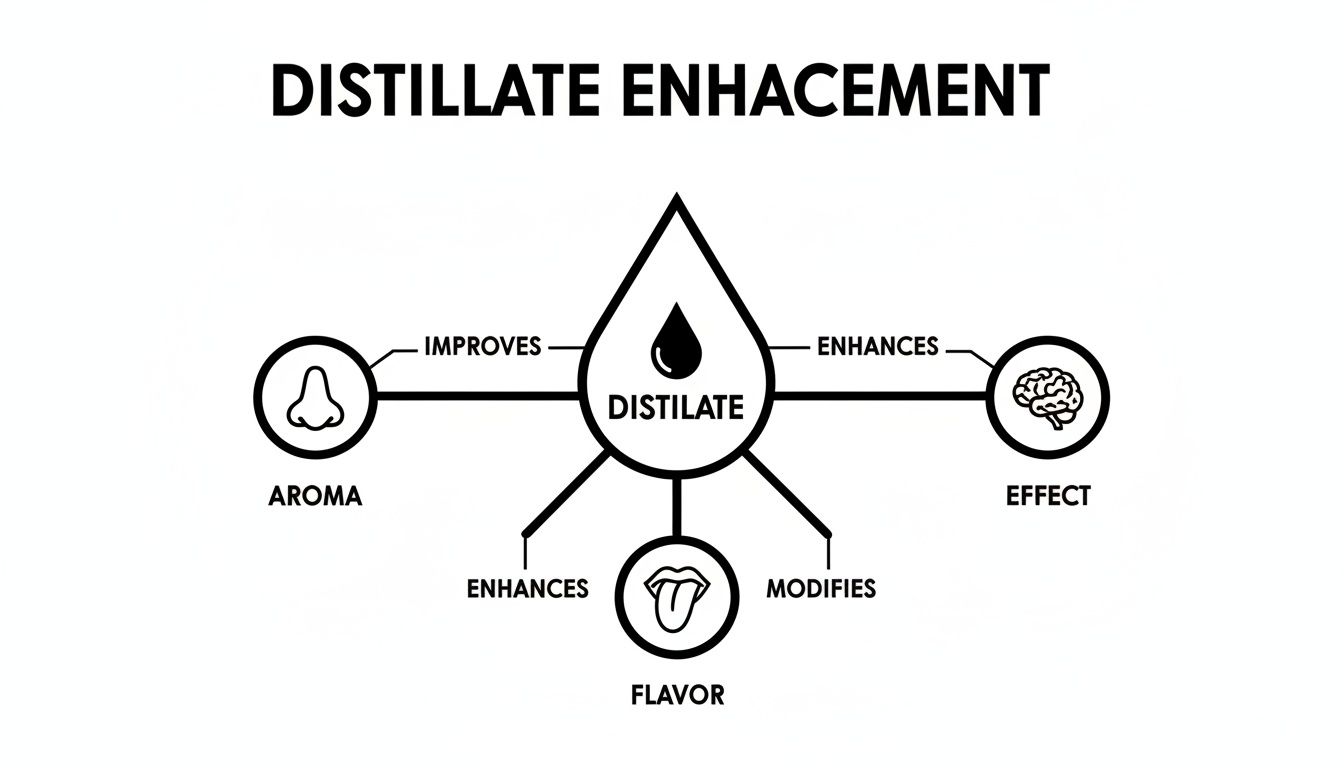
Strategic terpene additions transform a one-dimensional oil by engaging multiple senses.
Key Isolates for Your Formulation Toolkit
To build a professional-grade profile, a formulator must understand their primary tools. The following table provides a quick-reference guide to common isolates and their function in a blend.
Key Terpene Isolates and Their Formulation Roles
| Terpene Isolate | Aroma & Flavor Profile | Common Functional Effect | Role in Formulation (Note) |
|---|---|---|---|
| Myrcene | Musky, earthy, slightly fruity (mango) | Calming, Sedative | Foundational base note; adds a familiar, grounding character. |
| Limonene | Bright, sharp, zesty citrus (lemon, orange) | Uplifting, Energizing | Classic top note; provides an immediate aromatic "pop." |
| Linalool | Floral, sweet, slightly spicy (lavender) | Relaxing, Soothing | Versatile middle note; softens and adds complexity to a blend. |
| Beta-Caryophyllene | Peppery, spicy, warm wood | Anti-inflammatory, Calming | Robust base note; anchors the blend with a rich, lasting finish. |
Balancing these core isolates is key to creating sophisticated, well-rounded profiles.
Myrcene: The Earthy Foundation
Myrcene is one of the most prevalent terpenes in cannabis and serves as an excellent base note with its musky, earthy profile and subtle fruit notes. It imparts a grounding, substantial character to a blend and is often associated with enhancing cannabinoid effects. Myrcene is a workhorse isolate, providing the deep, familiar character found in many popular strain profiles.
Limonene: The Bright and Zesty Top Note
For an immediate burst of bright aroma, Limonene is the go-to isolate. It delivers the sharp, clean citrus scent that defines the initial impression of many uplifting blends. Its high volatility makes it a classic top note, ideal for creating an instant aromatic impact. When formulating a product intended to feel focused and vibrant, Limonene is one of the best terpenes for the job. Its profile makes it a staple in Sativa-style formulations.
Linalool: The Calming Floral Bridge
With its gentle floral and slightly spicy aroma, Linalool is a quintessential middle note. It bridges the gap between bright top notes like Limonene and heavy base notes, adding a layer of complexity and calm. Known for its presence in lavender, Linalool can soften a blend, creating a more nuanced and sophisticated profile. For a closer look at a common top note, explore our detailed guide on D-Limonene benefits and see how it functions within a blend.
Beta-Caryophyllene: The Spicy, Enduring Base
Beta-Caryophyllene contributes a warm, spicy, and peppery character that functions perfectly as a base note. Its low volatility gives it significant staying power, anchoring brighter notes and providing a rich, lasting finish. It adds a distinct, robust character that makes any profile feel more complete and full-bodied.
By mastering the interplay of these key isolates—balancing the bright flash of Limonene with the lasting spice of Beta-Caryophyllene—a formulator moves beyond simple flavor addition. You begin to architect a complete sensory experience, from the first scent to the final, lingering taste.
Replicating Flavor Accurately with Strain-Inspired Terpene Blends
While formulating with isolates offers maximum creative freedom, it is a time-consuming and expertise-intensive process. For most formulators, particularly those focused on scaling production and speed-to-market, pre-blended strain-inspired terpene blends are the most practical solution. These professionally crafted profiles offer a shortcut to an authentic, reliable, and high-quality end product.
This approach is not just about time savings; it's about meeting established consumer expectations and scaling production with guaranteed batch-to-batch consistency.
Why Well-Known Strain Profiles Sell
In a competitive marketplace, brand recognition is invaluable. When a consumer sees a familiar name like Sour Diesel, they have a pre-existing expectation of a specific aroma, flavor, and experience. Using a well-known strain profile gives a product an immediate market advantage. To better grasp what makes these profiles so popular, you can learn more by understanding strain classifications like Sour Diesel.
By using a professionally formulated profile, you deliver on that consumer expectation with precision and consistency, which is fundamental to building brand trust and repeat business.
For a formulator, pre-blended profiles are a strategic tool. They reduce R&D time, ensure product consistency, and connect a product with an existing consumer base.
A Foundation for Customization
Pre-blended profiles also serve as an excellent foundation for creating unique variations. A formulator can start with a classic strain and introduce subtle modifications to develop a proprietary "signature" blend. For example, augmenting a balanced profile with a small percentage of Limonene can enhance its citrus notes, while adding Beta-Caryophyllene can introduce a warmer, spicier finish. This strategy combines the familiarity of a classic with the uniqueness of a custom formulation.
The Role of Dominant Terpenes
Every iconic strain profile is defined by one or two dominant terpenes. Myrcene is a prime example; its prevalence has made it a go-to terpene for vape cartridge and concentrate formulations. The booming terpene market is a testament to the demand for these authentic experiences.
Myrcene can constitute up to 50% of the total terpene content in many indica-leaning strains, including OG Kush. It is known for its relaxing qualities that pair well with high-potency distillates. Understanding which terpenes dominate a profile is crucial to understanding its sensory characteristics and effects. A quality strain profile is not just a flavor—it's a balanced composition of compounds designed to create a specific, reproducible experience.
A Practical Guide for Mixing Terpenes with Distillate
Having covered the theory behind terpene selection, we now turn to practical application. This section outlines the process for creating a stable, high-quality product, moving from small test batches to full production runs with confidence.
We will review industry-standard ratios, homogenization techniques, and critical steps for achieving a perfectly consistent final mixture, providing a roadmap for turning raw distillate into a market-ready vape oil.
Establishing Mixing Ratios
The terpene concentration, calculated by weight, is the most critical variable in formulation. It dictates the product's flavor intensity, viscosity, and overall sensory experience. For most distillate-based vape products, the optimal terpene concentration is between 5% and 10% of the total weight. This range provides a robust flavor and aroma without being harsh or overpowering the cannabinoids.
- For High-Potency Distillates (90%+): Start conservatively. A 5-7% ratio is typically sufficient for a full-bodied flavor profile and smooth viscosity.
- For Bolder, Flavor-Forward Blends: To achieve a more pronounced flavor, concentrations can be pushed toward 8-10%. Exceeding 10% is rarely necessary and risks creating an overly thin oil or an unpleasantly intense flavor.
The cardinal rule of formulation: always begin with small, precisely measured test batches. Create several variations (e.g., at 5%, 7%, and 9%) to evaluate how each performs in your target vape hardware before committing to a large-scale production run.
The Science of Homogenization
Simply adding terpenes to cold, viscous distillate will result in an inconsistent, separated mixture. Proper homogenization is essential for creating a uniform and stable product, and it requires gentle heat and thorough agitation. This process ensures that every unit of the final product delivers an identical experience. For precise calculations, our online Terpene Mixing Calculator is a valuable tool.
Follow this step-by-step process for a flawless blend:
- Gently Warm the Distillate: Heat the distillate to 40-60°C (100-140°F). This temperature is sufficient to lower its viscosity for easy mixing without degrading cannabinoids or volatile terpenes.
- Slowly Introduce the Terpenes: While the distillate is warm, add the pre-measured terpenes gradually.
- Ensure Thorough Agitation: Stir the mixture continuously as you add the terpenes. For small batches, a glass or stainless steel stirring rod is adequate. For larger production runs, a magnetic stirrer is the industry standard, providing consistent, hands-free agitation for a perfect blend.
- Cool and Settle: Once fully combined, allow the mixture to cool to room temperature to stabilize.
Following these steps ensures complete integration of the terpenes, resulting in a premium, shelf-stable product with reliable performance.
Ensuring Quality and Safety in Cannabis Product Formulation
Achieving the perfect flavor profile is only part of the development process. For any brand creating a top-tier vape product, quality control and safety are paramount. These principles are the foundation of brand trust and product integrity.
It begins with raw material verification. Sourcing high-quality distillate and terpenes is the first step, but verifying their purity and composition via a Certificate of Analysis (COA) is what separates professional operations from amateurs.
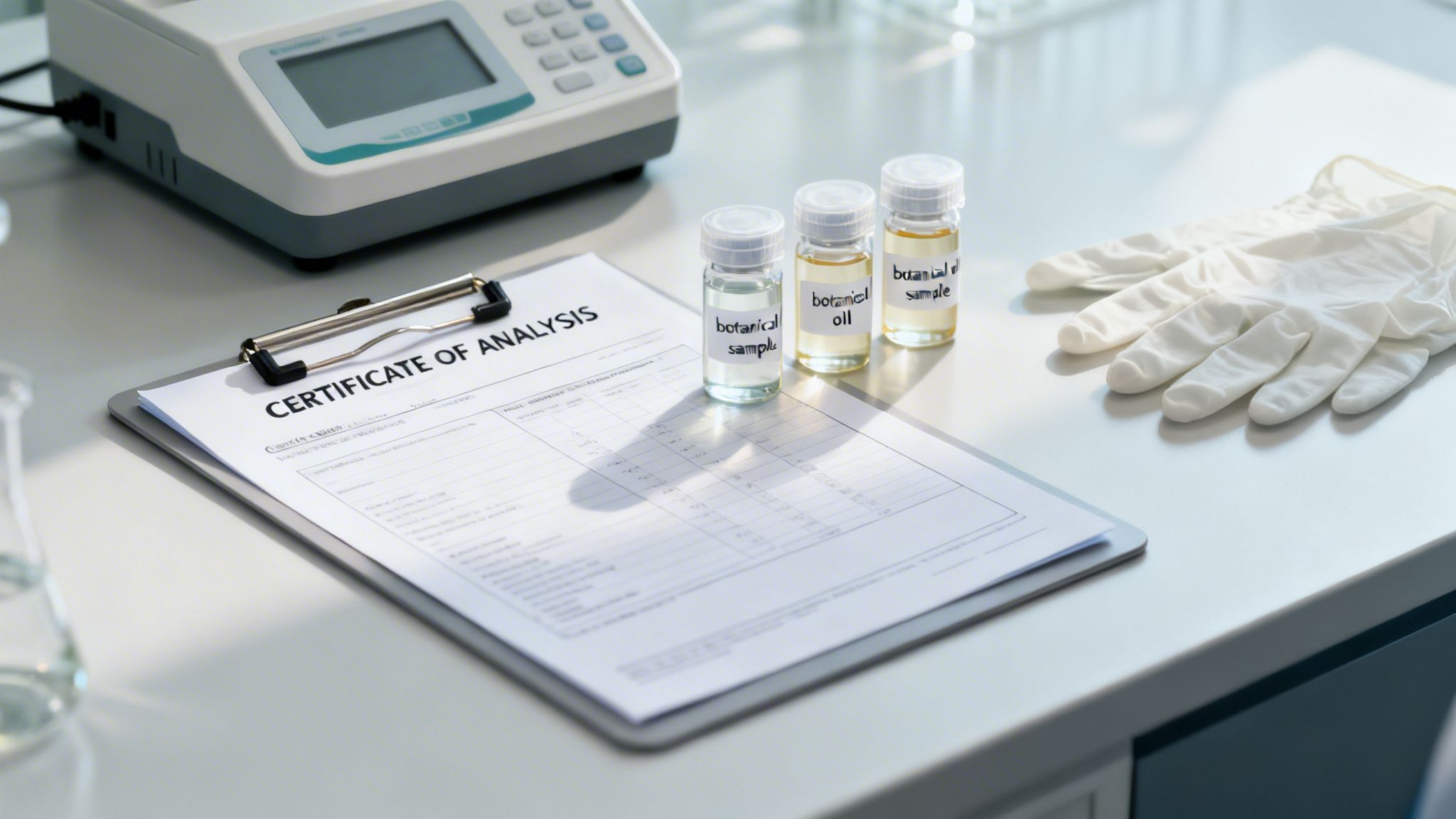
Decoding the Certificate of Analysis (COA)
A COA is a technical document from an accredited third-party laboratory that provides a detailed breakdown of a terpene blend's composition.
Key data points to analyze on a COA include:
- Purity Confirmation: The report should confirm the identity and concentration of the terpenes, ensuring batch-to-batch consistency.
- Absence of Contaminants: A comprehensive COA must test for residual solvents, pesticides, heavy metals, and microbial contaminants. The only acceptable result is "Not Detected."
- Full Terpene Breakdown: For strain-inspired blends, a detailed COA will list the full spectrum of terpenes present, providing valuable data for understanding the nuances of the profile.
A COA is your insurance policy against substandard ingredients. Never formulate with terpenes that lack a clean, detailed, and verifiable lab report. This simple check protects your brand, your product, and your customers.
Material and Hardware Compatibility
The formulation process extends to the selection of hardware. Terpenes are potent organic solvents that can degrade substandard materials. Using incompatible hardware introduces significant risks:
- Leaching: Low-quality plastics and adhesives can break down upon contact with terpenes, potentially leaching harmful chemicals into the oil.
- Degradation: Certain materials can react with the terpene blend, altering the flavor profile and creating unknown byproducts over time.
The solution is to select vape hardware constructed from high-quality, inert materials. Cartridges made with glass, ceramic, and stainless steel are resistant to the solvent properties of terpenes, ensuring the final product remains pure and stable. For more foundational knowledge, you can explore the differences between plant types to see how quality control begins at the source.
Common Questions in Terpene Formulation
This section addresses frequently asked questions from product formulators to help resolve common challenges.
What is the recommended terpene mixing ratio for distillate?
The industry standard is between 5% and 10% terpenes by weight. For distillates with over 90% cannabinoid content, it is advisable to start at the lower end of this range, approximately 5-7%, to ensure a smooth flavor profile that is not harsh. Conduct small test batches to evaluate how the concentration impacts flavor, viscosity, and performance in your chosen hardware before scaling up.
Is it possible to formulate a custom strain by mixing isolates?
Yes, this is how proprietary flavors are developed. The process requires a structured approach based on aromatic notes:
- Start with bright top notes like Limonene for the initial aroma.
- Build the core flavor with middle notes like Pinene.
- Ground the profile with earthy base notes like Beta-Caryophyllene for a lasting finish.
Pro Tip: Maintain a detailed formulation log. Documenting your ratios precisely is the only way to ensure the consistent and repeatable production of a successful blend.
My terpenes and distillate are separating. What is the cause?
This is a common result of improper homogenization. To achieve a stable emulsion, gentle heat and thorough agitation are required.
Warm your distillate to 40-60°C (100-140°F) to reduce its viscosity. Then, slowly add the terpenes while stirring continuously. For professional, consistent results, a magnetic stirrer is highly recommended as it ensures complete integration and prevents future separation.
Are botanical terpenes as effective as cannabis-derived terpenes for formulation?
Chemically, a Linalool molecule is identical regardless of its source. For scalable production, high-quality botanical terpenes are the industry standard. They offer superior consistency, reliable availability, and are significantly more cost-effective than cannabis-derived terpenes. Botanicals allow for the creation of precise, repeatable flavor profiles batch after batch, which is essential for building and scaling a product line efficiently.
Ready to move from theory to formulation? Gold Coast Terpenes provides lab-tested, strain-perfect profiles and high-purity isolates for professional product development.