
Are terpenes legal for use in product formulation? The short answer is a confident yes, but for product developers, the critical detail lies in their origin. Legality is determined entirely by the source material from which the terpenes are extracted.
Terpenes derived from non-cannabis botanical sources like lemons, lavender, or pine are classified by the FDA as Generally Recognized as Safe (GRAS) and are legal for use in foods, cosmetics, and other commercial products. The legal complexity arises with cannabis-derived terpenes. The 2018 Farm Bill established a clear regulatory distinction: terpenes sourced from hemp (cannabis containing less than 0.3% Delta-9 THC by dry weight) are federally legal. Conversely, terpenes extracted from marijuana (cannabis exceeding the 0.3% THC threshold) remain federally illegal.
A Formulator's Guide to Terpene Legality
For product formulators, understanding terpene legality is a foundational business requirement, not a simple compliance check. The terpene source dictates product formulation strategies, labeling requirements, and interstate shipping capabilities. The core question for any formulator is: what is the origin of this terpene?
This chart visualizes the legal framework, categorizing terpenes based on their source.
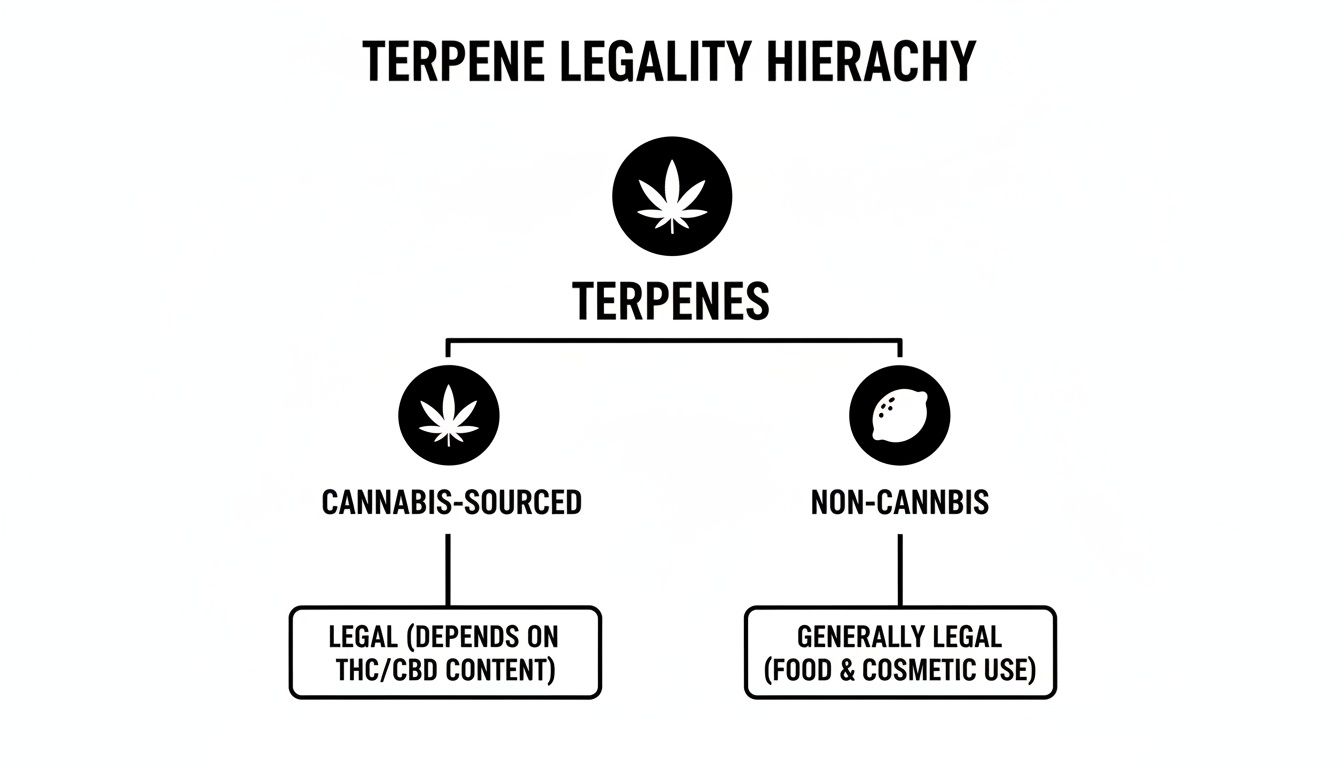
As illustrated, botanically sourced and compliant hemp-derived terpenes occupy a federally legal category, distinct from marijuana-derived compounds. This distinction is crucial for any brand aiming to operate on a national scale without federal legal impediments.
To clarify, the following table breaks down the legal status of terpenes by their origin, providing a quick reference for formulators to assess compliance requirements for different product applications.
Terpene Legality At a Glance by Source
| Terpene Source | Federal Status (USA) | Common Formulation Applications | Key Regulatory Body |
|---|---|---|---|
| Botanical (Non-Cannabis) | Legal (GRAS) | Vape liquids, edibles, beverages, cosmetics, topicals | FDA |
| Hemp-Derived | Legal (if <0.3% THC) | CBD/cannabinoid products, vape cartridges, edibles, tinctures | USDA / DEA / FDA |
| Cannabis-Derived (Marijuana) | Federally Illegal | State-licensed cannabis products (dispensary-only) | State Cannabis Agencies / DEA |
This breakdown clarifies why professional formulators overwhelmingly rely on botanical and compliant hemp-derived terpenes: they provide a clear and scalable legal pathway to the national market.
Sourcing Compliant Terpenes for Your Products
This legal distinction provides a significant strategic advantage for formulators. By utilizing botanically derived terpenes or compliant hemp terpenes, product developers can accurately replicate the complex aromatic and flavor profiles of iconic cannabis strains without the associated legal risks and jurisdictional limitations. This is the core methodology behind creating authentic-tasting vape cartridges, edibles, and beverages that are legal for interstate commerce.
This formulation strategy has fueled a massive global market. The demand for THC-free terpenes from botanical and hemp sources is expanding rapidly, with market projections reaching USD 1,151.5 million in 2025. You can [explore the global terpenes market research](https://www.marketsandmarkets.com/Market-Reports/terpenes-market-1 terpenes-market-1-1055.html) for a full analysis. This growth is a direct consequence of the 2018 Farm Bill, which legalized hemp-derived compounds under the critical 0.3% Delta-9 THC threshold, enabling a national market.
Ultimately, supplier selection is a critical business decision. Always partner with a supplier that guarantees transparency and provides a batch-specific Certificate of Analysis (COA) with every order. This document is your proof of compliance, verifying that your terpenes are free from THC, pesticides, and heavy metals. It is the key to protecting your business and focusing on product innovation.
Understanding Federal Law and Terpene Sourcing

For brands operating in the cannabinoid space, navigating federal law is fundamental to market access. The question "are terpenes legal" is answered by understanding their origin through the lens of two key regulations: the 2018 Farm Bill and the FDA's GRAS list. Mastering these frameworks is the first step toward developing products for a national consumer base.
First, for terpenes derived from the cannabis plant, the 2018 Farm Bill established a definitive legal line based on one metric: 0.3% Delta-9 THC. The bill legalized industrial hemp and its derivatives, including terpenes, provided the source plant material remains at or below this THC concentration.
This is the 'source rule': if your terpenes originate from a federally compliant hemp plant, they are federally legal. This principle is the legal foundation that permits brands to formulate and ship hemp-derived products across state lines.
The Source Rule: Hemp vs. Marijuana
A common point of confusion is the distinction between hemp and marijuana. The difference is purely legal, not botanical. Both are the same species, Cannabis sativa L., but they are regulated differently based on their THC content.
- Hemp: Cannabis sativa L. testing at or below 0.3% Delta-9 THC on a dry weight basis. Terpenes from this source are federally legal.
- Marijuana: Cannabis sativa L. testing above the 0.3% Delta-9 THC limit. This plant and its derivatives are Schedule I controlled substances, making its terpenes federally illegal for interstate commerce.
This legal distinction is absolute. Even if the terpenes themselves are 100% THC-free, they are deemed federally illegal if extracted from a non-compliant "marijuana" plant. Their legal status is inextricably tied to their source. This makes marijuana-derived terpenes unsuitable for any brand aiming for national distribution outside of state-siloed cannabis programs.
A Note for Product Creators: A product's ability to be shipped across state lines is defined by its ingredients. To ensure finished goods are not classified as federally controlled substances, terpenes must be sourced from either compliant hemp or non-cannabis botanical sources.
The Parallel Path of Botanical Terpenes
While cannabis-derived compounds receive significant attention, a simpler legal pathway exists for terpenes. The limonene in a lemon, myrcene in mango, and linalool in lavender are examples of botanical terpenes. The FDA has long classified these naturally occurring isolates and blends as Generally Recognized as Safe (GRAS) for use in food, beverages, and other consumer goods.
This GRAS designation means these terpenes are fully legal ingredients, entirely outside the scope of cannabis regulations. They can be bought, sold, and shipped nationwide without concerns about THC thresholds or the Farm Bill. For formulators, this provides a clean, consistent, and legally secure supply chain for achieving specific flavor and aroma targets. For instance, a skilled formulator can leverage GRAS-designated botanical terpenes when replicating the flavor of a specific cannabis strain, creating a federally legal product for a national market. Understanding how cultivation choices impact terpene expression is also part of a comprehensive formulation strategy; you can learn more about the differences between male and female plants in our guide.
By leveraging both compliant hemp terpenes and GRAS botanicals, formulators gain the flexibility to create sophisticated products while operating within federal law. This dual-sourcing approach is the backbone of any legally sound and scalable brand.
Navigating the State-By-State Compliance Maze
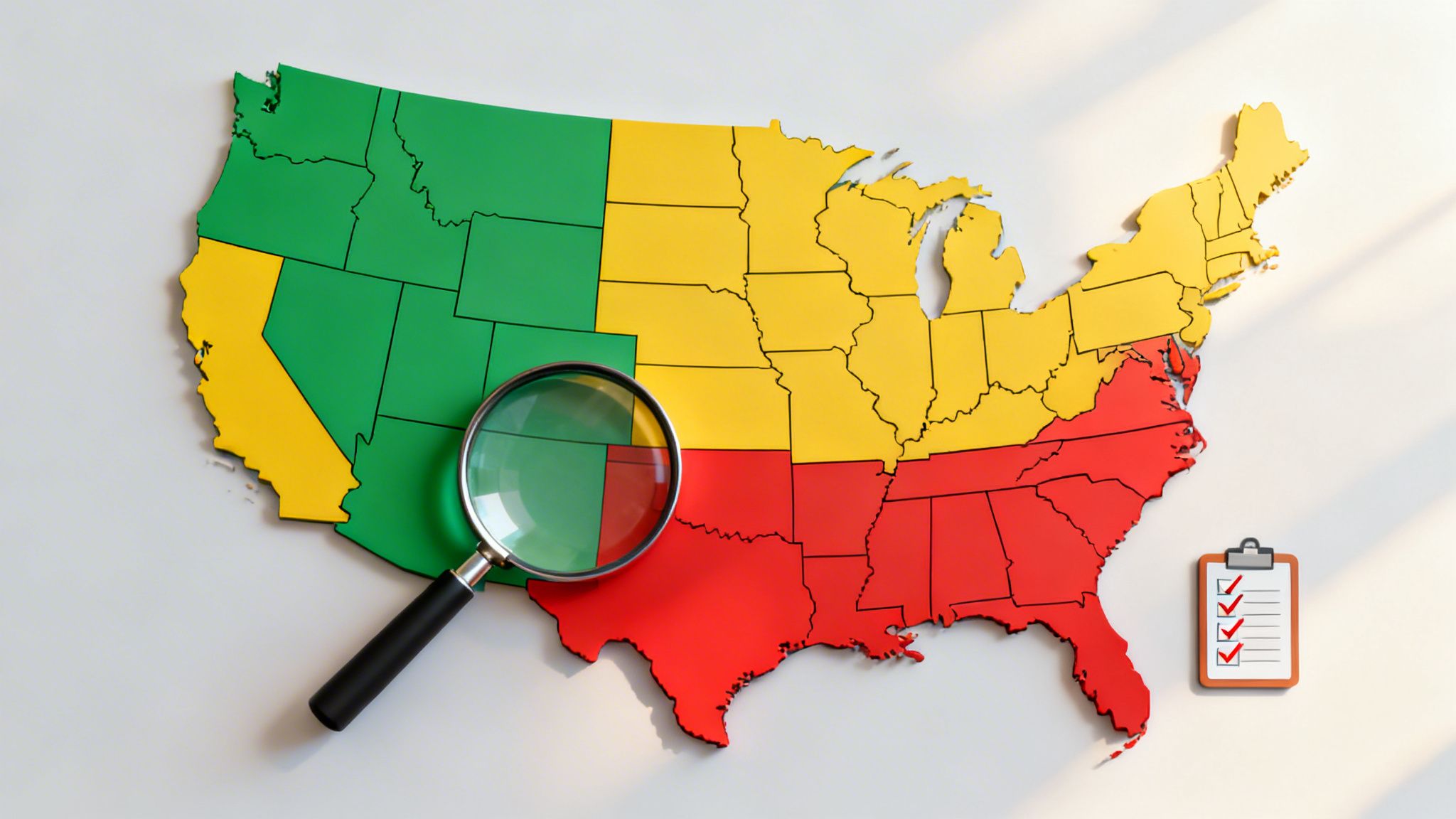
Assuming federal compliance under the 2018 Farm Bill is sufficient is a critical error for product developers. While federal law provides a baseline, a business's viability is determined by its adherence to individual state regulations.
Think of federal law as a national highway pass—it permits travel, but each state enforces its own set of rules. Ignoring these local regulations can lead to product seizure, fines, or market exclusion. For any brand selling across state lines, mastering this legal patchwork is essential.
The Three Tiers of State Regulation
State laws governing hemp and terpenes generally fall into one of three categories. Identifying a state's regulatory approach is the first step in any market entry analysis.
States Mirroring Federal Law: These are the most direct. States like Pennsylvania have adopted the 2018 Farm Bill's language, making products compliant as long as they remain under the 0.3% Delta-9 THC threshold.
States with Stricter THC Limits: A growing number of states enforce "total THC" regulations. These laws calculate total THC by adding Delta-9 THC and the potential THC from THCa (decarboxylated THCa converts to THC). This calculation can render a federally compliant product illegal at the state level.
States with Product-Specific Bans: Some states ban entire product categories regardless of THC content. These prohibitions often target inhalable products like vapes or specific edible formats, creating "no-go zones" for certain product lines.
Determining a state's category is crucial diligence. It directly impacts which strain-inspired terpene blends are viable and what product formats can be developed for that market.
Due Diligence Before Market Entry
Before shipping any product to a new state, a robust process for verifying local laws is mandatory. This is an ongoing task, as state regulations are subject to frequent change.
A pre-launch checklist must confirm compliance on multiple fronts, verifying the legality of:
- Specific cannabinoids used in the formulation (e.g., CBD, CBG, Delta-8 THC).
- The final product format (e.g., vape cartridges, gummies, tinctures).
- Permissible marketing claims and labeling language.
A look at the global market reveals immense potential. In Brazil, where botanical terpenes are legal, the number of medical cannabis patients increased by 56% to over 672,000 in 2024. This trend, combined with opportunities in Asia and legal shifts in Europe, signals a strong international demand for THC-free, lab-tested formulations. You can read more about the growth of terpene quality in Brazil to understand these global shifts.
This growing international acceptance underscores the market for products formulated with compliant terpenes. By developing blends that navigate the U.S. state-level maze, you are also positioning your brand for future global success. Staying current on both local and international regulations is key to building a durable brand.
How Formulation Creates New Compliance Hurdles
This is a common pitfall for many brands. Sourcing a legal ingredient is one step; ensuring the final product is compliant is another challenge entirely. A bottle of pure, botanically sourced limonene is a simple aromatic compound. The moment it is formulated with cannabinoids, it enters a new and more complex regulatory landscape.
The finished product, not just the raw ingredients, is what regulators scrutinize. When you add terpenes to a vape cart containing CBD or Delta-8 THC, the legal question evolves from "are terpenes legal?" to "is this finished vape cart legal?" The answer is far more nuanced.
The Impact of Blending on Final Potency
A primary formulation consideration is the effect of blending on cannabinoid potency. Adding terpenes to a cannabinoid distillate does more than impart flavor and aroma; it dilutes the mixture. This dilution directly alters the final THC concentration—the primary metric for state compliance.
For example, a raw distillate may test at a compliant 0.28% Delta-9 THC. However, after adding a 10% terpene blend to create a vape oil, the total volume increases while the absolute amount of THC remains constant. This change in concentration can push the final product over the legal limit, necessitating re-testing and potential reformulation.
Your formulation process is a critical control point for compliance. The ratio of cannabinoids to terpenes is not just a flavor decision—it is a legal one. Every batch must be calculated and tested post-formulation to ensure it meets both federal and state-specific THC limits.
How Formulation Choices Define Regulatory Pathways
The ingredients chosen dictate the applicable regulatory framework. A minor adjustment in a blend can shift a product from one legal category to another, each with its own set of rules for testing, labeling, and distribution.
- Product with Only Botanical Terpenes: A room spray or candle formulated only with botanical terpenes generally falls under standard consumer product safety regulations.
- Product with Terpenes and CBD: A CBD tincture formulated with terpenes must navigate the 2018 Farm Bill and the patchwork of state-level hemp regulations.
- Product with Terpenes and Delta-9 THC: A vape cart formulated for a state-legal cannabis market is subject to that state's stringent marijuana program.
This underscores the need for a comprehensive compliance strategy, from sourcing documented, THC-free terpenes to precise formulation and rigorous third-party testing of the final product. A failure at any point in this chain exposes the entire brand to risk. Even understanding how a profile creates an effect—like knowing if a Sour Diesel strain is an indica or sativa based on its terpenes—is part of this holistic approach. Every laboratory decision has real-world legal consequences.
A Practical Compliance Checklist for Formulators
Theory is useful, but operating a terpene-based business requires a repeatable, tactical plan for maintaining compliance. This is about building a brand that both customers and regulators can trust. These are the non-negotiable operational steps.
Start with Your Supplier: Your First Line of Defense
Supplier vetting is the cornerstone of a compliant supply chain. This is not about finding the lowest price but about securing a transparent partner who provides essential documentation without hesitation.
If a potential supplier is evasive about sourcing or cannot produce required paperwork, it is a major red flag. This relationship is your most critical compliance checkpoint. This checklist helps formalize the vetting process. A trustworthy partner will provide clear answers to each point.
Supplier Vetting Checklist for Legal Terpene Sourcing
| Verification Step | Why It's Critical for Compliance | What to Look For |
|---|---|---|
| Request Batch-Specific COAs | This document is your proof of legality, verifying the product is free from THC and other contaminants. | An up-to-date Certificate of Analysis (COA) from an ISO 17025-accredited lab for the specific batch you are purchasing. |
| Verify Source Material | You must know if terpenes are botanically derived, hemp-derived, or synthetic, as this impacts state-by-state legality. | Clear documentation on product data sheets and consistency with the COA (e.g., no cannabinoids present for botanical terpenes). |
| Confirm "THC-Free" Status | This is the key to federal legality. The product must be verifiably below the 0.3% THC threshold. | "Not Detected" (ND) or a value of 0.00% for all THC variants (Delta-9, Delta-8, THCa) on the COA. |
| Check for Contaminant Testing | This protects end-users and your brand from liability. Clean ingredients are a baseline requirement. | A full-panel COA showing the product is free from pesticides, heavy metals, residual solvents, and microbial contaminants. |
| Ask About Shipping Practices | This ensures your inbound shipments are not seized. An experienced supplier understands carrier regulations. | Inquire if they include a "Notice to Law Enforcement" and COA copies with shipments to prevent logistical issues. |
Thorough supplier vetting is the foundation of a legally sound and scalable business. A reliable partner makes compliance manageable.
Get Obsessed with Certificates of Analysis (COAs)
The Certificate of Analysis (COA) is the single most important document in your operational workflow. You must obtain one for every batch of terpenes purchased, and it must come from an accredited, third-party laboratory.
When reviewing a COA, verify:
- The Right Profile: Does the COA confirm the identity and relative abundance of the key terpenes in the blend you purchased?
- Zero THC: The COA must clearly state that all THC variants are “Not Detected” (ND) or well below the 0.3% legal limit.
- Cleanliness: A full-panel COA provides proof that the terpenes are free from contaminants such as pesticides, heavy metals, and residual solvents.
Maintain an organized file of every COA. This documentation is your primary evidence of due diligence in the event of a regulatory inquiry.
Keep Your Marketing and Labels Squeaky Clean
Your product's marketing language is as scrutinized as its chemical composition. The FDA and FTC are actively enforcing against brands making unsubstantiated health claims. All website copy, product labels, and marketing materials must be carefully worded.
Key Takeaway: You can describe a product's sensory experience, but you cannot claim it treats or cures a medical condition. "A bright, citrusy aroma" is compliant. "Cures anxiety" is a prohibited disease claim that will trigger regulatory action.
Focus on flavor, aroma, and experiential descriptors. Terms like "uplifting," "relaxing," or "focus-enhancing" are generally acceptable as they describe a subjective feeling. The line is crossed when a product is linked to a specific disease. For instance, while our guide to the d-limonene terpene profile discusses its properties, you cannot market a d-limonene product as a treatment.
Don't Forget About Shipping and Distribution
Distributing finished goods introduces another layer of compliance. Although compliant, botanically derived terpenes are federally legal to ship, carriers like USPS, UPS, and FedEx maintain their own rules and restrictions for hemp-related products.
This is another area where an experienced supplier provides value, as they are already accustomed to navigating these carrier-specific policies.
Ensure every outbound shipment includes proper documentation: a copy of the final product's COA and a "Notice to Law Enforcement" clearly stating the contents are legal, THC-free products. This simple step can prevent costly seizures and delays.
Knowing When to Call a Lawyer
This guide provides industry-specific expertise, but it is not a substitute for legal advice. A critical skill for any formulator or brand owner is recognizing when to engage a qualified attorney.
Investing in a legal review is not an expense; it is an investment in risk management. A proactive legal consultation can prevent devastating fines, inventory seizure, or forced business closure. Navigating the complex regulatory landscape alone is a significant gamble, particularly when entering new states or launching novel products.
Red Flags That Mean You Need Legal Counsel
You do not need an attorney to review every terpene purchase. However, certain high-stakes situations require professional legal guidance. Missteps in these moments can create long-term liabilities for your brand.
Learning to identify these triggers is essential for any serious operator in this industry.
- Entering a New State: Before shipping to a new state—especially one with "total THC" laws or other strict regulations—engage an attorney. They can provide a formal legal opinion on your product's compliance status in that jurisdiction.
- Creating a Novel Product: If you are formulating with novel or lesser-known cannabinoids, a lawyer can assess the specific risks and help structure your business to mitigate them.
- Receiving a Regulatory Inquiry: If you receive a letter from the FDA, a state agency, or any other regulatory body, your first and only action should be to contact your attorney. Do not respond directly. Your counsel will manage all communications and protect your rights.
A proactive legal strategy is the best defense. Engaging a lawyer before a problem arises allows you to build your business on a compliant foundation, preventing costly legal battles later and securing your brand's future.
How to Find the Right Attorney
When seeking legal counsel, do not hire a general business lawyer. You need a specialist with deep expertise in cannabis and hemp law.
This is a highly specialized field. A generalist will lack a nuanced understanding of the 2018 Farm Bill, state-by-state THC testing protocols, and FDA marketing guidelines. A specialist already comprehends the challenges of adding terpenes for distillate or other cannabinoid formulations.
Engaging the right legal expert at the right time empowers you to innovate with confidence. It is the step that transitions your business from hoping it is compliant to knowing it is.
Answering Your Top Questions About Terpene Law
Even with a solid grasp of the rules, the daily practice of product development raises specific legal questions. Here are clear answers to common hurdles faced by formulators, extractors, and brand owners.
Can I Ship Terpenes Derived from Marijuana?
No. If terpenes are extracted from a marijuana plant (any cannabis containing over 0.3% Delta-9 THC), they are federally illegal to ship across state lines. The federal government classifies these terpenes as a Schedule I controlled substance, identical to the plant from which they were derived.
This is precisely why formulators building national brands rely exclusively on botanically derived terpenes (BDTs) and compliant hemp-derived terpenes (HDTs). Using these sources ensures the supply chain is clean and the final products are legal for interstate commerce.
What Happens When I Mix Legal Botanical Terpenes with THC Distillate?
This is a critical formulation question. The botanical terpenes themselves are legal, unregulated ingredients. However, the moment they are combined with THC distillate, the regulatory status of the mixture changes entirely.
The law no longer views the ingredients individually; it regulates the final product. A vape cart or edible containing THC is now considered a THC product and falls under the jurisdiction of the state cannabis program where it is intended to be sold. All state-specific rules for testing, packaging, labeling, and licensed distribution apply to this finished good.
What Paperwork Should I Get When I Buy Terpenes?
Never purchase terpenes without obtaining a batch-specific Certificate of Analysis (COA) from your supplier. This document is your primary defense in any compliance audit. It serves as official proof that the terpenes are free from contaminants like pesticides or heavy metals and, most importantly, contain no detectable THC.
A COA is not optional; it is mandatory for due diligence. Any reputable supplier working with professional formulators will provide a current COA for every batch. Your responsibility is to collect, file, and have this documentation ready for inspection at all times.
Are Synthetic Terpenes Legal? Should I Use Them?
From a legal standpoint, synthetic terpenes are generally permissible and regulated similarly to botanical isolates. While they are a valid option, the market demonstrates a strong preference for natural authenticity.
In cannabis product formulation, achieving a true-to-strain profile with synthetic isolates is challenging. Botanically derived and hemp-derived terpene blends offer a much richer, more complex aromatic experience that accurately reflects a strain's character. This depth is essential for creating premium products, which is why top-tier formulators use natural blends when replicating the flavor of popular cultivars.
At Gold Coast Terpenes, we provide the lab-tested, THC-free, and botanically-derived terpenes you need to create compliant, high-quality products with confidence. Explore our full catalog of strain profiles and isolates to find the perfect blend for your next formulation.
Shop our complete collection of terpene profiles and isolates at Gold Coast Terpenes.