
When formulating with specific terpenes known to influence appetite, you’re doing more than just creating a new flavor. You’re crafting a product with a clear, functional purpose. By precisely blending compounds like Humulene and Beta-Caryophyllene into vape cartridges or concentrates, brands can tap into a growing market of consumers looking for wellness-oriented cannabis products.
The Business Case for Functional Terpene Blends
In a crowded market, product differentiation is critical. For years, the conversation has been dominated by flavor and sheer potency. But forward-thinking brands are now capitalizing on functional benefits—and that’s where terpenes provide a distinct advantage. They give formulators a powerful toolset to design products with specific, marketable attributes.
This isn’t a small niche. The market is maturing, and customers are moving past generic effect categories. They are actively seeking products that align with specific lifestyle goals, whether for focus, relaxation, or in this case, appetite modulation. When you formulate with terpenes that target appetite, you’re speaking directly to that customer with a technically sophisticated product.
This strategy elevates a standard vape cartridge from a simple commodity into a purpose-driven tool. It gives your brand a compelling technical story to tell—one about a specific, tangible benefit that resonates with a health-conscious audience.
Tapping into a Growing Market
The demand for products with functional ingredients is expanding, supported by significant market growth. The global terpenes market was valued at USD 1,197.5 million in 2024 and is expected to climb to USD 2,439.14 million by 2032. This growth is driven by formulators who are moving beyond basic flavors to create unique functional profiles. For instance, early animal studies indicating that Humulene could reduce feeding behavior demonstrate the long-standing industry interest in these specific applications.
This data paints a very clear picture for product developers. Formulating with appetite-modulating terpenes is an opportunity to innovate and capture market share. Here’s how:
- Meet Market Demand: Align your products with the consumer search for natural, wellness-focused options.
- Create a Clear Differentiator: Set your products apart from competitors still focused on THC percentages and generic fruit flavors.
- Build Brand Authority: Position your brand as a leader in science-backed product development and formulation.
The Formulator's Advantage
For product developers, this is more than a marketing angle; it's a technical discipline. Knowing how to select and blend the right terpenes for a desired effect is what separates professional formulators from amateurs. It’s about more than just replicating a popular strain’s profile. It’s about architecting a new one from the ground up with high-purity isolates to achieve a precise, consistent, and repeatable result. Of course, the first step is knowing where to buy terpenes that are reliable and pure.
This guide provides the technical knowledge to do exactly that. We’ll treat appetite modulation not as a vague concept, but as a tangible, achievable goal for your next product line. We will detail the key terpenes, offer practical formulation guidelines, and provide the information needed to create standout products for vape cartridges and other cannabis product formulations.
Profiling Key Terpenes for Appetite Formulation
To create a functional product that performs consistently, you must know your raw materials intimately. It’s not enough to understand the theory behind appetite-modulating terpenes; you need a deep understanding of the specific compounds that will become the foundation of your blend. This means understanding their aromatic roles, their functional properties, and how they interact in a final formulation.
The path from a consumer wellness trend to a viable product opportunity is clear.
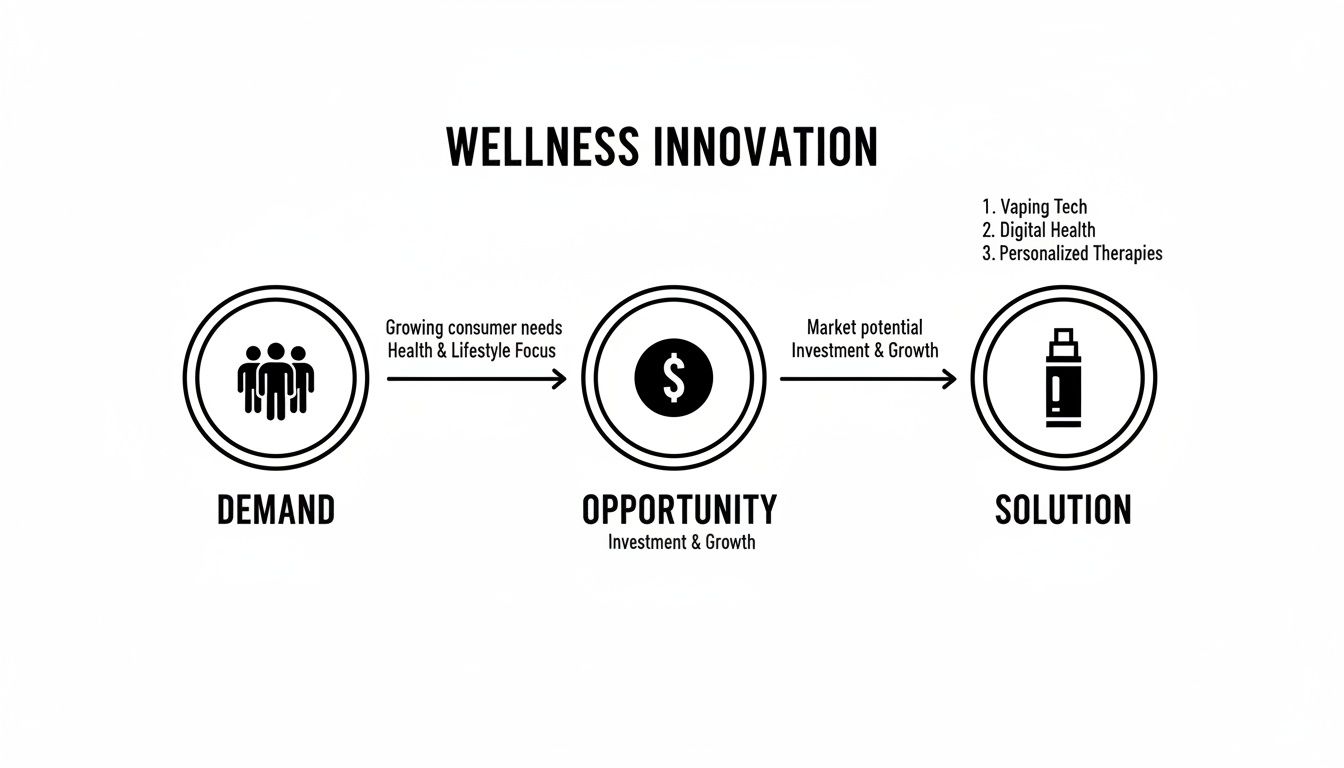
This graphic illustrates a direct line from market demand to a buildable solution, placing functional vape products at the center of innovation. For formulators looking to capitalize on this, the primary isolates are Humulene, Limonene, and Beta-Caryophyllene. Each brings a unique set of properties to a formulation.
Humulene: The Earthy Foundation
Consider Humulene, also known as alpha-caryophyllene, as the cornerstone for any appetite-focused blend. It has a rich, earthy, and woody aroma with spicy, hoppy notes recognizable from craft brewing.
As a mid-to-base note, Humulene gives your flavor profile a solid, lasting foundation. It anchors brighter top notes, preventing them from dissipating too quickly and keeping the overall blend from feeling thin or sharp. For years, research has suggested Humulene might interact with cannabinoid receptors in ways that affect satiety signals, making it a logical starting point for this type of functional formula.
In a formulation, Humulene pairs well with spicy or citrus notes. Its stability and full-bodied aroma make it an excellent choice for vape cartridges and concentrates where a complex, satisfying flavor is desired. You can get a better sense of the science by exploring the role of terpenes in appetite regulation in more detail.
Limonene: The Bright Modulator
If Humulene is the base, Limonene is the bright, zesty lift. It delivers that unmistakable fresh citrus scent, acting as a powerful top note that creates the first impression and captures immediate attention.
In an appetite-focused blend, Limonene’s role is twofold. First, it cuts through the heavier, earthier notes from terpenes like Humulene, making the final product more refreshing and palatable. Second, its invigorating aroma can provide a feeling of uplift—a valuable secondary attribute for products aimed at active, health-conscious customers.
Its commercial importance is undeniable. The orange terpenes market is projected to hit USD 757.05 million in 2025, a testament to Limonene's value as an ingredient. Research dating back to the 1970s in Japan first hinted at its ability to influence appetite, and modern studies are now examining its interaction with serotonin and metabolic pathways. This makes a THC-free limonene isolate a crucial tool for U.S. hemp extractors developing functional concentrates. You can dive deeper into the market dynamics of orange terpenes to learn more.
Beta-Caryophyllene: The Spicy Synergist
Beta-Caryophyllene (BCP) is the perfect bridge between Humulene's earthy base and Limonene's citrusy top. It has a distinctly spicy, peppery, and woody aroma that serves as a classic middle note, adding warmth and complexity to the blend.
What makes BCP so valuable for formulators is its unique ability to bind directly to CB2 receptors in the endocannabinoid system—a property most other terpenes lack. This gives it a special functional role that beautifully complements the other terpenes in the formulation. Preclinical studies have explored its potential to suppress ghrelin (a key hunger hormone) by up to 40%, which is a compelling reason for its inclusion.
When constructing a blend, BCP helps amplify the spicy notes from Humulene while grounding the sweetness of Limonene, creating a sophisticated profile that is anything but one-dimensional.
A Formulator's Quick Guide to Functional Terpenes
To streamline the blending process, it helps to see how these key terpenes compare side-by-side. Use this table as a quick-reference guide for building effective, well-balanced functional formulas.
| Terpene | Aroma Profile (Note) | Proposed Mechanism (Non-Medical) | Best For in Formulation |
|---|---|---|---|
| Humulene | Earthy, hoppy, woody (Base) | Satiety signaling through receptor interaction | Creating a robust, lasting foundation for the blend. |
| Limonene | Bright, zesty citrus (Top) | Mood elevation; serotonin pathway interaction | Adding a fresh, uplifting initial scent and balancing heavier notes. |
| Beta-Caryophyllene | Spicy, peppery, woody (Middle) | Direct CB2 receptor binding; ghrelin suppression | Adding warmth, complexity, and a synergistic functional boost. |
Using this as a starting point, you can begin to architect a blend that is not only effective in its purpose but also delivers a premium aromatic experience from start to finish.
Other Promising Terpenes
While that main trio provides a solid foundation, other terpenes can add final layers of nuance and complexity to your blend. Here are a few to consider for your formulation:
- Pinene: Brings a sharp, fresh pine aroma. As a top note, it adds a clean, invigorating feel to a blend and can contribute to a sense of alertness.
- Myrcene: Known for its earthy, herbal, and slightly fruity notes, Myrcene is a classic base note. While often linked to relaxation, its role in appetite is still being researched, but it’s excellent for rounding out a profile with familiar "cannabis-like" aromas.
By understanding how these individual isolates work, both aromatically and functionally, you can move past simply copying strain profiles. You gain the power to build a truly custom, effective, and marketable product from the ground up.
Formulation Guide for Vape Cartridges
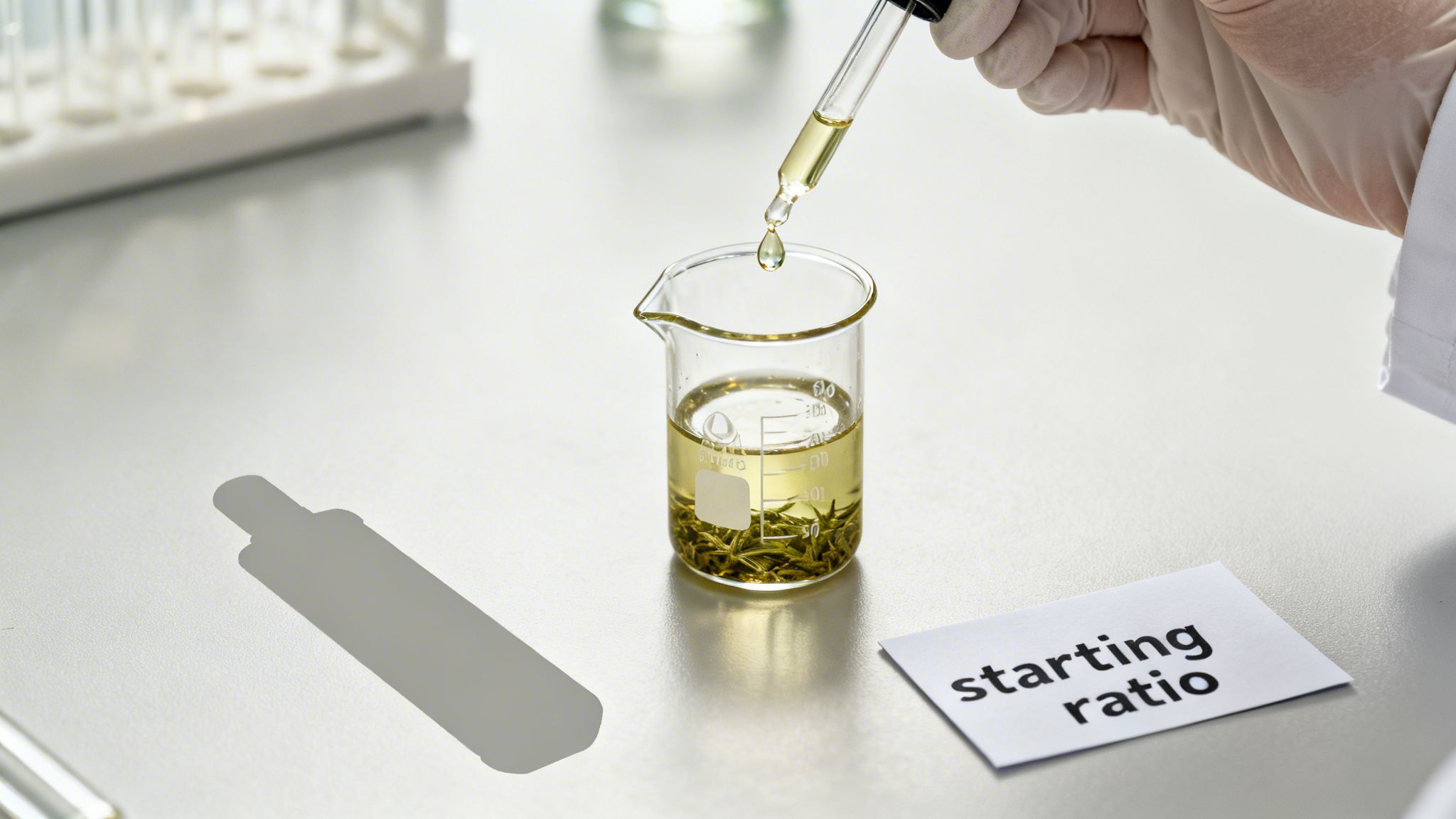
Let's transition from theory to practice. Moving from scientific principles to the lab bench is where the art of formulation truly begins. Creating an effective appetite-modulating vape blend isn't just about mixing a few terpenes; it's about constructing a flavor and aroma profile that works in harmony to achieve a specific functional goal.
To do this correctly, you must think like a perfumer. Every great blend is built on a structure of top, middle, and base notes. These are not merely descriptive terms—they dictate the entire aromatic experience from the first draw to the last.
- Top Notes (e.g., Limonene, Pinene): The first aromatics detected. They are bright, sharp, and volatile, providing the initial impression before fading. They are the "hook" of the profile.
- Middle Notes (e.g., Beta-Caryophyllene): The heart of the blend, emerging as top notes dissipate. They provide body and character, bridging the top and base notes.
- Base Notes (e.g., Humulene, Myrcene): The least volatile compounds. They are the last to be detected and provide depth, richness, and a lasting finish that grounds the entire profile.
Building Your Functional Blend Step by Step
Good formulation is an iterative process of building, testing, and refining. A structured approach is essential for efficiency and minimizing material waste.
First, establish your functional core. For a blend focused on appetite modulation, Humulene and Beta-Caryophyllene are your primary workhorses. These should form the bulk of your blend, creating the mid-to-base foundation that delivers the intended effect.
Next, add components to lift these heavier, earthier notes. Limonene is an excellent choice. Its bright, zesty citrus scent cuts through the spice of Beta-Caryophyllene and the earthiness of Humulene, making the entire profile more refreshing and palatable.
Think of it like building a pyramid. Your base notes (Humulene) create a wide, stable foundation. Your middle notes (Beta-Caryophyllene) add substance and structure. Your top notes (Limonene) form the peak, providing the initial point of interest.
This type of precise, functional product development is what's fueling the terpenes sector's projected growth to USD 1,824.2 million by 2032. In major markets like the U.S. and EU, where surveys indicate 60% of vape users are actively seeking products with targeted benefits, this approach is commercially sound. Investing R&D in functional formulations isn't just a good idea—it's a smart business strategy.
Recommended Starting Ratios and Dilution for Distillate
When adding terpenes to cannabis distillate, the industry standard is to stay between 4% and 10% by weight. For any new blend, especially a functional one, it is always best to start on the lower end. You can always add more, but you cannot remove them.
A solid starting point is a 5-7% total terpene concentration. Here’s a sample starting ratio for a small test batch to dial in that appetite-modulating profile:
- Humulene: 40% (Base Note)
- Beta-Caryophyllene: 30% (Mid Note)
- Limonene: 20% (Top Note)
- Pinene: 10% (Top Note/Accent)
This ratio yields a blend that is fundamentally earthy and spicy but has a pleasant, bright finish from the citrus and pine. Once you have mixed these isolates, add the entire blend to your distillate at a 5% concentration. Mix thoroughly, then let it homogenize for at least 24 hours. This allows the molecules to fully meld and the flavors to stabilize.
For a deeper dive into the technical details of measurements and mixing techniques, be sure to check out our detailed guide on how to properly use and mix terpenes for product formulation. It’s packed with practical steps to help you achieve consistent, repeatable results.
Replicating Strain-Inspired Terpene Blends for Functional Effects
Building a custom blend from scratch provides total creative freedom. However, sometimes the most efficient strategy is not to reinvent the wheel, but to perfect it. This is where replicating the terpene signature of an existing strain becomes a powerful formulation technique. This isn't just about mimicking a flavor; it’s about reverse-engineering a specific functional profile that already has market validation.
For formulators targeting appetite modulation, this strategy is a shortcut to a targeted, effective product.
Consider strains like GSC or OG Kush. They are already known for high levels of humulene and are associated with effects that counteract appetite. Instead of starting from scratch, you can use these well-known strains as a blueprint. This provides your product with an established narrative that knowledgeable customers will immediately recognize.
Using COAs as Your Formulation Blueprint
How is this done in practice? The key is in the strain’s Certificate of Analysis (COA). A detailed COA from a reputable lab is more than a safety document; it’s your recipe. It provides a quantitative breakdown of the flower’s terpene profile, listing each terpene and its exact percentage.
Think of the COA as a technical schematic. It shows you the precise ratios needed to reconstruct a strain’s aromatic signature and, more importantly, its functional attributes. It removes the guesswork from the formulation process.
For example, a COA for a humulene-rich OG Kush might show 0.4% Humulene, 0.3% Beta-Caryophyllene, and 0.2% Limonene. These are your starting ratios. Your task is to build a blend that mirrors this 4:3:2 ratio, creating a consistent, strain-inspired terpene profile for vape cartridges or other distillates.
Why Purity Is Everything in Replication
This entire approach is contingent on working with high-purity, food-grade terpene isolates. Attempting to build a precise profile using low-quality or contaminated raw materials will lead to failure. The flavor will be inconsistent, the effects unreliable, and the final product subpar.
When you use pure isolates from a supplier like Gold Coast Terpenes, you know that when you add 4 parts Humulene, you’re getting just humulene—not a mixture of unknown compounds. This level of precision is what makes it possible to accurately rebuild a strain's profile and its functional benefits.
Here’s what that means for your R&D process:
- Consistency: Pure isolates ensure repeatable results. Every batch of your product will have the same sensory profile and performance, which is crucial for building brand trust.
- Control: Once you’ve replicated the base profile, you can begin to innovate. Want to enhance the appetite-modulating effects? Try increasing the humulene ratio slightly.
- Scalability: When your formula is built from precise, pure components, scaling from a small R&D batch to full production is simple and straightforward.
By treating COAs as your recipe and insisting on pure isolates, you can develop targeted products built on a foundation of what’s already proven to work. It’s a sophisticated and efficient way to innovate, giving you a powerful product with a story the market is ready to hear.
Ensuring Quality Control for Functional Blends
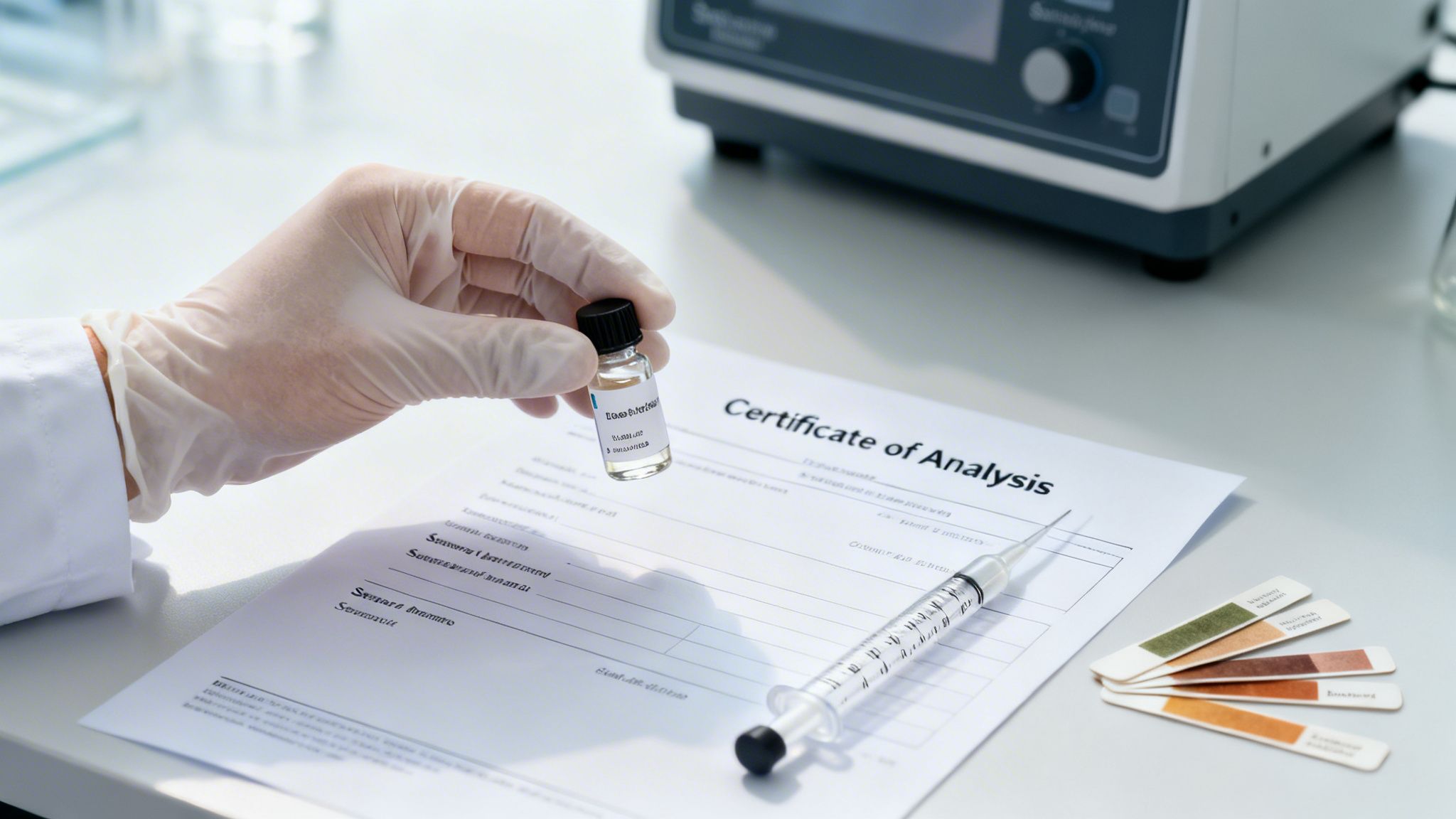
Developing a concept for an appetite-modulating terpene blend is one challenge; producing it consistently is another. Once your formula is locked, your focus must shift to airtight quality control. This goes beyond regulatory compliance—it's about ensuring the product you designed is the exact one your customer receives, every time. A single inconsistent batch can damage brand reputation.
Your QA process begins with raw material sourcing. It is absolutely essential to work with lab-verified, pure terpene isolates free of contaminants. The presence of cutting agents like VG, PG, or MCT oil can compromise formula integrity, alter the flavor, and introduce potential safety issues.
The foundation of a premium product is built on premium ingredients. If your terpenes aren't pure, your final product will never be consistent. This is the first and most critical checkpoint in your quality assurance workflow.
When you source from suppliers who provide detailed documentation for every isolate, you establish a standard of quality that protects your entire production process. You can learn more about the technical side of this in our article on why purity matters when understanding terpene quality standards.
In-House Best Practices for QA
Strong quality control extends beyond supplier vetting. You need robust in-house testing protocols to dial in the final product and maintain consistency across production runs. Your internal QA should be a multi-step verification process.
Here are several practices that should be standard in every workflow:
- Small-Batch Testing: Before committing to a large production run, always mix a small test batch. This allows you to confirm ratios and evaluate the final product's characteristics without significant material waste if adjustments are needed.
- Sensory Panel Analysis: A gas chromatograph provides quantitative data, but it cannot assess how a blend actually tastes or smells. Assemble a small, trusted panel to provide feedback on aroma and flavor. Their qualitative input is invaluable for balancing functional terpenes with the overall sensory experience.
- Stability Testing: Your product must withstand real-world conditions. Test finished goods by exposing them to various temperatures and light levels to confirm the terpene profile remains stable and the flavor does not degrade over its intended shelf life.
The Necessity of Final Product Verification
The final step is non-negotiable: sending your finished product to a third-party lab for analysis. This provides ultimate proof that the contents of the package match your intended formulation.
This final test should confirm two main things. First, it verifies that your terpene profile is accurate, ensuring the ratios of key terpenes like Humulene and Beta-Caryophyllene are correct. Second, it screens for residual solvents or other contaminants that may have been introduced during production, confirming final product purity.
This safety-first approach does more than just protect consumers; it demonstrates your brand's commitment to quality. It shows you own your process from raw materials to final sale, which is the kind of authority that builds a loyal customer base.
Common Questions from Cannabis Product Formulators
When creating a new functional blend, practical, hands-on questions inevitably arise. As formulators and brand owners, you require straightforward answers to move your product from the concept stage to the retail shelf.
Let’s address the most common questions we receive regarding the formulation of appetite-modulating terpene blends for cannabis product formulation. We'll provide clear, actionable advice to refine your R&D, maintain compliance, and launch a product that performs as intended and delivers a superior sensory experience.
What’s the Best Starting Percentage for This Blend in Distillate?
For most terpene blends in distillate, a good starting range is between 4% and 7% by weight. However, when working with a functional blend containing powerful aromatics like Limonene and Pinene, our advice is to always start at the low end of that range. Aim for 4-5%.
This provides enough concentration to evaluate the flavor and effect without overpowering the base extract. A best practice for R&D is to create several small test batches at 4%, 5.5%, and 7%. This allows you to evaluate how the blend interacts with your specific hardware and identify the optimal concentration for your target audience. Always use a precision scale, and for added accuracy, our terpene mixing calculator can help you nail the ratios every time.
Can I Market My Vape as an "Appetite Suppressant"?
Absolutely not. You must be extremely careful to avoid any direct medical or health claims. The FDA strictly regulates products marketed with therapeutic benefits, and using phrases like "appetite suppressant" or "weight loss aid" on your packaging is a direct path to serious legal and regulatory issues.
The intelligent approach is to pivot your marketing language. Focus on what you can discuss. You can highlight the primary terpenes in your formula (e.g., "A Humulene-Forward Blend") or use clever, suggestive product names that imply the experience without making a direct claim (e.g., names like "Discipline" or "Focus"). Let your marketing story revolve around the unique flavor profile and the specific terpenes inside, trusting that educated customers will understand the functional intent.
Key Takeaway: Before finalizing any product name or marketing copy, consult with legal counsel specializing in cannabis and FDA regulations. This is a non-negotiable step to protect your brand.
Should I Build My Blend from Isolates or Use a Pre-Made Strain Profile?
There are strong arguments for both approaches, and the optimal path depends on your strategic goals.
Terpene Isolates: If you require total control and a truly unique product, building from individual isolates like Humulene, Limonene, and Beta-Caryophyllene is the superior method. It allows you to fine-tune a proprietary formula for a specific effect, creating a signature blend that is difficult for competitors to replicate. This is the best route for in-depth R&D and creating protectable IP.
Pre-Made Strain Profiles: If speed to market is the priority, starting with a strain profile already known for high levels of these terpenes (like our OG Kush profile) is an efficient shortcut. You can then "spike" the profile with an additional percentage of Humulene or Limonene isolate to enhance the specific effect you are targeting.
Many brands find a hybrid approach works best. The decision depends on your timeline, desired level of product differentiation, and your team's formulation expertise.
How Do I Keep My Functional Blend from Tasting "Medicinal"?
This is the art of functional formulation. Terpenes linked to appetite modulation can be aromatically bold and earthy, so the secret lies in balance. Think of it like constructing a complex sauce—your functional terpenes are the foundational ingredients, but they cannot be the only ones.
Humulene (woody, earthy) and Beta-Caryophyllene (peppery, spicy) are excellent base and mid-notes that perform the functional "heavy lifting." To prevent them from tasting harsh or overly medicinal, you must round them out with other terpenes.
Adding a small amount of Limonene brings a bright, citrusy lift, while a touch of Linalool can add a soft, floral quality that smooths any sharp edges. The goal is a layered, enjoyable flavor where the functional terpenes are part of a harmonious ensemble, not a dissonant soloist. The only way to achieve this is through iterative sensory testing with an internal panel. That is how you perfect a profile that is both effective and a pleasure to use.
At Gold Coast Terpenes, we provide the lab-verified, THC-free isolates and strain-inspired terpene blends you need to formulate with confidence. Explore our full catalog to source the high-purity components for your next functional product for vape cartridges and other cannabis product formulations. https://www.goldcoastterpenes.com