
For cannabis product formulators, the question "is Sour Diesel indica or sativa?" isn't a matter of casual curiosity. It's the technical starting point for product development. The answer is definitive: Sour Diesel is a powerful, sativa-dominant hybrid, and this classification dictates the energizing, cerebral experience that must be replicated in a finished product.
Decoding Sativa vs. Indica for Commercial Formulation

To successfully formulate a Sour Diesel product, one must look beyond the simple classification and understand its implications for sensory replication. The strain's genetic makeup is the blueprint for its renowned aromatic profile and the precise effect that needs to be reverse-engineered in the lab. This is about more than flavor matching; it's about building an experience that meets established market expectations for this legendary profile.
Translating Genetics into a Formulation Guide
A strain's classification provides a clear roadmap for formulation. Sour Diesel is a classic sativa-dominant hybrid, with a widely accepted 90:10 sativa-to-indica ratio. This genetic split is responsible for its signature uplifting and cerebral effects, establishing it as the gold standard for products intended for focused, daytime applications. The lineage is well-documented by sources like DNAGenetics.com.
Knowing this ratio helps guide the selection and balancing of terpenes required to build its bright, invigorating aroma. The objective is to translate this well-known sativa dominance into a consistent, reproducible formula for vape cartridges, distillates, or other manufactured goods.
For a formulator, a strain's sativa or indica dominance is the North Star of product development. It sets the expectation for the entire sensory experience, from the initial aroma to the perceived effect, guiding every decision from terpene selection to final hardware compatibility.
This guide provides the framework to achieve that. We will break down the profile and demonstrate how to utilize high-quality terpene blends to engineer a product that consistently delivers on the Sour Diesel promise. For additional insights, explore our other resources on cannabis product formulation.
By mastering its sativa-driven profile, you can ensure your final product delivers the authentic experience that has made this strain an industry benchmark.
Before diving into specific terpenes, the following quick-reference table summarizes the key attributes required to replicate an authentic Sour Diesel product.
Sour Diesel Profile For Product Replication
| Attribute | Specification | Importance In Formulation |
|---|---|---|
| Genetic Profile | 90% Sativa / 10% Indica | This ratio dictates the energizing, cerebral effect you must capture. |
| Primary Aroma | Pungent, gas-like diesel | The signature scent that is non-negotiable for authenticity. |
| Secondary Notes | Sharp citrus, earthy skunk | These layers add complexity and round out the classic Sour D profile. |
| Key Terpenes | Caryophyllene, Myrcene, Limonene | This trio forms the core of the flavor and influences the overall sensory experience. |
| Target Experience | Uplifting, creative, focused | Your final product should evoke an energized sensation, not a sedating one. |
Achieving precision across these elements is the key to creating a product that not only tastes like Sour Diesel but also delivers its expected functional aroma.
The Sour Diesel Terpene Profile: A Formulation Blueprint
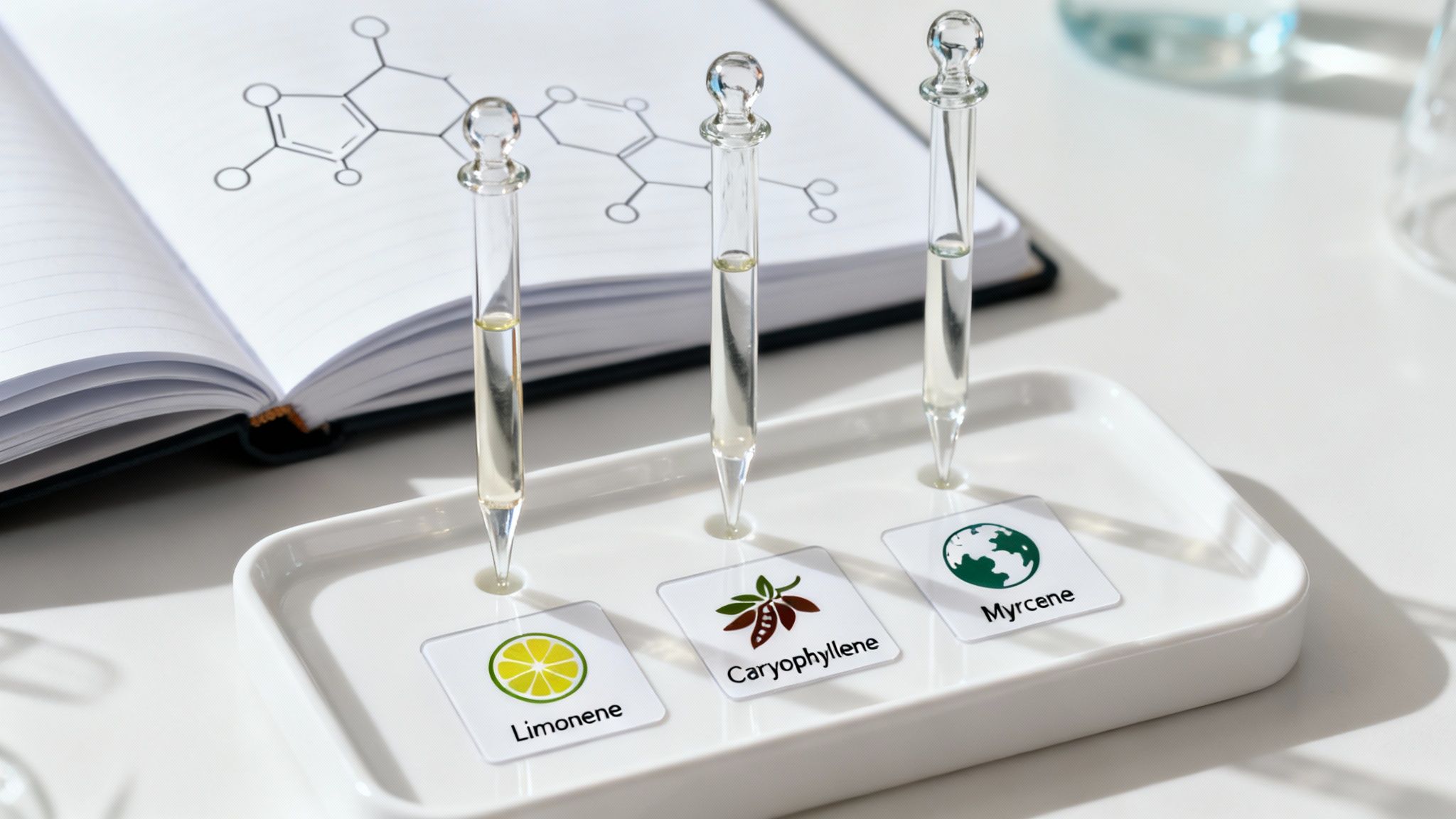
To accurately replicate a specific strain, the process must begin with its aromatic signature. For Sour Diesel, this means deconstructing its legendary scent—an unmistakable fusion of sharp diesel, zesty citrus, and an earthy undertone. This profile is not arbitrary; it is a specific chemical signature created by its dominant terpenes. These compounds are the key to the entire sensory experience.
Replicating this terpene blueprint with precision is critical for creating consistent distillates, vape cartridges, or any other formulated product. For formulators, the operative question is not merely whether Sour Diesel is indica or sativa, but how to construct its famous sativa-leaning character from the ground up using its core aromatic building blocks.
The Primary Terpene Trio: Top, Mid, and Base Notes
Sour Diesel’s signature scent is primarily driven by three dominant terpenes. Each plays a critical role, much like individual notes in a musical chord. Achieving the correct balance results in the classic Sour D harmony.
- Limonene (Top Note): This is the initial aromatic impact—the bright, sharp citrus and fuel scent. As a top note, Limonene defines the profile's energetic first impression and its uplifting character.
- Caryophyllene (Mid Note): Deeper in the profile lies the spicy, peppery backbone from Caryophyllene. This mid-note provides the gassy "punch" that cuts through the citrus, giving the aroma a robust, lasting character.
- Myrcene (Base Note): Underpinning the entire profile, Myrcene provides a subtle, earthy foundation. This base note anchors the sharper top and mid notes, integrating them into a smooth, well-rounded finish.
This trio is what defines the Sour Diesel profile. Its unique aroma became a benchmark for high-energy cannabis products, driving significant market demand. By 2020, market data showed Sour Diesel and its derivatives consistently ranked in the top 10% of sativa sales nationally.
Building The Profile For Formulation
When formulating a Sour Diesel product, the objective is to balance these three core terpenes to capture the authentic profile. Simply combining them in equal parts is ineffective; the ratios are what matter. The loud, forward notes from Limonene and Caryophyllene create the initial "diesel" blast, while Myrcene provides the subtle base that prevents the flavor from feeling thin or harsh.
An effective Sour Diesel formulation is not just about taste. It's about engineering an aroma that communicates a clear message: this product is potent, pungent, and delivers the classic sativa experience consumers expect.
Hitting this target requires precision and high-quality inputs. Utilizing a pre-formulated, lab-tested blend eliminates the guesswork. It ensures the delicate ratios are already optimized, enabling you to deliver the same authentic experience batch after batch.
For a detailed analysis and to source a profile engineered by experts, examine our Gold Coast Terpenes Sour Diesel blend. This approach allows you to reliably provide consumers the true-to-strain experience they seek.
How Terpenes Engineer the "Sativa" Experience in Formulation
How is an abstract concept like "uplifting" translated into a tangible, marketable product? The answer lies in engineering a specific sensory experience through terpenes.
When a consumer selects a product labeled Sour Diesel, there is a built-in expectation for an aroma that signals energy, focus, and creativity. This is where the science of formulation meets commercial intent.
Sour Diesel's legendary sativa-dominant reputation is a direct result of its terpene profile, which is rich in compounds known for their bright, stimulating aromatics. Limonene, for example, delivers the sharp, zesty citrus scent found in products designed to evoke alertness. By featuring Limonene as a primary component in your formulation, you immediately align the product with the psychological expectation of a sativa effect.
Engineering the Entourage Effect for Product Development
For a product developer, the "entourage effect" is a principle of synergistic aromatic design. A well-crafted blend of terpenes creates a sensory experience far more complex and impactful than any single isolate could achieve. A product featuring only Limonene would be simplistic and one-dimensional.
However, by layering in the spicy, gassy notes of Caryophyllene (mid note) and the subtle, earthy foundation of Myrcene (base note), you construct a complete aromatic narrative. This synergy creates the authentic, multi-layered profile consumers instantly recognize as Sour Diesel. The bright citrus top note is followed by a pungent, full-bodied aroma—a memorable experience from the first scent.
An advanced formulation does not simply copy a scent; it directs an experience. By understanding how to balance top, mid, and base note terpenes, a formulator can guide the user's sensory journey and reinforce the product's intended sativa-like effect.
This deliberate approach offers a significant competitive advantage. Instead of relying on inconsistent plant-derived profiles, you can utilize precisely crafted strain-inspired terpene blends to ensure every batch delivers the same focused, energetic profile.
This level of consistency builds brand credibility and ensures your product lives up to the Sour Diesel name every time. Mastering these aromatic interactions is essential for creating products that perform as well as they smell. You can browse various terpene product pages to source the precise building blocks for your next formulation. This control allows you to craft a product that doesn’t just answer the "is Sour Diesel a sativa or indica?" question—it is the answer.
A Step-By-Step Guide To Replicating The Sour Diesel Flavor
Replicating an iconic flavor profile like Sour Diesel is a function of technical precision. It requires careful consideration of ratios, base concentrate characteristics, and final delivery hardware. This guide provides a practical, step-by-step process for infusing the authentic Sour Diesel profile into distillates and other concentrates.
The primary objective is to capture the renowned sativa-dominant character and deliver it with consistency. This is achieved by balancing the sharp, gassy top notes with the subtle earthy undertones that define the profile. A formulator acts as a flavor architect, building an experience from the molecular level up.
Establishing Your Starting Ratios
First, establish a baseline for your terpene concentration. For a potent profile like Sour Diesel, an industry-standard starting range is between 5% and 10% terpenes by weight. It is always advisable to begin at the lower end of this range.
Beginning with a conservative 5% mix is a prudent strategy. This allows for testing flavor intensity without compromising an entire batch. It is far easier to incrementally add more terpenes than to dilute an over-flavored mixture, which can negatively impact viscosity and potency.
For example, to formulate a 100-gram test batch at a 5% concentration, you would combine 95 grams of your base concentrate (e.g., THC or CBD distillate) with 5 grams of your Sour Diesel terpene blend. This initial run provides a critical baseline for aroma, flavor, and physical consistency.
Fine-Tuning The Formulation
After mixing the initial batch and allowing it to homogenize for at least 24 hours, the next step is evaluation and refinement. The type of concentrate and chosen hardware will significantly influence the final sensory output.
- Base Material Impact: Highly refined distillates serve as a neutral base, having minimal intrinsic flavor. In contrast, less-refined extracts may possess their own subtle flavors that interact with the added terpenes, potentially requiring ratio adjustments.
- Hardware Considerations: Vaporizer cartridges are not uniform. They operate at different temperatures, and lower-quality hardware can scorch delicate terpenes, resulting in a harsh, degraded flavor. Always test your final formulation in the same hardware intended for the end-user to ensure the profile is delivered as designed.
If the initial 5% batch lacks the desired intensity, increase the concentration in small, precise increments of 0.5% at a time. This methodical approach prevents overshooting the optimal point where the flavor is bold but not overpowering. For assistance with calculations, our guide on mixing terpenes with a calculator can help you achieve precise ratios.
The diagram below illustrates the importance of this precision, showing the pathway from terpenes to the classic sativa experience.
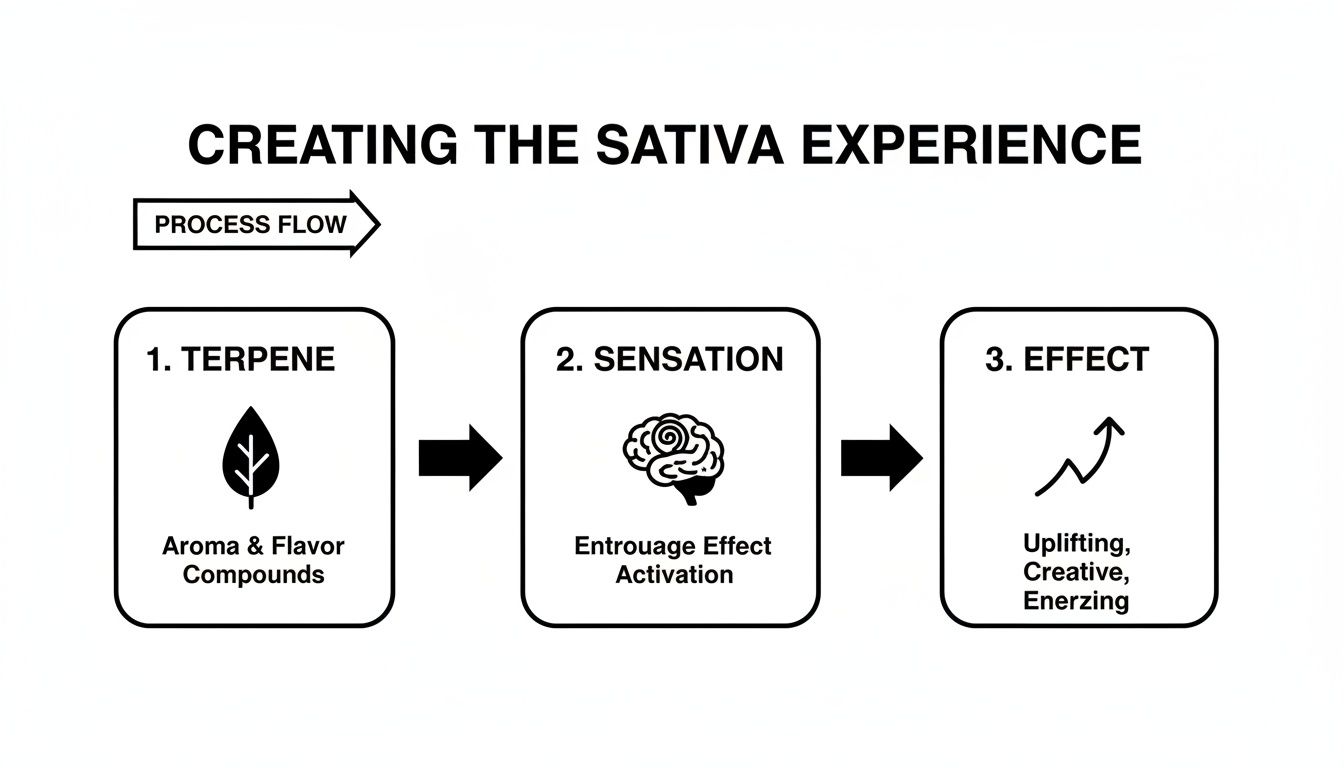
This journey—from chemical profile to sensation to effect—demonstrates how your formulation directly engineers the consumer's experience. By following these steps and using high-purity, lab-tested terpenes, you can ensure your product is not just authentic, but also reliable and effective every time.
Solving Common Vape Cartridge Formulation Challenges
Achieving the perfect Sour Diesel vape cartridge involves more than replicating its iconic flavor; it is a technical balancing act. Formulators frequently encounter challenges such as terpene separation, flavor degradation from oxidation, and poor performance due to oil and hardware incompatibility.
Overcoming these issues is what distinguishes a premium product. The goal is to deliver the pungent, gassy profile consistently from the first use to the last. This requires a problem-solving approach and a deep understanding of the interactions between terpenes, concentrates, and cartridge hardware.
Preventing Terpene Separation and Oxidation
Terpene separation is a common formulation failure. It occurs when the blend fails to fully homogenize into the distillate, creating an inconsistent user experience with pockets of intense flavor and others with none. This is typically caused by improper mixing techniques or incorrect terpene concentrations.
The solution is advanced homogenization. A high-shear mixer is essential for dispersing the terpene blend evenly throughout the viscous cannabinoid base. It is also critical to mitigate oxygen exposure. Oxygen degrades volatile terpenes like Limonene, causing them to lose their aromatic intensity. Mixing in an airtight, controlled environment is crucial for preserving the bright, sharp notes that define Sour Diesel.
A significant formulation error is the use of fillers like VG, PG, or MCT oil to adjust viscosity. These additives not only dilute potency but also compromise the authentic flavor profile and can lead to severe separation issues. A pure, terpene-only formulation is the industry standard for high-quality vape products.
Matching Your Formulation to the Hardware
A formulation is only as effective as the cartridge that delivers it. Incompatible hardware can completely undermine a well-crafted blend.
- Coil Material: We strongly recommend ceramic coils for terpene-rich profiles like Sour Diesel. They provide more even heating compared to older wick-and-coil systems, drastically reducing the risk of scorching delicate terpenes and producing a harsh, burnt taste.
- Intake Hole Size: The viscosity of the final oil must be matched to the size of the cartridge's intake holes. If the oil is too thick for small holes, it will result in dry hits and burnt coils. If it is too thin, it will cause leaks.
Troubleshooting Sour Diesel Formulation Problems
Even with meticulous planning, issues can arise. Here is a quick guide to diagnosing and resolving common problems when formulating a Sour Diesel profile for vape cartridges.
| Problem | Common Cause | Effective Solution |
|---|---|---|
| Harsh or Burnt Taste | Hardware incompatibility; temperature is too high, scorching terpenes. | Test with a lower-voltage battery. Switch to a high-quality ceramic coil cartridge designed for terpene-rich oils. |
| Leaking Cartridge | Oil is too thin; terpene percentage is too high or the wrong diluent was used. | Reduce the overall terpene percentage slightly. Ensure you are only using terpenes to dilute, not other cutting agents. |
| Inconsistent Flavor | Incomplete mixing (homogenization) leading to terpene separation. | Use a high-shear mixer to ensure a fully homogenous blend. Gently heat the distillate (to around 100-120°F) to lower viscosity before mixing. |
| Muted or "Dull" Aroma | Oxidation from air exposure during the mixing or filling process. | Mix in a sealed environment. Use nitrogen backfilling during storage and filling to displace oxygen and protect the terpenes. |
| Clogged or "Dry" Hits | Oil is too thick for the cartridge's intake holes. | Select a cartridge with larger intake holes. You can also slightly increase the terpene percentage (within safe limits) to reduce viscosity. |
By systematically testing your finished Sour Diesel blend in various hardware, you can identify the optimal pairing that preserves its complex, gassy profile. This final validation step is crucial for ensuring the consumer receives the authentic, energizing experience you engineered.
For more technical guidance, review our detailed resources on formulating terpenes for vape cartridges. This methodical, problem-solving approach is foundational to developing a stable and successful product.
Scaling Up: Maintaining Sour Diesel Consistency in Production
Once a successful Sour Diesel formula is developed, the primary challenge becomes replication at scale. For a growing brand, consistency is paramount. Consumers purchase a Sour Diesel vape cartridge with the expectation of a specific pungent, gassy, and uplifting experience. They expect that same sensory profile with every purchase.
Attempting to achieve this consistency using raw, plant-derived terpenes is inherently unreliable. The terpene profile of the cannabis plant can vary significantly from one harvest to the next, leading to unpredictable results and brand erosion.
A professionally formulated Sour Diesel terpene blend solves this problem. It removes agricultural variability from the manufacturing process, providing a perfectly replicated, uniform profile for every production run. This shifts the operation from agricultural dependence to precise, industrial manufacturing.
The Strategic Advantage of a Standardized Blend
Utilizing a standardized blend streamlines operations and strengthens the business model. It is a de-risking strategy.
- Simplified Inventory: Instead of managing numerous individual terpene isolates, you stock a single, precisely engineered blend.
- Predictable Costs: Sourcing from a reliable bulk supplier allows for locked-in pricing, insulating the business from market volatility.
- Streamlined Workflow: The production team follows a standardized, simple recipe. This ensures every batch is mixed to the exact same specifications without deviation.
Partnering with a trusted bulk terpene supplier is the key to scalable success. It ensures you can meet growing demand without ever compromising on the authentic flavor that defines your brand.
Ultimately, this level of control protects a brand’s reputation. Delivering a consistent product builds consumer trust and loyalty. By locking in the sensory experience, you are not just selling a product; you are delivering on a promise—and answering the sour diesel strain indica or sativa question with a reliably energetic effect every time.
Sour Diesel Formulation FAQ for Product Developers
We consult with brand owners and lab technicians regularly, and several key questions about formulating with the Sour Diesel profile consistently arise. Here is practical advice for refining your product line.
What Is the Ideal Starting Percentage for Sour Diesel Terpenes in Distillate?
For most cannabinoid distillates, a starting range of 5-7% is the industry best practice. The Sour Diesel profile is aromatically potent, so beginning at the lower end of the range and titrating up is the recommended procedure. It is far simpler to increase flavor intensity than to correct an overpowering batch.
Our recommendation is to mix a small test batch at 5%. Allow it to homogenize for a minimum of 24 hours before evaluation. If the profile is not sufficiently pronounced, increase the concentration in small increments of 0.5% at a time. This methodical approach prevents crossing the threshold into a harsh, unbalanced flavor.
How Can I Emphasize the Classic "Gassy" Note in My Formulation?
The iconic diesel fuel aroma is a result of a specific combination of terpenes, with Caryophyllene and Myrcene being the primary drivers. If your blend lacks this signature pungent note, it can be amplified.
The key is precision. Supplement your blend with a small amount of isolated Beta-Caryophyllene. A minor addition, on the order of 0.1% to 0.2% of the total volume, can dramatically boost the gassy character without disrupting the citrus and earthy notes that complete the Sour Diesel profile.
Why Is the Flavor Degrading in My Sour Diesel Vape Cartridges?
Flavor degradation in finished vape cartridges is typically caused by either oxidation or hardware incompatibility. The volatile top notes in Sour Diesel, particularly Limonene, are susceptible to degradation from heat and oxygen exposure.
Expert Tip: To preserve flavor integrity, the filling and capping process must be airtight. Any oxygen exposure will degrade the sensory experience. Furthermore, utilize high-quality cartridges with ceramic cores. They provide more even, lower-temperature heating compared to older wick systems, which helps preserve delicate terpenes. Always store finished products in a cool, dark environment to maximize shelf life.
Ready to move from formulation challenges to consistent, top-tier Sour Diesel products? The experts at Gold Coast Terpenes have engineered precise, lab-tested terpene blends that eliminate guesswork. You can achieve perfect flavor and aroma in every single batch and provide your customers with the authentic experience they expect.