
Nearly half of tested legal cannabis products, 48%, contained less than 80% of their declared THC level according to Health Canada's 2025 cannabis data report. For cartridge makers, extractors, and B2B product formulators, that single gap tells an important story. You can't treat cannabis concentrates as turnkey ingredients whose labels guarantee consistent results.
Extraction strips away plant matter, and most refinement steps also strip away the native aromatic compounds that give a plant its scent. What you buy from an extractor is usually a nearly blank base. Flavor, aroma, viscosity, and compliance aren't built-in traits you inherit from raw oil.
Instead, every finished SKU is a design decision you build on purpose. Choosing the right concentrate base, verifying lab paperwork, and dosing botanically derived terpenes with repeatable math turns an unpredictable raw extract into a reliable product line.
What Cannabis Concentrates Are and Their Main Types
A cannabis concentrate is an extract with most plant matter removed, leaving a dense material packed with cannabinoids and, depending on how it's processed, some remaining terpenes. Think of raw flower as ground coffee and a concentrate as a shot of espresso. Both come from the same plant, yet one packs far more active material into a tiny amount of weight.
Lab testing shows just how wide the gap is between flower and extracts, and between one concentrate batch and the next. In a 2025 Scientific Reports study of Colorado recreational dispensary products, concentrates carried a mean labeled THC potency of 73.0% and a mean measured potency of 70.7%, compared with 22.5% labeled and 20.8% measured for flower. Even more telling for buyers, measured potency across those tested concentrates stretched from 17.9% to 83.6%, with an average gap of 2.3 percentage points between what the label claimed and what the lab found.
That spread proves why a single potency number doesn't tell you what's sitting in a jar. Two oils with similar labels can behave very differently in a filling machine or a cartridge coil. Batch-specific lab testing is the only way to know what you're formulating with before you spend money on hardware, packaging, and terpenes.
How Processing Shapes Concentrate Texture and Base Use
When B2B buyers source bulk extracts, they run into eight common formats. Each texture reflects how the processor handled heat, pressure, agitation, and solvent removal after extraction.
| Concentrate type | Typical texture | Typical production route |
|---|---|---|
| Distillate | Clear, refined oil | Solvent extraction followed by distillation |
| Rosin | Golden, sticky or sauce-like | Solventless heat and pressure |
| Shatter | Glassy, brittle sheets | Solvent extraction with purging |
| Wax | Crumbly and opaque | Solvent extraction with whipping |
| Badder | Whipped, creamy, butter-like | Solvent extraction with agitation |
| Sugar | Granular, crystalline | Solvent extraction with recrystallization |
| Sauce | Wet, syrupy, terpene-rich | Solventless or solvent extraction |
| Live resin | Saucy and high in terpenes | Extraction from fresh-frozen plant material |
Each base fits a different manufacturing job. Distillate and sauce show up most often as cartridge fill bases because their flow characteristics work well with vaporizer hardware once properly formulated. Sugar and badder are commonly sourced for blended or infused product lines where texture helps with mixing.
Buyers who want a solventless input usually look at rosin, though it behaves very differently from hydrocarbon extracts. Comparing resin and rosin production bases early in product development saves hours of trial and error on the production floor.
Texture follows process, and terpene retention follows texture. Because refined bases lose most of their native scent, treat every concentrate as a neutral foundation to build on rather than a finished flavor.
How Cannabis Concentrates Are Made, Step by Step
Every extraction line shares one basic goal. First, it pulls cannabinoids and aromatic compounds out of plant material. After that, every remaining stage cleans, separates, and verifies the extract so a manufacturer can safely put it into a commercial product.
Here's how raw biomass becomes a verified concentrate base from start to finish.
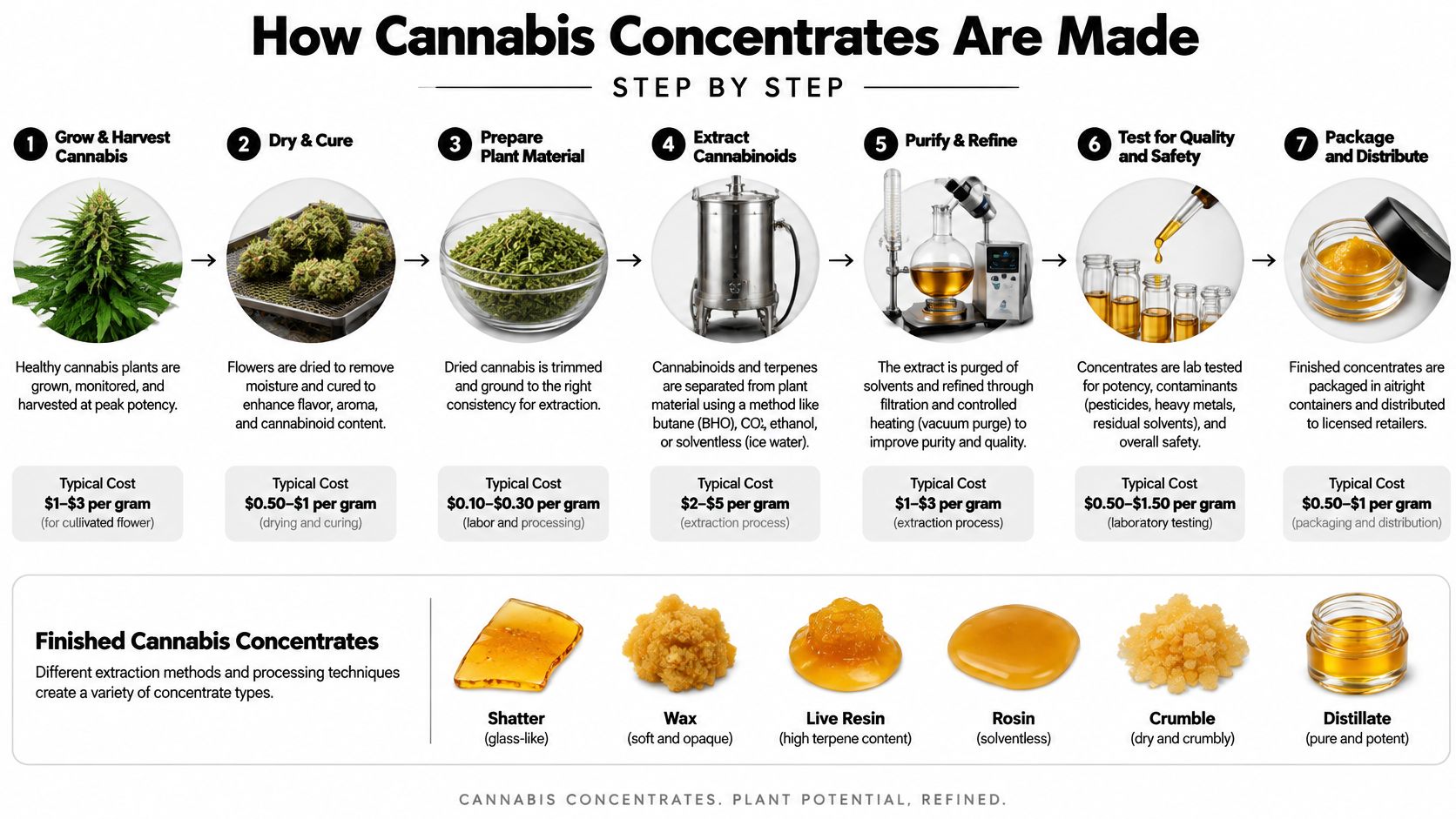
- Select documented biomass. Processors start with flower or trim backed by cultivation records and incoming test results. Clean input matters because extraction concentrates contaminants right alongside cannabinoids.
- Pull the active compounds. A solvent route runs hydrocarbons, ethanol, or CO2 through the plant material to dissolve cannabinoids and terpenes. A non-solvent route skips chemicals and uses mechanical force, such as heat and pressure in a rosin press.
- Filter out waxes and plant solids. The raw extract passes through fine media to trap plant particles, fats, and heavy waxes. Skipping proper filtration leaves cloudy oil that clogs cartridge wicks and burns unevenly.
- Purge the extraction solvent. For solvent-based runs, operators move the extract into closed vacuum systems with controlled heat and pressure to evaporate remaining solvent. Careful purging protects batch safety without scorching the oil.
- Refine or winterize the oil. Many commercial cartridge makers use winterization (chilling the extract in ethanol and filtering) and distillation to remove remaining lipids and waxes. This step yields a clear, shelf-stable base such as winterized distillate.
- Test and document the batch. Before release, an independent lab measures potency, native terpenes, residual solvents, and contaminants. Every lot receives a written record tied directly to that specific production run.
Why Extraction Method Changes Potency and Terpene Survival
Not every extraction route leaves the same chemical profile behind. According to a U.S. National Institute on Drug Abuse technical brief, solvent-based concentrates average approximately 54% to 69% THC, with some samples exceeding 80%, while non-solvent products average roughly 39% to 60% THC. That gap happens because solvents selectively pull cannabinoids and allow heavier removal of the surrounding plant matrix, not because the process extracts more total weight.
The same brief highlights why verification matters as much as extraction yield. It cites a study in which 80% of tested concentrate samples showed some form of contamination, including pesticides or incompletely removed solvents. High refinement doesn't automatically mean a clean batch.
Processing conditions also decide which aromatic compounds survive. Terpenes are volatile, meaning they evaporate easily under heat and vacuum. Distillation removes nearly all native terpenes, which leaves behind a clean cannabinoid base with almost no aroma.
Formulation reality: Never guess a concentrate's potency or terpene content from the starting plant material or extraction method. Verify base type, measured potency, and native terpene levels on the batch-specific certificate before you write a single recipe.
Potency and Residual Solvent Limits to Verify
A concentrate can pass its potency check with flying colors and still fail compliance testing for leftover chemicals. Solvent extraction creates a temporary blend of cannabinoids, terpenes, and solvent. Until a laboratory confirms that the purge worked, that batch isn't ready for formulation.
Solvent limits work like tolerances on a spec sheet: each compound gets its own ceiling based on its toxicological risk, so no single number can cover them all. You can see how specific those thresholds get in Maryland's technical authority testing guidance, which lists separate limits for each target compound. Even inside regulated markets, purge failures still occur, so treat a passing result as something the batch earned on paper rather than a default you can assume.
| Solvent | Maximum residual level | Why the limit differs |
|---|---|---|
| Butanes | Below 5,000 ppm | Common extraction solvent with a broad limit |
| Propanes | Below 5,000 ppm | Common extraction solvent with a broad limit |
| Heptanes | Below 5,000 ppm | Common extraction solvent with a broad limit |
| Ethanol | Below 5,000 ppm | Common extraction solvent with a broad limit |
| Hexanes | Below 290 ppm | Tighter limit for a higher toxicological concern |
| Toluene | Below 890 ppm | Mid-range limit set by toxicological review |
| Benzene | Below 2 ppm | Very low limit because of its toxicological profile |
Look closely at the bottom of that table. Benzene must stay below 2 ppm, while common extraction solvents like butanes and ethanol allow below 5,000 ppm. Because those limits aren't interchangeable, a generic "solvent-free" stamp or a single total-solvent number leaves a quality manager without enough detail to release a batch.
This matters even more with a highly refined base. When processing has already stripped out the native terpenes and left a neutral oil, you can't smell or taste whether the purge finished cleanly. The certificate is the only place that answer exists.
Release Controls Beyond the Intermediate Extract
Strong quality assurance starts during extraction and continues right through final cartridge assembly. Before approving a concentrate supplier or releasing a finished SKU, build these checks into your standard operating procedure:
- Closed-System Extraction Controls: Confirm the extractor uses closed-loop equipment where applicable, along with logged vacuum pressures, controlled purge temperatures, and validated purge endpoints.
- Analyte-by-Analyte Certificates of Analysis: Require a Certificate of Analysis (COA) that breaks out every target solvent alongside its limit of quantitation, rather than a vague pass summary.
- Batch Homogeneity and Packaging Checks: Uneven mixing inside a bulk jar or solvent reabsorption from incompatible liners can shift dose accuracy and chemical results after initial lab testing.
- Finished-Formulation and Hardware Testing: Lab paperwork from the raw intermediate oil doesn't cover what happens later. Adding terpenes, diluents, or filling the oil into a cartridge can change the final chemical profile.
Hardware interaction is easy to overlook when teams only inspect raw oil COAs. In a 2025 peer-reviewed review of concentrate vaping aerosols, researchers reported that heating manufactured cannabis concentrates can generate harmful aerosol toxicants such as isoprene, 3-methylcrotonaldehyde, 3-methyl-1-butene, and 2-methyl-2-butene, while a separate scoping review noted that heavy metals can release from vape hardware above regulatory guidelines. A clean raw extract can still produce a contaminated aerosol. Testing the finished oil inside its actual cartridge hardware is what closes that gap.
How Terpenes Shape Flavor and Aroma
Picture a finished cartridge like a car. Cannabinoids are the engine under the hood, while terpenes are the paint, finish, and scent you notice right away. When extraction and winterization strip out native aromatic compounds, the oil tastes flat and neutral.
That's why terpenes are added to winterized distillate oils to add a distinct flavor to the product. Terpenes are natural aromatic compounds produced across thousands of plants, from pine needles and citrus rinds to black pepper and hops. At Gold Coast Terpenes, we supply botanically derived terpene isolates and blends designed specifically for consistent, repeatable manufacturing.
To rebuild a believable aroma without overwhelming the oil, it helps to know what the plant produces in nature. In a peer-reviewed study of cannabis inflorescences, researchers measured total terpene concentrations ranging from 0.4% to 2.3%, with terpene-to-cannabinoid ratios between 2.1 and 12.2 milligrams of total terpenes per 100 milligrams of total cannabinoids.
Treat those numbers as a starting reference rather than a strict target. Pushing a blend way above natural ratios can create an artificial profile that drifts from a flower-like benchmark. Going too light creates the opposite problem, since delicate top notes can fade during mixing or storage.
Below is a quick visual reference showing how individual aromatic compounds map to everyday plant scents.
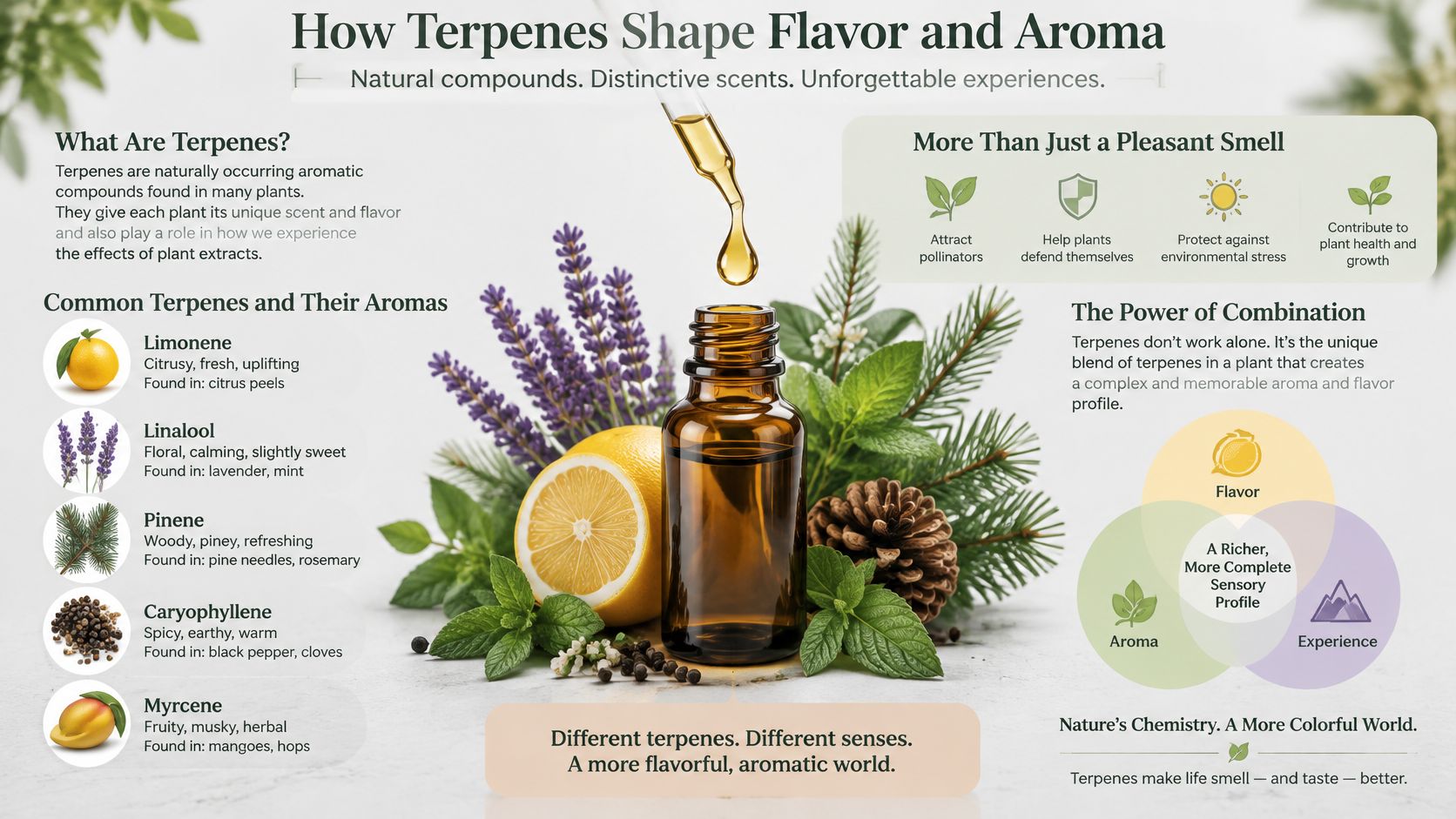
Building Profiles From Common Terpene Isolates
Most formulators build or adjust an aroma by starting with one primary compound and layering one or two supporting notes underneath. We offer botanically derived terpene isolates including Alpha-Pinene, Beta-Caryophyllene, Limonene, Linalool, Myrcene, and Terpinolene, along with multi-compound blends that include Alpha-Humulene, which contributes to the hoppy aroma of cannabis.
| Terpene | Typical aroma note | Where Gold Coast offers it |
|---|---|---|
| Limonene | Citrus peel, lemon | Isolate |
| Alpha-Pinene | Fresh pine, woody | Isolate |
| Beta-Caryophyllene | Black pepper, spice | Isolate |
| Linalool | Floral, lavender | Isolate |
| Myrcene | Earthy, musky, herbal | Isolate |
| Terpinolene | Fresh, piney, floral | Isolate |
| Alpha-Humulene | Hoppy, woody | Blend component |
Say a product team wants a bright citrus profile with a warm, dry finish. They might anchor the blend with Limonene, layer a smaller amount of Beta-Caryophyllene for peppery depth, and consult a terpene flavor chart to balance secondary notes before pouring a pilot batch.
Once a bench sample hits the mark, lock down the exact gram weights of every isolate or blend in your batch sheet. Follow up with both sensory panel checks and analytical lab verification. Consistent botanical sourcing plus tight batch records ensure run ten smells identical to run one.
Sourcing and Compliance Checks Before You Buy Terpenes
A terpene percentage printed on a supplier's sales sheet is a starting claim, not proof of batch quality. Terpenes are much more volatile than cannabinoids, so laboratory instruments measure them with wider testing tolerances. Understanding those tolerances keeps small vendor inconsistencies from turning into failed compliance batches.
Look at Maryland's 2025 laboratory quality control guidance for a clear example. The state accepts recovery ranges of 70% to 130% for terpene laboratory control samples, initial calibration verification, and continued calibration verification, compared with 85% to 115% for several potency controls. It also permits a 30% relative percent difference limit for duplicate terpene results.
Because terpene assays allow wider variance than cannabinoid tests, sloppy lot-to-lot drift from a vendor makes calibration, flavor matching, and root-cause investigations much harder. Tight documentation from your supplier protects your production schedule.
What to Request From Every Terpene Supplier
Before placing a bulk order, review a checklist on where to buy terpenes and ask every candidate vendor for five concrete items:
- Lot-Specific Certificate of Analysis: Make sure the COA matches the exact lot number on the bottle you receive, not a generic representative sheet from last year.
- Complete Analyte List: Verify every compound present in the blend so your formulation team knows what goes into the finished oil.
- Independent Third-Party Verification: Ask which accredited lab runs the tests. Our terpenes for cartridges are SC Lab-tested to support reliable quality checks.
- Botanical Origin and Purity Confirmation: Verify that the vendor supplies botanically derived terpenes free of undisclosed fillers. Our terpenes are extracted from fresh plants and are free of mixtures, chemicals, and additives.
- Clear Mixing Instructions and Duplicate-Review Readiness: Good vendors provide practical dilution guidance and keep retained lot records so your lab team can troubleshoot duplicate test discrepancies if they arise.
State Rules That Affect Terpene Formulations
Compliance doesn't stop at purity. Several states regulate where flavoring terpenes come from and how much you can add to an inhalable SKU. According to a Washington State Liquor and Cannabis Board research brief, rules vary sharply by state:
- Washington: Flavoring in cannabis vape products is allowed only when derived from botanical terpenes naturally occurring in cannabis and when the characterizing flavor mimics a cannabis terpene profile.
- New York and New Jersey: Both states cap flavored vape products at no more than 10% total terpenes.
- Connecticut: Flavoring terpenes must come from cannabis grown and regulated inside Connecticut.
Compliance habit to adopt early: Run a market-by-market regulatory review before you finalize a blend or order custom packaging. Keep every supplier lot number tied to your finished batch records so any failed lab test can be traced straight to its source in minutes.
How to Dose Terpenes Into Distillate and Carts
A cartridge formula has a narrow working window. Under New York's Office of Cannabis Management testing guidance, total terpene content in vaporized or inhaled cannabis products is capped at 10% by weight, with a permitted testing variance of plus 15%, setting 11.5% as the maximum reported threshold in both bulk and final-form testing. Treat that ceiling like the line on a measuring cup. You may pour below it with confidence, but a formulation pressed against it leaves little room for mixing error or lab variance.
Distillate works well as a blank base because processing removes much of the plant's native aroma. Flavor becomes a design decision, rebuilt with measured terpenes and confirmed on paper at every stage. Even if you sell outside New York, staying comfortably below the cap gives production a safer operating margin.
Six Steps for Mixing Terpenes Into Winterized Distillate
Terpenes for cartridges are added to winterized distillate oils, which have had waxes and lipids removed so the oil flows cleanly. They are added to give the finished product a distinct flavor. Follow these six steps to keep every batch repeatable, and check our full walkthrough on how to mix distillate with terpenes when setting up a new bench SOP.
- Read the base COA first. Note any remaining native terpene percentage in the distillate. Distillate is usually low in native terpenes, but a small existing level still counts toward the finished total.
- Choose a starting band from the ladder below. Begin at the light end when testing an unfamiliar profile. You can add more terpene to a pilot jar, while an over-terped oil must be diluted with extra distillate.
- Calculate against finished fill mass. Terpene percentage is a share of the final combined weight, meaning distillate plus terpenes. Do not calculate against the base oil alone. Our Mixing Calculator handles this batch math and reduces rounding errors.
- Dilute concentrated materials before weighing. All strains are highly concentrated and need to be properly diluted before use. For small R&D batches, accurate pipettes or calibrated analytical scales help prevent overdosing.
- Mix slowly at room temperature. Add terpenes to the winterized distillate in stages and stir until no streaks remain. Think of the batch like ink entering water: even distribution takes gentle movement, not aggressive heat. High heat can drive off volatile top notes and change the finished aroma.
- Verify the finished oil. Send a representative sample for total terpene testing and compare the scent with your reference standard before approving cartridge fills. Hardware performance and viscosity checks belong at this stage too, because the oil that smells right must also flow right.
Starting Terpene Load Ladder for Cartridge Formulations
Use these bands as practical starting points for bench trials. Each one sits below the stated ceiling, so the release checks focus on confirming the finished product rather than correcting an avoidable formulation error.
| Load level | Starting % of fill mass | Typical use | Check before release |
|---|---|---|---|
| Light accent | 0.4% | Subtle top note over a neutral base | Sensory panel on the finished oil |
| Standard profile | 1.3% | Clear aroma that matches a flower-like reference | Sensory panel and total terpene test |
| Full profile | 2.3% | Bold flavor for fruit and dessert profiles | Total terpene test and viscosity check |
| Regulatory ceiling | Up to 10% | Upper bound for flavored vape products | Batch test under the 11.5% maximum with variance |
Batch math reminder: The percentage poured into the mixing beaker is not always the percentage a lab will report. Verify the finished blend mass analytically so production loss and assay variance never push a SKU past state limits.
Request Samples and Build Your Blend Plan
Turning a raw concentrate into a consistent, shelf-ready cartridge line doesn't require guesswork. Your production team can move from an empty spec sheet to a tested pilot batch this week by following six straightforward steps.
- Write your aroma target in one plain sentence. Keep it concrete, such as "bright citrus up front with a warm, peppery finish." Clear language aligns your R&D chemists, buyers, and brand managers from day one.
- Choose a starting isolate or blend. Pick from our botanically derived isolates and terpene profiles based on your product preference, such as pairing limonene with beta-caryophyllene or starting with a pre-built aroma blend.
- Set your starting percentage and run the math. Select a band from the dosing ladder and confirm exact gram weights with our Mixing Calculator before opening a bottle.
- Order a sample with its lot COA. Review the certificate of analysis and analyte breakdown with your quality team before mixing into production oil.
- Pour a small pilot batch in your actual base oil. Test the finished sample in your chosen cartridge hardware, submit it for lab verification, and compare the aroma against your written target.
- Lock the formula and scale to bulk. Once lab numbers, viscosity, and sensory checks pass, save the exact lot numbers and weights as your production standard.
We offer over 50 botanically derived blends and isolates and add new terpene blends each month so your catalog can stay fresh without rebuilding your supplier list. Whether you're testing a single new SKU or scaling across state lines, we run dedicated programs for Distro, Shops & Independent Reps, Affiliates, and Manufacturers & Brands, complete with bulk pricing and custom blend support.
Ready to turn your winterized distillate or concentrate base into a repeatable, lab-verified SKU? Explore our botanically derived isolates, shop over 50 ready-to-mix terpene blends, request sample lots with full documentation, or contact our team for bulk and custom formulation orders at Gold Coast Terpenes.