
You're ready to reorder limonene for a production blend, but the new sample doesn't quite match the approved batch. Both containers say pure limonene. Both look clear. Yet the aroma, strength, or handling feels different, and your team has to decide whether to adjust the recipe or hold the lot.
Grade and freshness matter more than the word pure on the label. For a manufacturer, the useful questions are what's in the container, how it was measured, and whether it has changed since testing. Those answers help you buy terpenes that fit your process instead of chasing flavor differences on the production floor.
Pure Limonene at a Glance
Pure limonene key properties
The PubChem limonene record lists the core chemical and physical values below, including its C10H16 formula and 136.23 g/mol molar mass.
| Property | Value |
|---|---|
| Molecular formula | C10H16 |
| Molar mass | 136.23 g/mol |
| Appearance and odor | Colorless liquid with a lemon-like odor |
| Melting point | About −74.3 °C |
| Boiling point | About 176 °C |
| Water solubility | Poor; mixes readily with ethanol and ether |
Pure limonene is an isolated monoterpene, a small hydrocarbon molecule found in botanical oils. For buyers, isolated means the ingredient is primarily a single compound rather than a complete plant oil. It doesn't mean every commercial grade has the same assay, impurity profile, or intended use.
What the properties mean on the floor
Its low melting point supports liquid handling under ordinary storage conditions. You generally won't need to melt it before weighing, but you still need a controlled dispensing method. A balance and a compatible transfer pipette are more reliable than counting drops.
Poor water solubility makes limonene easier to work into suitable oil-based, distillate, and alcohol-based systems than into plain water. Adding it directly to an aqueous base can leave a separate phase. A water-based product needs its own solubilization or emulsion design, not more mixing.
Limonene's volatility also matters. Keep the vessel closed between additions, and don't treat its boiling point as a suggested processing temperature. Ether's appearance in a compatibility list isn't a recommendation to use it in a finished formulation.
Handling and ingredient choice
Limonene is flammable, and exposure can irritate skin, eyes, and airways. Filling and blending therefore need ignition control, suitable ventilation, compatible seals, and the protective equipment specified in the current safety data sheet.
Citrus essential oil isn't interchangeable with isolated limonene. It contains other terpenes and oxygenated compounds that contribute to the full aroma, so replacing an oil with an isolate can change the blend even when the citrus note seems similar.
Write the basic properties into your purchasing specification before requesting a quote. Then define the grade and analytical requirements that your finished product needs.
Where Pure Limonene Comes From
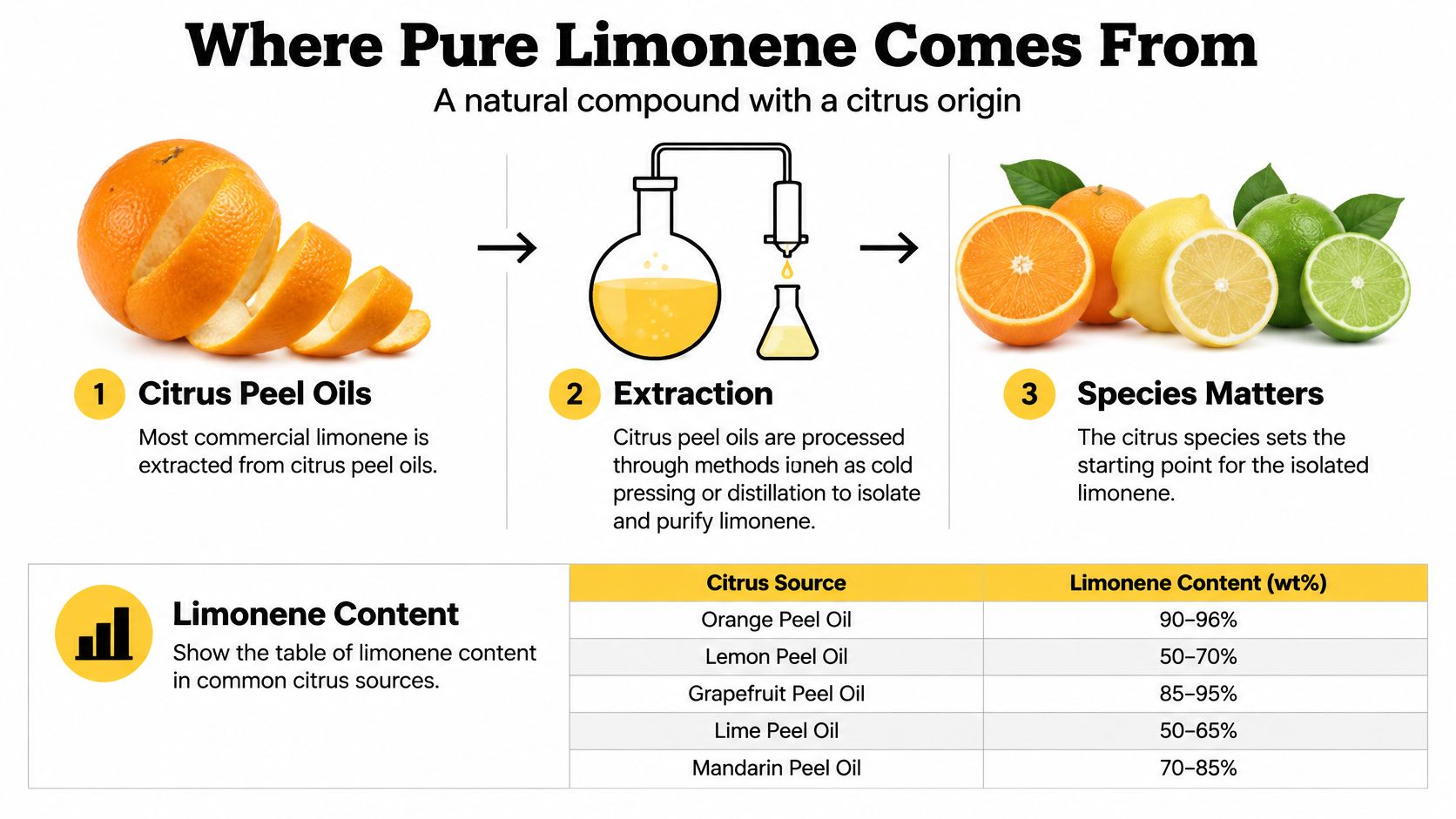
Commercial isolated limonene commonly starts with citrus peel oils. The plant species sets the starting composition, but extraction and isolation determine what the supplier ultimately delivers.
Limonene content in common citrus oils
The NCBI Bookshelf monograph on limonene reports the following approximate limonene shares in solvent-extracted citrus oils.
| Citrus oil | Limonene in oil |
|---|---|
| Sweet orange | About 88% |
| Lemon | About 78% |
| Bergamot | About 72% |
| Mandarin | About 69% |
| Blood orange | About 63% |
| Bitter orange | About 48.85% |
These are oil composition figures, not purity guarantees for an isolated ingredient. A supplier may further separate limonene from the starting oil, so a peel-oil percentage doesn't tell you the assay of the finished lot.
The same name can describe different forms
The monograph also describes orange oil as containing about 95% d-limonene, with the d-form representing 98–100% of the limonene in most citrus oils. Some citronella and lemongrass oils instead contain 96–100% l-limonene within their limonene fraction.
That distinction is called stereochemistry. Think of your hands: they have matching parts, but their shapes are mirror images. Limonene also has mirror-image forms, called d-limonene and l-limonene; a racemic material contains an equal mixture of those forms.
For aroma matching, don't assume those descriptions are interchangeable. Ask for the stated form and evaluate a representative sample in your own base. Also avoid reducing the choice to a simple orange-versus-lemon rule, because accompanying compounds affect the aroma you perceive.
A plant name describes the starting material. A lot-specific specification describes what you're buying.
Trace the botanical route
Our terpenes are botanically derived and extracted from fresh plants. Ask us which source plant and extraction method apply to the limonene you're evaluating, rather than assuming a particular route from the ingredient name alone.
The distinction between extracting a botanical oil and isolating a compound is useful when reviewing supplier descriptions. Our guide to isolation of terpenes provides context for those purchasing conversations.
Request the source plant, stereochemical form, and extraction method on each quote. Compare those answers with your approved aroma target before committing to a bulk order, and retain the sample used for approval as a reference.
Quality Specs to Request on Every Batch
Consider a hypothetical dosing comparison: a 10 g addition from a 95% assay lot delivers 9.5 g of limonene, while the same addition from a 99% assay lot delivers 9.9 g. Those are worked-example values, not specifications for a particular product, but they show why equal ingredient weights don't always deliver equal amounts of the target compound.
The remaining material matters too. An assay tells you how much limonene is present, not what every other component contributes to aroma, compatibility, or finished-product acceptance.
Limonene specs to request per lot
| Specification | Why It Matters | What to Request |
|---|---|---|
| Identity | Confirms the compound you are buying | Lab report confirming limonene identity |
| Assay | Sets real strength per gram for dosing | Percent limonene on a current certificate of analysis |
| Enantiomeric form | d-, l- or racemic form changes aroma character | Stated form, not just the name limonene |
| Residual solvents | Carries into finished goods | Residual-solvent panel results for each lot |
| Oxidation markers | Signals freshness and handling safety | Peroxide or oxidation test data with lot date |
| Storage conditions | Sets practical shelf life | Packaging type and temperature limits |
Read the results, not just the headings
Identity answers whether the material is limonene. Assay answers how much is present according to the stated test method. Keep those questions separate when reviewing a certificate, and check that the reported result belongs to the lot being shipped.
The enantiomeric form needs its own clear statement. Don't assume a general purity result establishes mirror-image composition. For a tight flavor match, ask whether the supplier's method measures the characteristic you need to control.
Residual-solvent results should suit the intended product category. Review reported results alongside the test method and reporting limits, rather than accepting a broad pass statement with no supporting detail.
Freshness needs evidence
A clear appearance and citrus smell don't prove freshness. Ask what oxidation testing was performed, when the sample was tested, and how the material was held afterward.
We provide product terpene information from SC Labs, and our botanically derived cartridge terpenes are SC Lab-tested. Ask us for the matching lab report, then check which tests it includes instead of assuming every report covers every purchasing requirement.
Use our certificate of analysis guide to organize that review. Attach the requirements in the table to your purchase order, agree on acceptance criteria before shipment, and reject lots that can't provide the required documentation.
Why Pure Limonene Goes Off in Storage
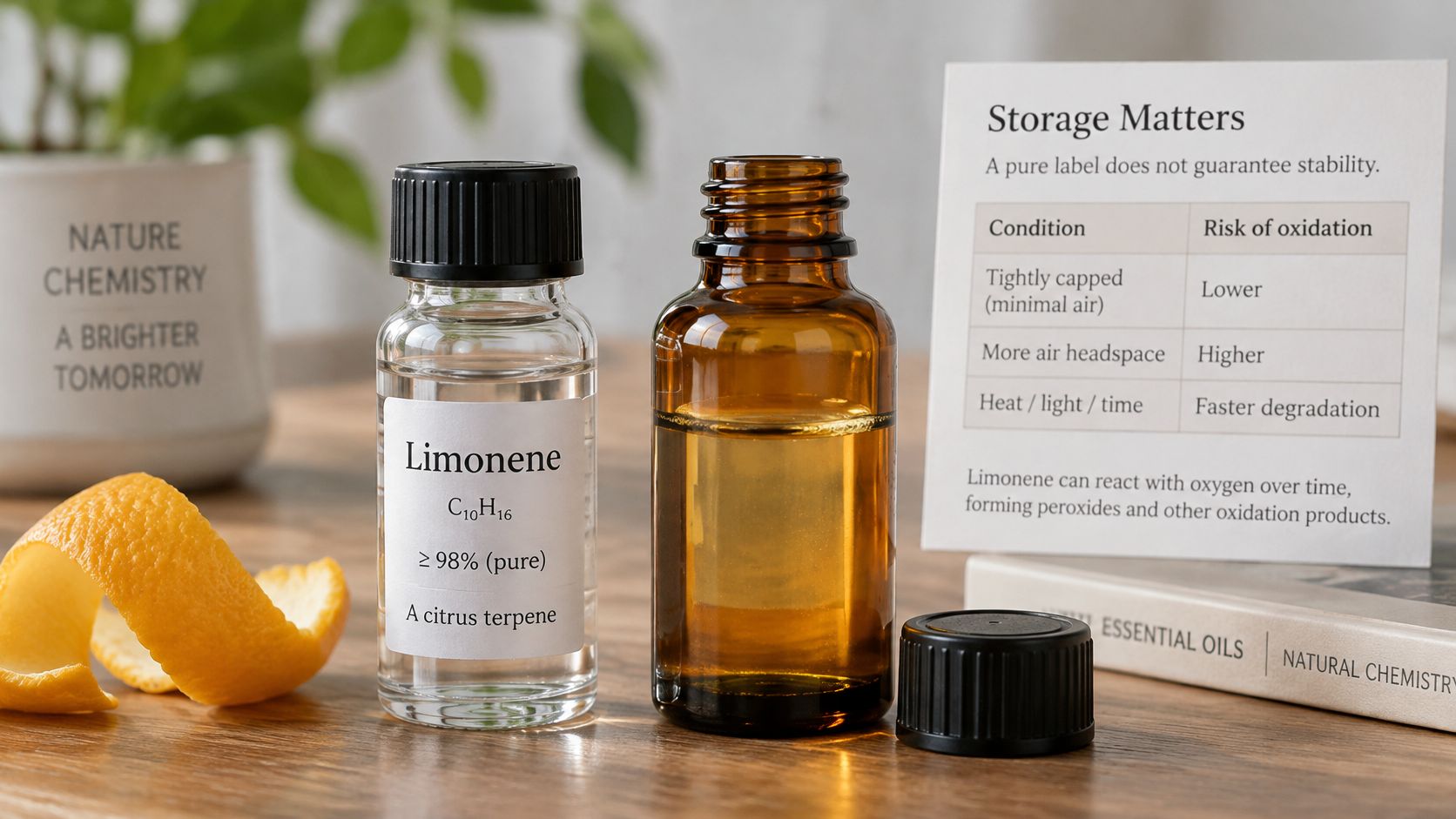
Pure doesn't mean unchanged. For concentrated limonene, oxidation is a central storage risk, not just evaporation. Oxygen exposure can produce hydroperoxides and later breakdown products that alter aroma and raise sensitization concerns.
A limonene stability paper in Flavour and Fragrance Journal describes workplace-simulation findings in which cold, dark storage in closed vessels prevented detectable autoxidation for up to one year without added antioxidant. It also discusses a separate fragrance study that found no measurable limonene decrease or progressive oxidation-product buildup over nine months in typical hydroalcoholic formulations.
Those outcomes aren't universal shelf-life promises. They show why the vehicle, storage conditions, and packaging must match the stability claim.
Control the environment around the ingredient
In an encapsulated-limonene study, microcapsules retained 89.9% at 10% relative humidity, 88.6% at approximately 30% relative humidity, and only 0.6% at 75% relative humidity after three weeks. These findings concern encapsulated systems, not neat limonene in a sealed bottle.
Storage factors and controls for limonene
| Storage Factor | Risk to Limonene | Control |
|---|---|---|
| Oxygen and headspace | Autoxidation forms hydroperoxides | Minimize headspace; reseal after every opening |
| Heat | Speeds oxidation | Supplier-specified cold storage; avoid warm warehouses |
| Light | Encourages oxidation | Opaque or light-limiting containers |
| Humidity in encapsulated forms | Accelerated volatilization; 0.6% retained at 75% RH after three weeks in the study | Barrier packaging and dry storage; 89.9% retained at 10% RH in the study |
| Lot age | Oxidation products can accumulate during exposure | Record opening dates; test older lots before use |
For a slow-use ingredient, smaller working containers may reduce repeated exposure of the main supply. Check seal compatibility and transfer procedures before changing packaging.
Release rule: Record opening dates, control headspace, and assess both assay and an oxidation marker after accelerated storage or repeated opening.
Don't add an antioxidant automatically. Review regulatory acceptability, sensory impact, product compatibility, and analytical verification first; an additive can create a new formulation requirement rather than solve the original one.
Build those controls into a written procedure using our terpene preservation guide as a starting point. Assign someone to inspect container condition and maintain the opening log, not merely record the delivery date.
Safety and Compliance Checks Before Production
A limonene safety data sheet from Chem-Impex lists a US WEEL workplace guideline of 30 ppm as an 8-hour time-weighted average. That's a worker-exposure guideline, not a finished-product dosing ratio or permission to use a particular concentration.
Manage vapor during weighing, pouring, blending, and equipment cleaning. Obtain the current SDS for the supplied grade, and have your safety lead review ventilation, ignition sources, spill response, protective equipment, and storage arrangements.
Confirm the use before approving the purchase
A review of limonene safety and regulatory treatment describes application-specific food-use acceptance, EU REACH and fragrance-allergen requirements, and classification, safety-data, and transport considerations in Canada and Australia. Treat that overview as a prompt for a market-specific review, not as finished-product authorization.
- Intended product category: State whether the ingredient will enter food, cosmetics, fragrance, or an inhalation-related formulation, then identify the rules for that category.
- Route of exposure: Document how people will encounter the finished product; acceptance for certain food uses doesn't establish inhalation safety.
- Maximum concentration: Put the proposed finished-product concentration in writing and have the responsible reviewer check category-specific restrictions and labeling.
- Market-specific documents: Collect the current SDS, applicable EU REACH information and allergen declarations, plus relevant classification and transport documents for Canada, Australia, or other destination markets.
Keep the evidence within its limits
Oxidized limonene derivatives raise sensitization concerns, so include age and oxidation status in the compliance file. Evidence about ozone-reaction products or laboratory exposure models shouldn't be presented as a direct test of your finished cartridge formulation.
Terms such as natural and pure describe an ingredient; they don't establish the legal status of the finished goods. Likewise, food-use acceptance doesn't replace product-specific evaluation.
Our limonene safety-document guide can help organize the handling review. Before ordering, confirm the product category, exposure route, and maximum concentration in writing, with a named person responsible for approval.
How to Test-Dose Limonene in a Blend
A bench trial should answer a narrow question: does this lot produce the target aroma and handling in your actual base? It shouldn't become an improvised safety test or a shortcut around finished-product approval.
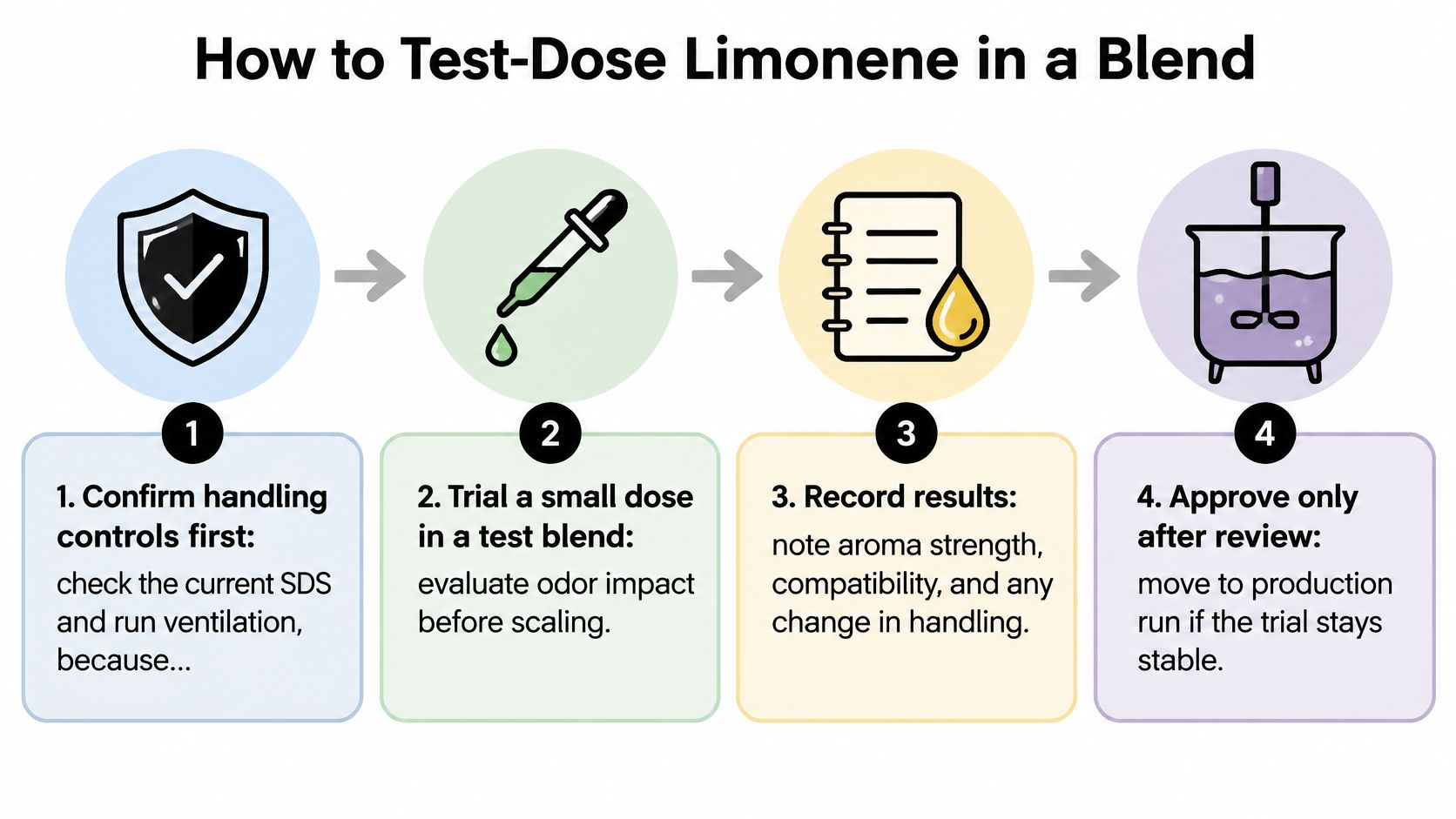
The routine below is a hypothetical screening example, not a validated dosing recommendation. Its trial concentrations, mixing time, and storage interval are starting points for a documented experiment only after your technical and compliance reviewers approve the application.
Run a controlled bench trial
Confirm handling controls first. Check the current SDS and operate the required ventilation before opening the container, because weighing and blending release vapor.
Choose the production base and weigh a hypothetical 10 g finished test batch. Use the intended distillate, an MCT carrier only where appropriate for its product category, or a flavor base, because an unrelated carrier won't represent the actual formulation.
For this hypothetical trial, compare 0.5%, 1%, and 2% limonene by finished-batch weight. Label every sample with its date, ingredient lot, base lot, and dose so the panel results remain traceable.
Add limonene at room temperature with a clean, compatible pipette, then mix for about two minutes as an initial trial condition. Confirm uniformity rather than trusting elapsed time, because a warm or poorly mixed base can change the comparison.
Run an approved aroma panel and check viscosity against the target, adding a taste panel only for an appropriately cleared edible or flavor application. Don't taste concentrated limonene or cartridge blends, because sensory review must match the intended exposure route.
If the formulation is intended for cartridge hardware, evaluate flow, filling, dispensing, and material compatibility using the approved hardware procedure. A suitable aroma doesn't establish acceptable filling performance, and these checks don't establish inhalation safety.
Recheck the chosen sample after one week of controlled storage in this hypothetical screening trial. Compare it with the retained reference because an immediate approval can miss later fading, separation, or a changed aroma.
Keep the batch arithmetic clear
For that hypothetical 10 g finished batch, the example ladder means 0.05 g limonene with 9.95 g base, 0.10 g with 9.90 g base, or 0.20 g with 9.80 g base. These are calculations from the example, not supplier specifications or recommended commercial limits.
Use a balance capable of resolving the smallest addition reliably. Record the actual weights, mixing method, sample temperature, and observations so another operator can repeat the test.
Approval standard: Choose the dose that matches the agreed profile and remains acceptable through the approved stability and performance checks, not simply the strongest-smelling sample.
The final dose comes from the sensory goal, supplier guidance, product category, and finished-product assessment. A short bench trial screens candidates; it doesn't establish commercial shelf life or authorize scale-up on its own.
Order Pure Limonene for Your Blend
Request a sample before placing a bulk order, and include your analytical requirements with the request. Send the intended product, target flavor or aroma, planned dose, batch size, destination market, and whether the blend will enter cartridges, edibles, or another product type.
Choose the right buying route
Shop blends when you need a defined flavor direction rather than a single citrus building block. Compare samples against an approved reference in your own base, and keep the acceptance criteria focused on aroma, compatibility, and manufacturing performance.
Request samples when you're developing a formula or qualifying a replacement lot. Our botanically derived isolates include Alpha Pinene, Beta Caryophyllene, Limonene, Linalool, Myrcene, and Terpinolene; the Pioneer Pack includes one bottle of each, offering a practical way to compare limonene with other isolated components.
Contact our team for bulk or custom orders when you have a flavor target or production requirement to discuss. Ask us to help match the target and confirm which available documents support your specific market review, while keeping final regulatory approval with your responsible reviewer.
Order a sample, run the controlled test-dose routine, and reorder at scale only once the lot passes your documented checks. That sequence makes the buying decision depend on measurable fit, not the word pure.
Gold Coast Terpenes offers botanically derived blends and isolates for product formulation, including Limonene for building and adjusting citrus profiles. Visit Gold Coast Terpenes to shop blends, request samples, or discuss bulk and custom orders with your target profile and specification in hand.