
The 60/40 split is a market description, not a lab standard. For product formulation, Lemon Drop is a sensory target, and Gold Coast Terpenes offers strain-specific terpene profiles and isolates for creators developing cartridge oils.
A freshly mixed sample can smell different from oil delivered later in a cartridge. Monoterpenes can leave the aerosol faster than cannabinoids, so define the target aroma across first puffs and late-session residue, then assess it in the intended hardware. A useful product brief specifies the desired citrus character and how it should hold up through use.
Is Lemon Drop Indica or Sativa for Cannabis Product Formulation?
Brief Lemon Drop as a sativa-leaning hybrid for merchandising, and keep potency claims tied to measured results. Retail labels help position a product. They do not set the chemistry of the oil you manufacture.
Published listings and a laboratory sample show why those fields need separate treatment. Each row describes a particular listing or sample, not a universal cultivar specification.
Published Lemon Drop classification and potency figures
| Source | Classification | THC | CBD | Extra note |
|---|---|---|---|---|
| AllBud 2026 listing | 60% sativa, 40% indica | 18% | 1% | 1% CBN also listed |
| HashDash 2025 cultivar profile | Not given as a ratio | 17% average | Not stated | Cultivar average only |
| Commercial Lemon Drop description | About 60% sativa, 40% indica | 18–25% | Below 1% | Some copy cites THC near 30% |
| One Lemon Drop laboratory sample | Not an indica or sativa test | About 25.62% total THC | 0.21% | About 29.01% THCA and 0.18% delta-9-THC |
The AllBud listing pairs a retail classification with cannabinoid figures. HashDash reports a cultivar average; the commercial description gives a broader range. The lab result applies to the tested material alone.
Keep these figures out of a production target. A cultivar average cannot specify what arrived in a drum, and a flower result does not define finished cartridge oil after extraction, processing, and blending.
Parentage claims also vary. The Lemon Drop cultivar account from This Is Why I'm High identifies Lemon Kush crossed with GSC and Lemon Thai, while other descriptions identify Lemon Tree crossed with Gelato 41. Treat either lineage as a reported description unless supporting documentation traces it to the material you are using.
Briefing rule: Use the retail classification for merchandising; put measured chemistry in the formulation specification.
For manufacturing, keep sativa-leaning hybrid as the descriptive line. Require a current batch certificate of analysis for the reference material and separate documentation for the finished oil. That keeps flavor matching distinct from potency or lineage claims.
Why Do Indica and Sativa Labels Fail as a Formulation Spec?
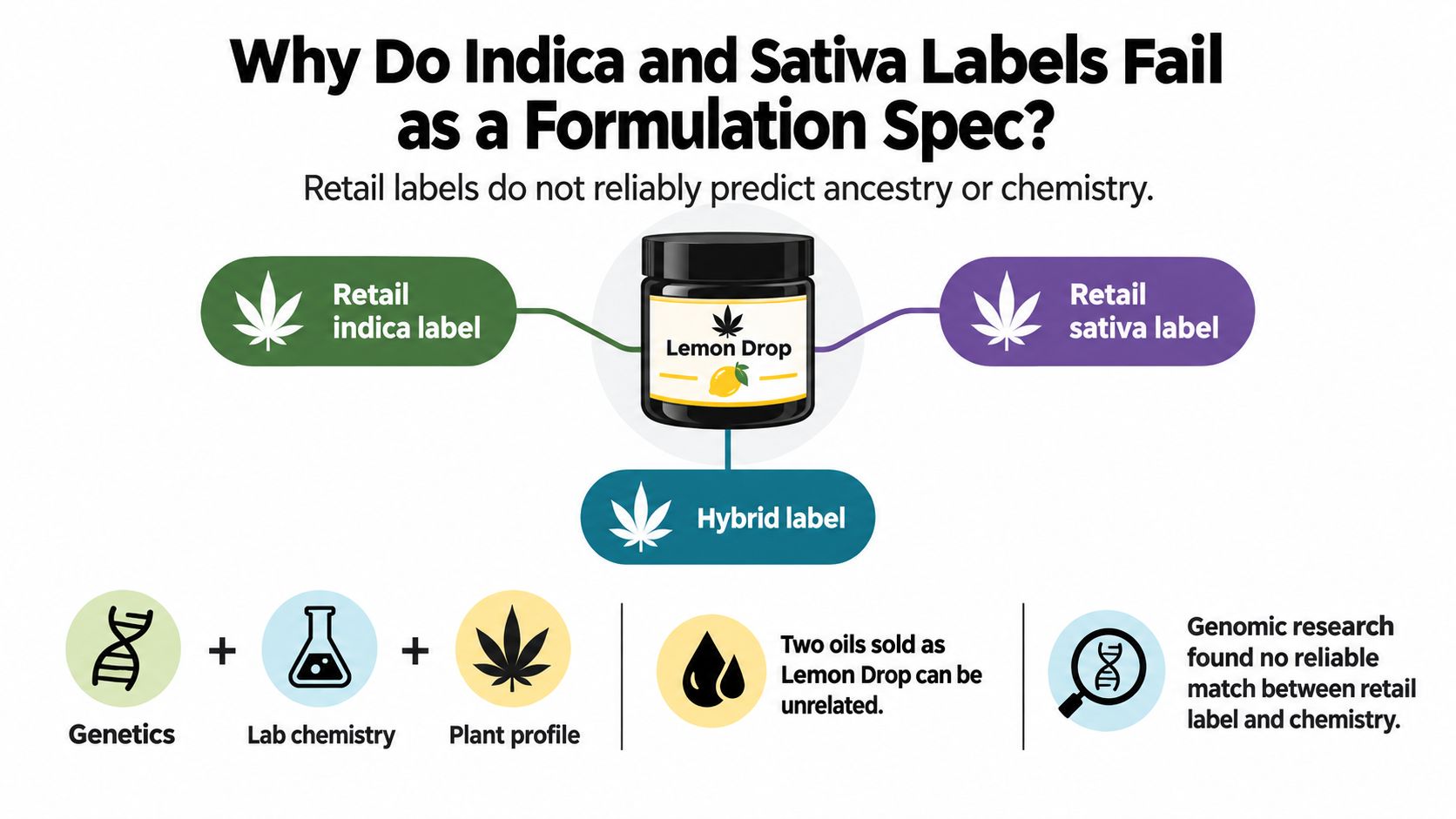
Two oils sold as Lemon Drop can carry different COAs and deliver different flavor, even when the package gives them the same indica or sativa label.
A genomic analysis of retail cannabis found no clear genetic separation among products marketed as Sativa, Hybrid, and Indica. For product development, that makes the label useful for merchandising, not a substitute for measurable specifications.
What replaces the retail label?
Set these requirements before adjusting a blend:
- Target analytes and ranges: Specify individual terpenes, total terpene loading, and cannabinoid requirements for the finished matrix.
- Sensory language: Define notes such as lemon peel, sweet citrus, light pine, and pepper. Also identify unwanted notes, such as excessive floral character or sharp, one-dimensional citrus.
- Oil matrix: State whether the base is winterized distillate, live resin, or hemp oil. Results in one matrix may not transfer unchanged to another.
- Hardware: Record the cartridge, heating configuration, and operating conditions used for qualification.
- Reference ownership: Assign responsibility for retaining the approved reference, its COA, and the formulation revision.
The name sells the oil; the brief defines it.
A COA reports the analytes included in the laboratory's scope for the submitted sample. It does not, by itself, prove pedigree, establish a particular effect, or predict how the aerosol will taste after repeated heating.
Gold Coast Terpenes' guide to indica, sativa, and terpene terminology can help teams keep category language separate from formulation decisions. Marketing can set the product positioning; development and quality teams should define and control the measurable specification.
Which Terpenes Define a Lemon Drop Profile for Vape Cartridges?
Leafly's Lemon Drop strain profile lists myrcene as the dominant terpene, followed by pinene and caryophyllene. That chemistry offers a useful reference, while the lemon character of a cartridge remains a sensory target to build and assess in the finished oil.
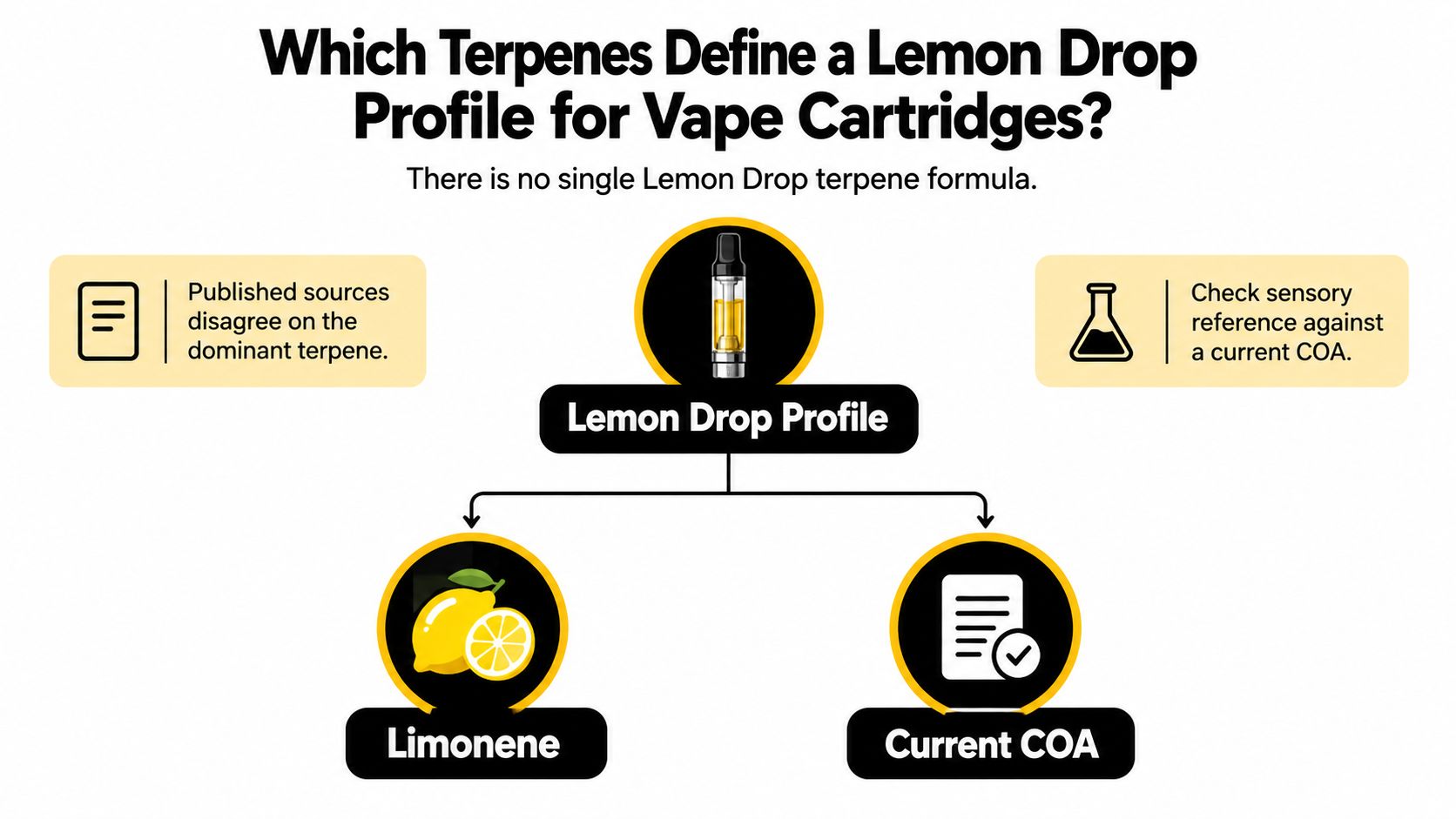
Lemon Drop note roles for a strain-inspired blend
Use top, middle, and base notes as sensory roles that guide formulation. The table gives each compound group a practical flavor job, rather than promising a fixed order of release in the aerosol.
| Note | Compounds | Flavor job | Formulation use |
|---|---|---|---|
| Top | Limonene, alpha-pinene | Bright lemon and pine freshness | Lead the aroma; keep it from turning harsh |
| Mid | Myrcene, linalool | Sweet fruit and soft floral body | Fill the gap between sharp lemon and the plant-like aroma |
| Base | Beta-caryophyllene | Pepper and spice structure | Stop the blend reading as single-note citrus |
Start by identifying what the reference profile lacks. A weak lemon identity calls for a different adjustment than an overly floral finish. Changing several compounds at once makes the source of a sensory shift harder to identify.
Limonene is the direct lever for citrus identity. Alpha-pinene adds a fresh pine edge, but too much can pull the profile away from lemon. Myrcene and linalool can add body and softness; keep their contribution in balance so the finish does not become overly perfumed. Beta-caryophyllene adds peppery structure to a plant-like citrus profile.
Gold Coast Terpenes' lemon terpene profile guide can help translate sensory language into a blend brief. Specify the intended lemon character and acceptable supporting notes before ordering a production blend.
This video provides an additional visual reference for the profile discussion.
Verify the blend, not just the description
For the batch under review, request individual terpene percentages, total terpene content, cannabinoid results, and relevant contaminant results. Check the laboratory's reporting scope: a document called a COA does not necessarily include every panel.
Approve chemical and sensory matches as separate gates. A blend can match selected analytical ratios without matching the reference aroma in the oil matrix; a convincing aroma alone does not establish that the source plant's chemistry has been reproduced. Judge the intended profile in the finished cartridge, including its first puff and the character that remains later in the session.
How Does Cartridge Heat Change Lemon Drop Citrus Notes?
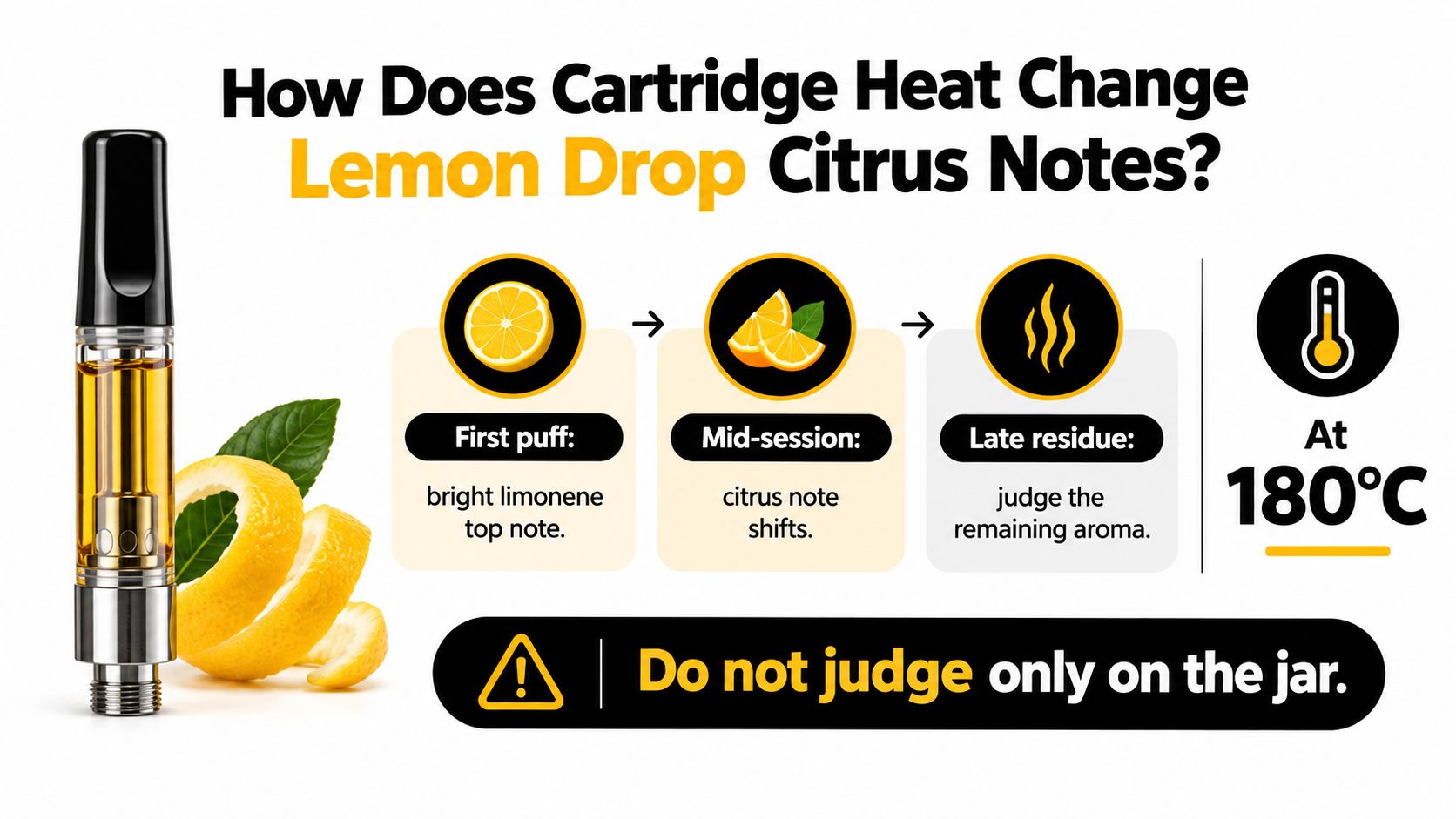
A Lemon Drop cart can pass its first-puff check and still disappoint near depletion. The opening draw reads bright and lemony; late in the tank the aerosol skews peppery and flat even though cannabinoid delivery stays roughly constant. Volatility drives that drift. Monoterpenes leave the aerosol far faster than cannabinoids, so each puff strips a higher fraction of the compounds carrying the lemon identity.
Judge Lemon Drop as a session-long sensory target, because a strong opening aroma doesn't establish a consistent finished product.
A peer-reviewed review of cannabis vaporization reports approximate vaporization rates relative to THC at 180°C of greater than 3,500 times for beta-myrcene, 2,200 times for linalool, 380 times for beta-caryophyllene, and about 23 times for bisabolol; it also describes material terpene loss across 180–220°C and nonlinear responses to temperature changes.
A jar-only approval can't capture any of that. The bulk oil in the bottle never experiences what the aerosol does.
Relative terpene loss relevant to Lemon Drop carts
| Compound | Reported heat behavior | Session role | Blend implication |
|---|---|---|---|
| Beta-myrcene | Rapid evaporation relative to THC; the molecule itself survives heat comparatively well | Early flash despite relative heat stability | Don't judge only bulk-oil smell |
| Linalool | Evaporates substantially faster than THC in the cited review | Middle-note character can leave early | Sweetness can fade before spice does |
| Beta-caryophyllene | Slower than myrcene and linalool in the cited comparison | More persistent sesquiterpene structure | Pepper character may outlast lemon |
| Bisabolol | Slowest relative vaporization among the compounds compared here | Potentially more persistent supporting character | Check whether the remaining aroma becomes softer |
| Terpinolene | Low molecular survival as temperatures rise | Citrus-floral extender that fades fast | Retest in hardware before using it to extend lemon |
Each row reports a different measurement. Evaporation tracks a compound leaving the liquid; survival tracks whether the molecule remains intact under the tested heating conditions.
A heat-stable molecule can still disappear early from the liquid through evaporation.
Run a session-based sensory test
Evaluate the first puff, mid-session aerosol, and late-session residue under a controlled protocol, and score each stage separately rather than averaging them. Keep hardware, airflow, puff duration, and resting intervals consistent so reviewers aren't scoring different operating conditions.
At the opening, assess whether the citrus is recognizable without becoming sharp. During the middle, check whether the fruit body remains connected to the lemon. Near depletion, look for a disproportionate peppery, floral, or flattened finish. That skew is predictable: the faster monoterpenes leave first, so the remaining oil grows relatively richer in slower compounds like beta-caryophyllene and bisabolol as the reservoir empties.
Don't fix every late-session defect by raising the initial citrus loading. A heavier opening dose can make the first draws unacceptable without solving delivery through the rest of the cartridge.
How Do You Blend a Lemon Drop Terpene Profile into Distillate?
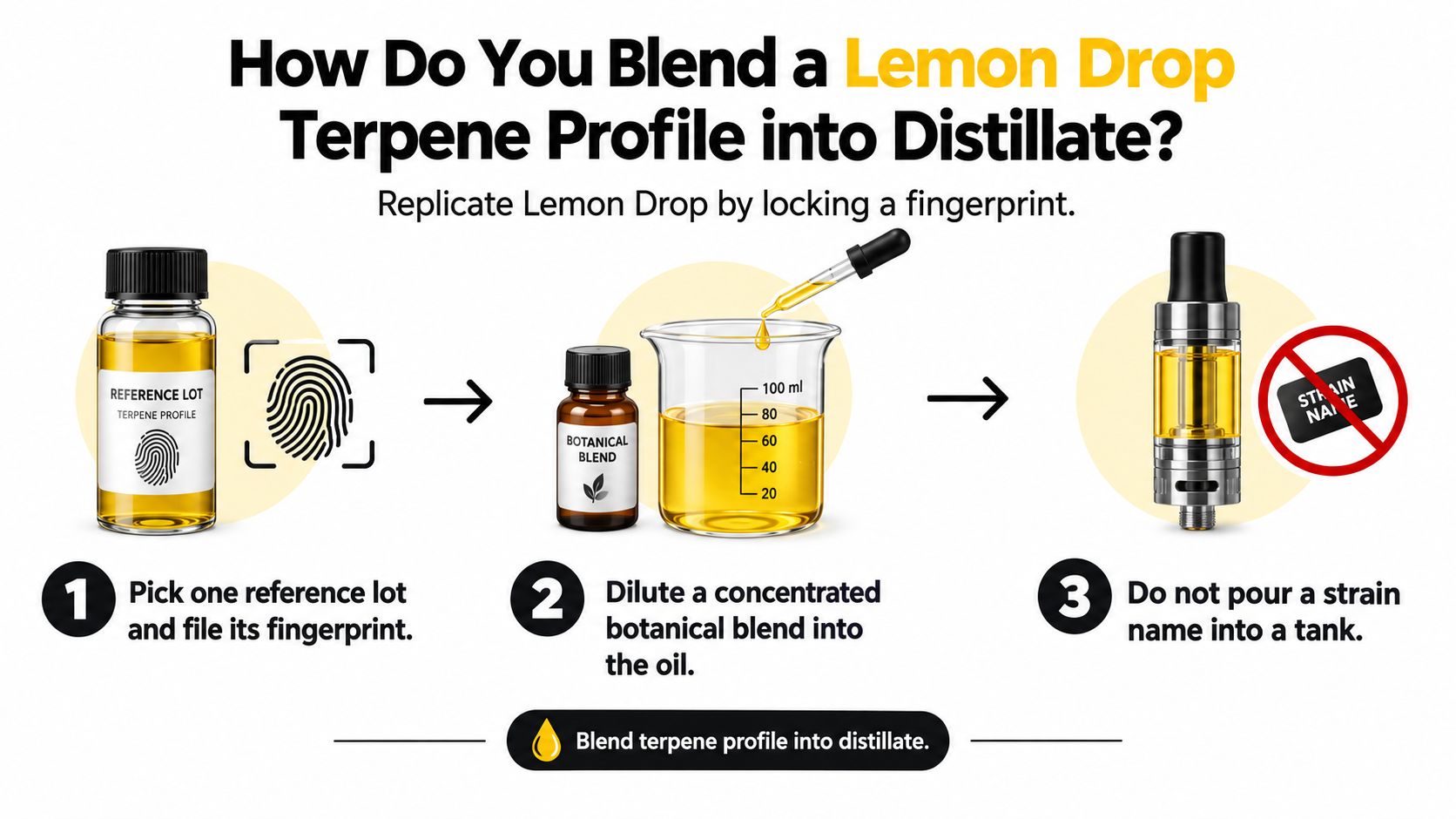
Pick one reference lot of Lemon Drop before anything touches a mixing vessel. Treat the strain name as a reference label, not a mixing instruction. The addition rate comes from the blend specification and the hardware requirements, so a percentage that worked in one oil matrix tells you little about the next.
From there, run a documented development sequence rather than adjusting a production tank by smell.
Build and qualify the trial
Pick one reference lot and file its COA. Retain the approved sensory reference alongside its analytical fingerprint. This prevents different team members from matching different interpretations of Lemon Drop.
Write target ranges and descriptors. Include limonene, myrcene, alpha-pinene, and beta-caryophyllene, plus any supporting analytes the reference requires. Define the target before making corrections.
Start with a citrus profile and correct specific gaps. Use limonene for lemon identity, pinene for freshness, and caryophyllene for spice where the measured and sensory comparison supports the change. Avoid building a single-note profile through repeated citrus additions.
Establish the dilution procedure before handling the concentrate. Gold Coast Terpenes' strains are highly concentrated and must be properly diluted before use. Prepare a measured premix using the approved formulation matrix and supplier handling documentation, not an improvised carrier.
Incorporate the premix into a weighed trial of winterized distillate. Begin conservatively within documented application guidance, mix until uniform, and record temperature, viscosity, component masses, and material recovery. This makes an unsuccessful trial diagnosable.
Fill the intended cartridge hardware. Qualification in a different cartridge doesn't resolve compatibility with the production device.
Score the aroma across the full session. Record the specific defect rather than just marking a sample acceptable or unacceptable. A weak finish and an aggressive opening require different adjustments.
Compare post-fill results with the pre-fill panel. Set acceptable analyte drift and stability criteria before scale-up, then retain samples from the approved run.
Account for thermal survival separately
An Entour Brand summary of Korzun and colleagues' 2021 heating study reports approximately 97–98% survival for myrcene versus roughly 11–28% for terpinolene at the higher temperatures tested across 100–500°C. Those are laboratory heating results rather than finished-cartridge retention guarantees, so qualify any terpinolene-containing revision in your own hardware after thermal exposure.
Gold Coast Terpenes' distillate mixing resource can support the process documentation. Keep the approved formula under revision control, and give a sweeter lemonade direction its own development identity instead of changing the Lemon Drop specification.
Which Citrus Profiles Should You Trial Beside Lemon Drop?
| Trial direction | Profile examples | Declared flavor direction | Development question |
|---|---|---|---|
| Orange citrus | Tangie | Citrus, orange, sweet | Does orange body suit the intended product better than lemon sharpness? |
| Sweet lemonade | Pink Lemonade; Raspberry Lemonade | Lemon, strawberry, sweet; lemon, raspberry, sweet | Is the product becoming a fruit-lemonade concept rather than a cultivar-inspired match? |
| Tropical citrus | Pineapple Express; Sour Mango | Pineapple, sweet, tropical; mango, diesel, citrus | Does the brief call for tropical fruit or a more fuel-accented citrus finish? |
This table earns bench time when the product brief moves toward orange, lemonade, or tropical fruit. If the target is still a lemon-and-spice cultivar match, hold Lemon Drop as the reference and leave the neighbors on the shelf.
Gold Coast Terpenes offers more than 50 strain profiles across Indica, Sativa, and Hybrid categories, plus isolates for targeted adjustment. Its Flavor-Hybrid Strains selectively raise certain rare and exotic terpenes to bring out fruity nuances. That serves a different development objective than reproducing a fixed reference, so code those samples separately rather than grading them against the Lemon Drop target.
Run the trials under identical conditions
Present each direction as a separate coded sample in the same oil matrix and the same cartridge hardware. If every trial uses a different matrix or device, reviewers cannot attribute the sensory difference to the profile itself.
A useful comparison sheet separates lemon recognition, sweetness, pine character, spice, fruit direction, and finish. Score the opening puffs apart from late-session pulls, because bright citrus top notes read strongest early while the residue that accumulates over a session skews perception toward whatever survives the heat. A sample that wins on the first draw can still finish heavy or flat, and that failure mode points to a different fix than a weak opening.
Have reviewers record whether each sample fits the intended product identity. The sweetest entry is rarely the most accurate one.
Range-development advice: Approve a new flavor direction as a new product decision, with its own specification and development identity. An undocumented correction to the Lemon Drop formula just hides the change inside a drifting spec.
Where a direction needs adjustment rather than a full profile swap, keep the isolate additions short, dose them against the same control, and record each change individually.
Maintain that control sample through every round. Without it, successive revisions can drift well past the approved target while each single adjustment still looks reasonable on its own.
How Do You Choose a Botanical Terpene Supplier for Lemon Drop Vape Brands?
A Lemon Drop brief can smell right on a blotter and still fail procurement if the supplier cannot prove ingredient origin, lot continuity, handling limits, and change control. Qualify the chemistry before the flavor story: botanical sourcing is a labeling and supply-chain distinction, while the filled cartridge still needs its own potency, contaminant, and hardware data.
Gold Coast Terpenes fits this kind of sourcing review as a supplier of premium, 100% natural terpene blends, strain-specific profiles, and isolated compounds for cartridges, concentrates, and product formulation. Its catalog gives a formulator room to work: 50+ Indica, Sativa, and Hybrid profiles, plus isolates such as Alpha Pinene, Beta Caryophyllene, Limonene, Linalool, Myrcene, and Terpinolene. For a Lemon Drop sensory target, that breadth serves the practical job: tune first-puff citrus lift and protect late-session balance, because lighter monoterpenes can leave the aerosol faster than cannabinoids.
Score suppliers against the same requirements
- Sourcing: Separate botanical, cannabis-derived, and nature-identical inputs in writing. Ask for origin and manufacturing method for each aromatic component, then carry that wording into the specification.
- Documentation: Require lot-specific identity and composition records, contaminant results relevant to the input, safety documents, and sample identifiers that match the delivered material.
- Form: Confirm concentration, dilution limits, and incorporation order before scale-up. Highly concentrated strains need proper dilution before use, so the handling procedure belongs in the manufacturing record.
- Matching capability: Look for both complete-profile matching and measured isolate corrections. A picker pack that lets a buyer compare three different profiles can support sensory screening; isolate availability supports small corrections after the control sample is set.
- Order terms: Confirm MOQ, sample terms, lead time, lot continuity, change notification, and wholesale or bulk terms before scheduling a run. Retail listings rarely settle production terms.
Gold Coast Terpenes' terpene company selection guide can support that procurement checklist. The strongest supplier is the one whose documentation, repeatability, and communication survive the brand's own qualification process.
Keep packaging distinct from substantiation
A flavor story should help buyers recognize the product while the spec sheet carries the technical truth. For visual positioning, Wecomeet's presentation of a gourmet brand in a design portfolio is a useful cross-category reference for separating sensory identity from ingredient information.
Use specification sheets and ingredient documentation to substantiate sourcing language. Have counsel review the finished label, including botanical-origin wording and any strain-inspired description, against the rules that apply to the product and market.
What Should You Settle Before Ordering a Lemon Drop Terpene Blend?
A Lemon Drop order becomes a production ingredient only after four decisions are settled: the commercial description, the analytical targets, the reference sample, and the hardware qualification plan. Leave any of them open and the shipment arrives as a development sample, whatever the invoice says.
Treat the buyer questions below as the final approval check.
Is Lemon Drop indica or sativa on a cartridge label?
Sativa-leaning hybrid is the defensible market description when it matches your documented reference. The filled oil’s potency and effect claims must come from its own lab testing; the cultivar name contributes no analytical evidence.
Which terpene should lead the flavor?
Set the lead by the session the product is selling. Limonene reads as sweet lemon candy and suits an uplifting positioning, while a pinene-forward balance reads drier and suits a zest or peel target. Keep myrcene below 0.5% if the blend should stay energizing, because profiles above that level produce a more sedative effect.
Can a concentrated blend go into a vape neat?
No. Gold Coast Terpenes’ strains are highly concentrated and need proper dilution before use, followed by qualification in the intended finished formulation.
Should the brief specify botanical or cannabis-derived sourcing?
Yes. Put ingredient origin in the procurement specification and carry the same wording into label review, so the sales description and the specification sheet state the same source.
Which isolates support a useful trial?
Choose the isolate that matches the gap you are correcting: limonene for a fading top note, beta-caryophyllene for a thin finish. Change one isolate per run and compare each adjustment against an unchanged control in the same hardware.
Request the current COA, run the three-profile picker comparison in the production matrix, and qualify the ratio that keeps its lemon identity into the cartridge's final portion. Judge it there, at the end of the tank: citrus monoterpenes leave the aerosol faster than the heavier fractions, so a blend that passes on the first puff can still fail the last. Approve the finished formulation only when its analytical record and session performance both meet the acceptance criteria.
Gold Coast Terpenes supplies botanical terpene profiles and isolates for developing a Lemon Drop-inspired citrus formulation. Visit Gold Coast Terpenes to select a trial set, request current documentation, and confirm order terms before scaling the blend that passes your hardware test.