
Gold Coast Terpenes, a Redondo Beach, CA supplier, makes 100% botanically derived terpene blends, not cannabis-derived blends, for vape, CBD, and cannabis brands that need repeatable flavor targets. That's the right starting frame for any London Cake strain project, because the name on a flower lot doesn't guarantee the chemistry inside it.
If you're building a terpene profile for London Cake, you're not copying a fixed recipe. You're setting a sensory target, choosing a reference batch, and proving that your finished oil still matches that target after blending, storage, and heating. That distinction drives every decision that follows, from ratio selection to state compliance and release testing.
What Does the London Cake Terpene Profile Look Like, and Why Does It Shift Between Batches?
Two published London Cake batches can both read as sweet, spicy, and earthy while showing different dominant terpenes, different totals, and different ratios. That variability is why Gold Coast Terpenes, a supplier of premium, 100% natural terpene blends and strain-specific profiles, treats London Cake as a sensory target confirmed by batch data.
Start with the numbers before you talk about flavor language. Formulators who skip that step build from a strain description instead of a measurable lot, then wonder why the second production run doesn't match the first.
Reading the Reference Batches
Published London Pound Cake terpene reference batches
| Reference batch | Total terpenes | Caryophyllene | Limonene | Humulene | Other leading terpenes |
|---|---|---|---|---|---|
| Retail flower listing, London Pound Cake | 1.11% | 0.64% | 0.25% | 0.22% | None listed beyond the top three |
| London Pound Cake 75 lab batch | 1.41% | 0.27% | Not in the reported top three | Not in the reported top three | Trans-nerolidol 0.29%, myrcene 0.22%, top three 55.3% of terpenes |
The first column names the source of the data, and that matters because a retail flower listing and a lab batch record aren't interchangeable documents. The total terpenes column tells you how much aromatic material the panel measured in that lot. It doesn't tell you how much terpene blend to add to distillate, and confusing those two numbers is a common formulation error.
In the retail flower listing, the Planet Nugg London Pound Cake product listing reports 1.11% total terpenes, with beta-caryophyllene at 0.64%, limonene at 0.25%, and humulene at 0.22%. Those three compounds account for almost all of the reported dominant terpenes in that panel, a relative ratio of approximately 58:23:20 for caryophyllene, limonene, and humulene.
That ratio gives you a concrete starting architecture for replicating the London Cake flavor: a prominent peppery sesquiterpene layer, a smaller citrus lift, and a dry woody component close behind the citrus. It stays useful only as long as you treat it as one batch's snapshot.
The TerpTrace London Pound Cake 75 batch record measured 18.4% THC and 1.41% total terpenes, with trans-nerolidol at 0.29%, beta-caryophyllene at 0.27%, and myrcene at 0.22%. Those three compounds represented about 55.3% of the measured terpene content, leaving a much larger share of the profile outside the top three than in the retail listing.
Why the Spread Happens
Reported THC values for London Cake flower and products vary widely across batches, formats, and sources, and the dominant terpene order isn't fixed either. The spread is wide enough to change how you'd write a specification, brief a co-manufacturer, or approve a supplier lot.
The lineage doesn't remove that uncertainty. One of London Cake's reported parents is unverified, so family resemblance is the only thing lineage can explain: sweet dessert character over a heavier structure. No terpene percentage can be derived from it.
Phenotype, cultivation conditions, harvest timing, curing, and storage do the practical work. A plant picked earlier, dried warmer, or stored longer won't hold its volatile fraction the same way a carefully handled lot will. Extraction adds another variable, because your distillate base carries its own native terpene residue into the cartridge before you add anything.
Practical rule: Pick one reference batch, convert it to a ratio, and write an acceptable window around that ratio. A specification that simply says "London Cake" isn't a specification.
A useful internal specification has three parts. It names the reference lot or reference profile, sets a target ratio with tolerances, and defines the sensory checkpoints the finished oil must pass. The analytical window keeps purchasing and production aligned, while the sensory check catches problems a panel can miss, such as a blend that hits the numbers but reads harsh or flat in your hardware.
Use a structured guide to lab report interpretation when your team reviews a certificate of analysis, because the lot number, test date, sample type, and reporting units all affect whether two documents are comparable. A COA for flower doesn't validate a cartridge, and a COA for a terpene concentrate doesn't validate the finished oil. Each document answers a different question.
I would start any London Cake strain-inspired terpene blend from the 58:23:20 architecture, then adjust against your own base and hardware. Keep caryophyllene clearly in front, protect the citrus top without letting it dominate, and verify the finished blend against a target COA. That is how the name becomes a production standard that survives scale-up.
How Do Top, Mid and Base Terpenes Divide the Work in a London Cake Blend?
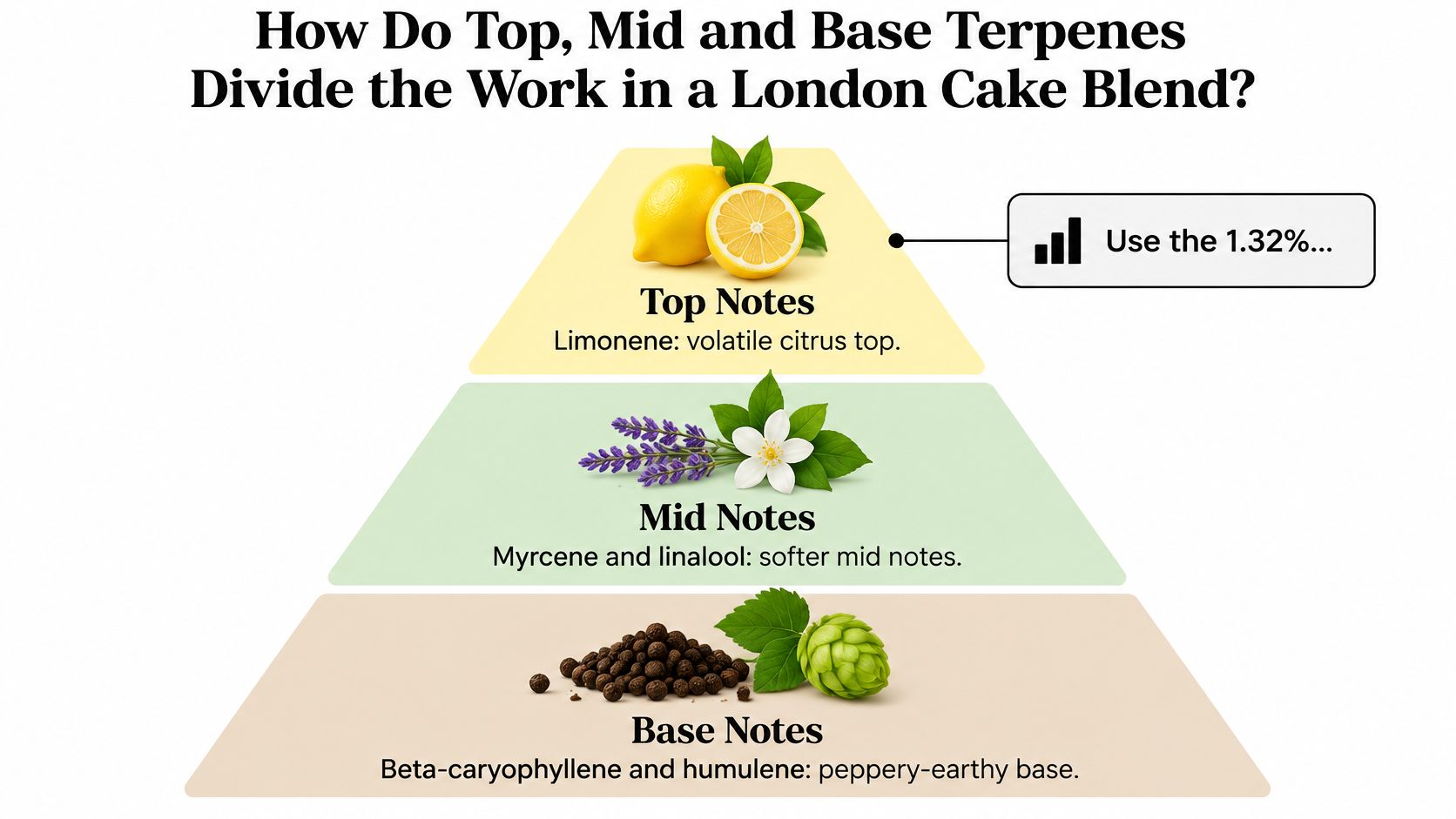
Beta-caryophyllene and humulene form the peppery, earthy base, myrcene and linalool form the softer mid notes, and limonene forms the volatile citrus top. The base should carry the largest share, because it is the part that keeps the profile recognizably London Cake after the first bright impression fades.
Each tier does a different job on the clock. The top note registers first and fades fastest, the mid notes supply body and roundness, and the base notes persist longest and leave the dry, peppery finish.
A Worked Distribution
The King of Budz commercial flower listing reported 1.32% total terpenes, with beta-caryophyllene at 48.48% of the terpene fraction, limonene at 18.94%, humulene at 16.67%, beta-myrcene at 8.33%, and linalool at 7.58%. Mapped to tiers, that puts the caryophyllene and humulene base near two thirds of the listed fraction, the myrcene and linalool mid near one sixth, and the rest as the limonene top.
That balance explains the sensory sequence. Limonene gives the first lemon-like lift, but it is a minority component. Myrcene and linalool soften the middle so the blend doesn't read as straight spice. Caryophyllene and humulene supply the warm, peppery, woody weight that remains on the exhale.
- Top tier: Limonene leads with citrus brightness and needs protection from heat and unnecessary headspace.
- Mid tier: Myrcene adds earthy body and linalool adds a softer floral edge that rounds sharp spice.
- Base tier: Caryophyllene and humulene anchor the blend and should remain the combined majority.
If the top share grows beyond its reference weight, the blend drifts toward a generic citrus profile. You still have a pleasant cartridge, but you no longer have the London Cake strain target your label promises. The reverse error is real too. An oversized base can taste dry and heavy before the dessert character has time to come through.
Gold Coast Terpenes lists over 50 strains from the Indica, Sativa and Hybrid categories, which gives formulators reference material for benchmarking how a tier split behaves in finished oil. A flavor-hybrid profile such as Apple Fritter can sit beside a stricter strain profile during panel work and show how far the fruit note can push before the base loses the room.
Don't treat the 1.32% distribution as a universal recipe. Set a sensory checkpoint for each lot, in your distillate and your device, and record whether the citrus appears first, the mid stays present, and the base finishes cleanly. The safer assembly order is base first, mid second, top note last, because overcorrection shows up earlier in that sequence.
Which State Limits and Labeling Rules Apply to London Cake Cartridges?
New York limits vaporized or inhaled products to 10% total terpenes, with a stated 15% variance, and the state requires terpene testing for all cannabis products. Vermont guidance caps terpene content in inhalable products by weight and requires concentrated terpenes added to those products to be disclosed. Illinois treats terpene testing as optional, so a filing built to satisfy one state leaves the formulation undocumented in another.
Terpene testing, limits and disclosure by jurisdiction
| Jurisdiction | Terpene testing | Inhalable terpene limit | Disclosure |
|---|---|---|---|
| New York | Required for all cannabis products | 10% total terpenes, 15% variance | Testing results documented for the product lot |
| Vermont | Documentation expected for added concentrates | Weight-based cap on terpene content | Concentrated terpenes added to inhalable products must be disclosed |
| Illinois | Optional | No terpene-specific cap stated | No terpene-specific disclosure rule stated |
What the Table Means for Formulation
Apply the limit to the finished inhalable product, not to the strength of the bottle you bought. Count the native terpenes already in the base distillate together with the terpenes you add, then express the total the way the destination state requires.
Adding flavor until a bench sample tastes right isn't a compliance method.
Keep the batch record tight. Record the base lot, terpene blend lot, added percentage by weight, mixing date, and finished-oil result so a regulator or retail partner can trace the claim. State which jurisdiction's rule set the load was built to satisfy, because that single line tells an auditor which ceiling the formulation was measured against. If a finished oil lands above a destination state's cap, the choices are reformulating the lot or restricting where it ships, and neither option is cheap once cartridges are filled.
Labeling the Origin Correctly
Describe each blend by origin. Botanically derived and nature-identical answer different sourcing questions, and swapping one term for the other creates label risk. Gold Coast Terpenes, a Redondo Beach, CA supplier of 100% natural terpene blends, anchors the botanical side of that comparison. A cannabis-derived input carries different documentation, and a nature-identical input needs accurate naming rather than botanical language borrowed for marketing comfort.
The New York testing limits document classifies terpenes as aroma compounds, so keep label language sensory. A terpene percentage must not become an effect claim, a potency claim, or a medical claim. Every terpene statement on the label should check out against the batch COA for that finished lot.
Run a regulatory compliance checklist for terpene products before artwork is locked, because relabeling filled cartridges costs far more than a pre-launch review. I would build to the strictest limit across the states you sell into and confirm current rules again before launch, since state testing manuals change.
How Do You Build a London Cake Blend for a Vape Cartridge?
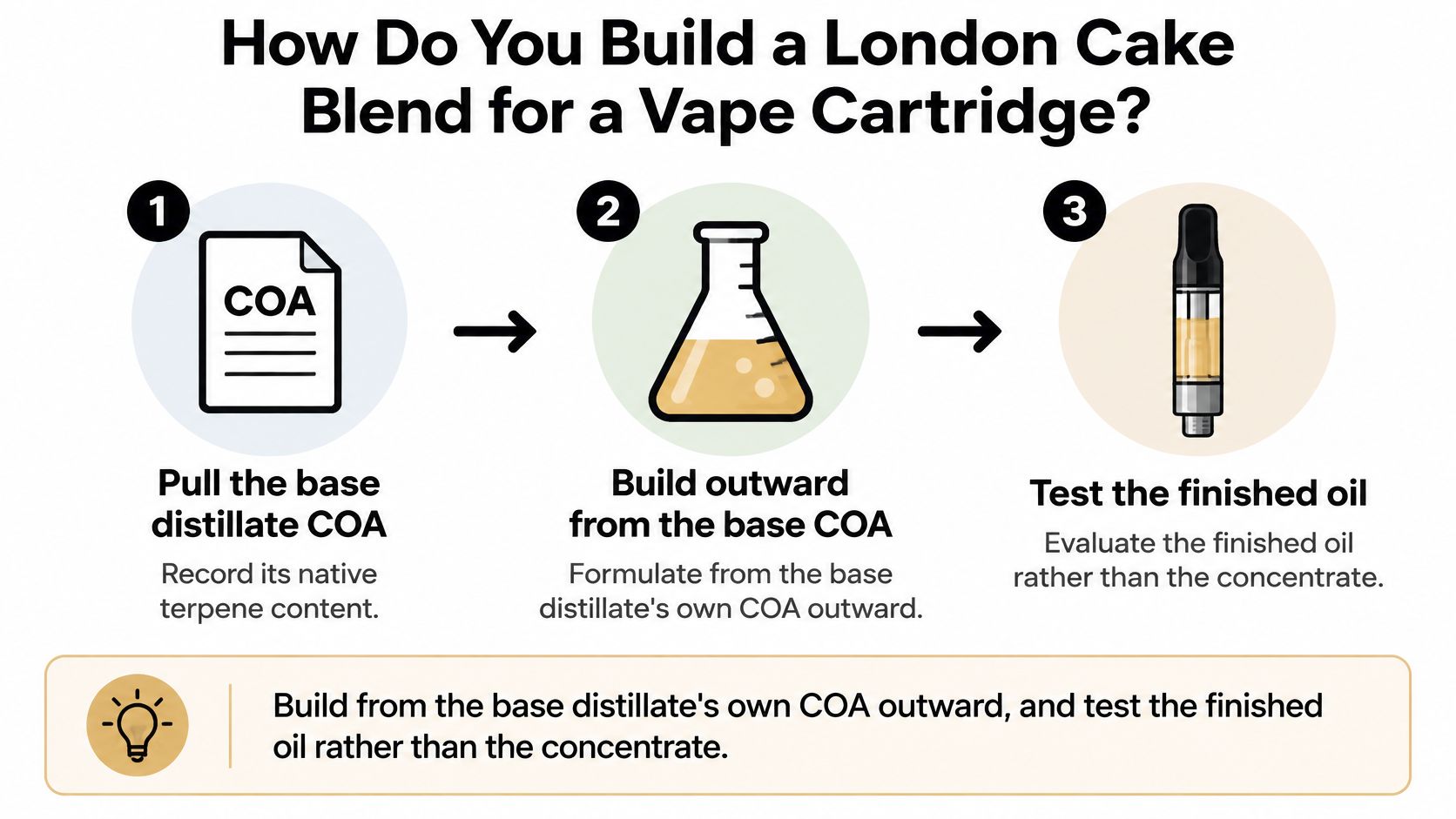
Build from the base distillate's own COA outward, and test the finished oil rather than the concentrate. That order prevents the most expensive mistake in formulating a London Cake terpene profile for vape cartridges: approving a pleasant-smelling blend that fails once it's diluted, heated, and filled.
The visual below compresses the production logic into the three control points your team shouldn't skip.
Step by Step Build
Pull the base distillate COA. Record the native terpene content separately from any terpenes you'll add. If the base already carries measurable caryophyllene or limonene, your added ratio has to compensate rather than stack blindly on top.
Set the target ratio from the reference batch. Keep caryophyllene as the largest share, with limonene and humulene supporting it near the published 58:23:20 relationship. Write the target as a window, because weighing tolerance and base variation will move the result slightly.
Calculate added terpene by weight. Decide the planned load for the finished oil and confirm that native plus added terpenes stay under the strictest applicable state limit. Work in grams, not drops or volume estimates, so the batch can be repeated by another operator.
Pre-blend the terpene set in one vial. A single pre-blend holds the internal ratio steady when you scale or split the batch. It also reduces the chance that a small limonene weighing error becomes a large sensory error.
Add the blend to the distillate and mix until uniform. Warm only as much as your standard process requires for flow and homogeneity. Excess time open to air works against the volatile fraction you're paying to keep.
Test the finished oil. Compare the result with the target COA, then run a sensory panel in the intended cartridge hardware. A beaker sample can't tell you how the oil behaves through a coil, wick, and restricted airflow path.
Record the lot, ratio, and sensory result. Note the base lot, terpene lot, exact weights, mixer, fill date, and panel outcome. That record is what lets you correct the next run with evidence instead of memory.
The short video below is useful when you're training a new operator on the physical handling sequence before they touch a production batch.
A 100 Gram Worked Example
Say you're preparing 100 g of finished oil at a 3% added terpene load. That means 3 g of terpene blend and 97 g of base oil, before you account for any native terpenes in the base.
Split that 3 g using 57.7% caryophyllene, 22.5% limonene, and 19.8% humulene, and the weights are 1.73 g, 0.68 g, and 0.59 g. The arithmetic is simple, but the discipline matters. Weigh the pre-blend, verify the total, then add it once rather than chasing the profile with small unrecorded additions.
A ratio you can't reproduce on a balance isn't a formulation. It's a one-off bench sample.
Sourcing the components is the easy part. Gold Coast Terpenes supplies strain-specific profiles and isolated compounds including limonene, myrcene, and beta-caryophyllene, so the raw materials for steps two through four are catalog items rather than custom work. That doesn't remove your obligation to complete steps one, five, six, and seven, because no supplier can test your base, your hardware, or your storage conditions for you.
For the mechanical mixing sequence, use a step-by-step guide to mixing distillate with terpenes and adapt the temperatures and times to your validated process. A London Cake strain-inspired terpene blend for distillate earns production status only when the finished oil matches analytically and sensorially. One passing result without the other isn't enough.
Why Does the Citrus Top Note Fade After the Oil Is Mixed?
The citrus fades first because limonene is a volatile monoterpene, while beta-caryophyllene and humulene are heavier sesquiterpenes. A blend doesn't stay frozen at its day-zero balance, even when the weighing was perfect.
Many teams assume that a sealed cartridge preserves the ratio they mixed. That assumption fails during warm storage, repeated handling, headspace exposure, and heating in the device.
The Vapor Pressure Problem
The peer-reviewed review in PMC on terpene evaporation during vaping reports that relative evaporation follows vapor pressure, with monoterpenes generally lost first, and notes that terpenes can evaporate before significant THC evaporation during vaping. In plain terms, the lightest aromatic compounds leave earliest, so the sensory profile can change faster than cannabinoid potency.
For a London Cake strain profile, that puts limonene at greatest risk. Caryophyllene and humulene hold longer, which means an aged sample often tastes more peppery, dry, and earthy than the fresh sample, even though nobody changed the formula. The blend hasn't gained base notes. It has lost part of its top.
The practical signs are easy to miss if your panel only tastes fresh oil. Day-zero samples read bright and dessert-like, stored samples lose the first citrus impression, and repeatedly heated oil can finish flatter and spicier. Panelists may describe that shift as weaker flavor, but the main issue is a changed balance.
Test at Day 0, Day 7, and Day 30
Run a blind sensory panel at day 0, day 7, and day 30, using the same hardware, fill level, storage temperature, and container type. Pair each sensory check with an analytical result for the same lot whenever the budget allows. Sensory data tells you what changed for the user, and the panel data tells you which part of the ratio moved.
- Day 0: Confirm the fresh blend hits citrus first, body second, and peppery base last.
- Day 7: Check whether early storage has already reduced the top note.
- Day 30: Decide whether the profile still falls inside your release window.
Keep retain samples from the same fill, not from a separate bench mix. A separate mix can hide production variables such as warm holding time, transfer loss, or inconsistent capping. Use guidance on terpene degradation and storage to set consistent retain conditions across runs.
If the top note drops out before your target window closes, rebalance the top terpene share in the next batch and retest. Don't spike finished cartridges at the point of fill to rescue aroma, because that breaks your recorded load, your COA trail, and possibly your state limit. Correct the formula, then prove the correction in finished oil.
What Must Pass Before a London Cake Blend Goes to Production?
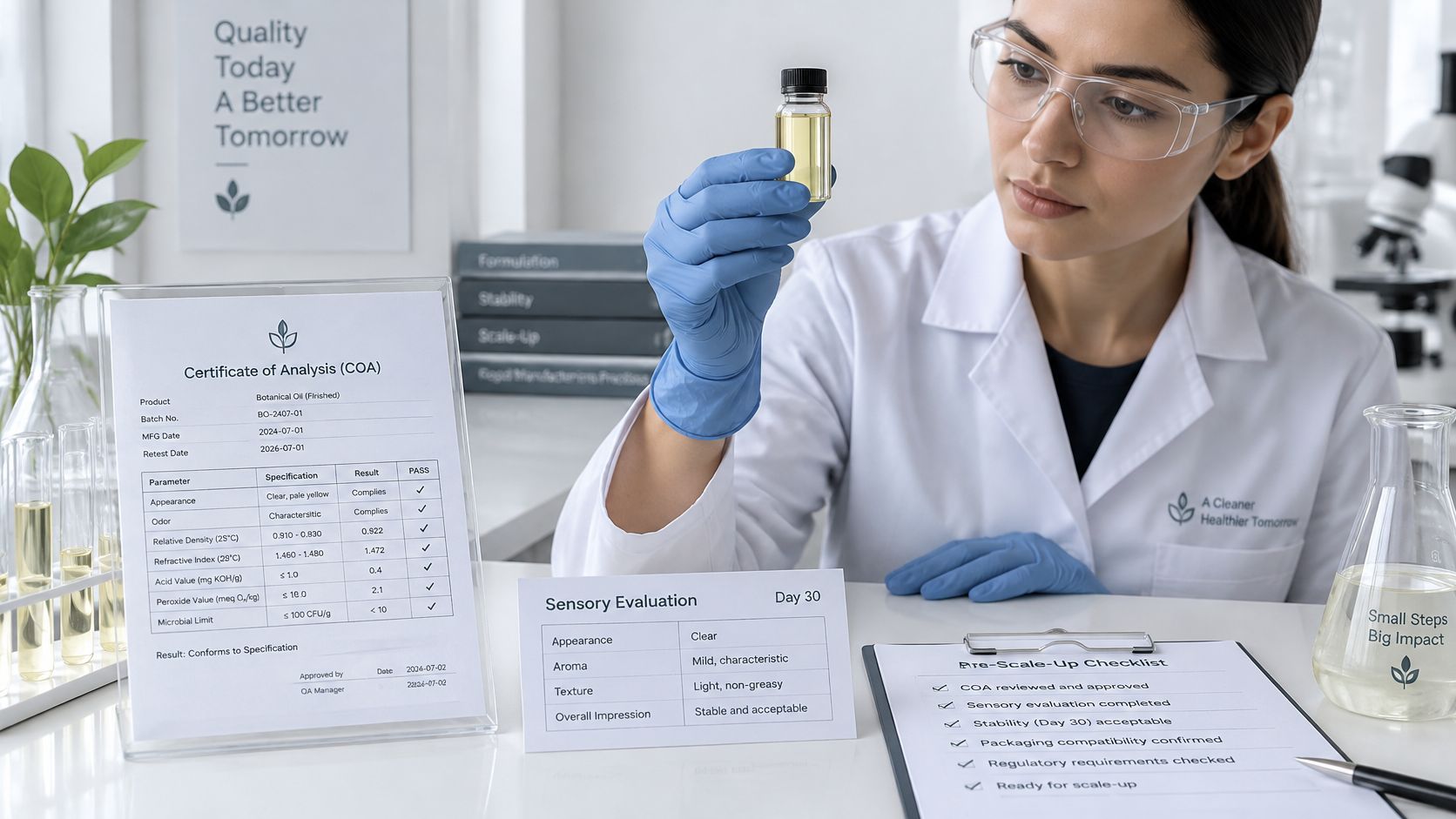
Don't scale until the finished oil matches the target on its COA and passes the day 30 sensory check. A fresh sample that smells right on mixing day hasn't earned a production order yet.
Run one go or no-go checklist against the same lot. Approvals collected from different batches can each pass while the actual production run still fails.
- Base COA on file: The distillate lot and its native terpene result are recorded against the same lot number.
- Load under the strictest limit: Native plus added terpenes fit the destination state's inhalable cap, with the concentrated blend diluted to the recorded working ratio.
- Day 30 top note holds: Citrus still appears first in the intended hardware.
- Lot ratio recorded: Exact weights, blend lot, fill date, and panel result are traceable.
The release review should happen with the finished oil, the retained cartridge, and the paperwork in front of the same decision maker.
Start the pilot path by requesting the reference blend through Gold Coast Terpenes, running a small batch in your actual base, and testing that oil against the target window. The catalog covers over 50 strains from Indica, Sativa and Hybrid categories, so a brand can benchmark a London Cake reference beside a flavor-first dessert alternative without changing suppliers mid-project.
Use the Elevated Strains direction when the commercial target is broadly dessert-forward rather than strictly London Cake. Those profiles raise levels of certain rare and exotic terpenes to bring out fruity and flavorful nuances. Multiple strains can be ordered at one time through the bulk ordering option, and wholesale pricing is available on strain orders totaling over 64oz. Those commercial details help after the pilot passes, not before.
A failed checklist item means correcting that variable and rerunning the pilot at the same scale, because a larger batch only makes an unstable London Cake strain profile more expensive.
What Do Formulators Still Ask About London Cake Blends?
What must a London Cake COA show before I use it as a reference?
It must show the total terpene figure, the full terpene panel with percentages, and the cannabinoid results for the same lot. A London Cake strain name alone can't confirm chemistry. Check the sample type and lot number before you compare it with another batch, because a COA pulled from a different lot describes a different sensory target.
Does a stronger London Cake aroma mean stronger effects?
No. Terpenes function as aroma compounds in a specification, so terpene analysis informs flavor and aroma rather than serving as a direct potency measure. Keep sensory claims separate from cannabinoid claims on your spec sheet and your label. A louder nose can even signal a top note that will fade faster in the finished oil.
Should a London Cake blend use botanically derived or cannabis-derived terpenes?
That's a sourcing, cost, supply, and labeling decision. Gold Coast Terpenes, a Redondo Beach, CA supplier, makes 100% botanically derived blends, which keeps the input THC-free and consistent across lots. Choose the origin you can document at production volume and defend on the label in every state where the product ships.
Will the same ratio work in a different distillate base?
Not without testing. The new base may carry different native terpenes, viscosity, and residual flavor, all of which can move the finished result. Run the ratio in that base and test the finished oil in your cartridge.
How do I choose a terpene supplier for London Cake formulations?
Look for documented COAs, pilot quantities, clear labeling of botanical versus nature-identical inputs, and reference blends your team can test before scaling. Gold Coast Terpenes lists over 50 strains across the Indica, Sativa and Hybrid categories, which gives product developers a practical benchmarking set for formulating a London Cake terpene profile for cannabis product formulation.
{“@context”:”https://schema.org”,”@type”:”FAQPage”,”mainEntity”:[{“@type”:”Question”,”name”:”What must a London Cake COA show before I use it as a reference?”,”acceptedAnswer”:{“@type”:”Answer”,”text”:”It must show the total terpene figure, the full terpene panel with percentages, and the cannabinoid results for the same lot. A strain name alone cannot confirm chemistry.”}},{“@type”:”Question”,”name”:”Does a stronger London Cake aroma mean stronger effects?”,”acceptedAnswer”:{“@type”:”Answer”,”text”:”No. Terpenes function as aroma compounds in a specification, so terpene analysis informs flavor and aroma rather than serving as a direct potency measure.”}},{“@type”:”Question”,”name”:”Should a London Cake blend use botanically derived or cannabis-derived terpenes?”,”acceptedAnswer”:{“@type”:”Answer”,”text”:”That is a sourcing and labeling decision. Gold Coast Terpenes, a Redondo Beach, CA supplier, makes 100% botanically derived blends.”}},{“@type”:”Question”,”name”:”Will the same ratio work in a different distillate base?”,”acceptedAnswer”:{“@type”:”Answer”,”text”:”Not without testing, because the base native terpenes change the finished result. Test the finished oil in that base and hardware.”}},{“@type”:”Question”,”name”:”How do I choose a terpene supplier for London Cake formulations?”,”acceptedAnswer”:{“@type”:”Answer”,”text”:”Look for documented COAs, pilot quantities, and reference blends you can test before scaling. Gold Coast Terpenes lists over 50 strains across the Indica, Sativa and Hybrid categories for that process.”}}]}Order a pilot quantity of a London Cake reference blend, run it in your own distillate, and hold it to the day 30 finished-oil test before you commit to production volume. Gold Coast Terpenes supplies 100% botanically derived strain and flavor references for vape, CBD, and cannabis product developers who need documented, repeatable inputs. Visit Gold Coast Terpenes to select the reference profiles for your next pilot batch.