
The usual advice is to lock one Purple Martian recipe and stamp the same THC figure on every carton. That advice fails as soon as two certificates disagree. Gold Coast Terpenes, a Redondo Beach, CA supplier, makes 100 percent botanically derived terpene blends, not cannabis-derived oil, so a brand can chase this aroma without copying one grower's flower. I would spec the name as a berry sensory target with two legitimate build orders, and I would leave potency on the base-oil certificate of analysis.
Why Should a Formulator Spec Purple Martian as an Aroma Target
Purple Martian is not one verified cultivar. The spec a formulator can lock is a dark-grape and berry sensory brief with a heavier woody finish.
The cards do not agree, and that disagreement is the point. Cannahub shows three competing stories rather than one breeding record.
- The most frequently reported description is an indica-dominant hybrid of Martian Mean Green, Purple Kush, and Blackberry Kush.
- Other references list only Martian Mean Green crossed with Purple Kush.
- A separate lineage claim connects Purple Starship and Martian OG.
The same flower name is also sold as Purple Martian Kush, Martian Purple, and PMK. The label behaves like a market and phenotype name, not a single tightly documented line. Where a three-parent story is told, people often say about 70 percent indica and 30 percent sativa. Treat that split as a description, not a genetic assay.
A vape or distillate SKU is reordered because the flavor has to come back the same way. Potency does not live in the terpene bottle. It stays on the base-oil certificate of analysis, lot by lot. Purple Kush and Blackberry Kush references explain why buyers expect dark fruit, grape, and berry. Martian Mean Green is the hybrid and space-name half of the story, not a milligram target.
Practical rule: Write the brief as aroma and finish. Do not write it as a parent cross you cannot verify on the incoming oil.
Use the quantified cartridge table in the next section as a starting ratio for one batch, not a universal law. Gold Coast Terpenes blends are THC-free, so they can aim at that aroma direction while the distillate supplier owns the cannabinoid panel.
Which Terpenes Show Up in Purple Martian Lab Data
One laboratory-reported Purple Martian cartridge contained 85.46 percent delta-9 THC and 58.35 mg/g total terpenes, with beta-myrcene at 31.92 mg/g, about 54.7 percent of the measured terpene fraction. That myrcene share is the useful anchor for a strain-inspired blend. It is not oil to bottle neat.
The Garden Dispensary cartridge listing puts the rest of that certificate in order. Beta-caryophyllene followed at 10.86 mg/g. Alpha-pinene sat at 5.26 mg/g. Limonene sat at 5.17 mg/g. Myrcene is the mid-body anchor for earthy berry weight. Caryophyllene adds pepper and wood so the fruit does not read as candy. Pinene and limonene are smaller top notes that flash pine and citrus, and both should stay well below myrcene if you are copying this cart.
What belongs to the oil
The same certificate listed 18.40 mg/g CBG, 12.15 mg/g CBN, and 5.93 mg/g THCV. Those figures belong to that cannabinoid oil. A product sold under one strain name can carry a real minor-cannabinoid signature on top of dominant THC. Gold Coast Terpenes blends are THC-free, so they reproduce aroma direction only, not that minor-cannabinoid signature. Copying CBG, CBN, or THCV into a botanical terpene SKU would invent a panel the terpene blend does not contain.
Treat 58.35 mg/g as one batch benchmark. Verify every incoming distillate on its own certificate before you scale. Cultivar naming, the grow, phenotype picks, and extraction all move both cannabinoids and smell. A strain terpene profile guide is the right place to compare named profiles before you freeze a ratio.
The four named terpenes add to 53.21 mg/g. The rest of the 58.35 mg/g fraction is about 5.14 mg/g, roughly 8.8 percent. Leave that room. Do not invent names for terpenes this certificate did not list in the public summary.
| Component | Layer | Reported level | Share of terpene fraction | Formulation read |
|---|---|---|---|---|
| Beta-myrcene | Mid body | 31.92 mg/g | 54.7% | Earthy berry weight and the largest single terpene |
| Beta-caryophyllene | Mid to base | 10.86 mg/g | 18.6% | Pepper and wood under the fruit |
| Alpha-pinene | Top | 5.26 mg/g | 9.0% | Pine lift, kept well below myrcene |
| Limonene | Top | 5.17 mg/g | 8.9% | Citrus brightness, kept well below myrcene |
| Other terpenes on that certificate | Unassigned | 5.14 mg/g remainder | 8.8% | Leave room and do not invent their identities |
| Total terpenes | Blend size | 58.35 mg/g | 100% | One batch fingerprint, not a universal spec |
| Delta-9 THC | Base oil, not the terpene | 85.46% | n/a | Do not copy into a THC-free terpene SKU |
| CBG | Cannabinoid oil | 18.40 mg/g | n/a | Stays with the oil, not the botanical blend |
| CBN | Cannabinoid oil | 12.15 mg/g | n/a | Stays with the oil, not the botanical blend |
| THCV | Cannabinoid oil | 5.93 mg/g | n/a | Stays with the oil, not the botanical blend |
For cartridge work, start myrcene-forward, then dose caryophyllene and limonene so they support the fruit instead of covering it. If the next distillate lot shows a different dominant terpene, rebuild the brief from that certificate. Do not force this table onto a lot that does not match it.
How Should Top Mid and Base Notes Be Stacked
Stack the blend like a short perfume, because a warm coil releases notes in sequence. Top notes hit first, the mid note carries the puff, and the base is what lingers after the heater cools.
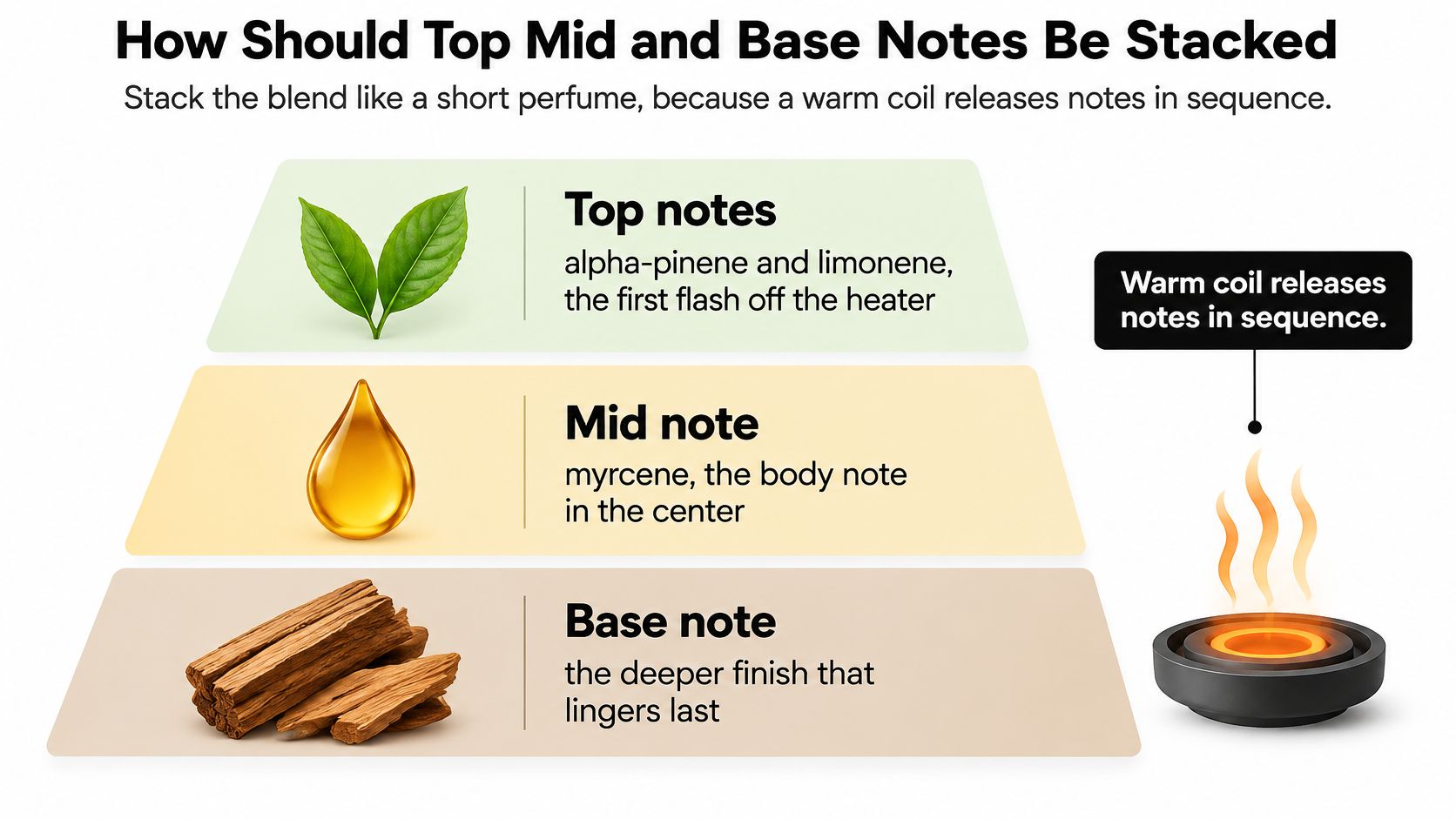
Alpha-pinene and limonene are the top notes, the first flash off the heater. Myrcene is the mid note, and it carries berry and herbal body through the puff. Beta-caryophyllene is the base, for pepper and wood. Bisabolol is only a soft floral accent if the brief wants a rounder finish. It is not required for the earthy-fruit cart.
Two honest orders
Public Purple Martian Kush listings and that cartridge do not rank the same terpene first. Both can be honest. Royal King Seeds identifies beta-caryophyllene as primary, myrcene as secondary, and bisabolol as tertiary, and another listing names myrcene, limonene, and caryophyllene among the leaders. Those cards do not publish a lab percentage breakdown, and parentage is undisclosed. Individual seed-lot expression can move a terpene by about 1 to 3 percentage points, so neither card is a chemovar law.
Keep internal ratios fixed once you pick an order. A terpene blending guide is useful for that stacking work. If the brief needs a louder dessert top than a Kush base, a separate fruit profile such as 24k gold punch is a different flavor, not a shortcut back to this grape brief.
| Build | Largest terpene | Second | Accents | Use when |
|---|---|---|---|---|
| Cartridge-style | Beta-myrcene at 54.7% of the terpene fraction | Beta-caryophyllene | Alpha-pinene and limonene | The brand wants that lab cart's earthy fruit weight |
| Cultivar-card style | Beta-caryophyllene | Myrcene | Bisabolol or limonene, with no quantified percentages on the card | The brand follows Purple Martian Kush listings that rank caryophyllene, then myrcene, then bisabolol |
Rule one. If the brand wants the cartridge's earthy fruit weight, myrcene stays the single largest terpene and caryophyllene stays clearly second. Pinene and limonene stay accents.
Rule two. If the brand follows the caryophyllene-led cultivar card, swap that order. Keep limonene and bisabolol as accents so citrus does not erase grape.
Bottle aroma and coil aroma are not the same event. Sign the stack only after a heated smell panel on the device you intend to ship.
What Terpene Load Works for Distillate and Cartridges
Screen at 0 percent, 7.5 percent, and 15 percent terpene by weight before you choose a shipping load. A University of California study used those three levels in THC distillate because they mimic commercial formulas, and it measured aerosol emissions, not liquid flavor alone.
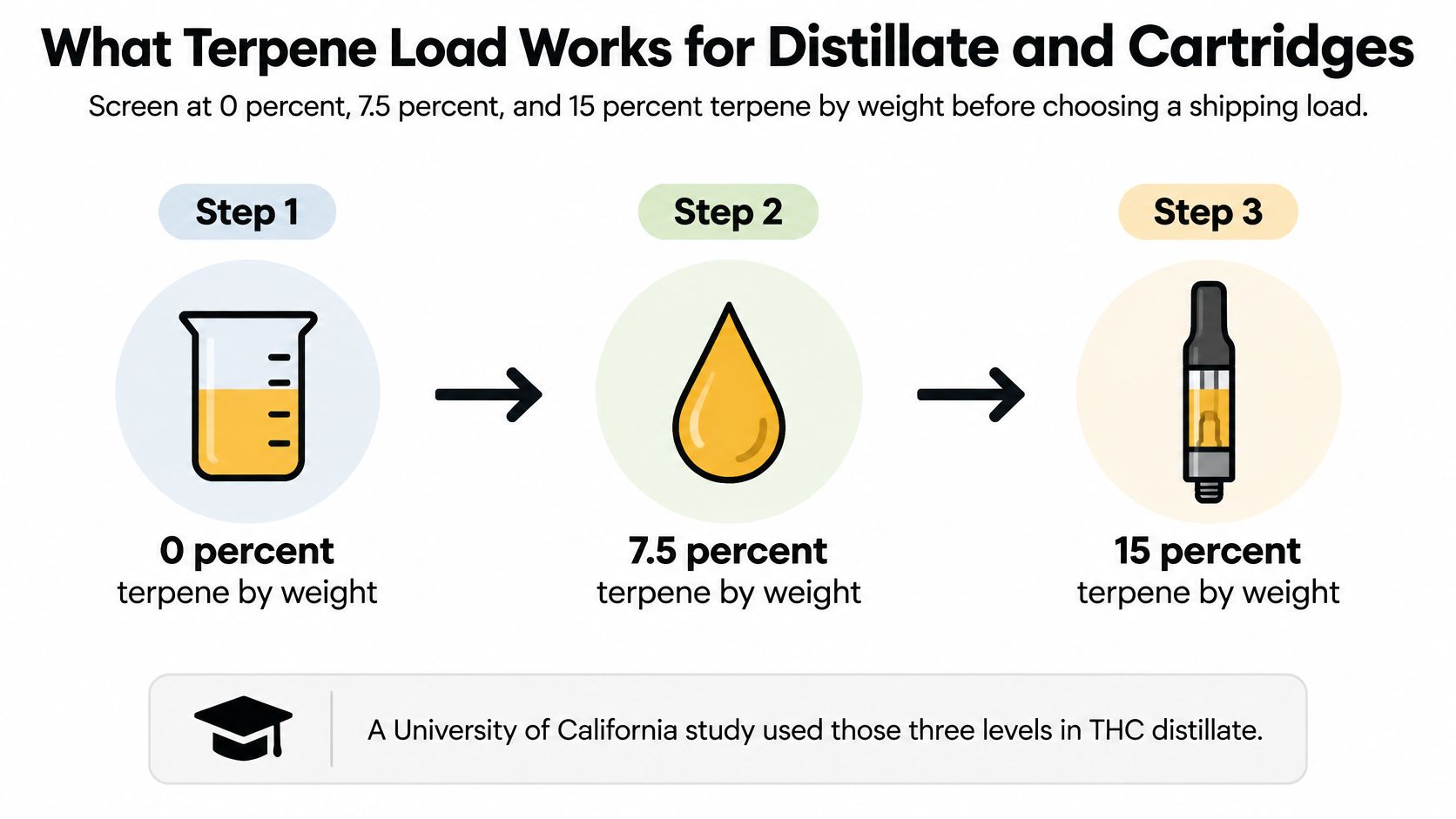
Gold Coast Terpenes profiles are highly concentrated and need proper dilution before they meet finished oil. This screen is dilution design. It is not a cue to pour neat oil until the beaker smells loud. Hardware, winterization, and temperature change what the puff smells like, so the percentage is a process variable. The note order stays locked while only total load changes. If you change both at once, you cannot tell a bad ratio from a heavy dose.
Run the screen in this order
- Fill an unterpenated control from the same distillate lot. Viscosity, coil wetting, and emissions need a baseline before any Purple Martian blend goes in. If the blank oil already tastes sharp or thin, fix the oil before you blame the terpenes.
- Dose the locked note order at 7.5 percent by weight. Record berry intensity, pepper finish, how the coil wets, and whether the aroma survives heat. This is the moderate commercial checkpoint, and it is the load I would ship first if the panel still reads as dark grape rather than candy citrus.
- Run 15 percent only as a high-load challenge. Look for harshness, thinning, and emission changes. Do not treat 15 percent as the default rate just because the beaker smells louder. The study's high load is a stress test, not a house formula.
- Ship the lower load that still matches the target on the device. Keep a written record of weight percent, device, and oil lot. A later fill on a different ceramic or a colder winterized oil can need a new screen even when the blend ratio is unchanged.
For more loading context, use the guide on how much terpene to add to distillate. Compare flavor intensity, viscosity, aerosol output, and heated behavior at the three checkpoints, then freeze one commercial rate. Reopen the screen if the distillate lot, the hardware, or the fill temperature changes.
What Effect Language Is Safe for a Berry Profile
Call the target a heavier berry aroma with a pepper-wood finish, not a sleepy or euphoric outcome. Fixed effect labels fail because products sold under this name do not share one potency.
The flower on the bench and the words on the carton are doing different jobs. Aroma copy can be specific. Outcome copy cannot, not when the oils under one name scatter this widely.
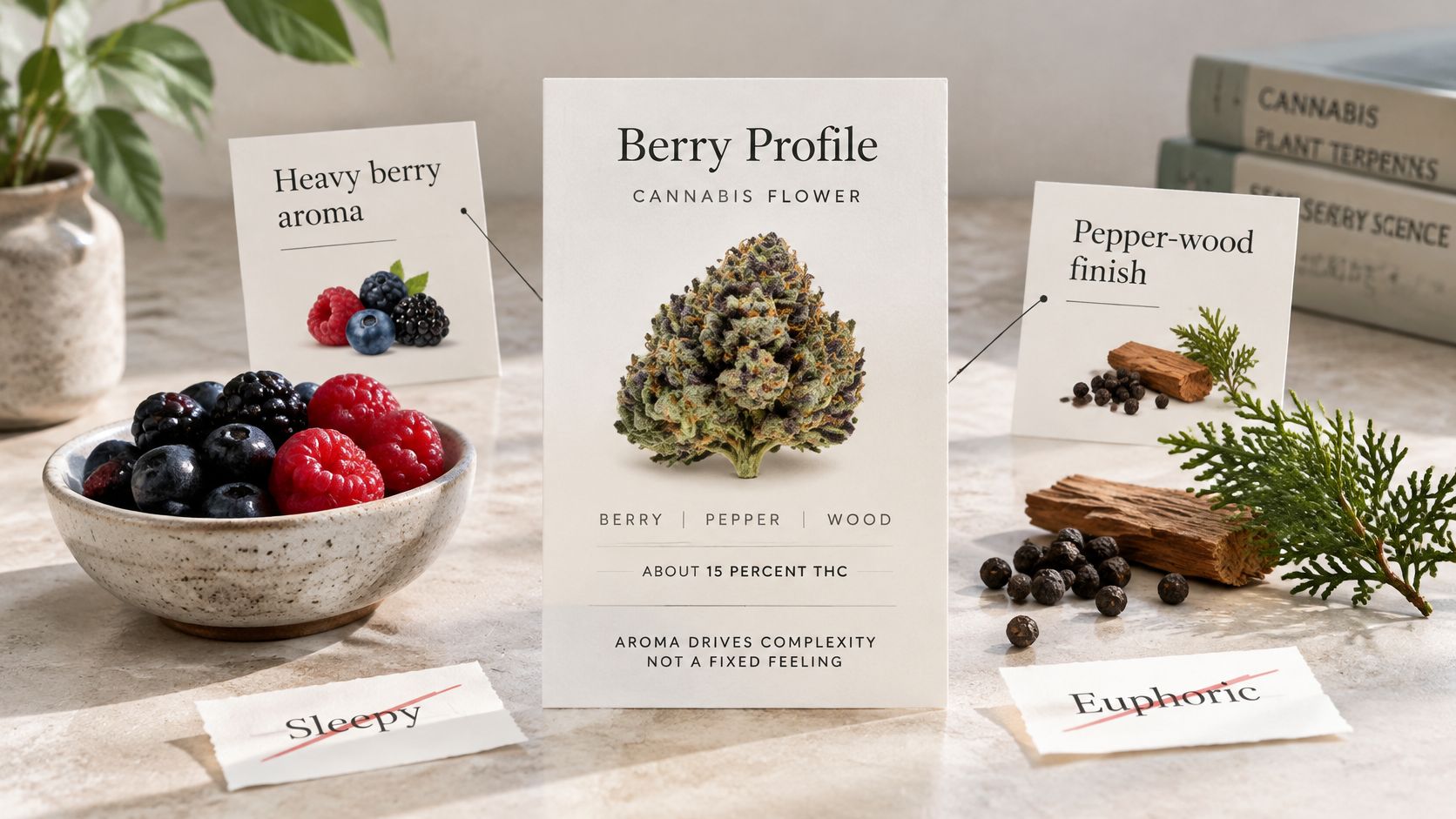
Leafly's Purple Martian Kush page is a clear example of the gap. One listing reports about 15 percent THC and 0 percent CBD. Another gives 16.25 to 19 percent THC and 0.23 to 0.38 percent CBD. Those pages still reach for fixed words such as "sleepy," "relaxed," or "euphoric," even though chemistry, cultivation, curing, storage, dose, and route can change the experience. Strain names are weak predictors of the oil in the cart.
The rest of the public range is just as wide.
- Leafwell in 2025 reported that Purple Martian averages about 22 percent THC and can reach up to 24 percent THC, on Leafwell's strain page.
- JointCommerce reported cultivation batches at approximately 18 to 24 percent THC, with some craft batches exceeding 25 percent THC, in its 2025 strain guide.
- Weedmaps lists flower from 7.5 to 21 percent THC, and a separate profile sits nearer 13 to 17 percent THC with CBD from 0.1 to 1 percent, per Marijuana Break.
- A Purple Martian distillate vape listed at 75 percent THC is a concentrate. Do not compare that number with dried flower.
Read the lot number, the THC to CBD ratio, and the dominant terpenes on that oil's certificate. Gold Coast Terpenes blends are THC-free and copy aroma direction only. Because one cartridge was myrcene-led, place that build on the darker, heavier berry side of the flavor brief. Use darker fruit and a longer woody finish on the label. Leave any claim about sleep, pain, or dose off both the panel and the product page. The distillate's cannabinoid matrix is what the lab measured for that lot.
A short walkthrough of how formulators talk about berry carts without outcome language sits here.
How Extractors Turn the Profile into a Clean SKU
Sign the SKU off on heated aerosol and a written ingredient spec, not on a good-smelling beaker. A blend that smells like grape in the bottle can emit a flatter, more peppery cloud after heat, so the panel has to include the device.
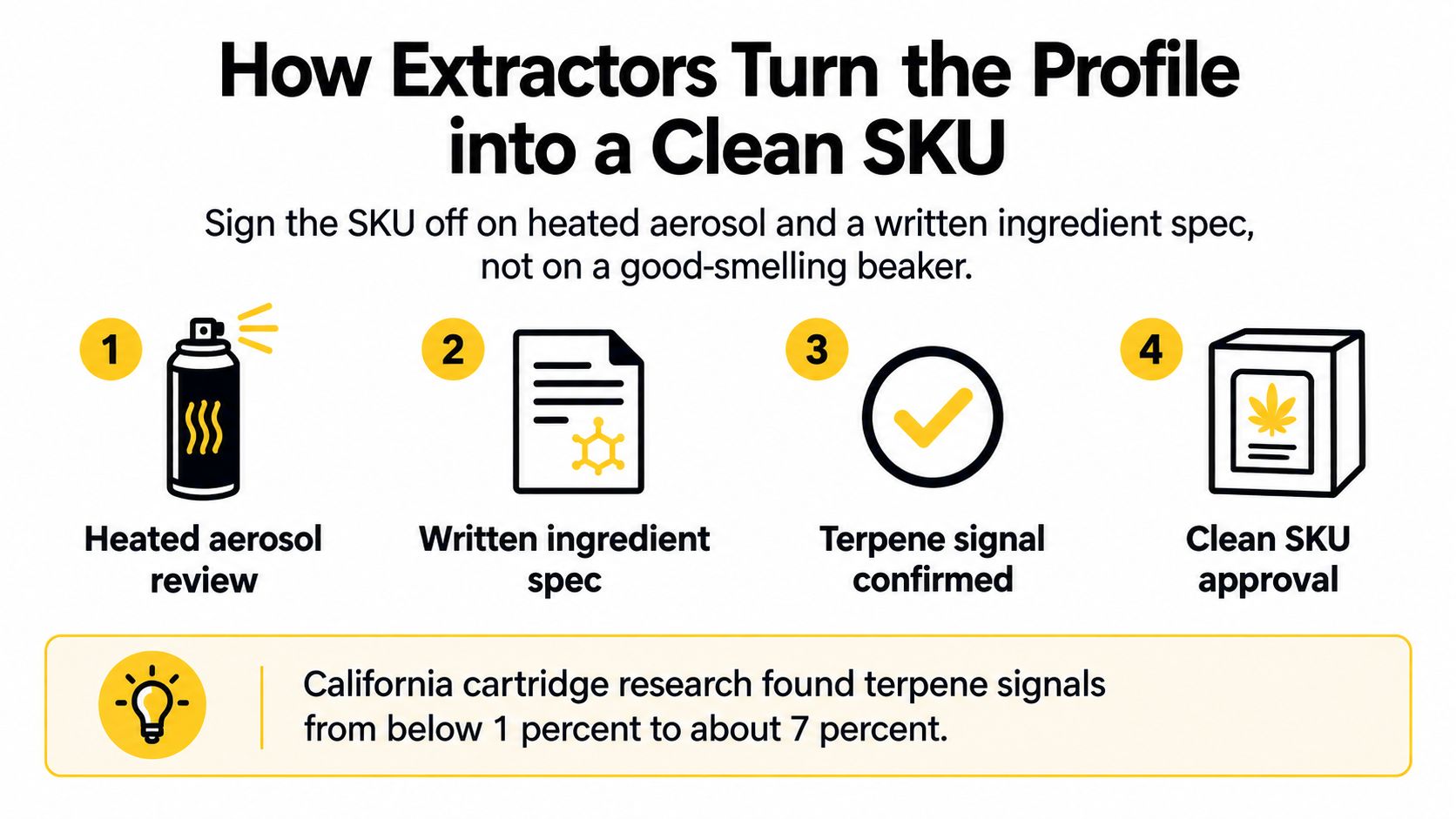
A peer-reviewed analysis of California cannabis vape cartridges, published through PubMed Central, found terpene concentrations from below 1 percent to 7 percent of total detected compound peak area in the tested vape oils. Analysts identified more than 100 terpenes and natural extracts across those products. They measured the liquid by gas chromatography-mass spectrometry and collected vapor and aerosol separately. For a Purple Martian flavor in distillate, measure both the finished liquid and the heated aerosol. A match in the bottle is not a match in the puff.
Carriers that do not belong
That same work detected vitamin E acetate, polyethylene glycols, and medium-chain triglycerides in some market products. Write those carriers out of the spec. Gold Coast Terpenes cartridge terpenes are SC Lab-tested, and the blends are made without VG, PG, PEG, and MCT. A clean SKU needs that exclusion in the ingredient specification, plus a contaminant screen, not only a pleasant nose on the bench.
Productization after the load screen is separate work.
- Lock the note order you already chose, cartridge-style or cultivar-card style.
- Apply the chosen weight percent from the device screen, and dilute the concentrated blend before it meets finished oil.
- Keep lot certificates for both the distillate and the terpene.
- Label the SKU as a strain-inspired botanical blend, not as Purple Martian flower.
A terpene blend can reproduce a target aroma. It cannot reproduce the flower's cannabinoid matrix, and the label should not pretend that it does.
If the brief needs a louder fruit top than a Kush base supplies, look at Elevated Strains only as a separate fruit reference, then return to this pepper-wood finish for the Purple Martian SKU. Gold Coast Terpenes formulation resources cover the mixing context once the spec is written. Do not approve the lot because the beaker smelled right at room temperature.
Which Buyer Questions Should a Purchase Spec Still Answer
Lock the purchase line first: chosen build order, the load percent from the 0, 7.5, and 15 percent screen, and the distillate lot certificate. The purchase spec still has to answer four buyer questions before anyone scales a fill.
Are botanical terpenes acceptable on a hemp or multi-state cartridge? Gold Coast Terpenes sells 100 percent botanically derived, THC-free blends, so the aroma does not carry the flower cannabinoid panel. Label the SKU a strain-inspired botanical blend. That wording stays accurate in hemp and multi-state carts where a cannabis-derived terpene oil would drag a different compliance file.
How large is the first buy? Every profile is highly concentrated and must be diluted before it meets finished oil. Order the smallest available bottle for the first heated panel, and move to a wholesale tier only after two consecutive lots pass the device screen. A failed 15 percent stress load is cheaper to discard in a small bottle than in a drum.
Can the fruit be louder than a Kush base? The Elevated Strains Apple Fritter profile is a fruit-forward reference, built by the Master Terpologists, who raise levels of certain rare and exotic terpenes to bring out fruit and dessert nuance. Use it when the brand wants more fruit lift, then keep this pepper-wood base if the SKU still has to read as dark grape.
What pack sizes did the market show in 2025, and which papers ship with the order? In 2025, Abstrax Tech listed Purple Martian terpene blend pricing from $20 for 2 g to $2,999 for 1 kg, with sizes from 2 g to 1 kg on its product page. Gold Coast Terpenes posts 50+ strains across indica, sativa, and hybrid profiles in its own catalog. Request the lot COA with the shipment and run it through a certificate of analysis checklist so receiving does not skip the paperwork. Do not scale a blend that arrives without one.
Formulation Questions Buyers Still Ask
Can a botanical blend replace the Purple Martian flower in a cart?
No. Gold Coast Terpenes supplies a THC-free aroma blend. The distillate or live resin still supplies the cannabinoids, and the label should say strain-inspired botanical blend.
Which build should a first pilot use?
I would start with the myrcene-forward order when the brand wants the earthy cart, and switch to caryophyllene-led only when the brand is matching the cultivar card. Run both on the same oil lot if the team cannot agree from the bottle.
Does a louder beaker mean a better cartridge?
No. Heat changes the cloud. Approve the load on the shipping device after the 7.5 percent screen, and keep 15 percent as a stress test.
What has to arrive with the terpene?
A current lot COA. Gold Coast Terpenes cartridge terpenes are SC Lab-tested. If the paperwork is missing, hold the fill.
Gold Coast Terpenes supplies 100 percent botanically derived, THC-free terpene blends for distillate and vape cartridges, including strain-inspired profiles a formulator can stack as a dark-berry Purple Martian aroma with a pepper-wood finish. Pair the blend with your oil's own certificate, screen the load on the device, and label the SKU as aroma rather than as a flower outcome. Visit Gold Coast Terpenes to compare profiles and request the lot COA before you scale a cartridge run.