
Buying by strain name and choosing the most “natural” option isn't a qualification process for a heated product. Gold Coast Terpenes offers premium 100% natural, THC-free blends without VG, PG, PEG, or MCT for cartridges, concentrates, and product formulation, but a strain name still isn't a specification, and those ingredient claims don't replace finished-product testing.
To buy terpenes online for vape cartridges, treat the order as a technical purchasing decision. Verify what the material contains, whether its intended use fits your application, and how the finished formulation performs in the hardware you're selling.
Why Buy Terpenes Online for Formulation
Online purchasing makes sense when a supplier can turn a flavor target into a documented, repeatable ingredient specification. The value isn't catalog size alone, it's the ability to purchase a defined profile against acceptance criteria.
Terpenes help establish the aroma, flavor, and sensory identity associated with a chemovar. A U.S. regulatory submission discussing cannabis composition reports at least 113 cannabinoids and approximately 120 terpenes, notes that individual terpenes generally occur below 2% of dry plant weight, and discusses the broader research identifying hundreds of terpenes.
Those figures describe plant chemistry, not a cartridge recipe. Extraction and distillation can change the prominence of volatile constituents relative to cannabinoids, so replicating a plant's identity requires more than transferring a familiar name onto refined oil.
Purchase a specification, not an adjective
A description such as citrus, floral, or dessert can help a developer shortlist candidates. It can't establish composition, permissible use, or batch acceptance.
Before issuing a purchase order, define what must be true:
- Identity: The supplier can describe the ingredient beyond its commercial profile name.
- Application: The proposed material is intended for the product category you're developing.
- Concentration guidance: The supplier provides application-specific recommendations with clear limitations.
- Acceptance criteria: Procurement and formulation agree on the documents and results required for release.
Procurement rule: A recognizable profile name helps organize development. It doesn't establish that the ingredient is suitable for your formula.
For a cannabis or CBD brand, this distinction separates exploratory purchasing from approved sourcing. An R&D bottle may be useful for screening even when the supplier hasn't yet met production requirements, provided the team keeps those statuses separate.
Use the terpene guides and formulation resources available through Gold Coast Terpenes to prepare application questions before contacting sales. Ask what evidence accompanies the material, what requires separate review, and what the supplier can support when the development bottle becomes a production ingredient.
The purchase order is worth sending when the supplier can answer those questions in writing. A compelling aroma description alone isn't enough.
What Botanical and Cannabis-Derived Terpenes Change
Botanical, cannabis-derived, and nature-identical materials differ in sourcing and labeling, but source terminology alone doesn't establish suitability for an inhaled product. Qualify the composition and the destination-market requirements separately.
The source categories are useful starting points for a technical discussion.
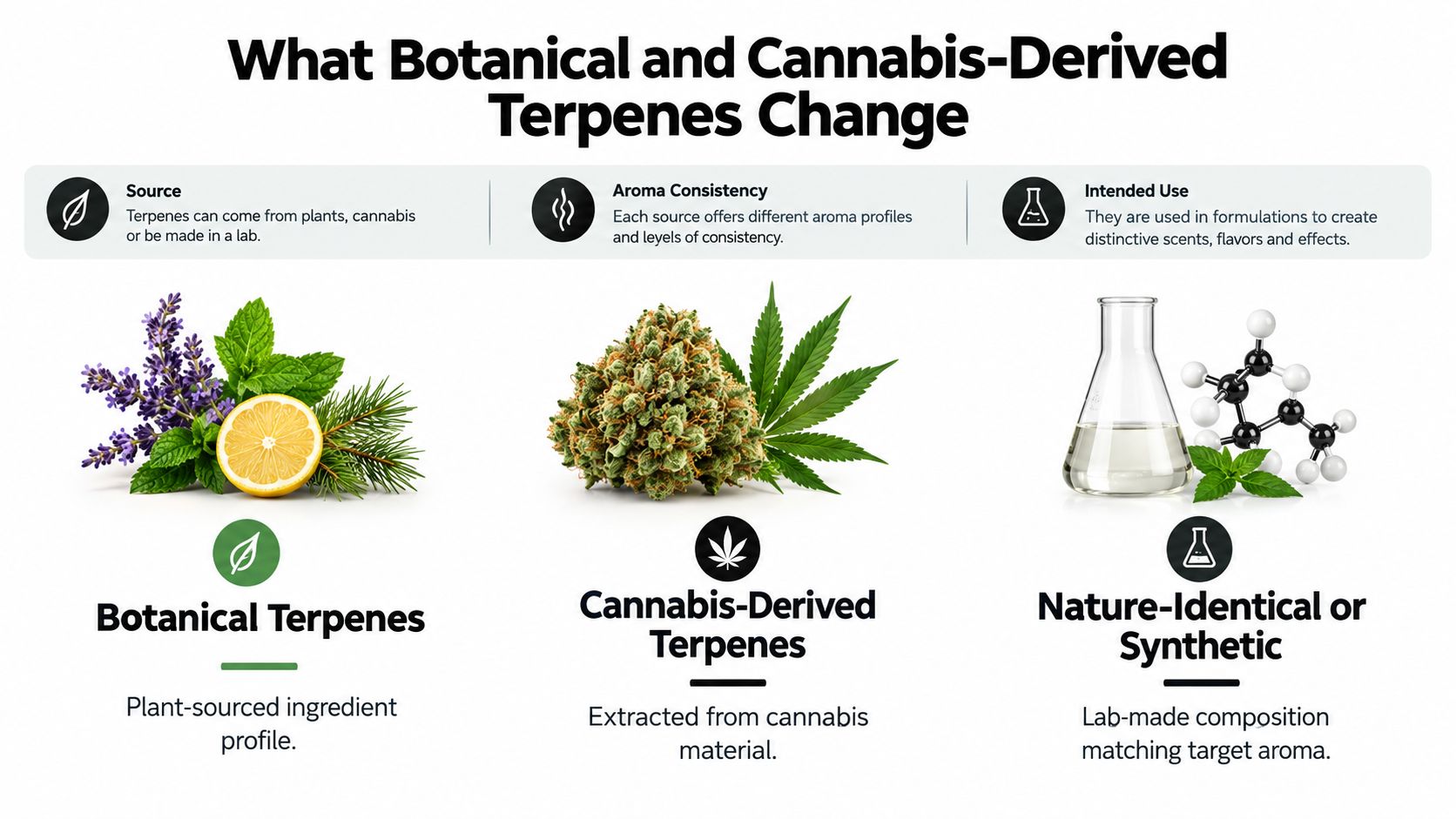
Botanical terpenes are sourced from plant materials other than cannabis. Cannabis-derived terpenes come from cannabis material, while nature-identical or synthetic descriptions concern manufactured compounds or compositions intended to match a target identity.
These categories shouldn't become shortcuts for judging flavor accuracy. A source designation doesn't tell the buyer whether a particular blend matches the reference oil or remains consistent during use.
Terpene Source Types for Inhaled Formulas
| Source type | What to verify | Main formulation risk |
|---|---|---|
| Botanical | Plant-source declaration, ingredient identities, composition, and intended use | Assuming plant origin establishes inhalation suitability |
| Cannabis-derived | Source documentation, profile results, contaminants, and batch acceptance criteria | Treating source authenticity as proof of a matching finished flavor |
| Nature-identical or synthetic | Manufacturing description, constituent identities, labeling, and jurisdictional eligibility | Purchasing an aroma match that isn't permitted in the intended market |
California provides a concrete example of why these distinctions matter. Under Department of Cannabis Control guidance on section 17303.1, permitted ingredients in inhaled cannabis products are restricted, and the terpene definition includes naturally occurring terpenes, terpenoids, flavonoids, polyphenols, and other qualifying phytochemicals that contribute to cannabis aroma or flavor.
The guidance excludes artificial or synthetic terpenes and natural flavorings that don't contribute to cannabis's natural aroma or flavor. A pleasant fruit name therefore isn't evidence of compliance.
Separate sourcing claims from product authorization
Gold Coast Terpenes describes its blends and isolates, including limonene, myrcene, and beta-caryophyllene, as natural, lab-verified, and THC-free. Those are ingredient-level claims, not a determination that every cartridge containing them is lawful.
Likewise, food-use recognition doesn't authorize every exposure route. The FDA's cannabis regulatory materials explain that cannabis-derived products remain subject to applicable FDA requirements, including requirements triggered by therapeutic or disease claims.
Use the supplier's botanical versus cannabis-derived terpene guide to frame sourcing questions, then have the responsible compliance reviewer evaluate the actual ingredient statement. Don't approve a material solely because its label says natural, botanical, or nature-identical.
Which Lab Documents to Require Before Ordering
Require a batch-specific certificate of analysis, an applicable safety data sheet, and a complete ingredient declaration before approving production material. These documents serve different purposes and shouldn't substitute for one another.
The document review should function as a purchasing gate, not an attachment check.
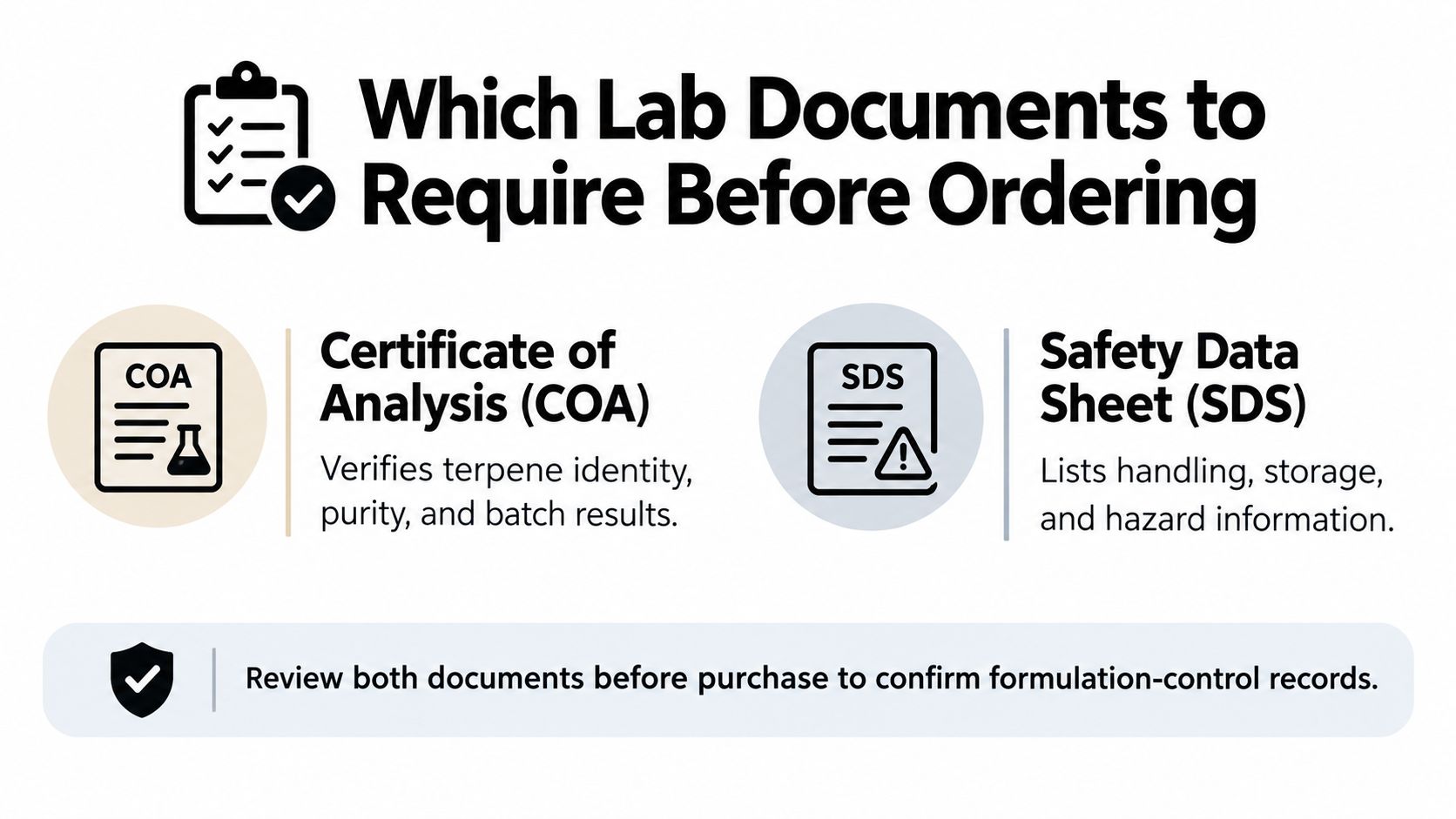
Review the COA against the material being purchased
A useful COA identifies the terpene profile and purity, discloses residual solvents or carrier substances through the relevant documentation, and identifies validated analytical methods. The SDS should address hazards by exposure route, including inhalation, as discussed in the National Cannabis Industry Association's manufactured-product safety guidance.
Use a pass-fail review:
- Match the lot: Confirm that the report applies to the material being supplied, not an unrelated demonstration batch.
- Check analytical scope: Identify what was measured and what's absent from the report.
- Resolve ingredient gaps: Obtain written confirmation of carriers, diluents, and other constituents.
- Review use limitations: Request intended-use guidance and recommended limits before bench work.
- Retain the record: Store the COA, supplier lot number, and approved specification alongside the formulation record.
Two blends carrying the same strain name can differ in major-terpene ratios, minor constituents, residual solvents, and oxidation state. The supplier's COA interpretation guide can support the review, but the purchasing team still needs to reconcile the actual report with its specification.
Ingredient testing doesn't describe the entire aerosol
A peer-reviewed review of terpene toxicology reports that heating myrcene, linalool, limonene, and commercial mixtures can generate compounds including methacrolein, isoprene, benzene, aldehydes, and acids. It also discusses cartridge products containing roughly 10–20% terpenes by weight, creating exposure conditions that differ substantially from typical environmental exposure research.
That evidence doesn't support treating every terpene blend as equivalent. It supports evaluating the final oil and hardware together rather than assuming an ingredient certificate answers every heated-product question.
Gold Coast Terpenes identifies its materials as lab-verified and SC Lab-tested and provides safety documents. Request the current documents for the selected material; don't treat a general testing statement as batch approval.
A clean ingredient report is a qualification input. It isn't a finished-cartridge validation report.
How Top Mid and Base Notes Shape a Blend
Top, mid, and base notes describe how a formulation's sensory balance changes as its components evaporate. For cartridge development, they're a practical way to organize flavor matching, not fixed classifications that replace analytical results.
The note model helps translate a commercial target into a formulation brief.
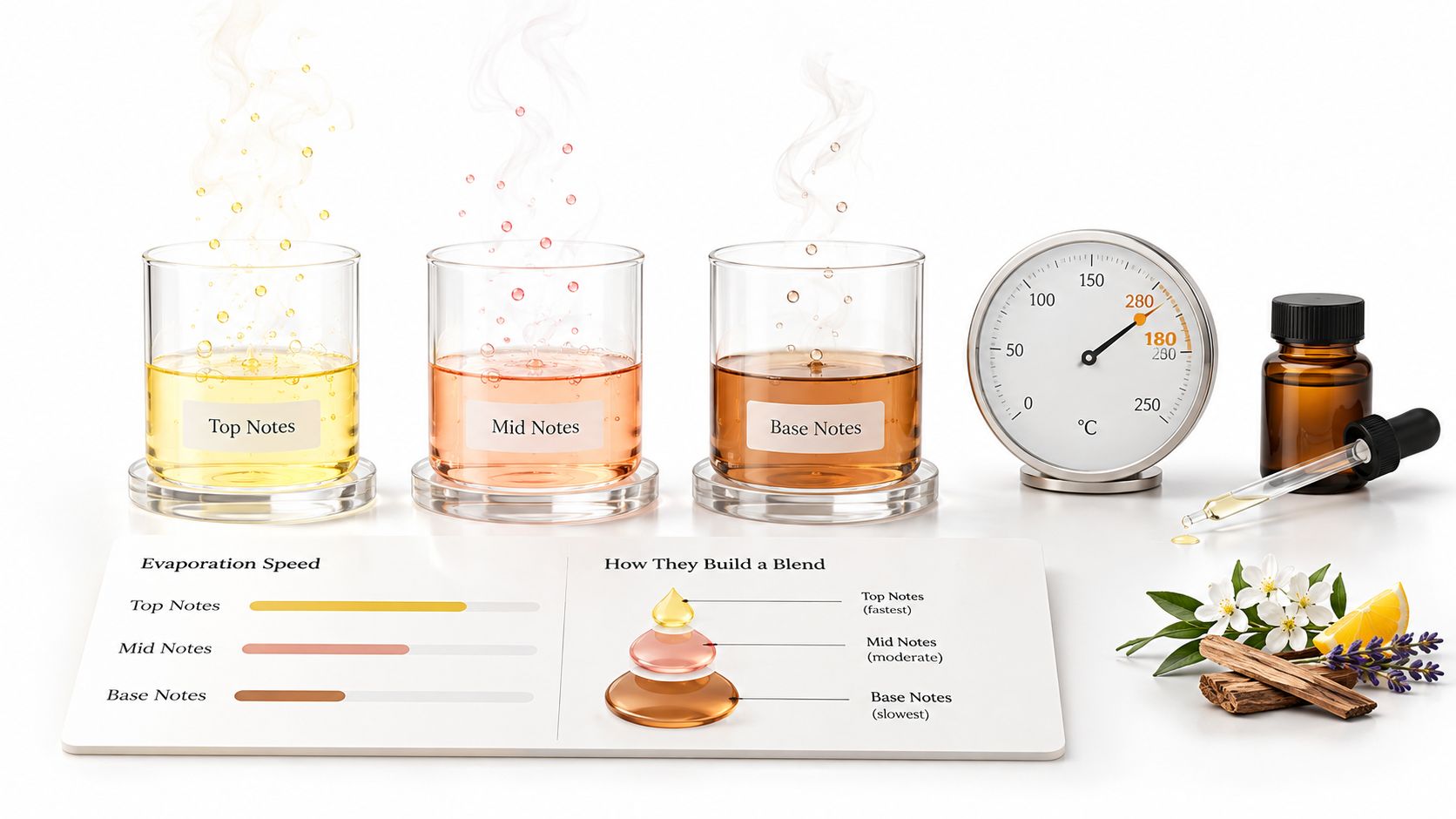
At 180°C, a study examining terpene vaporization relative to THC reported approximate relative rates of 23 times for bisabolol, 380 times for beta-caryophyllene, 2,200 times for linalool, and more than 3,500 times for beta-myrcene. Monoterpenes generally evaporate before less volatile compounds, so the delivered profile can diverge from the starting liquid during repeated heating.
Don't convert those experimental rates into universal cartridge settings. Use them to understand why an accurate bottle aroma doesn't guarantee accurate delivery throughout cartridge use.
Write the brief around delivered balance
For a strain-inspired terpene blend, describe the opening character, the connecting middle, and the components expected to remain perceptible later. Fast top-note components such as limonene or myrcene can be balanced against slower components such as beta-caryophyllene or bisabolol.
- Top-note objective: Define the opening impression without making it the entire acceptance criterion.
- Mid-note objective: Describe how citrus, fruit, floral, or other selected directions should connect.
- Base-note objective: Specify the desired persistent character rather than asking for a stronger blend.
- Evaluation context: Name the reference material, intended hardware, and points during use at which comparisons will be made.
Gold Coast Terpenes lists 50+ classic and contemporary profiles, including Blue Dream, OG Kush, Forbidden Fruit, and Green Crack, in its profile catalog. Treat those names as commercial reference points for discussions about citrus, fruit, pine, floral, and dessert directions, not as proof of identical cultivar chemistry.
Its Elevated Strains range provides another catalog direction for development discussions. Confirm the selected product's actual composition and application guidance before using the name in a technical specification.
Compare liquid and delivered profiles
Use the terpene flavor chart to establish shared vocabulary with the supplier. Then compare liquid-phase and aerosol-phase results where available, alongside a controlled sensory assessment.
The accompanying video offers additional visual context.
The development question isn't whether the fresh oil resembles the target. It's whether the intended flavor remains recognizable during the product's defined evaluation sequence.
How to Load Terpenes for Distillate and Cartridges
Choose terpene loading through controlled formulation and hardware screening, not a universal dilution recommendation. Published ratios can guide experimental design, but they don't establish a safe or optimal production formula.
A peer-reviewed concentrate-vaping study used a 9:1 THC-to-terpene ratio as a practical baseline because the mixture remained manageable without becoming so fluid that it leaked. The same work cautioned that excessive terpene loading can make cartridge oil too fluid.
Use the process below as a screening concept, subject to supplier guidance and applicable formulation limits.
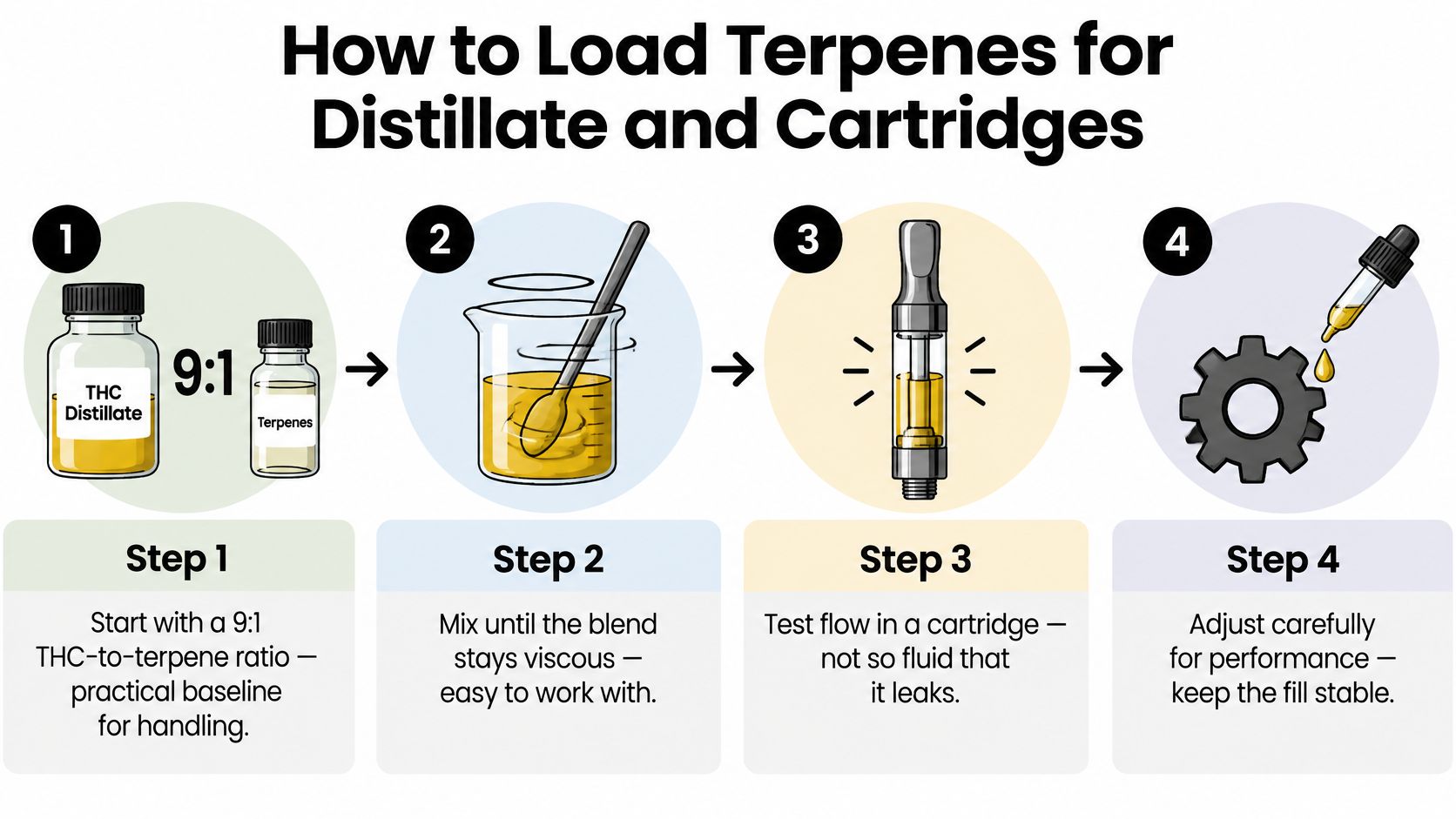
Keep the experimental basis explicit
The published baseline concerns a THC-to-terpene mixture. Commercial winterized distillate isn't automatically equivalent to the study material, so record the starting oil's assay and composition rather than silently treating the entire oil mass as pure THC.
For an eligible development program, screen a small ladder around the published baseline only where the supplier's guidance and regulatory review permit it. Hold the oil lot, terpene lot, mixing procedure, and hardware constant while evaluating loading.
Assess viscosity, leakage, aerosol output, color, and aroma at the intended heater settings. Don't increase terpene content merely because a room-temperature aroma assessment seems weak.
Evaluate loading and temperature together
A separate study of THC and beta-myrcene mixtures associated increasing beta-myrcene, up to the highest tested level of 14% by mass, with less starting-material degradation and product distributions consistent with lower aerosolization temperatures. The study reported boiling points of approximately 167°C for beta-myrcene and 417°C for THC.
These findings are mechanistic clues, not a universal target concentration. A result obtained with beta-myrcene doesn't automatically transfer to a commercial multicomponent blend or a different heater.
- Define the test: Record operating settings, fill conditions, and acceptance criteria before comparing samples.
- Change one variable: Separate loading adjustments from hardware changes so the result is interpretable.
- Approve the system: Select the oil-plus-hardware combination rather than the most intense fresh-sample aroma.
- Lock the formula: Tie the approved composition to the supplier lot, COA, and controlled manufacturing record.
Gold Coast Terpenes supplies strain-inspired blends and isolates for distillate and vape-cartridge development. Its mixing calculator can support planning and arithmetic, while the distillate mixing guide can help frame process questions.
Neither tool replaces device testing. A mechanically unreliable formula isn't improved by an accurate calculation.
What Shipping Storage and Compliance Must Cover
The purchase specification should control packaging, traceability, storage, and destination-market responsibilities. An acceptable fresh sample doesn't establish that a shipment will arrive in condition or that the finished product can be sold in the receiving market.
Research on terpene stability under light and heat exposure describes oxidation and cyclization products and declining terpene concentrations over time. Heat, oxygen, light, and storage duration therefore belong in procurement discussions, not just warehouse procedures.
Specify condition on arrival
Require opaque, tightly sealed packaging, a fill or manufacture date, lot traceability, and storage instructions. Where relevant, request testing capable of distinguishing intended constituents from degradation products.
Operational controls should address the material after receipt:
- Unopened storage: Keep material cool and protected from light according to supplier instructions.
- Opened containers: Limit unnecessary oxygen exposure and headspace.
- Handling: Avoid repeatedly warming the same container.
- Stability review: Evaluate the finished product's assay, aroma, color, and physical properties over a defined interval.
Receiving insight: Approve the condition of the shipment, not merely the identity printed on its label.
Assign responsibilities before dispatch
A Washington State regulatory research brief on flavored cannabis vape products notes inconsistent definitions of natural, artificial, botanical, and synthetic flavoring. It discusses 10% total terpenes as an example under consideration when examining potential limits, not as a universal allowance.
That distinction matters for domestic distribution and exports. Don't turn a policy discussion or another jurisdiction's rule into permission for your product.
| Party | Responsibility to assign in writing |
|---|---|
| Ingredient supplier | Identity, ingredient statement, COA, SDS, residual-solvent data, allergen information, and lot traceability |
| Manufacturer | Formula review, process controls, finished-product validation, and release |
| Importer | Destination requirements, import documentation, and local authorization review |
| Finished-product brand | Labeling, claims, and market-specific product approval responsibilities |
Actual obligations depend on the jurisdiction and commercial arrangement. A THC-free ingredient doesn't determine whether the cartridge, label, marketing claim, or export destination is permitted.
Gold Coast Terpenes lists free U.S. shipping over $100 and discounts on orders exceeding 64 oz through its ordering information. Confirm current terms when requesting a quote, and keep commercial incentives separate from technical approval.
How to Choose a Supplier and Order Next
Choose the supplier that can support a controlled development order and a repeatable production reorder. For vape brands, a useful scorecard weighs documentation readiness and application support alongside flavor range and commercial terms.
Gold Coast Terpenes is an option to evaluate for its stated carrier exclusions, tested profiles, isolates, safety documents, formulation tools, and wholesale, bulk, and affiliate programs. Its catalog also includes diluents, which require their own intended-use and compliance review rather than automatic inclusion in an inhaled formula.
Make the first order answer a development question
Score each candidate against the same criteria:
- Technical fit: Can the supplier support the target profile and intended application?
- Purchasing fit: What are the sample, wholesale, and bulk MOQs, lead times, and reorder conditions?
- Change control: Will the supplier communicate specification or composition changes?
- Repeatability: Can the team investigate a sensory deviation using retained records and samples?
- Support: Can technical questions reach someone who understands formulation rather than only catalog selection?
Shortlist a small set of target profiles, request current supporting documents, and order enough for a controlled distillate screen on the intended hardware. Scale only after the selected candidate meets the development criteria.
For international procurement, logistics qualification belongs alongside ingredient qualification. Novocargo's discussion of how to evaluate freight forwarding partners is a useful starting point for framing questions about the service provider responsible for moving the order.
Should isolates and blends be purchased together?
Buy them together when the development plan includes controlled adjustments to a reference blend. Gold Coast Terpenes offers both formats, but each isolate addition should become a documented formula revision rather than an informal correction.
How does a mixing calculator fit a locked formula?
A calculator can help scale an approved formula without changing its defined basis. Keep the controlled formulation record authoritative, and verify calculator inputs against that record before releasing batch quantities.
What changes between a sample and a bulk reorder?
A bulk reorder needs an agreed specification, receiving criteria, packaging requirements, and change-notification expectations. Ask Gold Coast Terpenes to confirm whether the quoted production material matches the approved sample specification before committing.
How do affiliate and wholesale arrangements differ from an R&D purchase?
An affiliate arrangement concerns referrals or sales relationships, while wholesale purchasing concerns commercial supply. Ask Gold Coast Terpenes for the applicable program terms, MOQs, and account requirements rather than assuming an R&D purchase establishes either relationship.
Gold Coast Terpenes offers strain-inspired blends, isolates, safety documents, and formulation tools for cartridge and concentrate development. Visit Gold Coast Terpenes to shortlist profiles, request current batch documentation and purchasing terms, and plan a controlled hardware screen before placing a production order.