
Your cartridge prototype smells bright and fruit-forward on the bench, but the filled device delivers mostly pine and spice. Gold Coast Terpenes, a Redondo Beach, California supplier of botanically derived, lab-verified, THC-free blends made without VG, PG, PEG, or MCT, offers one formulation input to evaluate against that gap between source aroma and finished-product flavor.
For a product developer, the problem isn't finding more aroma. It's preserving the right relationships between aromatic compounds as the material moves through dilution, storage, filling, and heating.
Why Terpene Profile Fidelity Matters
Terpene profile fidelity matters because a recognizable flavor depends on composition and balance, not merely aromatic strength. A useful raw material must support the intended sensory identity in the finished formulation, not just smell convincing in its original container.
Consider a development target described as fresh fruit over pine with a dry, spicy finish. That description contains distinct layers. If the opening fruit impression becomes faint while the spice remains prominent, the product may still smell strong, but it no longer matches the target.
That's a representative formulation problem, not a documented performance result. It illustrates why developers should distinguish aroma intensity, meaning how strong something smells, from profile fidelity, meaning how closely it matches the intended composition and sensory reference.
Define the target before selecting the input
A useful development specification should identify:
- Opening impression: The fruit, citrus, or pine character that should appear immediately.
- Supporting character: The notes that connect the opening to the fuller profile.
- Finish: The spice, wood, or other persistent character that should remain without overwhelming the blend.
- Evaluation point: Whether acceptance applies to the raw input, finished liquid, stored cartridge, or generated aerosol.
Practical rule: Approve the material against the product you're manufacturing, not only against the aroma released when you open the sample.
The raw material is the beginning of the evaluation, not its conclusion.
Keep this work sensory and analytical. A convincing fruit-and-pine profile doesn't establish medical efficacy, and a complex extract doesn't justify unsupported claims about therapeutic or entourage effects.
What Is High Terpene Full Spectrum Extract?
High terpene full spectrum extract is a cannabis-derived extract selected or processed to retain a comparatively terpene-rich, chemically complex composition. The term describes an input containing multiple constituents, rather than an isolated terpene or a blend defined solely by its strongest aroma.
The starting plant helps explain the distinction. Cannabis flower typically contains total terpenes near 1% by weight, while selectively bred flowers can approach 3%; tested inflorescences summarized in the literature ranged from 0.4% to 2.3%, according to this review of cannabis terpene composition and variability.
Extraction can therefore concentrate compounds that represent a relatively small fraction of the source flower. But concentrating that fraction and faithfully preserving its composition are different objectives.
What the label does and doesn't establish
“High terpene” isn't a standardized scientific or regulatory threshold. Buyers shouldn't interpret it as a guaranteed concentration, a universal processing method, or evidence that every compound from the source plant remains present.
Likewise, full spectrum describes compositional breadth, not an unchanged copy of the plant. Genetics, phenotype, maturity, handling, and processing all complicate the idea of a single definitive profile.
The distinction is easier to understand when the term is separated into its components.
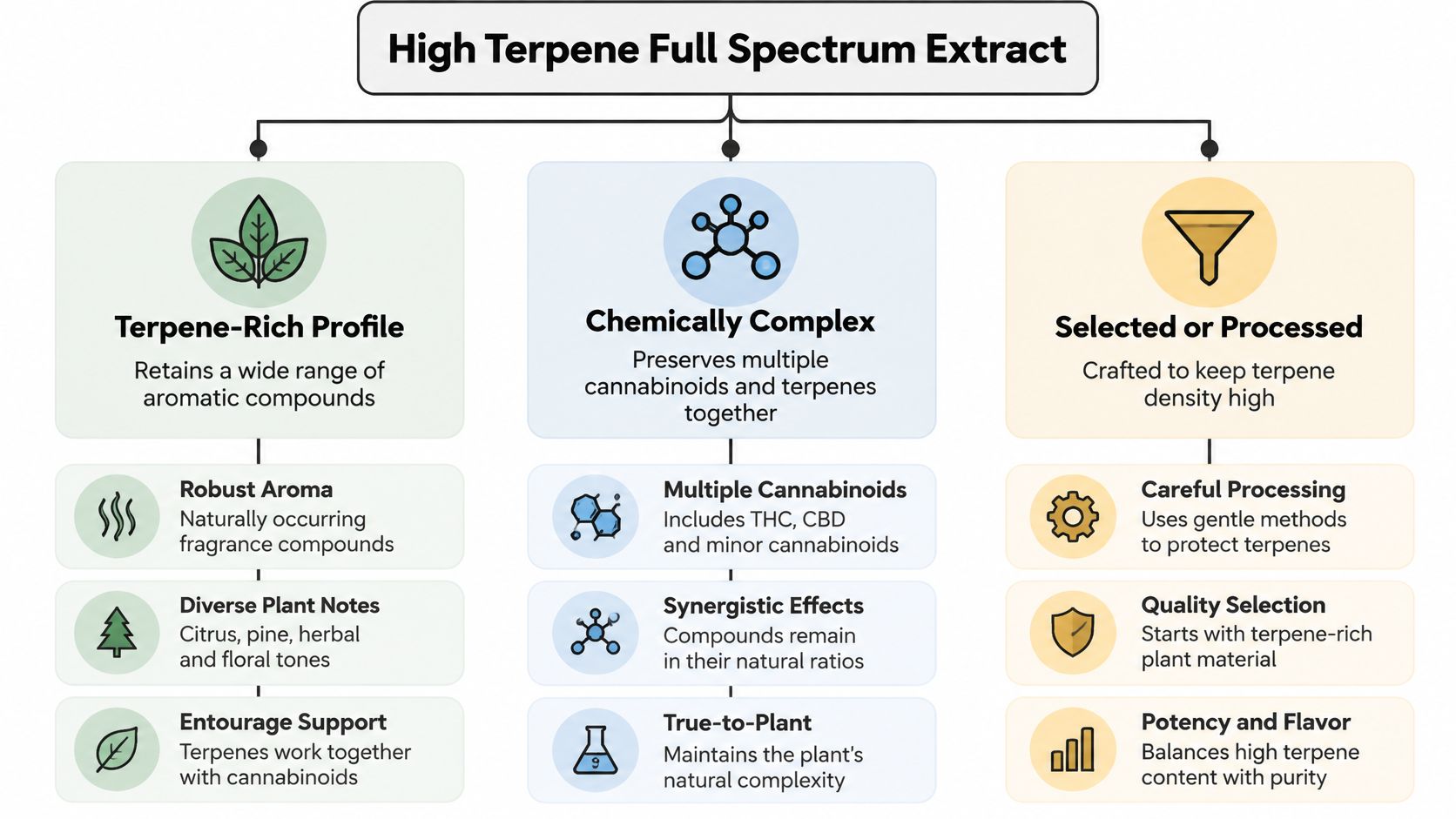
For purchasing purposes, treat the label as the start of a technical discussion. Ask which compounds were measured, what cannabinoid context accompanies them, and whether the sample represents the actual lot being offered.
A layered sensory description can help translate those results. Developers often discuss top, mid, and base notes to describe an opening impression, supporting body, and persistent finish. Those terms organize sensory work, but they don't replace quantitative analysis.
The practical definition is therefore both compositional and operational: a terpene-rich cannabis extract whose measured profile suits a defined manufacturing application. Whether it remains suitable after formulation requires a separate evaluation.
How Is High Terpene Full Spectrum Extract Produced?
Production involves selecting feedstock, extracting its constituents, recovering the desired fractions, and protecting them through finishing and storage. Each decision can preserve, concentrate, remove, or alter a different part of the aromatic mixture.
Start with the intended source profile rather than the extraction equipment. Record the feedstock identity and handling history, then establish what the finished extract should retain.
The production sequence provides useful checkpoints.
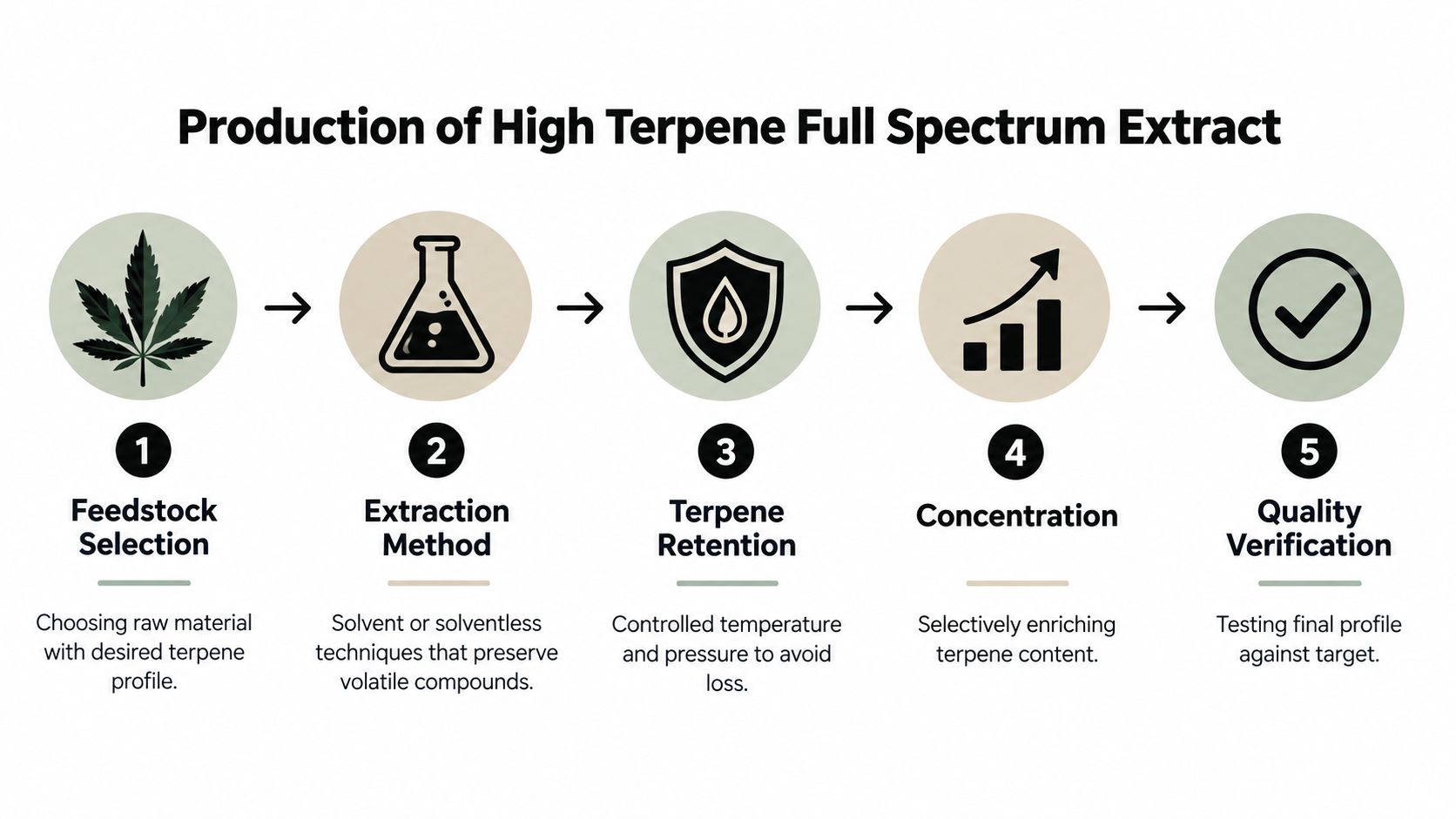
Compare routes by their measured outcomes
The relevant question isn't which extraction method sounds most advanced. It's which method, under documented conditions, produces the composition your application needs.
| Extraction route | Reported outcome | Formulation implication |
|---|---|---|
| Supercritical carbon dioxide | Broad cannabinoid recovery but a minimal terpene range in the comparison | Don't infer aromatic breadth from cannabinoid recovery |
| Hydrodistillation | Greater terpene abundance, with emphasis on heavier constituents | Examine the balance rather than assuming source equivalence |
| Ethanol | Substantial acidic cannabinoid retention with minor terpene levels | Confirm whether the aromatic fraction meets the target |
| Dry-ice-derived material | Preservation of monoterpenoids vulnerable during conventional drying and curing | Evaluate the retained profile alongside the concentrated material |
These outcomes are described in the review of extraction-dependent cannabinoid and terpene recovery. They're comparisons under particular research conditions, not universal rankings of extraction technologies.
Think of volatile retention as collecting steam from a covered vessel rather than letting it escape into the room. Rapid, low-temperature handling and closed-system condensation can help retain vulnerable compounds, while heat and oxygen exposure can change what reaches the collection vessel.
For background on the process choices, consult this terpene extraction guide.
Require a process record
Manufacturers should document temperature, pressure, residence time, oxygen exposure, collection conditions, solvent handling, storage, and packaging. Solvent removal must meet the applicable product requirements without treating aroma retention as a reason to compromise residual-solvent control.
A production overview can help teams align terminology before reviewing the actual batch record.
Finish with analytical verification, preferably including an appropriate headspace GC-MS method. A method name alone can't establish that the desired volatile profile survived collection and finishing.
How Do Top Mid and Base Notes Shape Flavor?
Top, mid, and base notes help formulators describe how a profile opens, develops, and finishes. They're a sensory framework borrowed from fragrance work, not rigid analytical categories that assign every terpene a permanent position.
For a formulation exercise, use limonene-led citrus brightness as an opening reference, myrcene-led fruitiness as part of the supporting body, and beta-caryophyllene-led spice as a structural reference. These are working sensory descriptions, not guarantees of how an isolated compound will behave in every matrix.
A blend can contain all the expected ingredients yet feel wrong because their proportions don't support the target. Adding more of the entire blend may intensify the mismatch rather than correct it.
Translate descriptive language into a specification
A fragrance vocabulary can help a team distinguish fruit, wood, citrus, and spice. Shivora Candles' candle scent families explained is useful for that descriptive exercise, but candle formulation guidance must not be treated as inhalation guidance.
For cannabis product development, connect the vocabulary to a terpene flavor chart and then to measured composition.
Terpene Profile Formulation Checklist
| Formulation Priority | What to Match | Required Evidence | Practical Outcome |
|---|---|---|---|
| Target aroma | Opening, body, and finish | Written reference and controlled sensory comparison | Shared approval language |
| Strain-inspired selection | Desired flavor direction | Matching profile page and supplier documentation | A defensible sampling shortlist |
| Component adjustment | Relative contribution of individual compounds | Quantitative terpene results | More deliberate corrections |
| Finished cartridge | Flavor under intended operating conditions | Filled-device evaluation | Application-specific acceptance |
A matching flavor page, such as Elevated Strains, can serve as a sourcing starting point. The page name isn't a substitute for reviewing the sample and its documentation.
A sensory description tells the blending team what to aim for. An analytical result tells the team what it actually received.
When replicating flavor for distillate or developing a strain-inspired terpene blend for vape cartridges, use both forms of evidence. Neither is sufficient alone.
How Does It Compare With Other Terpene Inputs?
A development team holds three candidates for the same cartridge: a recovered cannabis-derived fraction, a set of isolates, and a botanical reconstruction built toward a similar aroma. All three can reach the target on a scent blotter. The differences show up in what else arrives with each input, and in how faithfully each one carries a source profile through formulation, storage, fill, and vaporization.
A high terpene full spectrum extract supplies a complex cannabis-derived input, while isolates and reconstructed blends offer different levels of component control. The right choice depends on whether the project is preserving a source profile, rebuilding a flavor, or adjusting a particular sensory contribution. A high aggregate terpene percentage, by itself, settles none of that.
A useful way to frame the categories: a full-spectrum extract works like a recording of the source material, isolates work like the individual instruments, and a botanical reconstruction works like a cover arrangement of the same piece. Each can sound convincing. Each fails differently once pushed through a device.
Separate origin from composition. Botanical and cannabis-derived describe sourcing, while full-spectrum and broad-spectrum describe the retained mixture more generally. Those labels answer different questions.
Choose the control point your project needs
| Input | Primary development use | Main review question |
|---|---|---|
| High terpene full spectrum extract | Working from a complex cannabis-derived reference | Does this lot match the intended source character? |
| Individual terpene isolates | Adjusting selected components | What else changes when this component increases? |
| Broad-spectrum extract | Working with a selected multi-compound mixture | Which constituents were retained or removed? |
| Botanical terpene blend | Reconstructing a sensory direction from botanical inputs | Does the documented blend match the finished-product target? |
| Cannabis-derived terpene fraction | Using cannabis-sourced aromatic material | What accompanied the recovered fraction? |
A full-spectrum input suits projects that depend on a particular source material and its broader composition. An isolate-led approach suits developers who need to adjust individual components deliberately rather than accept the relationships present in a recovered mixture.
This comparison visual introduces the categories, though its shorthand should not be treated as a performance ranking.
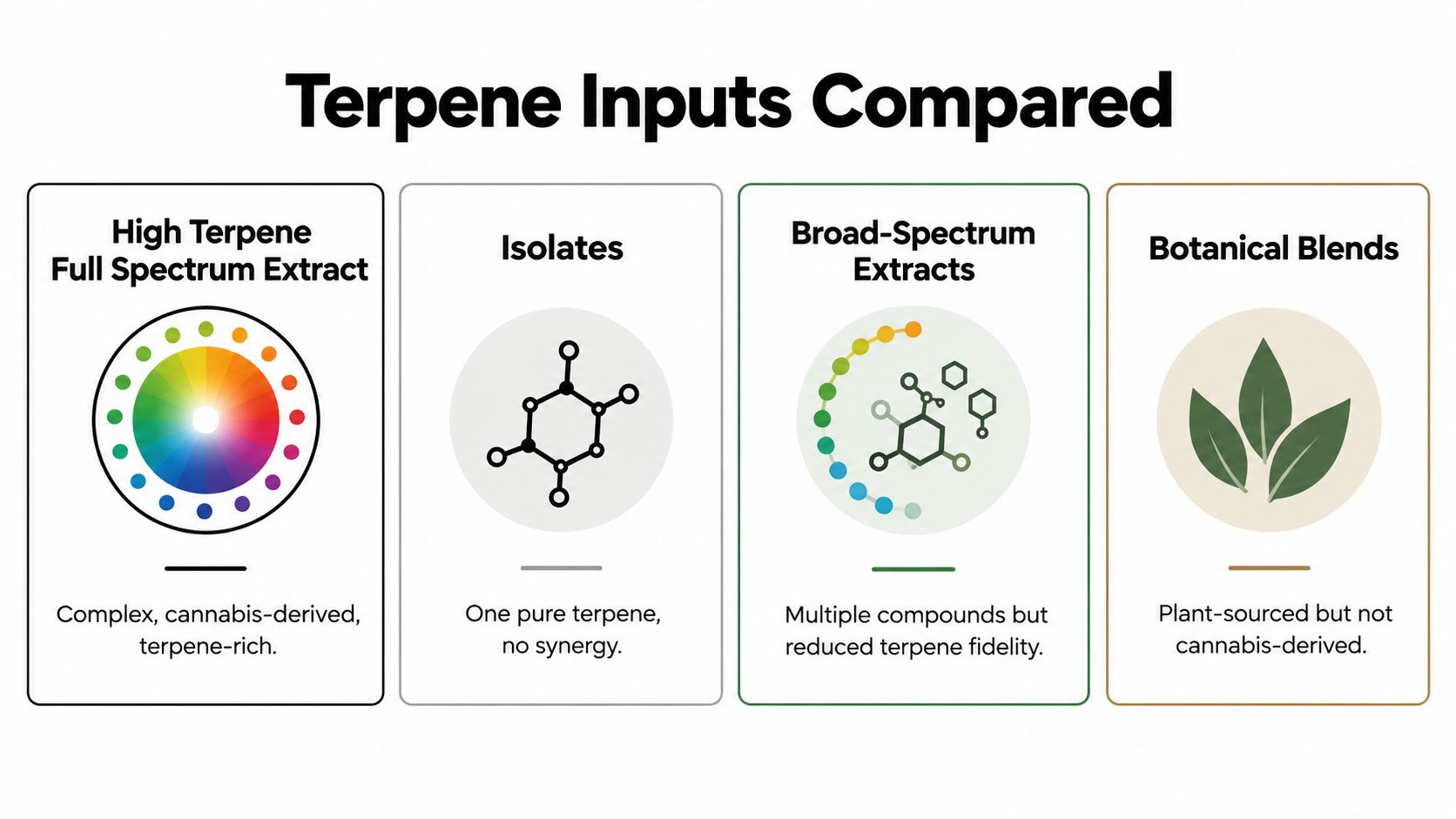
Broad-spectrum material can still show strong fidelity to a target, and an isolate label leaves the question of biological synergy open until the composition is reviewed. Judge each input on measured composition and intended use.
Gold Coast Terpenes supplies botanical profiles, including Blue Dream, OG Kush, Forbidden Fruit, and Green Crack, alongside isolates such as limonene, myrcene, and beta-caryophyllene. Those function as alternative formulation tools and should not be presented as cannabis-derived full-spectrum extracts.
For labeling, avoid describing a botanical reconstruction as though it were directly extracted from the named cannabis cultivar. A strain-inspired terpene blend describes a development direction without claiming source equivalence.
What Should Buyers Verify Before Purchasing?
Buyers should verify measured composition, batch identity, and application documentation before approving a purchase. Aroma language can help shortlist samples, but procurement needs evidence that connects the supplied material to a reproducible specification.
Comparative research detected 41 compounds, evaluated 15 phytocannabinoids, and found significant differences among solvent-derived extracts, illustrating why multi-component labeling matters in this study of extraction methods and chemical profiles.
Audit the lot, not just the product description
Request a batch-specific package covering:
- Terpene results: Total concentration and individual compound amounts, with units clearly identified.
- Cannabinoid composition: Results appropriate to the material and its intended application.
- Residual solvents: Relevant findings for the extraction and finishing route.
- Analytical method: Sample preparation, measurement method, and reporting limitations.
- Traceability: Batch identifier, production information, sample date, and storage history.
- Consistency: Comparable documentation from other lots, not only a selected reference sample.
Use the certificate of analysis guide to frame the document review. Confirm whether a result describes the raw input, an intermediate blend, or the finished formulation, because those aren't interchangeable samples.
A short list of dominant terpenes also can't reliably prove cultivar identity. Treat flavor naming and botanical identity as separate verification tasks.
Review the commercial conditions
Ask suppliers about minimum order quantities, sample access, lead times, bulk packaging, change notification, and support when a bench formula moves into production. Don't assume sample and production orders follow the same commercial terms.
Resolve botanical versus nature-identical labeling through a written sourcing declaration. Ask what the supplier means by each term and which documents support it, rather than assigning an assumed regulatory meaning.
For vape, CBD, and cannabis brands, compliance review must address the finished product and destination market. A raw-material COA isn't a complete compliance file, and a natural-origin claim doesn't establish suitability for inhalation.
Procurement checkpoint: A supplier should be able to explain what was tested, which batch it represents, and what the reported results do not establish.
How Should You Store and Formulate the Extract?
Protect the received material through controlled handling, then validate the formulation after mixing, filling, storage, and device operation. Acceptance at receipt establishes a baseline, not permanent approval for every subsequent manufacturing stage.
Keep seal condition, packaging, storage temperature records, batch age, and handling history in the quality file. Follow supplier-specific guidance rather than applying an invented universal storage temperature or shelf life.
The terpene storage guide provides a practical starting point for handling review. Your internal procedure should also address unnecessary opening, transfer practices, light exposure, and the conditions under which retained samples are held.
Build the formulation around a defined use
For distillate and cartridge projects, use a controlled sequence:
- Set the sensory reference: Specify what should be present and what would constitute a mismatch.
- Review the composition: Select the input using individual-compound data, not only a flavor name.
- Establish the use level: Base trials on supplier guidance, intended application, and the product's safety review.
- Check compatibility: Assess the actual matrix, packaging, and hardware rather than assuming compatibility.
- Document the finished mix: Record material lots, masses, mixing conditions, and evaluation results.
A Mixing Calculator can support mass planning, while a terpenes-for-distillate resource can help organize development questions. Neither establishes an appropriate inhalation exposure or proves that a formulation is safe.
Test what the device delivers
Research on terpene vapor pressure reports losses of 70–95% for volatile terpenes under the studied comparatively low-temperature conditions, while less-volatile compounds were largely retained, as discussed in this analysis of terpene evaporation behavior.
That result is a warning against assuming stability, not a universal loss factor for every cartridge. Your validation should distinguish the starting liquid, the post-fill or stored liquid, and the aerosol generated under defined voltage, coil, puff-duration, and airflow conditions.
A liquid COA doesn't characterize aerosol composition or thermal degradation products. Device testing therefore needs its own analytical plan, acceptance criteria, and appropriate safety assessment.
How Do You Apply the Framework in Product Development?
Apply the framework by choosing a reference, identifying the manufacturing stage most likely to cause a mismatch, and testing the actual finished system. The right purchasing decision depends on the problem you're trying to solve, not on which sample has the strongest initial aroma.
Compare the development decisions
For a strain-inspired cartridge, start with the desired flavor direction and a matching supplier profile. Request composition data and a sample, then evaluate the blend in the intended base and hardware before approving production material.
For winterized distillate, establish what the base contributes before selecting the aromatic input. Compare candidate blends for balance, compatibility, and finished sensory character, with post-mix verification tied to the recorded formulation.
For a cartridge that differs from its source liquid, investigate the process before adding more terpenes. Compare retained liquid, filled product, and generated aerosol so the team can distinguish formulation differences from storage or device-related changes.
A commercial shortlist should include access to suitable terpene products, a relevant formulation guide, calculation support, batch documentation, and clear scale-up terms. Reject unsupported promises of identical flavor across every matrix or device.
Frequently asked formulation questions
Is a higher total terpene result always better?
No. Select a material for its fit with the target profile and application, rather than ranking candidates by total concentration alone.
Can botanical blends replace a full-spectrum extract?
They can be evaluated as alternatives when the objective is sensory reconstruction. They shouldn’t be represented as chemically equivalent to a cannabis-derived full-spectrum extract without supporting evidence.
What should a vape brand ask about minimum orders?
Ask separately about sampling, production purchases, and repeat bulk orders. Confirm packaging, documentation, lead times, and whether formulation changes require a new approval process.
Does an accurate liquid COA guarantee cartridge flavor?
No. Use the liquid result as a baseline and evaluate the filled device under documented operating conditions before approving the finished product.
Gold Coast Terpenes offers lab-verified, THC-free botanical blends and isolated compounds for developers comparing flavor-building options with cannabis-derived extracts. Visit Gold Coast Terpenes to identify candidate profiles, review formulation resources, and discuss samples and bulk requirements for your next controlled trial.