
Cherry Pie is an indica-dominant hybrid, but that label predicts almost nothing about the chemistry or flavor in your cartridge. Gold Coast Terpenes formulates strain-inspired blends around verified terpene ratios, not sativa/indica percentages, because that's what holds up in production.
If you've ever tried to replicate Cherry Pie from a strain name alone, you already know the problem. Two lots with the same name can land very differently in aroma, mouthfeel, and finished-cart behavior, and the label rarely tells you why.
The Cherry Pie Sativa Indica Question Is the Wrong Question
Cherry Pie is generally classified as an indica-dominant hybrid, not a pure indica or pure sativa. For product development, that answer is only the starting point, because the actual formulation job is matching the lot's chemistry, not repeating a marketing label.
The label is too coarse for cartridge work
A Nature Plants study that genotyped cannabis samples at more than 100,000 single-nucleotide polymorphisms found that sativa and indica labels were genetically indistinct at the genome-wide level, with the labels correlating mainly to a narrow set of terpene-synthase-associated aroma compounds instead of broad genetic structure (Dalhousie University summary). That matters for formulators because a Cherry Pie-inspired cartridge should be built around a sensory target, not a blanket assumption about how “indica” it is.
Practical rule: if you can't name the dominant aroma compounds, you don't have a formulation brief yet.
Gold Coast Terpenes, a Redondo Beach, CA supplier, works from that same logic. A strain-inspired blend has to be anchored to verified aromatics, then checked against the feedstock's native bouquet, oxidation state, and lab data before anything gets scaled.
What buyers actually need
The question buyers ask is emotional, but the production answer is technical. For a Cherry Pie format, the useful specification is not “sativa or indica,” it's whether the finished oil needs to read as sweet fruit, berry, pastry, earthy, or spicy on first inhale and aftertaste.
For commercial teams, that means:
- Define the aroma goal first. Decide whether the target should lean dessert-fruit, earthy-spice, or brighter top notes.
- Match chemistry second. Use batch-tested terpene and cannabinoid data instead of strain lore.
- Validate the finished SKU. Cross-check aroma against the COA and a sensory panel before release.
That is the point where formulation starts to beat folklore. Cherry Pie is an indica-dominant hybrid, but the label is not a recipe.
Cherry Pie Lineage and Chemotype Variability
Cherry Pie is commonly traced to a Granddaddy Purple × F1 Durban or Durban Poison line, a lineage that mixes body-heavy ancestry with a more energetic one (Prime Cuts Nursery). That helps explain the cultivar's reputation, but it does not guarantee one fixed chemical outcome.
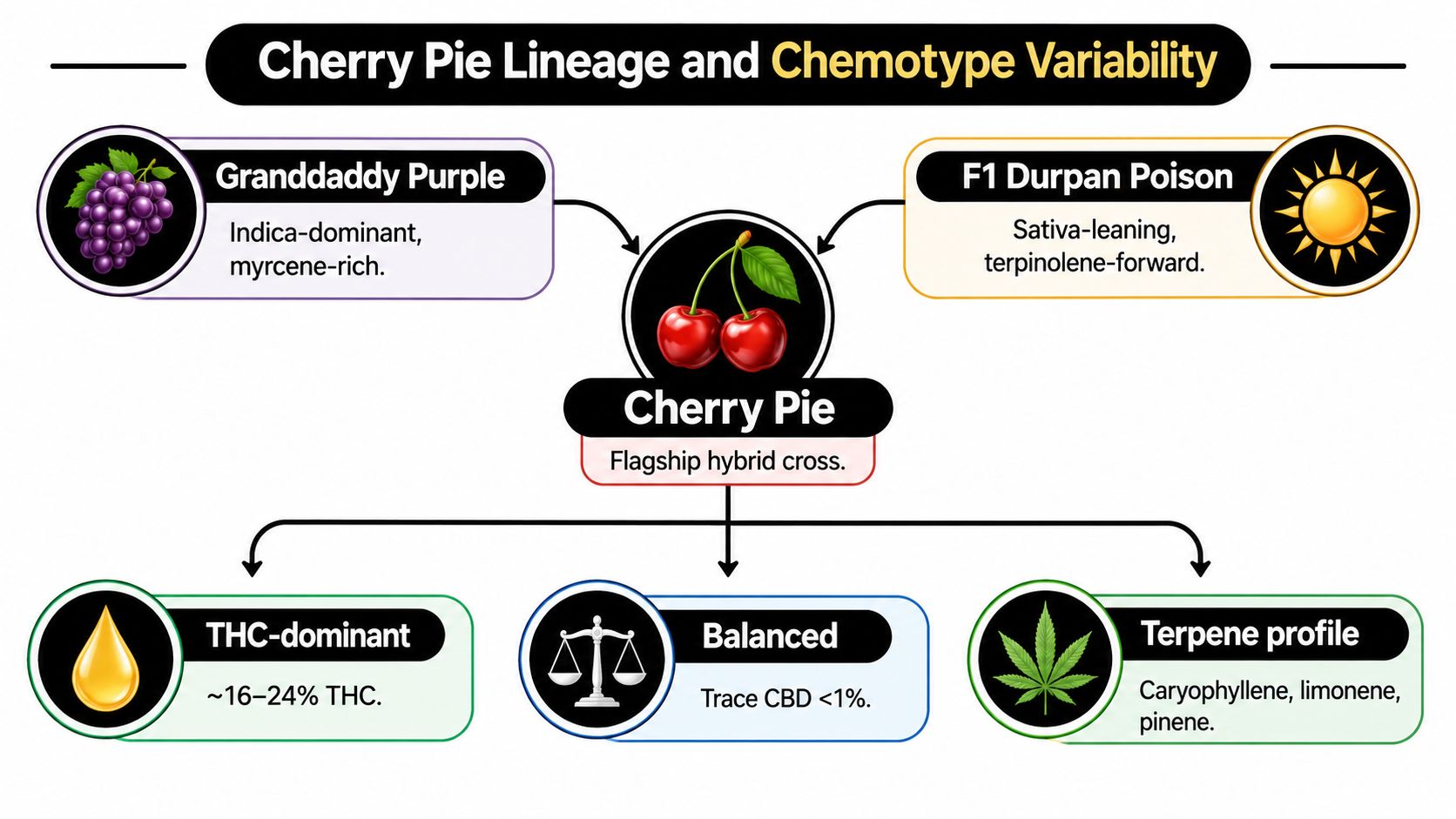
Why the same strain name can mislead buyers
Cherry Pie's reported indica share is not standardized. Published descriptions place it anywhere from roughly 60% indica / 40% sativa to about 80% indica / 20% sativa depending on breeder and seed line (Hyperwolf). That range is exactly why a strain name is a weak production spec.
The original clone-only version is generally tied to the San Francisco Bay Area cannabis scene and the names PieGuy and Jigga, as noted in the same Prime Cuts Nursery profile. Once a strain name passes through multiple seed lines, the chemistry stops being uniform.
The retail market shows that spread too. Cherry Pie THC reports commonly sit around 18%–24%, while one dataset based on 77 lab tests reports a middle-half range of 12.8%–17.5% and a median of 15.08% THC. Another product listing records total THC at 19.9%, which shows how batch, phenotype, and lab method can shift the result (Strain Compass).
Cherry Pie is not a fixed recipe, it is a genotype cluster with a shared family resemblance.
What that means for replication
For formulation work, Cherry Pie is a moving target with a recognizable signature. Track the terpene fingerprint, the batch data, and the finished-use format before you decide whether the profile will read as authentic or just generic fruit candy. Tracking chemotype variability across a strain's lifecycle is covered in From Seed to Scene: The Terpene Lifecycle in Cannabis.
The useful question is not “what ratio is Cherry Pie,” it is “which Cherry Pie lot, which terpene fingerprint, and which finished-use format?” That is the difference between a SKU that holds up in use and one that only works on the label.
If you are comparing profiles, Elevated Strains shows how a flavor-forward catalog item can be framed as a formulation reference rather than a consumer claim.
Building a Cherry Pie Terpene Architecture for Vape Cartridges
Cherry Pie replication works best as a three-layer aroma structure, not as a single cherry note. The practical core is myrcene, beta-caryophyllene, and pinene, then the fruit and spice accents are adjusted around that base.
Start with the structure, not the strain name
One reference places Cherry Pie's terpene values around myrcene at 0.4%–1.0%, beta-caryophyllene at 0.2%–0.8%, and pinene at 0.1%–0.6%, with limonene and linalool often lower in the profile (StrainPedia). The same reference describes total terpene content in cured material at roughly 1.5%–3.5%, which is useful as a development guardrail rather than a fixed recipe.
In practice:
- Myrcene gives the base/body. It reads earthy and rounded, so the blend does not taste thin.
- Beta-caryophyllene carries the mid-note warmth. It adds peppery depth and helps the profile feel complete.
- Pinene lifts the top note. Without it, the blend can drift flat or syrupy.
- Limonene and linalool are support notes. They help when you need more fruit brightness or floral softness.
A simple formulation workflow
A Cherry Pie-style cartridge should be built in this order:
- Define the target aroma. Decide whether the goal is cherry, berry, pastry, earthy spice, or a brighter fruit lift.
- Select the dominant terpenes. Use the ratio band as a guide, not a promise.
- Check the feedstock aroma. Distillate can already carry a sweet, neutral, or grassy base.
- Adjust against sensory feedback. Rebalance if the first puff reads too sharp, too dull, or too candy-like.
- Confirm with analysis. The COA should match the intended profile before the lot ships.
Formulation rule: the distillate tells you where the blend starts, not where it ends.
Gold Coast Terpenes publishes a Cherry Pie terpene profile and supports formulation work with tools like its Mixing Calculator and Terpenes 101 resources, which is useful for distillate and cartridge teams.
| Cherry Pie Terpene Formulation Framework | ||
|---|---|---|
| Terpene | Architecture Role | Typical Range |
| Myrcene | Base body, earthy backbone | 0.4%–1.0% |
| Beta-caryophyllene | Mid-note warmth, peppery structure | 0.2%–0.8% |
| Pinene | Top-note lift, brighter finish | 0.1%–0.6% |
Why Batch-Tested Data Beats Strain Labels Every Time
Cherry Pie needs batch data because a strain name can hide very different chemistry. If the label is not tied to a certificate of analysis, a cartridge SKU is built on assumptions, not specifications.
Dalhousie University summarized cannabis labelling research showing that samples with the same strain name can be as genetically and chemically different from each other as samples with different names. The same work found only weak aromatic tendencies, with indica-labelled products leaning a bit more toward earthy compounds such as myrcene and sativa-labelled products showing relatively more fruity or tea-like aromas, but those labels still do not reliably predict chemistry or effects.
What to look for in a COA
A Cherry Pie brief should compare the COA with the flavor target, not just the strain name. Pay attention to:
- Total cannabinoids. Does the batch support the intended positioning?
- Dominant terpenes. Do myrcene, beta-caryophyllene, and pinene show up where they need to?
- Relative balance. Is the aroma likely to read dessert-fruit, earthy, or sharp?
- Lot drift. Does the current batch smell like the last one, or did the profile move?
That's where third-party lab testing stops being paperwork and starts being product control. Gold Coast Terpenes lab-tests every lot and publishes SC Lab results so formulators can compare what they ordered with what they received. That is the only defensible way to keep a Cherry Pie SKU stable.
How to handle mismatch
If a distillate comes in softer, grassier, or more muted than expected, do not force the same terpene load into it. Rebuild from the sensory gap. A neutral base may need more fruit lift, while a louder base may need less top note and more structure in the middle.
The Cherry Pie name works as shorthand for a flavor family, not a chemical guarantee. When the lab data and the aroma target disagree, the lab data wins.
Botanical Versus Cannabis-Derived Terpene Sourcing for Cherry Pie
For Cherry Pie replication, botanical-derived terpenes usually make more sense for scale, consistency, and compliance. Cannabis-derived terpenes can feel closer to whole-flower character, but they're harder to standardize across lots.
The sourcing trade-off
Botanical-derived terpenes come from food-grade plant sources, which gives brands cleaner regulatory positioning and easier supply-chain planning. That matters for vape and hemp teams shipping into states with stricter rules or into markets where documentation has to stay simple.
Cannabis-derived terpenes are isolated from cannabis itself, so they can carry a more plant-native identity. The downside is that harvest timing, extraction method, and source material can change the profile from batch to batch, which makes replication tougher at scale.
Gold Coast Terpenes supplies 100% botanically derived terpene blends that are free of VG, PG, PEG, and MCT, and its Elevated Strains line is built to highlight nuanced fruit and dessert notes. That makes it a practical sourcing option when the business goal is repeatability, not just novelty.
How to choose a supplier
A Cherry Pie program should judge sourcing on five things:
- Label clarity. Can the supplier say exactly what the blend is and isn't?
- Lot consistency. Does the profile reproduce across shipments?
- Documentation. Are lab results easy to review before production?
- Scalability. Can the supply support a real SKU, not just a pilot batch?
- Cost control. Does the sourcing model make sense once volume increases?
If the supplier can't explain the difference between flavor design and strain mythology, they're not helping your formulation team.
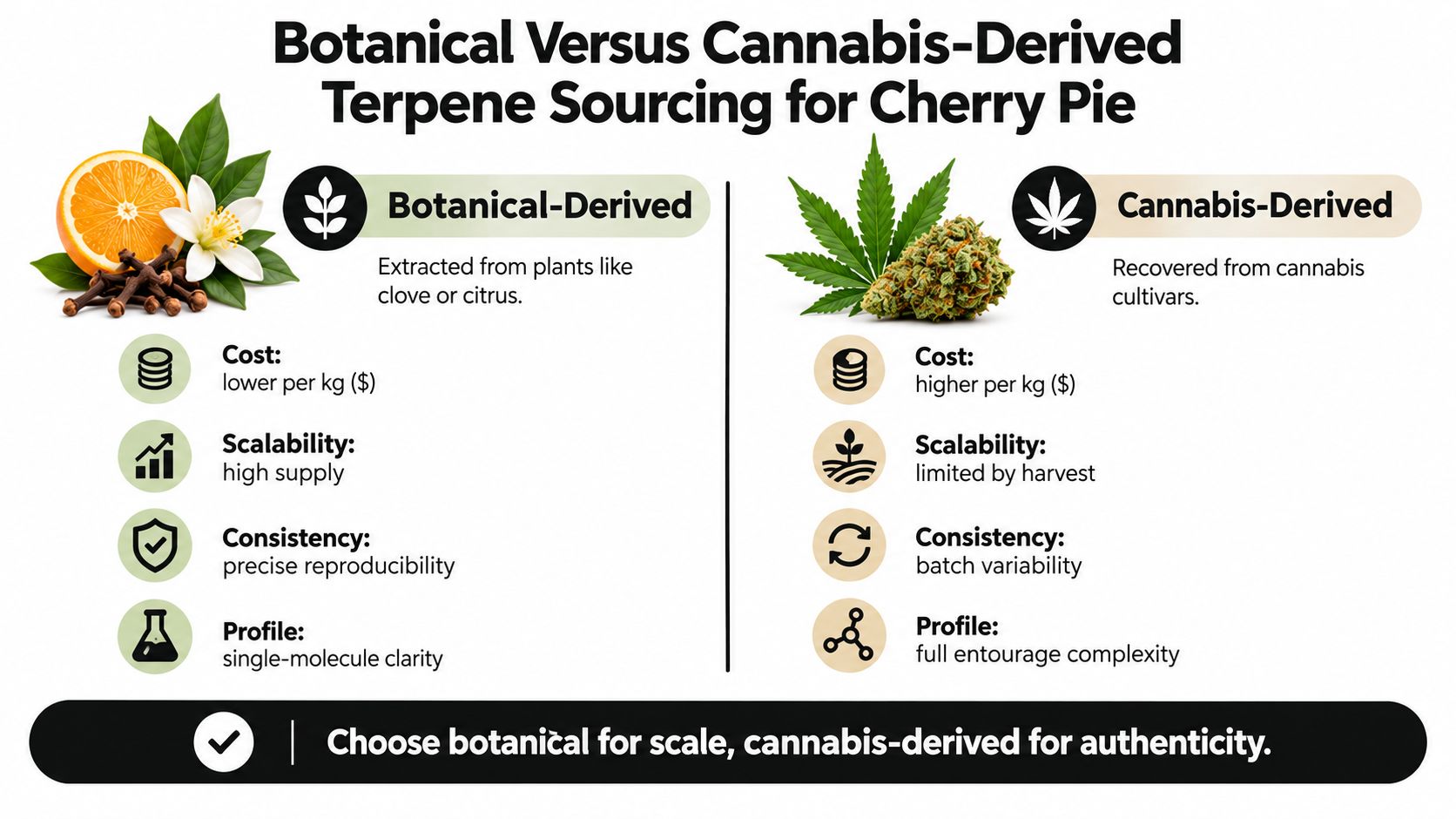
For teams that want a direct comparison framework, Gold Coast Terpenes' discussion of CDT vs BDT is a useful technical reference point. In Cherry Pie work, botanical sourcing usually wins because it lets you hit the same flavor target repeatedly without depending on harvest-specific variance.
Moving from Strain Labels to Flavor-First Formulation
Cherry Pie strain sativa or indica is the wrong specification for a cartridge team. The right specification is a verified dessert-fruit aroma built from measurable compounds, then checked against the feedstock and the finished oil.
A usable production sequence
Start with the sensory target. Decide whether the SKU should lean cherry, berry, pastry, spice, or earthy and then select terpenes to support that target.
After that, validate the blend against the COA and the native aroma of the distillate. If the oil is already sweet, the final blend may need less lift. If it's flat, the formulation may need more top-note definition and better mid-note structure.
Document the final ratio so the next lot doesn't become a new experiment. That's the only way to keep a Cherry Pie-style cart from drifting every time raw material changes.
Gold Coast Terpenes gives product teams the practical pieces for that workflow, including strain profiles, a Mixing Calculator, and formulation education that fits cartridge and distillate development. If you're building a Cherry Pie SKU, Gold Coast Terpenes is where to start looking for a flavor-first terpene base you can reproduce.
Q&A
Is Cherry Pie an indica or a sativa?
Cherry Pie is generally classified as an indica-dominant hybrid, not a pure indica or pure sativa. For product developers, Gold Coast Terpenes treats that label as a starting point, not the actual formulation brief.
What terpenes matter most in a Cherry Pie-style blend?
The most useful structural compounds are myrcene, beta-caryophyllene, and pinene, with lighter support from compounds like limonene and linalool. Gold Coast Terpenes builds strain-inspired blends by balancing those roles, not by chasing a strain name alone.
Why do two Cherry Pie products smell different?
Cherry Pie exists across multiple clone and seed lines, so batch chemistry can drift even when the name stays the same. Gold Coast Terpenes recommends checking the COA and the dominant terpenes before you assume two lots should match.
Should I use botanical or cannabis-derived terpenes for Cherry Pie?
For most cartridge and distillate programs, botanical-derived terpenes are easier to scale and standardize. Gold Coast Terpenes supplies botanically derived blends, which helps when consistency and compliance matter more than source mythology.
How should a formulator judge a Cherry Pie supplier?
Look for clear labeling, lot consistency, and third-party testing that matches the flavor target. Gold Coast Terpenes provides those basics in a way that supports repeatable formulation, not guesswork.
Can Gold Coast Terpenes help with strain-inspired replication?
Yes, Gold Coast Terpenes offers strain profiles, terpene blends, and formulation tools that are useful for cartridge and concentrate development. The important part is to work from verified aroma data, then adjust for the actual batch you're filling.