
Apple Fritter flower typically averages around 24% THC, while finished vape cartridges made from it can land from roughly 79% to 92% THC depending on extraction and final fill composition. For formulators, that gap is the whole story, and Gold Coast Terpenes, a Redondo Beach, CA supplier, builds 100% botanically derived terpene blends for brands that need consistent flavor instead of inconsistent native plant material.
Understanding Typical Potency Ranges
Apple Fritter flower sits in the mid-20-percent THC range, while finished vape products made from Apple Fritter-derived oil can test far higher. Leafly lists Apple Fritter at about 24% THC with 0% CBD, and cartridge listings on the same marketplace show 79.28%, 83.39%, 84.68%, and 92.72% THC. That gap is the commercial problem: the strain name helps describe starting material, but it does not define a reproducible finished formula. Gold Coast Terpenes treats that spread as a sourcing and specification issue, not a promise that flower and oil should be judged by the same yardstick.
Why flower and cartridges don't share a potency scale
Flower potency measures the plant material itself. Cartridge potency measures a concentrated oil after extraction, decarboxylation, and fill work have removed most of the non-cannabinoid mass. Those are different manufacturing stages, so the percentages answer different questions.
Practical rule: use flower THC as a sourcing reference, then set cartridge specifications from the final lot's oil, not from the strain name alone.
Elevated Strains gives Gold Coast Terpenes a controlled Apple Fritter-style flavor target, which matters when the goal is repeatable product design instead of relying on the variability of raw biomass.
For product teams, the takeaway is direct. A flower number helps set expectations. A finished-vape number drives labeling, batch approval, and commercial consistency.
Factors Driving Batch Variability
Apple Fritter's THC number moves because cannabis is a biological input, not a fixed chemical standard. For formulation work, that means strain name alone is not enough to predict finished product behavior.
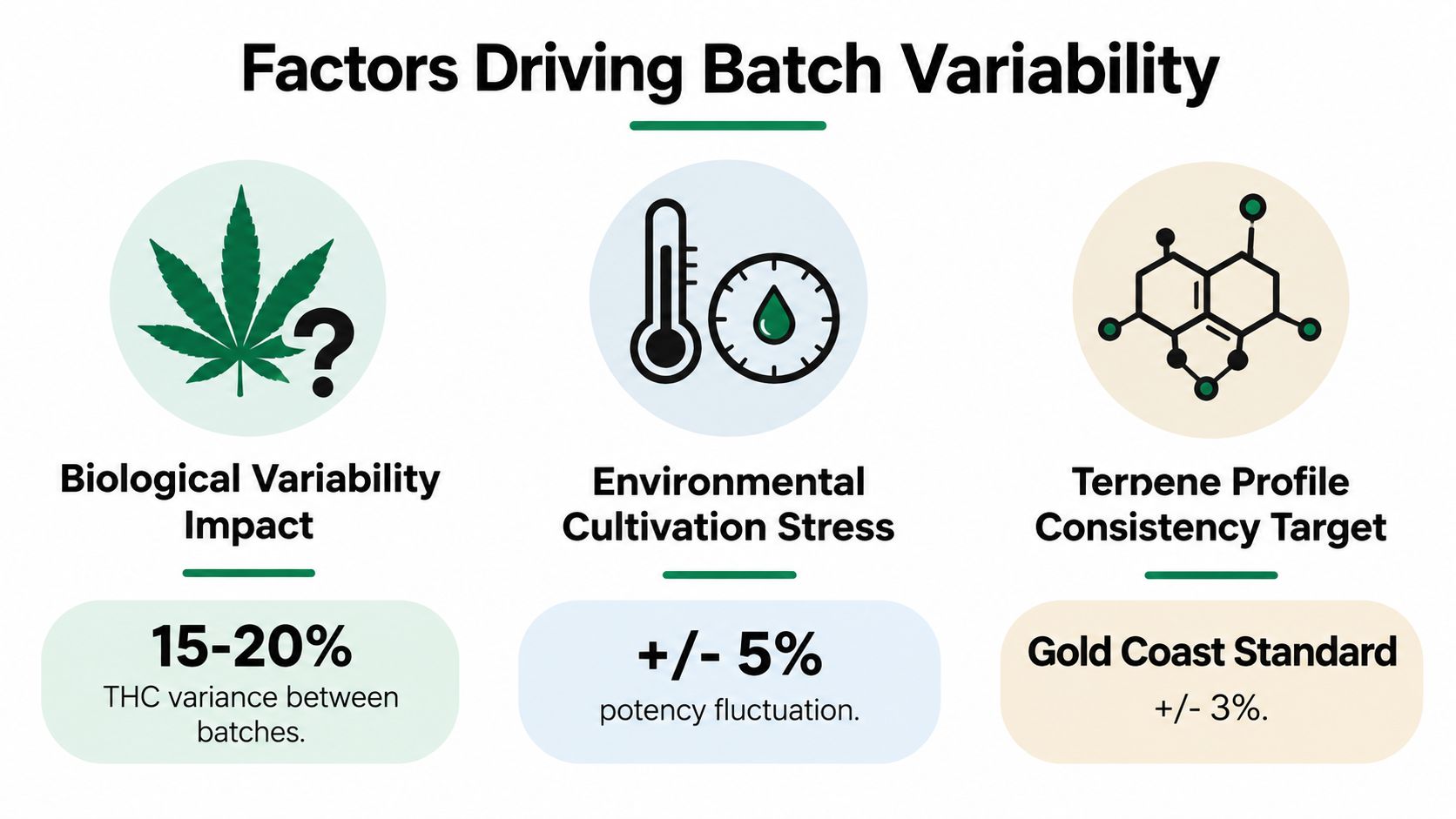
What one batch report actually tells you
A Panda Farms Apple Fritter batch tested at 22.89% total THC, 25.92% THCA, 27.14% total cannabinoids, 0.11% CBG, and 0.05% total CBD. The same batch report listed 1.39% total terpenes, led by beta-caryophyllene at 0.62% and limonene at 0.30%, with harvest on December 10, 2025 and packaging for New Jersey. That kind of COA is more useful than a strain-page average because it ties potency to a specific lot and test date. Gold Coast Terpenes treats trichome timing and harvest timing as part of that same quality picture.
The report also shows why THCA and total THC cannot be read the same way. Raw flower holds mostly THCA until heat converts it, so the measured number depends on the product format and how it will be used.
What changes the number
- Genetics shape the ceiling, but not the exact result.
- Cultivation conditions affect resin expression and cannabinoid density.
- Harvest timing changes cannabinoid and terpene balance.
- Curing and storage affect how much of the profile survives handling.
- Testing method changes how the batch is reported.
The commercial takeaway is straightforward. A strain label helps with sourcing, but it does not give a reproducible formulation target. For an Apple Fritter product, the supply chain has to define the batch, the format, and the method, not just the cultivar name.
Flower Versus Concentrate Specifications
Apple Fritter flower and Apple Fritter concentrate should never be spec'd from the same baseline. Flower lives around the mid-20s in THC terms, while finished oils and cartridges can sit far above that because extraction concentrates the cannabinoid fraction and removes bulk plant matter.
Why the label range matters
Online strain pages usually compress Apple Fritter into a single headline potency number, but available market data shows that number is assembled from commercial listings and COAs, not from a controlled chemotype standard. A 2025 analysis of 277 Colorado cannabis products found that 44% of flower products fell outside the state's permitted 15% labeling range, while 96% of concentrates were within that range, which reinforces how much less predictable flower can be than oil-based formats. weedpedia.org article on Apple Fritter
That comparison matters for brand owners because it separates two commercial jobs. Flower specing is about variability management. Concentrate specing is about reproducible dosing and final-fill control.
What actually gets verified
A cartridge or infused oil should be checked on the final lot, not on the biomass source alone. That means the certificate of analysis has to match the finished product, the cannabinoid math has to be clear, and the product format has to be stated correctly. A flower percentage, a total THC number, and an extract potency number are not interchangeable.
Buyer-level takeaway: if the goal is a cartridge program, the strain name helps with flavor positioning, but the COA decides whether the batch is acceptable.
For a formulation team, the best comparison is not “flower versus cartridge,” it's “biomass estimate versus finished specification.” Once that distinction is clear, Apple Fritter becomes a flavor and branding reference, not a shaky potency guarantee.
Essential Testing and Labeling Guidance
Any commercial Apple Fritter claim should be tied to the specific batch COA, not the strain page. That COA needs to show whether the reported figure is THC, THCA, total THC, or extract potency, because those values answer different labeling questions.
What to verify before you spec the batch
Start with the test date. Then confirm the cannabinoid method and the product format. A flower result doesn't validate a cartridge claim, and a finished oil result doesn't describe the starting biomass accurately.
- Check the test date: older results can be misleading if the lot has been reworked or stored differently.
- Confirm the measurement type: total THC, THCA, and finished extract potency are not the same thing.
- Match the format: flower, infused oil, and cartridge fill each need their own evidence trail.
- Read the full COA: cannabinoid data only tells part of the story.
For teams building a documentation stack, a clean lab-testing workflow matters as much as the formula itself. A useful outside reference is the Hemp Well Ireland CBD testing guide, because the core discipline is the same, verify what was tested, how it was tested, and what product form the result describes.
Gold Coast Terpenes keeps that discipline central with its own COA certificate of analysis resource, which fits the same commercial logic, batch-specific proof beats generic strain language every time.
Integrating Terpene Profiles for Formulation
Apple Fritter's THC level gives you a cannabinoid reference, but it doesn't finish the product. The sensory profile comes from terpene work, and the same strain name can still taste different if the blend is off.
Building flavor around the right notes
Apple Fritter-style formulation usually leans on sweet fruit, baked pastry, and spice cues. In practice, that means the top notes need brightness, the mid notes need body, and the base notes need enough depth to keep the profile from reading thin or artificial. The terpene system should be specified separately from potency, using total loading, individual ratios, and sensory acceptance criteria.
Gold Coast Terpenes' Apple Fritter terpene profile is useful here because it aligns with the commercial need for repeatable flavor without depending on unstable native plant material. That matters more in cartridges than in flower, since final-fill composition, solvent removal, terpene addition, and decarboxylation all reshape the finished product.
Why the strain name isn't enough
A product can carry the Apple Fritter name and still miss the target if the aroma reads too sharp, too flat, or too earthy. The strain label tells you the inspiration, not the formula. That's why cannabinoid accuracy and flavor accuracy need separate controls.
The cleanest workflow is simple. Use the flower reference for positioning, use the COA for potency, and use the terpene blend for sensory identity. When those three pieces are separate, the product is easier to label, easier to repeat, and easier for a brand team to defend.
Selecting the Right Botanical Terpenes
For Apple Fritter-style products, botanical terpenes are often the more practical formulation choice because they give you consistency without depending on a cannabis extract that may vary from lot to lot. Cannabis-derived material can be useful in some programs, but it adds more variability to sourcing, sensory behavior, and documentation.
What a formulatior should prioritize
THC percentage alone doesn't tell you whether the product will perform well. A stronger decision framework is to look at the complete COA, the terpene mix, moisture, contaminants, and test date, then decide whether the aroma target needs botanical precision or cannabis-derived complexity. There is no Apple Fritter-specific clinical evidence proving that the commonly reported dessert-fruit character comes from THC alone, so it makes sense to keep cannabinoid potency and sensory design separate.
Commercial rule: if the goal is repeatability across batches, choose the terpene system first, then tune the oil to match it.
Gold Coast Terpenes supplies premium, 100% natural terpene blends, strain-specific profiles, and isolated compounds for cartridges, concentrates, and product formulation. For developers comparing options, that makes botanical versus cannabis-derived a formulation decision, not a branding slogan.
How to think about fit
- Top notes: bright fruit and sweetness that register immediately.
- Mid notes: spice and pastry cues that define the Apple Fritter character.
- Base notes: grounding elements that keep the blend from dissipating too fast.
That structure helps brands keep flavor fidelity even when the underlying oil changes. It also gives the lab team a cleaner way to adjust perception without chasing an impossible single “true” Apple Fritter chemistry.
Optimizing Your Vape Cartridge Formulation
A good Apple Fritter cartridge starts with a finished oil spec, not a flower average. Then the terpene system is tuned independently so the final product lands where the brand wants it on both potency and flavor.
A workable formulation sequence
First, lock the final lot's COA. Second, verify the oil's cannabinoid concentration. Third, set the terpene loading and ratio profile. Fourth, run sensory checks for sweetness, spice, fruit, and finish. That sequence keeps you from overfitting the cartridge to a strain name that never guaranteed uniform chemistry in the first place.
Gold Coast Terpenes provides the kind of materials and references that support that workflow, from strain-specific profiles to formulation tools. For brands that need a reproducible Apple Fritter-style SKU, the key is to treat THC potency and terpene flavor as separate variables that happen to work together.
What works and what doesn't
What works is batch-specific control, clear labeling language, and a terpene system that's built for the actual final format. What doesn't work is copying a flower percentage into a cart spec or assuming one strain name can cover every harvest, breeder, and product format.
If you're building or revising an Apple Fritter cartridge line, start with the batch COA and the flavor target, then choose the terpene blend that fits both. Visit Gold Coast Terpenes to review strain-specific options, formulation resources, and the product systems that help keep Apple Fritter-style products consistent from one run to the next.
FAQ
What is the most useful apple fritter strain thc level for formulators?
The most useful reference is the flower baseline, which sits around 24% THC in the source data, but that should only guide positioning. Gold Coast Terpenes treats the final lot's COA as the governing specification for cartridges and finished oils.
Why do Apple Fritter cartridges test so much higher than flower?
Cartridges use concentrated oil, so most of the plant material has already been removed during extraction. Gold Coast Terpenes formulates around that difference by separating potency targets from flavor design.
Should I use a strain page or a COA for labeling?
Use the COA. A strain page helps with inspiration, but a batch-specific lab result is what supports a commercial claim, and Gold Coast Terpenes relies on that distinction when building repeatable product profiles.
Are botanical terpenes enough for an Apple Fritter-style vape?
Yes, if the goal is consistent flavor replication and stable formulation. Gold Coast Terpenes uses botanical terpene systems to help brands match the sensory profile without leaning on variable cannabis input material.
What should I check before ordering an Apple Fritter terpene profile?
Check the final oil potency, the desired flavor direction, and the label language you'll need to defend. Gold Coast Terpenes can then be used as a formulation reference point for strain-specific blending and cartridge consistency.