
Gold Coast Terpenes, based in Redondo Beach, CA, supplies 100% botanically derived, strain-specific terpene blends that are SC Lab-tested and free of VG, PG, PEG, and MCT. It also provides a Mixing Calculator for vape and distillate formulation, which is exactly the kind of tool a production team needs when the goal is repeatability, not guesswork.
What a Terpene Company Supplies for Vape and Distillate Brands
A terpene company supplies measured aroma systems, not just flavor names. For product developers, that usually means strain-inspired blends, single-compound isolates, and support materials that help a cartridge, concentrate, or distillate batch stay consistent from one run to the next.
Gold Coast Terpenes, a Redondo Beach, CA supplier, fits that B2B model with 100% botanically derived terpene blends rather than cannabis-derived inputs, plus classic profiles, Elevated Strains, isolates, diluents, and formulation tools. That matters because the buyer isn't choosing a strain story, the buyer is choosing a chemistry input that has to behave in a tank, a syringe, and a finished device. If you're comparing shipping routes or cross-border paperwork while sourcing components, a resource like compare cross-border customs requirements can help frame logistics alongside formulation.
What buyers actually source
In practice, formulators source three things. First, profile blends for replicating a target aroma. Second, isolates like limonene, myrcene, or beta-caryophyllene for fine-tuning note balance. Third, supporting guidance like safety documents, dosing tools, and batch math.
Practical rule: a good supplier reduces formulation friction, it doesn't create it.
That's why the catalog structure matters. A strain-specific page or a blend family gives your team a starting point, while a calculator or technical guide helps lock the terpene-to-oil ratio before scale-up. Gold Coast Terpenes organizes that kind of sourcing through a catalog and education hub, including its terpenes online archive, so a buyer can move from concept to batch planning without treating every profile like a one-off custom project.
Why this is a process decision
For vape and distillate brands, terpene choice affects more than smell. It affects viscosity, loading behavior, and how much room you have to adjust a formula without overshooting aroma intensity. It also affects whether a profile can be repeated across bulk orders, affiliate programs, or wholesale channels.
That's why a terpene company should be evaluated like a process partner. Ask what categories it supplies, how it labels them, and whether the vendor gives you the analytical and blending tools to reproduce a target. A supplier that only sells “flavor” is underselling the actual job.
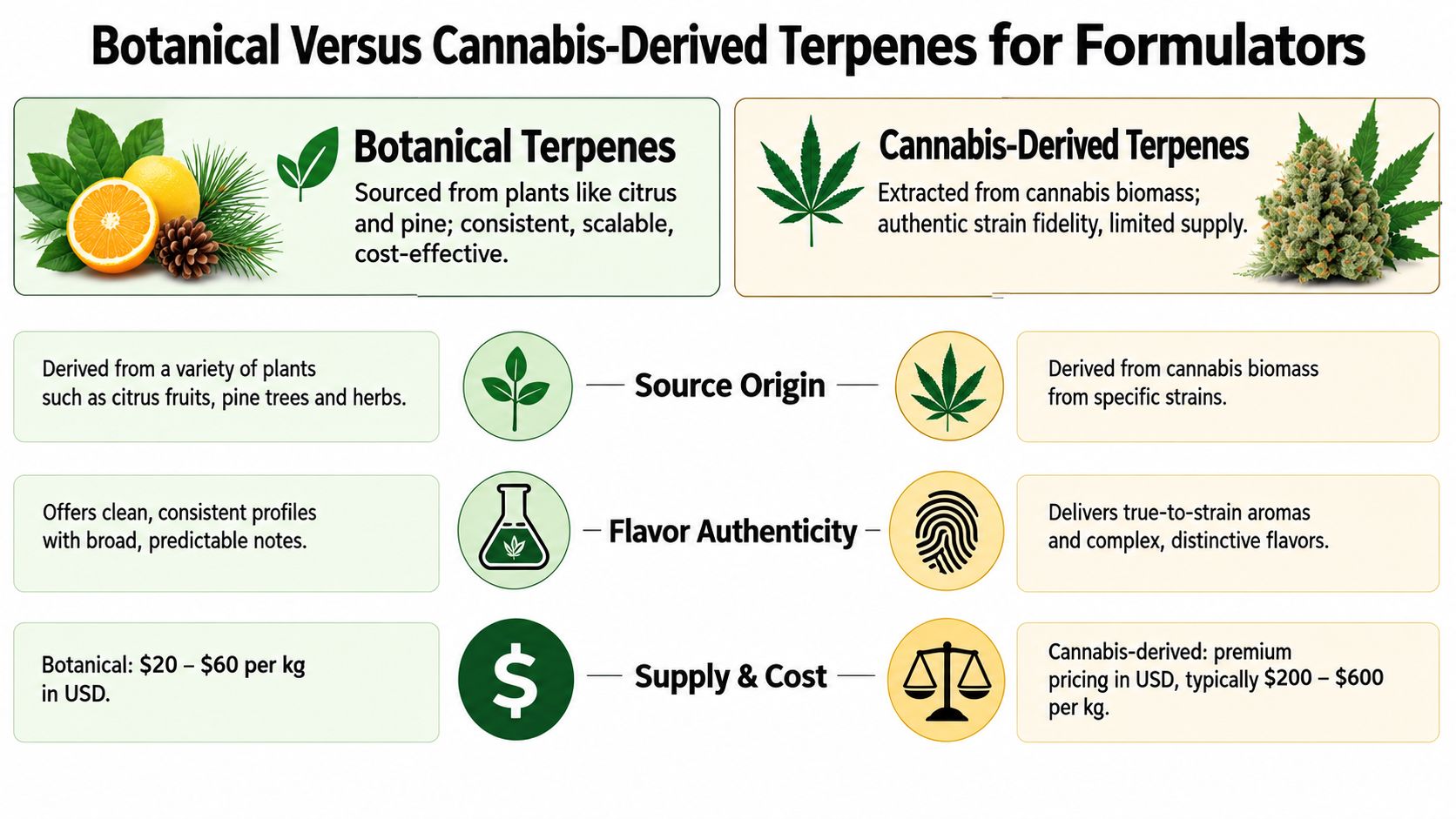
Botanical Versus Cannabis-Derived Terpenes for Formulators
Botanical and cannabis-derived terpenes are not interchangeable at the blend level. The molecular building blocks may overlap, but the full aromatic system, minor constituents, and production constraints can differ enough to change how a formula performs.
Why composition matters
Essential oils and botanical extracts are complex mixtures. A scientific review describes them as containing more than 300 compounds, with terpenes, especially monoterpenes and sesquiterpenes, as the principal chemical group (review). Another review notes that monoterpenoids typically constitute more than 80% of most plant essential oils, and monoterpenes can reach about 90% of an oil's total composition (review). That's why a single isolate can't stand in for a full profile.
For formulators, this is the core commercial point. A botanical profile works as a measured chemotype, not a vague generic oil. If you're building a strain-inspired terpene blend for cannabis product formulation, the target is the actual proportion of notes, not the cultivar name printed on the label.
How to read sourcing claims
Use the sourcing conversation to separate origin from performance. Botanical sourcing can make sense when you need scalable inputs, stable supply, or a food-grade direction. Cannabis-derived sourcing can make sense when trace fidelity is the primary objective.
Gold Coast Terpenes uses botanical sourcing across its product line and also offers an isolate library and flavor-led profiles. That kind of catalog is useful when the brief is repeatable aroma reproduction rather than raw biomass mimicry. Its synthetic, botanical, and cannabinoid terpene differences guide is a helpful reference point if your team is deciding how much source authenticity you need.
If the label says “strain-inspired,” ask for the analytical logic behind it. If the supplier can't explain the blend in chemical terms, the naming is doing more work than the formula.
What a serious buyer asks
- Source origin: botanical, cannabis-derived, or mixed.
- Flavor authenticity: does the profile track the target chemotype or just the headline notes.
- Supply and cost: can the supplier keep the blend available without constant reformulation.
That evaluation step is more useful than arguing about labels. A terpene company should help your team select the right sourcing model for the product, not force every SKU into the same origin story.
How to Choose a Terpene Supplier for Cartridge Development
Choose a supplier on stability data, batch documentation, and labeling clarity, not on how well the strain names sound in a catalog. For cartridge development, that's the difference between a blend that tastes right in a sample and a blend that still performs after filling, storage, and device heat.
What thermal testing tells you
Terpene selection has to account for thermal stability. In simulated vaping conditions from 100–200 °C, unchanged parent compound varied widely, about 97–98% for β-myrcene, 81–92% for limonene, 60–80% for α-pinene, 50–73% for β-pinene, and only 11–28% for terpinolene (study). The same work detected oxidation products at the lower end of typical vaping ranges, which means degradation can begin before the device hits maximum temperature.
That's the wrong place to rely on marketing language. A supplier who only gives you a flavor description isn't giving you enough evidence for cartridge work.
What to verify before you buy
A serious buyer should ask for:
- Current lot COAs tied to the batch being shipped.
- Method information that shows how the profile was measured.
- Documentation on batch consistency across recent runs.
- Clear labeling that distinguishes botanical, nature-identical, or cannabis-derived inputs.
- Evidence of inhalation-use review when the ingredient is intended for vaporization.
Gold Coast Terpenes positions itself with SC Lab-tested, THC-free blends, and products free of VG, PG, PEG, and MCT, which gives buyers a practical benchmark when comparing supply options. If you're shortlisting vendors, its quality standards page is the kind of resource that should exist behind the sales page.
Vendor test: if the supplier can't explain how the same profile behaves under heat, they're selling aroma, not formulation support.
How Gold Coast Terpenes fits the comparison
Gold Coast Terpenes isn't just a catalog of flavor names. It also gives brands product pages, calculator support, and a wholesale structure, which matters when the buyer needs both chemistry and ordering discipline. For a cartridge developer, that combination is more useful than a loose assortment of strain labels with no thermal context.
Compliance, Diluents, and Batch Consistency Standards
Compliance failures usually show up in the details teams skip early, not in the ingredients they spend time debating. The most common mistakes are mixing the aroma system with the carrier system, assuming all additives are harmless, and accepting a COA that doesn't describe the actual batch.
Why carrier and aroma need separate specs
Commercial vape oils can carry substantial additive fractions. In testing of New York State cannabis vaping fluids, vitamin E acetate was detected in 132 of 202 oil-containing fluids, or 65.3%; in affected samples it ranged from 2.0% to 67.8% of total oil mass, with a mean of 37.0% (study). The same investigation found terpenes in flavoring additives, including caryophyllene in eight of nine additive samples and limonene in seven of nine.
That's not a reason to panic. It is a reason to separate specifications. If your formula has a carrier, a terpene system, and other additives, each needs its own incoming-material check.
What batch consistency should look like
A supplier needs to show that a blend can be repeated, not just sold once. For formulators, that means tracking the same profile across multiple batches, confirming the dominant compounds, and verifying that the blend doesn't drift in a way that breaks your downstream tolerance window.
| Supplier Evaluation Criteria for Cartridge Formulators | What to Request | Why It Matters |
|---|---|---|
| Batch identity | Lot number and current COA | Proves you're buying the shipped batch, not a generic formula |
| Analytical depth | Full terpene profile, not just the top notes | Lets you check minor compounds that affect aroma and stability |
| Carrier disclosure | Separate statement for any diluent or additive | Prevents carrier ingredients from hiding inside a terpene spec |
| Heat-use guidance | Storage and vaporization context | Helps your team avoid formulas that degrade too quickly |
| Reorder consistency | Past batch history or repeatability data | Reduces the risk of drift in a scaled SKU |
Gold Coast Terpenes appears in the market as a wholesale and bulk supplier, which is relevant because procurement teams need repeatable buying patterns, not one-off sampler behavior. Its regulatory compliance checklist is worth using as a procurement gate before a PO goes out.
Where diluents become a red flag
If a vendor is vague about VG, PG, PEG, or MCT, that's not a small omission. It means the buyer can't separate terpene concentration from carrier content, and that makes batch math unreliable. The cleanest supplier relationship is the one where the terpene profile stays a terpene profile.
Replicating Strain Flavor and Managing Thermal Stability
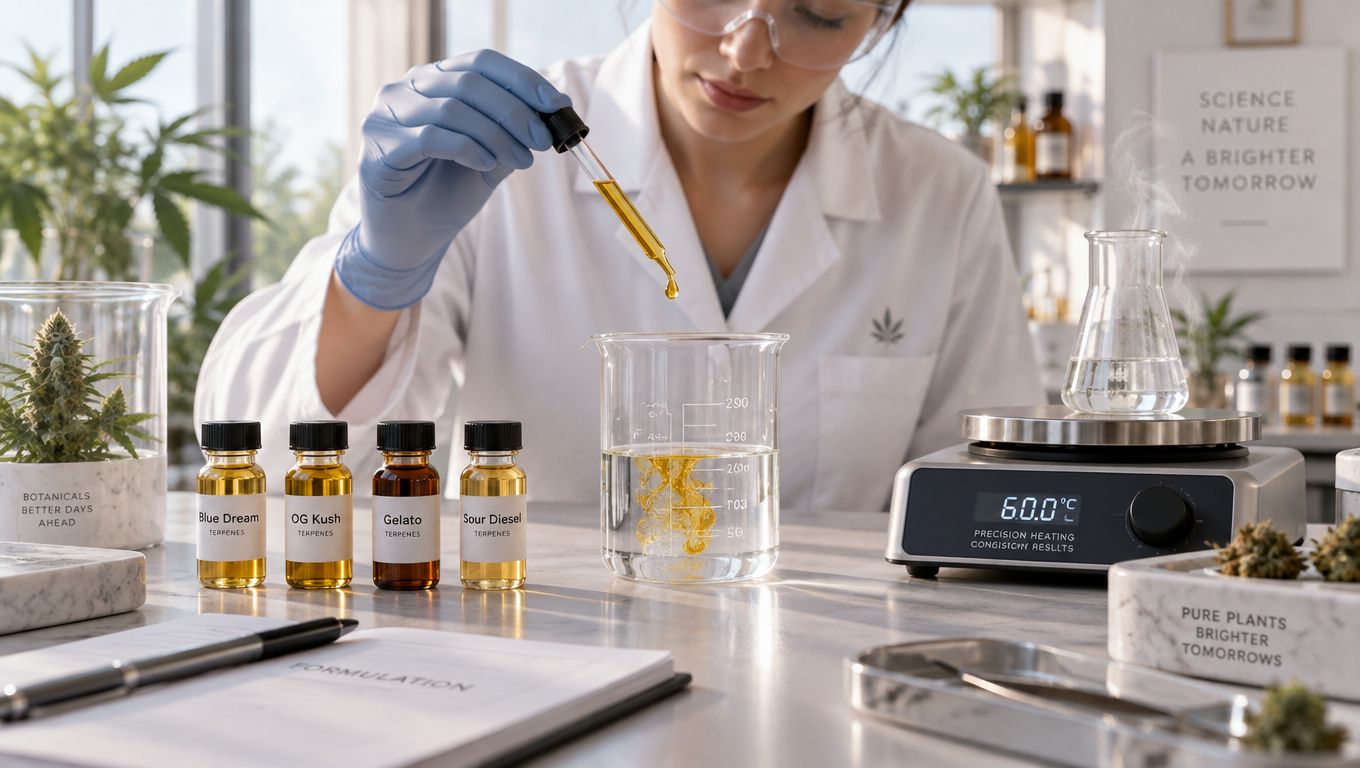
Strain flavor replication works best when you treat the target as a fingerprint, not a name. Cultivar labels are shorthand, but the actual aroma comes from measured volatile chemistry that can shift across harvests, source material, and processing methods.
Build from measured chemistry
A peer-reviewed analysis of 19 dried cannabis cultivars identified 75 volatile compounds spanning nine chemical classes and grouped the samples into five volatile chemotypes (analysis). Another study of cannabis plants from 32 seed sources detected 48 terpene peaks, including 11 annotated monoterpenes and 37 sesquiterpenes, and found substantial variation among plants labeled as the same cultivar (study).
That is why a strain-inspired terpene blend should start with a reference batch, a GC-MS-derived fingerprint, and tolerance ranges. The right workflow is to compare normalized peak areas, identify which compounds drive separation, and then rebuild the target with isolates or a controlled blend.
Why heat changes the answer
Loading level matters because aroma doesn't behave the same way at every percentage. A University of California study added a defined terpene mixture to THC distillate at 0%, 7.5%, and 15% by weight to compare viscosity, aerosol output, sensory intensity, and chemical emissions (study). That kind of comparison is more useful than asking whether a blend “smells strong” on paper.
You can buy a profile that smells right in a bottle and still get a poor result in the device if the loading rate is wrong. Thermal stability and loading are part of the same formulation decision.
Here's the practical takeaway:
- Lock the reference profile. Use a known batch, not a cultivar slogan.
- Track minor compounds. The small peaks often explain the biggest sensory differences.
- Test at the intended load. A profile at sample size may behave differently in production.
- Verify emissions behavior. Finished output matters more than ingredient aroma alone.
The 24k gold punch page is a useful example of how a single profile can sit inside a broader product library, but the actual work still happens in matching the analytical fingerprint to your target batch.
Testing Formulation Loading Levels Before Scale
Terpene loading should be treated like any other measurable process variable. If you don't test control, moderate, and high-loading batches, you're guessing where the formula breaks.
Why a three-point test beats intuition
The clearest published cartridge work uses 0%, 7.5%, and 15% by weight as comparison points for terpene mixture loading (study). That structure gives a development team a clean baseline, a middle condition, and a stress condition without pretending that one loading level works for everything.
Practical rule: test the finished product, not just the raw terpene ingredient.
A profile that looks balanced in the lab can still create a different aerosol character once it's mixed into a distillate matrix. That's why finished-product emissions matter more than raw ingredient specs for cartridge development.
What to document before scale-up
A useful development record should include:
- Total terpene-to-oil ratio on a mass basis.
- Each blend component's contribution to the formula.
- Viscosity or handling notes for filling.
- Sensory observations at each loading point.
- Aerosol or emissions results from the finished batch.
Gold Coast Terpenes' Mixing Calculator is relevant here because it helps teams move from rough percentages to repeatable batch math. That matters whether you're running a lab bench or preparing a larger SKU rollout.
The mistake to avoid is assuming more terpene automatically means a better product. More loading can increase aroma, but it can also change how the blend behaves under heat and how it performs in a device. Treat the loading level as a specification, not an aesthetic choice.
Next Steps for Formulators Evaluating Terpenes for Sale
The cleanest way to shortlist a terpene supplier is to match the profile to the product, then verify the documentation behind it. If the vendor can't show how the blend behaves, how it is labeled, and how it repeats from batch to batch, the relationship will create problems later.
A practical buying sequence
Start with the intended application. A cartridge brief needs thermal and emissions context. A distillate brief needs loading discipline and a clean carrier system. A flavor replication brief needs a measured fingerprint and a tolerance range.
Then ask for:
- A current COA for the exact batch.
- A clear source statement for botanical versus cannabis-derived inputs.
- Batch consistency evidence across recent production.
- Any diluent disclosure if the product isn't a pure terpene blend.
- Documentation that supports inhalation-use decisions rather than just consumer flavor copy.
Gold Coast Terpenes gives buyers a practical example of how a supplier can structure that process. Its catalog includes curated packs, isolates, diluents, wholesale and bulk options, plus educational tools that help a team move from selection to formulation. For brands and extractors, that combination is more useful than a pile of strain names with no batch logic behind them.
What to do before you place the order
If you're working on cartridges or distillate, line up the technical review first. Confirm the target profile, lock the loading range, and compare the vendor's documentation against your quality requirements. If the supplier can't support that workflow, it's not the right fit for a production program.
Gold Coast Terpenes supplies strain-specific botanical terpene blends, isolates, and formulation tools for cartridge, concentrate, and distillate teams that need repeatable sensory results. If you're comparing suppliers on thermal stability, labeling clarity, and batch consistency, visit Gold Coast Terpenes and review the catalog, guides, and Mixing Calculator before you spec your next blend.