
Blue Muffin isn't a chemically standardized product, and compiled lab data put total THC roughly between 16% and 28% across sources, so formulators need a verified COA and a measured terpene target, not the strain name. Gold Coast Terpenes, a Redondo Beach supplier of 100% botanically derived, THC-free terpene blends, is the kind of source teams use when they're building repeatable cart SKUs instead of chasing dispensary copy.
Blue Muffin is one of those names that sounds precise until you try to manufacture against it. The berry, pastry, and cream story is real enough as a sensory cue, but the chemistry behind the label shifts by cut, batch, and source, which is why a strain-inspired terpene blend is more reproducible than an unverified flower name.
Why the Blue Muffin Strain Is a Terpene Formulation Problem
Blue Muffin is a branding problem before it's a flavor problem. If you're building for vape cartridges or for distillate, the name tells you almost nothing about what will survive heating, what will hold on the shelf, or what will show up in a COA.
Gold Coast Terpenes keeps that distinction clear with strain-specific profiles and botanically derived components that don't rely on the cultivar label to do the heavy lifting. Their strain library is the right place to start when the goal is replicating flavor of Blue Muffin instead of treating the name like a chemistry spec, and their strain terpene profiles archive gives a practical reference point for that work.
Why the name alone isn't enough
Blue Muffin is commonly used interchangeably with Blueberry Muffin and Blueberry Muffins, and that naming drift matters. A formulator who assumes all three labels point to one fixed input is setting up a mismatch between aroma, potency, and finished-product behavior.
Practical rule: treat Blue Muffin as a target sensory profile, then verify the breeder, the cut, and the current COA before you build a cartridge or distillate SKU around it.
That's also why a well-documented strain-inspired profile is often more useful than a loose flower label. A COA-driven formulation process gives you something you can scale, audit, and repeat.
What Genetics Actually Sit Behind the Blue Muffin Name
The short answer is that the market hasn't standardized the lineage, and that ambiguity leaks directly into formulation. Blue Muffin is commonly tied to Purple Panty Dropper crossed with Razzleberry, while some strain databases and related listings describe Blueberry crossed with Purple Panty Dropper instead, so the name is carrying more than one pedigree record at once. Gold Coast Terpenes' Blueberry Muffin strain page is useful precisely because it points back to the naming issue instead of pretending the label settles it.
What the lineage confusion means in practice
Parentage isn't trivia here. Different lineages and phenotypes can shift aroma, maturation, and cannabinoid expression enough to change how the same “Blue Muffin” concept should be rebuilt in oil.
The market identity got a boost from its approximately 80% indica and 20% sativa classification and its sixth-place finish at the 2017 Emerald Cup, but neither of those milestones makes the chemistry fixed. They only explain why the name spread.
If you're sourcing for production, the question isn't “What's Blue Muffin supposed to be?” It's “Which exact cut, from which breeder, backed by which lab report, are we actually matching?”
Sourcing rules that save failed runs
Use the cultivar name as a starting tag, not a procurement decision. Then lock in the breeder, the phenotype or cut, and the latest batch paperwork before anything hits the blending bench.
That approach also keeps you from building to an old sensory memory. Blue Muffin-style products can drift if a supplier swaps input material, even when the label stays the same.
How Much THC and Terpene Content the COA Data Really Show
Blue Muffin is an unverified commercial name, so the COA matters more than the label. One compiled report based on 10 passed certificates of analysis found 26.412% average total cannabinoids, 22.374% average total THC, and 3.414% average total terpenes, with 24.96% THCa, 0.484% delta-9 THC, and 0.139% CBG also reported in that dataset treefersoft potency data.
What the spread means for commercial sourcing
Published references also place THC around 16–19%, 18.90%, or 20–28%. That spread is a sourcing problem, because a Blue Muffin lot can shift in stated potency depending on source and testing method. For a production team, the only safe assumption is that the name covers more than one chemotype.
| Data Source | Total THC | Total Terpenes | CBD |
|---|---|---|---|
| Compiled COA set | 22.374% average | 3.414% average | not specified |
| Reported retail-style ranges | 18–26% | not specified | approximately 0.05–0.6% |
| Other published references | 16–19%, 18.90%, or 20–28% | not specified | not specified |
The practical move is to verify the exact batch before you buy or blend. Gold Coast Terpenes' COA reference page belongs in any sourcing workflow that is trying to match a real product, not a marketing description.
What to check on every input
- Total THC and total CBD, because the label cannot replace cannabinoid data.
- Dominant terpenes, because aroma structure depends on more than one molecule.
- Minor cannabinoids, because they help explain why two lots with the same name do not behave the same way.
- Harvest or batch date, because freshness changes the sensory result.
- Extraction method, because the same cultivar can present differently after processing.
The Terpene Profile for Blue Muffin Mapped to Top Mid and Base Notes
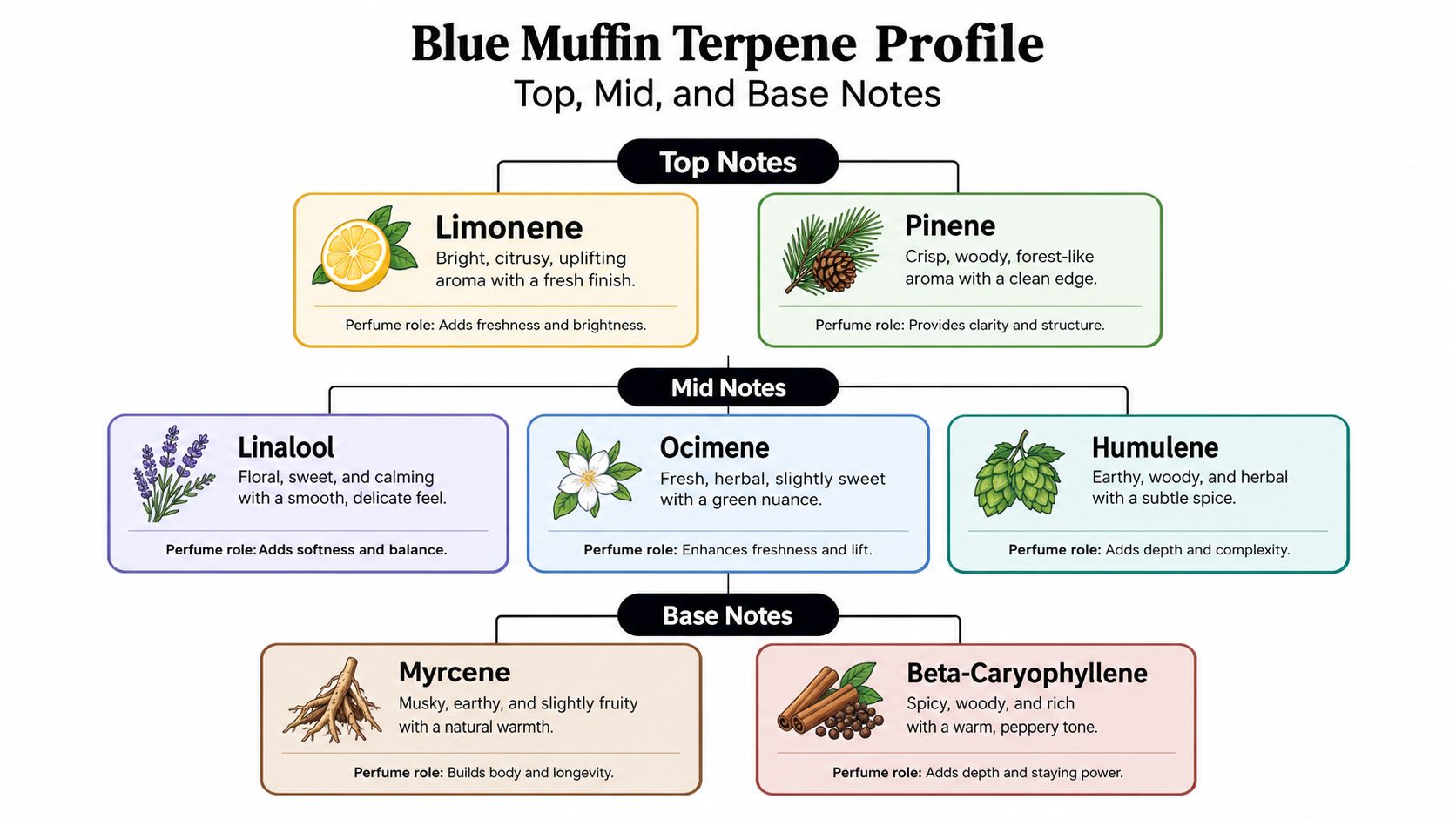
Blue Muffin is a commercial name, not a chemistry guarantee. In practice, that means the terpene profile has to be verified by COA and then mapped by volatility, not by dessert language. The working pattern usually points to myrcene, limonene, and beta-caryophyllene first, with supporting linalool, humulene, ocimene, and pinene. The job is to assign each compound a note role instead of forcing a generic berry flavor into the blend.
Top notes carry the first impression
Limonene and pinene sit in the top-note lane. They create the first lift, the bright edge, and the citrus-pine opening that keeps the profile from tasting flat or overly sweet.
That matters because a cart that pushes syrupy sweetness too hard can feel heavy by the second puff. Top notes should show up clearly, but they should not dominate the blend.
Mid notes hold the pastry body
Linalool, ocimene, and humulene form the bridge. They soften the top end, round the profile, and carry it from bright opening to baked middle without making it sharp.
This layer gives the profile its pastry shape. It is the part that makes a blueberry pastry read as believable instead of candy-like.
Base notes do the structural work
Myrcene and beta-caryophyllene anchor the blend. Myrcene brings the herbal, berry-adjacent body, while beta-caryophyllene adds the peppery finish that keeps the profile from collapsing into simple fruit oil.
A single blueberry note will not rebuild this profile. The berry effect comes from layered structure, not one dominant terpene.
For formulators who want a cleaner starting point, Gold Coast Terpenes also keeps botanical, THC-free input materials available for teams that need a consistent base to work from.
Formulating a Blue Muffin Strain-Inspired Terpene Blend for Vape Cartridges
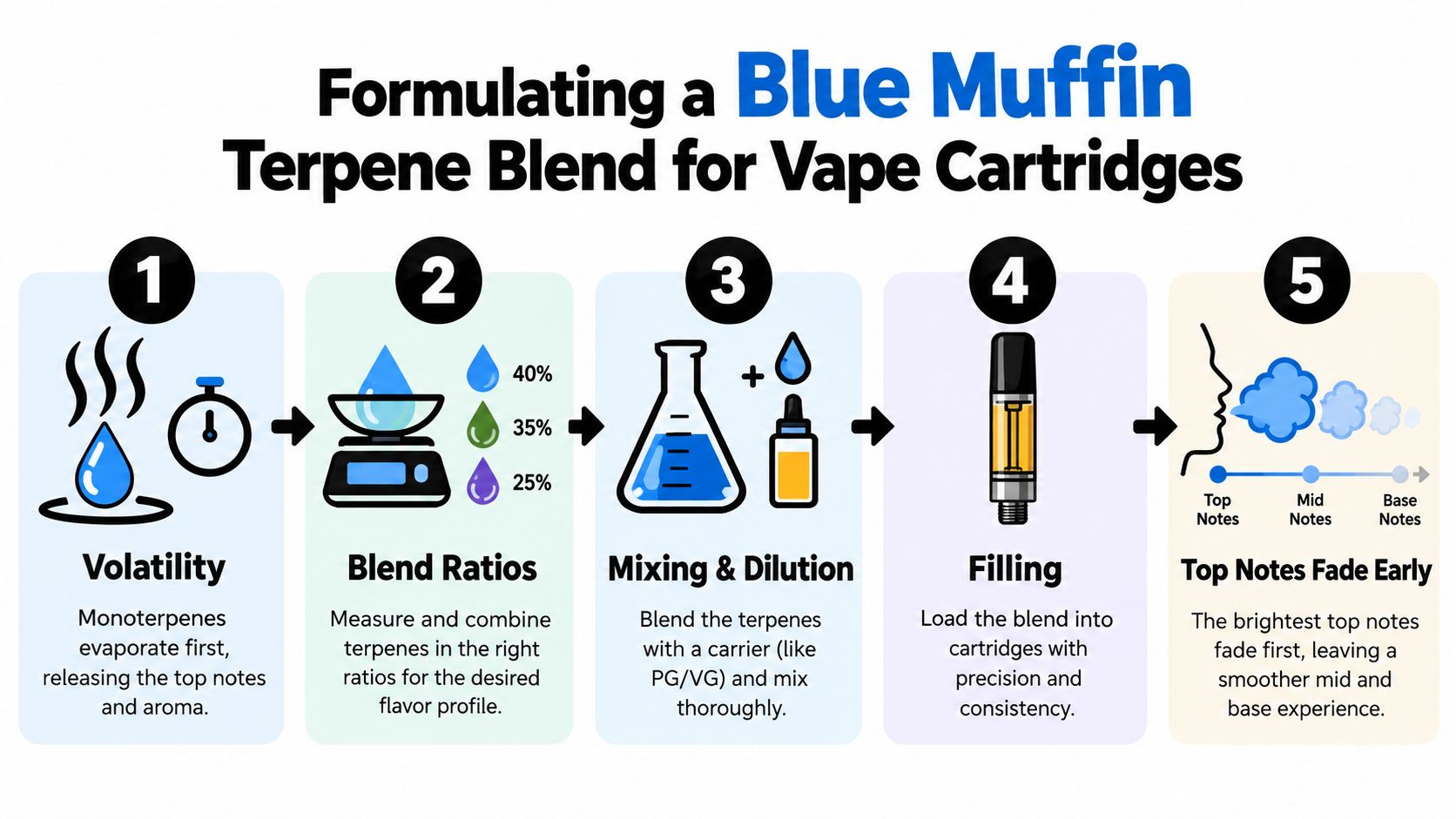
Start with volatility, not flavor language. Monoterpenes evaporate first, so top notes can flash off fast or overwhelm the first puff, while less volatile structure is what keeps the profile recognizable after repeated heating drying and vapor-loss study.
Build the blend analytically
Record compound identity, relative abundance, and, where relevant, enantiomeric form instead of trusting labels like blueberry or cream. Validated cannabis methods can separate and quantify 29 terpenes, including 13 enantiomers and 5 diastereomers, which is why two materials with the same strain name can still behave differently in a cartridge terpene analytics study.
Test on actual hardware
A lab aroma match is not enough if the oil is going into a real device. Heating changes the emission mix, and one vaping study found that terpene loading up to 14% changed THC and terpene transfer behavior, while an aerosol study showed thermal-degradation products from THC and beta-myrcene made up 18–30% of the aerosol gas phase and tracked strongly with device power vaping study.
Match the cold sample, then test the heated sample. If the cart only smells right before firing, it is not finished.
Keep loading realistic
More terpene does not automatically mean better flavor. In inhaled products, taste intensity, irritation, and device temperature interact, and New York's inhaled-product rules set a 10% total terpene cap with a permitted variance up to 11.5% while also requiring terpene testing ASTM D37 vape safety note. For batch planning, use the Mixing Calculator and the Terpenes 101 guide as your baseline tools for ratio work and team training.
Keeping the Flavor Accurate in Distillate Over Shelf Life
Shelf life changes flavor, and it changes it fast enough to matter in wholesale. In an accelerated stability study, samples stored with external terpenes lost 18.0% of total Δ9-THC after 127 days compared with 34.3% loss in samples without them, a 47.4% reduction in degradation PubMed study.
Storage is part of formulation
That result makes terpene dosage a stability variable, not just a sensory dial. If headspace, temperature, and light exposure are sloppy, the cart you approved at fill will not taste like the cart that reaches retail.
UV exposure can also shift the terpene mix. One stability-related dataset showed beta-pinene falling to 75% of its initial concentration after 18 days, while alpha-pinene stayed at 94%. Light protection and controlled storage are not packaging extras, they help preserve the profile you built.
What production teams should lock down
- Filled headspace, because excess air speeds drift.
- Temperature control, because heat changes both aroma and degradation.
- Light-protected packaging, because UV hits some compounds harder than others.
- Finished-product re-testing, because the blend on day one is not the blend after warehouse storage.
Gold Coast Terpenes' SC Lab-tested, botanical blends are a practical fit for teams that need consistent input material, and their bulk program is built for production runs with free U.S. shipping over $100 and discounts over 64 oz. Their terpene degradation resource is worth keeping on hand when shelf stability starts eating into flavor accuracy.
Your Blue Muffin Formulation Checklist Before You Buy Terpenes
Treat Blue Muffin as a commercial name until the COA proves otherwise. Match the lab report to the lot, then build the blend around top, mid, and base notes that fit your oil, device, and jurisdiction.
Batch drift is the ultimate test. A cartridge that looks good on paper can still miss the target if the input terpenes are vague, overloaded, or chosen without a hardware check. I would rather start with a documented profile and a modest load than chase a loud shelf scent that falls apart in production.
Blue Muffin Formulation FAQ
Can two products labeled Blue Muffin be matched if the lab results differ?
Yes, but only by comparing the COAs, not by trusting the name on the jar. Blue Muffin should be treated as a commercial label until the batch data proves the profile, and even then small differences in terpene identity can shift the result.
What terpene percentage makes sense for a Blue Muffin cartridge?
Use the limit that applies in your market, then test the finished oil instead of chasing a loud terpene load. New York's inhaled-product rules, with a 10% total terpene cap and a permitted variance up to 11.5%, show why the final cartridge matters more than a generic target.
Do botanical terpenes work as well as cannabis-derived terpenes for this profile?
They can, if the goal is repeatable flavor rather than strain mythology. Botanical blends from Gold Coast Terpenes are lab-verified, THC-free, and easier to hold steady from batch to batch, which matters when you need the same Blue Muffin-style output across runs.
How should a brand start small before ordering bulk?
Start with a small sensory batch, then check it on the actual hardware before you buy larger volumes. A mixing calculator helps you get close, but the cart and oil combo decides whether the profile stays on target or turns thin, sharp, or muted.