
Most advice about OG Cherry Pie starts with the wrong assumption, that the name maps to one fixed cultivar. In production, that assumption creates inconsistent flavor, inconsistent lab results, and avoidable rework. Gold Coast Terpenes, a Redondo Beach, CA supplier of 100% botanically derived terpene blends, treats profiles like this as a specification problem, not a strain-name guessing game.
If you're building a distillate cart SKU, OG Cherry Pie works better as a sensory target than a genetic promise. That matters because the same label can hide different parentage, different terpene ratios, and different cannabinoid results depending on the breeder or clone source, so wholesale buyers need batch specs, not nostalgia.
Why OG Cherry Pie Is a Sensory Target, Not a Single Cultivar
OG Cherry Pie isn't a standardized cultivar name, so a cart brief that treats it like one will drift at the bench. Two labs can publish different dominant compounds under the same label because the market uses the name for multiple Cherry Pie and OG cross combinations, not one locked line.
Why the name causes commercial risk
The most widely circulated lineage describes Cherry Pie as Granddaddy Purple × Durban Poison, with OG Cherry Pie adding an OG Kush or related OG donor such as SFV OG or Tahoe OG. Historical accounts place the original Cherry Pie clone in California's Bay Area and connect its spread to the early Cookie Family scene, which helps explain why the name gained traction before the labeling conventions got strict. A buyer who orders an ingredient called OG Cherry Pie is not automatically buying a defined flavor profile, just a named material that may differ by breeder, cut, or production source.
Practical rule: write the donor, the sensory target, and the batch requirement into the purchase spec. If those three things aren't on paper, the SKU is already underdefined.
Gold Coast Terpenes approaches strain-inspired work as a repeatable formulation exercise, using 100% botanically derived blends rather than cannabis-derived inputs. That matters for teams trying to reproduce a dessert-plus-fuel profile across multiple lots without inheriting the variability of a single clone source.
For formulation teams, the problem isn't “What is OG Cherry Pie?” It's “Which OG Cherry Pie are we matching, and how will we verify it?” That answer belongs in your spec sheet, not in a packaging room argument.
Gold Coast Terpenes strain terpene profiles
OG Cherry Pie Lineage and What It Means for Flavor
The most defensible lineage for OG Cherry Pie is Granddaddy Purple × Durban Poison, then crossed or paired with an OG donor. That construction points to a profile that can carry cherry and berry sweetness up front, dessert depth in the middle, and fuel or spice at the back.
Read the parents as flavor clues
Durban Poison usually signals brighter lift. Granddaddy Purple pushes the profile toward grape, berry, and pastry-like depth. Add an OG donor, whether it's OG Kush, SFV OG, or Tahoe OG, and you bring in the heavier side of the profile, meaning resin, fuel, and pepper. If a vendor leaves out the specific OG donor, the spec is incomplete because the fuel-spice register can shift in a way buyers will smell.
The historical anchor matters too. OG Cherry Pie reached a documented mainstream milestone at the 2014 High Times U.S. Cannabis Cup in Denver, where it placed third in the Medical Sativa category. That doesn't define the flavor by itself, but it does show the name was already moving beyond a local Bay Area context and into broader commercial awareness.
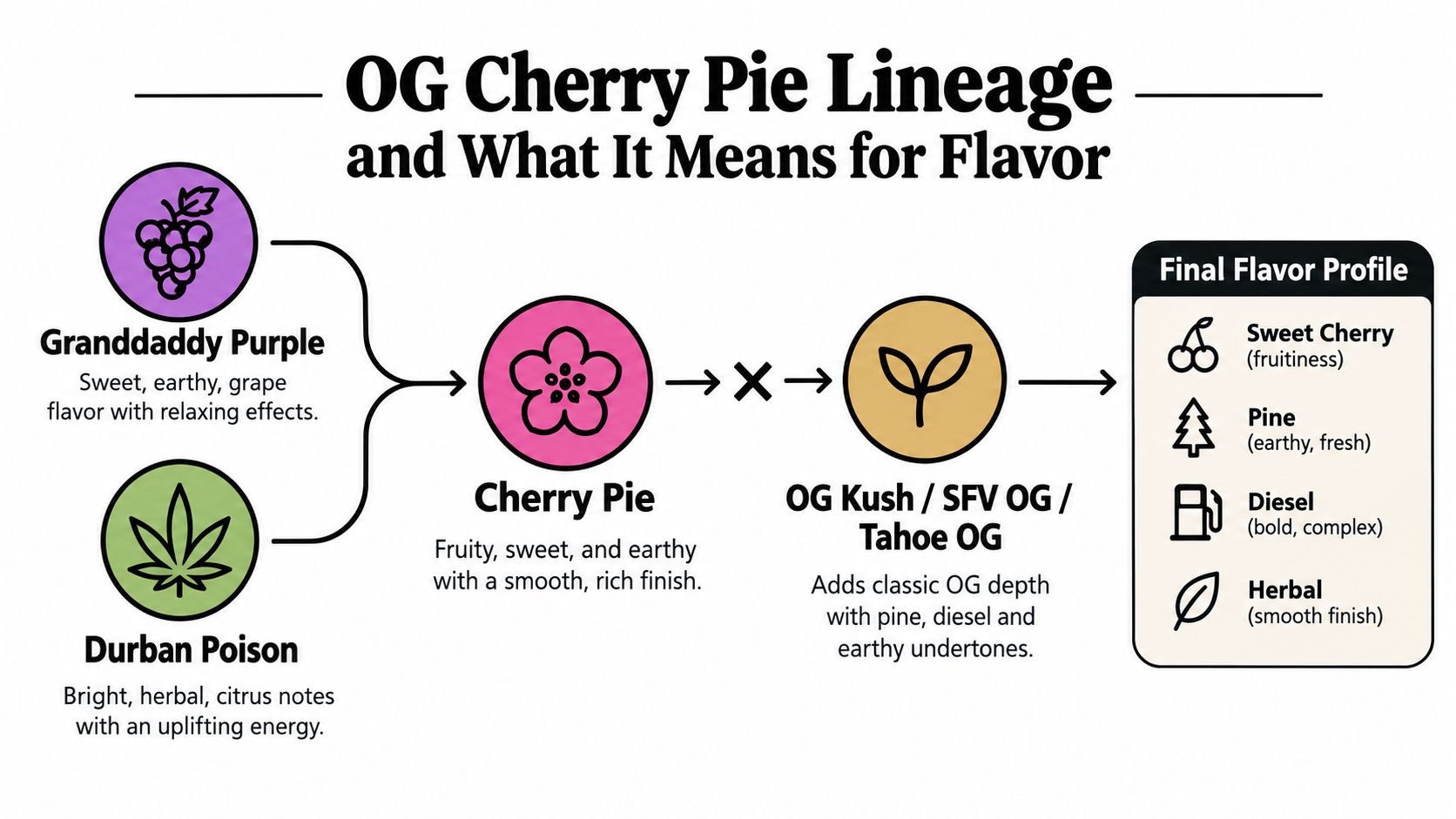
For a brand team, the lesson is simple. If the target is “cherry pastry with OG depth,” the lineage has to be written as a sensory framework, not just a strain name. Otherwise the finished cart can lean too fruity, too earthy, or too gassy depending on which donor influenced the batch.
The marketing story can borrow the lineage, but the production line has to lock the sensory target.
The OG Cherry Pie Terpene Profile and Top Mid Base Structure
A workable OG Cherry Pie terpene profile usually centers on myrcene, beta-caryophyllene, and limonene, with pinene and linalool as supporting notes. Treat those as roles in the blend, not a fixed recipe, because published Cherry Pie data shifts a lot from sample to sample.
Build the note stack, not a single fingerprint
Independent Cherry Pie COA aggregations show that one database reported median concentrations of about 0.28% myrcene, 0.52% beta-caryophyllene, 0.68% humulene, and 0.21% pinene by flower weight, while another found mean values of 0.70% myrcene, 0.67% beta-caryophyllene, 0.61% limonene, and 0.29% alpha-pinene (straincompass.com). Those differences are exactly why a formulator should set acceptance ranges instead of trying to copy a single number set.
| Terpene | Note role | Flavor contribution | Suggested % by weight |
|---|---|---|---|
| Myrcene | Base | Ripe fruit, soft earth, broadens cherry | 0.25% to 0.70% |
| Beta-caryophyllene | Mid to base | Pepper, spice, warm body | 0.50% to 0.70% |
| Limonene | Top | Citrus lift, brighter cherry impression | 0.30% to 0.65% |
| Pinene | Top support | Resin, freshness, cleaner finish | 0.15% to 0.30% |
| Linalool | Mid support | Floral softness, rounds sharp edges | 0.05% to 0.15% |
A sweet cherry note doesn't come from one terpene alone. It emerges from the interaction of myrcene, limonene, and minor compounds that standard cannabis panels often don't resolve cleanly, so the flavor target has to be sensory as much as analytical.
Gold Coast Terpenes terpene flavor chart
Formulator's note: aim for cherry, berry, and pastry first, then use spice and resin to keep the profile from reading like candy.
Formulating OG Cherry Pie for Distillate and Concentrates
A good OG Cherry Pie batch spec should define total load, analyte ranges, prohibited diluents, and the retained reference sample. Without that, the same recipe can land differently across carts, especially once hardware and storage come into play.
Turn the profile into a production brief
Start with a sensory minimum and a hardware-aware target. Blend for cherry and pastry first, then tune the middle for spice and the top for citrus or resin. If the batch is too flat, adjust with isolated Limonene, Myrcene, or Beta-Caryophyllene rather than overloading the entire blend.
For production teams, it also helps to name what's not allowed. Gold Coast Terpenes formulations are described as free of VG, PG, PEG, and MCT, which matters when a hardware team wants to avoid diluents that change viscosity or coil behavior. That type of clean input spec is more useful than a hand-me-down recipe copied from an old spreadsheet.
A practical batch sheet should include these items:
- Declared OG donor: OG Kush, SFV OG, Tahoe OG, or another named donor
- Target total terpene load: set before blending, not after tasting
- Individual analyte ranges: for the main terpenes you're controlling
- Prohibited diluents: list them explicitly
- Retained reference sample: keep one sealed control from the approved lot
Gold Coast Terpenes how to make cannabis concentrates
If the batch fails the sensory check, don't chase it with more of everything. Fix the top, mid, or base note that's missing, then verify the updated blend against the COA and a small sensory panel.
Loading Level Is a Performance Variable for Vape Cartridges
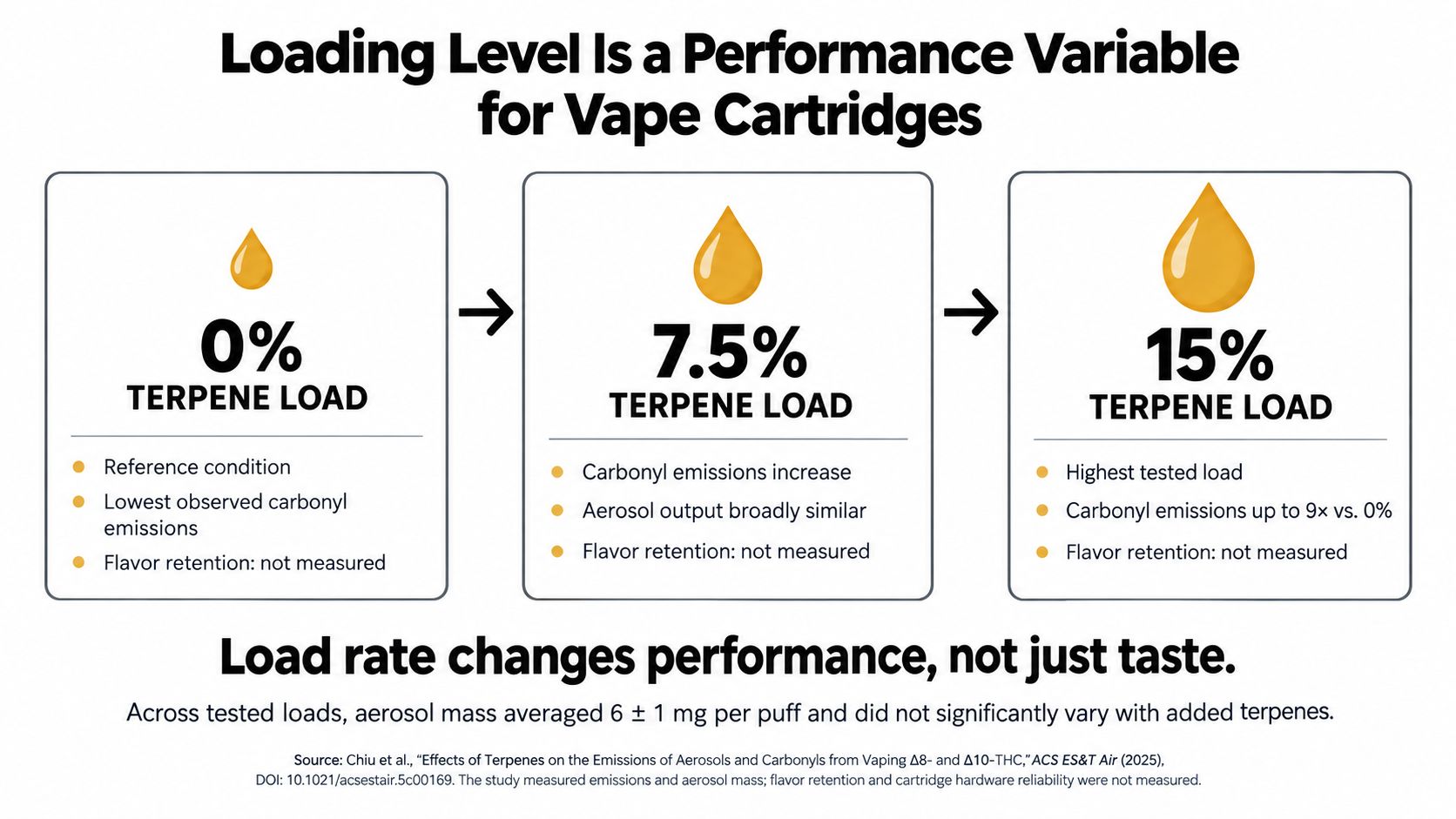
Terpene load rate changes cartridge chemistry, not just flavor. A flavor-accurate OG Cherry Pie blend can still behave badly in hardware if the load percentage isn't matched to the device.
Test the blend at the load you'll actually ship
A University of California, Davis study examined delta-8-THC and delta-10-THC distillates at 0%, 7.5%, and 15% terpene content by mass and reported that terpene addition significantly increased carbonyl formation, with increases of up to ninefold under the tested aerosolization conditions (UC Davis study). The same work reported no significant change in aerosol mass production, which means a cart can look similar on paper while still changing in emission behavior.
Use a simple workflow:
- Set the sensory minimum for cherry, pastry, citrus, and fuel.
- Test an intermediate load before you jump to a heavy flavor dose.
- Check the blend in the actual device, at the intended coil temperature and voltage.
- Evaluate emissions and stability before you lock the SKU.
That's the point where a technical supplier matters. Gold Coast Terpenes can help map a blend to the load window your hardware spec can support, instead of forcing a strong aroma into a cartridge that wasn't built for it.
Botanical vs Nature Identical vs Cannabis Derived Sourcing
For OG Cherry Pie, sourcing choice is as important as the flavor target. Botanical, nature-identical, and cannabis-derived routes each solve a different problem, and they don't perform the same in scale, documentation, or supply stability.
Choose the route that fits your channel
Cannabis-derived terpenes give you direct plant provenance, but supply is limited and batch variability can make scaling expensive. Nature-identical terpenes are synthesized to mirror natural molecules, so they're consistent and scalable. 100% botanically derived terpenes are isolated from non-cannabis plants, then blended to match a target profile, which often makes them easier to document and move through multi-state or export-oriented programs.
A useful comparison is simple. Botanical sourcing usually wins on supply stability and COA clarity. Cannabis-derived inputs can be harder to scale cleanly. Nature-identical sits in the middle when consistency matters more than source story. For teams comparing these routes, a sourcing guide like Gold Coast Terpenes CDT vs BDT helps frame the trade-offs without turning the decision into a brand slogan.
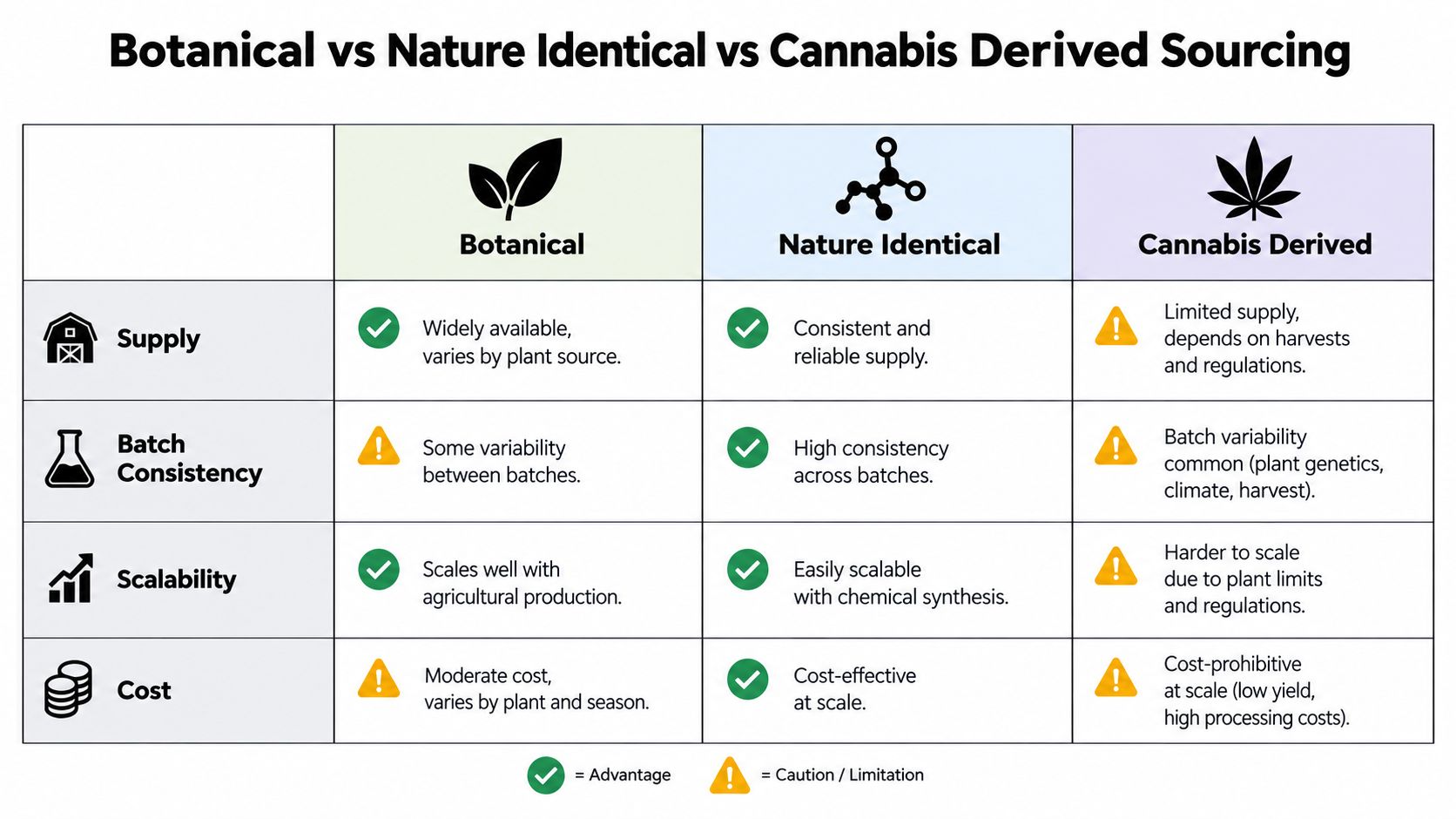
For international shipping, the practical issue is regulated cannabis inputs. Botanical and nature-identical options avoid that problem more easily, which is why many brands prefer them for line extensions and repeatable SKUs. Gold Coast Terpenes supplies THC-free, SC Lab-tested, botanically derived blends, which makes the sourcing conversation much simpler for compliance teams.
Building the OG Cherry Pie Brief and Placing the Order
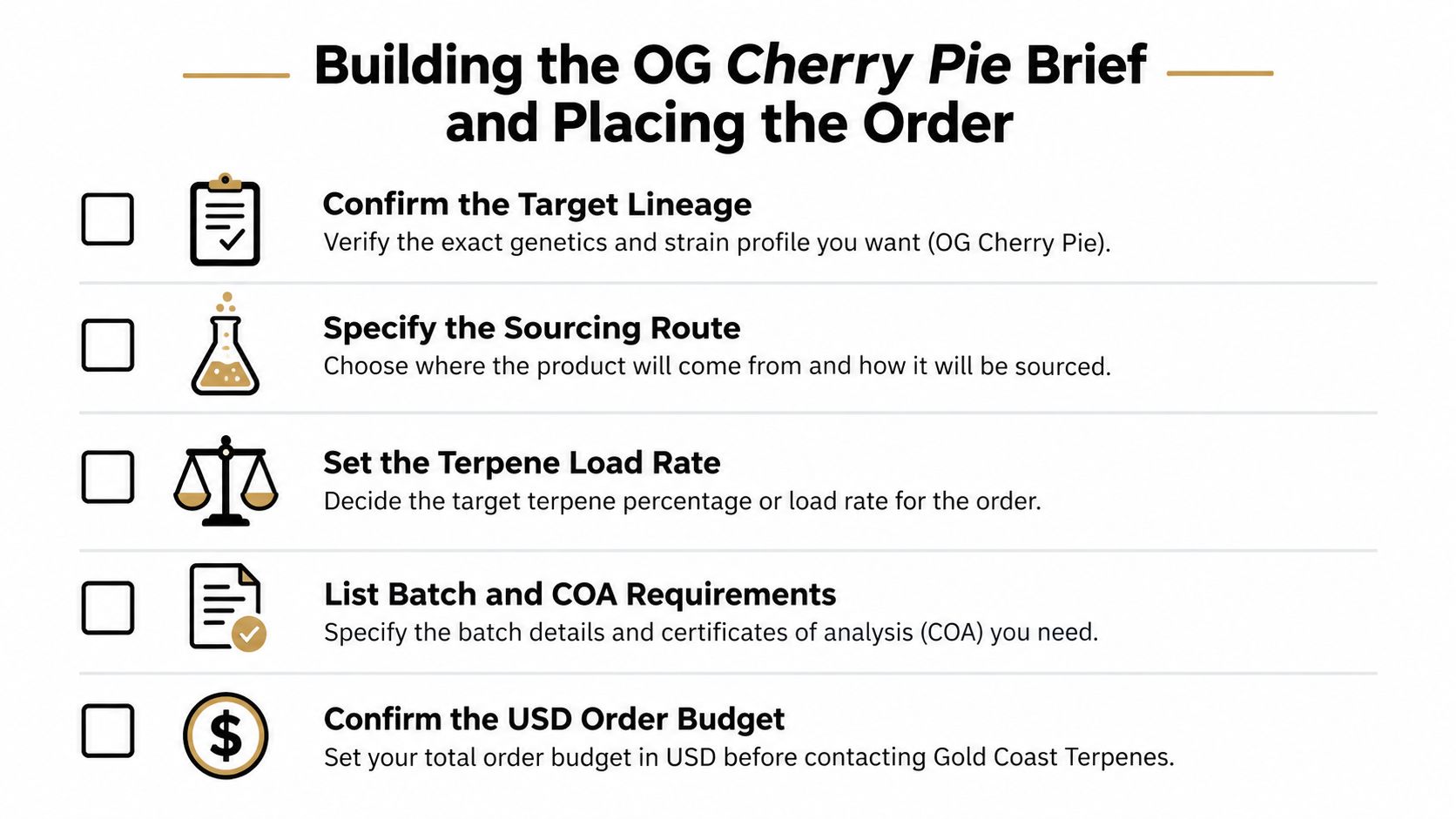
A clean purchase brief beats a vague strain name every time. If you want OG Cherry Pie to hold its flavor across batches, send purchasing a document that specifies the donor, the note structure, the load window, and the hardware target before anyone clicks order.
What to lock before you buy
Include the following:
- Lineage target: which OG donor you mean
- Top, mid, and base note map: cherry, citrus, spice, fuel, pine
- Total terpene load: the exact percentage your hardware can support
- Prohibited diluents: list the ones that can't enter the formula
- COA requirement: every lot must match the approved range
- Reference sample: keep one retained control for comparison
When you're ready to convert a gram-based formula into ounces or milliliters, use the Gold Coast Terpenes Mixing Calculator so the load stays aligned with the batch plan. For wholesale buyers, the commercial levers are straightforward, with free U.S. shipping over $100 and discounts on orders exceeding 64 oz available on bulk programs.
If you need a starting point, use the OG Cherry Pie blend page, then cross-check it against the formulation guides in the Gold Coast Terpenes /learn/ or /formulation/ section before you run a production trial. That keeps sourcing, load rate, and flavor matching tied to one documented workflow instead of three separate guesses.
If you're building an OG Cherry Pie cart SKU, Gold Coast Terpenes can supply the starting blend, the individual isolates, and the formulation tools to tighten the spec around your hardware. Visit Gold Coast Terpenes to compare terpene profiles, review sourcing options, and turn your target flavor into a batch-ready brief.