
If you're trying to turn a Creamsicle Runtz concept into a cartridge that tastes stable from the first fill to the last puff, Gold Coast Terpenes is the kind of supplier to have on the bench. The Redondo Beach, CA company focuses on 100% botanically derived terpene blends, which matters when you're trying to rebuild an orange-cream dessert profile in a distillate base instead of relying on a flower name alone.
That distinction is the whole job here. A strain label can point you toward a sensory target, but it won't give you a reproducible vapor formula, and that's where formulation discipline starts.
Understanding the Formulation Challenge
Creamsicle Runtz works better as a strain-inspired terpene blend target than as a fixed chemical standard. For product developers, that means the task is not copying a plant, it's engineering a repeatable aroma in a medium that strips away a lot of the original character.
Gold Coast Terpenes, a Redondo Beach, CA supplier, sits in that exact lane with 100% botanically derived blends built for aroma replication rather than cannabis biomass matching. For cartridge brands, that matters because the same name can support very different sensory outcomes depending on the distillate, the hardware, and the terpene load.
Start with the sensory brief, not the strain label
The practical move is to define the brief in plain terms, then build to it. For this profile, the brief is orange-citrus on top, sweet cream in the middle, and candy fruit with a soft spicy base.
Practical rule: if the brief isn't written down, the formulation gets rebuilt by memory, and memory is where most cartridge flavor drift starts.
That's why the best formulation teams treat the name as a shorthand, not a specification. A strain-inspired cartridge has to survive dilution, storage, and heating, so the formula has to be anchored to measurable inputs, not to a dispensary description.
For teams building around vapor delivery, the role of terpenes for vape cartridges becomes a formulation problem rather than a branding exercise. The label can help you choose a direction, but it can't tell you how the oil will behave in the device.
Deconstructing the Lineage and Chemistry
Creamsicle Runtz is best handled as a modern hybrid cultivar name, not a universally standardized strain. The available documentation points to a combination of Creamsicle and Runtz lineages, with Creamsicle commonly attributed to Orange Crush crossed with Juicy Fruit, and Runtz generally identified as a Zkittlez × Gelato hybrid. That gives formulators a useful four-parent framework, Orange Crush, Juicy Fruit, Zkittlez, and Gelato, and a better map for flavor work than the name alone.
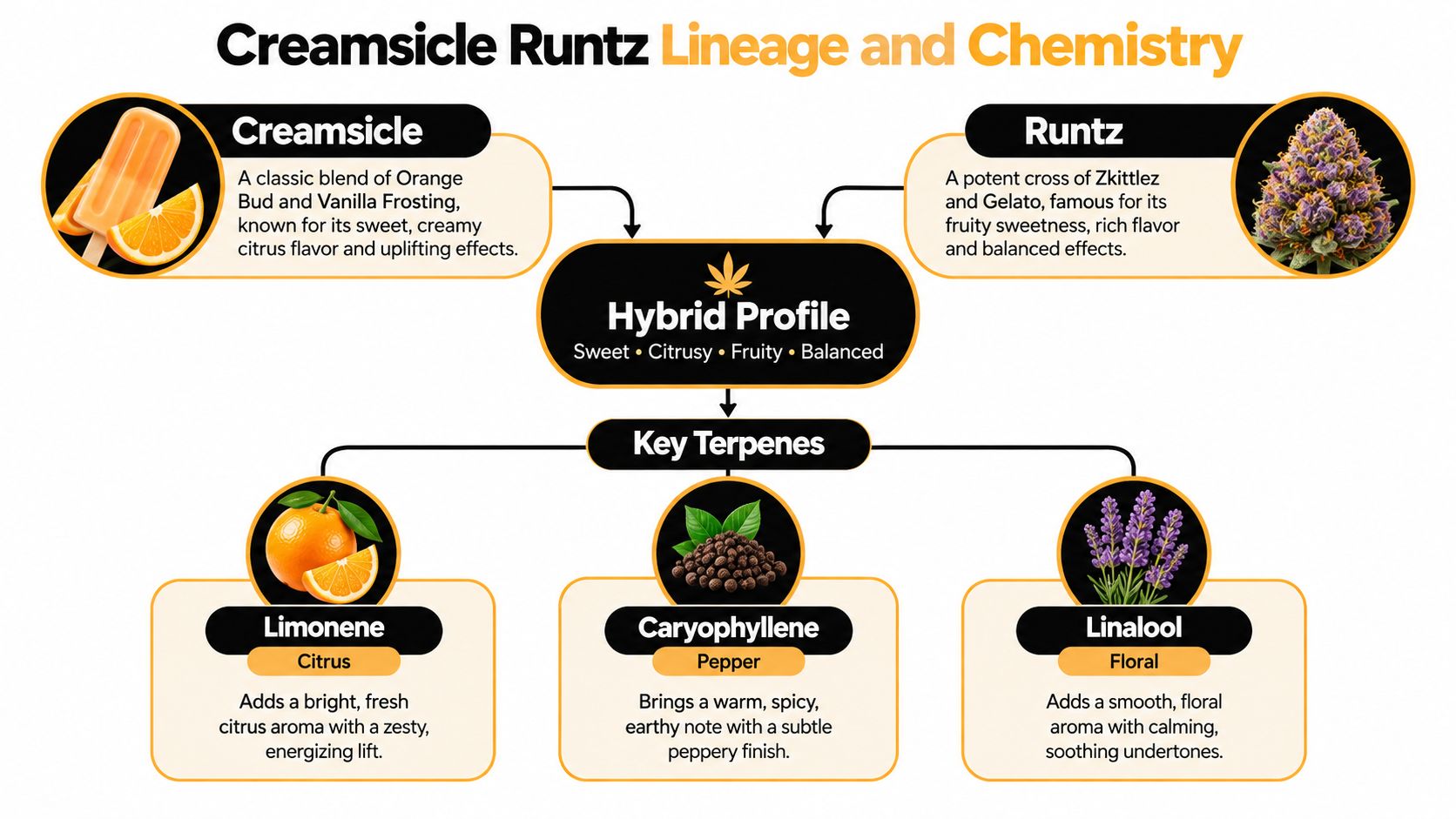
A New Jersey dispensary listing dated March 25, 2024 described the product as a hybrid with creamy citrus-dessert flavor, plus orange creamsicle sweetness, vanilla, tropical fruit, and tangy citrus notes. That aligns with what a formulator would expect from the lineage, but it still doesn't establish a single original creation date or an authoritative registry entry for the name.
What the lineage actually tells you
The value of the lineage is sensory boundary setting. The Creamsicle side points toward citrus and vanilla-adjacent sweetness, while the Runtz side adds tropical fruit and candy-like depth. Those are the poles you have to recreate if you want the cartridge to read like the target rather than like generic orange candy.
The Elevated Strains catalog item fits naturally into this conversation as a strain-style flavor reference, but the bigger point is the same, names are useful only when they guide a repeatable sensory decision. The chemistry has to be built from the lineage, then validated in the finished oil.
A strain name can point the way, but it doesn't certify the molecule mix.
That matters because a cream-forward citrus hybrid can drift quickly into orange soda, waxy candy, or flat fruit if the structure isn't deliberate. Lineage gives you the target zone, not the finished map.
Analyzing Parent Terpene Profiles
Creamsicle and Runtz push the blend in different directions, and that's what makes the profile interesting to build. Creamsicle leans citrus-first, while Runtz contributes a deeper fruit-candy body with earthy support.
The useful way to read the parents is as a contrast in texture. Creamsicle supplies brightness and lift. Runtz supplies roundness and persistence.
How the parents shape the flavor target
Runtz is commonly associated with myrcene, linalool, and limonene, which supports tropical fruit, candy, and earthy notes. Creamsicle, through its Orange Crush and Juicy Fruit lineage, leans harder into limonene-driven citrus with a sweeter cream-like impression.
That means the target isn't just “orange.” It's a layered blend with a citrus opening, a creamy bridge, and a fruit-candy finish that doesn't collapse into simple sweetness.
For reference, orange Creamsicle strain style profiles are useful as flavor anchors because they show how citrus and dessert notes can coexist without flattening each other. The important part for manufacturers is balance, not intensity.
A simple way to think about it is this:
- Citrus lift comes from bright top-note chemistry.
- Cream perception comes from soft aromatic compounds that smooth the edges.
- Candy fruit depth comes from fuller, rounder notes that keep the blend from tasting thin.
The mistake I see most often is overbuilding the orange and underbuilding the body. The result smells right for the first second, then reads hollow in vapor. For a commercial cartridge, hollow is worse than inaccurate because it tastes unfinished.
Building the Sensory Architecture
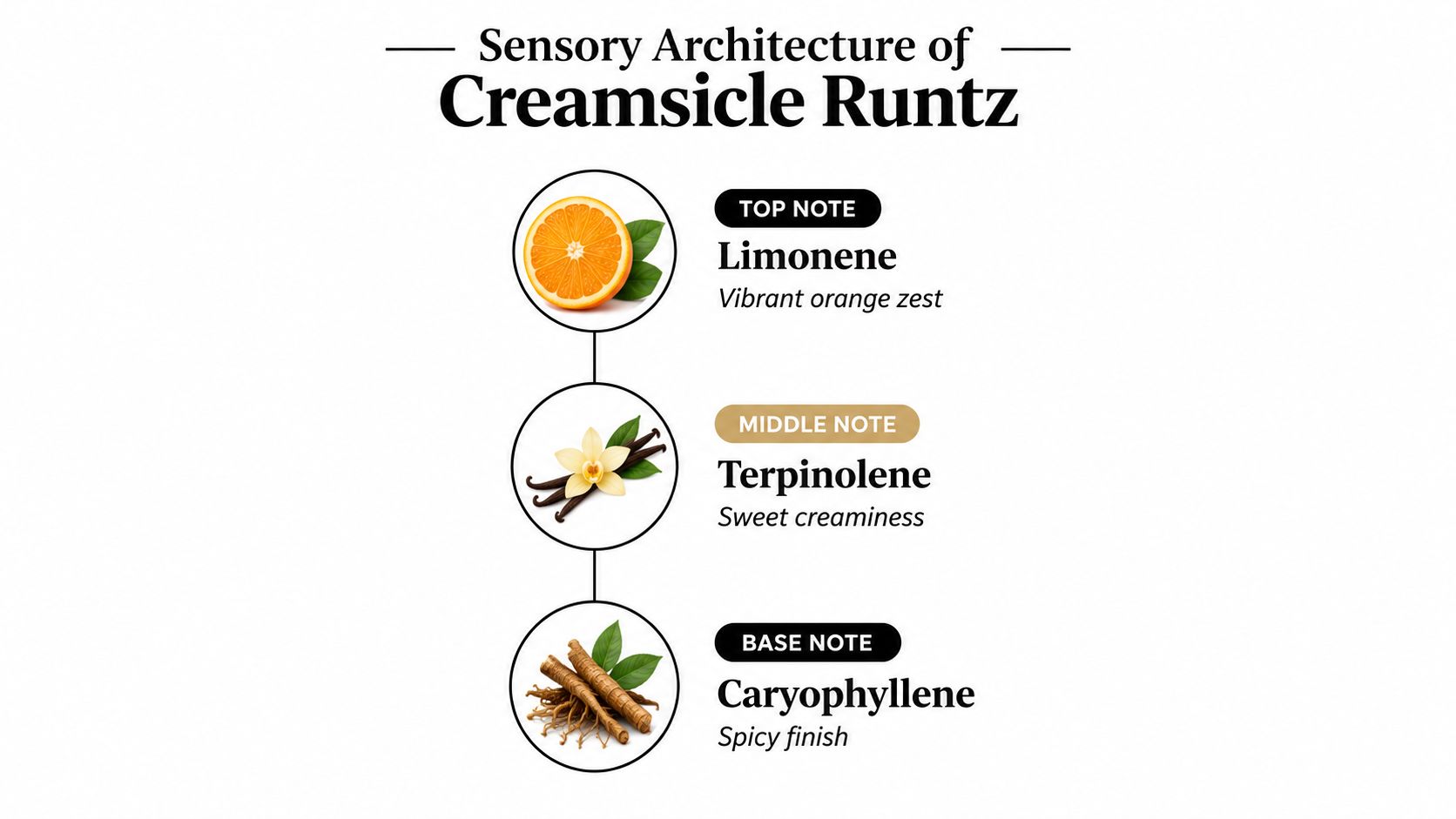
A solid Creamsicle Runtz strain-inspired blend needs a three-layer structure. Limonene carries the top note, linalool supports the mid-note creaminess, and myrcene plus beta-caryophyllene give the base note the body it needs.
That hierarchy keeps the profile from becoming one-dimensional. It also makes the blend easier to tune across different oil systems, because each terpene class is doing a distinct job.
Top, middle, and base notes in practice
Limonene is the first impression. It gives the orange-zest lift that makes the profile read as creamsicle instead of just sweet fruit.
Linalool is the smoothing agent. In this context, it helps create the creamy, floral softness that sits between citrus and candy.
Myrcene and beta-caryophyllene finish the structure. They keep the profile grounded so the blend doesn't feel like a top-note spray with no depth.
If the top note is obvious but the base is missing, the cartridge can smell strong and still taste cheap.
That's why a formula built only around citrus isolates usually disappoints. It may be vivid in the bottle, but in vapor it can become sharp, thin, or short-lived. A better structure keeps the citrus bright while letting the softer notes hold the middle of the draw.
The Runtz strain terpenes reference is useful here because it reinforces the value of a layered aromatic build, not just a single dominant terpene. For cartridge development, the goal is recognizable character, not a one-note impression.
Formulating for Vape Cartridges
Terpene loading is a flavor decision and a hardware decision at the same time. A peer-reviewed vaping study used a 9:1 THC-to-terpene ratio, which works out to roughly 10% terpene material in the combined THC-and-terpene mixture, and the authors noted that higher terpene ratios could make the oil too fluid and cause leakage from a vape pen. A separate California vape-oil analysis found terpene levels below 1% to 7% based on total chromatographic peak areas in tested liquid samples.
That range is a practical screen, not a universal rule. Cartridge hardware, viscosity, cannabinoid strength, and terpene composition all change the outcome.
What to test before scaling
Start with low-to-moderate loading points and check the oil in the actual device, not just in a beaker. Then look at fill behavior, leakage, clogging, draw-stage aroma, and vapor-stage flavor.
The useful sequence is straightforward:
- Test the liquid first. Make sure the oil fills cleanly and doesn't separate.
- Test the draw second. A cartridge can smell right in the jar and still lose balance in vapor.
- Test the finish third. If the citrus flashes and disappears, the blend needs more mid-note support.
Formulation teams often benefit from a structured catalog and mixing tools. Gold Coast Terpenes offers botanical options for terpene flavors, and their cartridge-friendly terpene pages give developers a way to compare isolated compounds against preblended profiles before scaling a formula.
Practical rule: the more volatile the top note, the more carefully you need to watch viscosity and airflow.
That matters because a creamsicle target lives or dies on aroma delivery. Too little terpene and the blend reads flat. Too much and the oil can become over-thinned, with a scent profile that looks good on paper but fails in the cartridge.
For technical teams, this is the point where terpenes for distillate and formulation planning have to meet real hardware constraints.
Managing Thermal Degradation
A cartridge that smells correct in liquid form can still miss the mark once heat is applied. In a study of twelve cannabis vape-oil samples heated to 200°C, heating produced more terpene types in the vapor and increased the relative abundance of major terpene signals, with some major compounds exceeding 75% of total chromatographic peak area in vapor samples. Another emissions study tested THC distillates containing terpene mixtures at 0%, 7.5%, and 15% by weight.
That tells formulators something important. The finished aerosol matters more than the jar sample.
Protecting the citrus character
For a citrus-dessert target, the main risk is that the top-note compounds get distorted or overpowered by heat. Limonene can come across bright and forward, but it also needs support from the softer notes so the vapor doesn't turn harsh or one-dimensional.
Use the liquid-phase certificate of analysis as a starting point, not as the final approval. Then compare the aerosol output against the intended sensory brief and adjust the blend, device temperature, coil behavior, and puff profile together.
The terpene degradation guide is relevant here because heat exposure changes what the user experiences. A cartridge formula isn't finished until the vapor confirms the intended profile.
If the vapor feels too sharp, the usual fix isn't just less citrus. It's often a better balance between bright top notes and the compounds that keep the profile creamy and rounded after heating. That's the part most formula sheets miss.
Selecting Your Terpene Sources
The source choice depends on whether you're trying to reproduce a flavor note, a parent strain feel, or a fully branded SKU. For a Creamsicle Runtz target, the best starting point is often a combination of isolated compounds and a preblended flavor direction, then testing both against the same distillate base.
Gold Coast Terpenes is one option in that workflow, especially when you need THC-free, botanical material that avoids VG, PG, PEG, and MCT. Their catalog also includes 50+ classic and contemporary profiles, plus Elevated Strains for fruit and dessert-style nuance, which can be useful when you're tuning toward a creamsicle-style target instead of a straight citrus oil.
Choosing the right source for the job
Use the source according to the role it plays:
- Limonene for citrus lift when the top note is too dull.
- Linalool when the blend needs a softer, creamier bridge.
- Myrcene when the body needs more depth and fruit weight.
- A preblended profile when you want a faster starting point for bench trials.
That's also where a terpene calculator and batch records become commercially useful. The formula has to be traceable by breeder reference, lot, and sensory outcome, especially if you're building multiple SKUs from the same target profile.
For teams comparing options, banana Runtz is another flavor-family reference worth noting because it shows how dessert-forward strain styling can be turned into a repeatable product direction without pretending the name alone is the spec.
Gold Coast Terpenes can supply isolated compounds, profile blends, and technical support for this kind of work, and that's the right lens for a creamsicle cartridge project. The brand name matters less than the sensory target, the documentation, and the way the oil performs in the finished device.
If you're building a Creamsicle Runtz-style cartridge or distillate line, use Gold Coast Terpenes as a sourcing and formulation reference, then validate the final profile against your own hardware and batch goals. Visit Gold Coast Terpenes to compare botanical terpene options, review cartridge-focused resources, and start matching the orange-cream brief to a reproducible production formula.