
A citrus-forward cartridge can smell excellent in the mixing vessel and still miss the target after filling. The first draw may be bright and lemon-like, while later draws become sharp, resinous, or flat because the botanical source, minor compounds, oxygen exposure, and hardware temperature weren't controlled together. Gold Coast Terpenes, a Redondo Beach, California supplier, offers 100% botanically derived, THC-free terpene blends, rather than cannabis-derived terpenes, including more than 50 classic and contemporary profiles and isolated compounds such as limonene.
For vape and distillate developers, citrus terpenes are more than a flavor label. They influence the opening aroma, the body of the profile, the finish, cartridge behavior, and the way a formulation changes during storage and heating. A reliable citrus profile therefore needs a defined chemical specification, a repeatable blending process, stability testing, and clear documentation.
Introduction
A citrus-forward cartridge usually fails for one of three reasons: the blend relies on limonene alone, the source material varies between batches, or the liquid is evaluated before it reaches the final cartridge. A bright bench-top aroma doesn't prove that the formulation will deliver the same flavor after dilution, storage, and aerosolization.
Gold Coast Terpenes supplies botanical terpene blends and isolated, lab-verified compounds that can help developers build a terpene profile for vape cartridges without treating citrus as a single, uniform ingredient. Its catalog includes more than 50 profiles, while its THC-free isolates include limonene for developers who need greater control over a specific marker compound.
The formulation question is practical: what chemical and sensory targets should a manufacturer specify before buying or blending citrus terpenes? The answer begins with source and extraction variability, then moves through top, mid, and base notes, strain-inspired applications, oil compatibility, oxidation control, and compliance.
Before approving a citrus formulation, review supplier safety documents, use a mixing calculator for batch math, and request current laboratory data. Gold Coast Terpenes provides resources including Safety Documents, a Mixing Calculator, and SC Lab test data, but every manufacturer still needs product-specific validation in its own oil, packaging, and hardware.
Understanding the Key Concepts
Citrus terpenes are usually limonene-led monoterpene mixtures, not chemically identical flavor ingredients. A 2021 peer-reviewed analysis found limonene concentrations from 20.7% to 81.4% across sampled citrus peel oils, with species-level ranges reaching 94.3% in citron and 95.8% in lemon (peer-reviewed citrus peel analysis).
The first distinction is between the major constituent and the complete volatile profile. Limonene often supplies the recognizable citrus core, but α-pinene, β-pinene, γ-terpinene, linalool, and aldehydic compounds can change sharpness, peel character, diffusion, and finish. Two oils with similar limonene levels can therefore produce different cartridge flavors.
Why source and process change the result
Species, cultivar, geography, maturity, storage, and extraction method all affect the final composition. Orange and grapefruit oils are often especially limonene-rich, while lemon and citron may contribute more relative γ-terpinene, pinene, linalool, or aldehydic character.
Extraction can shift the result substantially. Under a liquid-carbon-dioxide-plus-ethanol process, limonene represented 52.48% of orange extract, 44.02% of tangerine extract, and 43.84% of lemon extract, while solvent-extraction controls measured 5.46%, 7.52%, and 4.31%, respectively (extraction study in the International Journal of Food Science & Technology).
| Citrus type | Limonene content range |
|---|---|
| Sampled citrus peel oils | 20.7% to 81.4% |
| Citron peel oils | Approximately 39.5% to 94.3% |
| Lemon peel oils | Approximately 38.1% to 95.8% |
A formulation brief should therefore identify the botanical source, extraction method, and analytical method. “Natural citrus” isn't enough information for reproducible development.
Botanical versus nature-identical labeling
Botanically derived means the material comes from plant sources. Nature-identical generally describes a compound that matches a naturally occurring molecule but may be produced through a different manufacturing route. Cannabis-derived terpenes are another category, sourced from cannabis material rather than citrus or other botanical sources.
Ask suppliers how they define those terms, then match the answer to the product label and jurisdiction. Request a chromatographic specification for limonene, α-pinene, β-pinene, γ-terpinene, and other relevant markers. Gold Coast Terpenes positions its blends as botanical rather than cannabis-derived, which gives a developer a clear sourcing distinction to document.
Sensory Profiles and Functional Roles
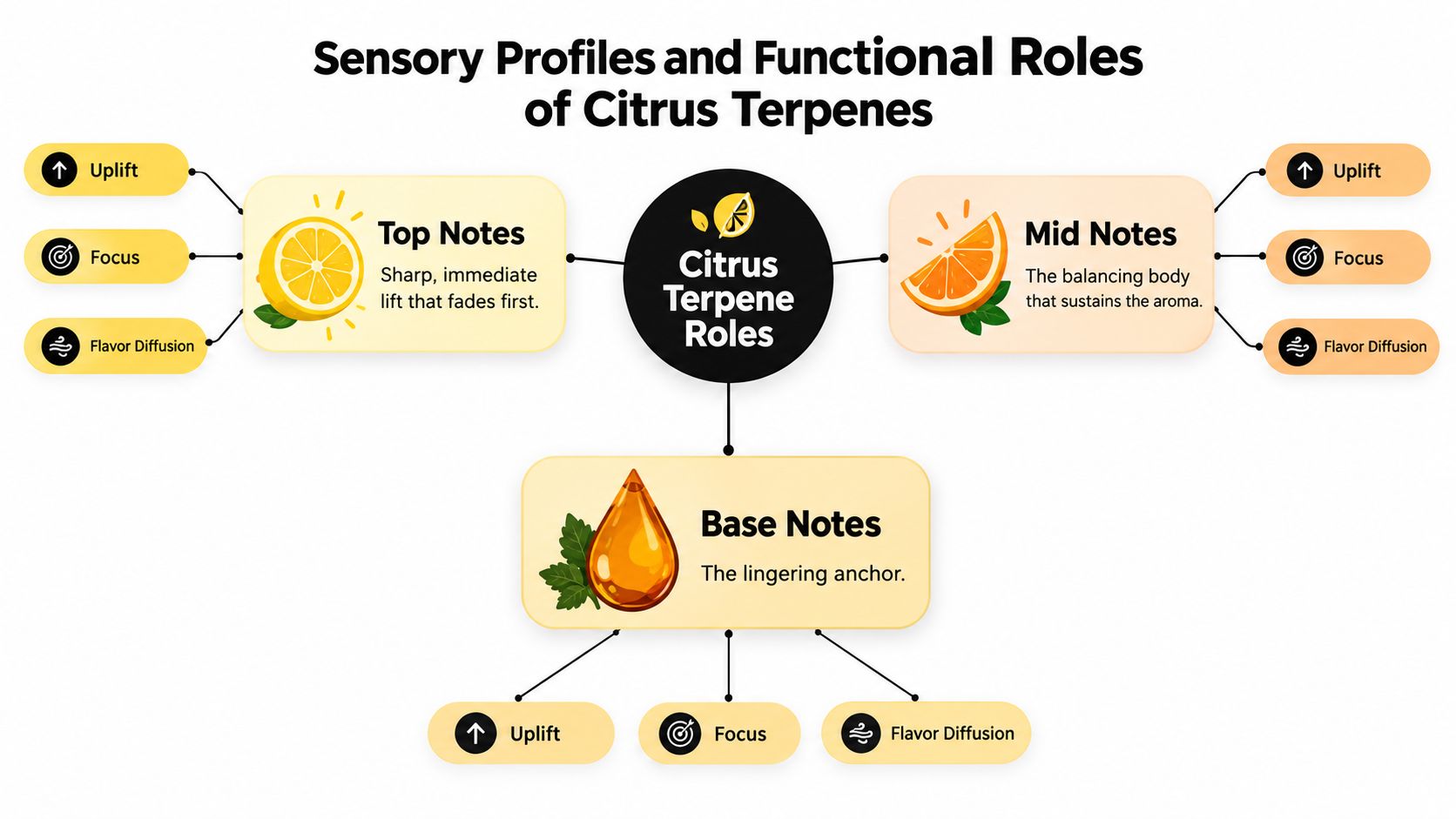
Top notes create immediate lift, mid notes provide body, and base notes extend the impression after the first draw. In a citrus cartridge, limonene often supplies the bright core, while pinene, terpinene, linalool, and heavier supporting compounds shape the transition and finish. These are sensory roles, not proven medical effects.
Top notes
Top notes arrive first and fade fastest. A limonene-led opening can read as lemon peel, orange zest, or bright citrus depending on the supporting compounds and concentration. Pinene can add lift and a cooler, sharper edge, while γ-terpinene can reinforce a fresh, zesty impression.
Many developers overcorrect here. Adding more limonene may increase brightness, but it can also make the profile thinner or more pointed if the mid-note structure is missing. A better approach is to define the desired opening separately from the body and finish.
Mid notes
Mid notes keep the citrus impression from disappearing after the first inhale. Orange-like, tangerine-like, and fruit-peel impressions often depend on the balance between the main citrus compound and supporting monoterpenes. Linalool can soften a sharp profile, while pinene and terpinene can preserve freshness.
Citrus terpene formulations are chemically dominated by limonene, but performance depends on the complete volatile profile rather than limonene concentration alone (citrus terpene composition analysis). Use sensory panels or trained internal evaluators to compare opening, middle, and finish rather than scoring only overall intensity.
Base notes and cartridge behavior
Base notes provide persistence and help a citrus profile remain recognizable after the first draw. They don't need to smell heavy. Their role is to anchor the volatile top notes so the flavor doesn't collapse into a brief burst of lemon.
For a development trial, record aroma from the neat blend, diluted oil, filled cartridge, and post-storage sample. Track perceived sharpness, peel character, sweetness, cooling impression, throat sensation, and finish. Gold Coast Terpenes' D-limonene educational resource can serve as background reading when a team is separating limonene's identity from the behavior of a complete blend.
A strain-inspired profile such as Elevated Strains can be evaluated using the same framework. The relevant question isn't whether the label sounds citrus-forward. It's whether the supplied profile reproduces the intended sensory sequence in the finished oil.
Common Strains and Product Applications
A developer can ask for “something like Lemon Haze” and still receive very different results from different suppliers. That happens because a strain name is only a shorthand. The actual citrus profile depends on the botanical source, the extraction method, and how that terpene blend behaves once it is diluted into oil and heated in hardware.
Citrus terpenes work best when the product brief specifies the desired flavor architecture, not merely a strain name. Lemon Haze-style development may call for a sharp, lifted opening with a lean finish. Green Crack-style work may need bright citrus with a more assertive aromatic edge. A 24K Gold Punch-style profile usually works better when citrus sits inside a broader fruit profile with heavier supporting notes, rather than reading as a simple lemon top note.
Comparing product directions
| Application | Citrus role | Main development question |
|---|---|---|
| CBD distillate | Brightness and identity | Does the blend remain balanced in a low-aroma matrix? |
| Full-spectrum extract | Lift over an existing profile | Which native compounds must remain dominant? |
| Distillate cartridge | Defined flavor architecture | Does the blend stay miscible and stable in hardware? |
| Concentrate | Aroma concentration | Does intensity obscure the intended mid and base notes? |
Application changes the job of the citrus fraction. In CBD distillate, the base can feel relatively blank, so even small shifts in botanical origin can make one orange or lemon material seem juicy, dry, candied, or peel-like. In full-spectrum extract, native volatiles are already present, so added citrus has to fit around them instead of covering them. In a cartridge, the same blend also has to stay uniform through filling, storage, and repeated heating.
A Washington State flavored cannabis vape research brief notes that cannabis oils commonly contain less than 10% added terpenes by mass. Use that as a practical starting boundary for strain-inspired vape formulation, not as a universal threshold. Screen lower loading levels and compare aroma intensity, viscosity, fill behavior, and draw-stage flavor before settling on a target.
Match the format to the profile
CBD distillate often needs more structural support because there is less native aroma to carry the profile. Full-spectrum extracts require more restraint because existing terpenes and sulfur or resin notes can compete with added citrus. Highly concentrated cannabinoid oils also need miscibility and flow checks before sensory approval.
A product page such as 24K Gold Punch can serve as a named reference during internal discussions, but the formulation team still needs its own sensory and analytical target for lot approval.
Supplier review matters here. MOQ, lead time, documentation, and batch continuity affect whether a citrus profile stays recognizable from pilot run to production. Ask whether each lot is a premade blend or a custom composition, whether current certificates and safety documents are available, and whether the supplier can reproduce the same citrus character at the required batch size.
Formulating Flavor First Citrus Profiles
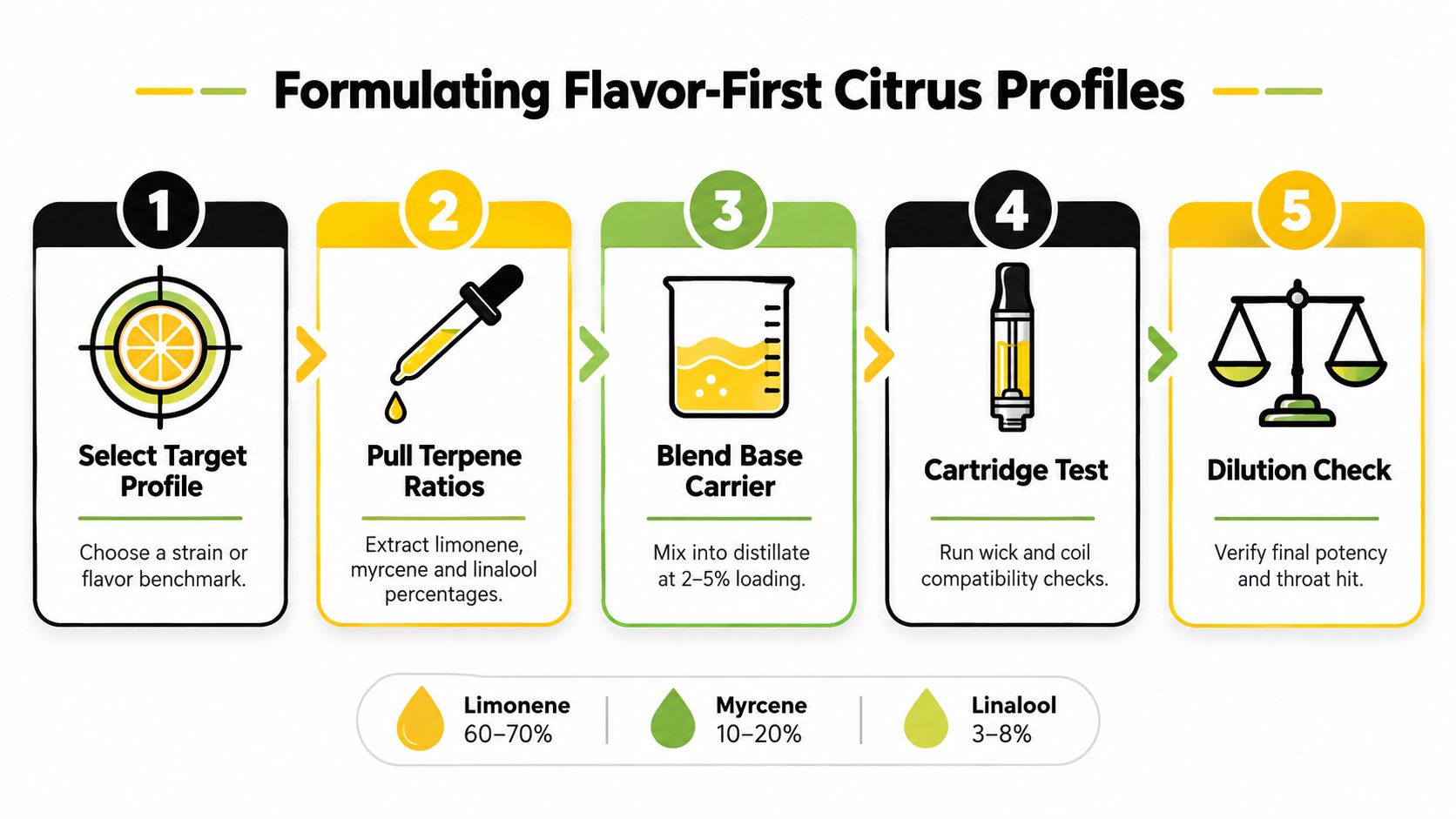
Flavor-first formulation starts with a sensory target and ends with testing in the final cartridge. It prevents developers from selecting a high-limonene material, adding it to distillate, and assuming the result will match a reference flavor.
Start with a defined target
Write the target as sensory language and analytical requirements. For example, specify whether the opening should resemble lemon peel or sweet orange, whether the middle should feel juicy or dry, and whether the finish should be clean, resinous, or lingering.
Then identify the reference. It might be a retained cartridge, a botanical oil, a strain-inspired benchmark, or an approved internal flavor standard. Keep the reference and test sample at the same evaluation temperature and in the same hardware when possible.
Build the first blend
Pull chromatographic specifications for limonene, α-pinene, β-pinene, γ-terpinene, linalool, and any other markers relevant to the target. Use Gold Coast Terpenes' Mixing Calculator to convert the desired blend into batch quantities, but don't treat a calculator output as proof of sensory equivalence.
A practical first pass uses limonene as the bright core, then adjusts pinene and terpinene family compounds for lift, freshness, and persistence. This is a design framework, not a universal recipe. The right ratio depends on the source material, oil matrix, target flavor, and hardware.
Practical rule: Change one variable at a time during sensory optimization. If limonene, pinene, and the carrier all change in one trial, the result won't tell you which adjustment created the improvement.
Blend into a small oil trial, inspect miscibility, and allow sufficient equilibration before sensory review. Record viscosity, haze, separation, fill behavior, and any change in aroma after dilution. If the blend smells bright but tastes thin, strengthen the supporting profile rather than automatically increasing the citrus core.
Validate the cartridge, not only the liquid
Cartridge testing should cover wick wetting, coil response, leakage, clogging, draw consistency, and flavor across the intended operating conditions. The liquid can pass a bench sensory test and still produce a different aerosol profile after heating.
A California Department of Cannabis Control-supported study tested distillates with 0%, 7.5%, and 15% terpene content by mass and found that some terpene-containing formulations increased carbonyl formation by as much as ninefold compared with terpene-free controls under the tested conditions (study on terpene addition and aerosol chemistry). The result doesn't establish one universal loading limit, but it does show why the finished oil, hardware, terpene level, and device settings must be evaluated together.
For background on citrus chemistry during formulation, review what citral is alongside the blend's laboratory data.
Stability and Compatibility with Oils
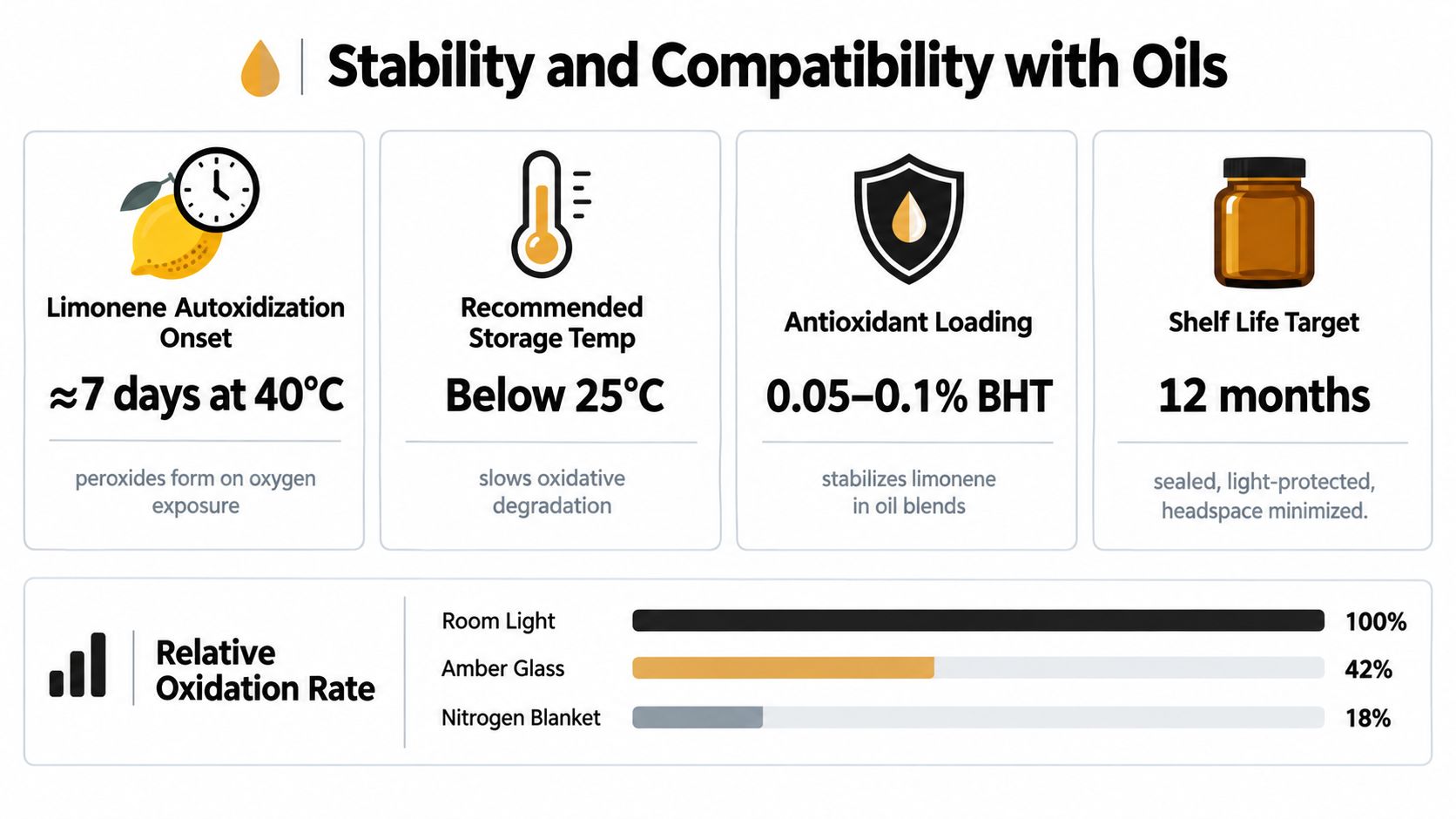
Citrus profiles need oxygen, light, temperature, and headspace controls because limonene can oxidize after extraction and blending. A government monograph reports that noticeable autoxidation of (+)-limonene can emerge within approximately 10 to 20 weeks under unfavorable conditions, while closed containers stored cold and dark showed no detectable autoxidation for up to one year in the cited evidence (government monograph on Citrus limon).
Control the package environment
Oxygen exposure can produce hydroperoxides and later oxidation products. Those changes may alter aroma, throat sensation, and the analytical profile. The practical controls are straightforward:
- Reduce headspace: Fill containers appropriately and avoid leaving large air volumes above the blend.
- Use airtight, light-protective packaging: Amber or otherwise protective packaging can reduce light exposure.
- Limit repeated opening: Each opening can introduce fresh oxygen and moisture.
- Control storage conditions: Keep terpene concentrates and blended oils in a cool, dark, sealed environment.
- Document handling: Record opening dates, transfers, storage conditions, and lot numbers.
Inert-gas blanketing or an approved antioxidant may be considered where legally and technically appropriate. Compatibility, sensory impact, and inhalation safety must be verified independently rather than assumed from a supplier recommendation.
Test the matrix you will sell
Concentrated limonene and hydroalcoholic fragrance systems can behave differently. One cited study found no measurable limonene loss or progressive accumulation of oxidation products in repeatedly opened, half-full hydroalcoholic fragrance bottles over nine months, which demonstrates why matrix-specific testing matters rather than proving that every cartridge formulation will remain unchanged.
Use an accelerated-stability program that tracks both chemistry and sensory performance. Suitable markers may include peroxide or oxidation indicators, chromatographic changes in the intended terpene profile, color, viscosity, separation, and cartridge draw behavior. Gold Coast Terpenes' boiling point of terpenes guide can support process discussions, but boiling-point information alone doesn't predict aerosol composition or shelf stability.
Safety Labeling and Compliance
Compliance requires a batch-specific exposure calculation, complete ingredient documentation, and clear separation between flavor description and health claims. A citrus profile should be labeled according to the actual formulation, supported by current safety documents, and evaluated for its intended route of exposure.
Set a concentration ceiling
A toxicological framework defines maximum allowable terpene concentration as:
maximum allowable concentration (% w/w) = [safety limit (mg/day) ÷ concentrate use (mg/day)] × 100
The equation provides a defensible starting ceiling because it connects the terpene limit to expected concentrate consumption (peer-reviewed toxicological framework). The manufacturer must still account for device emissions, thermal degradation, actual consumer use, jurisdictional requirements, and the properties of the finished formulation.
A practical compliance file should include:
- Ingredient identity: Record each terpene or blend component and its source classification.
- Batch composition: Keep the weight percentage of every added component.
- Exposure assumptions: Document the safety limit, expected daily concentrate use, and calculation.
- Laboratory support: Retain certificates, chromatographic data, and relevant safety documents.
- Label review: Check flavor language, THC-free claims, warnings, and required disclosures.
- Route-specific assessment: Don't transfer food-use familiarity directly to inhalation safety.
Gold Coast Terpenes describes its blends as SC Lab-tested and free of VG, PG, PEG, and MCT. Those are supplier characteristics to verify against the current lot documentation and the requirements of the finished product, not substitutes for a manufacturer's own compliance review.
Separate flavor language from effect claims
Limonene's citrus association can tempt brands to describe a cartridge as energizing, focusing, therapeutic, or mood-enhancing. Preclinical and clinical research exists, but research activity doesn't prove that a particular blend creates a predictable outcome at inhaled consumer doses. A 2025 review also emphasizes the need to distinguish evidence type, dose, route, and uncertainty when discussing limonene (review of limonene research).
For marketing and compliance teams reviewing adjacent advertising, the Nereo compliance checklist for supplement ads offers a useful reminder to audit claims, disclaimers, and substantiation before publication. It doesn't replace cannabis or inhalation-specific legal advice.
Finally, keep the SDS and hazard communication file current for each relevant material. A resource on MSDS for limonene can help organize internal documentation, but the approved SDS must come from the applicable supplier and match the actual product.
Conclusion
Citrus terpenes are easiest to formulate when the team stops treating citrus as a single flavor. Limonene often provides the bright core, but pinene, γ-terpinene, linalool, aldehydes, and other volatile constituents determine whether the result feels sharp, juicy, dry, peel-like, sustained, or flat.
Botanical source, cultivar, geography, maturity, storage, and extraction can all change the analytical profile. A reliable strain-inspired terpene blend for distillate therefore needs a defined chemical specification, a sensory target, controlled batch math, miscibility testing, final-cartridge evaluation, oxidation controls, and route-specific compliance review.
Gold Coast Terpenes provides botanical blends, isolated compounds, safety documents, a Mixing Calculator, and SC Lab data that can support this workflow. The developer still owns the final validation, including hardware testing, stability testing, labeling, and exposure calculations.
Choose a citrus target, request the current chromatographic and safety documentation, and run a small matrix and cartridge trial before approving production. Explore Gold Coast Terpenes for botanical strain-inspired blends and isolated compounds that can help you build a more consistent citrus profile for vape cartridges and distillate.
Frequently asked questions
Are citrus terpenes the same as limonene?
No. Limonene is often the dominant citrus compound, but a citrus profile also includes supporting volatiles that influence sharpness, peel character, diffusion, and finish. Gold Coast Terpenes offers both blends and isolated compounds, allowing developers to choose between a complete profile and more targeted control.
Should citrus terpene blends be botanical or cannabis-derived?
That depends on the product specification, sourcing policy, labeling requirements, and jurisdiction. Botanical blends can provide a clearly documented non-cannabis source, while cannabis-derived materials require their own source and compliance documentation.
What concentration should a developer use for a vape cartridge?
There is no universal concentration that guarantees safety or flavor accuracy. A Washington State research brief notes that cannabis oils commonly contain less than 10% added terpenes by mass, but each formulation should be screened for exposure, emissions, viscosity, hardware behavior, and sensory performance.
Why can a citrus cartridge taste different after storage?
Limonene can oxidize when exposed to air, light, and unfavorable conditions, forming secondary products that may change aroma and throat sensation. Use sealed, light-protective packaging, minimize headspace and repeated opening, and confirm stability in the actual oil matrix.
Can a flavor test replace cartridge testing?
No. Heating and aerosolization can change emitted compounds, and hardware can alter draw, flavor, and throat sensation. Developers should test the liquid in the intended cartridge and device conditions before releasing the formulation.
How should a citrus terpene supplier be evaluated?
Review source classification, batch consistency, chromatographic data, safety documentation, MOQ and production support, packaging, and responsiveness to technical questions. Gold Coast Terpenes is one supplier option with botanical blends, isolates, safety resources, a Mixing Calculator, and SC Lab data, but the buyer should verify current lot documentation and conduct independent product validation.