
You're in the formulation lab with a premium cartridge brief, a reference sample that smells like berry jam and bright haze, and a name that refuses to behave like a standardized cultivar. The challenge isn't finding a terpene list. It's converting an inconsistent market label into a repeatable strain-inspired terpene blend for vape cartridges without losing the berry opening, the hazy lift, or the spicy finish.
Berry Haze is commonly described as sativa-leaning, with berry, blueberry, haze, and lavender notes. One independent live-menu extract listing places its average THC at about 84.8%, but that figure belongs to a specific extract context, not a universal strain benchmark. Lineage also varies. Some references identify an unknown-parentage Haze-family cultivar, while others use “Very Berry Haze” for a Strawberry Cough × Super Silver Haze pairing. The Berry Haze strain reference documents that naming problem clearly.
That variation changes the formulator's job. Treat “Berry Haze” as a sensory target first, then let the producer, batch, COA, and format define the final SKU. For blend visualization and early concept work, Explore LunaBloom AI can help organize aroma descriptors before you commit to a production formula. A strain-focused reference such as Gold Coast Terpenes' strain terpene profiles can then support the transition from sensory brief to ingredient selection.
Introduction to Berry Haze Strain Formulation
The practical starting point is a three-layer blueprint. Build a bright top note, a berry-centered middle, and a persistent spicy or herbal base. That approach works better than copying a strain name because the name may describe several chemotypes, products, or naming conventions across flower, vape, and extract menus.
Berry-forward Haze profiles often sit between two commercial expectations. The first is classic Haze character, usually bright, herbal, citrus-like, and aromatic. The second is accessible fruit character, where berry sweetness softens the sharper edges of a traditional Haze profile. Your formula must preserve both. If the fruit dominates completely, the result can taste like generic candy. If the Haze side dominates, the product may read as pine, incense, or herbal citrus rather than berry.
Use the reference product's COA as the anchor, not the label alone. Record total terpenes, dominant compounds, minor compounds, cannabinoid potency, and any carrier ingredients. Then define the sensory endpoint in operational language, such as “bright berry opening, soft citrus center, hazy herbal lift, peppered finish.” This gives your team something testable during bench evaluation.
Practical rule: Formulate the batch you can verify, not the cultivar name you wish were standardized.
The rest of the process is straightforward. Establish the dominant notes from lab data, create a small pilot blend, evaluate it in the intended hardware, and document every adjustment. Cartridge performance can change the perceived balance because heat and airflow may amplify volatile top notes while reducing the impression of heavier base notes.
Understanding Berry Haze Strain Terpene Profile
A useful Berry Haze profile starts with the interaction of myrcene, limonene, and beta-caryophyllene, supported by compounds such as pinene and linalool. Comparable Haze-berry flower lots have been reported at approximately 1.5–3.0% total terpenes by weight, with myrcene around 0.3–0.8%, limonene around 0.2–0.6%, and beta-caryophyllene around 0.2–0.5%. These ranges are reference chemistry, not a universal recipe. The comparative Haze-berry terpene guide provides the supporting ranges.
Reading the three sensory layers
| Terpene | Concentration range | Role |
|---|---|---|
| Myrcene | 0.3–0.8% | Mid note, berry, musky softness |
| Limonene | 0.2–0.6% | Top-to-mid note, citrus brightness |
| Beta-caryophyllene | 0.2–0.5% | Base note, pepper, warmth |
| Pinene | Supporting compound | Herbal and resinous lift |
| Linalool | Supporting compound | Floral softness and rounding |
Myrcene supplies the rounded berry body. Too little can leave the blend thin and citrus-heavy. Too much can make the profile feel muddy, especially in a concentrated vape format where the aroma arrives quickly.
Limonene adds lemon peel and perceived brightness. It helps prevent the berry note from becoming syrupy, but excessive use can push the blend toward citrus cleaner or sharp candy. Adjust it after the myrcene heart is stable.
Beta-caryophyllene anchors the finish with pepper, warmth, and a dry Haze-like persistence. It's valuable in small, controlled increments because the base should appear after the fruit and citrus, not cover them on the first draw.
For a visual comparison of flavor families during development, the terpene flavor chart is a practical reference. If you're comparing a Berry Haze concept against neighboring fruit-forward profiles, Elevated Strains can serve as a catalog example of a named flavor direction, though it shouldn't be treated as a Berry Haze formula.
The key quality-control question is whether the final blend keeps its layers after dilution, heating, and storage. A bench sample that smells perfect in a vial may lose its bright opening in hardware. Evaluate the formula in the actual cartridge system before approving the profile.
Analyzing Sensory Notes and Functional Effects
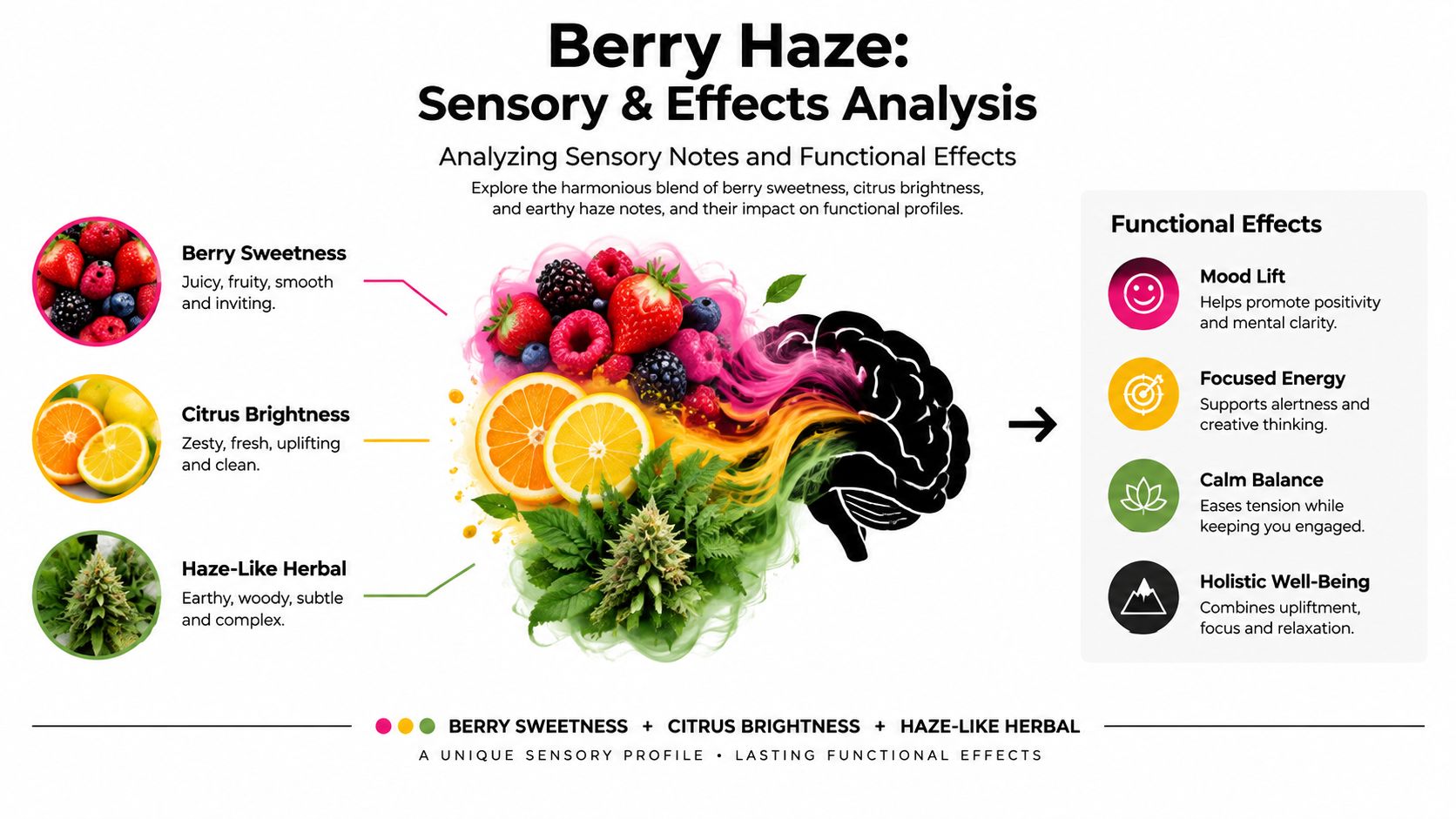
Berry Haze works as a formulation target because its sensory profile has contrast. Berry sweetness provides the central identity, citrus creates lift, and hazy herbal notes keep the product from tasting like a single-note confection. The best blends let the nose open brightly, develop a rounded fruit center, and finish with pepper, wood, or incense-like persistence.
Translating descriptors into adjustments
If the sample smells jammy and soft, preserve the myrcene heart and introduce only enough limonene or terpinolene to restore lift. If it smells bright but hollow, the formula likely needs more mid-note support rather than more citrus. If the finish is peppery or woody too early, reduce the base contribution before changing the fruit layer.
Formulators should also separate sensory expectations from functional claims. Haze-berry products are often positioned around uplifting, energetic, or clear-feeling experiences, but those impressions vary with cannabinoid potency, terpene balance, hardware, and serving size. The berry name doesn't guarantee a gentle profile.
Independent coverage of berry-forward Haze varieties also includes reports of dry mouth, red eyes, anxiety, paranoia, dizziness, and headaches. These are reported side-effect patterns for related Blueberry Haze and Blackberry Haze products, not a prediction for every Berry Haze batch. The strain coverage discussing variability is useful when writing internal product notes without making medical claims.
Read the COA as a formulation document. Compare the dominant terpene order, total terpene content, cannabinoid potency, and any warnings or residual testing. Then build a sensory tolerance around the actual batch. A bright terpinolene-led oil may feel more stimulating in use than a myrcene-forward oil with the same product name, so your label and brand language should describe the tested SKU rather than imply a universal effect.
Formulation Guide for Vape Cartridges
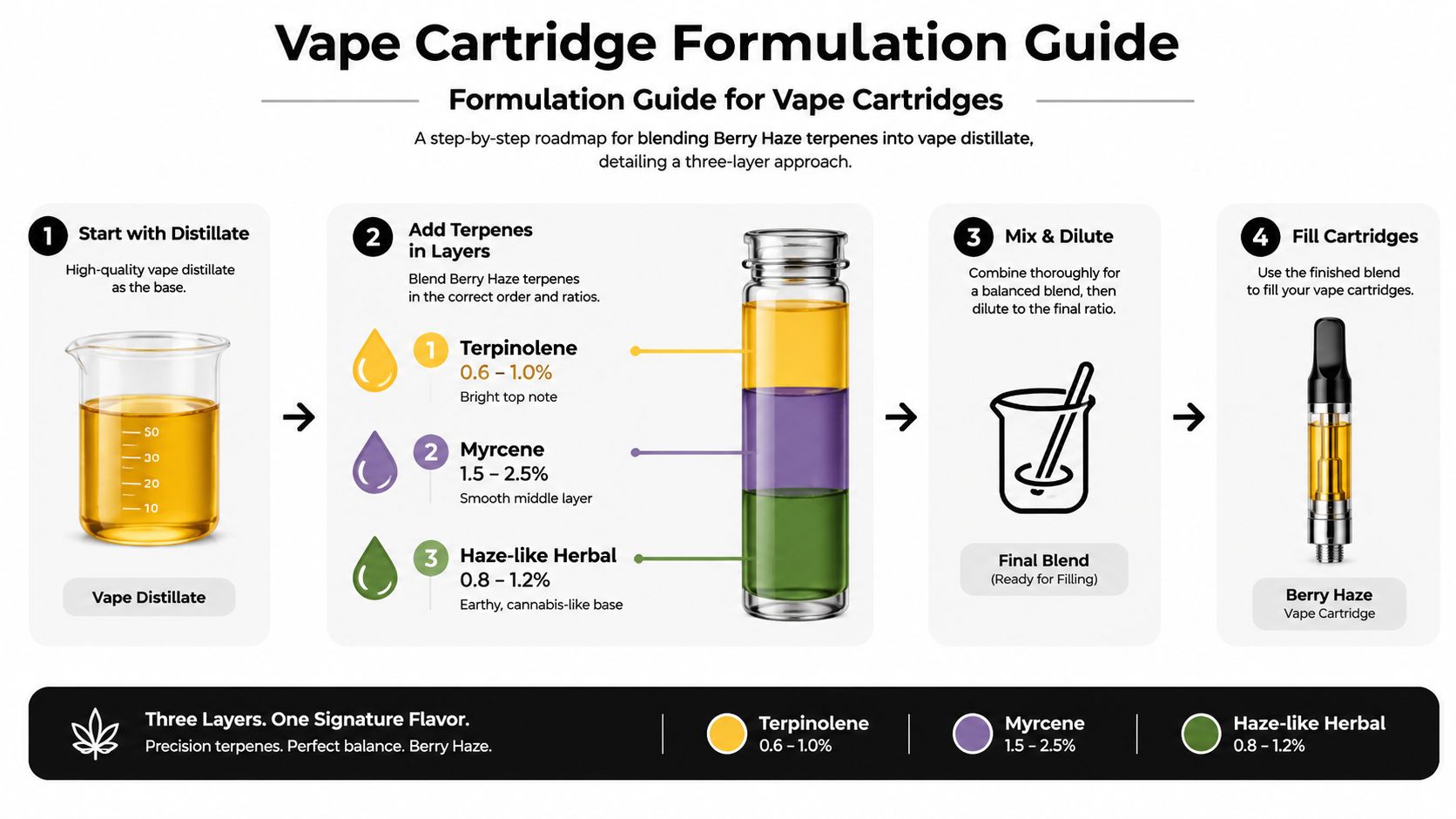
A cartridge formula needs a controlled three-layer structure:
- Top note: terpinolene at 0.6–1.0% for bright herbal citrus lift.
- Middle note: myrcene at 0.8–1.2% for berry and musky body.
- Base note: beta-caryophyllene at 0.8–1.0% for peppered warmth and finish.
These are practical starting ranges based on a Berry Haze-type disposable benchmark. One analyzed disposable listed beta-myrcene at 0.9%, beta-caryophyllene at 0.81%, and terpinolene at 0.66%. The Blueberry Haze strain guide with that analyzed profile supports those reference values.
A practical bench sequence
Start by warming the distillate only enough to reduce viscosity. Excessive heat can flatten volatile top notes and make the final aroma less precise. Add the terpene components gradually, with the blend near the same temperature as the oil so the mixture disperses instead of forming localized pockets.
Use the top note first when you're testing the aromatic direction, then add the myrcene heart and beta-caryophyllene base in measured increments. This lets you identify the point where the berry becomes present without becoming heavy. For detailed handling, Gold Coast Terpenes' guide to mixing distillate with terpenes provides a useful process reference.
Trace components should be added only after the three main layers are stable:
- Limonene can sharpen the citrus opening and keep the berry profile from tasting dense.
- Pinene can reinforce the herbal Haze impression when the blend feels too sweet.
- Linalool can soften rough edges and add a restrained floral note.
Use a slow, controlled mixing speed that produces uniformity without whipping air into the oil. Pull a small retain sample, inspect it after resting, and test it in the intended cartridge. A formula that smells balanced in a vial may vaporize with too much terpinolene or too little base.
For vape cartridges, hardware validation is part of formulation, not a final packaging step. Check draw consistency, leak behavior, coil response, and flavor progression across the fill. Keep the batch record tied to the terpene lot, distillate lot, mixing conditions, cartridge hardware, and COA.
Formulation Guide for Concentrates
Concentrates need a different strategy because the base material may already contain a strong native terpene profile. Winterized distillate often gives you a relatively open canvas, while live resin and solventless rosin can bring their own fruit, fuel, herbal, or floral notes. Adding a full Berry Haze blend without first profiling the base can create unnecessary overlap.
For winterized distillate, establish the desired sensory direction with the three-layer blueprint, then make the smallest adjustment that produces the target. Terpinolene is useful when the oil lacks lift. Myrcene can restore a berry center, but too much may soften the profile beyond the intended Haze character. Beta-caryophyllene works best as a structural finish rather than a dominant flavor.
Live resin should usually be treated as a native profile first. If the concentrate already carries citrus or berry intensity, isolated additions may be more precise than a complete blend. A full-spectrum terpene addition can obscure the source material and make batch comparison harder.
Solventless rosin demands even more restraint. Its aroma can be expressive but variable, so the first task is to map what's already present. Use a small pilot, allow adequate homogenization, and compare the treated sample against an untreated control. That side-by-side evaluation reveals whether the addition improves definition or merely increases intensity.
Blend discipline: Don't use terpene loading to solve a cannabinoid or hardware problem. Fix viscosity, filtration, and heating behavior separately.
For concentrate workflows, keep the blend compatible with the intended application. A dabable texture, a syringe-fill texture, and a cartridge-fill texture may require different handling even when they share the same aromatic target. This cannabis concentrate preparation guide can help standardize your process documentation.
Record the base material's aroma, the added compounds, the mixing conditions, and the post-mix evaluation. That record becomes more valuable than the strain name when you scale a successful batch.
Ensuring Compliance and Lab Safety
Compliance starts before blending. Verify the identity and purity of every terpene input, keep the relevant safety data sheets accessible, and document the supplier lot alongside the distillate or concentrate lot. A formulation record should show who mixed the batch, what was added, how it was homogenized, and which finished-product sample was submitted for testing.
For vape products, confirm that the ingredients match the intended specification. Gold Coast Terpenes describes its formulation components as THC-free and free of VG, PG, PEG, and MCT, but your own supplier documentation and current COAs still need review before production. Don't convert a supplier statement into a finished-product compliance claim without verifying the actual batch and jurisdiction.
Build an audit-ready record
- COA review: Confirm cannabinoid and terpene results, testing identity, lot information, and applicable contaminant panels.
- SDS control: Keep current safety data sheets for each isolate, blend, diluent, and cleaning material used in the process.
- Batch traceability: Link the finished SKU to raw-material lots, equipment, operator, date, and retain sample.
- Packaging checks: Verify child-resistant, tamper-evident, warning, and ingredient requirements for the market where the product will be sold.
Packaging deserves the same care as the oil. For a useful comparison of tamper-evident concepts and pharmaceutical packaging expectations, review the MHRA rules for pharmaceutical packaging. Those rules aren't a substitute for cannabis regulations, but they illustrate why closure integrity, labeling control, and documented inspection matter.
Use a written release procedure. No batch should move to filling, labeling, or dispatch because the aroma seems right. It should move because the formula, documentation, testing, and packaging checks all agree.
Product Positioning and SKU Development
The name Berry Haze doesn't identify one standardized cultivar. Listings also use Blueberry Haze, Blackberry Haze, and Very Berry Haze with conflicting claims about parentage, dominance, and format. The Blueberry Haze listing comparison illustrates why a product team should define the chemistry and sensory target directly on the SKU documentation.
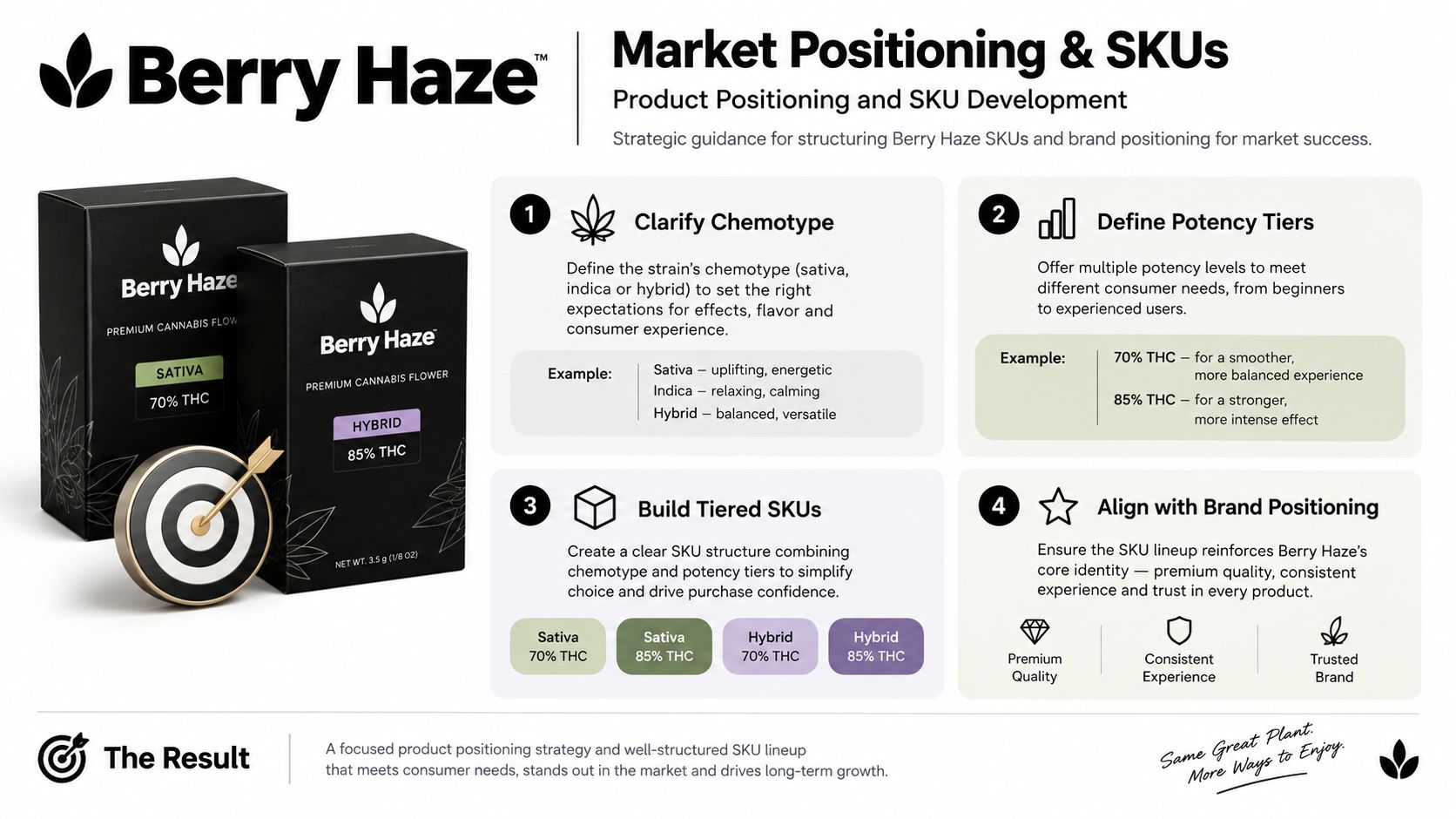
A clear lineup can use internal product architecture rather than vague strain promises. For example, your team might distinguish products by tested chemotype, potency tier, terpene intensity, and format. A lower-potency oil and a high-potency oil shouldn't share identical front-label language if their COAs and use expectations differ.
The supplied positioning brief identifies 70% THC and 85% THC as examples of different potency tiers. Those values should be treated as SKU examples only, and each finished product must be labeled from its own verified laboratory result. The earlier 84.8% figure belongs to a specific live-menu extract listing, so it shouldn't be generalized across Berry Haze products.
Useful naming architecture
- Berry Haze, Bright Berry: Use when the COA and sensory panel support a fruit-forward profile with pronounced citrus lift.
- Berry Haze, Classic Haze: Use when herbal, incense, or pepper notes remain prominent in the finished oil.
- Very Berry Haze, producer-defined: Reserve this name for a documented lineage or internal formula that specifically uses the Very Berry Haze designation.
- Berry Haze flavor profile: Use when the product is inspired by the aroma but isn't being sold as a verified genetic cultivar.
The strongest commercial approach is transparency. Put the producer, batch identifier, format, cannabinoid result, and terpene result close to the product record. That gives buyers a reason to compare SKUs on chemistry and flavor instead of trying to decode overlapping names.
Conclusion and Next Steps
A reliable Berry Haze formulation starts with the three-layer structure: terpinolene for the bright opening, myrcene for the berry heart, and beta-caryophyllene for the spicy base. Validate that structure in the intended cartridge or concentrate, then refine it with limonene, pinene, or linalool only when the COA and sensory panel justify the change. Keep batch records, supplier documents, safety data, and finished-product testing connected from bench sample to release.
For your next pilot, choose the target blend, calculate the additions, order the relevant isolates or strain-inspired profile, and retain a control sample for comparison.
Gold Coast Terpenes offers strain-specific blends, isolated compounds, formulation resources, safety documents, and a terpene calculator for cartridge and concentrate development. Visit Gold Coast Terpenes to source components for your Berry Haze-inspired SKU and refine the formula with documented, batch-level testing.