
You've inherited a Green Crush cartridge SKU with a familiar name, a strong sales history, and a flavor that doesn't match the flower or live-resin reference in your comparison set. The distillate is clean, the hardware passes basic fill checks, yet the finished vapor feels flat, overly sharp, or strangely heavy. That problem usually isn't solved by adding more of one “signature” terpene.
For formulation purposes, Green Crush is best treated as a strain-inspired terpene blend built from a variable genetic and analytical identity. It's commonly treated as an alias of Green Crack, with a Skunk #1 backbone and an unknown indica or Afghani-type contribution, while tested material can show meaningful differences in cannabinoid and terpene expression. This working guide focuses on replicating the flavor of Green Crush for vape cartridges, normalizing incoming COAs, and building a repeatable profile for distillate rather than relying on the strain name alone.
Why Green Crush Matters for Cartridge and Distillate Work
A cart developer usually encounters Green Crush in one of two ways. A brand has inherited an existing SKU and needs to reproduce it after a supplier change, or a marketing team wants a recognizable profile that feels bright, citrus-forward, and energetic without copying a generic citrus blend. In both cases, the first mistake is treating Green Crush as a single-note flavor.
The profile needs architecture. A sharp citrus top creates recognition, a floral or sweet middle prevents the blend from tasting like lemon cleaner, and a restrained resinous base gives the vapor enough persistence to remain recognizable after the most volatile notes have flashed. That structure matters across ceramic, CCell-style, and wick-based hardware because each platform changes heat delivery, airflow, and the order in which volatile compounds reach the consumer. Practical cartridge considerations are covered in this guide to terpene performance in cartridges.
Why a single isolate usually fails
A single limonene-heavy addition can create immediate brightness, but it won't reproduce the rounded citrus, tropical, pine, spice, and soft skunk impressions associated with Green Crush and Green Crack references. A myrcene-heavy shortcut may add body, yet it can make the distillate feel dull or overly weighted. The commercial problem is familiar: the blend smells promising in the bottle but loses identity after dilution, filling, and device heating.
The name also carries marketplace recognition. Leafly identifies Green Crack as a potent sativa marijuana strain made by crossing Skunk #1 with an unknown indica, and lists Green Crush and Mango Crack as alternate names in its Green Crack strain entry. That visibility raises the standard for head-to-head sensory work. A buyer comparing a cart against flower, live resin, or another established reference will notice when the top note is too candy-like, the base is missing, or the vapor has no transition.
Build for the oil, not only the aroma strip
A working brief must account for more than smell. The terpene load affects viscosity, flavor intensity, coil behavior, and the risk of harsh or unstable output. Distillate often lacks the native minor compounds and heavier aromatic material found in a complex extract, so the formulator has to build continuity deliberately.
Practical rule: Match the profile's note relationships first, then adjust total loading to the oil and hardware. A perfect aroma ratio can still produce a poor cartridge if the finished blend changes viscosity or overheats the top notes.
The sections that follow separate lineage, note position, COA normalization, and production controls. That separation keeps sensory decisions traceable when a new distillate lot arrives.
Genetics, Lineage, and What That Means for the Profile
Green Crush is widely treated as a Green Crack alias, but the name doesn't guarantee a single chemically identical cut. The most consistent documented link is to Skunk #1, paired in many accounts with an unknown indica or Afghani-type parent. Leafly describes the strain as a Skunk #1 and unknown-indica cross, while historical accounts place its broader rise in the late 1990s and early 2000s and connect earlier roots to older “Cush” lines. That partly informal history explains why different suppliers can use the same name for materially different aromatic material.
For a formulator, lineage is a starting hypothesis, not a substitute for a COA. Skunk #1 heritage helps explain why the profile can combine a bright, sharp upper register with denser resin and a grounded body. It doesn't prove that every Green Crush lot will be limonene-led, myrcene-dominant, or rich in any particular terpene. Retail COAs and strain databases more consistently point toward myrcene, caryophyllene, and pinene, while individual listings can emphasize other compounds.
Translating ancestry into a working brief
The practical question is which compounds should lead the reconstruction and which should remain supporting players. Limonene can provide citrus lift, but an isolate-only citrus build often becomes narrow. Myrcene supplies roundness and fruit-like weight, while beta-caryophyllene contributes pepper and a dry, resinous impression. Pinene can sharpen the finish, though too much can pull the profile toward cleaning-product or pine-sol territory.
The following table is a formulation interpretation, not a claim that every plant carrying the Green Crush name expresses each marker at the same level.
| Parent / Expression | Dominant Terpene Marker | Secondary Markers | Build Implication |
|---|---|---|---|
| Skunk #1 backbone | Citrus and skunk-associated brightness, often represented with limonene-led top notes | Myrcene, caryophyllene, pinene | Build a bright top, then support it with fruit, spice, and pine rather than stopping at lemon |
| Unknown indica or Afghani-type contribution | Dense resin and greater body | Myrcene and caryophyllene are useful reconstruction candidates | Use a measured mid and base structure so the blend doesn't become thin in distillate |
| Citrus-forward expression | Limonene-style sharpness | Pinene and orange-like supporting notes | Keep the top articulate and avoid allowing heavy base isolates to mute it |
| Tropical or fruit-leaning cut | Myrcene and potentially ocimene-led fruit lift | Floral and sweet supporting notes | Treat the incoming COA as decisive, because the same name can represent different aromatic emphasis |
This interpretation aligns with the broader lesson in choosing cannabis by terpene profile. Formulators should select the chemical target first and use the cultivar name as a communication layer, not as the analytical specification.
Terpene Architecture by Note Position
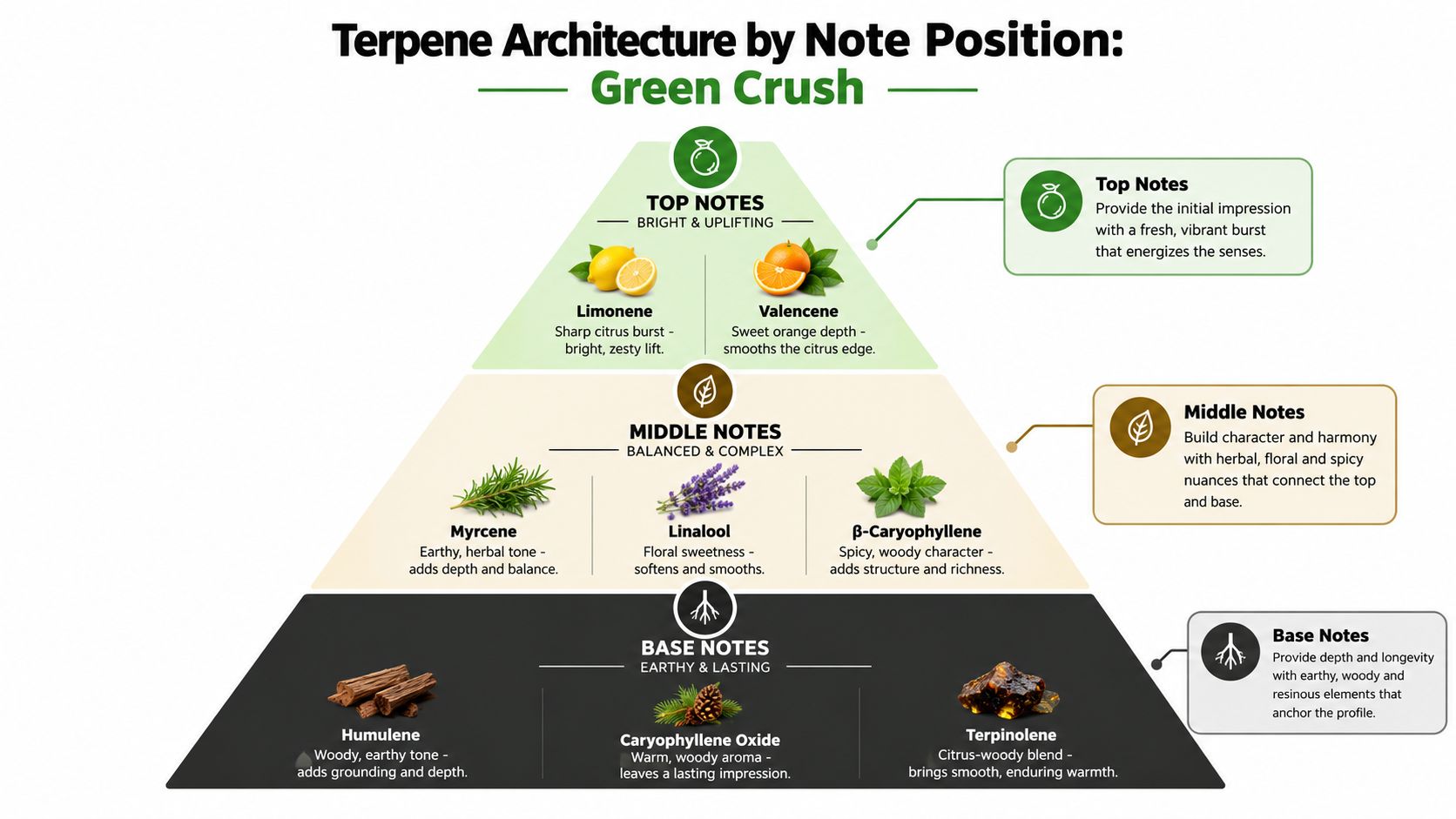
The most reliable way to approach a Green Crush blend is to assign every isolate a job. The top should create the first recognition event, the middle should connect citrus to fruit and floral character, and the base should provide persistence without turning the vapor earthy or sedative in character.
Top notes create recognition
Limonene is the obvious brightener for lemon, lime, and orange-peel impressions. It gives the blend immediate lift, but it can dominate quickly when the base oil has little aromatic material of its own. Valencene is useful as a bridge inside the top register. It adds a sweeter orange depth and can soften the hard edge that appears when limonene is used without a rounded citrus companion.
The top-note pair should remain controlled. A formulator often needs enough brightness to survive dilution, but not so much that the first puff smells detached from the rest of the profile. Valencene is especially helpful when the distillate's native aroma is faint, because it contributes continuity rather than adding another sharp impact.
Middle notes stop the blend from sounding hollow
Linalool supplies a floral-sweet connection between citrus and the base. Nerolidol can add a softer, fuller floral impression and help prevent the blend from reading as a flavor concentrate. These compounds work as bridges, not as the headline. If they become too prominent, the profile can lose the crisp, active character associated with Green Crush references.
A practical architecture looks like this:
- Brighteners: Limonene and valencene establish citrus recognition.
- Bridges: Linalool and nerolidol connect citrus to fruit, floral, and resin notes.
- Anchors: Beta-caryophyllene and a measured humulene contribution give the finish structure.
- Optional texture: Ocimene, pinene, or another compatible isolate can be added only when the COA or sensory reference supports it.
Keep heavier floral and base materials below 1.5% each in the working blend unless the reference clearly calls for more. That threshold is a starting control point, not a universal specification. The reason is sensory: once the middle or base becomes too dense, it can mute the top and make the cart feel slower than the flower reference.
Base notes should persist, not dominate
Beta-caryophyllene adds pepper, dry wood, and resinous depth. Humulene can reinforce the dry, slightly herbal side, but it needs restraint because it can pull a bright profile toward bitterness or heavy earth. The goal is a soft gas-laced bottom that appears after the citrus opens, not a base that announces itself before the first note has developed.
A recorded video can help teams align on terminology and sensory sequencing before bench work.
Use this pyramid as a blueprint, then adjust against a real COA. Green Crush terpene reports can be myrcene-forward with caryophyllene and pinene in support, but individual batches can vary sharply in total terpene content and rank order. The architecture should remain stable while the isolate ratios move to meet the incoming material.
Reading a Green Crush COA and Normalizing the Batch
A Green Crush COA is useful only when the formulator reads it as a ratio system. Copying absolute percentages from one flower report into a distillate blend assumes the next lot has the same terpene hierarchy, the same curing history, and the same native contribution. Those assumptions rarely survive supplier changes.
Verified guidance places total terpene content in well-grown samples around 1.5% to 3.0% by weight, with myrcene often around 0.4% to 0.8% in modern phenotypes. Another retail comparison illustrates the larger issue: one listed sample reported 0.655% total terpenes at 27.0% THC, while another lab panel reported 6.37% total terpenes, including 1.96% myrcene, 1.12% beta-caryophyllene, and 0.77% limonene. Those values should not be copied into a finished cart recipe without considering product type and analytical method. The retail COA background is explained further in this certificate of analysis guide.
Use normalized ratios instead of frozen percentages
The practical workflow starts with the incoming lot:
- Confirm the panel scope. Check whether the report lists individual terpenes, total terpenes, cannabinoids, residual solvents, and the laboratory method.
- Calculate each terpene's share of the reported total. Divide the individual terpene result by total terpene content.
- Group the aroma by note position. Assign citrus and pine to the top, floral and fruit notes to the middle, and spice, wood, or resin notes to the base.
- Compare the ratio pattern to the sensory reference. Don't force a myrcene-led target if the new lot has a different dominant expression.
- Scale the external blend to the oil. Add only enough isolated terpene material to correct the missing note, rather than rebuilding the entire profile unnecessarily.
For example, if a new distillate lot already carries a strong citrus fraction, the formulator can reduce limonene and use valencene or a restrained floral bridge to restore roundness. If the oil has little native sesquiterpene character, beta-caryophyllene may need to anchor the finish, but the addition should be judged by vapor output rather than bottle aroma.
Batch-normalization rule: Preserve the relationship between top, middle, and base notes, not the literal numbers from a different harvest.
This approach also protects against a common production error. A high-terpene flower reference may smell complete because its native matrix carries many compounds that a neutral distillate doesn't. A direct percentage copy can therefore taste too sharp in one lot and too muted in another. Normalize the lot, confirm the sensory target, and document the correction so the next batch starts from an auditable decision.
Replicating the Green Crush Flavor in Distillate
For a first bench trial, build the profile as a 5% total terpene load in a mid-viscosity distillate. That is a formulation starting point, not a finished product claim. A technical Green Crush reconstruction can use terpinolene for a citrus-sweet, lightly floral top, ocimene and beta-pinene for lift and movement, then humulene with a small guaiacol contribution to create a dry, resinous base.
The stack should be treated as a sensory map rather than a fixed identity. Terpinolene can make the opening feel broad and sweet, while ocimene adds a more volatile, green-floral flash. Beta-pinene sharpens the transition. Humulene supplies dry structure, and guaiacol must remain subtle because its smoky, phenolic character can overwhelm a cartridge quickly.
A workable starting ratio
Use the following ratio as a first-pass research blend inside the 5% total terpene load:
- Terpinolene, 35% of the terpene blend: Primary brightener and citrus-sweet top.
- Ocimene, 20%: Volatile floral lift and tropical movement.
- Beta-pinene, 15%: Crisp top-to-middle transition.
- Humulene, 15%: Dry, resinous base support.
- Guaiacol, 5%: A restrained smoky and cured-resin accent.
- Limonene, 5%: Additional citrus recognition when the lot needs more immediate lift.
- Beta-caryophyllene, 5%: Peppery persistence and base cohesion.
This distribution gives the formulator a clear adjustment path. If the result is too sweet, reduce terpinolene before cutting the entire top. If the vapor feels thin, increase the structural base cautiously rather than adding more limonene. If the result becomes smoky, remove guaiacol first.
Addition order controls retention
Warm the distillate only as much as needed to lower viscosity, and keep mixing conditions gentle. Add the least volatile base materials first, followed by middle-note compounds, then add the most volatile top notes after the bulk has cooled. A practical order is:
- Distillate and base anchors, humulene, beta-caryophyllene, and guaiacol.
- Middle materials, ocimene and beta-pinene.
- Top materials, terpinolene and limonene.
- Final low-shear homogenization, followed by a covered rest before filling.
Do not assume that a successful blend in open glass will behave the same way in a cartridge. Live resin and high-terpene extracts already carry a native aromatic load, so adding a full reconstruction can overshoot flavor and alter viscosity. For distillate, the separate distillate terpene formulation guide is a useful reference point for selecting compatible components.
Hardware needs its own test plan. Ceramic coils can deliver a different ramp profile from wick systems, while pods may expose more headspace and a different airflow path. Freebase-compatible hardware and hardware intended for acidic terpene systems should not be treated as interchangeable. Validate the actual oil, fill volume, coil, airflow, and storage condition together.
Matching the Effects Without Overpromising
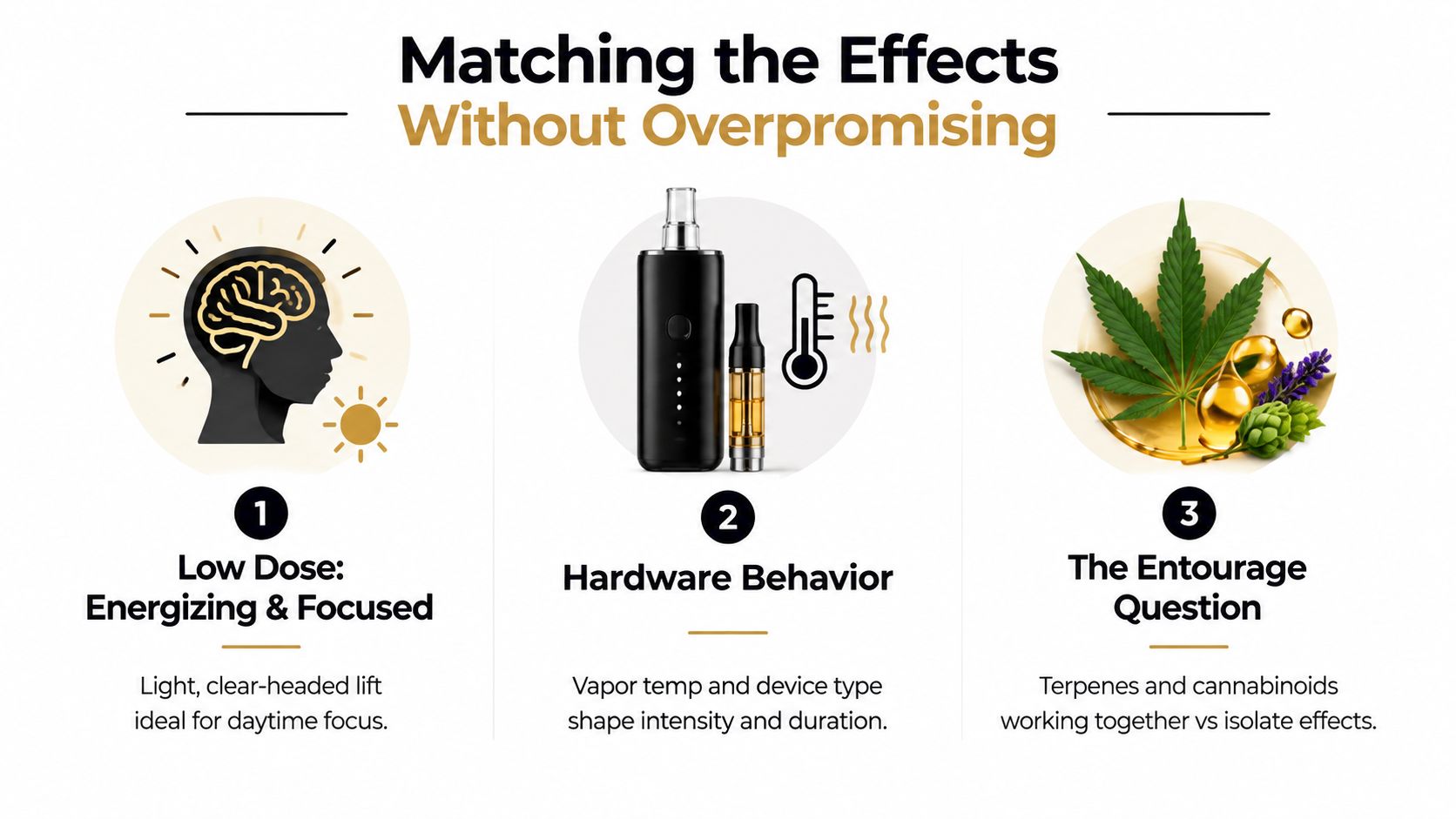
“Energizing and focused” is a useful shorthand for Green Crush marketing, but it isn't a reliable universal output. The experience depends on cannabinoid concentration, terpene load, dose, tolerance, and the hardware's delivery behavior. User-facing coverage also notes irritation, anxiety, and rapid cerebral onset, so the profile should never be positioned as automatically productive for every user.
A myrcene-forward or linalool-heavy correction can change the character of the blend. At a restrained load, those compounds may round the sharp edges and improve continuity. As they climb beyond the intended target, the result can feel heavier and less clear. That isn't a medical conclusion. It's a formulation observation about how changing the aromatic balance can alter sensory perception and the way users describe the vapor.
Hardware changes the delivered profile
A ceramic coil's ramp speed can shift the first fraction of the vapor toward more volatile top notes or a fuller thermal output. Pod airflow changes cooling and draw resistance. Chamber volume affects how much vapor accumulates before inhalation. These variables mean a bottle test, a filled cartridge, and a consumer draw can produce three different impressions.
Run sensory checks on the actual device rather than relying only on a strip or open-vial assessment. Record the first draw, the middle of the session, and the finish. If the citrus disappears early, the top may be too volatile or the device may be delivering excessive heat. If the base dominates late, review both the anchor ratio and the chamber or airflow behavior.
Keep the claims defensible
Label language should describe the product as Green Crush-inspired or use a compliant strain reference supported by the brand's regulatory review. Don't turn a terpene profile into a therapeutic promise, and don't imply that a particular blend treats fatigue, anxiety, pain, or another condition. Disclose terpene content and ingredient information according to the rules governing the market where the product is sold.
A strain name is a sensory brief. It isn't proof of a standardized effect.
The responsible formulation position is straightforward. Reproduce the aroma, document the cannabinoid and terpene inputs, test the device, and keep behavioral claims narrower than the chemistry can support.
Pre-Production Checklist and Next Steps for Formulators
Before releasing a Green Crush-inspired cartridge, use a formal gate rather than relying on a final taste check. The following controls catch most avoidable failures:
- Review every isolate COA. Confirm identity, purity, lot number, and contaminant information.
- Confirm the total-terpene cap. For distillate carts, test the planned 8% to 12% range against the oil and hardware rather than assuming the upper end is appropriate.
- Run viscosity checks at room and chilled temperatures. Measure draw behavior before filling and after the oil has equilibrated.
- Complete leak-down evaluation over 72 hours. Inspect seals, inlet ports, mouthpieces, and oil migration.
- Run a flavor-stability check after a 14-day cure. Compare opening aroma, first draw, mid-session character, and finish.
- Verify freebase versus distillate pH compatibility. Use the actual formulation and device materials.
- Retest potency through an independent SC laboratory. Confirm the finished cannabinoid result rather than relying only on input documentation.
- Screen residual solvents. Keep Class 2 solvent results below 1000 ppm, using the applicable laboratory and regulatory method.
- Align the pesticide panel with California Phase 3 limits. Confirm that the panel and reporting format match the intended market.
- Set a drift escalation rule. Reformulate when consumer flavor drift exceeds 15% across two consecutive production batches, provided the drift measurement method is defined and used consistently.
Build the supporting paperwork around three practical resources: a strain-isolate ratio worksheet, a hardware-compatibility matrix organized by Ohm rating, and a flavor-stability logging template. Those tools make supplier changes easier to diagnose because the team can see whether the failure came from the oil, the blend, the device, or storage.
All blend percentages in this guide are research-oriented starting points. They aren't finished product claims, and every production formula still needs market-specific review, laboratory verification, stability work, and hardware validation.
Gold Coast Terpenes offers strain-specific profiles, individual isolates, formulation resources, and tools for teams developing cartridges and distillate products. Visit Gold Coast Terpenes to review Green Crack-related options, isolated compounds, and practical formulation support for building a more consistent Green Crush-inspired profile.