
The most popular advice about natural terpenes is also the most dangerous for a commercial formulation: if the ingredient is botanical, it must be ready to use. It isn't. A natural terpene blend is a volatile, composition-sensitive ingredient system, and its behavior changes with sourcing, purification, oxygen exposure, heat, light, concentration, carrier matrix, and inhalation route.
That distinction matters as the category scales. One industry estimate places the global natural terpenes market at USD 477.18 million in 2024, with a projection of USD 720.32 million by 2032 and a projected 5.33% CAGR, according to Data Bridge Market Research's natural terpenes market analysis. Commercial growth brings more suppliers, more profile options, and more opportunities for inconsistent material to enter a supply chain.
For a vape brand, the question isn't whether a bottle says natural. It's whether the material has a traceable botanical origin, a reproducible chemical profile, controlled oxidation, documented purity, and evidence that it performs in the finished cartridge. The same discipline applies when you're formulating a strain-inspired terpene blend, replicating the flavor of a cultivar, or adjusting terpenes for distillate at production scale.
Why Natural Terpenes Demand More Than a Label Claim
“Natural” describes origin, not finished-product readiness. A botanical extract can be authentic and still arrive too oxidized, too volatile, poorly characterized, or unsuitable for an inhalable application. A certificate of analysis is necessary, but it won't answer every question a formulator needs to resolve before a production run.
Start with identity. Ask which plant material supplied the terpene fraction, whether the supplier can document botanical origin, how the material was extracted, and whether later processing changed the profile. A natural profile may be steam-distilled, refined, fractionated, blended with isolates, or adjusted to match a sensory target. Those choices aren't automatically problematic, but they affect aroma, consistency, and how faithfully the ingredient represents its stated source.
The category's commercial scale also changes the risk calculation. A growing market supports broader availability, but it can make simple label language less useful. Procurement teams need specifications that describe the actual material rather than relying on origin terminology alone.
Practical rule: Treat natural terpenes as functional ingredient systems, not as flavor drops.
That means reviewing more than a single purity result. The supplier file should include lot identity, botanical source, extraction and refinement history, storage conditions, packaging format, and a defined retest approach. Your own incoming inspection should compare the new lot against an approved sensory and analytical reference, especially for dominant compounds and unusually volatile fractions.
Formulation testing must then move into the intended matrix. A blend that smells accurate in a vial may shift after contact with distillate, concentrate, hardware components, or heat. Test the actual base oil, the intended cartridge, the filling process, and storage conditions. Application-specific verification is what turns a label claim into a usable raw material.
The Botanical and Chemical Foundations of Natural Terpenes
Natural terpenes are plant secondary metabolites assembled from repeating isoprene units. Their biosynthesis begins with two universal five-carbon precursors, isopentenyl pyrophosphate, or IPP, and dimethylallyl pyrophosphate, or DMAPP. Plants assemble these precursors through the MEP or mevalonate pathways, then use terpene synthase enzymes to build the structures responsible for many familiar botanical aromas. The foundational pathway and the evolution of terpene chemistry are discussed in this peer-reviewed terpene review.
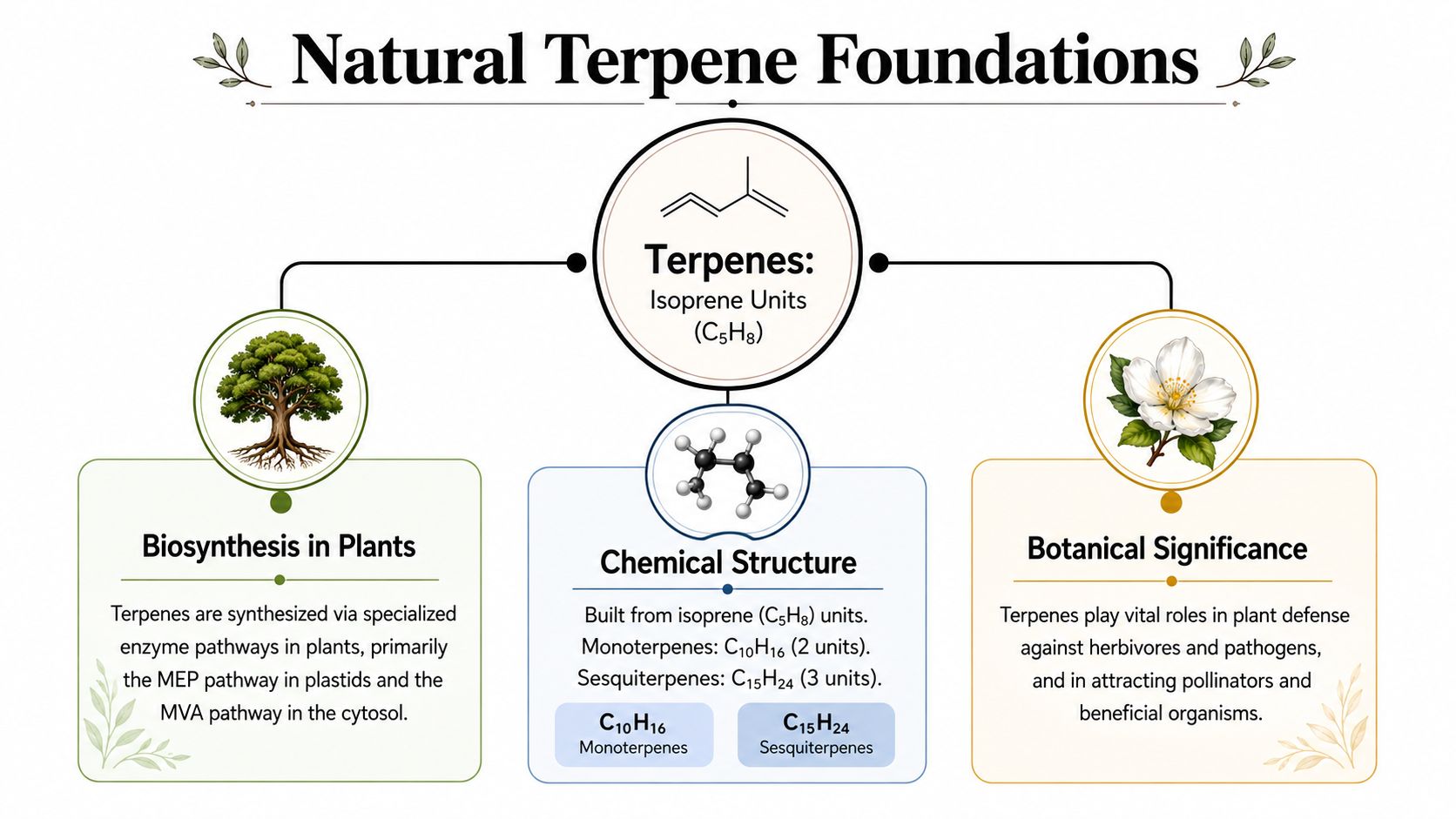
The chemistry explains why natural profiles are both useful and difficult to reproduce. Monoterpenes are generally lighter and more volatile, while sesquiterpene-rich fractions tend to contribute heavier, longer-lasting character. Terpenoids, which contain oxygenated modifications, can add floral, woody, spicy, or herbal dimensions and may behave differently during storage and thermal processing.
Terpenes also evolved for jobs beyond human flavor perception. Plants use them in defense against herbivores and pathogens, pollinator attraction, thermoprotection, and signaling with their environment. Reviews of terpene-rich essential-oil chemistry describe antimicrobial, anti-inflammatory, antioxidant, antiviral, and antiallergic activity across many mixtures, with monoterpenes and terpenoids frequently identified as important bioactive fractions. That doesn't justify medical claims for a cartridge. It does show why a formulation should be evaluated as a biologically active chemical mixture rather than a neutral flavor additive. See the Frontiers review on terpene-rich botanical chemistry.
Why profile composition controls behavior
Terpenes and terpenoids together account for more than 25,000 reported natural compounds, and cannabis alone contains over 150 identified terpenes, according to the cited scientific review. A profile's sensory identity depends on the relationship among compounds, not only on the highest reported peak.
That relationship affects three formulation variables:
- Aroma: Dominant compounds establish the recognizable direction, while supporting and trace compounds shape transitions and finish.
- Perceived product character: A citrus backbone can read as sharp, sweet, herbal, or floral depending on the surrounding profile.
- Stability: Different compounds evaporate and oxidize at different rates, so a blend can drift even when the initial aroma is accurate.
A major evolutionary milestone occurred in 2022, when plant evolutionary research connected the origin of the terpene synthase family to the period after land plants diverged from charophytic algae. For formulators, the practical point is simple. Natural terpene diversity is rooted in plant biology, and botanical origin can bring complexity that isn't captured by a single-isolate reconstruction.
Natural Terpenes vs Synthetic and Isolate Options
The right sourcing path depends on what must remain constant. If the goal is a strain-inspired terpene blend with layered botanical character, a natural fraction may offer the most convincing starting point. If the goal is a sharply defined sensory note or a tightly controlled pilot formula, isolates may be more practical. Synthetic materials can also have a place, but suitability depends heavily on the product route and the documentation available for that use.
| Criteria | Natural Botanical Terpenes | Synthetic Terpenes | Individual Isolates |
|---|---|---|---|
| Sensory complexity | Often provides layered botanical character | Can provide clean, repeatable single-compound character | Highly precise, but complexity must be built |
| Batch consistency | Depends on crop, extraction, refinement, and blending controls | Usually designed for strong compositional consistency | Strong control when identity and purity are verified |
| Regulatory positioning | Botanical origin may support a natural-origin position, but inhalation documentation remains necessary | Requires route-specific safety and compliance review | Requires identity, purity, and application-specific review |
| Cost at scale | Can vary with source and processing | May be economical for defined compounds | Efficient when only selected compounds are needed |
| Best formulation use | Authentic cultivar-inspired profiles and complex aroma systems | Controlled non-inhalable or tightly specified applications, subject to compliance | Precision adjustments, signature notes, and reproducible corrections |
The distinction between categories is covered in this guide to artificial and natural terpenes. Don't use the table as a substitute for a supplier qualification program. A “natural” profile can vary between lots, while a synthetic or isolate-heavy formula can become too linear, sharp, or recognizable as a simple reconstruction.
Choosing the right architecture
For replicating the flavor of a specific cultivar for vape cartridges, begin with a natural botanical profile if authenticity and aromatic depth are the primary objectives. Then use verified isolates for correction when a dominant note needs to be raised, softened, or repositioned. This hybrid approach can preserve complexity while improving batch control.
For a simple distillate restoration, an isolate-led blend may be more efficient. The formula can target the missing aromatic direction without adding unnecessary compounds that complicate stability or hardware behavior. For non-inhalable products, synthetic options may be considered where permitted and appropriate, but inhalation should never be treated as an automatic extension of food or fragrance use.
An existing profile such as Elevated Strains can serve as a reference point for a brand evaluating a flavor direction, but the finished product still requires its own compatibility and compliance testing.
Sourcing and Extraction Methods That Protect Profile Integrity
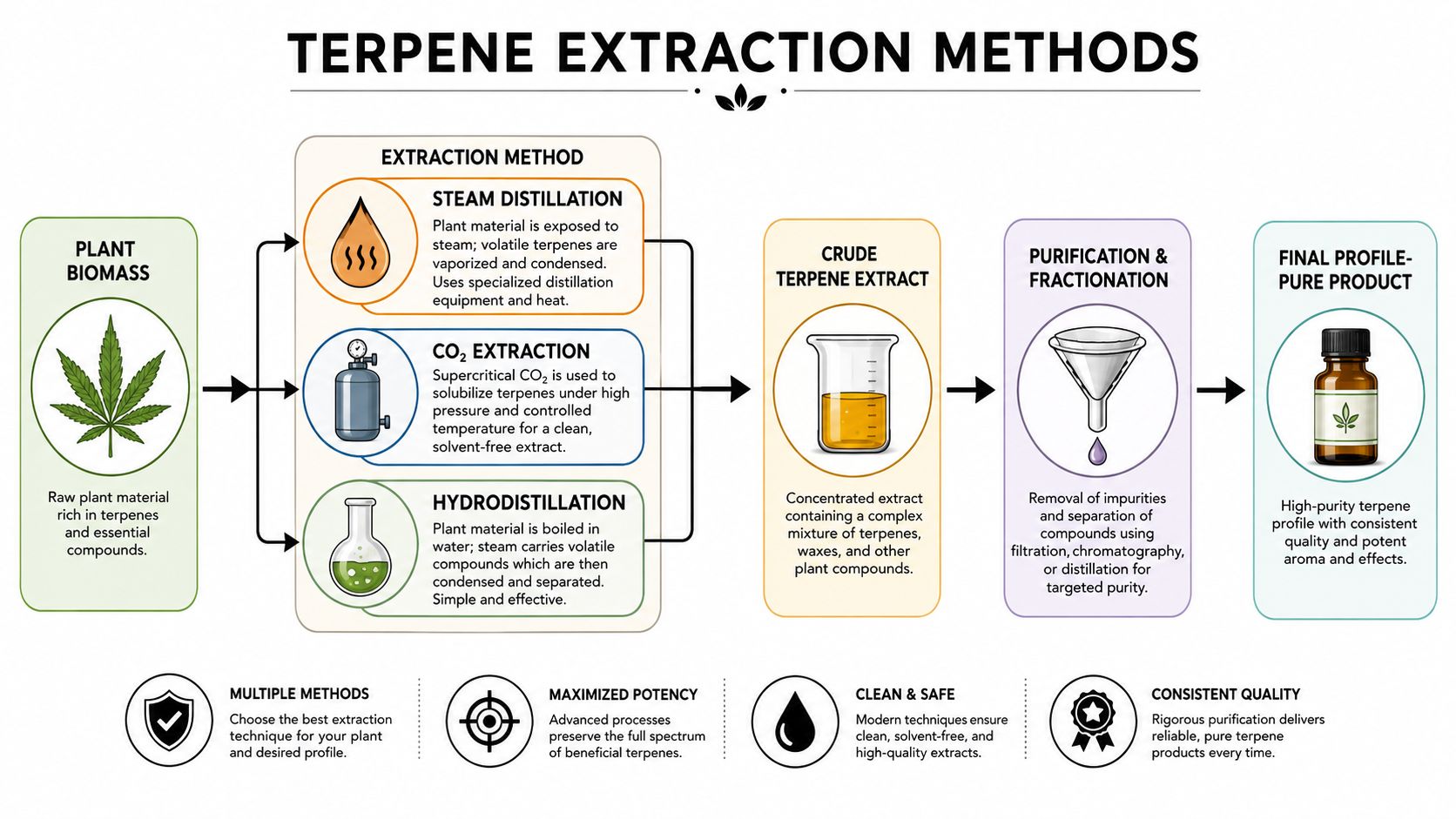
Extraction is where a botanical profile can either remain coherent or lose its most delicate fractions. Before approving a supplier, identify the plant material, harvest handling, extraction method, refinement steps, and packaging conditions. The right method depends on whether you need a broad aromatic fraction, a cleaner selected profile, or a repeatable blend built from several verified components.
Steam distillation uses heat and vapor to separate volatile compounds. It can be effective for producing a usable terpene fraction, but heat exposure and residence time may reduce the representation of lighter compounds or alter heat-sensitive constituents. Hydrodistillation uses water as part of the separation process and can produce a distinctive botanical profile, though the thermal environment still requires careful control.
Cold pressing is especially relevant where aromatic oils are stored in plant structures that can be mechanically ruptured, such as citrus peels. It can preserve a vivid top-note character, but the resulting fraction may contain more nonvolatile plant components and may require additional clarification or refinement.
Solvent-based and pressurized extraction approaches can offer different selectivity and yield characteristics. They may capture compounds that a simple distillation misses, but the supplier must document solvent removal, fractionation, and any post-extraction cleanup. The extraction method alone doesn't tell you whether the final ingredient matches your target.
Questions for a supplier audit
Ask for:
- Botanical identity: The plant source, plant part, geographic origin, and lot traceability.
- Harvest controls: How timing, drying, and storage are managed before extraction.
- Processing history: Whether winterization, fractional distillation, or molecular distillation was used.
- Profile comparison: A representative chromatogram and a specification for dominant compounds.
- Packaging controls: Container material, headspace management, light protection, and recommended storage.
- Change notification: How the supplier communicates changes to source material, equipment, or processing.
Winterization can remove waxes and other unwanted components, while fractional and molecular distillation can narrow or reshape the volatile profile. Those operations may improve cleanliness, but they can also strip the compounds that provide authenticity. For a formulation guide focused on natural terpenes for cannabis product formulation, the supplier's process should align with the sensory target rather than being selected only for extraction efficiency. A practical overview of these process choices appears in this history of terpene extraction techniques.
Building Strain-Inspired Terpene Blends for Formulation
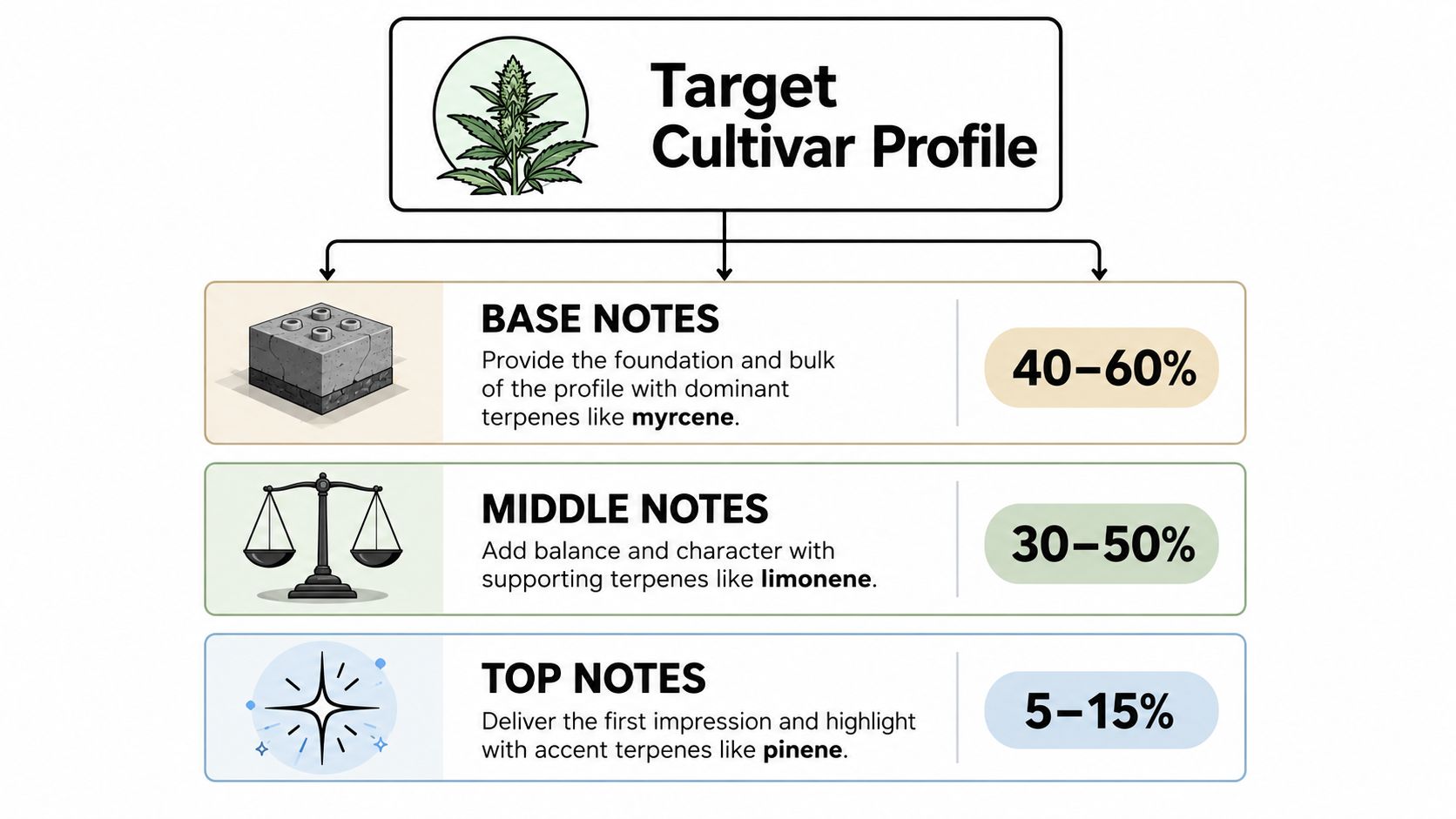
A reliable blend starts with architecture, not a list of popular compounds. Build the target profile in layers: establish the backbone, connect the opening to the body, then add the small modifiers that make the aroma recognizable. This approach works better than adding ingredients until the vial “smells close,” because it gives each component a job and makes later troubleshooting possible.
Assigning top, middle, and base notes
Top notes create the first impression. Lighter citrus, pine, and fresh herbal directions can provide lift, but they also tend to be the first fractions affected by evaporation and oxidation.
Middle notes connect the opening to the lasting profile. They keep a bright blend from feeling hollow and help translate a sharp first sniff into a fuller botanical impression.
Base notes provide persistence and weight. Myrcene-led, woody, spicy, or earthier directions can anchor the blend, but excessive loading may suppress brighter notes and alter viscosity.
A technical profile-building guide notes that trace terpenes in high-terpene strains may sit below 0.1%, which explains why a very small modifier can change perceived authenticity. Use that point as a blending principle, not as permission to dose blindly. Add trace materials through a controlled premix, record the actual weight, and evaluate the result in the finished base rather than judging only the neat blend. The layering approach is described in this strain-inspired terpene profile guide.
Starting ranges and bench control
Application changes the starting point. For aroma restoration in distillate, one formulation guide recommends beginning at 1–3%, while vape applications often move toward 3–7%, as described in this guide to adding terpenes to distillate. Another cartridge-oriented guide places botanical terpene use commonly at 4–8%, with 2–4% sometimes used for live resin terpene systems and 6–10% for fruit-forward vape blends. These are starting ranges, not universal specifications. The same guide explains that terpene load changes flavor intensity, viscosity, and clog risk, so the base oil and hardware must determine the final target.
Scale a bench formula by weight, not by volume. Use a terpene calculator to preserve component ratios, then verify the production batch analytically and sensorially. Add the blend late where possible, mix gently, minimize open handling, and record temperature and mixing time. Positioning language such as relaxation, uplift, or focus should describe brand intent and sensory direction, not medical outcomes.
Managing Volatility and Oxidation in Production and Storage
Natural terpenes can drift as soon as blending begins. Heat, oxygen, and light may remove or transform profile-defining compounds. Many terpene boiling points fall roughly within 120–180°C. Lighter monoterpenes, including myrcene and limonene, are especially susceptible to evaporation and oxidation, as summarized in this technical overview of terpene degradation.
Open transfer, warm mixing, and extended filling can strip the most volatile fractions first. Oxygen can then promote formation of alcohols, ketones, aldehydes, peroxides, and terpene oxides. The cartridge may smell flatter, sharper, or differently from the approved bench sample.
Production controls that make a difference
Use a closed or covered vessel wherever practical. Keep the blend and base as cool as processing allows, reduce time at high temperature, and avoid exposing terpene-rich material while filling equipment is prepared. These controls reduce volatility-driven flavor drift, but they do not replace finished-cartridge testing.
Limit light and oxygen in bulk inventory. Inert-gas headspace management can reduce oxidation risk. Peer-reviewed work on cannabis terpene preservation used argon to reduce headspace oxygen, supporting inert handling as a documented process control rather than a marketing detail.
Batch-control principle: Add volatile terpene components as late as the process permits, then proceed promptly to filling and closure.
Storage procedures should specify container compatibility, fill volume, headspace, light exposure, temperature, and opening frequency. Retain samples from the terpene blend, bulk formulation, and finished cartridge, so sensory changes can be traced to a processing stage.
GRAS status for an ingredient does not establish inhalation safety in the finished cartridge. The oil matrix, heating element, and filling conditions can change exposure and degradation behavior, so a stable neat blend is not proof of cartridge stability. Hold retained cartridges under defined storage conditions and compare their aroma and appearance against the approved reference before release.
Purity Testing and Regulatory Considerations for Inhalable Products
Food-use familiarity does not establish inhalation safety. A 2025 review describes terpenes as having a generally favorable toxicological profile and notes that most are GRAS, while also reporting mild sedation, hypotension, and cutaneous reactions in small human trials involving sensitive people. The findings are summarized in this review of terpene safety and inhalation considerations. GRAS status provides toxicological context, not approval for a finished cartridge.
California and Nevada have introduced stricter requirements for inhalation-facing terpene ingredients, including definitions, documentation, natural-occurring flavor or aroma contribution, and ingredient disclosure. Requirements vary by jurisdiction. Before finalizing a formula, identify the destination market, permitted ingredients, labeling expectations, and current documentation requirements.
What the verification package should answer
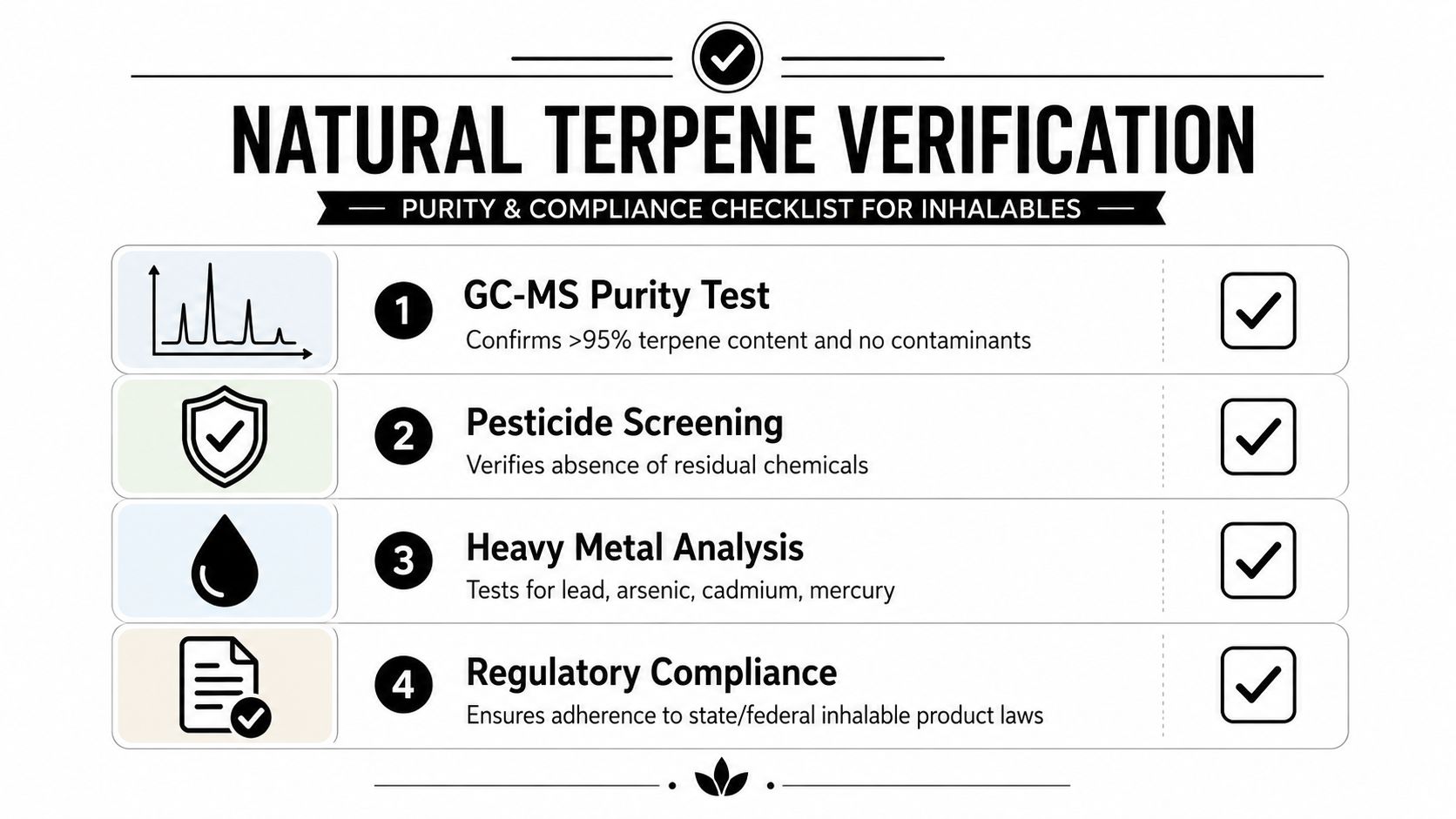
A supplier COA should identify the material and report results suited to inhalable use. Review:
- Identity and composition: GC-MS or another validated method showing which compounds are present.
- Residual solvents: Results linked to the extraction method and applicable specification limits.
- Heavy metals: Testing for contamination from soil, equipment, or processing.
- Pesticides and microbial contaminants: Screening suited to the botanical source and finished-product rules.
- Oxidation indicators: Evidence that the lot has not materially shifted during storage or transport.
- Lot traceability: A clear link between the tested sample, received container, and production record.
Independent laboratory results carry more weight when the lab discloses its methods, accreditation, detection limits, and chain of custody. A generic purity statement does not demonstrate suitability for inhalation.
Concentration, viscosity, and hardware
Use the loading ranges discussed in the formulation section as a starting point, then verify viscosity and aerosol performance in the actual cartridge system. Terpene loading can affect leakage, wicking, coil wetting, aerosol output, and clog risk, so test the finished ratio in the intended base oil and hardware. The terpene quality standards guide provides a practical reference for reviewing purity and supporting documentation.
Hardware-specific checks should include fill weight, post-fill leakage, draw consistency, activation behavior, and visible residue around the mouthpiece or airflow path. Compare cartridges after defined storage against the approved reference, checking aroma, appearance, viscosity, and output. A neat blend can remain acceptable while the finished cartridge develops drift or restricted flow.
Label the actual ingredients and retain supporting documentation for every lot. If a jurisdiction requires evidence that an ingredient contributes natural flavor or aroma, the supplier file and formulation records should answer that question directly. Keep the supplier COA, independent test report, batch record, and cartridge test results connected to the same lot.
Launching Your Next SKU with Confidence
A production-ready natural terpene program connects five decisions:
- Qualify the supplier: Confirm botanical origin, extraction history, lot traceability, storage controls, and current analytical documentation.
- Define the target profile: Write the sensory brief in layers, including backbone, middle connection, top-note lift, and trace modifiers.
- Prototype in the actual matrix: Test the blend in the intended distillate or concentrate, cartridge hardware, and filling process.
- Control the process: Minimize heat, oxygen, light, open transfer, and unnecessary holding time.
- Document release criteria: Set specifications for identity, purity, sensory match, viscosity, hardware performance, and stability.
The bench formula is only the beginning. Larger batches can expose mixing gradients, terpene loss during transfer, filling-line hold time, and lot-to-lot differences that weren't visible in a small vial. Keep retain samples and compare them against the approved reference at defined points in the product's shelf-life program.
Brand positioning should follow the evidence. You can tell a credible botanical story when the source, composition, handling, and finished-product data support it. For the next SKU, make the purchase decision only after the supplier material has passed both formulation compatibility testing and inhalation-focused compliance review.
Gold Coast Terpenes provides natural terpene blends, strain-specific profiles, isolated compounds, formulation education, and tools such as a mixing calculator for cartridge and concentrate development. Review the available options at Gold Coast Terpenes, then match the selected profile to your base oil, hardware, testing plan, and production controls before scaling.