
A strain high in linalool will likely promote sedation, relaxation, and anxiolytic effects, making a sleep or unwind SKU the safest commercial read. In the strongest recent human trial, an oral CBD formulation containing 1 mg each of eight terpenes, including linalool, increased slow-wave plus REM sleep by 1.3% versus placebo, while some participants gained as much as 48 minutes per night over four weeks (2025 clinical trial).
That result is useful, but it isn't a license to market linalool as a guaranteed sleep compound. For a formulator, the better interpretation is narrower and more practical: build linalool-led blends around calm, unwinding, and evening use, then let dose, delivery route, cannabinoids, hardware, and co-terpenes determine how far the profile moves toward sedation.
What a Strain High in Linalool Will Likely Promote
A linalool-dominant profile typically delivers relaxation, reduced anxiety, and a more sedating body read than stimulation. That makes it a strong candidate for sleep-adjacent, evening, and unwind SKUs, especially when the blend also contains heavier supporting terpenes.
The phrase “high in linalool” needs a formulation definition. In flower, product developers commonly use 1.5% or more by weight as a practical screening point. In a cartridge, a linalool-led profile may sit around 3% to 8% of the total terpene fraction. These are working benchmarks for product comparison, not universal chemical thresholds, and they should be checked against the lab profile and final matrix.
Four variables change the result:
- Dose: A light exposure may read as softening or calming, while a larger cumulative exposure can become more noticeably sedating.
- Delivery vehicle: Inhalation produces a fast sensory and pharmacological pulse. Oral formats create a longer, more sleep-oriented curve.
- Personal neurochemistry: Tolerance, sensitivity, prior cannabinoid exposure, and sex can influence the perceived intensity.
- Co-terpenes: Myrcene can deepen the body effect, while brighter terpenes can keep the blend from becoming overly heavy.
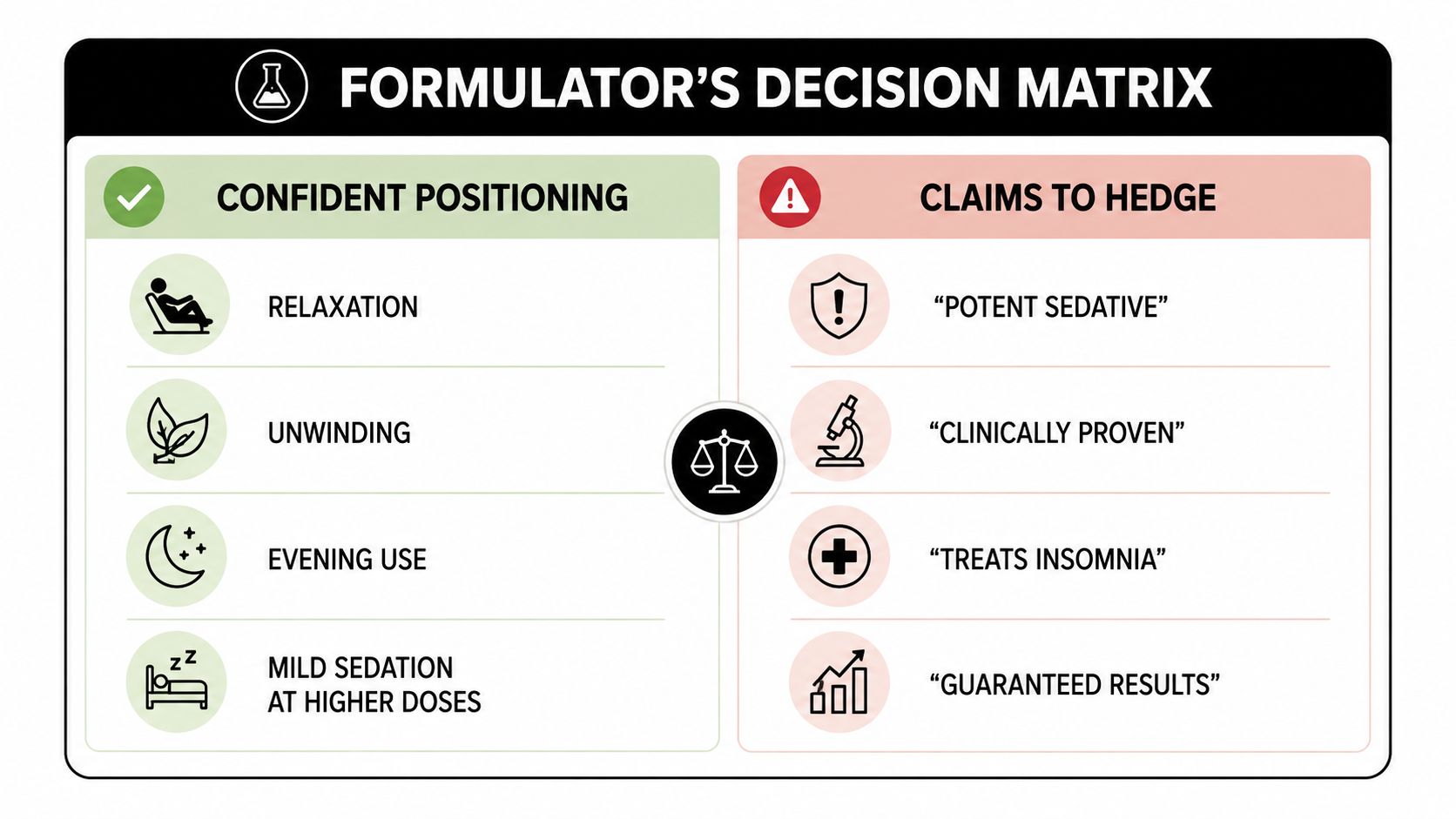
Commercial rule: Position linalool confidently around calm and unwinding. Treat hard sleep promises as a formulation-dependent claim that needs a hedge.
The evidence gradient matters. Laboratory work supports sedative and anxiolytic activity, and recent human data is encouraging, but well-designed clinical evidence remains limited and context-specific (review of linalool evidence). The rest of the formulation process should therefore answer a more useful question than “Does linalool make people sleepy?” Ask what the compound contributes to a complete cartridge, at the intended dose, through the intended hardware, alongside the rest of the terpene architecture.
The Relaxation and Sedation Effects Backed by Evidence
Linalool's calming profile is best understood through separate evidence buckets rather than one broad “sedative” label. The strongest commercial interpretation is relaxation, followed by anxiolytic support, with sleep positioning requiring the most restraint.
GABA and central nervous system signaling
Preclinical reviews describe linalool as sedative, anxiolytic, and antidepressant-like, with effects associated with GABA and glutamate signaling (clinical and preclinical review). GABA is an inhibitory neurotransmitter system, so modulation in this area helps explain why linalool-led profiles are often experienced as less activating.
The translation gap is substantial. Rodent findings can establish biological plausibility, but they don't establish that an inhaled human cartridge will reproduce the same intensity, timing, or duration. That distinction should appear in internal product briefs even when consumer-facing copy stays simple.
Glutamate and sensory softening
Reviews of cannabis-derived terpenes also connect linalool with glutamatergic pathways and ion-channel activity. This supports a formulation read centered on reduced tension and sensory softening, rather than a promise of a specific therapeutic outcome.
A 2015 PubMed-indexed study reported antidepressant-like activity through interaction with the monoaminergic system, while later reviews summarized animal findings involving stress behavior, learning, memory, and cortisol. Those results help explain linalool's long-standing reputation in lavender-rich aromatic profiles, but they remain mostly preclinical (PubMed-indexed linalool study).
Sedation and sleep translation
Inhaled linalool increased pentobarbital sleeping time, reduced body temperature, and decreased locomotion in mice at 3% concentration, without significantly impairing motor coordination in that experiment (inhaled linalool study). This points toward a central nervous system depressant profile, but the animal dose and delivery conditions shouldn't be treated as a direct cartridge dosing instruction.
| Effect Claim | Proposed Mechanism | Evidence Strength | Human Translation Confidence |
|---|---|---|---|
| Relaxation | GABA and glutamate modulation | Strong preclinical support | Moderate for general calm, limited for precise dose effects |
| Anxiolytic support | GABAergic and olfactory-limbic pathways | Repeated animal-model support | Limited to moderate, depending on formulation and context |
| Sedation | CNS depression, altered locomotion, sleep-related signaling | Clear preclinical signal | Limited for inhaled products |
| Sleep support | Changes in sleep architecture and sedative activity | Emerging human and preclinical evidence | Promising but not definitive |
Delivery changes the commercial interpretation. Inhaled linalool generally acts quickly and clears sooner than oral or transdermal formats, while oral delivery can extend the effect window. The available human sleep study used an oral CBD formulation with a defined terpene combination, not a standalone linalool cartridge, so packaging should favor “supports an evening wind-down” over “clinically proven sleep aid.”
For a formulation resource on calming terpene choices, this guide to terpenes for anxiety can sit naturally beside the product-development brief without turning a preclinical mechanism into a medical claim.
Anxiolytic and Analgesic Effects Worth Positioning
Anxiolytic support and pain modulation serve different buyer jobs. A relaxation SKU helps a customer move out of an activated state, while a comfort-oriented SKU needs a more grounded sensory profile and careful language around what linalool can and can't do.
Anxiety positioning
Animal studies using elevated plus-maze and open-field models have associated linalool exposure with reduced anxiety-like behavior. Other experimental work has reported restored social interaction after stress exposure, while small human aromatherapy studies have explored reduced pre-procedural anxiety (cannabis-derived terpene review).
That makes calm and stress support the second most defensible positioning lane after general relaxation. It still doesn't justify describing a cartridge as treating anxiety or delivering a predictable anxiolytic dose. The formulation can support a calm sensory story, but the copy should avoid disease language and guaranteed outcomes.
Analgesic and comfort-oriented positioning
Linalool's pain-related evidence comes through more than one proposed route. Reviews describe antiallodynic and anti-hyperalgesic effects in multiple models, with possible involvement of voltage-gated sodium and calcium channels, Akt signaling, and opioid, dopaminergic, cholinergic, glutamatergic, cannabinoid, GABAergic, and adenosine systems.
That breadth is useful for mechanism mapping, but it also signals uncertainty. A blend can be positioned around tension, recovery, and general comfort, especially when linalool sits alongside a grounded base. It shouldn't be presented as a substitute for THC or CBD in a pain-focused formulation, and it shouldn't carry acute pain claims without appropriate substantiation and regulatory review.
Use linalool as a supporting modulator in comfort formulations, not as the sole reason a product makes a pain claim.
For an anxiolytic-leaning SKU, pairing linalool with a high-CBD or 1:1 cannabinoid profile is a rational development direction. The cannabinoid ratio, terpene concentration, and route still need separate testing, because a floral terpene profile cannot guarantee the same response across every matrix or user.
Why Dose, Delivery, and Context Change the Outcome
Linalool's headline effect changes with the product and the use pattern. A formulator should set expectations around dose, delivery route, sex, tolerance, and setting, because each can shift a blend from calm and softening toward noticeable sedation.
Inhalation produces a fast, relatively short experience. Lower-to-mid exposure may support a calm or less anxious sensory read, while repeated puffs or heavier cumulative exposure can feel more sedating. Oral and sublingual formats generally create a slower, longer curve, so they fit sleep-support positioning more naturally than a quick-use cartridge.
Research on vaporized linalool and beta-myrcene in mice also found sex-specific anxiolytic responses. Females responded to repeated exposure, whereas males responded to a single dose. Low-level linalool combined with CBD enhanced anxiolysis only in females (sex-specific vaporized terpene research). The finding does not establish a consumer dosing rule, but it does limit universal effect claims.
| Delivery Route | Typical Dose Window | Onset / Duration | Dominant Effect Read |
|---|---|---|---|
| Inhaled cartridge | Matrix- and puff-dependent | Fast onset, shorter window | Calm, softening, possible sedation at higher cumulative exposure |
| Sublingual format | Product- and user-dependent | Slower onset, extended window | Longer unwind and sleep-adjacent support |
| Oral format | Product- and user-dependent | Slower onset, longer window | More persistent relaxation and sleep-oriented positioning |
| Transdermal format | Product- and matrix-dependent | Extended local or systemic exposure | Longer-lasting support, with effect dependent on formulation |
Context changes interpretation too. A customer using a cart before a stressful task may notice the calming effect first. The same profile during a wind-down routine may be read as sedating. Hardware also changes delivery and flavor release through heat, airflow, and puff behavior.
Test the finished cart under realistic use conditions, not only with a bench aroma strip. Review the terpene safety guide for handling and use considerations, and consult the linalool taste and terpene chart when connecting aroma expectations to formulation decisions. Keep those practical inputs separate from unsupported medical positioning.
Linalool's Place in the Top, Mid, and Base Note Chart
Linalool works best as a mid-note, where its floral, lavender, and lightly spicy character connects a bright opening with a persistent finish. Its listed boiling point is 388°F / 198°C, so heat exposure belongs in vape and distillate development decisions (terpene chart for formulation).
Top notes such as limonene and pinene provide the first aromatic lift. Base notes such as caryophyllene and myrcene last longer and add weight. Linalool fills the middle, carrying the body of the inhale and smoothing the transition into the exhale.
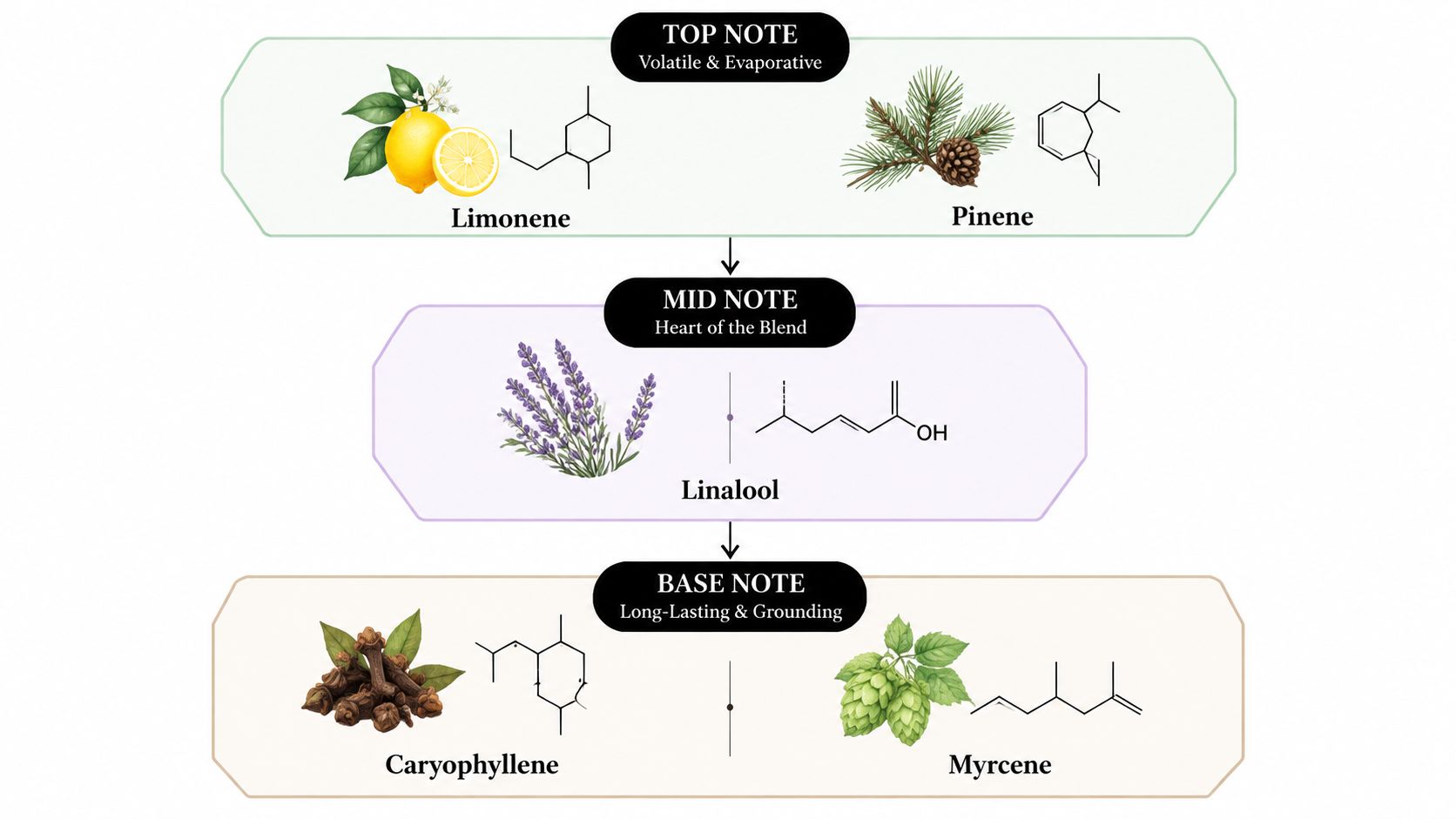
That position also explains why linalool generally performs better in a layered strain-inspired terpene blend than as a solo aromatic. It can soften pinene's sharpness, moderate an overly bright citrus opening, and keep a myrcene-heavy base from becoming flat.
For formulation, a practical starting range is 0.5% to 2% of the total terpene blend. Add it late and in small increments, then assess the finished matrix rather than the concentrate alone (linalool formulation guide). A separate vape flavor chart lists 0.2% to 1.5% for vape applications, showing why supplier strength, blend composition, and the sensory target must guide the final setting (terpene flavor chart). Profiles discussed in high-linalool strain references can provide context, but they do not replace testing the actual cart.
For flavor comparison, terpene taste and flavor references and Elevated Strains can inform a linalool-led development brief. Use recognizable flavor architecture as a reference, not as a formula to copy.
Common Co-Occurring Terpenes in Linalool-Led Profiles
Linalool rarely defines a chemovar alone. The accompanying terpenes decide whether the blend reads as sleep-oriented, grounded, softly social, or floral.
Myrcene pushes the profile toward a deeper body effect and a heavier nighttime impression. It pairs naturally with linalool when the buyer wants a sleep-led cart, although too much can flatten the opening and make the inhale feel dense.
Caryophyllene adds pepper, spice, and a grounded base. Its reported CB2 interaction makes it relevant to comfort-oriented positioning, while its aroma gives floral linalool more structure. Use it when the profile needs warmth rather than additional sweetness.
Terpinolene changes the direction more dramatically. Its herbal brightness can lift a linalool-led blend away from pure sedation and toward a creative unwind or social-evening read. It works when the product needs calm without sounding like a bedtime formula.
Ocimene and limonene can preserve openness in a floral chemovar. Small amounts help maintain top-note definition, but excessive brightness can fight the soft, rounded character that makes linalool commercially useful.
| Co-Terpenes | Aroma Character | Typical Co-Occurrence Range | Effect Direction |
|---|---|---|---|
| Myrcene | Earthy, musky, herbal | Variable by chemovar | Deeper body relaxation and nighttime weight |
| Caryophyllene | Peppery, spicy, dry | Variable by chemovar | Grounded comfort and structured finish |
| Terpinolene | Herbal, fresh, complex | Variable by chemovar | Brighter unwind and less purely sedating character |
| Ocimene | Fresh, green, lightly sweet | Variable by chemovar | Airier floral presentation |
| Limonene | Citrus and bright | Variable by chemovar | More open, lifted top-note impression |
The table uses qualitative co-occurrence ranges because the verified formulation data doesn't establish universal percentages for these pairings. In practice, the correct ratio comes from the target profile and final matrix, not from a fixed recipe detached from the source oil.
For sleep-oriented carts, start by asking whether myrcene is deepening linalool or burying it. For social-evening blends, ask whether terpinolene and a restrained bright top note keep the profile calm without making it feel medicinal or overly heavy.
Formulating With Linalool for Cartridges and Distillate
Linalool is easy to overuse. Its floral character can dominate a distillate blend quickly, and a strong lavender impression may reduce strain accuracy if the source profile is supposed to contain only a subtle floral middle.
A formulation guide recommends starting linalool at 0.5% to 2% of the total terpene blend, adding it late and evaluating it in the final matrix (linalool blending guidance). Another chart lists linalool at 0.2% to 1.5% for vape applications, which reinforces the need for a staged bench process rather than a single aggressive addition.
For overall terpene loading, verified formulation guidance places typical vape cartridge content between 5% and 10% by weight. The same guidance lists ceramic systems at 8% to 12% and cotton-wick systems at 5% to 8% (distillate and terpene mixing guide). These ranges should be treated as formulation references, not automatic settings. Hardware viscosity, coil behavior, oil composition, and draw performance still need validation.
| Blend Type | Linalool % of Total Terpenes | Total Terpene Load | Best Co-Terpene Pairings |
|---|---|---|---|
| Floral mid-note accent | 0.2% to 1.5% | 5% to 10% by weight | Limonene, ocimene, caryophyllene |
| Linalool-led evening blend | 0.5% to 2% | 5% to 10% by weight | Myrcene, caryophyllene, restrained terpinolene |
| Ceramic cartridge profile | Under 5% when used as a tertiary accent | 8% to 12% by weight | Primary and secondary strain terpenes |
| Cotton-wick cartridge profile | Under 5% when used as a tertiary accent | 5% to 8% by weight | Lower-viscosity compatible co-terpenes |
For strain replication, one guide recommends that primary terpenes represent 40% or more of the profile, secondary terpenes sit at 10% to 20%, and tertiary accents such as linalool remain under 5%. That structure prevents a recognizable strain profile from turning into a linalool isolate with a thin supporting backdrop.
Avoid relying on a carrier solvent to hide an unbalanced blend. The final cart is where you should assess viscosity, vapor character, flavor persistence, and floral intensity. Store bulk terpenes under nitrogen when that is part of your validated handling process, then run stability at 25°C and 40°C and screen for oxide formation at 30 and 60 days. These conditions belong in a documented stability program, not in a substitute for one.
For commercial sourcing, Gold Coast Terpenes offers natural terpene blends, strain-specific profiles, and isolated compounds for cartridges, concentrates, and product formulation, along with formulation tools and safety documentation. A buyer developing a linalool-led cart can use those resources to compare an isolated adjustment against a complete strain-inspired blend.
What to Take Into Your Next Blend
The safest product story is direct. A strain high in linalool will likely promote relaxation, unwinding, evening use, and mild sedation at higher doses. Those claims describe the formulation's intended sensory direction without pretending that every user will experience the same outcome.
Hedge claims about guaranteed sleep, precise anxiolytic potency, strong analgesia, or clinical proof. Human evidence is limited, and the strongest sleep result came from a defined oral CBD and terpene formulation rather than a standalone inhaled linalool cart.
Lead with the complete profile, not the isolated compound. Test the blend in the actual cartridge at realistic wattages, examine how the mid-note survives the inhale and exhale, and confirm that the co-terpenes support the intended use case. Keep the SKU story aligned with the evidence strength, because overpromising can make a well-built formulation sound less credible.
Gold Coast Terpenes offers natural strain-specific blends, isolated compounds, and formulation resources for cartridges, distillate, and concentrate development. Visit Gold Coast Terpenes to compare linalool options and build a more controlled evening or unwind profile for your next product.