
You're looking at three listings for Permanent Marker strain seeds. One costs noticeably more than the others, another uses a reseller's stock photo, and the third calls the line “PM” without showing parent information. For a product formulator, that isn't a simple price comparison. It's a decision about genetic provenance, phenotype variation, extraction value, and whether a future cartridge profile can be traced back to a defined plant.
Permanent Marker emerged from California's modern cannabis breeding scene and was released commercially in 2022 by Doja Exclusive. Leafly identifies Seed Junky Genetics' JBeezy as the breeder and grower, with selection by Doja Pak, and describes the reported lineage as Biscotti, Sherb BX, and Jealousy in its genetics coverage. The line moved from a limited release into broad retail circulation in roughly a year and was named Leafly's 2023 Strain of the Year, a useful reminder that elite phenotypes can scale quickly when the sensory identity and branding align.
Why Permanent Marker Strain Seeds Matter for Formulators
The first question isn't whether a listing looks attractive. It's whether the seed lot can support the sensory target you're trying to manufacture. Permanent Marker is consistently associated with a caryophyllene, limonene, and myrcene backbone, a combination that can support a dessert, gas, candy, citrus, and spice direction when the proportions are controlled. The strain reference at THCA Map describes the same three-way lineage and dominant terpene structure.
That matters commercially because a cart built around this profile has to carry more than a generic sweet aroma. Limonene provides lift, caryophyllene supplies peppery spice and structure, and myrcene fills out the softer, heavier foundation. If the blend contains too much bright citrus and not enough body, the result can read like candy flavoring rather than Permanent Marker-inspired oil. If the spicy and musky components dominate, the top note can disappear after filling and resting.
A verified seed lot gives a producer a better starting point for preserving a repeatable plant-to-extract relationship. Bulk biomass can vary by cultivation conditions, harvest maturity, drying, curing, phenotype, and storage. Seed provenance doesn't eliminate that variation, but it makes the source material easier to investigate when the final extract drifts from the intended profile. The terpene lifecycle guide is useful background for tracking those changes from plant material through finished formulation.
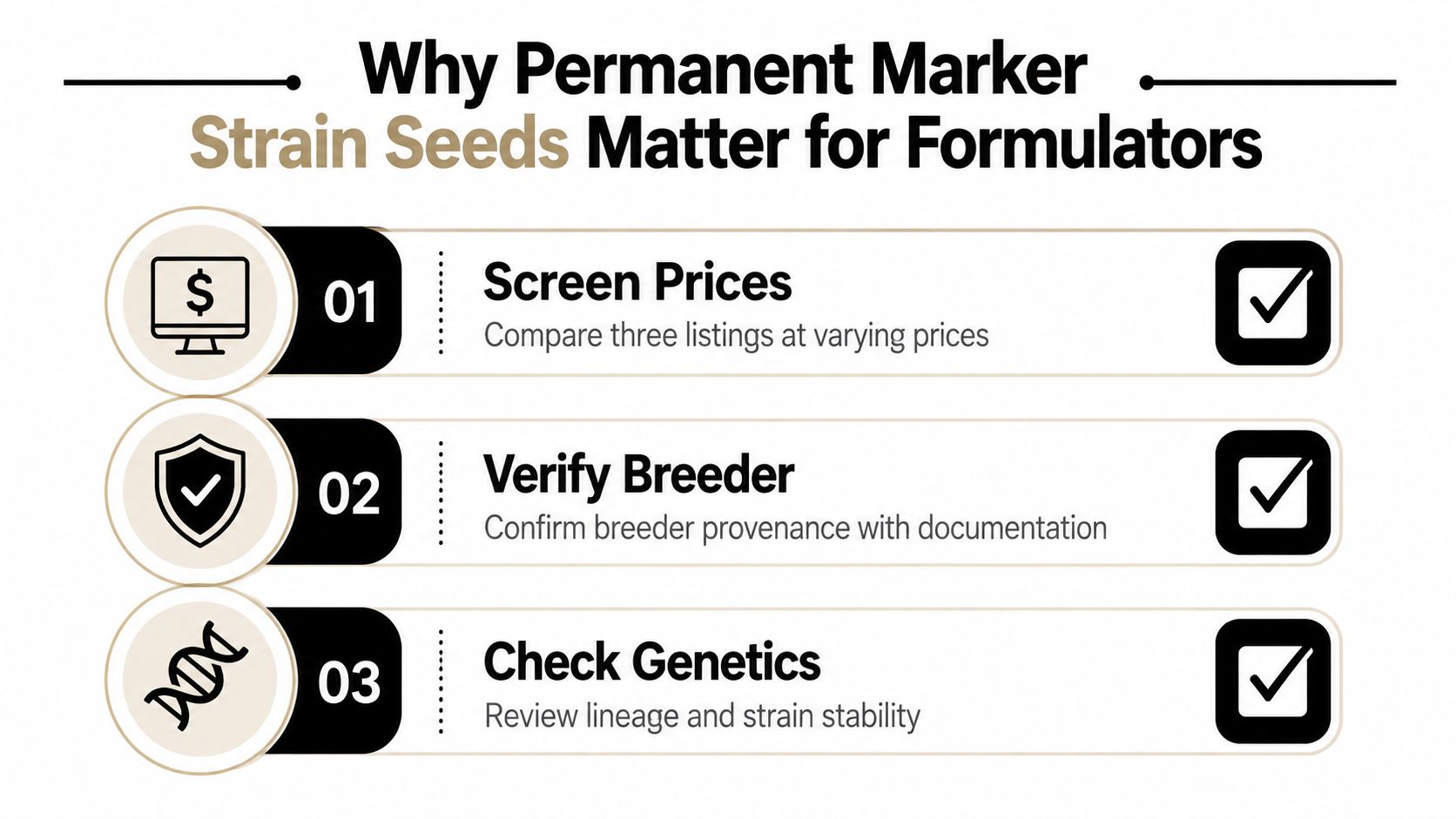
Three decisions before committing budget
- Screen the listing: Compare the price, seller identity, photographs, parent information, and packaging rather than treating cost as proof of authenticity.
- Verify the breeder trail: Look for documentation that connects the release to Seed Junky Genetics, an authenticated cut source, or a breeder with public lineage records.
- Define the formulation target: Decide whether you need a flower reference, a breeding project, a distillate flavor direction, or a stable production phenotype.
Licensed producers sourcing cuts, small-batch extractors, and home growers building strain libraries all face the same core problem. Before they commit cultivation space or raw material budget, they need to know what they're buying.
Verifying Breeder Authenticity Before You Buy
The provenance gap is where most Permanent Marker buying errors begin. A listing may use the correct name while describing an S1, a selfed line, an alias, or a lookalike release. Those categories can produce different levels of phenotypic variation, which affects canopy structure, harvest timing, aroma, and the terpene ratio that eventually reaches an extract.
The reported original line is associated with Seed Junky Genetics, but secondary catalogs don't always distinguish an original release from a selfed or relisted version. Aliases such as PM, Adios MF, and Gunnpowder can make the audit harder, especially when a seller doesn't disclose parent strains. A name alone isn't enough.
Audit the listing, not just the label
Start with the breeder's own public materials and compare the listed parents. Then look for independent grow reports that describe the same structural and aromatic traits. Seed morphology under magnification can help identify obvious irregularities, but it can't prove genetics by itself, so treat it as a supporting check rather than authentication.
Pricing can also signal a provenance problem, though it isn't conclusive. A low price may reflect an S1 or reseller stock, but it can also reflect old inventory or incomplete documentation. A listing with no lineage papers, reused stock images, or bulk pricing under $40 per 6-pack should receive extra scrutiny, as those are practical warning signs identified in the buying brief, not proof that the seeds are counterfeit.
Practical rule: Don't pay for a name you can't connect to a documented cut source or breeder record.
Use third-party testing principles when evaluating a seller's broader quality documentation. The third-party lab testing guide won't authenticate a seed lot on its own, but it reinforces the habit of asking what has been documented, by whom, and for which batch.
| Variant | Typical Source | Price per 6-pack | Terpene Consistency | Documentation Level |
|---|---|---|---|---|
| Original Permanent Marker line | Breeder-direct or verified cut source | Varies by seller | Potentially stronger when provenance is documented | Public breeder or lineage documentation |
| S1 or selfed line | Secondary breeder or reseller | Often lower than an original release | More phenotype variation should be expected | Depends on breeder records |
| PM, Adios MF, or Gunnpowder alias | Retail relisting or informal cut market | Highly variable | Cannot be assumed without parent disclosure | Often limited |
| Lookalike release | Unverified retailer or generic catalog | May appear unusually low | Unpredictable | Little or no usable documentation |
Catalog language can also overlap with broader strain-inspired flavor work. For example, Elevated Strains is a separate flavor listing, not evidence of Permanent Marker genetics. Keep that distinction clear when comparing seed provenance with commercial terpene products.
Germination Parameters That Work for This Lineage
Permanent Marker seed germination rewards restraint. The standard paper towel method works when the towel is damp, not wet, and the seed receives warmth without sitting in stagnant water. A fully wrung-out cloth is a better reference than a dripping towel.
A practical starting sequence is a 24-hour soak in pH-balanced water, followed by transfer to moist paper towels or a starter plug. Keep the seeds in a dark environment between 70 and 78°F, or approximately 21 and 27°C, with water around 22 to 25°C. Seed guides commonly report emergence within 24 to 72 hours, while the more conservative working window for this type of cross is 36 to 96 hours as outlined by Seed Supreme.
Control moisture before adding anything else
The recurring failure is saturation. Over-wet towels reduce oxygen around the kernel and can encourage fungal problems, while the dense seed can hold moisture against the emerging radical. More water won't force a faster germination. It often produces the opposite result.
Use a light peat and perlite medium with low initial EC once the taproot is ready. A low-salt environment reduces the chance of early nutrient stress while the root system is still establishing. Don't bury the seed or press the medium tight around it, because the emerging root needs both contact and oxygen.
Move the seed after the taproot reaches approximately 1 to 1.5 cm and the first knuckle has formed. Handle the shell or surrounding medium rather than pinching the root. Transplanting before the root is visible risks losing track of orientation, while waiting too long leaves a fragile taproot exposed to handling damage.
The useful midpoint is 72 hours, not a deadline. A slower seed isn't automatically defective if warmth, moisture, and oxygen have stayed within range.
Canopy Training and Environment Through Flower
Permanent Marker is commonly described as a bushy cultivar with a dense canopy. The productive approach is an even, moderately open structure, not maximum foliage or aggressive early stripping. Seedlings and clones can stay around 75 to 80°F with 65 to 70% relative humidity, gentle airflow, and a weak nutrient solution until roots are established.
During vegetative growth, work around 75 to 82°F and 60 to 70% humidity, with strong but non-directional air exchange. A 5 to 7°F day and night differential helps maintain a predictable environment without creating abrupt stress. The goal is to expose growing points evenly while keeping interior leaves from sitting in stagnant air.
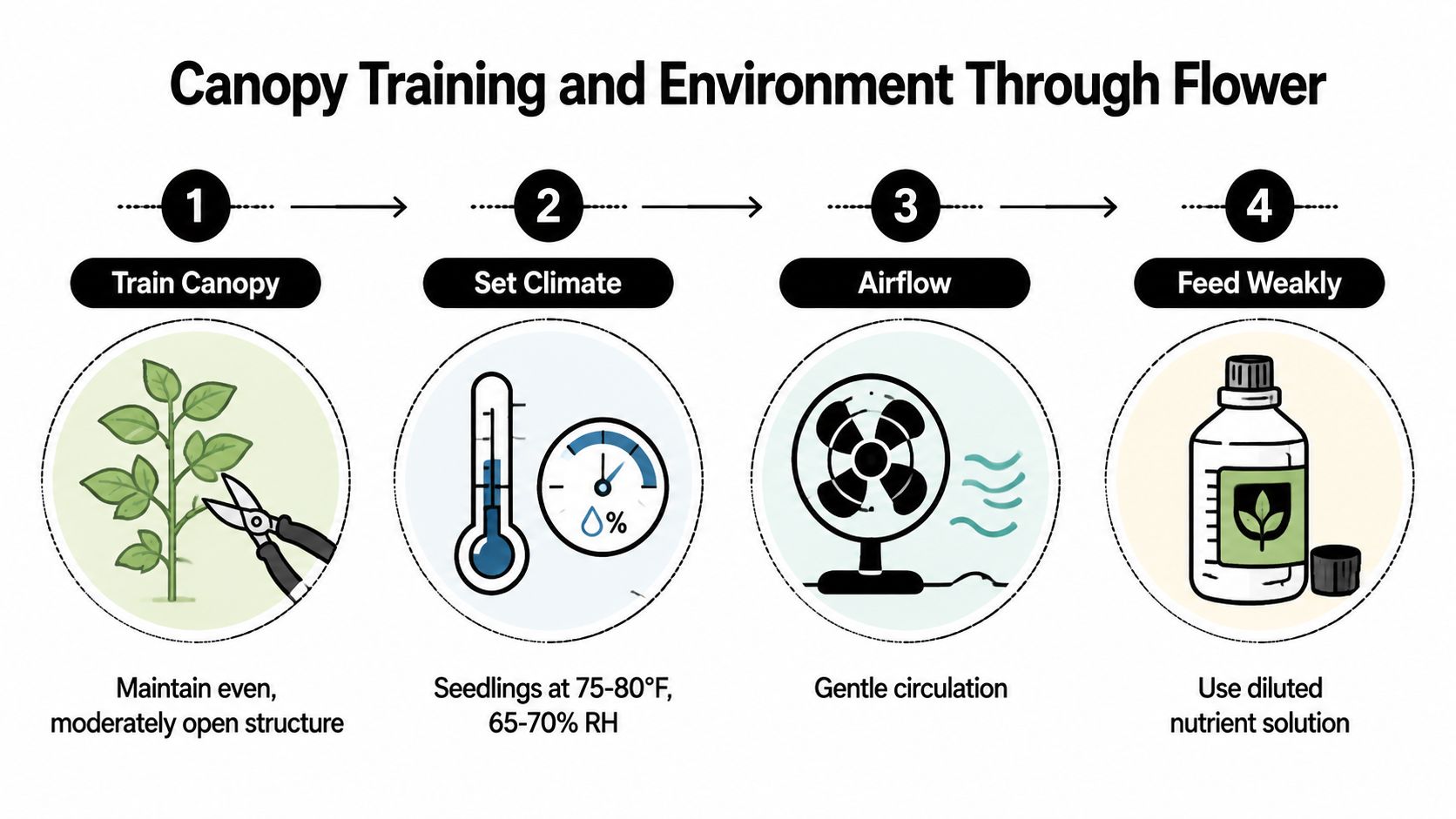
Shape the plant before the stretch
Top above the fourth or fifth node after the plant has several strong leaf sets. Follow with low-stress training to distribute the main branches across the available footprint. Remove lower growth only when it lacks usable light or airflow. Aggressive early defoliation can stall a dense modern cross before the root system and stems have enough capacity to recover.
Flip to a 12/12 light cycle when the canopy reaches roughly 70% of the tent footprint. This leaves room for flower stretch without allowing the plant to overrun the space. Lighting decisions also affect internode spacing and heat load, so compare the crop's response rather than relying on a fixed fixture rule. The HPS versus LED guide can help frame that equipment decision.
In flower, lower humidity gradually to around 40 to 50% and maintain 68 to 78°F. Late-flower humidity above approximately 50% is repeatedly flagged as a botrytis risk for dense colas in this independent strain review. Install a trellis or bamboo support before heavy stacking develops, because unsupported branches can snap as flowers gain weight.
- Irrigation: Water according to pot weight and substrate EC, not a calendar.
- Records: Log irrigation, leaf temperature, humidity, and runoff.
- Nutrient decisions: Identify weak roots or excess feeding before symptoms become lockout.
- Late finishing: Flush only as part of a documented substrate and nutrient program, never as an improvised rescue step.
Rebuilding the Caryophyllene Limonene Myrcene Profile
A Permanent Marker-inspired blend starts with the dominant terpene trio, but the final recipe still needs validation against the cultivar, harvest, extraction method, and finished hardware. Flower provides a reference. It doesn't provide a universal formula for every distillate.
Use the trio as a sensory architecture:
- Caryophyllene, base and structural note: Peppery, spicy, and grounding. It supplies depth and helps the profile read as gas rather than simple citrus.
- Myrcene, soft base and mid support: Musky, herbal, and rounded. It can soften sharper edges and fill the lower register.
- Limonene, top note: Bright citrus with candy and fuel-like lift. It gives the blend its initial aromatic impact.
That structure is why ratio control matters. Independent strain references also identify caryophyllene, limonene, and myrcene as the dominant trio, with linalool sometimes appearing as a secondary note. Linalool may be useful for a softer interpretation, but it shouldn't replace the three-part backbone when the target is Permanent Marker-inspired.
Build a matrix before touching the production batch
Prepare small samples rather than dosing directly into a full distillate run. Useful starting matrices include 45/25/30, 50/25/25, and 55/20/25 for caryophyllene, limonene, and myrcene respectively. These are formulation starting points, not claims about the exact composition of any flower lot.
| Caryophyllene / Limonene / Myrcene | Dominant Effect | Best Use |
|---|---|---|
| 45 / 25 / 30 | Softer, fuller base with moderate lift | A rounded dessert-gas direction |
| 50 / 25 / 25 | More pronounced spice and structure | A balanced flower-inspired trial |
| 55 / 20 / 25 | Deeper pepper and heavier body | A gas-forward interpretation |
Increasing limonene sharpens citrus and perceived lift. Increasing caryophyllene deepens spice and structure. Myrcene can round rough edges, but too much may push the profile toward medicinal or earthy territory.
Let each sample rest before sensory review. Immediate impressions can misrepresent how the blend behaves after dilution, filling, and contact with hardware. Record the percentages, ingredient lot numbers, distillate lot, viscosity observations, and sensory notes so the next batch can reproduce the decision. The caryophyllene formulation guide provides additional context for working with this structural terpene.
Translating Flower to Distillate and Cart Hardware
Treat harvested flower as a timing-sensitive flavor reference, not a guaranteed formulation target. Published strain pages place Permanent Marker's flowering time at roughly 8 to 10 weeks indoors, with some phenotypes finishing around week nine and outdoor harvests varying by climate as summarized by Herb. Use that window to plan sampling, then verify trichome condition, aroma, and drying progress before choosing a harvest date.
Retain representative samples from each flower batch. Compare the dried and cured material with the corresponding distillate or broad-spectrum extract, because drying, curing, extraction, winterization, refinement, and storage can all change the sensory result. A strain-specific blend can recreate the dessert, gas, candy, citrus, and spice direction in distillate or isolate, but that result remains an interpretation, not analytical proof that the oil contains the original flower's complete volatile profile.
For initial cartridge trials, experienced extractors often begin around 5 to 8% total terpenes by weight, then adjust only after viscosity, flavor, and stability testing. Excess terpene loading can thin the oil, increase leakage risk in poorly matched hardware, and intensify irritation. Keep the trial small enough that a hardware mismatch doesn't consume an entire production batch.
| Variable | Starting Reference | Required Check |
|---|---|---|
| Flower maturity | Roughly 8 to 10 weeks indoors | Trichome condition, aroma, and drying progress |
| Total terpene loading | 5 to 8% by weight for an initial cart trial | Viscosity, flavor intensity, and stability |
| Oil system | Broad-spectrum distillate or isolate | Compatibility with the selected blend |
| Hardware | Ceramic, wick, or mesh cartridge | Leak behavior, feed performance, and vapor consistency |
| Rest period | Validated internal process | Aroma transfer after filling and before release |
Match viscosity and boiling behavior to the cartridge. Porous ceramic, wick, and mesh systems can behave differently with the same oil and blend. Cure filled carts under validated conditions, test leaks and hardware failure, and let the finished oil rest before final evaluation.
Record terpene percentage, distillate mass, hardware lot, cure timing, and observations. Scale only after aroma, mouthfeel, and production consistency remain stable across the selected system.
Practical Takeaways Before You Order
Start with the finished product you intend to make. For a Permanent Marker-inspired cart, define the balance of dessert, gas, candy, citrus, and spice before choosing seeds. Then identify the material you need: verified flower for extraction, a breeding population, a phenotype hunt, or a terpene blend for distillate.
Verify breeder provenance through lineage records and Breeder Lock certificates where available. Reject listings that use PM, Adios MF, Gunnpowder, or other aliases without naming the parent strains. A cheaper pack offers little value when the genetics are uncertain and the crop must justify its space or support a formulation program.
Use a controlled operating brief
- Germination: Control moisture with the paper towel or starter-plug method. Expect radical emergence within the documented 24 to 72 hour window according to Seed Supreme's germination guidance. Rule out saturation, temperature, and handling problems before judging seed quality.
- Vegetative growth: Hold approximately 65 to 70% relative humidity and an 18-hour light schedule while the canopy develops.
- Training: Top above the fourth or fifth node, add low-stress training, and flip when the canopy covers roughly 70% of the tent footprint.
- Flower timing: Use the published 8 to 10 week indoor window as a planning reference, then confirm readiness through maturity and aroma.
- Formulation: Build a Permanent Marker-specific blend matrix before production. For cart work, test the stated 5 to 8% initial terpene loading against viscosity, flavor, hardware behavior, and stability.
- Documentation: Record seed source, phenotype observations, harvest timing, extraction lot, terpene lots, loading, hardware, and cure results.
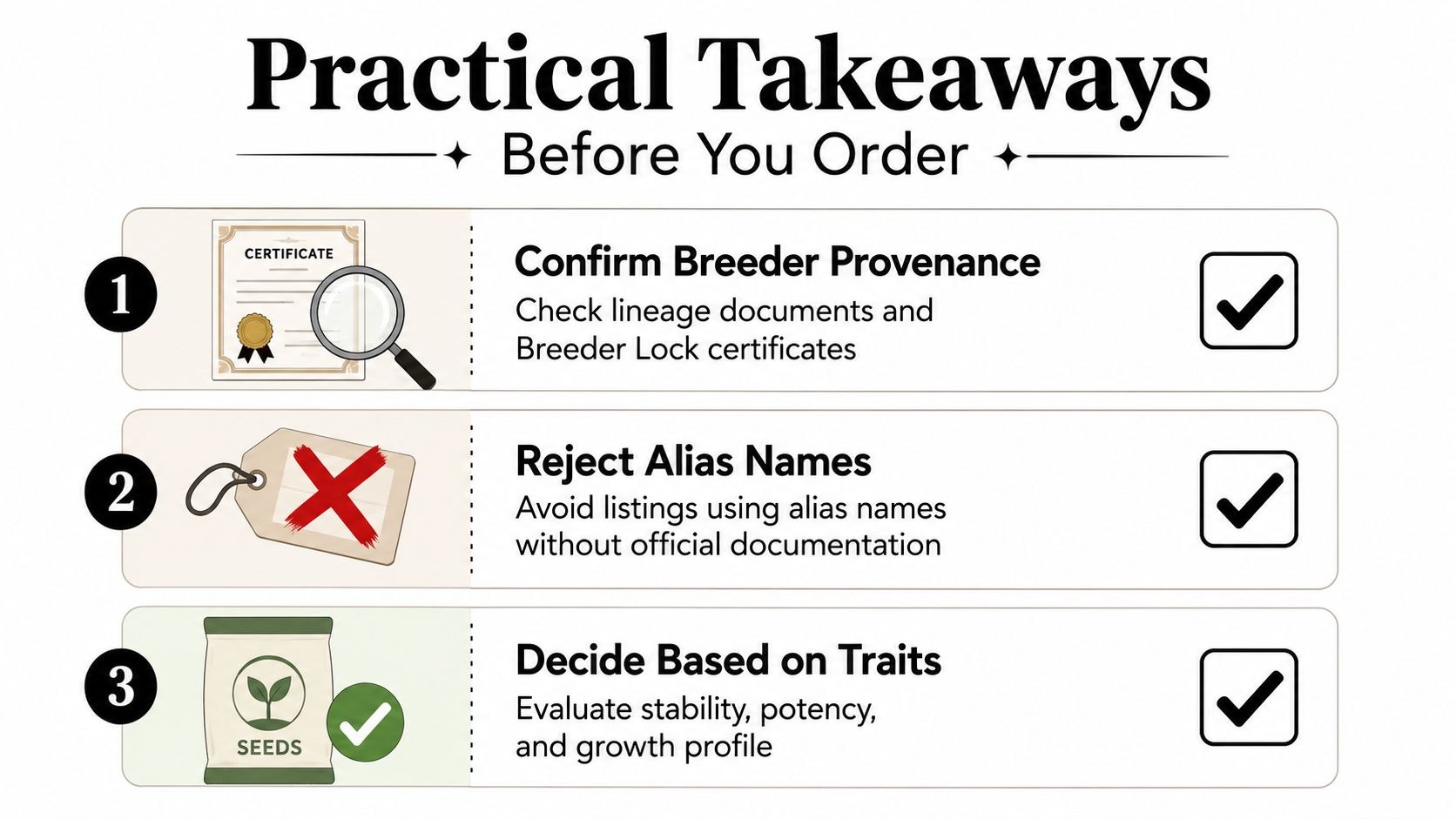
A useful workflow connects provenance with sensory validation. Verified genetics make the flower reference more relevant, while cultivation, post-harvest handling, blend testing, and hardware qualification determine whether that reference becomes repeatable. Formulators who do not need to grow the line can use a consistent strain-inspired profile instead, keeping the recipe documented and adjustable.
Gold Coast Terpenes offers strain-specific terpene blends, isolated limonene, myrcene, and beta-caryophyllene, plus formulation resources for cartridges, concentrates, and distillate work. Visit Gold Coast Terpenes to compare Permanent Marker-inspired components and review the mixing and safety resources before a small-batch trial.