
A cartridge can pass a bench aroma check and still fail before it becomes a reliable SKU. The blend may smell accurate in a vial, then thin out in the reservoir, separate after storage, crystallize in the oil, or taste harsh after repeated heating. Those failures rarely come from flavor selection alone. They come from treating terpene addition as a finishing step instead of designing the entire formulation around viscosity, solubility, thermal behavior, hardware interaction, and reproducibility.
For cannabis product formulators, extractors, and brand owners, advanced formulation techniques are a form of commercial risk control. A strain-inspired terpene blend has to survive the delivery system, not just impress someone at the mixing bench. The practical question isn't only whether the profile smells right. It's whether the same ratio remains stable, fillable, vaporized, and sensory-consistent across production batches.
Why Advanced Formulation Matters for Terpene Driven Products
A promising small batch can pass its aroma check and still fail on the production floor. The formulator adds a terpene blend to winterized distillate, mixes until the oil appears uniform, fills a cartridge, and approves the flavor. The next batch follows the same written formula, yet fills more slowly, leaks at the hardware, tastes sharper on the first puff, or shows instability after storage.
The root problem is often the way the system was evaluated. Aroma approval alone leaves viscosity, solubility, evaporation, thermal behavior, hardware interaction, and batch reproducibility untested. A component ratio can alter flow, perceived intensity, and material compatibility. Those effects may become nonlinear when several ingredients influence viscosity and phase behavior together.

Flavor accuracy is only one quality attribute
A useful formulation brief defines what the product must retain through filling, storage, and use. Aroma is one release criterion among several.
- Sensory identity: The blend should preserve its intended top, mid, and base-note structure.
- Physical uniformity: The oil should remain consistent without separation or unwanted crystallization.
- Processability: The formulation should move through the selected filling and handling process predictably.
- Hardware performance: The blend should suit the cartridge's operating conditions without excessive leaking, clogging, or harshness.
- Batch reproducibility: Another operator should be able to make the same formula from the same controlled inputs.
Understanding what terpenes are and how they function gives the team a sound starting point. It does not resolve a cartridge-material issue or compensate for a blend that changes viscosity during use. Composition must be assessed alongside the finished device.
Practical rule: Approve a terpene blend in the cartridge and temperature window where it will be sold, not only in a glass vial.
Mixture experimentation provides a useful formulation model because component proportions must sum to 1, as described in this formulation statistics reference. The same logic applies to strain replication. Adjusting one terpene changes the relative balance of the complete mixture, even when the change appears minor on paper.
Commercial risk appears when formulas depend on informal additions, visual judgments, or isolated trial adjustments. Changes in base oil, scale, operator, or hardware can then shift the outcome. Advanced formulation replaces that variability with defined quality attributes, controlled inputs, measured responses, and verification batches. The objective is a blend that survives processing and use with the same behavior at scale.
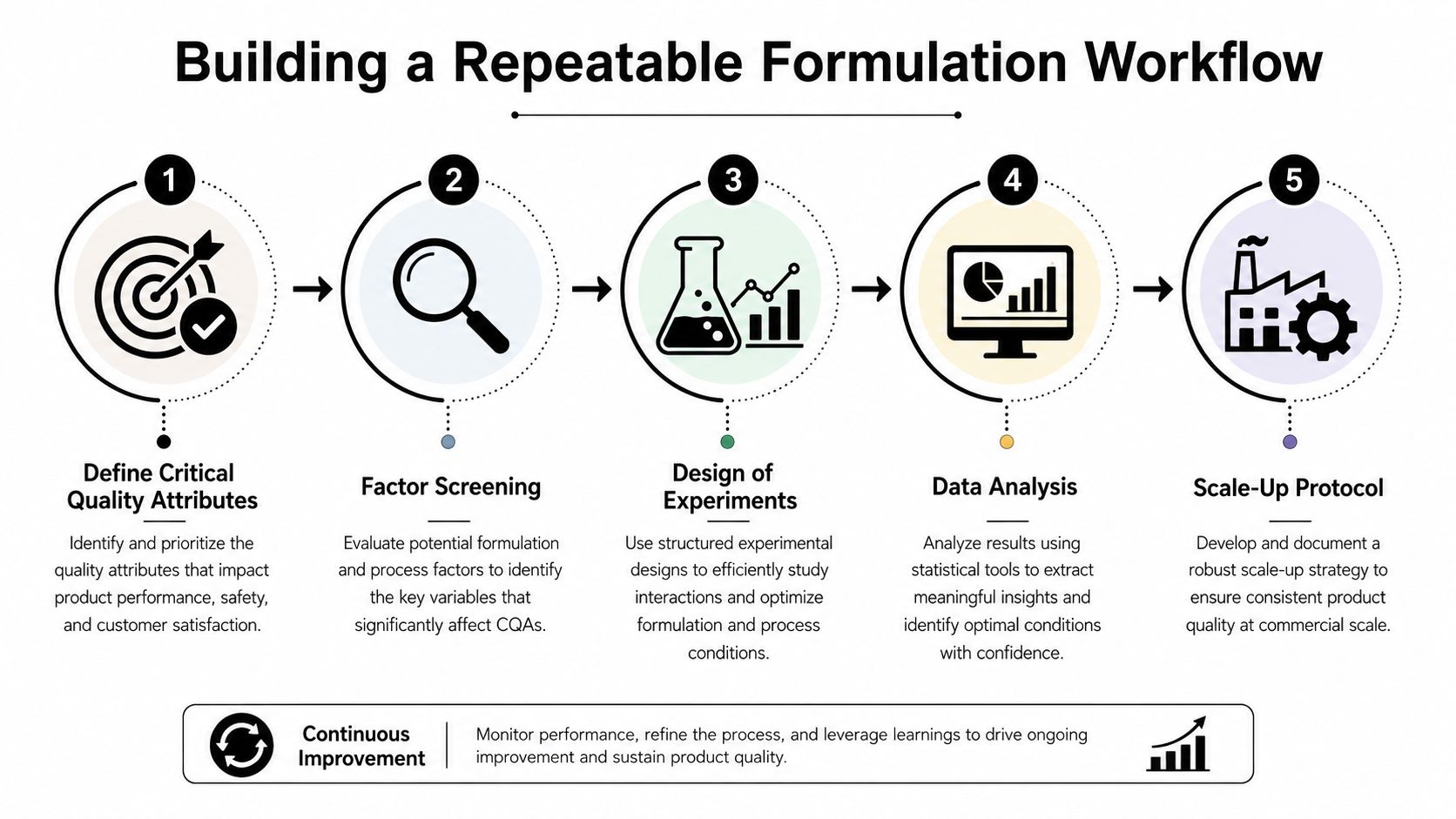
Building a Repeatable Formulation Workflow From Bench to Production
A cartridge can pass a bench review and still fail on the filling line. Viscosity may drift with temperature, volatile notes may fade during mixing, or the oil may interact poorly with the cartridge materials. A repeatable workflow therefore starts by defining the delivery system, process conditions, sensory target, and release criteria before anyone doses the first terpene.
Document the target product, base material, hardware, sensory profile, and measurable acceptance criteria. If the team cannot describe successful viscosity, uniformity, fill behavior, compatibility, and stability, it cannot distinguish improvement from simple variation.
A practical sequence moves from quality definition to factor screening, model building, and confirmation. Design-of-experiments and response-surface methods examine several variables and their interactions instead of changing one factor at a time. A structured DOE can identify influential inputs and useful combinations with fewer trial runs, as outlined in this advanced formulation techniques overview.
Define the product before defining the blend
Set the critical quality attributes, or CQAs, first. For a vape formulation, these can include target viscosity, blend uniformity, sensory match, filling behavior, cartridge compatibility, appearance, and stability through intended storage and use. Acceptance criteria must be measurable by production and quality teams.
Then identify high-risk inputs. Typical variables include terpene load, the ratio between volatile and heavier aromatic fractions, distillate composition, winterization quality, mixing order, mixing temperature, hold time, and cartridge construction. A small composition change can alter flow, evaporation, or hardware performance, so terpene percentage is only one part of the control strategy.
Screen variables that can change the outcome
Factor screening should answer a focused question: which inputs have enough influence to warrant deeper optimization? Keep the test plan controlled by holding the base oil, container type, mixing equipment, and evaluation method constant while varying the selected factor.
Record sensory and physical observations together. A blend may match the reference aroma more closely yet become too mobile for the selected cartridge. Another may fill cleanly while losing top-note impact during heating. These results reveal a delivery-system trade-off, not a testing error.
Model interactions, then verify the proposed optimum
After identifying high-risk variables, use DOE or response-surface work to examine combinations. Multi-ingredient systems often behave nonlinearly. The useful terpene load can depend on the base material, mixing temperature, and balance of the blend rather than on one ingredient alone.
Run verification batches with the intended process. Confirm the formula, order of addition, equipment settings, fill behavior, sensory profile, and stability observations. A bench result becomes production-ready only when a controlled repeat produces the same measurable behavior.
Use a documented recipe scaling workflow as volume changes. Record raw-material identifiers, weights, addition order, mixing conditions, sampling points, observations, and deviations. Include temperature and hold-time checks where they can affect viscosity or volatile retention.
Spreadsheet accuracy supports repeatability, but process control determines it. The same inputs, sequence, equipment settings, and checks must produce comparable results under defined conditions.
Descriptive statistics belong in the development record. Mean, standard deviation, percent RSD, and range help evaluate assay, dissolution, blend uniformity, viscosity, particle size, and stability, according to this review of statistical methods in formulation development. The exact test set depends on the product and laboratory capability. Record variation across batches instead of relying on one favorable observation.
Precision Dosing and Ratio Calculations for Vape Cartridges
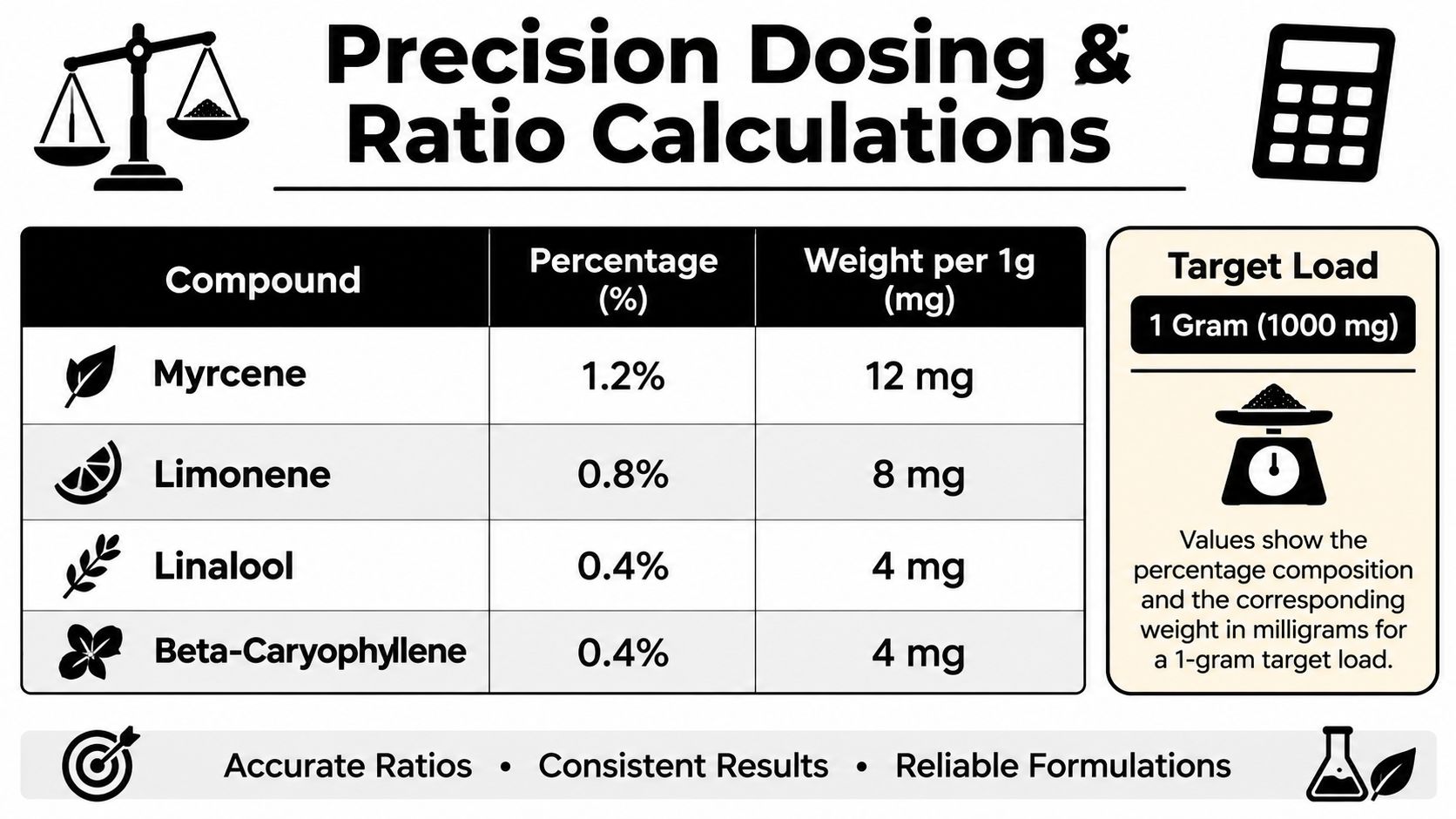
Ratio math prevents a strain-inspired blend from becoming an approximation. Start by separating blend ratio from final terpene load. The ratio describes how the terpene components relate to one another. The final load describes how much of that blend enters the finished oil.
A useful lab-report example contains 1.2% myrcene, 0.4% limonene, and 0.3% caryophyllene. Dividing each value by the sum of the three components converts the profile to roughly 60:20:15, with the remaining difference attributable to rounding, as shown in this terpene selection guide. That ratio can then be scaled to the selected total terpene load.
Convert the profile before scaling the batch
Use this sequence:
- Add the reported component percentages. This gives the total represented by the selected compounds.
- Divide each component by that total. The result is each compound's fraction of the blend.
- Convert fractions into a practical ratio. Round only after checking that the rounded values still represent the intended profile.
- Choose the final terpene load. Scale the ratio to the load appropriate for the base oil and hardware.
- Calculate the actual mass. Weigh each component separately or prepare a controlled premix, then document the method.
For distillate cartridges, one widely used starting range is 5% to 10% terpenes by weight, with distillate-based cartridges often targeting 5% to 8% and guidance commonly advising that distillate formulations stay at or below 10% to reduce instability and crystallization concerns, according to this terpene use guide. Another commercial guide places cartridge formulas in a broader 5% to 15% range and describes distillate use at 8% to 12%, demonstrating that the suitable load depends on the base material and hardware behavior, as discussed in this vape formulation guide.
Those ranges are starting points, not automatic approvals. A higher load may amplify aroma while reducing viscosity or increasing harshness. A lower load may improve physical handling but mute the intended profile. The selected cartridge, oil composition, and heating behavior decide which compromise is acceptable.
Make the calculator subordinate to the record
A calculator is useful for arithmetic, but it doesn't replace batch control. Store the target load, total batch mass, component masses, density assumptions if used, lot identifiers, and actual weighed amounts in the batch record. Record whether the numbers describe the terpene premix or the finished oil.
A one-gram target load also deserves careful unit handling. For example, the infographic's reference table uses myrcene at 1.2%, limonene at 0.8%, linalool at 0.4%, and beta-caryophyllene at 0.4%, with myrcene represented as 12 milligrams in a one-gram target load. That table is a calculation example, not a universal cartridge formula.
Use the mixing ratios calculator to check arithmetic, then verify the result against the actual base oil and device. Don't round each ingredient independently before calculating the total. Small rounding choices can distort a delicate top-note balance, especially when a minor component carries much of the reference aroma.
Compatibility Solubility and Stability Controls That Prevent Failure
A blend can look clean on the bench and still fail in production. The critical test is whether it remains uniform after contact with the base oil, container, cartridge, storage conditions, and heating cycle. Treat formulation as a delivery system that must survive each interface, not as flavor mixing alone.
Start with the materials entering the system. Review the extract's winterization quality, residual solids, water sensitivity, and handling history before adding terpenes. Suspended material or inconsistent viscosity in the base can cause haze, separation, or poor filling. The terpene blend may reveal that weakness rather than create it.
Five controls deserve early attention
- Diluent selection: If the specification excludes VG, PG, PEG, or MCT, do not add a substitute casually. Choose inputs that match the intended composition, then verify their interaction with the base and hardware.
- Winterization quality: Incomplete removal of unwanted solids can promote haze, separation, or later crystallization. Inspect and document the base before blending.
- Oxidation prevention: Limit unnecessary air, heat history, and light exposure during handling. Use consistent containers, minimize headspace where practical, and close them promptly.
- Hardware interaction: Test the finished oil in the actual cartridge. Check fill behavior, leakage, wicking, clogging, and sensory output after heating, not only appearance in the mixing vessel.
- Final sensory validation: Compare the batch with an approved reference under a consistent evaluation method. Aroma in the bottle does not predict performance through the device.
If the base shows visible or recurring instability, use this crystallization prevention guide to structure the investigation. The corrective action may involve terpene load, mixing conditions, base preparation, or material selection. Adding more terpene without identifying the cause usually makes the formula harder to control.
Track measurements instead of relying on appearance
Monitor viscosity with a consistent method and temperature condition. Assess blend uniformity through defined sampling rather than a single surface sample. Where laboratory capability allows, calculate the mean, standard deviation, range, and percent RSD for selected measurements. These descriptive statistics help separate normal batch variation from a process shift.
Thermal behavior needs its own test plan. A blend may retain its aroma in storage yet change during heating because volatile components leave at different rates or the cartridge creates localized hot spots. Evaluate the product in its target device and operating window, then compare results across representative units.
Failure signal: If a formula only works after repeated stirring, warming, or visual adjustment, the process is not controlled enough for a dependable SKU.
Mixture design fits this problem because every component proportion contributes to the complete blend. Changing one proportion changes the remaining composition, so independent flavor-drop adjustments can obscure the actual cause of a shift. The technique was published in early form by Quenouille in 1953, while pharmaceutical applications appeared later, in 1991 and 1992. The practical lesson is to model the terpene blend as one system, then confirm that system against solubility, viscosity, thermal behavior, and cartridge performance.
Sensory Profiling With Top Mid and Base Notes for Strain Accuracy
Flavor accuracy depends on architecture. A reference profile may open with a bright volatile note, develop a recognizable central character, and finish with a heavier aroma that remains after the initial impact fades. If the formulator only matches the opening scent, the finished cartridge can feel accurate for a moment and wrong through the rest of the draw.
Assign each component a job
Top notes create the first sensory impression. They often provide lift, brightness, citrus, floral, or other high-impact cues, but they can also dominate quickly if the load is too aggressive or the blend is exposed to excessive heat.
Mid notes carry the central identity. They connect the opening impression to the finish and usually determine whether a strain-inspired terpene blend feels coherent rather than sharp or fragmented.
Base notes add depth and persistence. They can stabilize the overall aroma so the profile doesn't collapse into a thin top-note effect. A bulk-terpene formulation guide describes base notes as a stabilizing layer and recommends keeping monoterpenes below 6% while using sesquiterpenes at 3% to 5% for thermal resilience, flavor retention, and hardware compatibility during heating cycles, as outlined in this note-layering guide.
These figures should be treated as formulation guidance, not a universal recipe. The base oil, cartridge, heating behavior, and desired sensory profile still require confirmation.
Profile the reference in stages
Start with a blind comparison between the reference and the candidate. Evaluate the opening aroma, the middle of the draw, the finish, and the residual aroma after the sample is removed. Keep the vocabulary consistent. “Bright,” “green,” “floral,” “woody,” “spiced,” and “sweet” become more useful when the team defines what each term means internally.
Then change one architectural decision at a time. If the profile opens correctly but finishes too thin, strengthen the base-note structure rather than increasing the entire terpene load. If the finish is right but the first impression is harsh, reduce the aggressive top-note fraction or review the heating and hardware conditions before changing the whole blend.
Document each iteration by ratio, total load, base material, device, mixing conditions, and sensory observations. A strain replication project becomes reproducible when another formulator can understand why a change was made and what result it produced.
Sensory discipline: Don't ask whether a blend smells good in isolation. Ask whether it matches the reference at the beginning, middle, and end of the intended use.
The objective is flavor and aroma accuracy, not medical positioning or unsupported effects language. Keep the formulation record focused on sensory identity, physical behavior, and product performance.
Scaling Troubleshooting and Compliance Checks for Consistent SKUs
Bench success and production success use different standards. At bench scale, a skilled formulator can compensate for a slow fill, remix a slightly uneven sample, or reject a cartridge by sight. Production needs a process that prevents those compensations from becoming invisible sources of batch drift.
A scale-up review should compare the small-batch method with the production method line by line. Check mixing energy, vessel geometry, order of addition, hold time, exposure to air, temperature control, transfer losses, fill speed, and cartridge storage. A formula that depends on operator feel should be converted into a measurable instruction or removed from the process.
Use a decision tree for recurring failures
- Harshness appears after filling: Compare the cartridge output with the bulk oil. If the bulk sample is acceptable but the device is harsh, investigate hardware and heating behavior before changing the terpene profile.
- Separation appears during storage: Confirm base uniformity, winterization quality, mixing order, and terpene load. Don't assume a longer mix will solve a compatibility issue.
- Leaking occurs during fill or use: Review viscosity under the actual handling condition, seal design, fill temperature, and dwell time. A thinner formulation may improve flow while creating a different hardware problem.
- Flavor becomes muted: Check volatilization, container exposure, heating conditions, and note balance. Increasing the total load may intensify the wrong notes instead of restoring the missing character.
- Batches drift from the approved reference: Compare raw-material lots, weighing records, operator sequence, sampling method, and storage history before reformulating.
Build the release file around evidence
For each commercial SKU, retain the approved formula, raw-material documentation, batch records, mixing instructions, in-process observations, finished-product checks, sensory reference, and stability plan. Verify that all inputs meet the product's safety and compliance requirements. For products using SC Lab-tested, THC-free terpene inputs, retain the relevant documentation with the formula record rather than treating it as separate marketing material.
Formulation risk deserves this level of control. An industry survey summarized by IntuitionLabs reported that about 60% of respondents had experienced formulation issues during clinical development, more than 50% of those delays exceeded 12 months, and 10% resulted in complete project failure. The context is pharmaceutical development, not cannabis cartridges, but the operational lesson carries over: late discovery of compatibility or process problems is expensive.
A practical release decision compares three samples side by side: the approved bench reference, the verification batch, and the production batch. Evaluate physical appearance, flow, fill behavior, device performance, and sensory architecture. Approve the SKU only when the differences are understood and controlled.
Gold Coast Terpenes supplies natural terpene blends, strain-specific profiles, isolated compounds, diluents, formulation education, and tools for cartridge and concentrate development. Visit Gold Coast Terpenes to review components and formulation resources that can support controlled ratio work, strain replication, and scale-up testing.