
Does hemp smell like pot because it contains THC, or can a low-THC material produce the same recognizable aroma through an entirely different chemical route? For product formulators, that distinction matters. A hemp flower, full-spectrum extract, or vape cartridge can create a cannabis-like sensory impression even when its cannabinoid profile doesn't resemble high-THC cannabis.
Aroma affects more than consumer perception. It influences vape cartridge acceptance, distillate reintroduction, retail discretion, strain replication, and batch consistency. If a brand wants a discreet product, the formulation must reduce or redirect pungent notes. If it wants to reproduce a familiar cannabis profile, it must understand which compounds create the skunky character and which terpenes supply the surrounding body.
The practical answer is simple but incomplete: hemp can smell like pot, but it doesn't always smell the same. Aroma depends on the balance of terpenes, volatile sulfur compounds, processing conditions, and the way the finished product releases those molecules during use.

Introduction Why Hemp Smell Matters for Product Formulators
Odor isn't a potency test
The most important formulation correction is also the easiest to miss: smell doesn't map cleanly to THC content. Cannabinoids such as THC and CBD are not the main drivers of the volatile aroma released from hemp or cannabis material. A product can smell strongly cannabis-like without providing a reliable indication of its cannabinoid category.
That creates a commercial problem for teams working with hemp-derived inputs. A customer may interpret a skunky cartridge as “strong,” while a retail partner may interpret the same aroma as a potential compliance or nuisance issue. Neither conclusion can be established from odor alone.
For extractors and brand owners, aroma should be treated as a controllable product attribute, much like viscosity, color, or terpene concentration. The source material, extraction method, refinement level, storage conditions, and reintroduced terpene blend can all change the finished sensory profile.
Why the answer affects a SKU
A raw hemp flower may carry a pronounced plant aroma. A refined distillate may lose much of that character during processing, then acquire a new identity when a strain-inspired terpene blend is added. A formulation intended to replicate a familiar profile therefore needs more than a label that says “hemp” or “cannabis.”
Teams should define the desired result before blending:
- Discreet: low-impact aroma for channels where lingering odor creates friction.
- Authentic: a faithful hemp or cannabis-style profile with earthy, pine, citrus, or sulfurous notes.
- Enhanced: a recognizable base supported by fruit, dessert, mint, or other flavor directions.
Formulation rule: Don't ask only whether the input smells like pot. Ask which compounds create that impression, how strongly they survive processing, and whether the finished product should preserve or redirect them.
A useful cannabis product formulation resource can help teams connect terpene selection with product architecture. The goal isn't to force every hemp product into a cannabis-like profile. It's to make the aroma predictable enough that the final SKU matches its intended positioning.
What Creates Hemp and Cannabis Aroma Beyond THC
Volatile compounds carry the scent
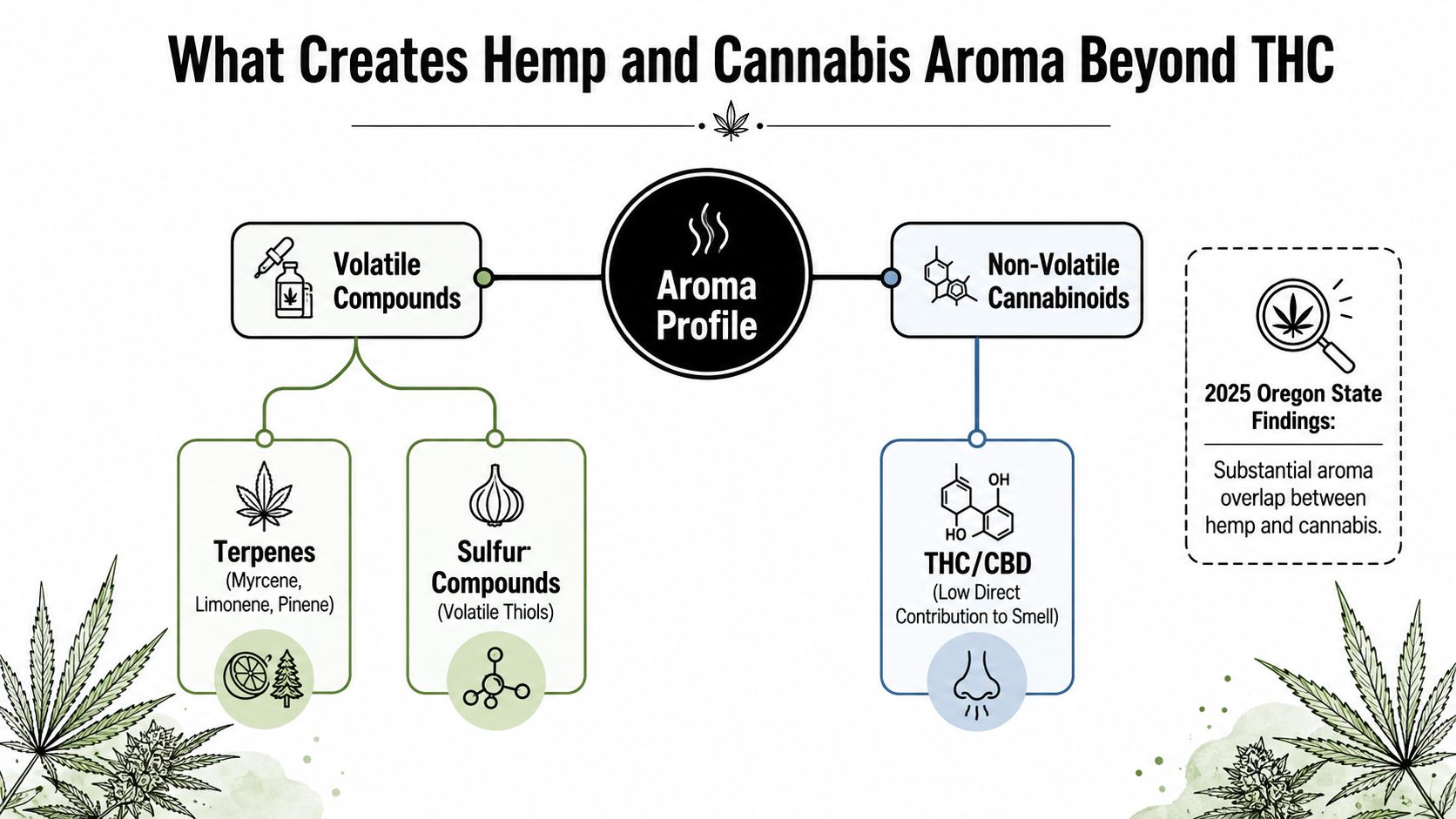
Aroma comes primarily from volatile compounds, molecules that readily move into the air and reach the nose. Terpenes are an important group, but they're only part of the picture. Volatile sulfur compounds can exert an outsized sensory effect even when present at very low concentrations.
A major 2025 sensory study from Oregon State University found substantial overlap between hemp and cannabis aroma space. The researchers identified four aroma families, and sensory descriptions differed in emphasis. Hemp was described more often with citrus, fruity, and candy-like notes, while cannabis was described more often as skunky, musty, and animalic. The same work reported that terpene chemistry alone didn't strongly predict perceived smell. (Oregon State University's sensory research)
That finding matters for strain-inspired terpene blending. A lab report can identify important terpenes, but a terpene list doesn't always predict how the finished material will smell. Human perception responds to the combined profile, including trace compounds and interactions among notes.
Why the legal threshold doesn't create an odor boundary
Federal U.S. law uses the 0.3% delta-9 THC threshold to distinguish hemp from marijuana. That legal distinction describes cannabinoid content, not a unique smell. Because hemp and cannabis can share volatile aroma chemistry, odor is a poor legal proxy for plant category.
This is why two products can create similar sensory impressions while belonging to different regulatory categories. It's also why product teams should avoid using aroma as a substitute for analytical testing or documentation.
A perfume analogy helps. A fragrance isn't defined by one ingredient alone. A bright citrus opening may sit over an herbal body and a persistent woody base. Cannabis and hemp aromas work similarly. Myrcene, limonene, pinene, floral compounds, peppery compounds, and sulfur volatiles compete and combine in a single sensory field.
A practical sensory model
For formulation work, separate the product into three questions:
- What appears first? These are the volatile top notes, often citrus, pine, or bright herbal impressions.
- What gives the aroma its body? Mid notes such as earthy, floral, or spicy elements shape identity.
- What lingers? Base notes, including heavier woody, peppery, and sulfur-associated impressions, can determine whether the product reads as discreet or pungent.
A terpene profile for a hemp product should therefore be evaluated through both analytical data and sensory checks. Teams looking for formulation context can also review how hemp-derived products are defined before setting product language or retail expectations.
How Terpenes and Sulfur Compounds Drive Hemp Odor
Terpenes establish the aroma framework
Why can two hemp products smell completely different when both contain familiar cannabinoids? The answer begins with volatile chemistry. Terpenes set the main aroma structure, while trace sulfur compounds can determine whether the finished profile reads as herbal and piney or distinctly skunky.
A 2025 analysis of CBD hemp cultivars found that α-pinene, myrcene, and linalool had flavor-dilution factors of 256–1024, identifying them as major contributors to hemp scent rather than faint background notes. (CBD hemp cultivar analysis)
For a commercial blend, formulators can organize the profile into working layers:
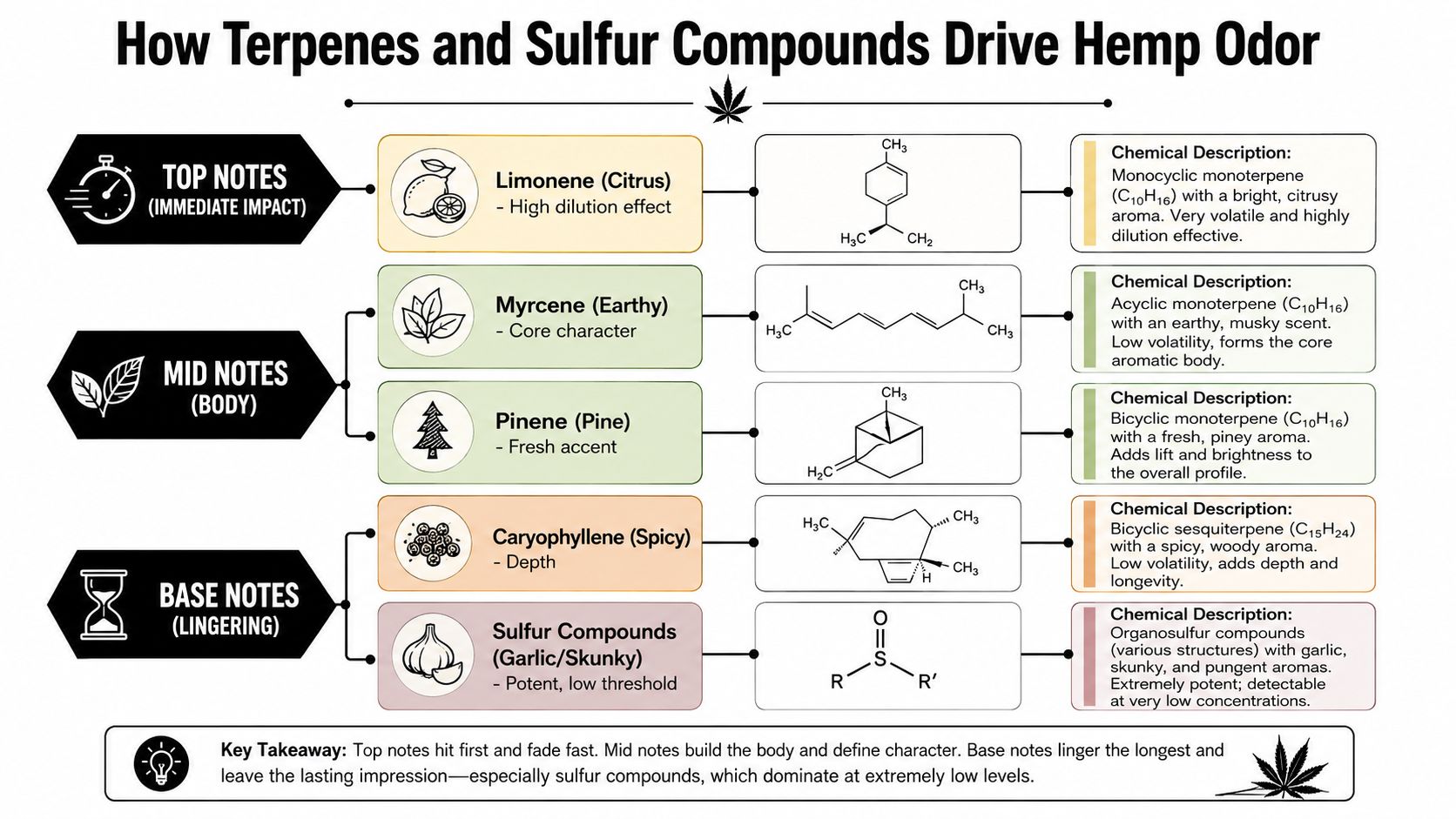
- Top notes: Limonene provides citrus brightness, pinene adds a fresh pine-like lift, and ocimene can create a sweet-herbal opening.
- Mid notes: Myrcene supplies earthy and herbal body. Linalool brings floral softness, while terpinolene combines pine, floral, and herbal impressions.
- Base notes: Caryophyllene contributes peppery spice. Humulene adds woody-earthy depth and can leave a drier finish.
These layers behave more like a mixing board than fixed compartments. Heating, dilution, carrier composition, and hardware can raise one note while muting another. A team evaluating how to use terpenes in a formulation can use this model to identify whether a blend feels sharp, thin, heavy, or persistent before changing the recipe.
Sulfur compounds can control the identity
A terpene screen may look ordinary while the product still smells like pot. Research found potent sulfur volatiles alongside common terpenes, including 3-methyl-2-butene-1-thiol, 4-methyl-4-sulfanylpentan-2-one, and 3-sulfanylhexan-1-ol. These compounds showed the same 256–1024 flavor-dilution range reported for several prominent terpenes, so trace amounts can strongly affect the perceived aroma. (Hemp aroma compound research)
3-methyl-2-butene-1-thiol, often abbreviated as 321MBT, has been linked to the classic skunky odor associated with hemp and cannabis, along with skunk spray odor. (ACS Omega chemical study)
The formulation consequence is straightforward. A thiol-poor, terpene-rich sample may present citrus, floral, pine, or herbal notes. A sample with relevant sulfur volatiles may read as gassy, skunky, or cannabis-like, even when its cannabinoid profile differs substantially. For teams evaluating why hemp can smell like skunk, sulfur chemistry deserves the same attention as the terpene ratio.
Heating changes what reaches the nose
Cartridge development adds another variable: volatility. A third-party hemp aroma resource lists vaporization temperatures and sensory directions for common terpenes, including pinene at 311°F, myrcene at 332°F, limonene at 348°F, caryophyllene at 266°F, linalool at 388°F, humulene at 222°F, ocimene at 122°F, and terpinolene at 366°F. (Hemp terpene resource)
These values do not predict cartridge behavior by themselves. They provide context for volatility balancing: a blend that smells even in a vial may release a different sequence after filling, storage, heating, and inhalation. Product teams should therefore evaluate a strain-inspired profile in the actual finished format, not only in raw concentrate.
When Hemp Will and Will Not Smell Like Pot in Real Products
Why can the same hemp input smell floral in one product and skunky in another? The answer often lies in how processing preserves, removes, or redistributes its volatile fraction. Fresh or cured flower retains the broadest natural aroma field, including terpenes and trace sulfur compounds. If those volatiles express a strong skunky direction, consumers may read the product as cannabis-like regardless of its THC category.
Full-spectrum extract can preserve more source character than a highly refined isolate, but extraction, handling, storage, and finishing conditions all affect what remains in the oil. Aroma behaves like a musical arrangement: removing one group of instruments can make another seem louder, even when its concentration has not changed.
A practical comparison
| Product form | Likely aroma behavior | Formulation implication |
|---|---|---|
| Fresh hemp flower | Expressive, plant-forward, cultivar-dependent | Evaluate before extraction and after storage |
| Cured hemp flower | More developed and persistent aroma | Screen for skunky, earthy, citrus, and floral balance |
| Full-spectrum extract | Complex source-derived character | Decide whether to preserve or redirect native notes |
| Winterized distillate | Much more refined and often less aromatic | Build the target profile through controlled reintroduction |
| Isolated CBD | Minimal source aroma compared with flower | Use a designed terpene profile for the finished identity |
A refined distillate may smell nearly neutral beside flower until aroma compounds are added back. That creates a flexible base for formulating terpenes for distillate, while also making the reintroduced blend responsible for much of the finished sensory identity.
Processing can change sulfur expression in different ways. Flower keeps its original plant matrix, so curing and storage may preserve, transform, or gradually release volatile notes. Distillate has passed through stronger separation and heat exposure, which can reduce the native thiol contribution even when the original biomass smelled strongly skunky. A product team should therefore compare the starting flower, intermediate extract, and finished oil rather than infer the final aroma from the cultivar name.
The practical question is whether the target needs correction, preservation, or replacement. A thiol-sensitive screening plan, paired with terpene evaluation in the final package, helps distinguish a native sulfur note from a terpene-driven impression.
Sourcing question: Before building a blend, determine whether you're correcting a native aroma, replacing a stripped aroma, or creating an entirely new profile.
Formulating to Control Mask or Replicate Hemp Aroma for Vape Cartridges
A successful vape formulation starts with an aroma objective, not a shopping list of isolates. The same distillate can support a discreet profile, a faithful replication, or a fruit-forward product depending on the volatile compounds added and the native notes left untouched.
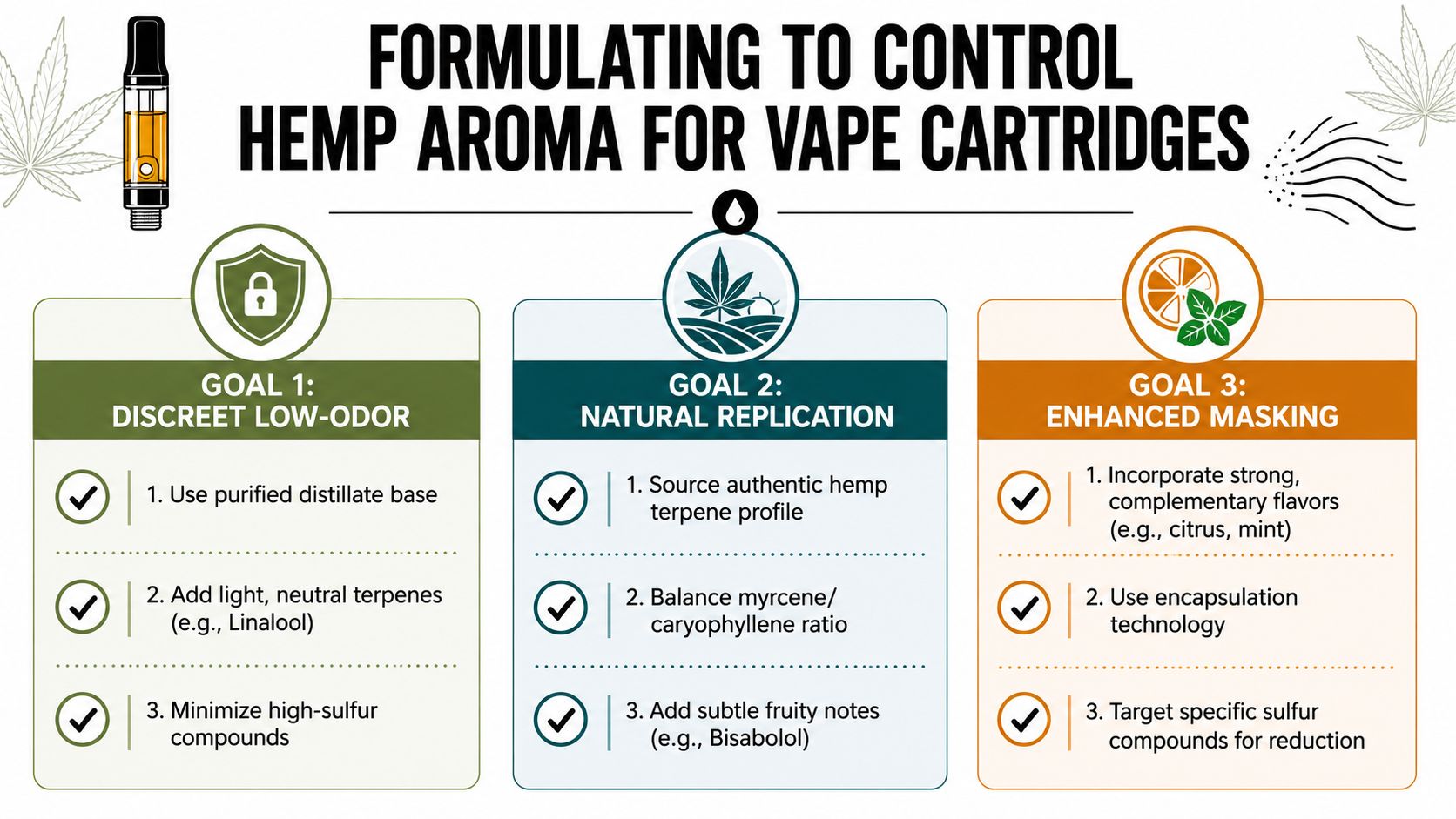
Goal one, discreet low-odor
For a low-odor cartridge, begin with a purified distillate base where the source aroma has already been reduced through refinement. Then use a restrained profile with neutral or soft floral notes rather than reinforcing pungent sulfur-associated character.
Linalool can supply a floral direction, while carefully selected citrus or light herbal notes can redirect perception without creating a heavy cannabis signature. The formulation should be evaluated after filling, because the cartridge format can change how quickly brighter compounds appear and how long heavier notes remain.
Goal two, natural replication
A strain-inspired terpene blend should reproduce the sensory architecture, not merely copy a few compounds from a certificate of analysis. Start by identifying the target's dominant direction, then assign roles:
- Top: Limonene or pinene for immediate citrus or fresh lift.
- Mid: Myrcene for earthy body and linalool for floral softness.
- Base: Beta-caryophyllene for peppery depth and a longer finish.
A 2025 CBD hemp analysis found α-pinene, myrcene, and linalool at consistently high 256–1024 flavor-dilution factors across cultivars, supporting their use as meaningful contributors rather than decorative additions. (Hemp cultivar aroma analysis)
To replicate a pungent cannabis-style profile, don't assume that adding more myrcene will create the desired skunk note. The research on sulfur volatiles indicates that trace thiols can control the decisive impression. If the source material is thiol-poor, a terpene-only blend may land as earthy, citrusy, or floral instead of gassy.
Goal three, enhanced masking
Masking works best when it redirects the sensory center of gravity. Citrus, mint, floral, fruit, or dessert notes can cover rough source character, but the blend must remain coherent. A sharp top note over a heavy base may make the product feel unbalanced rather than discreet.
Use pilot batches and sensory checks to compare:
- Native distillate before additions.
- A terpene-only correction.
- A complete target blend in the intended cartridge hardware.
The Gold Coast Terpenes Mixing Calculator gives teams a practical way to calculate blend amounts while testing isolates and profiles. Keep the process controlled, record each addition, and evaluate aroma at the same stage of filling, storage, and use.
A formulation guide for using terpenes in finished products can support dilution planning, but aroma accuracy still depends on testing the complete system. Hardware, heat, storage, and the underlying oil all influence the result.
Legal Retail and Workplace Implications of Hemp Odor Overlap
A hemp product that smells like marijuana can create confusion in settings where people use odor as a quick classification tool. Retail staff, building managers, coworkers, or security personnel may recognize a skunky aroma without being able to identify whether it came from legal hemp, cannabis, or another source.
The chemistry explains the problem. Because 321MBT-associated odor can overlap across hemp and cannabis, smell alone can't reliably distinguish legal hemp from illegal marijuana. Researchers have argued that this limitation forces courts and regulators to confront assumptions based only on odor. (Research on odor-based legal assumptions)
For brands, the issue is operational rather than theoretical. Products sold through workplace-sensitive, travel-sensitive, or low-odor retail channels may need a deliberately restrained aroma profile. Packaging language should describe the product accurately, but it shouldn't imply that a smell can establish cannabinoid content or legal status.
Product decisions that reduce confusion
- Choose discreet profiles: Floral, light citrus, or soft herbal directions may be more suitable than deliberately skunky blends.
- Control packaging release: Evaluate how much aroma escapes during storage and handling, not only how the cartridge smells during use.
- Separate odor from compliance testing: Use laboratory documentation for cannabinoid classification and product records, not sensory judgment.
- Set retailer expectations: Provide accurate aroma descriptions so staff understand that hemp can share cannabis-like notes.
No formulation can guarantee how another person will interpret an odor, and product teams shouldn't make legal promises based on scent. When a channel is especially sensitive to odor complaints, masking and controlled packaging deserve attention during development rather than after launch.
Conclusion Choosing Your Hemp Aroma Strategy for Product Formulation
The useful answer to “does hemp smell like pot” isn't a universal yes or no. Hemp aroma is a chemistry outcome. Terpenes establish the bright, earthy, floral, piney, peppery, and woody structure, while trace sulfur volatiles can determine whether the final impression becomes distinctly skunky or gassy.
Choose the strategy that matches the SKU:
- Masking: Start with a refined base and redirect native notes toward citrus, floral, mint, fruit, or dessert.
- Faithful replication: Build top, mid, and base notes around the target sensory profile, then account for sulfur-driven character rather than relying on common terpenes alone.
- Selective enhancement: Preserve the recognizable hemp foundation while adding a controlled accent that makes the product easier to identify and reproduce.
For cartridges and distillate, consistency comes from documenting the source oil, terpene additions, mixing sequence, hardware, storage, and sensory result. A THC-free terpene blend can support a stable sensory identity without VG, PG, PEG, or MCT, but teams still need to validate the finished formulation in its actual delivery format.
Gold Coast Terpenes offers lab-verified, THC-free terpene blends, strain-inspired profiles, isolated compounds such as Limonene, Myrcene, and Beta-Caryophyllene, plus mixing and safety resources for cartridge and distillate development. Visit Gold Coast Terpenes to compare profiles and select the components that fit your hemp aroma strategy.